
Job Search Tools vs Manual Tracking: Which Works Better?
Compare spreadsheets, bulk autofill apps, and hybrid human+AI services to see which method best balances speed, customization, and ATS compliance for job applications.


When it comes to tracking job applications, the choice between manual tracking and automated tools depends on your priorities: control, efficiency, or personalization. Manual tracking offers complete oversight but can become time-consuming as application volumes grow. job search automation tools like LazyApply and Simplify.jobs save time but often lack the customization needed to stand out. A hybrid option like scale.jobs combines human oversight with AI to balance efficiency and quality, making it ideal for high-volume applicants or those with specific needs like visa sponsorship or ATS compliance.
Key Takeaways:
- Manual Tracking: Best for small-scale, personalized applications but requires significant time.
- LazyApply: Focuses on high-volume applications but risks generic submissions and bot-detection issues.
- Simplify.jobs: Speeds up application processes but lacks robust customization and visa-specific support.
- scale.jobs: Offers tailored resumes, manual submissions, and proof of application, making it suitable for those applying to 250+ roles or needing ATS optimization.
For job seekers juggling multiple applications, scale.jobs provides a balanced approach, ensuring your applications are tailored, ATS-compliant, and submitted with transparency.
Unemployed in Tech in 2026: My Job Application Tracking Method to Stay Organized (with Template)
Why Manual Tracking Still Works
Manual tracking remains a sensible option for job seekers who want complete control over their data without spending extra money. Using a simple Google Sheets or Excel template, you can log custom details like visa sponsorship availability, referrals, or recruiter feedback. Unlike automated systems that often have fixed layouts, spreadsheets give you the flexibility to adapt to your unique job search needs.
Full Control Over Your Data
With manual tracking, you decide what information matters most. For instance, if you're an international job seeker, you can easily add a column to track companies offering H1B sponsorship. If you're a student juggling internship applications, you can create fields for deadlines and even color-code rows to keep everything visually organized. This hands-on approach is particularly helpful for those navigating complex job markets or managing multiple application cycles.
Another advantage of manual tracking is the ability to capture qualitative insights - like a company’s work environment, specific interview questions, or notes from networking events. These details are often missed by automated tools but can make a huge difference in refining your approach. Considering that 85% of jobs are secured through networking rather than cold applications, having a system to document these interactions can help you identify which efforts lead to interviews. If you're applying to a manageable number of roles and value building personal connections with recruiters, this method can be especially effective.
Zero Cost Setup
One of the biggest perks of manual tracking is that it’s completely free. Tools like Google Sheets or Excel can be set up in just a few minutes. On the other hand, automated job search tools often come with a price tag, ranging from $10 to $50 per month. However, while manual tracking saves you money, it can become time-consuming as the number of applications grows. Crafting resumes, cover letters, and completing forms manually might take up to an hour per application. If you’re applying to over 100 roles, this can quickly add up to more than 12 hours a week just on tracking and follow-ups.
When manual tracking starts to feel overwhelming, many job seekers turn to hybrid solutions like scale.jobs. These platforms combine free tools with professional support, ensuring your applications are optimized for Applicant Tracking Systems (ATS) while still allowing a personal touch. While manual tracking shines in terms of cost and control, its time demands often lead job seekers to explore automated or blended approaches for greater efficiency.
Where Manual Tracking Falls Short
Manual tracking might work for a small number of applications, but it quickly becomes unmanageable when the volume increases. Today, the typical job seeker applies to 50+ positions before landing an offer. At that scale, maintaining a spreadsheet becomes a full-blown administrative task.
Time Drain on Data Entry
Each application requires recording a variety of details - like the job URL, company name, job title, salary, location, contact information, and application date. From there, you’ll need to update statuses when you hear back, track interview schedules, set follow-up reminders, and document rejection reasons. According to a 2023 LinkedIn survey, job seekers spend an average of 12 hours per week on applications and tracking. As the number of applications increases, so does the time commitment.
Take, for example, a case study where a job seeker manually tracked 22 applications over five weeks. They spent 60 hours on the process, with most of that time consumed by data entry and status updates - time that could have been better spent networking or preparing for interviews. When the same individual switched to an AI-assisted system, their workload dropped by 70%, allowing them to submit 78 applications in the same time frame. The improvement wasn’t due to cutting corners but by eliminating repetitive administrative tasks.
For those managing 100+ applications, the data entry workload becomes overwhelming. You’re dealing with hundreds of individual data points and often need to create complex spreadsheet formulas or formatting just to keep track. If you’re juggling multiple job types - like full-time jobs, internships, or contract work - the complexity multiplies. Many job seekers experience application fatigue after manually tracking just 15 applications, with some abandoning the process entirely due to the repetitive nature of the task.
And it’s not just the time commitment - manual tracking also fails to deliver meaningful insights into your job search performance.
No Built-In Analytics
Spreadsheets lack the ability to provide actionable analytics. They won’t tell you which companies respond the quickest, which job titles lead to interviews, or whether your follow-up timing is effective. Without automated insights, you’re left calculating metrics like interview rates and response times manually - often without any benchmarks to compare against.
Automated tools, on the other hand, offer real-time dashboards that provide metrics like application volume trends, response rates, and relevance scores for job matches. These platforms can also help you evaluate your efficiency, revealing whether you’re spending $50–$120 per application in opportunity costs versus the more efficient $10–$30 range. They can even identify patterns, such as which days yield faster responses or whether certain industries are more likely to ghost candidates.
For job seekers applying to dozens of roles, having access to these insights can refine your strategy and improve results. Instead of merely tracking which companies haven’t replied, you’ll gain a deeper understanding of what’s working and what’s not. Platforms like scale.jobs combine automation with human oversight, offering the detailed analytics of automated systems alongside the personal touch of manual methods.
These shortcomings in manual tracking highlight the need for smarter tools that streamline the process while providing data-driven insights to optimize your job search.
Automated Tools: What They Offer and Where They Miss
Automated tools can certainly make job applications faster, but they often fall short when it comes to personalization - a gap scale.jobs bridges with human expertise. These tools are great at handling repetitive tasks like auto-filling forms, tracking submissions, and matching jobs to profiles. Platforms such as Simplify.jobs and LazyApply cater to high-volume applicants by prioritizing speed. However, their lack of customization, transparency, and human oversight can be a drawback, especially for roles requiring tailored applications.
Simplify.jobs simplifies the application process with a browser extension that auto-fills forms and allows one-click job tracking. It also provides basic resume and cover letter builders, making it a decent choice for entry-level candidates who need to apply quickly. However, its reliance on pre-existing job databases limits its reach in certain industries and regions. Moreover, it doesn’t offer the human touch needed for ATS compliance or roles requiring visa-specific expertise like H1B or O1 applications. While it can save time for those applying to 30+ jobs weekly, the generic nature of its applications may not impress recruiters.
LazyApply, on the other hand, takes automation to the next level, enabling up to 1,500 bulk applications per day across platforms like LinkedIn and Indeed. It’s ideal for those seeking entry-level roles who need to apply en masse. However, the absence of human verification leads to generic submissions that can be flagged as bot-generated. Without proof-of-work documentation, applicants have no way to confirm if their applications were successfully submitted or how they were received by recruiters.
This is where scale.jobs stands out. By combining AI with trained human assistants, it ensures applications are manually submitted, resumes are customized for ATS optimization, and real-time updates with proof-of-work screenshots are provided via WhatsApp. The flat-fee pricing model eliminates recurring costs, offering transparency and refunds for unused credits. For those applying to 250+ roles or navigating visa requirements, this hybrid approach addresses the shortcomings of fully automated tools. Let’s dive deeper into how Simplify.jobs and LazyApply compare to scale.jobs.
Simplify.jobs vs scale.jobs: Which Handles Applications Better?
Simplify.jobs is all about speed. Its browser extension auto-fills application forms on platforms like Workday and Greenhouse, saving you the hassle of repetitive data entry. It also matches jobs to your profile, but this feature depends on static databases rather than dynamic, real-time searches. For recent graduates or entry-level candidates applying to 30–50 jobs weekly, Simplify.jobs significantly reduces the administrative workload.
However, speed comes at a cost. The auto-fill feature doesn’t tailor resumes or cover letters for specific roles. This lack of customization can hurt your chances with ATS systems that prioritize role-specific keywords and formatting. Additionally, Simplify.jobs doesn’t offer support for visa-related applications, making it less suitable for international candidates.
scale.jobs takes a more personalized approach. Trained human assistants handle every application manually, ensuring ATS compliance and 100% completion. Resumes and cover letters are tailored for each role, incorporating relevant keywords to improve ATS performance. For those navigating visa requirements like H1B, F1, CPT, or O1, scale.jobs provides targeted support that Simplify.jobs cannot match. Real-time WhatsApp updates and time-stamped proof-of-work screenshots add a level of transparency that Simplify.jobs lacks.
Another advantage of scale.jobs is its flat-fee pricing. Unlike Simplify.jobs’ subscription model, scale.jobs offers one-time campaign bundles starting at $199 for 250 applications, with refunds for unused credits. This pricing structure avoids recurring costs and ensures you only pay for what you use. For job seekers applying to 250+ roles or needing customized, ATS-compliant applications, scale.jobs’ blend of human oversight and transparency makes it a worthwhile investment.
| Feature | Simplify.jobs | scale.jobs |
|---|---|---|
| Application Method | AI auto-fill (browser extension) | Human virtual assistants (manual submission) |
| Resume Customization | Basic templates | AI + human-tailored for each role |
| ATS Optimization | Limited keyword suggestions | Expert-led optimization + NLP |
| Visa Support | None | Specialized H1B, F1, CPT, TN, O1 support |
| Proof of Work | Basic dashboard | WhatsApp updates + time-stamped screenshots |
| Pricing Model | Subscription-based | Flat-fee with unused-credit refunds |
Simplify.jobs is best for: Entry-level candidates or recent graduates applying to 30–50 jobs weekly who value speed over customization and do not need visa-specific support.
scale.jobs is ideal for: Job seekers applying to 250+ roles, professionals requiring ATS-optimized resumes, or those needing visa-specific support with proof of submission.
LazyApply vs scale.jobs: Automation vs Human Oversight
Now, let’s see how LazyApply compares.
LazyApply focuses on high-volume applications. It automates the entire process, allowing up to 1,500 applications per day with minimal effort. For entry-level job seekers aiming to cast a wide net quickly, LazyApply offers unmatched speed. It integrates with major job boards like LinkedIn and Indeed, processing applications in minutes. This makes it suitable for roles where quantity outweighs quality.
However, LazyApply’s fully automated system comes with significant risks. It doesn’t verify whether your resume aligns with the job description, whether forms were completed correctly, or whether submissions were flagged as spam. Many ATS systems can detect and filter out bot-generated applications, reducing your chances of being noticed by recruiters. Additionally, LazyApply provides no proof-of-work, leaving you in the dark about application outcomes.
scale.jobs tackles these issues head-on with human oversight. Trained virtual assistants review and submit every application, ensuring resumes and cover letters are tailored to job descriptions and formatted for ATS compliance. This human element minimizes the risk of bot-flagging, increasing the likelihood of recruiter engagement. Real-time WhatsApp updates and time-stamped proof-of-work screenshots provide transparency that LazyApply’s basic dashboard cannot offer.
With one-time campaign bundles starting at $199 for 250 applications, scale.jobs eliminates recurring costs and offers refunds for unused credits. For job seekers applying to 250+ roles or requiring ATS-compliant resumes, the combination of human oversight and proof-of-work documentation justifies the upfront cost. If you’re also considering enhancing your application materials, exploring resume writing services can further boost your chances of success.
| Feature | LazyApply | scale.jobs |
|---|---|---|
| Application Volume | Up to 1,500 applications/day | Up to 30 applications/day |
| Human Verification | None (fully automated) | Yes, reverse recruiting experts |
| Risk of Bot-Flagging | High | Very low (human interaction) |
| Updates & Proof | Basic dashboard | WhatsApp updates + time-stamped screenshots |
| Customization | Limited (generic templates) | AI + human-tailored resumes and cover letters |
| Support | Email only | Dedicated WhatsApp assistant |
| Pricing Model | Subscription-based | Flat-fee with unused-credit refunds |
| Best For | High-volume entry-level roles | High-volume with ATS compliance and transparency |
LazyApply is best for: Entry-level job seekers needing to submit 100+ applications quickly, accepting the trade-off of generic submissions and a higher risk of bot-flagging.
scale.jobs is ideal for: Job seekers applying to 250+ roles who require ATS-compliant resumes, proof of submission, and human oversight to ensure quality and transparency.
Side-by-Side Comparison: Manual, LazyApply, Simplify.jobs, and scale.jobs
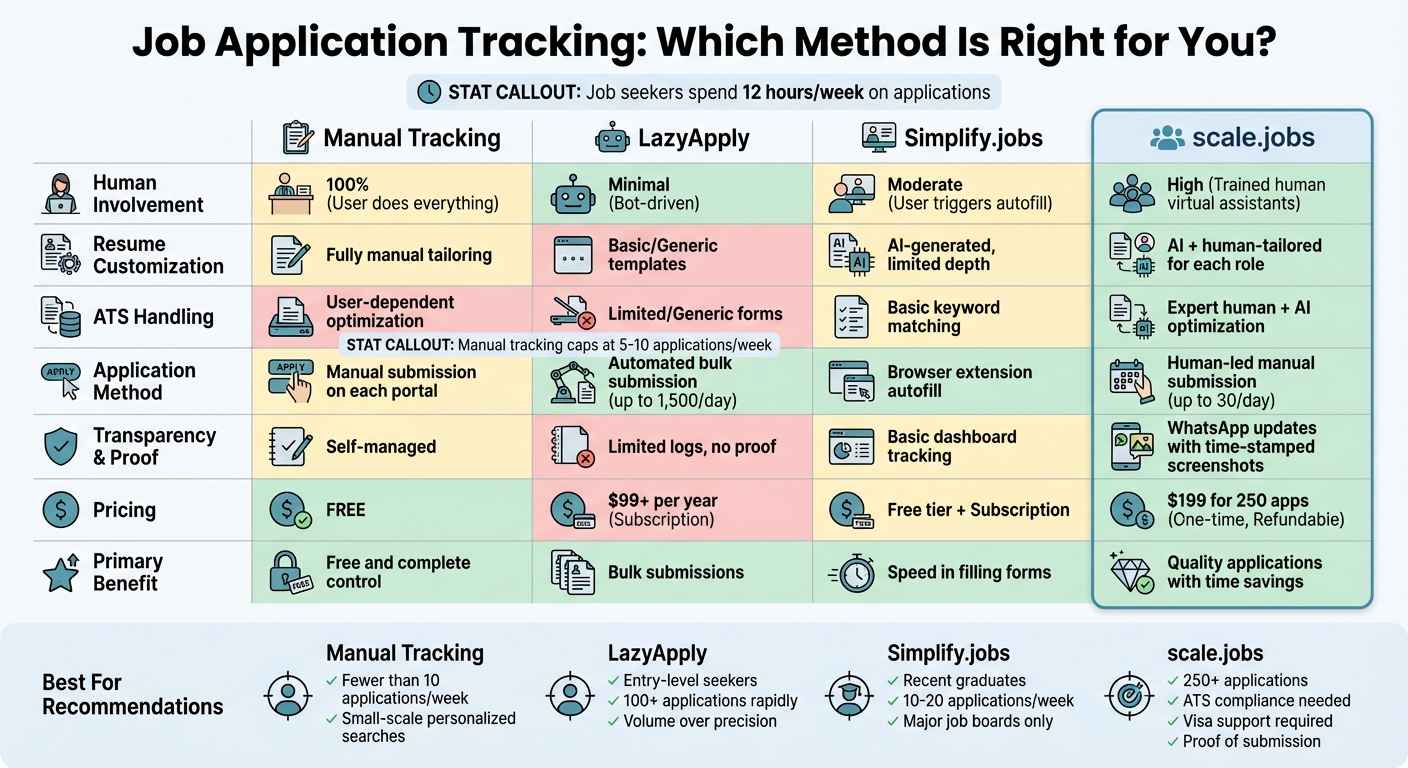
Job Application Tracking Methods Comparison: Manual vs Automated Tools
To help you decide between manual tracking, LazyApply, Simplify.jobs, and scale.jobs, this section offers a quick reference table and summary. Each method serves different needs, so understanding their strengths and limitations is key. Manual tracking gives you complete control but demands time and effort. LazyApply automates high-volume submissions but lacks customization and proof-of-work. Simplify.jobs accelerates form filling but offers limited ATS optimization. Meanwhile, scale.jobs combines human expertise with AI tools, ensuring personalized applications, ATS optimization, and transparent proof of submission.
Here's a breakdown of how these four options compare across key features like human involvement, resume customization, ATS handling, application methods, transparency, and pricing:
| Feature | Manual Tracking | LazyApply | Simplify.jobs | scale.jobs |
|---|---|---|---|---|
| Human Involvement | 100% (User does everything) | Minimal (Bot-driven) | Moderate (User triggers autofill) | High (Trained human virtual assistants) |
| Resume Customization | Fully manual tailoring | Basic/Generic templates | AI-generated, limited depth | AI + human-tailored for each role |
| ATS Handling | User-dependent optimization | Limited/Generic forms | Basic keyword matching | Expert human + AI optimization |
| Application Method | Manual submission on each portal | Automated bulk submission | Browser extension autofill | Human-led manual submission |
| Transparency & Proof | Self-managed | Limited logs, no proof | Basic dashboard tracking | WhatsApp updates with time-stamped screenshots |
| Pricing Model | Free | Subscription (Annual) | Free tier + Subscription | One-time fee (Refundable) |
| Primary Benefit | Free and complete control | Bulk submissions | Speed in filling forms | Quality applications with time savings |
This table highlights the differences, helping you quickly identify which option aligns with your needs.
For low-volume applications, manual tracking is a solid choice, offering full control at no cost. LazyApply is suitable for those prioritizing volume over precision but comes with risks tied to automation. Simplify.jobs is a good fit for those needing faster form completion without extensive customization. On the other hand, scale.jobs stands out for job seekers handling 250+ applications, navigating visa challenges, or requiring ATS-compliant resumes with human oversight and proof of submission. Its hybrid approach, blending AI with human expertise, addresses the shortcomings of both manual and automated methods.
If you're looking for additional support, consider exploring resume writing services to further enhance your job applications. Whether you're applying for full-time jobs or need a job application service, choosing the right platform can save time and improve your chances of success.
Ultimately, your decision should reflect your application volume, budget, and preference for control versus automation. For those managing high volumes while needing tailored applications and transparency, scale.jobs offers a strong middle ground that combines efficiency with quality.
When to Switch to scale.jobs
Tracking job applications manually can work when you're targeting just a few specific roles. But when the process becomes overwhelming, scale.jobs steps in to provide a smarter and more efficient solution. Some job search scenarios require more than just spreadsheets or basic automation, and scale.jobs combines AI tools with human oversight to tackle those challenges.
You're Applying to 250+ Jobs
Managing over 250 job applications with spreadsheets is a recipe for chaos. Research shows that manual methods often cap job seekers at 5-10 applications per week. While tools like LazyApply can automate 30-50 applications weekly, they tend to rely on generic submissions, which recruiters can easily spot, and often trigger spam filters.
scale.jobs addresses this by using trained virtual assistants to handle your applications across all platforms - whether it's corporate ATS systems, niche job boards, or company-specific portals. This human-driven approach ensures high-quality submissions that bypass bot-detection systems. On average, users reclaim 20+ hours per week, freeing up time for networking or interview preparation instead of filling out repetitive forms. With a flat-fee structure ($199 for 250 applications, $399 for 1,000), there are no recurring subscription costs, and unused credits are refundable. For those aiming to apply at scale without sacrificing quality, this solution bridges the gap between manual effort and automation.
However, applying in bulk is only part of the equation. Your resume also needs to stand out, which is where customization becomes crucial.
You Need Custom ATS-Compliant Resumes
Generic resumes often fall short in today's job market, where most companies use applicant tracking systems (ATS) to screen candidates. While tools like Simplify.jobs offer basic keyword matching, they don’t tailor resumes to specific job descriptions.
scale.jobs takes a different approach by combining AI with human expertise to deliver tailored, ATS-optimized resumes. Their AI Pro plan (currently $9/month) allows you to generate unlimited customized resumes and cover letters with a single click. These tailored documents typically achieve a 70-90% relevance score, compared to the 5-10% success rate of generic resumes. This boost in relevance can increase interview rates to 15-25%, making a significant difference for tech professionals, recent graduates, or anyone competing in crowded job markets. For those wanting even more personalized support, resume writing services are also available for expert-level preparation.
While resume quality and application volume are key, ensuring your applications are properly submitted is equally important.
You Want Application Proof
Relying on self-managed logs for tracking can lead to missed deadlines and lost follow-ups. Unlike the basic dashboards offered by LazyApply or Simplify.jobs, scale.jobs provides time-stamped screenshots and real-time WhatsApp updates for every application. This gives you a clear record of when and where your application was submitted and confirms that all required fields were completed accurately.
This level of transparency solves the "black box" problem common with manual tracking and fully automated tools. Whether you're documenting your job search for visa requirements or timing your follow-ups strategically, this proof-of-work system ensures accountability that spreadsheets and automation tools simply can’t match.
Switch to scale.jobs if…
- You're applying to 250+ jobs.
- You need custom ATS-compliant resumes.
- You require proof of submission with time-stamped updates.
- You want human oversight to avoid bot-related submission issues.
Which Option Fits Your Job Search?
When it comes to choosing the right tool for your job search, it all boils down to three key factors: the number of applications you're managing, your budget, and whether you need tailored materials. Let’s break down how each option serves different needs, so you can pick the one that works best for you.
Manual Tracking: Simple but Limited
If you're pursuing a small number of highly personalized opportunities, manual tracking could be the way to go. It's free and gives you complete control over the process. However, it becomes overwhelming as the volume of applications increases.
Why scale.jobs outperforms manual tracking:
- Saves time by eliminating repetitive data entry
- Creates ATS-friendly, customized resumes for each role
- Provides proof-of-work with human oversight for added transparency
Simplify.jobs: Budget-Friendly Autofill
Simplify.jobs is a solid choice if you're applying to 10–20 positions per week on major job boards. It offers a free tier with basic autofill features, making it a convenient option for straightforward applications. However, it lacks robust customization and doesn't work with all applicant tracking systems (ATS), which might leave some gaps in your application strategy.
Why scale.jobs stands out compared to Simplify.jobs:
- Human assistants can submit applications on any platform, not just supported ones
- Delivers fully customized, ATS-compliant resumes instead of basic templates
- Provides real-time updates via WhatsApp and proof-of-work screenshots
Who Should Use Simplify.jobs?
This tool is ideal for recent graduates or entry-level candidates applying to a moderate number of positions (10–20 per week) on major job boards. If speed is your priority and you don’t need extensive customization or visa-specific support, Simplify.jobs fits the bill.
LazyApply: Speed Over Precision
LazyApply caters to job seekers who prioritize volume over quality. For $99+ per year, it can push 50–100 applications per day, making it a good option for those who need to apply quickly. However, the generic templates it uses are often flagged by recruiters and ATS systems, which could lower your chances of success.
Why scale.jobs excels over LazyApply:
- Human verification reduces the risk of bot-flagging
- Personalized resumes and cover letters improve recruiter engagement
- Offers transparent proof-of-work instead of basic dashboard logs
Who Should Use LazyApply?
If you're an entry-level job seeker aiming to submit 100+ applications rapidly and are okay with generic submissions and a higher risk of bot-flagging, LazyApply might work for you.
Why Choose scale.jobs?
For job seekers managing 250+ applications, scale.jobs offers a hybrid approach that combines efficiency with quality. Starting at $199 for 250 applications (one-time fee), this service provides:
- ATS-compliant, customized resumes crafted by trained virtual assistants
- Application submissions across any platform, including niche portals
- Real-time updates and proof-of-work screenshots for transparency
This option is especially beneficial if you’re navigating visa requirements, competing in saturated markets like software engineering, or want to reclaim 20+ hours per week for networking and other priorities. Additionally, AI resume builder services are available for those who need expert-level document preparation.
Decision Summary
- Manual Tracking: Best for small-scale, personalized searches with fewer than 10 applications per week.
- Simplify.jobs: Ideal for budget-conscious applicants managing 10–20 weekly applications on major job boards.
- LazyApply: Suitable for entry-level job seekers focusing on high-volume submissions with less concern for customization.
- scale.jobs: Perfect for professionals applying to 250+ positions, requiring ATS-compliant materials, visa-specific support, and human oversight.
Ultimately, tools like scale.jobs are designed to save you time while delivering high-quality applications, making it a strong choice for those who need to balance scale with precision. Whether you’re aiming for a competitive edge or simply looking to streamline your efforts, this service ensures your job search stays efficient and effective.
FAQs
When should I stop using a spreadsheet and switch to a service?
When juggling applications for 30 or more jobs daily, relying on spreadsheets can quickly become overwhelming. Manual tracking often leads to errors, missed deadlines, and a lot of wasted time. That’s when switching to a dedicated job search service makes sense. Platforms like Scale.jobs simplify the process by offering tools such as automated reminders, AI-powered resume customization, and even human-assisted submissions. These features not only save you time but also help you stay organized, follow up more efficiently, and maintain a clear record of your applications. If your job search feels too complex for spreadsheets, it’s probably time to upgrade to a more streamlined solution.
How do I know my applications were actually submitted?
Using a platform like Scale.jobs simplifies the job application process by offering features that provide clarity and real-time updates. It delivers timestamped screenshots and WhatsApp notifications to confirm that your applications have been submitted successfully. In contrast, traditional tracking methods, such as spreadsheets or saving email confirmations, require you to manually record submission dates and follow-up details. Scale.jobs eliminates this hassle with its mix of automated tools and human support, giving you direct proof of submission and minimizing any guesswork.
Will my resume pass ATS without custom tailoring?
Passing an ATS (Applicant Tracking System) with a generic resume is a long shot. These systems are designed to filter applications based on specific keywords and criteria from the job description. A one-size-fits-all resume often fails to align with these requirements, significantly lowering your chances of getting through the initial screening. To improve your odds, tailor your resume to each job by incorporating relevant keywords and aligning your content with the job description. While platforms like Scale.jobs can help streamline this process, adding a personal touch is still key to standing out.