
Job Search Burnout Is Real. Here’s a Smarter Way to Apply
Mass-applying fuels burnout — targeted, human-optimized applications beat ATS and boost interview offers.


Job searching can be overwhelming, especially when dealing with constant rejections and ineffective application methods. A staggering 66% of job seekers report feeling burned out during the process. Traditional "spray and pray" approaches - sending out mass applications - often fail because they trigger ATS (Applicant Tracking System) filters and result in low response rates. Instead, focusing on personalized, high-quality applications can significantly improve your chances of landing interviews.
Platforms like Scale.jobs provide human-powered job application services, offering tailored resumes, ATS optimization, and manual submissions. These services not only save time but also help reduce stress by increasing the likelihood of success. With real-time updates via WhatsApp and proof of submission, Scale.jobs ensures transparency and accountability, making it an effective alternative to automated tools like LazyApply and Simplify.jobs.
Key Takeaways:
- Mass applications don't work. They often fail ATS screenings and result in fewer callbacks.
- Personalization is key. Tailored resumes and job-specific applications improve response rates.
- Use human job search assistance. Services like Scale.jobs handle the tedious tasks, optimize for ATS, and provide updates, saving you 10–20 hours per week.
If you're struggling with burnout, applying to competitive roles, or frustrated with low response rates, switching to a human-powered service could transform your job search experience.
Feeling Burnt Out? (How to Restart Your Job Search Properly)
A Better Way to Apply for Jobs
Job search burnout doesn't come from a lack of effort - it stems from an inefficient approach. Instead of flooding employers with generic applications, the key lies in sending targeted, high-quality applications. By prioritizing personalization, ensuring ATS (Applicant Tracking System) compliance, and maintaining transparency, you can cut down on repetitive tasks and focus your energy where it matters most. This shift not only reduces stress but also increases your chances of landing interviews.
Let Human Assistants Manage Applications
Platforms like Scale.jobs offer virtual assistants who take over the tedious process of job applications. These assistants don't just submit resumes - they carefully analyze job postings, tailor your materials to match each role, and manually navigate corporate portals like Greenhouse and Lever. This frees up 10–20 hours a week that you can use for networking, preparing for interviews, or simply recharging.
Unlike automated bots that can trigger spam filters, human assistants handle every detail with care. They fill out intricate forms, upload documents correctly, and manage the quirks of various application portals. For instance, one software engineer shared how their assistant submitted 50 customized applications, leading to 12 interview invitations in just two weeks - this was a dramatic improvement compared to zero responses from 200 mass applications sent through bots.
While personalized submissions are critical, ensuring you create a resume that shines and is ATS-friendly is equally important.
Ensure Every Resume Is ATS-Optimized
Did you know that up to 75% of resumes are rejected by Applicant Tracking Systems before a human even sees them? Often, this happens due to formatting issues or missing keywords. Human assistants can help you avoid this pitfall by optimizing your resume to meet ATS requirements while keeping it polished and engaging for hiring managers.
These assistants carefully scan job descriptions, identify essential keywords, and tailor your resume to align with the employer's expectations. They also ensure that formatting won't break when parsed by ATS software. Beyond keywords, human assistants pick up on subtle but important details, like preferred skills or values hinted at in the job description, which automated tools often miss. The result? Resumes that seamlessly pass ATS filters and resonate with recruiters.
Stay Updated with WhatsApp Notifications
Transparency is another game-changer in reducing job search stress. One of the most frustrating aspects of applying for jobs is the lack of feedback - 55% of job seekers say "waiting to hear back" is their biggest source of stress. Real-time updates via WhatsApp can bridge this gap.
With this system, you receive timestamped proof-of-work screenshots for every application. You'll know exactly when and where your materials were submitted, and you’ll have confirmation that the process went smoothly. Assistants can also send follow-up reminders, track application views (when the portal allows), and maintain an audit trail of your submissions. This level of accountability is something fully automated tools simply can't provide, giving you peace of mind throughout the process.
scale.jobs vs Competitors: Human-Powered vs Automation
Scale.jobs vs LazyApply vs Simplify.jobs: Job Application Services Comparison
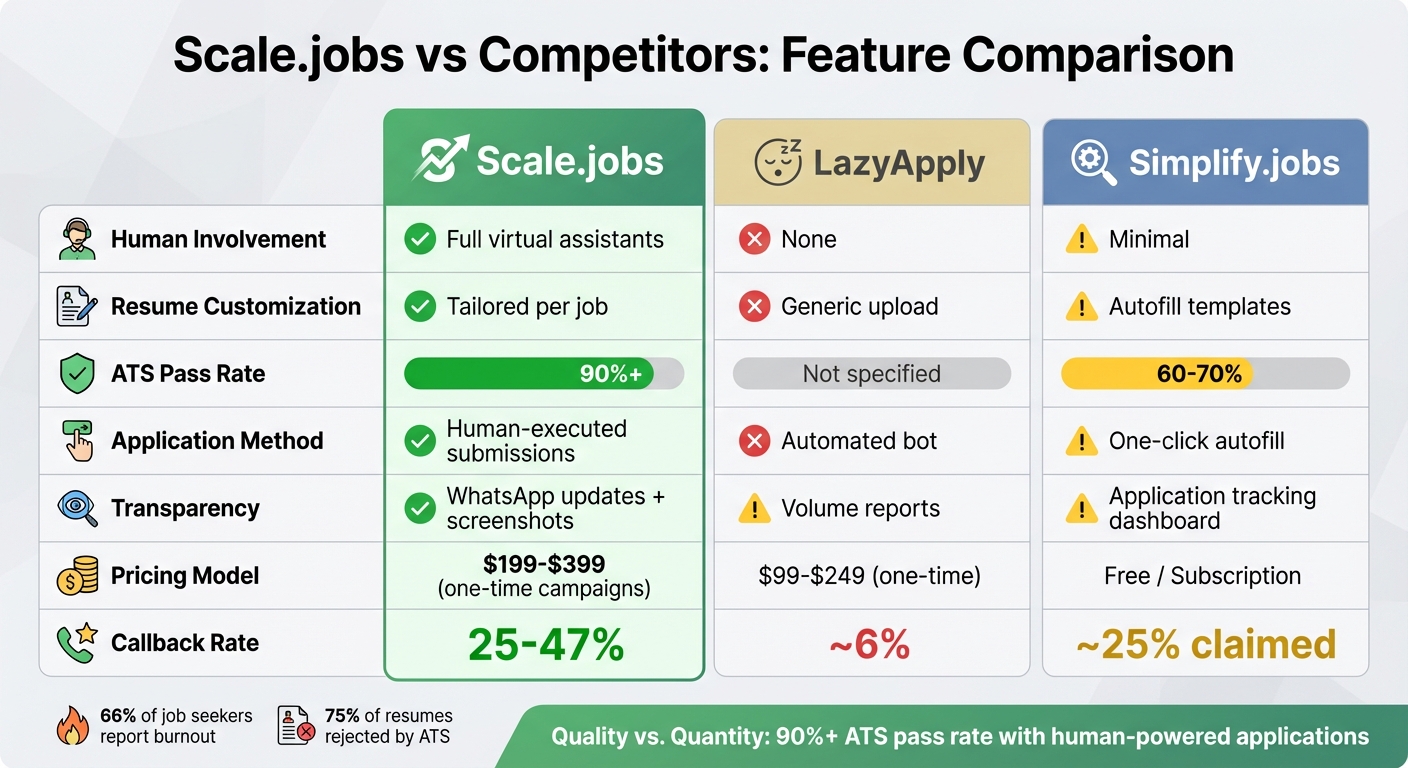
When choosing between automation tools and human-assisted services for job applications, the differences in quality, ATS (Applicant Tracking System) success rates, and transparency are crucial. Platforms like LazyApply and Simplify.jobs emphasize speed and volume, but they often miss the personalized touch that can make or break an application. This is especially relevant when 40% of job seekers report being ghosted after using automated tools. By prioritizing customization and quality, scale.jobs not only boosts ATS success rates but also reduces the frustration caused by ineffective mass applications.
LazyApply vs scale.jobs: Why Human Review Matters
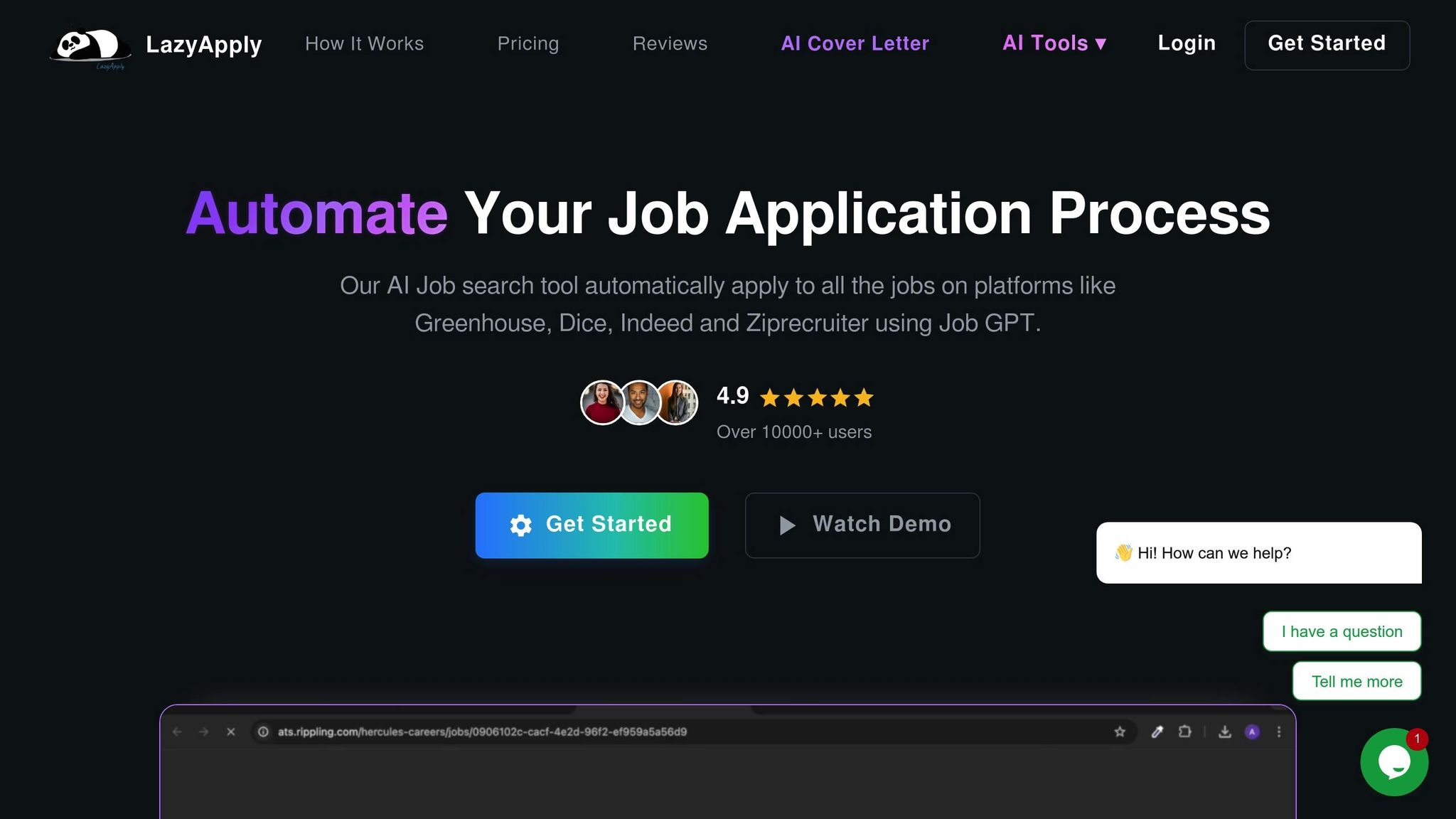
LazyApply simplifies the job application process by letting users upload a resume and apply to hundreds of positions across platforms like LinkedIn and Indeed with a single click. Priced at $99 for over 1,000 applications, it focuses on volume. However, this bulk approach often fails ATS screenings, as it relies on generic keywords and templates that don't align with specific job requirements. Additionally, automated submissions risk being flagged as spam by employers.
In contrast, scale.jobs employs human assistants who tailor resumes to match individual job postings. These assistants analyze job descriptions, integrate relevant keywords naturally, and optimize formatting to ensure ATS compatibility. According to user feedback, ATS pass rates with scale.jobs exceed 90%, while LazyApply's automated system often struggles to achieve similar results. Moreover, scale.jobs provides unmatched transparency through timestamped screenshots and real-time WhatsApp updates, offering proof of every submission - something volume reports from automation tools can't deliver.
Why scale.jobs stands out:
- Human assistants craft job-specific resumes using relevant keywords and context, avoiding generic templates.
- Manual submissions bypass bot detection systems that flag automated applications.
- Real-time updates via WhatsApp and screenshots ensure full transparency for every application.
- Flexible pricing, such as the Basic Campaign ($199 for 250 applications), balances cost with high-quality outcomes.
- Case studies show interview rates up to 3× higher compared to mass automation tools.
Who Benefits from LazyApply?
LazyApply may be a good fit for early-career job seekers who need to apply to many positions quickly and are working with a limited budget. For entry-level roles where quantity matters more than quality, the $99 fee might be appealing.
Who Should Opt for scale.jobs?
Mid-level and senior professionals are likely to gain the most from scale.jobs. When applying for roles that demand a tailored approach or competing against highly qualified candidates, the personalized strategy delivers higher callback rates - ranging from 25% to 47%, compared to LazyApply's ~6%.
Now, let’s see how Simplify.jobs compares to scale.jobs.
Simplify.jobs vs scale.jobs: One-Click vs Custom Applications
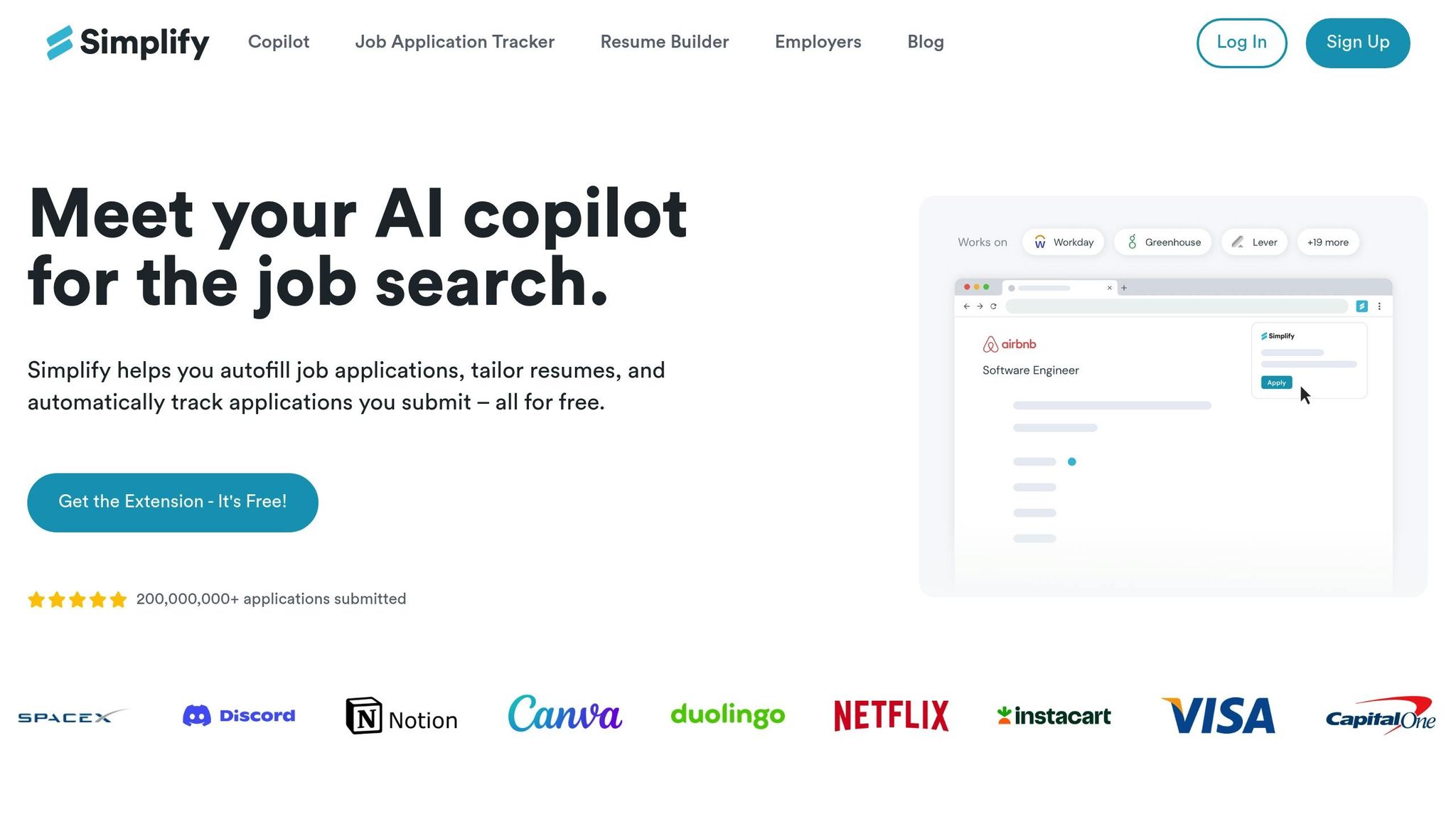
Simplify.jobs uses a browser extension to autofill application forms based on a single profile, enabling one-click submissions across various job boards. While its basic service is free, premium subscriptions add features like application tracking. However, these autofill templates often result in a 60–70% ATS pass rate, as they rely on standardized formats that fail to address specific employer requirements.
On the other hand, scale.jobs assigns human assistants to craft custom resumes and cover letters for each job application. Instead of using a generic profile, these assistants analyze individual job postings to highlight relevant skills and experiences. They also adjust the tone and language to align with the employer's expectations. This tailored approach reportedly increases response rates by 40%, as hiring managers receive applications that feel personalized rather than mass-produced.
Why scale.jobs excels:
- Applications are customized for each job, meeting specific employer needs.
- Human assistants navigate complex portals like Greenhouse, Lever, and Workday, which often challenge simple autofill tools.
- Real-time WhatsApp support ensures proof-of-work, transparency, and flexibility to adjust strategies mid-campaign.
- One-time pricing bundles (e.g., $199–$399 for 250–1,000 applications) eliminate the need for recurring subscription fees.
- Manual submissions reduce the risk of formatting errors or spam rejections.
Who Benefits from Simplify.jobs?
Simplify.jobs is a good choice for those applying to similar entry-level roles that use standard application forms. Its free or low-cost options are appealing for job seekers who prioritize speed over customization.
Who Should Opt for scale.jobs?
Job seekers aiming for competitive mid-to-senior level roles will see the most benefit from scale.jobs. When facing stiff competition or navigating complex application systems, the personalized approach ensures higher success rates.
When to Switch to scale.jobs
You should consider switching to scale.jobs if:
- You need tailored resumes to achieve higher ATS pass rates (above 90%).
- Real-time updates and proof-of-work transparency are essential for your job applications.
- You're applying through complex systems like Greenhouse, Lever, or Workday, which are unsuitable for automated tools.
- You're targeting mid-to-senior level positions where quality trumps quantity.
- Automated tools have resulted in low callback rates (under 10%).
The table below highlights how scale.jobs outperforms LazyApply and Simplify.jobs in key areas.
Feature Comparison: scale.jobs vs Competitors
| Feature | scale.jobs | LazyApply | Simplify.jobs |
|---|---|---|---|
| Human Involvement | Full virtual assistants | None | Minimal |
| Resume Customization | Tailored per job | Generic upload | Autofill templates |
| ATS Handling | Manual optimization (90%+ pass rate) | Algorithm-based | Standard parsing (60–70% pass rate) |
| Application Method | Human-executed submissions | Automated bot | One-click autofill |
| Transparency | WhatsApp updates + screenshots | Volume reports | Application tracking dashboard |
| Pricing Model | One-time campaign bundles ($199–$399) | One-time ($99–$249) | Free / Subscription |
| Callback Rate | 25–47% | ~6% | ~25% (claimed) |
In today’s competitive job market, where 68% of job seekers expect longer searches and 37% cite skills mismatches as a challenge, the quality of applications matters more than ever. With scale.jobs, job seekers can ensure that every application is optimized for success, rather than relying on the hit-or-miss approach of automated tools.
Who Should Use Scale.jobs?
Deciding between AI resume builders and personalized assistance depends on your specific job search needs and challenges. If you're applying to numerous entry-level positions where speed outweighs precision - or if you're exploring opportunities on a tight budget - services like LazyApply or Simplify.jobs can handle basic, high-volume submissions. However, when issues like ATS rejections, visa-specific requirements, or job search fatigue arise, it might be time to consider Scale.jobs for a more tailored approach.
When Competitors Make Sense
Automation is a good fit for straightforward job searches that don’t require much customization. For example, if you’re a recent graduate applying to customer service or retail roles with standard forms, Simplify.jobs' free autofill feature can save you time with minimal risk. Similarly, LazyApply’s $99 package is useful for job seekers casting a wide net - applying to over 200 roles on platforms like LinkedIn and Indeed to gauge market interest before narrowing their focus. While these tools are sufficient for basic applications, Scale.jobs excels in situations where more personalized, complex submissions are essential.
Switch to Scale.jobs If You Need...
For mid-to-senior roles or competitive positions requiring detailed applications, Scale.jobs provides the kind of tailored support that automation alone cannot offer. Its standout features include:
- Human-assisted resume customization for each job posting
- ATS-optimized submissions with success rates exceeding 90%
- Real-time WhatsApp updates with timestamped proof of work
- Expert handling of complex portals like Greenhouse, Lever, and Workday
When generic templates fail to earn callbacks, Scale.jobs steps in with trained assistants who analyze job descriptions, strategically integrate relevant keywords, and optimize resumes and cover letters for ATS systems. This approach is especially valuable when 37% of job seekers cite skills mismatches as a major obstacle.
Visa-sponsored roles, such as H-1B positions in tech or healthcare, often require precise language and sponsorship details that automated tools might miss. Scale.jobs' human assistants address these nuances, reducing the risk of rejection. With 68% of job seekers expecting longer searches, investing in tailored applications for such roles can be crucial.
Burnout is another signal to switch. With 31% of job seekers reporting increased fatigue and 40% citing mental health concerns, outsourcing your application process can save you over 20 hours a week. Scale.jobs provides transparency through WhatsApp updates and timestamped screenshots, relieving the stress of tracking progress yourself. Additionally, for roles that use complex application systems like Greenhouse or Workday, Scale.jobs ensures all forms are completed accurately, attachments are properly uploaded, and supplemental questions are thoughtfully answered. This level of detail is critical in a competitive market where 59% of candidates identify high competition as a major hurdle, and even minor errors can disqualify strong applicants.
Conclusion: Choose the Right Application Strategy
Job search burnout is more than just feeling tired - it’s a major drain on time and energy, with many spending over 20 hours a week on applications that often get lost in applicant tracking systems (ATS). The frustration is compounded by the lack of employer feedback and the mental toll it takes. The real issue? It’s not your effort; it’s the approach. Tools like LazyApply and Simplify.jobs may send out large volumes of applications, but they often fail to address the root problem: many submissions don’t pass ATS filters or get flagged as spam.
Scale.jobs offers a different solution by combining human expertise with ATS optimization. Rather than relying on generic, mass-produced applications, Scale.jobs employs trained virtual assistants who craft around 30 personalized applications daily. These include AI-optimized resumes, tailored cover letters, and precise entries into employer portals. You’ll also get real-time updates via WhatsApp, complete with timestamped screenshots, so you can be confident your applications are being submitted correctly. This transparency and personalized approach stand out, especially when 59% of candidates cite high competition as their biggest challenge and 68% expect their job search to take longer than ever.
The takeaway is clear: quality beats quantity. Automation may work for entry-level or high-turnover roles where a generic resume suffices. However, for mid-to-senior positions, visa-sponsored roles, or highly competitive fields - where 37% of applicants face skills mismatches - a tailored, human-driven application process can make all the difference. When generic submissions fall short, or when you need ATS-optimized applications that align with employer expectations, Scale.jobs offers a smarter way to maximize your efforts and focus on what truly matters.
Decision Summary: When to Choose Scale.jobs
- Opt for automation if you’re applying to a high volume of roles in fields like retail or customer service, where speed is key and you’re okay with a lower response rate (around 5%).
- Choose Scale.jobs if you need ATS-optimized, customized resumes for competitive roles, real-time tracking with proof of submission, and relief from managing the application process yourself. With 31% of job seekers reporting increased burnout, delegating this task to human assistants allows you to concentrate on networking and interview preparation.
For those dealing with ghosting (47.4% after interviews), navigating tricky portals like Greenhouse, or managing visa requirements, Scale.jobs provides better results than subscription-based tools that often end up flagged as spam. When precision and transparency matter, and prolonged searches are a common struggle, investing in human-powered applications isn’t about spending more - it’s about spending wisely to secure interviews and move closer to your next opportunity.
FAQs
How do I know if I should switch from mass applying to targeted applications?
If your current job search strategy involves mass-applying and you're seeing low callback rates (around 1-3%) or frequent rejections from Applicant Tracking Systems (ATS), it might be time to switch to a more targeted approach. By focusing on tailored applications - complete with personalized, ATS-friendly resumes and cover letters - you can potentially increase your callback rates dramatically, even reaching 25-47%. This method works particularly well for competitive roles, career transitions, or senior-level positions, where attention to detail and customization carry more weight than sheer application volume.
Looking for tools to help you create personalized applications? Consider using an AI resume builder or an AI cover letter builder to streamline the process.
What do I need to provide to get human-assisted applications started?
To begin using human-assisted applications with Scale.jobs, simply sign up and provide your job search goals along with key details about your career. The team will take the time to understand your objectives and priorities through a discussion tailored to your needs. Once everything is aligned, they’ll craft customized, ATS-friendly resumes and cover letters to match your target roles. Plus, you’ll receive real-time updates and consistent support through WhatsApp, ensuring the entire process stays smooth and personalized.
How can I track every application and confirm it was submitted correctly?
Human-powered services, such as Scale.jobs, simplify the process of tracking and confirming job applications. With real-time updates sent via WhatsApp, users can see screenshots as proof of submission, adding an extra layer of confidence. Each application is manually managed by human assistants, ensuring that resumes and cover letters are properly uploaded and submitted. This hands-on approach reduces errors and provides clarity - something automated tools often lack, as they may fail to confirm submissions or rely on generic processes. Scale.jobs prioritizes precision, accountability, and peace of mind for job seekers.