Interview Preparation Guide for First Time and Experienced Job Seekers
Step-by-step interview prep for first-time and experienced job seekers: research companies, craft STAR answers, practice technical and virtual interviews, and follow up.

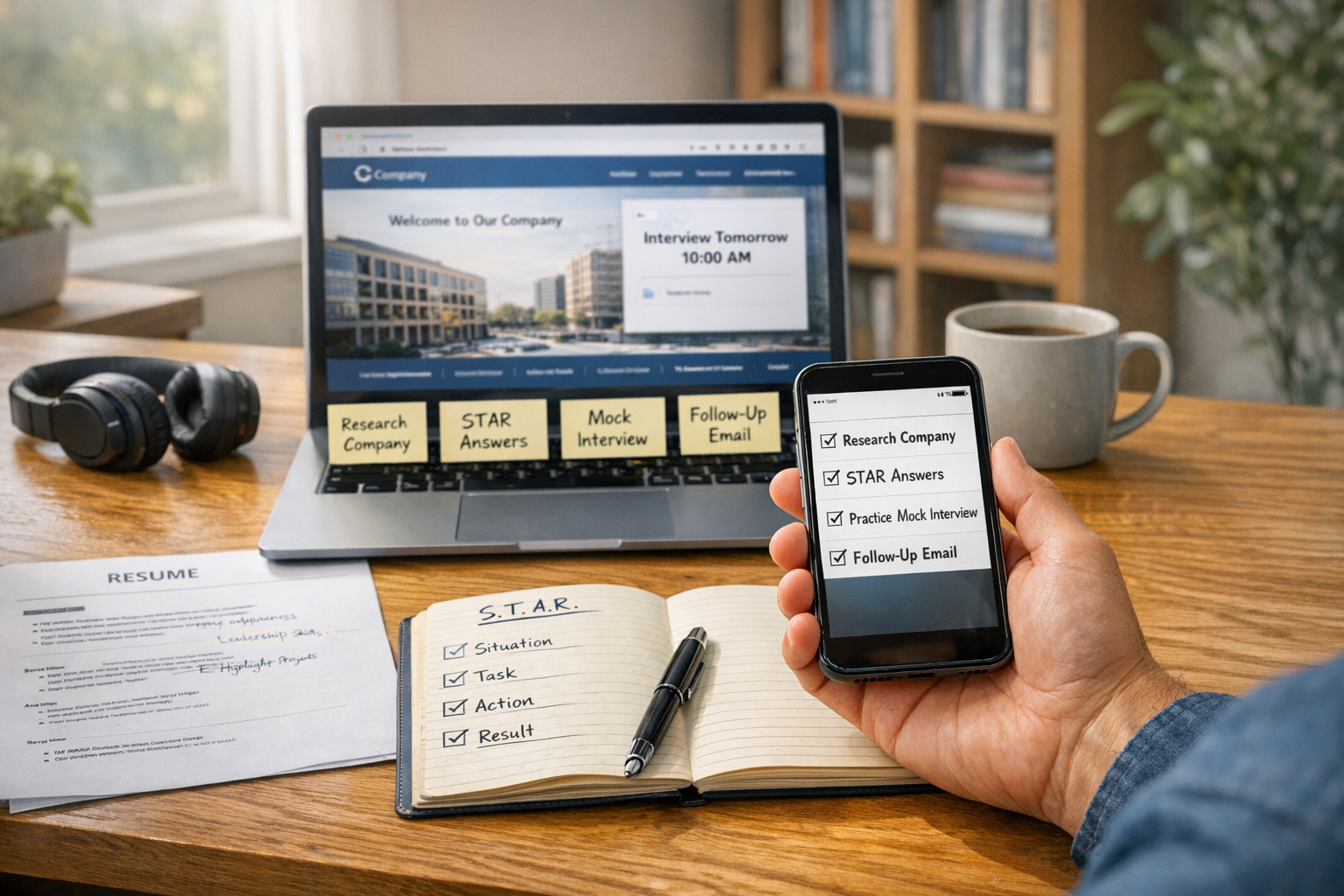
Walking into an interview without preparation can hurt your chances of success. Whether you’re applying for your first job or transitioning into a senior role, knowing how to prepare effectively is critical. This guide provides actionable strategies to help you stand out, from researching companies to mastering interview frameworks like STAR (Situation, Task, Action, Result).
Quick Takeaways:
- Research the company: Study their website, Glassdoor reviews, and LinkedIn profiles of your interviewers, and understand how ATS filters applications to ensure your profile gets noticed.
- Know the salary range: Use platforms like Glassdoor and LinkedIn Salary Insights to understand compensation expectations.
- Practice common questions: Behavioral questions make up 60%-70% of interviews. Use structured methods like STAR to answer effectively.
- Leverage tools: Platforms like scale.jobs provide ATS-friendly resume builders, job application tracking, and real-time support.
- Prepare for challenges: Learn how to handle tricky questions, technical tests, and virtual interview setups.
Why scale.jobs Stands Out:
Compared to competitors like findmyprofession.com, scale.jobs offers a personalized approach with features like real-time WhatsApp support, transparent pricing, and human-guided resume optimization.
This guide equips you with practical tips to navigate interviews confidently, ensuring you’re ready to make a strong impression. Keep reading for detailed frameworks, tools, and expert advice to ace your next interview.
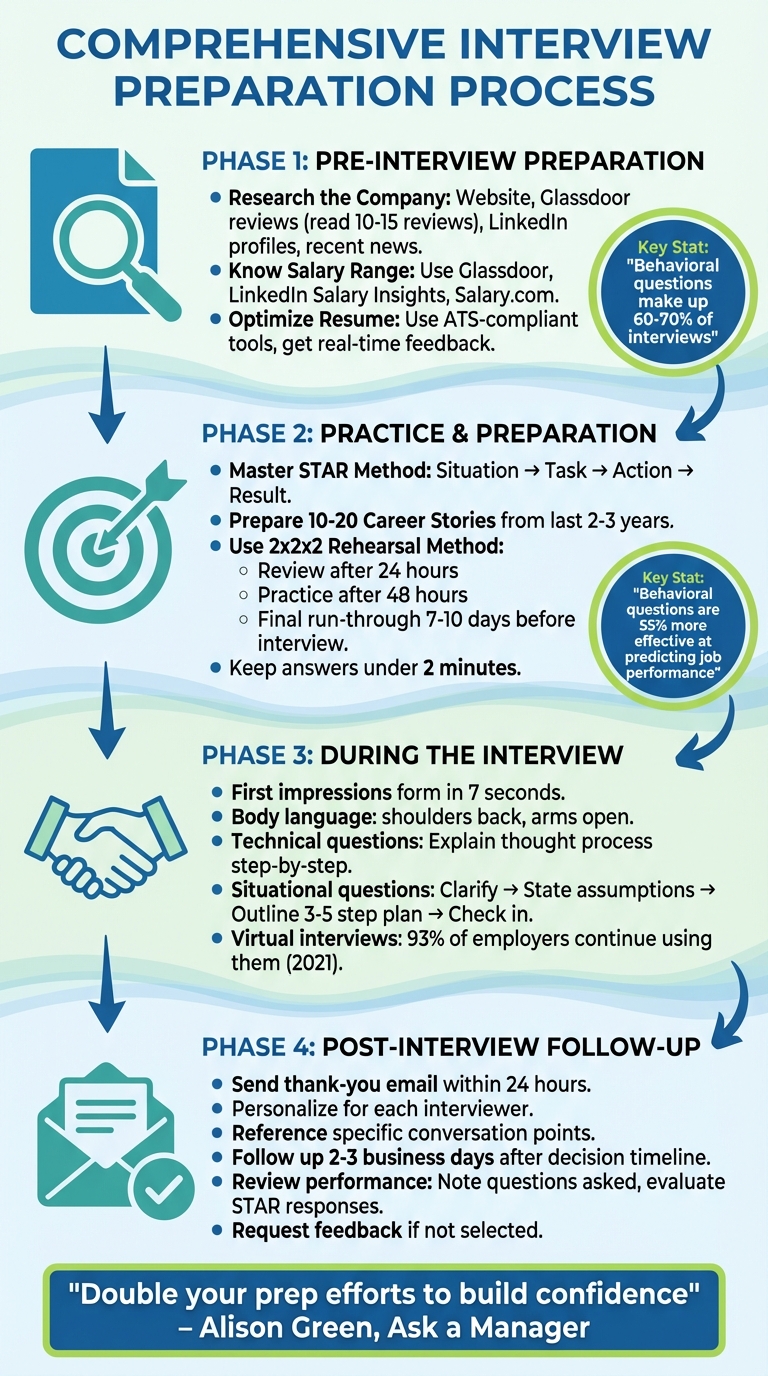
Complete Interview Preparation Process: From Research to Follow-Up
Stand Out in a Job Interview | The Harvard Business Review Guide
Interview Preparation Basics
Preparation often determines whether candidates excel or falter before they even enter the interview room. The essentials - thorough company research, understanding salary expectations, and leveraging the right tools - can help you stand out and approach interviews with confidence.
Research the Company and Role
Begin by diving into the company's core mission, target audience, and growth phase. Check their website to understand how they present themselves, and then compare this with Glassdoor reviews and social media activity to identify any differences between their branding and employee experiences.
Next, focus on the job description. Break down each responsibility and prepare specific examples from your past roles that demonstrate your qualifications. For instance, if the position emphasizes teamwork, think of a time when you successfully collaborated across departments. If data analysis is key, be ready to share metrics that highlight your impact.
Use LinkedIn to learn about your interviewers - review their career paths, tenure, and shared connections. This not only helps you understand their perspective but also provides opportunities to build rapport. Stay updated on recent company developments, such as new funding, product launches, or leadership changes, and familiarize yourself with their competitors to grasp their market position.
"Before you apply for a job, not only check out the company website, but find them on social media to get a sense of what the culture is like." – Austin Graff, Talent Acquisition & Branding Specialist, The Washington Post
Lastly, read 10–15 recent Glassdoor reviews to spot recurring themes, whether they relate to management style, work-life balance, or professional growth opportunities.
Know the Job Market and Salary Range
Being informed about salary expectations ensures you can confidently discuss compensation. Use platforms like Glassdoor, LinkedIn Salary Insights, and Salary.com to research typical pay for your role in your location. Since salary ranges can vary widely by geography, gather data on base pay, total compensation, and benefits specific to your area. Document these ranges in USD so you're prepared if the topic comes up during the interview.
When discussing salary, aim to provide a range rather than a fixed number. For example, you might say:
"Based on my research for this role in this market, I would expect a competitive range that reflects my experience and skills."
"Job seekers should take a thorough look at the job description, sometimes job titles can vary from company to company and it's important the job seeker know what the job entails." – Mary Ellen Appel, Recruiter, TruGreen
Armed with this knowledge, you're ready to move on to tools that can streamline your preparation.
Tools You Need for Preparation
The right tools can simplify every aspect of your preparation. Platforms like Glassdoor provide insights into company culture, typical interview questions, and compensation details, while LinkedIn is ideal for researching company structures and interviewers.
For resume optimization, scale.jobs offers a free, ATS-compliant resume builder and checker that gives real-time feedback on formatting, keywords, and structure - no credit card required. It also includes a job application tracker to help you keep tabs on your submissions and networking efforts.
Here's how scale.jobs compares to other platforms like Jobscan, Resumegenius, and LazyApply:
- Free ATS-compliant resume builder with actionable, real-time feedback.
- Integrated job application tracker to organize submissions and follow-ups.
- Human assistants offering personalized reverse recruiting approach for support.
- Real-time WhatsApp support with proof-of-work updates for transparency.
- Flat-fee pricing with no recurring subscriptions.
These features fit seamlessly into your preparation process, helping you create a polished, competitive profile.
Beyond resumes, practice tools can sharpen your interview skills. AI-powered platforms like Interview Smile (rated 4.9/5 by users) and Google's Gemini Live offer mock interview experiences with instant feedback. For technical roles, platforms like LeetCode and HackerRank provide excellent resources for coding and algorithm practice. As you prepare, rehearse your answers out loud to build confidence and fluency.
For those who want more hands-on assistance, professional resume and application services from scale.jobs can take care of the heavy lifting. Additionally, if you're attending a video interview, test your setup ahead of time, and for in-person interviews, aim to arrive early.
How to Answer Common Interview Questions
Interviews often center around three main types of questions: behavioral, technical, and situational. Mastering how to answer these can significantly boost your chances of success. Behavioral questions, in particular, dominate many interviews, especially in tech roles, making up 60% to 70% of the process. Research also shows they are 55% more effective at predicting job performance compared to traditional questions.
Behavioral Questions and the STAR Method
Behavioral questions aim to uncover how you've handled situations in the past to predict how you'll perform in the future. Examples include, "Tell me about a time you resolved a conflict" or "Describe a situation where you failed." These questions require structured, concise answers.
The STAR method - Situation, Task, Action, Result - helps you craft impactful responses. For instance, instead of vaguely stating, "We increased sales", you could say, "I redesigned the email campaign, which boosted click-through rates by 40% and generated $50,000 in additional revenue over three months."
"Your goal is to whittle down your answer into a short story that delivers your message and its value in as few words as possible." – Austin Belcak, Founder, Cultivated Culture
If you're just starting out, draw on experiences from internships, academic projects, or volunteer roles. For example, leading a university hackathon team to create a prototype in 48 hours demonstrates leadership and time management. For experienced professionals, focus on significant achievements like solving complex problems, managing budgets, or collaborating across teams. Always use "I" to highlight your personal contributions, rather than "we", to showcase your individual impact.
Prepare several STAR stories that align with the job description. Keep each answer under 2 minutes and rehearse using the 2x2x2 rule: practice 24 hours after writing your answers, again after 48 hours, and once more 7–10 days before the interview. This ensures you're ready for any question.
Once you've mastered behavioral questions, shift your focus to technical ones specific to your role.
Technical Questions by Job Type
Technical questions test your skills in areas directly related to your job. For example, software engineers tackle data structures, algorithms, and system design, while product managers work on product teardowns and prioritization frameworks. Roles in AI/ML or data analysis often involve SQL queries and statistical problem-solving.
| Job Role | Key Technical Focus Areas | Recommended Practice |
|---|---|---|
| Software Engineer | Data structures, algorithms, system design | LeetCode, HackerRank (20–30 medium problems) |
| Product Manager | Product teardowns, strategic roadmapping | Case interview prep books |
| AI/ML / Data Analyst | SQL queries, statistical analysis, data modeling | Gemini Live, industry reports |
When answering technical questions, explain your thought process step by step. Interviewers care more about how you approach problems than just the final answer. For system design questions, always ask clarifying questions before diving in. For example, if tasked with designing a URL shortener, inquire about expected traffic, storage needs, and whether analytics are required.
"Don't jump into solving - ask clarifying questions first." – QuickCV
To sharpen your skills, practice on platforms like LeetCode or HackerRank. For real-time feedback, tools like Gemini Live simulate technical interviews. Also, research company-specific questions on Glassdoor's "Interviews" section to get insights into what to expect.
If you’re juggling multiple interview preparations, scale.jobs offers tailored resume and application services. Their team of experts helps you present your technical achievements effectively, ensuring you stand out.
Finally, apply structured thinking to situational and problem-solving questions as well.
Situational and Problem-Solving Questions
Situational questions present hypothetical scenarios, such as "What would you do if a project deadline was moved up by two weeks?" or "How would you handle a disagreement with your manager?" These questions assess your ability to adapt, make decisions, and solve problems.
Use a clear framework to answer: clarify the scenario, state your assumptions, outline a 3–5 step plan, and check in with the interviewer for feedback. For example, if asked about handling a deadline change, you could say:
"First, I’d assess which tasks are critical versus optional. Second, I’d communicate with stakeholders about the trade-offs involved. Third, I’d reallocate resources or adjust the scope of work. Does that approach align with how your team typically handles such situations?"
"The goal is to get them to talk about how they handled situations in the past - particularly, situations you anticipate might come up in this role." – Irina Cozma, Author and Coach, Harvard Business Review
For theoretical questions like "How do you give feedback?" or "What's your approach to conflict resolution?" outline 3–5 principles of your process. Support your explanation with a STAR example to show how you’ve applied those principles in real situations. This blends your thought process with practical examples, giving interviewers a well-rounded view of your abilities.
Practice these frameworks with tools like Indeed Career Scout or Gemini Live, which provide personalized feedback on your answers. The more you rehearse, the more natural and confident you’ll sound during the interview.
How to Handle Interview Challenges
Interviews can throw curveballs when you least expect them. Whether it’s battling nerves, handling tricky questions, or dealing with technical hiccups, how you respond in these moments often sets you apart. Let’s dive into ways to tackle these challenges head-on.
Build Confidence and Reduce Anxiety
Confidence stems from preparation - the right kind of preparation. Alison Green, founder of Ask a Manager, suggests doubling your prep efforts to create a mental cushion for when anxiety creeps in.
One effective mindset shift is to pretend you’ve already been rejected. It sounds counterintuitive, but this approach can help you relax and focus on having a natural conversation instead of trying too hard to impress.
Since first impressions form in just seven seconds, your body language plays a big role. Keep your shoulders back, arms open, and match the interviewer’s energy. To boost your mood before the interview, try listening to an upbeat song. Arrive or log in a few minutes early to settle in and get comfortable with your surroundings.
If you find yourself blanking on a question, don’t panic. Pause, take a sip of water, or repeat the question out loud to buy yourself time. As Erin McGoff, founder of AdviceWithErin, explains:
"Take a moment to think and embrace silence. It's OK to think and even repeat the question out loud."
Now, let’s look at how to handle those tough questions that test your background and decision-making skills.
Answer Difficult Questions
Tough questions - like those about employment gaps, career shifts, or salary expectations - don’t have to derail your flow. The trick is to address them directly and then steer the conversation toward your strengths.
For employment gaps, keep your explanation short and honest. For example, you could say, “I took six months off to care for a family member,” and then pivot to what you achieved during that time, like freelance work, volunteering, or learning new skills. If you’re switching careers, emphasize transferable skills. For instance, a teacher moving into writing could highlight expertise in storytelling, communication, and meeting deadlines.
When discussing salary expectations, rely on market research to guide your response. Offering a range - like "$75,000 to $85,000 based on industry standards for this role" - shows you’re informed without locking yourself into a specific number.
If you’re stumped by a technical question, don’t fake it. Instead, explain your thought process or describe how you’d find the answer. Brian Lee, former chief of Product Management at Lifehack, advises:
"The essence of answering difficult questions is never answer with the information that the interviewer expects, but instead, provide an answer that includes information you'd like them to know."
These moments are your chance to showcase problem-solving skills and adaptability. Now, let’s explore how to excel in the increasingly common virtual interview format.
Succeed in Virtual Interviews
Virtual interviews are here to stay - Indeed’s 2021 survey found that 93% of employers planned to continue using them. To avoid hiccups, update your software beforehand and close unnecessary tabs or apps to minimize distractions.
Your setup matters just as much as your answers. Choose a quiet, private space with a neutral background. Position your camera at eye level, and ensure your lighting comes from the front to avoid shadows. Jewel tones like sapphire blue or emerald green work well on camera and flatter all skin tones, as personal branding consultant Nicole Otchy points out:
"Jewel tones have the right amount of saturation for all skin types and will prevent washing you out under harsh lighting."
To maintain eye contact, look directly into the camera lens instead of the screen. Stick Post-it notes with key points near your webcam to keep your focus without breaking eye contact. Use headphones with a built-in mic for better audio quality, and keep the interviewer’s contact info handy in case of connection issues. If something goes wrong, use the platform’s chat feature or suggest switching to a phone call.
For pre-recorded interviews, be mindful of time limits and remember that you often get only one attempt per question. Treat these as seriously as live interviews - dress professionally, rehearse your answers, and follow up with a thank-you email within 24 hours.
If the entire process feels daunting, scale.jobs can help simplify things. Their team creates ATS-friendly resumes and cover letters tailored to each role, giving you more time to focus on preparing for your interviews.
What to Do After the Interview
Once the interview is behind you, the next steps are just as important as the preparation that went into it. What you do in the 24–48 hours afterward can strengthen your impression and help you stand out to hiring managers. This is your opportunity to show professionalism and reflect on how you can improve for future opportunities.
Send Thank-You Emails and Follow Up
A well-timed thank-you email is a simple but powerful way to leave a lasting impression. Aim to send it within 24 hours of the interview. This small gesture not only shows professionalism but also reiterates your enthusiasm for the role.
If you interviewed with multiple people, avoid sending a generic group email. Instead, craft personalized messages for each person, referencing specific points from your conversation. For instance, if you and one interviewer discussed customer retention strategies, mention that topic to highlight your engagement and relevant experience.
Make sure your email includes a clear and professional subject line. While keeping your tone polite and professional, avoid using casual language, emojis, or slang - even if the company’s culture felt informal. You can also use this opportunity to briefly mention any skills or qualifications you didn’t get to emphasize during the interview.
When it comes to follow-ups, timing is key. If the employer mentioned a decision timeline, wait 2–3 business days after that date before checking in. If you still don’t hear back, you can send one final polite follow-up about a week later. After that, it’s best to shift your focus to other opportunities.
Managing multiple interviews and applications can be overwhelming. Using resources like scale.jobs can take some of the pressure off by helping you craft tailored resumes and cover letters, so you can focus on interviews and thoughtful follow-ups.
Once you’ve completed your follow-ups, take time to reflect on your interview experience. This will help you prepare even better for the next opportunity.
Review Your Interview Performance
Following up isn’t just about sending emails - taking a moment to evaluate your performance is just as important. Reflecting on how you handled the interview can provide valuable insights for future opportunities.
Right after the interview, jot down the questions you were asked and how you responded while the details are still fresh. This can help you spot patterns, such as areas where you excelled (like answering behavioral questions) and areas that might need improvement (like technical topics or concise responses).
Consider whether your answers followed a clear and structured format, such as STAR (Situation, Task, Action, Result), and whether they were appropriately timed - most responses should stay between 90 seconds and 2 minutes. As Christian Lovell from Careers by Chris advises:
"Treat interviews like conversations... You don't want to give a one sentence answer and stare at them, but you also don't want to share your whole life story."
Pay attention to the tone and flow of the interview. Positive signs include the meeting running longer than expected, a discussion about next steps, or being introduced to other team members. On the other hand, if the interview felt rushed or lacked any mention of next steps, it might indicate a less favorable outcome.
Finally, make a note of each interviewer’s name and role, along with your impressions of the company and areas where you could improve. If you don’t get the job, don’t hesitate to politely ask the recruiter for feedback - it can be a valuable tool for refining your approach in future interviews.
Next Steps
Preparing thoroughly can be the difference between landing a job and missing out. Alison Green, author of Ask a Manager, emphasizes this perfectly:
"The best thing you can do ahead of a job interview is to prepare for it about twice as much as you think you might need to."
Start by reflecting on your past experiences. Dedicate an hour to listing 10–20 career stories from the last two to three years that showcase your skills and achievements. Match these stories to the key competencies required for the role. Once you've done that, practice delivering these responses out loud. Record yourself to identify areas for improvement and fine-tune your delivery.
Incorporate a structured rehearsal approach to solidify your preparation. Use the 2x2x2 spaced repetition method: review your answers 24 hours after writing them, practice again 48 hours later, and do a final run-through about 10 days before the interview. This technique helps commit your stories to memory, ensuring you can recall them confidently during the interview.
If managing job applications feels overwhelming, consider using professional resume and cover letter services. These tools can free up your time, allowing you to focus on what truly matters - showing up well-prepared and self-assured.
FAQs
What is the STAR method, and how can I use it to answer behavioral interview questions?
The STAR method offers a straightforward way to craft compelling responses to behavioral interview questions. It breaks your answer into four key parts: Situation, Task, Action, and Result. Here's how it works:
- Situation: Set the scene by describing the context or background of the scenario. Keep it brief but relevant.
- Task: Outline the specific challenge or responsibility you faced in that situation.
- Action: Detail the steps you took to address the task, emphasizing your decisions, actions, and the skills you applied.
- Result: Wrap up with the outcome, focusing on measurable successes, lessons learned, or positive impacts.
Using this structure ensures your answers are clear, focused, and highlight your problem-solving and decision-making abilities. Preparing STAR stories for common interview topics can boost your confidence and help you stand out in interviews.
What are the top tools to help you prepare for technical interviews?
There are plenty of tools available to help you prepare for technical interviews, especially in areas like coding, system design, and live simulations. LeetCode stands out with its vast collection of coding problems, making it a go-to platform for many job seekers. On the other hand, CoderPad is ideal for practicing collaborative coding tasks that closely mimic real-world engineering challenges.
If you're looking for mock interview practice, platforms like Pramp and Exponent connect you with peers or experienced coaches for live sessions. These sessions include real-time feedback, helping you identify areas for improvement. Tools such as FinalRound AI and Google's Interview Warmup also offer tailored, role-specific questions and AI-driven insights to fine-tune your responses.
These resources are specifically designed to boost your confidence, enhance your technical skills, and replicate real interview scenarios, making them invaluable for anyone aiming to excel in technical roles.
What should I do if technical issues come up during a virtual interview?
Technical hiccups during virtual interviews are a possibility, but staying composed and addressing them professionally can make all the difference. To reduce the chances of issues, check your internet connection, microphone, and camera well in advance. If something does go awry during the interview, calmly explain the situation to the interviewer and request a moment to fix it. Should the issue persist, propose switching to a phone call or arranging a new time.
Having a backup plan is key - keep a fully charged phone or an alternate device at the ready. Most importantly, maintaining clear communication and a calm demeanor will highlight your professionalism and ability to handle challenges effectively.