How to Identify Companies That Truly Sponsor H1B (With Proof)
Cross-check USCIS H‑1B data, MyVisaJobs, job listings, and recruiter outreach to find employers actively sponsoring H‑1B visas and confirm role eligibility.

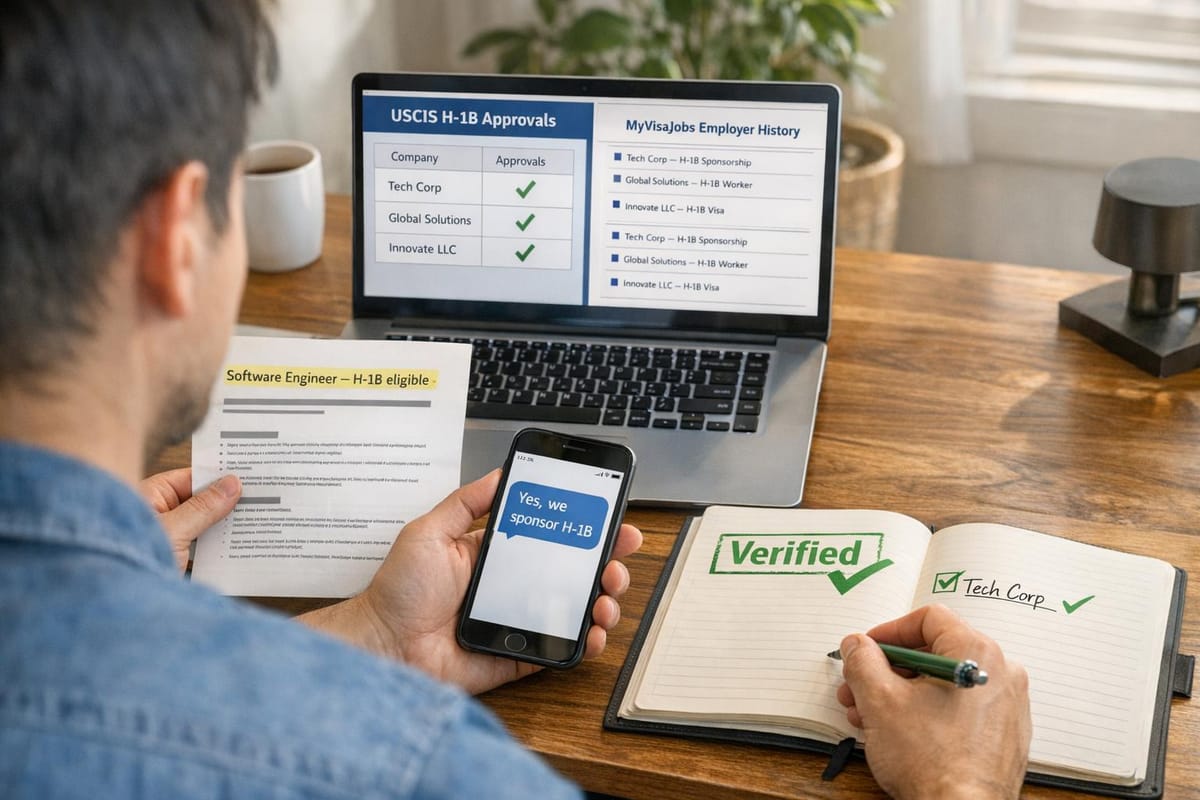
Finding companies that sponsor H1B visas can be tricky. Just because a company sponsored H1B visas in the past doesn't mean they still do. Policies, budgets, and hiring priorities change frequently, leaving many job seekers frustrated after applying to roles that don’t support sponsorship.
To save time and focus on opportunities that truly meet your visa needs, follow these steps:
- Use Official Databases: Check the USCIS H1B Employer Data Hub for historical sponsorship records.
- Leverage Tools: Platforms like MyVisaJobs and GoinGlobal help identify active sponsors and provide salary and LCA data.
- Analyze Job Postings: Look for clear language like “H1B sponsorship available” or “visa transfer supported” in job descriptions.
- Contact Companies Directly: Verify current sponsorship policies by reaching out to recruiters or HR teams.
- Consider Expert Help: Services like Scale.jobs combine data insights with human verification to ensure your applications target active sponsors.
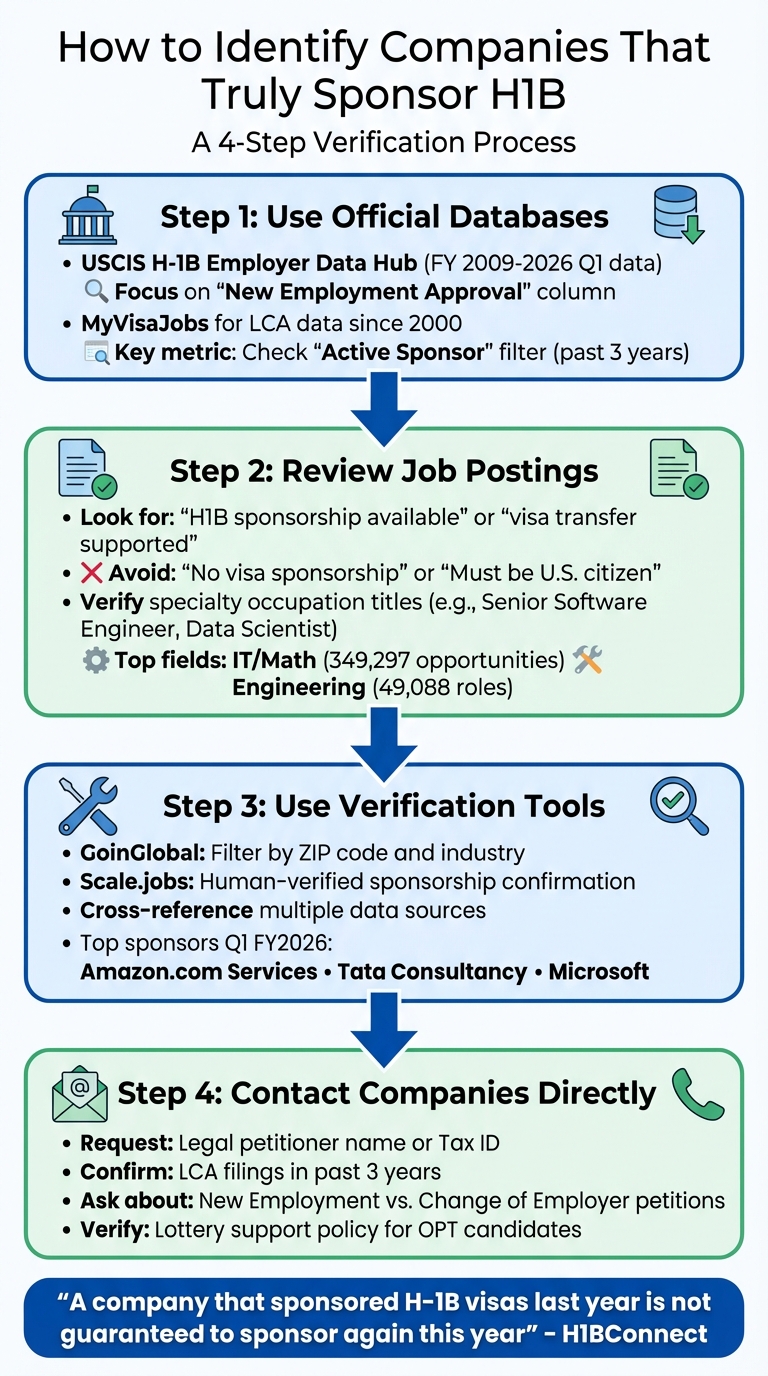
4-Step Process to Verify H1B Sponsorship Companies
Top 5 Companies That Sponsor H1B Visas Every Year
Step 1: Check Official Government Databases
Before diving into sponsorship tools, it’s essential to confirm your eligibility using official government data. These databases provide reliable insights into H1B sponsorships, including petition filings, sponsored workers, and approval outcomes. Unlike third-party tools, they give you verified records directly from government sources.
Search the USCIS H1B Sponsor Data Hub
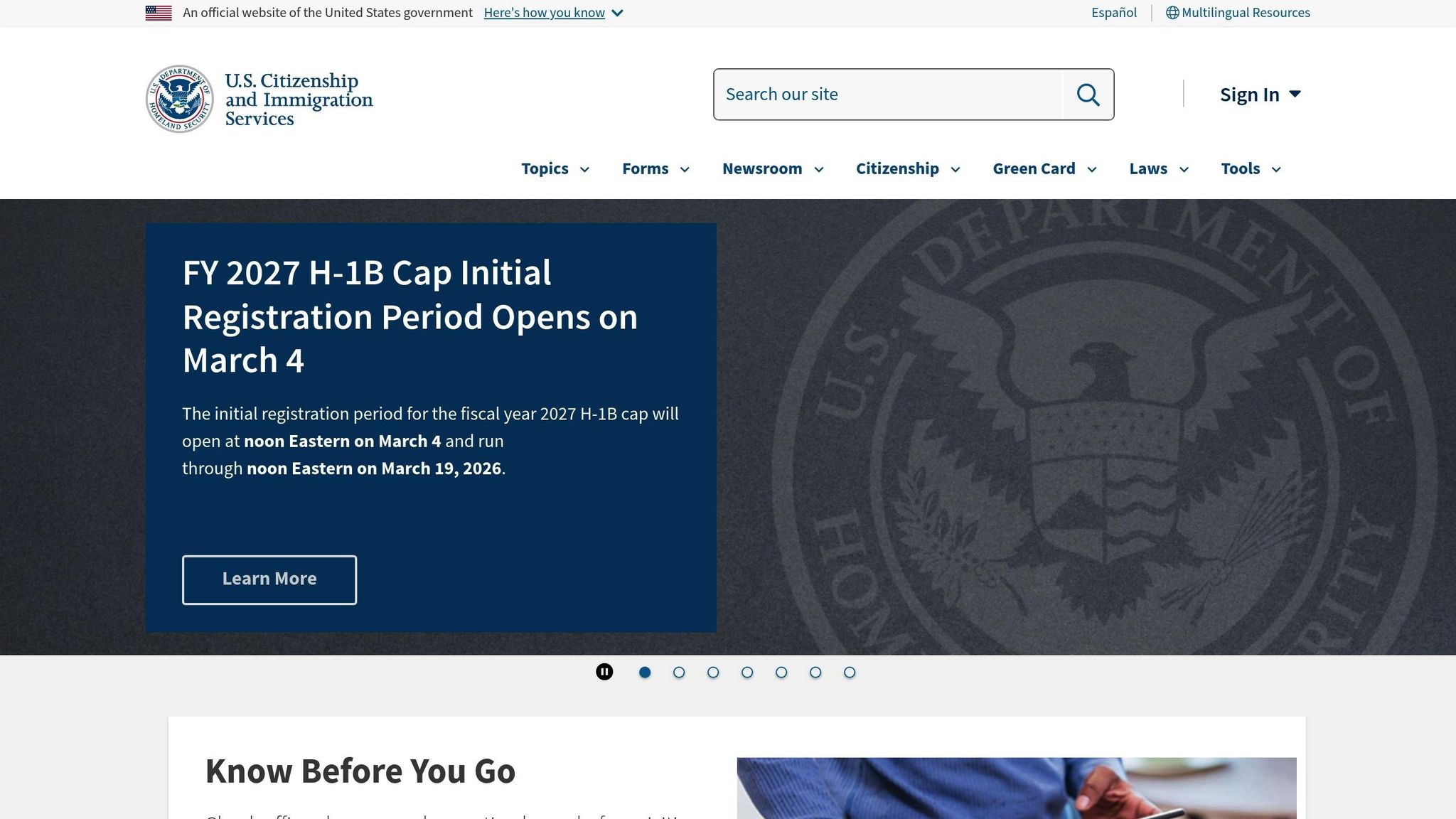
The USCIS H-1B Employer Data Hub is a great starting point for verifying sponsorship records. This free tool includes data from fiscal year 2009 through Q1 FY 2026. You can search by employer name, industry code, city, state, or ZIP code to find detailed H1B filing records.
When reviewing the data, focus on the "New Employment Approval" column. This shows how many employees a company sponsored for their first H1B visa or a new classification. Essentially, it highlights cases where companies hired workers from outside the U.S. or changed their visa status.
For instance, as of December 31, 2025, the top 10 employers for approved beneficiaries in FY 2026 Q1 included major players in the tech and financial sectors.
However, keep in mind a few limitations:
- The data only reflects the initial decision made by USCIS. It doesn’t account for appeals, revocations, or pending petitions.
- The listed city and state represent the employer’s mailing address, which may differ from your actual work location.
For deeper analysis, you can export the data using the "Crosstab View" feature to Excel or CSV files. This official resource gives you a solid foundation, which you can enhance with additional insights from platforms like MyVisaJobs.
Verify Details on MyVisaJobs
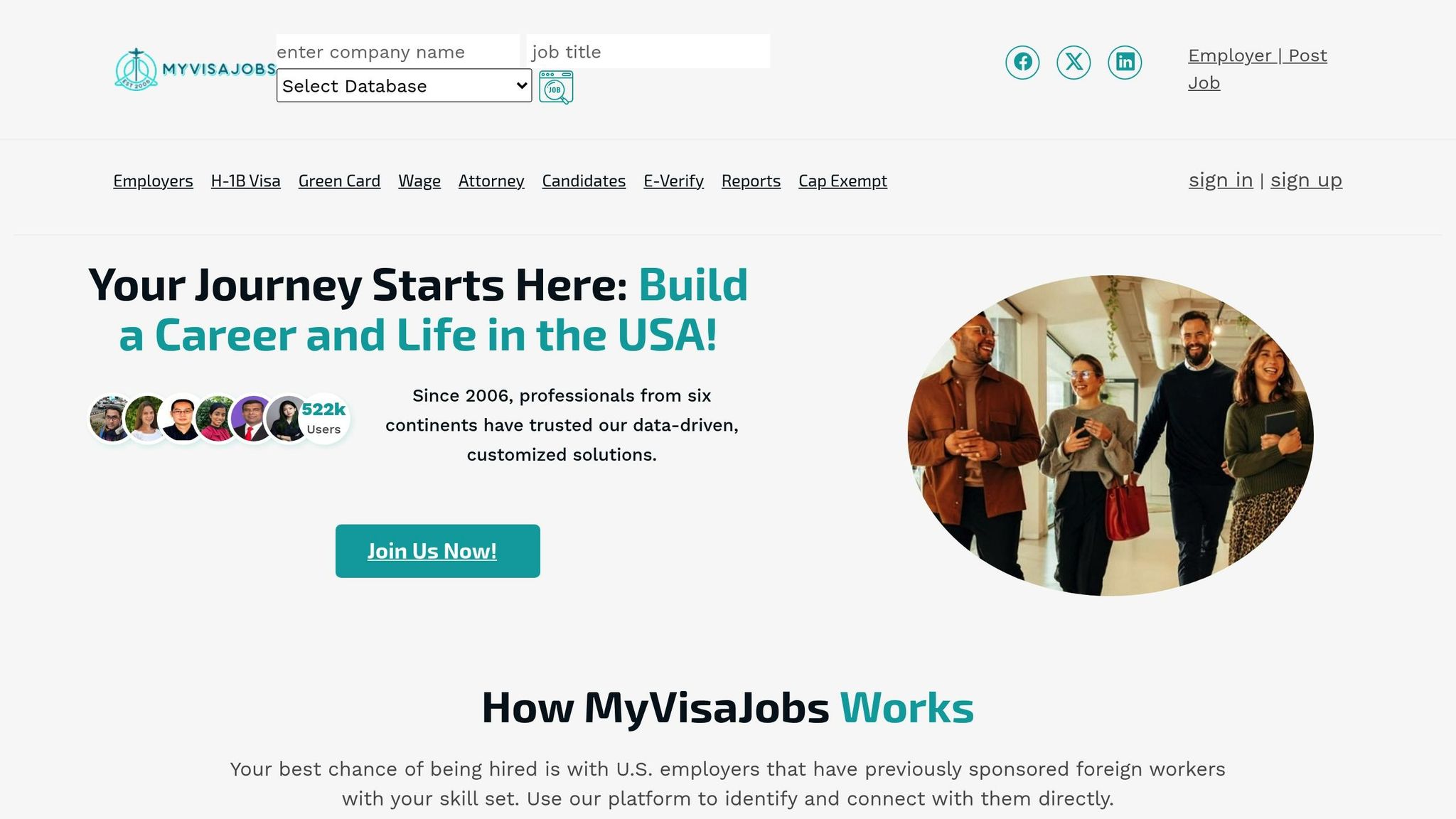
MyVisaJobs offers a broader perspective by providing data on salaries, job titles, and petition success rates. The platform tracks Labor Condition Applications (LCAs) filed by employers since 2000, helping you identify sponsorship trends.
When researching a company, pay attention to the Visa Rank, which is based on the total number of LCAs and Labor Certifications submitted over the last three fiscal years. Look at the H1B LCA column to see how many applications were denied or withdrawn compared to the total submitted. This gives you a clear picture of the company’s success rate.
For example, in fiscal year 2025, Amazon.com Services topped the list with 15,489 certified LCAs, offering an average salary of $157,276. Other high-paying sponsors included Nvidia ($225,600 average), Bloomberg ($223,164 average), and LinkedIn ($221,924 average). These figures reveal not just if a company sponsors but also how much they typically pay for roles like yours.
Use the "Active Sponsor" filter to narrow down results to companies that have sponsored employees in the last three years. You can also search for specific job titles to confirm whether a company sponsors roles that align with your skills. Keep in mind that high LCA counts may include transfers or renewals.
For personalized support, scale.jobs can help you identify the best sponsors and tailor your applications to improve your chances of success.
Step 2: Review Job Postings for Sponsorship Clues
Job postings can provide valuable insights into a company's willingness to sponsor visas - if you know how to interpret them. Even companies known for sponsorship may restrict it to specific roles or departments.
Look for Direct Sponsorship Indicators
The most straightforward clue is explicit language in the job description. Phrases like "H1B sponsorship available," "visa transfer supported," or "willing to provide sponsorship for international candidates" are clear signs that the employer is open to sponsoring visas. These statements indicate that the company understands the costs and processes involved in hiring international talent.
On the other hand, be cautious of exclusionary terms. If a job posting includes phrases like "No visa sponsorship available," "Must be a U.S. citizen or permanent resident," or "Unable to sponsor work authorization now or in the future," it’s a clear signal that sponsorship is not an option for that role.
"A company that sponsored H-1B visas last year is not guaranteed to sponsor again this year." - H1BConnect Team
To save time, use job board filters that allow you to search specifically for roles with sponsorship options, such as "Work authorization: H1B sponsorship." This can help you focus on positions where sponsorship is a real possibility, reducing the chances of applying to roles that don't align with your needs.
Once you identify sponsorship-friendly roles, take a closer look at the job title and requirements to ensure they meet H1B eligibility standards.
Evaluate Job Titles and Role Requirements
For H1B sponsorship, roles must qualify as "specialty occupations", meaning they require specific academic or professional expertise. USCIS examines job titles and descriptions against the Department of Labor's Occupational Outlook Handbook to confirm that a bachelor's degree (or higher) is typically required for the position.
Specialized job titles like "Senior Software Engineer," "Data Scientist," or "Financial Analyst" are more likely to qualify than vague or informal titles like "Coding Guru" or "Marketing Rockstar." Additionally, postings that clearly state a bachelor's or advanced degree requirement - or even specify a Ph.D. - are strong candidates for sponsorship.
Experience requirements also play a key role. Look for language such as "5+ years of experience in [specific field]" or "Proficiency in [specific programming language/tool]" to confirm the role’s complexity. Fields like IT and Math are especially promising, with 349,297 H1B opportunities in the past year, followed by Engineering with 49,088 roles. These statistics underscore the demand for specialized expertise in these areas.
Step 3: Use Tools to Speed Up Verification
Once you've gathered verified data from government sources and job postings, the next step is leveraging specialized tools to streamline the process of confirming H1B sponsorship records. Manually searching databases can be time-consuming, but platforms designed for this purpose can help you quickly identify legitimate sponsors, saving you valuable time during your job hunt.
Search GoinGlobal for Regional Data
GoinGlobal is a powerful resource that allows you to filter by ZIP code and industry, making it easier to focus on specific geographic areas or fields. This is especially useful if you're targeting companies in particular metropolitan hubs or industries. For instance, a software engineer looking for opportunities in Seattle can refine their search to find tech companies with active sponsorship records in that region, avoiding the clutter of nationwide data.
Sponsorship activity can vary by office location, so narrowing your search to specific cities or states helps ensure you're applying to offices with a proven history of supporting international hires. This regional insight complements the broader sponsorship data, giving you a more precise and actionable view of potential employers.
Get Help from Scale.jobs Human Assistants
While tools like MyVisaJobs and the USCIS Data Hub provide useful historical data, they often lack the ability to confirm whether a specific department or role is currently open to sponsorship. Scale.jobs offers a solution by combining data-driven insights with human verification. Their verified list of top H1B sponsors highlights companies actively hiring international talent, such as Amazon.com Services LLC, Tata Consultancy Services, and Microsoft Corporation - three of the leading sponsors in the first quarter of fiscal year 2026, according to the USCIS H-1B Employer Data Hub.
What sets Scale.jobs apart is its human assistants, who go beyond static lists by checking job descriptions, contacting recruiters, and verifying current sponsorship policies. This eliminates the uncertainty of relying solely on historical data. As noted by MyVisaJobs, "Your best chance of being hired is with U.S. employers that have previously sponsored foreign workers with your skill set." Scale.jobs takes this a step further by offering real-time verification and tailoring your application to meet employer-specific requirements.
Their services include ATS-optimized resume adjustments, customized cover letters, cross-portal job applications, and time-stamped proof of submission, all with instant updates via WhatsApp. This blend of automation and human oversight ensures your applications are targeted at the right sponsors, saving you from wasting time on positions that don't align with your visa needs.
| Tool | Primary Data Source | Key Verification Feature | Best For |
|---|---|---|---|
| USCIS Data Hub | Official Form I-129 filings | Approval/denial counts by employer | Verifying government-recorded outcomes |
| MyVisaJobs | LCA and LC filings since 2000 | "Active Sponsor" filter (past 3 years) | Identifying long-term sponsorship patterns |
| GoinGlobal | Regional employer data | ZIP code and NAICS industry filters | Location-specific sponsor searches |
| Scale.jobs | Curated lists + human verification | Real-time recruiter confirmation | Application customization and proof-of-work |
Step 4: Confirm Sponsorship by Contacting Companies
While historical data offers insights into a company's sponsorship patterns, direct communication is essential to verify their current policies for specific roles. After reviewing sponsorship history through databases and job postings, reach out to confirm real-time eligibility.
Email HR or Recruiters Directly
When contacting a company, reference their history in official databases to show you've done your homework. A straightforward email could say:
"I noticed on the USCIS H-1B Data Hub that [Company Name] has a history of sponsorship. Can you confirm if the [Job Title] position qualifies for H1B sponsorship at the required level?"
Be specific about role-related eligibility. For instance, ask whether they handle "New Employment" petitions for candidates outside the U.S. or those on F-1 OPT, or if they only process "Change of Employer" petitions for H-1B transfers. If you're currently on OPT, inquire if they assist employees through the H-1B lottery process, as this reflects their ability to support immigration needs effectively.
Additionally, request the legal petitioner name or the last four digits of their Tax ID to cross-check with the USCIS database. For example, a recruiter might refer to "Tata Consultancy Services", but the official filings could be listed under "TATA CONSULTANCY SERVICES LTD." Even small discrepancies like this can hinder your ability to verify their sponsorship status.
Request Evidence of Past Sponsorships
After making initial contact, ask for specific proof of recent sponsorship activity. Politely inquire if they have filed Labor Condition Applications (LCAs) in the last three years - this is a common indicator of "Active Sponsor" status on platforms like MyVisaJobs. You can also ask about their rates of "Initial Approval" versus "Continuing Approval" to gauge whether they support both new hires and visa extensions.
If their responses seem unclear or inconsistent, it could signal that their sponsorship policies are either outdated or limited. As noted by H1BConnect:
"A company that sponsored H-1B visas last year is not guaranteed to sponsor again this year."
If there are discrepancies between what recruiters claim and what you find in job descriptions or databases, it’s a sign to proceed cautiously.
For those looking to simplify this process, Scale.jobs offers a human-assisted outreach service. Their team directly contacts recruiters, verifies sponsorship policies, and customizes your application materials to align with employer requirements. This saves time and ensures you focus on positions that meet your visa needs. They even provide updates via WhatsApp and timestamped proof of recruiter interactions, giving you clarity and confidence in your job search.
Here’s a handy checklist of details to request when following up, ensuring you get solid confirmation of sponsorship:
| Information to Request | Why It Matters |
|---|---|
| Legal petitioner name or Tax ID | Ensures accurate database cross-referencing |
| New Employment approval history | Confirms they hire candidates without H-1Bs |
| LCA filing frequency (past 3 years) | Reflects current sponsorship activity |
| Role-specific eligibility | Verifies your seniority level qualifies |
| Lottery support policy | Indicates commitment to OPT candidates |
Conclusion: Focus on Companies with Proven H1B Records
When it comes to identifying legitimate H-1B sponsors, a well-rounded approach is essential. Relying on a single source isn't enough - cross-referencing multiple tools and databases is the way to go. Start by using the USCIS H-1B Employer Data Hub to confirm historical filings, then turn to MyVisaJobs to filter for "Active Sponsors" who have filed within the past three years. Pay close attention to job descriptions for clear sponsorship language and avoid positions with restrictions like "Must be a U.S. citizen." Finally, reach out directly to recruiters or HR for confirmation of current sponsorship policies.
"A company that sponsored H-1B visas last year is not guaranteed to sponsor again this year." - H1BConnect
Economic and policy changes can quickly alter sponsorship practices, so combining historical data with real-time verification is critical. Companies like Amazon.com Services LLC, Microsoft Corporation, and Google LLC are consistently top sponsors, but sponsorship availability often depends on team needs, seniority, or other factors. Always request the legal petitioner name or Tax ID for cross-referencing database entries.
LazyApply vs. scale.jobs: Why Human Verification Matters
While verifying sponsorship records is important, your choice of job application service can make or break your efforts. Comparing LazyApply with scale.jobs highlights the difference between automated mass applications and personalized, human-driven strategies.
Why scale.jobs stands out for H1B applicants:
- Human assistants directly verify sponsorship policies by contacting recruiters, ensuring up-to-date information.
- Custom ATS-optimized resumes and cover letters tailored to each employer's requirements and visa needs.
- Transparent one-time payment structure ($399–$799), avoiding recurring subscriptions.
- Dedicated WhatsApp support with real-time updates and proof-of-work screenshots showing recruiter interactions.
- Proof of application submission with timestamped confirmations and verified sponsorship status.
LazyApply's strengths: LazyApply is ideal for candidates who prioritize speed and volume, offering automated mass applications across job boards. Its subscription model ($129–$249/month) works well for broad, non-specialized job searches that don't require visa sponsorship.
Who Benefits from LazyApply
LazyApply is best suited for individuals who:
- Are U.S. citizens or permanent residents without visa requirements.
- Prefer automated, high-volume applications over targeted efforts.
- Focus on entry-level positions where customization isn't critical.
- Don't need verification of sponsorship policies or ATS compliance.
Why Choose scale.jobs
scale.jobs is the better option for those who:
- Require H1B sponsorship verification and want to avoid wasting applications on non-sponsoring employers.
- Need tailored, ATS-optimized application materials for each job.
- Value human oversight to confirm sponsorship policies in real-time.
- Want transparent updates and proof of recruiter interactions.
- Prefer a one-time payment model over ongoing subscription fees.
Comparison Table: scale.jobs vs. LazyApply
| Feature | scale.jobs | LazyApply |
|---|---|---|
| Human involvement | Dedicated assistants verify sponsorship and customize applications | Fully automated with no human verification |
| Resume customization | ATS-optimized, tailored to each role | Generic resume used across all applications |
| ATS compliance | Human-reviewed for employer-specific requirements | Automated submissions with limited optimization |
| Application process | Human assistants apply with verified sponsorship confirmation | Bot-driven mass applications |
| Transparency | WhatsApp updates with proof-of-work screenshots | Limited visibility into application status |
| Pricing model | One-time payment ($399–$799) | Monthly subscription ($129–$249/month) |
When to Switch to scale.jobs
Consider switching to scale.jobs if:
- You need real-time verification of H1B sponsorship policies.
- Your applications require customization for ATS compliance and visa documentation.
- You want proof of submissions with timestamped updates and recruiter contact.
- You're tired of wasting time on roles that don't support your visa status.
- You prefer a one-time payment model for cost transparency.
Decision Summary
For applicants needing H1B sponsorship, scale.jobs offers a tailored approach with human verification, ATS-optimized application materials, and real-time updates through WhatsApp. This ensures your efforts are focused on roles that align with your visa requirements, saving time and increasing your chances of success.
FAQs
How can I confirm a company will sponsor for my exact role right now?
To determine if a company will sponsor your role for an H-1B visa, start by checking reliable sources like the USCIS H-1B Employer Data Hub. This resource lists employers who have previously filed H-1B petitions and the positions they sponsored. Additionally, platforms like MyVisaJobs can offer insights into sponsorship histories. Use these tools alongside direct communication with the employer to confirm whether they currently sponsor your specific role.
What’s the fastest way to match a job posting to the correct USCIS employer record?
To quickly verify H-1B sponsorship, use the USCIS H-1B Employer Data Hub. You can search by employer name, city, state, or ZIP code to confirm if a company sponsors H-1B visas and ensure the legitimacy of their filings. This tool helps you avoid misinformation and ensures accurate results.
How can I tell if a company sponsors new H-1Bs or only H-1B transfers?
To figure out whether a company sponsors new H-1B visas or focuses only on transfers, start by exploring the USCIS H-1B Employer Data Hub. This resource offers detailed information about employer filings, including both new petitions and transfer cases. Another helpful tool is MyVisaJobs, which allows you to filter employers based on their sponsorship activity. Both platforms can give you a clear picture of a company's H-1B filing history and practices.