
Why iCIMS Applications Break Most Automation Tools
iCIMS' custom workflows, strict resume parsing, and bot detection tip off automation tools; human-assisted services ensure accurate, ATS-friendly submissions.


Applying to jobs can be time-consuming, especially when platforms like iCIMS complicate the process for automation tools. iCIMS stands out due to its customizable workflows, advanced AI-driven candidate ranking, and bot detection measures like CAPTCHA and session timeouts. This makes it challenging for tools like LazyApply, Simplify.jobs, and LoopCV to handle applications effectively, often leading to errors or flagged submissions.
For job seekers targeting employers using iCIMS, automation tools may not suffice. Instead, services like Scale.jobs provide a manual, human-assisted approach, ensuring accurate submissions and ATS-friendly resumes. This article explores why iCIMS poses challenges for automation tools, compares job search automation methods, and offers solutions for navigating this complex platform.
Why Automation Tools Fail on iCIMS Applications
iCIMS' unique structure and customization options make it particularly challenging for automation tools like LazyApply and LoopCV to navigate successfully. Let’s dig into the specific reasons these tools often fall short.
Custom Workflows and Non-Standard Form Fields
iCIMS stands out for its highly customizable, multi-step workflows, which vary significantly between employers. Unlike more standardized systems such as Greenhouse or Lever, iCIMS allows employers to create intricate application processes. For example, one company might require a detailed 500-character response to a question like, "Describe your experience with cross-functional teams," while another might use conditional questions that appear only after specific answers are given.
Automation tools typically rely on pre-programmed scripts designed for standard fields like "Name", "Email", and "Phone Number." These tools struggle when they encounter custom dropdowns, unique text fields, or conditional logic. The result? Incomplete or incorrect submissions that can flag your application as low-effort or even disqualify it entirely.
Resume Parsing Errors and Auto-Fill Failures
iCIMS uses a literal resume parser that adheres to strict formatting rules. It expects resumes to follow conventional headings like "Work Experience" and "Education", and it struggles with unconventional layouts, such as multi-column formats or resumes that place contact details in headers or footers. If your resume isn’t formatted with iCIMS in mind, the system may miscategorize or drop key information.
This issue becomes even more pronounced when automation tools attempt to auto-fill application fields using resumes that aren’t optimized for iCIMS. Common errors include:
- Work experience being mislabeled as "Education."
- Contact details, like phone numbers, disappearing entirely.
- Job titles becoming scrambled or misplaced.
If you frequently apply to jobs through iCIMS portals, it’s worth considering professional resume writing services that specialize in ATS-friendly formatting. These services can help ensure your resume is compatible with iCIMS’ parsing system, reducing the risk of errors during submission.
Bot Detection: CAPTCHA and Session Timeouts
iCIMS employs robust mechanisms to detect and block automated submissions. For instance, the platform tracks application patterns, such as IP addresses and submission timestamps. When bots submit applications at predictable intervals - say, every 2-3 minutes from the same IP address - they’re easily identified and flagged.
Additionally, iCIMS uses CAPTCHA challenges and enforces strict session timeouts. These measures are designed to disrupt bots, which cannot solve dynamic CAPTCHA puzzles or manage quick re-authentication requirements. Even if a bot completes most of the application process, it often fails at the final step, wasting your effort and potentially flagging your profile for suspicious activity.
LazyApply vs Simplify.jobs vs LoopCV vs Scale.jobs: Which Handles iCIMS Better?
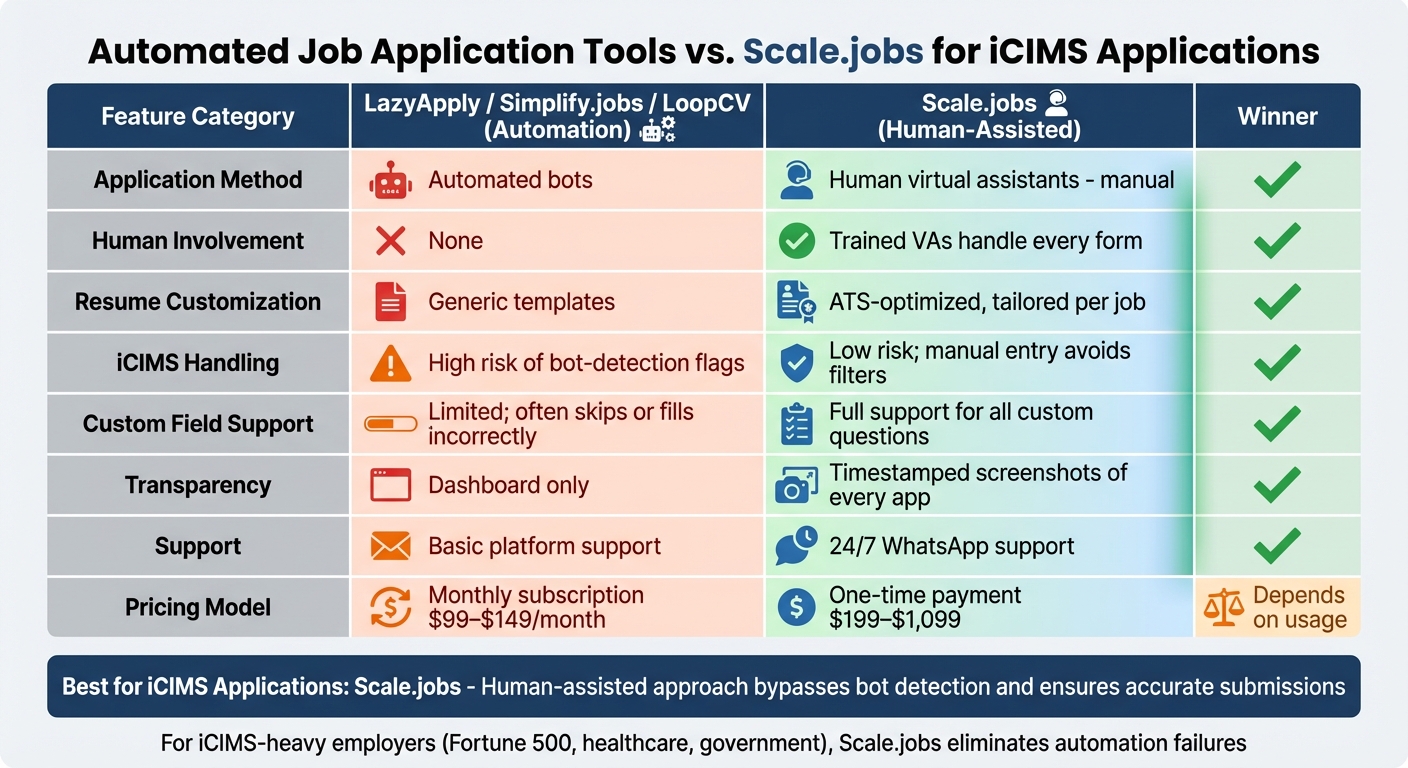
Job Application Tools Comparison: LazyApply vs Simplify.jobs vs LoopCV vs Scale.jobs for iCIMS
Navigating iCIMS portals can be a frustrating challenge for job seekers relying on automation tools. LazyApply, Simplify.jobs, and LoopCV promise to streamline the process, but their reliance on bots often falls short when faced with the complexities of iCIMS' custom workflows and anti-bot mechanisms. Let's explore how these tools handle iCIMS and see why Scale.jobs stands out.
How LazyApply, Simplify.jobs, and LoopCV Handle iCIMS (and Where They Fall Short)
LazyApply, Simplify.jobs, and LoopCV use automated scripts to fill out application forms, performing well on standardized ATS platforms like Greenhouse or Lever. However, iCIMS presents a different challenge.
These tools rely on preset logic to identify and fill fields. When faced with iCIMS' unique dropdowns, conditional questions, or multi-step forms, they often misfill or skip fields entirely. For example, LazyApply might provide a generic response to a custom question like "Describe your experience with Salesforce," leaving an application incomplete or irrelevant. Similarly, Simplify.jobs and LoopCV struggle to adapt to the tailored configurations used by different employers on iCIMS.
Another major issue is bot detection. iCIMS monitors submission patterns, and when these tools submit applications at predictable intervals or from the same IP address, they risk triggering flags. While your application might technically go through, it may be deprioritized or flagged as suspicious - often without your knowledge.
Each tool does have its strengths. LazyApply offers affordability with a $99/month subscription, making it attractive for high-volume applicants. Simplify.jobs provides a straightforward dashboard and browser extension that work well on simpler platforms. LoopCV combines job searches and applications into a single workflow, which is convenient for passive job seekers. However, their automation-first approach is a poor fit for iCIMS, where precision and flexibility are critical.
Why Scale.jobs Excels Where Automation Falls Short
Scale.jobs takes an entirely different approach by prioritizing human input over automation. Instead of relying on bots, Scale.jobs uses trained virtual assistants (VAs) to manually complete each application. This method eliminates the risks of bot detection, ensures accurate submissions, and adapts seamlessly to complex workflows.
Here’s why Scale.jobs is better equipped for iCIMS applications:
- No bot flags and ATS-optimized resumes: Human VAs ensure your applications avoid detection issues, and they use ATS-optimized resumes tailored to iCIMS requirements. Need help creating your resume? Scale.jobs even offers resume writing services to perfect your documents before applications begin.
- Custom field handling: VAs carefully read and answer every custom question, including detailed essays or conditional logic fields that automation tools often mishandle.
- Proof of work: You get timestamped screenshots of every submission, so you know exactly what was submitted and when.
- Real-time support: With WhatsApp integration, you can communicate directly with your VA team and adjust your application strategy as needed.
In terms of pricing, Scale.jobs uses a one-time payment model. For $199, you get 250 applications, $299 gets you 500, and $399 covers 1,000 applications. Unlike subscription-based tools, there are no hidden renewals, and unused credits are refunded. This transparent model offers flexibility and peace of mind.
Feature Comparison Table
| Feature | LazyApply / Simplify.jobs / LoopCV | Scale.jobs |
|---|---|---|
| Application Method | Automated bots | Human virtual assistants (manual) |
| Human Involvement | None | Trained VAs handle every form |
| Resume Customization | Generic templates | ATS-optimized, tailored per job |
| iCIMS Handling | High risk of bot-detection flags | Low risk; manual entry avoids filters |
| Custom Field Support | Limited; often skips or fills incorrectly | Full support for all custom questions |
| Transparency | Dashboard only | Timestamped screenshots of every app |
| Support | Basic platform support | 24/7 WhatsApp support |
| Pricing Model | Monthly subscription ($99–$149/month) | One-time payment ($199–$1,099) |
This comparison highlights how Scale.jobs' human-driven approach, tailored resumes, and transparent pricing make it the superior choice for iCIMS applications.
Who Should Use LazyApply, Simplify.jobs, or LoopCV?
These tools are ideal for job seekers applying to a high volume of positions on simpler ATS platforms like Greenhouse or Lever. If you're targeting startups, tech companies, or roles where speed is more important than customization, these tools can help you apply quickly. They're also a good fit for those on a tight budget who can tolerate occasional submission errors.
Who Should Choose Scale.jobs?
Scale.jobs is the best option for job seekers targeting large organizations like enterprise employers, Fortune 500 companies, healthcare systems, or government contractors - industries that often use iCIMS or similarly complex ATS platforms. If your applications require detailed responses, custom questions, and precise submissions, Scale.jobs ensures everything is handled correctly the first time. With its transparent pricing and ATS-optimized resumes, it's perfect for professionals who value accuracy and efficiency over speed.
For job seekers applying to iCIMS-based roles, automation tools may end up wasting more time than they save. Scale.jobs provides a reliable, human-assisted solution that ensures your applications are submitted flawlessly, reducing the risk of being flagged or overlooked.
How to Apply Successfully Through iCIMS
With iCIMS holding an 11% share of the global ATS market by 2025, it’s one of the most likely platforms you’ll encounter during your job search. Its complex workflows and resume-parsing technology can pose challenges, but with the right approach, you can improve your chances of submitting a successful application. Here’s how to navigate iCIMS effectively.
Format Your Resume for iCIMS Parsing
iCIMS relies on a parser to extract details from your resume and populate application fields. If the parser encounters formatting issues, crucial information might be misplaced or omitted, which could lower your chances of being accurately matched to the job. Additionally, iCIMS uses an AI-driven "Role Fit" algorithm (powered by Opening.io) to assess how well your skills align with job requirements. Proper resume formatting is key to avoiding errors and maintaining a strong Role Fit score.
To optimize your resume for iCIMS:
- Stick to a straightforward layout with clear headers like Work Experience, Education, and Skills.
- Avoid using tables, graphics, or text boxes, as these can confuse the parser.
- Choose standard fonts such as Arial, Calibri, or Times New Roman in 10–12 pt size.
- Save your resume as a .docx file for better compatibility.
- Use the "MM/YYYY" format for dates (e.g., "01/2023 – 12/2024").
- Spell out abbreviations the first time they appear, such as "Customer Relationship Management (CRM)", to ensure they’re recognized correctly.
Taking these steps ensures your resume is ATS-friendly and ready for iCIMS' parsing system.
Fill Critical Fields Manually
iCIMS' multi-step workflows, custom dropdowns, and conditional questions often require human judgment, which automated tools may not handle accurately. To avoid errors, focus on manually completing key fields, especially those marked with an asterisk (*) or requiring specific details about tools, certifications, or experience.
When answering dropdown menus or custom questions, double-check your responses to ensure they reflect your qualifications. Automation tools like LazyApply or Simplify.jobs might default to incorrect choices, so it’s essential to review every submission carefully. Pay extra attention to your contact information, work history, and responses to custom questions before finalizing your application.
Use Human-Assisted Services for Error-Free Submissions
For roles in industries like healthcare, government, or Fortune 500 companies that use iCIMS, human-assisted services can help you avoid common submission errors. Services like Scale.jobs offer trained virtual assistants (VAs) who manually complete your applications, ensuring they’re optimized for ATS systems like iCIMS.
Here’s what you can expect from Scale.jobs:
- VAs tailor your resume to meet ATS requirements and fill out application fields accurately.
- Each job posting is reviewed thoroughly to match your qualifications.
- You receive timestamped proof of submission via WhatsApp.
- Pricing is transparent, starting at $199 for 250 applications, with refunds for unused credits.
If you’re struggling to prepare an ATS-friendly resume, Scale.jobs also provides resume writing services to align your documents with iCIMS standards. For those who’ve faced repeated issues with automation tools, switching to a human-assisted approach can save time and improve your application success rate, eliminating the frustration of troubleshooting failed submissions.
Which Tool Should You Use?
Navigating the complexities of iCIMS applications can be tricky, but selecting the right tool for your job search can make a significant difference. Your choice between automation tools and human-assisted services will depend on factors like the type of employers you're targeting, the importance of accuracy, and whether you're prioritizing speed or quality in your submissions.
When Automation Tools Are a Good Fit
Automation tools like LazyApply, Simplify.jobs, and LoopCV can still be helpful if you're applying to companies that don't rely on iCIMS or other advanced ATS platforms with strict bot detection. These tools are ideal for high-volume job searches, especially when you're exploring opportunities with startups, smaller organizations, or companies using basic recruiting systems without custom workflows or detailed screening processes.
For straightforward applications - those without multi-stage evaluations or company-specific questions - automation tools can save time. They’re particularly useful when testing interest in a new industry or location, where submitting numerous applications quickly can provide valuable insights. However, always review auto-filled fields before submission to avoid errors.
When Scale.jobs Stands Out
Scale.jobs is the better option if you're applying to iCIMS-heavy employers like Fortune 500 companies, healthcare organizations, or government contractors where accuracy is critical. If you've faced repeated issues such as failed submissions, missing confirmation emails, or no callbacks despite high application volume, Scale.jobs offers a reliable solution with human-assisted services.
Unlike LazyApply, Simplify.jobs, and LoopCV, Scale.jobs employs trained virtual assistants who manually complete each application. This approach avoids iCIMS bot detection, ensures ATS-friendly resumes, and guarantees that every custom field is filled correctly. With timestamped proof of submission via WhatsApp, you’ll know exactly when and where your applications were sent. Additionally, Scale.jobs operates on a one-time payment model starting at $199 for 250 applications, with refunds for unused credits. They also provide resume writing services to help align your documents with iCIMS requirements.
Who Should Use LazyApply, Simplify.jobs, and LoopCV?
These tools are best suited for:
- High-volume applicants targeting simpler ATS platforms like Greenhouse or Lever, where bot detection is less of a concern.
- Budget-conscious job seekers willing to accept occasional errors in exchange for lower monthly costs ($99–$149/month).
- Exploratory job seekers applying across startups or tech companies where speed is more important than customization.
- Passive applicants who want to maintain momentum without daily involvement.
Strengths: LazyApply is affordable for high-volume applications, Simplify.jobs offers a user-friendly browser extension, and LoopCV combines job searching and applying in one workflow.
Limitations: These tools rely on automated scripts that often struggle with iCIMS workflows, conditional questions, and bot detection, risking flagged or incomplete applications.
Who Should Choose Scale.jobs?
Scale.jobs is ideal for:
- Professionals applying to enterprise employers using iCIMS or other complex ATS platforms where accuracy is crucial.
- Job seekers targeting Fortune 500 companies, healthcare systems, or government contractors with detailed screening requirements.
- Candidates frustrated by repeated automation failures on iCIMS portals.
- Applicants who value transparency and want timestamped proof of every submission through real-time WhatsApp updates.
- Those needing ATS-optimized resumes tailored for iCIMS parsing.
Why Scale.jobs excels:
- Human virtual assistants bypass bot detection and handle complex custom fields.
- ATS-optimized resumes ensure compatibility with iCIMS parsing algorithms.
- Timestamped proof of submission provides full transparency.
- One-time payment options ($199–$1,099) eliminate subscription renewals, with refunds for unused credits.
- 24/7 WhatsApp support allows for real-time communication and strategy adjustments.
When to Switch to Scale.jobs
Consider switching to Scale.jobs if you’re experiencing these issues:
- Automation tools frequently fail or time out on iCIMS portals, leaving you uncertain about submission status.
- Applications to the same company are flagged for identical responses or rapid submissions.
- Targeted roles require detailed answers to screening questions that automation tools can’t handle.
- Despite numerous applications, you’re not receiving interview requests from iCIMS-based employers.
- Troubleshooting automation failures consumes more time than manual applications, negating the intended efficiency.
In such cases, the cost of automation failures - missed opportunities, wasted time, or even IP-based blocking - outweighs the investment in a human-assisted service like Scale.jobs that guarantees accurate submissions.
Decision Summary
For job searches involving startups or smaller companies using basic ATS platforms, automation tools like LazyApply, Simplify.jobs, or LoopCV offer speed and convenience. However, for enterprise employers using iCIMS or similarly complex systems, Scale.jobs is the clear choice. Its human-assisted services ensure accurate submissions, avoid flagged applications, and provide peace of mind with verified proof of work. If precision and reliability are your priorities, Scale.jobs delivers where automation tools fall short.
FAQs
How can I tell if an iCIMS application got flagged or failed?
To determine if an iCIMS application has been flagged or failed, start by reviewing the application portal for any confirmation messages, status updates, or rejection notifications. If these are absent, a prolonged lack of response or interview invitations could also signal a potential issue. Incorporating manual tracking methods, such as maintaining a record of submitted applications and their statuses, can provide better oversight. This approach ensures transparency and helps you follow up effectively on your job applications.
What resume format works best with iCIMS parsing?
When creating a resume for iCIMS, opt for a straightforward chronological or hybrid format. These layouts are more compatible with ATS systems, ensuring your information is accurately extracted. Steer clear of intricate designs or heavy use of graphics, as these can interfere with the parsing process and make your resume harder to process.
When should I switch from automation to human-assisted applying?
When facing challenges like frequent ATS rejections or struggling to stand out in competitive roles, switching to human-assisted applying can make all the difference. Unlike automated tools that often churn out generic, keyword-packed applications with low success rates, human-assisted services focus on crafting tailored, ATS-friendly documents. These services prioritize personalization, ensuring your applications are customized to each role, improving your chances of callbacks. This approach is especially valuable when automation falls short in delivering the nuanced touch needed to make your application shine.