
Why Human-Reviewed Job Applications Still Beat Automation
Human-reviewed job applications avoid ATS parsing errors, tailor resumes and cover letters, and provide proof of submission for higher callback rates.


When it comes to job applications, relying solely on automation often leads to missed opportunities. Automated tools may speed up submissions but struggle with nuances like ATS parsing errors, keyword mismatches, and tailoring resumes for specific roles. Human-reviewed applications, however, ensure personalized and precise submissions that align with job descriptions and hiring manager expectations.
Key takeaways:
- Automation drawbacks: Generic resumes fail ATS filters, creative formatting causes parsing errors, and bots often trigger detection systems.
- Human advantages: Tailored resumes and cover letters, ATS-friendly formatting, and nuanced understanding of job descriptions lead to higher callback rates.
- Best solution: Services like scale.jobs combine human oversight with ATS optimization, offering proof of submission and real-time updates.
If you’re tired of rejections despite strong qualifications, switching to a job application service with a human touch can significantly improve your success rate.
"Beat the ATS"? They Lied | Ex-Google Recruiter Reveals the Resume Truth
How ATS Systems Reject Qualified Candidates
To grasp why applications reviewed by humans often perform better than those filtered by automation, it's crucial to understand how ATS (Applicant Tracking System) platforms can unintentionally reject qualified candidates. These systems evaluate resumes by parsing their content and comparing it to job descriptions using inflexible rules. Candidates are scored based on how closely their resumes match predefined criteria, and those who fail to meet these strict requirements - such as specific keywords or standard formatting - are eliminated before a human ever sees their application.
The problem lies in the rigidity of ATS algorithms, which lack the ability to interpret context. For example, while a human reviewer can easily navigate creative resume designs, ATS systems often misinterpret them. A decorative header or unique layout might obscure essential keywords, causing the system to miss critical qualifications. In some cases, entire sections - like skills or work experience - might not be parsed correctly, effectively erasing them from consideration.
Another major issue is keyword mismatches. Even slight deviations from expected formats or terminology can result in rejection. The table below highlights common ATS pitfalls and how to avoid them:
| Common ATS Rejection Cause | Optimized Alternative |
|---|---|
| Creative fonts (Script, Decorative) | Standard fonts (Arial, Calibri, Helvetica) |
| Multiple columns or tables | Single-column, text-only format |
| Custom section headers ("My Journey") | Standard headers ("Work Experience") |
| Inconsistent dates ("Jan '21") | Full format ("January 2021") |
| Non-text formats (.jpg, .png) | Text-based formats (.docx, .pdf) |
Recognizing these challenges is key when comparing ATS systems to human review services, such as Scale.jobs, which can navigate creative layouts and nuanced details with ease. This contrast between automated rigidity and human adaptability underscores why personalized, human-reviewed applications often achieve better outcomes.
Why Human Review Beats Automation
Automated systems rely heavily on keyword matching, often missing the finer details that recruiters value. Human reviewers, on the other hand, can interpret subtle cues, adapt tone, and shape applications to align with what employers genuinely seek. This personalized approach leads to higher callback rates and fewer rejections, particularly for candidates with unconventional career paths or those applying for roles requiring judgment beyond keyword density. Let’s explore how this human touch can revolutionize your application process.
Custom Resumes and Cover Letters for Each Role
Human reviewers excel at customizing resumes and cover letters to align with specific job postings, company values, and hiring manager preferences. Instead of simply inserting keywords, they reframe achievements to match the role’s primary requirements. For example, a project manager applying to a tech startup might highlight agile methodologies and cross-functional teamwork, whereas the same applicant targeting a Fortune 500 company would emphasize stakeholder management and process efficiency. This level of personalization - adjusting tone, prioritizing accomplishments, and reorganizing sections - goes far beyond the capabilities of automated tools.
At scale.jobs, trained professionals carefully analyze job descriptions and tailor your resume and cover letter to reflect the employer’s priorities. They don’t just sprinkle in keywords - they restructure your content to emphasize the experiences and skills that matter most for each specific role. This avoids the generic, one-size-fits-all approach of automation, where a single resume is sent to numerous postings without meaningful adjustments.
Moreover, understanding the hidden nuances in job descriptions can significantly enhance the quality of your application.
Reading Job Descriptions Beyond Keywords
Automated systems often treat job descriptions as mere collections of keywords, failing to grasp contextual details like company growth stage, team dynamics, or leadership expectations. Human reviewers, however, can identify these nuances and tweak applications accordingly. For instance, a reference to a "startup mentality" signals a need for adaptability and independence, while "proven track record" hints at the importance of showcasing measurable achievements. By interpreting these subtle cues, human reviewers help avoid mismatches that could lead to ATS rejections or disqualifications during the hiring process.
Experienced reviewers also address potential red flags, such as employment gaps or unconventional career moves, by framing them as strengths or adding context in cover letters or resume summaries. Automation lacks the ability to make such nuanced decisions - it either flags these details as anomalies or ignores them entirely, leaving candidates at risk of rejection.
Better ATS Compliance
Human reviewers ensure your resume meets ATS requirements by combining proper formatting with strategic keyword placement. They understand which fonts, section headers, and file types are compatible with various ATS platforms, and they validate formatting to ensure smooth parsing. More importantly, they balance keyword optimization with natural, engaging language, so your resume doesn’t end up sounding like a robotic list - something that often turns off hiring managers after ATS approval.
This dual focus on technical compliance and human appeal is where automation often stumbles. Automated tools either produce keyword-heavy resumes that lack personality or create overly stylized documents that ATS systems struggle to process. Human reviewers navigate this delicate balance by understanding both the technical and human elements, ensuring your application not only passes automated screening but also resonates with recruiters. If you’re frustrated by ATS rejections despite having strong qualifications, professional resume services can help bridge this gap by combining technical precision with a personalized approach.
Jobscan.co vs scale.jobs: Reviews & Alternatives
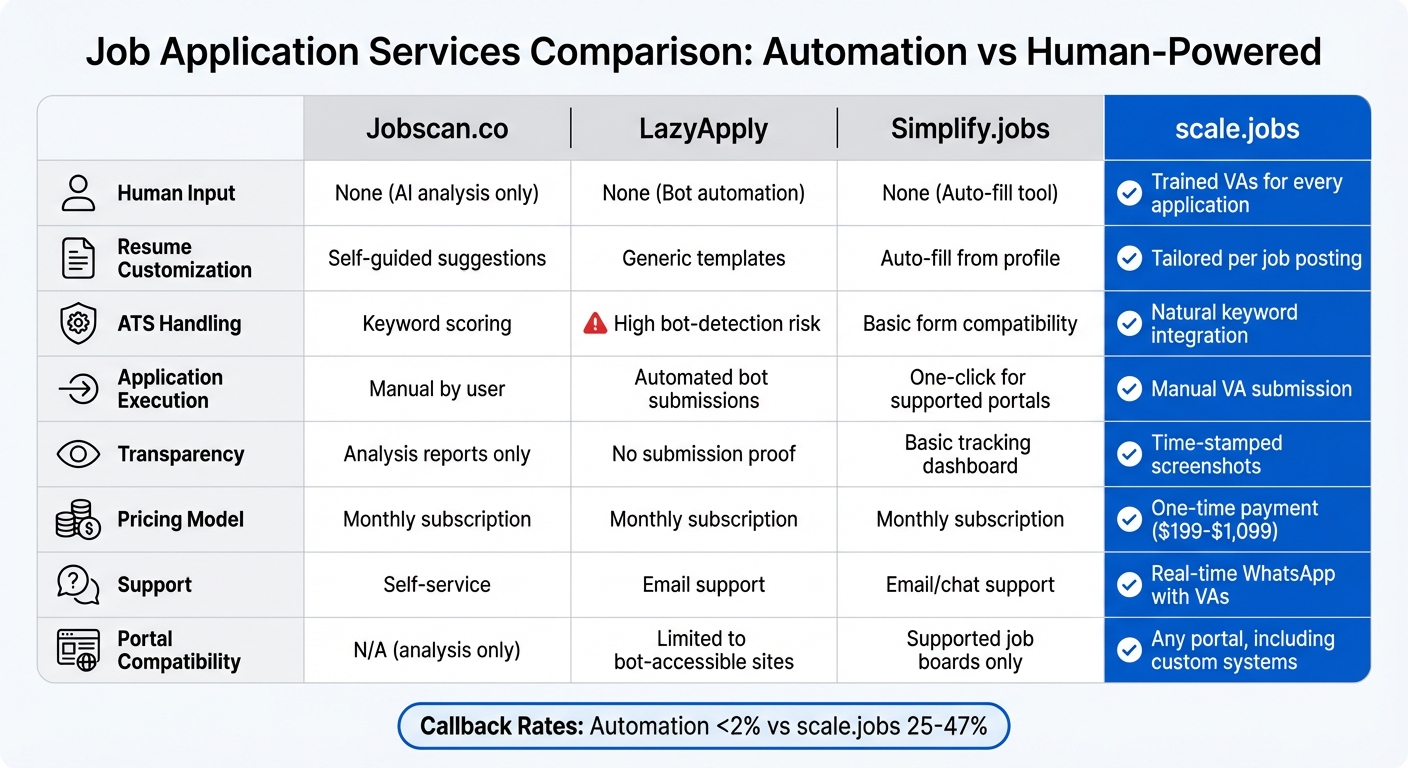
Comparison of Job Application Services: Features, Pricing, and Success Rates
Building on the challenges of automated tools, let's dive into a comparison of competitors to see how scale.jobs uses human expertise to tackle ATS issues and craft tailored applications.
Jobscan.co vs scale.jobs
Jobscan.co provides AI resume builders and keyword scanning to evaluate your resume against job descriptions. It generates a match score based on keyword usage and formatting alignment for ATS systems. This tool is self-service - you get automated insights, but you're responsible for editing your resume and applying for positions on your own. It’s a handy option for those who want to refine their documents independently, as it identifies missing keywords and formatting tweaks.
scale.jobs, on the other hand, assigns trained human virtual assistants (VAs) to manage the entire application process for you. Instead of just analyzing, these VAs manually update your resume and cover letter for each job, handle submissions across all types of portals (even the tricky ones), and provide real-time updates via WhatsApp. You’ll even receive timestamped screenshots as proof of every submission, removing the uncertainty that often comes with DIY tools.
Why scale.jobs stands out against Jobscan.co:
- Execution, not just analysis: Jobscan offers feedback, but scale.jobs' VAs implement those changes and manage submissions for you.
- Natural keyword optimization: Human assistants ensure your resume includes 80-90% of relevant keywords without sounding robotic.
- Portal flexibility: While Jobscan is focused on analysis, scale.jobs' VAs can navigate any application system, including complex corporate platforms.
- Proof of work: Every submission is backed by timestamped screenshots, unlike Jobscan's analysis reports.
- Time efficiency: Save over 20 hours a week as VAs handle tedious tasks like form-filling, follow-ups, and document revisions.
For candidates who enjoy hands-on adjustments and can dedicate time to refining their applications, Jobscan.co is a solid choice. But if you're tired of ATS rejection or need someone to handle the heavy lifting, scale.jobs offers a more comprehensive solution with human involvement.
Next, let’s see how LazyApply measures up to scale.jobs when it comes to bulk applications.
LazyApply vs scale.jobs: Why You Should Switch to Human-Powered Apply
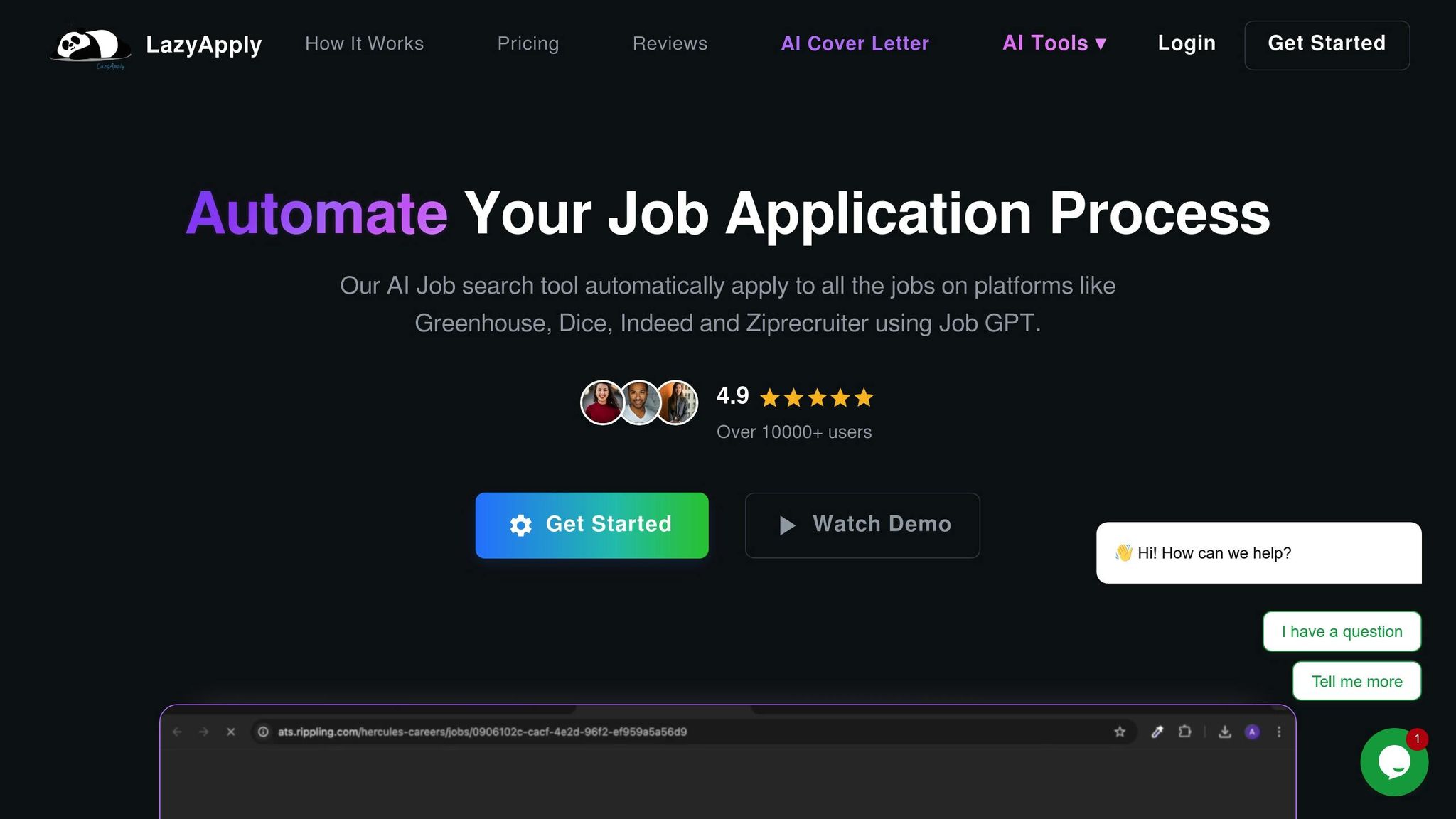
LazyApply focuses on automating bulk submissions by using bots to fill out application forms across various job boards. While this can seem efficient, automated tools often trigger bot-detection filters in corporate ATS systems, leading to instant rejections or even shadow bans. Many platforms now use CAPTCHA and behavioral analysis to block such tools, which means your applications might never even be seen by a recruiter.
scale.jobs avoids these issues by employing human VAs who manually complete each application. They carefully review job descriptions, tailor your resume to highlight relevant experience, write personalized cover letters, and submit applications through the employer's preferred method - whether that’s a corporate portal, email, or third-party platform. This personal approach ensures your applications pass both technical and human reviews.
Why scale.jobs outperforms LazyApply:
- No bot flags: Manual submissions ensure your applications bypass automated detection systems.
- Customized documents: Resumes and cover letters are tailored for each role, avoiding generic, one-size-fits-all applications.
- Complex portal handling: VAs handle multi-step forms, custom questions, and personality assessments that bots cannot process.
- Quality over quantity: Instead of mass submissions, scale.jobs focuses on strategic, targeted applications.
- Simplified pricing: Pay a one-time fee per campaign ($199-$1,099) rather than recurring subscriptions.
LazyApply may work for those who prioritize volume over precision and are okay with the risks of bot detection. However, for competitive roles at companies with advanced ATS systems, scale.jobs delivers far better results by combining tailored applications with human-powered execution.
Let’s now examine Simplify.jobs and why scale.jobs provides a more robust alternative.
Is Simplify.jobs Worth It? Reviews & Alternatives
Simplify.jobs offers a one-click application feature that auto-fills forms using stored profile data, making it convenient for quick submissions on supported job boards. While it works well for straightforward applications, it struggles with custom portals that require detailed responses, portfolio uploads, or multi-stage verification. Additionally, users are responsible for personalizing their resumes and cover letters, as the platform doesn’t adapt to unique employer requirements.
scale.jobs, on the other hand, provides full-service application management. Human VAs handle everything from customizing your resume and cover letter to submitting applications and following up. They adapt to the specific needs of each job posting, thoughtfully answer open-ended questions, and ensure your materials align perfectly with the employer's expectations. You’ll also receive updates and document submissions within 24 hours, with real-time communication via WhatsApp.
Why scale.jobs excels over Simplify.jobs:
- Complete customization: Resumes and cover letters are tailored for each job posting, not just auto-filled from a stored profile.
- Broad portal compatibility: Works on any application system, including proprietary platforms that one-click tools can’t manage.
- Thoughtful responses: VAs craft well-written answers to open-ended questions, unlike generic auto-fills.
- Transparency: Time-stamped screenshots provide proof of every submission, giving you peace of mind.
- Dedicated support: Get 24/7 real-time updates and assistance from your VA team, not automated bots.
Simplify.jobs is a good fit for candidates applying to high-volume, standardized postings who prioritize speed. But for roles requiring tailored applications, complex portal navigation, or proof of submission, scale.jobs provides a more thorough and reliable solution.
Comparison Table
| Feature | Jobscan.co | LazyApply | Simplify.jobs | scale.jobs |
|---|---|---|---|---|
| Human Input | None (AI analysis only) | None (Bot automation) | None (Auto-fill tool) | Trained VAs for every application |
| Resume Customization | Self-guided suggestions | Generic templates | Auto-fill from profile | Tailored per job posting |
| ATS Handling | Keyword scoring | High bot-detection risk | Basic form compatibility | Natural keyword integration |
| Application Execution | Manual by user | Automated bot submissions | One-click for supported portals | Manual VA submission |
| Transparency | Analysis reports only | No submission proof | Basic tracking dashboard | Time-stamped screenshots |
| Pricing Model | Monthly subscription | Monthly subscription | Monthly subscription | One-time payment ($199-$1,099) |
| Support | Self-service | Email support | Email/chat support | Real-time WhatsApp with VAs |
| Portal Compatibility | N/A (analysis only) | Limited to bot-accessible sites | Supported job boards only | Any portal, including custom systems |
When to Use Automation vs Human Review
Deciding between automation and human-reviewed services depends on where you are in your career, the complexity of the roles you're targeting, and the time you can commit to job searching. Both approaches have their strengths, but knowing when to use each can save you time and frustration while improving your chances of success.
Who Should Use Automation Tools
Automation tools are a great fit for passive job seekers and those applying for entry-level positions. Platforms like LazyApply or Simplify.jobs allow users to submit a high volume of applications quickly, making them ideal for roles like data entry clerks, sales associates, or customer service representatives. These tools shine during periods like holiday hiring seasons when companies are processing thousands of applications and speed matters.
For roles that rely on standardized resumes and keyword-heavy ATS filters, automation can handle the heavy lifting. If the application process is straightforward and doesn’t require customization, automation can save considerable time. However, it’s worth noting that automated tools come with risks, such as bot detection, formatting errors, and overly generic applications. For more nuanced roles or situations, automation might not be enough.
Who Should Choose scale.jobs
For job seekers facing more complex challenges, scale.jobs offers a human-driven approach that combines precision with personalization. This service is especially helpful for career changers, professionals navigating layoffs, and visa holders. If you're transitioning to a new industry, for instance, human reviewers can tailor your application to highlight transferable skills that align with the specific requirements of each role.
Take Apoorv Singh, for example. By using scale.jobs, he successfully transitioned careers, receiving three job offers in just four weeks and even achieving a 75% salary increase. This level of customization, including research into company leadership and crafting role-specific applications, is something automation tools simply cannot match.
For those dealing with visa complexities like H1B, F1 CPT, TN, or O1, human-reviewed applications ensure that work authorization details are accurately represented, avoiding errors that could lead to disqualification. Similarly, if you're targeting highly competitive roles at companies with sophisticated ATS systems or multi-layered application processes, human assistants can handle tasks like answering custom questions, completing personality assessments, and uploading portfolios - areas where automation often falls short.
scale.jobs also caters to professionals who value their time but don’t want to compromise on quality. With callback rates ranging from 25% to 47%, compared to automation’s less than 2%, this service is a powerful choice for anyone serious about landing their next role efficiently and effectively.
Switch to scale.jobs If...
Switch to scale.jobs when accuracy and a personal touch matter more than pure automation. Human review can be a game-changer in overcoming the hurdles of Applicant Tracking Systems (ATS). Here are some scenarios where scale.jobs stands out as the better choice.
You're Getting Rejected by ATS Repeatedly
If ATS rejections are piling up despite your qualifications, scale.jobs can help. Often, the problem lies in how ATS systems interpret keywords. For example, they might not connect terms like "Photoshop" with "Adobe Creative Suite" or "customer success" with "client relations", even though they describe related skills.
With scale.jobs, human assistants craft resumes using AI tools that naturally integrate keywords into achievement-based narratives. Instead of keyword stuffing - which can backfire - they create sentences like, "Developed Python-based SQL queries that reduced data processing time by 40%", ensuring compatibility with both ATS algorithms and hiring managers' expectations.
Additionally, many employers now use anti-bot filters to block mass-submitted applications. Human assistants at scale.jobs manually submit applications, making them indistinguishable from those submitted directly by candidates. This reduces the risk of bot detection. Plus, their one-time payment model and dedicated WhatsApp support ensure a seamless experience.
You Need to Apply Through Complex Job Portals
Automated tools often falter on intricate application processes, such as those involving dropdown menus, multi-step forms, or employer-specific questions. If you're applying for roles that require detailed inputs like portfolio uploads, visa-related fields (e.g., H1B, F1, CPT, TN, or O1), or additional assessments, automation can struggle to keep up.
scale.jobs steps in with human assistants who handle these complexities with precision. They ensure every field - whether it’s a portfolio upload or visa authorization detail - is completed accurately. For roles requiring work samples or certifications, their attention to detail mirrors the care you’d take if applying yourself.
This approach ensures your applications are submitted correctly on the first try, with ATS-optimized documents tailored to each employer. You’ll also receive real-time updates via WhatsApp, keeping you informed every step of the way.
You Want Proof of Work and Real-Time Updates
Transparency is a cornerstone of scale.jobs. They provide time-stamped screenshots of every application submission, showing exactly what was sent, when, and to which company.
This level of accountability is crucial when you're investing in your job search. Many automation tools don’t offer proof of proper submission, leaving you in the dark. With scale.jobs, you can track your entire campaign through a dedicated dashboard, ensuring every credit is used effectively. If any credits remain unused, they’ll refund you - a feature that sets them apart from subscription-based automation services.
For professionals prioritizing quality over quantity and seeking measurable results from their job search, this transparency ensures you’re not just hoping your applications are effective - you know they are. Explore more about their offerings here.
Decision Summary
When dealing with the challenges of Applicant Tracking Systems (ATS), choosing human-powered application services becomes crucial for accuracy and effectiveness. Automated tools like LazyApply, Simplify.jobs, and Jobscan.co often fall short in handling nuanced job requirements, career transitions, or complex application processes like portfolio uploads, visa-related fields, or multi-step assessments. These limitations make a strong case for the importance of human oversight.
Scale.jobs stands out with three key advantages:
- Tailored documents created by trained assistants who go beyond keyword matching to understand the bigger picture.
- Effective ATS optimization that avoids detection by increasingly sophisticated employer systems.
- Clear, time-stamped proof of submissions, eliminating the guesswork often associated with manual applications.
Their pricing model, starting at a one-time payment of $199 for 250 applications, avoids the hassle of recurring subscriptions. Additionally, they offer dedicated WhatsApp support and refunds for unused credits, making the process more transparent and user-friendly.
If you’re facing repeated ATS rejections despite strong qualifications or applying to roles with complex forms, a human review becomes the logical solution. While automation can be useful for high-volume applications to generic roles, human oversight ensures that every submission is carefully crafted to reach hiring managers directly, rather than being filtered out.
For those aiming to boost interview rates rather than just the number of applications, combining professional resume services with manual submissions consistently delivers better results. The difference is clear: verified proof of submission gives you confidence, replacing the uncertainty that often comes with automated tools.
FAQs
How can I tell if an ATS is rejecting my application due to formatting or keywords?
When it comes to applicant tracking systems (ATS), resumes can get rejected if the system struggles to interpret complex designs, unusual fonts, or graphics. Another common issue is the absence of key job-related keywords. To avoid these pitfalls, consider using ATS testing tools to evaluate your resume’s formatting and keyword recognition. Stick to a clean, straightforward layout with standard fonts and clearly defined sections. Additionally, customize your resume to align with the specific job description you're targeting. A final human review can help ensure everything is formatted correctly and that the essential keywords are included, minimizing the chances of rejection.
What parts of my application should be customized for each job?
When applying for a job, it's crucial to tailor both your resume and cover letter to highlight the skills, experiences, and accomplishments that directly align with the job description. Use keywords from the listing and adjust your tone to reflect the company's values and expectations. This approach helps establish a stronger connection with potential employers and makes your application stand out. Tools like an AI resume builder or an AI cover letter builder can simplify this process, ensuring your documents are polished and targeted effectively.
How can I verify my applications were actually submitted correctly?
To ensure your job application was successfully submitted, start by checking for a confirmation email or notification from the platform you used. If you don’t see one, it’s a good idea to reach out directly. Send a polite email to the contact provided in the job listing, include your application details, and kindly ask for confirmation. While some platforms offer status updates, reaching out directly is often the most dependable way to confirm your submission.