
How to Switch Careers Without Starting From Zero
Reframe your skills, identify transferable strengths, close key gaps, and tailor resumes and networking to switch careers without starting from zero.


Switching careers doesn’t mean starting over. It’s about reframing your existing skills to fit a new role. Most career changers already have 60–80% of the skills required for their next job. The key is identifying transferable skills, presenting them effectively, and addressing any gaps. This guide outlines practical steps to help you transition smoothly, from assessing your abilities and updating your resume to leveraging your network and using the right tools like Scale.jobs for tailored applications.
Here’s a quick roadmap for your career switch:
- Identify Transferable Skills: Use tools like SkillScan or CareerOneStop to map your skills to your target role.
- Tailor Your Resume: Highlight relevant skills and achievements using ATS-friendly formats.
- Leverage Networking Strategies: Conduct informational interviews and reconnect with contacts in your target industry.
- Close Skill Gaps: Take focused training or certifications to strengthen your qualifications.
- Use Job Search Tools: Platforms like Scale.jobs provide human-led application services and AI-powered tools to streamline your job search.
This article breaks down each step with actionable tips, real-world examples, and tools to help you confidently navigate your career transition.
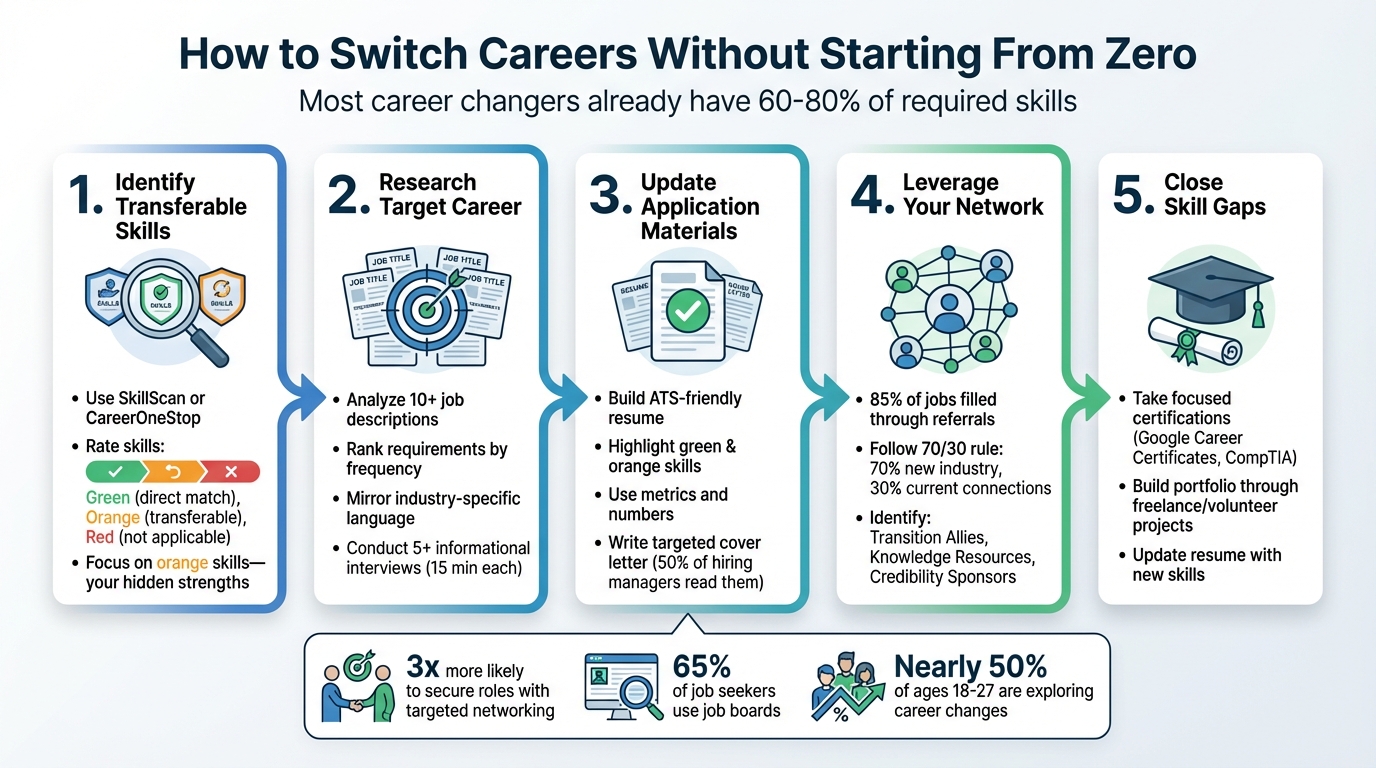
5-Step Career Switch Roadmap: From Skills Assessment to Job Application
How to identify a list of transferable skills in a career change | 4 easy steps
Find Your Transferable Skills
Transferable skills are the abilities you’ve developed over time that can be applied to new career paths. Think of them as the connection between your past roles and your future opportunities. The challenge isn’t about starting from scratch - it’s about showcasing your expertise in a way that resonates with hiring managers.
"The good news is that other industries may value your talents just as much, if not more, than your existing one. The challenges are understanding what those talents are and packaging them in a way that their value to others is apparent."
– Christopher Bowe, Author
Your skills generally fall into three categories: technical (such as software proficiency or project management), interpersonal (like communication and teamwork), and management (leadership and decision-making). These skills often carry over between industries, even if the specific job titles differ.
The trick is to identify which of your skills are directly relevant (green), transferable but requiring explanation (orange), or not applicable (red) to your desired role. Focus on the orange skills - they’re your hidden strengths. For example, if you’re moving from hospitality to IT support, your customer service experience directly applies to managing support tickets, as long as you explain the connection clearly. Start by assessing your skills in detail.
Run a Skills Assessment
Begin with a thorough review of your professional experience. List all your past jobs, volunteer work, and major projects, and break down your responsibilities into categories: technical skills (e.g., Adobe Creative Suite), soft skills (e.g., conflict resolution), and personal traits (e.g., adaptability). Don’t forget to include certifications and educational achievements - they’re part of your skillset too.
To make this process easier, tools like SkillScan and CareerOneStop can help you map your current abilities to the roles you’re aiming for. Once you’ve compiled your list, rate your proficiency for each skill as beginner, intermediate, or advanced. This exercise will help you identify your strengths and any gaps you may need to address. Use this inventory to pinpoint which skills are most valued in your target industry.
Match Your Skills to New Roles
Gather 10 job descriptions for the positions you’re targeting. Combine the requirements into a single document and rank them based on how often they appear. The most frequently mentioned skills are the ones you should prioritize.
Apply the green/orange/red system to these skills: highlight those that match directly, those that need additional context, and those that aren’t relevant. Then, tailor your resume to emphasize the green and orange skills.
Skills like communication, problem-solving, and leadership often apply across industries. For instance, if you’ve managed a team or coordinated projects, you can reframe those experiences with language from the job postings you’re targeting. Instead of saying "managed restaurant staff", you might write "led cross-functional team operations."
Unlike generic tools like resumegenius.com or topresume.com, Scale.jobs offers a free ATS-compliant resume builder that organizes your transferable skills in a way that hiring systems can easily process. For those needing more customization, Scale.jobs also provides human assistants who craft resumes tailored to your industry and highlight your transferable (orange) skills effectively. Additionally, their AI Assistant Pro (available for $9/month during the launch period) allows unlimited tailored resume creation for each job application, offering real-time feedback and transparency.
Why Scale.jobs Stands Out:
- Human-Powered Customization: Resumes crafted by trained professionals, not just automated templates.
- ATS-Optimized Formatting: Ensures your resume aligns with applicant tracking systems for better visibility.
- Flat-Fee Pricing: Avoid recurring subscriptions with a one-time payment model.
- Dedicated WhatsApp Support: Get real-time updates and proof-of-work screenshots, ensuring transparency throughout the process.
Research Your Target Career
To effectively align yourself with your desired role, it’s important to deeply understand what the job demands. Start by collecting at least 10 job descriptions for the position you’re targeting. You can find these on platforms like LinkedIn, Indeed, or Glassdoor. Once you have them, compile all the listed requirements into one document and rank them based on how often they appear. The most frequently mentioned skills and qualifications are likely the most critical for success in that role - these are the ones you’ll want to highlight in your resume and cover letter.
Pay close attention to the industry-specific language and terminology that appears repeatedly in these job descriptions. Mirroring this language in your application materials shows hiring managers that you’re familiar with the field and its expectations. However, don’t just focus on job titles - roles with the same name can vary greatly between companies. For instance, a "Data Analyst" at one company may require expertise in SQL and database management, while another might prioritize Python scripting and data visualization tools. Take time to examine the responsibilities and tools emphasized in each description. Additionally, researching the company's recent projects, goals, and values can help you tailor your materials to align with their specific needs.
Study Job Postings
Job postings are a goldmine for understanding what employers are looking for. By reviewing postings from a range of companies, you can identify which qualifications and skills are standard in the industry versus those that are unique to specific employers.
One effective strategy is to use a frequency analysis. Organize the listed requirements by how often they appear across the job descriptions you’ve collected. The skills that show up the most frequently are the essentials, while those mentioned less often are likely secondary or "nice-to-have" qualifications. You can apply a green/orange/red system to your professional inventory:
- Green: Skills you already have and can confidently showcase.
- Orange: Skills you possess but may need to reframe or contextualize.
- Red: Skills you lack and should avoid emphasizing in your application.
If you’re unsure how your current skills align with your target role, tools like LinkedIn Career Explorer can be incredibly useful. For example, if you’re transitioning from project coordination to program management, you’ll likely notice that stakeholder communication and timeline management are key requirements - skills you may already possess but need to present in a way that matches the job’s terminology.
Once you’ve gathered insights from job postings, it’s time to dig deeper by learning directly from professionals in the field.
Learn Through Networking
While job postings provide a snapshot of what employers want, networking can give you a behind-the-scenes look at why those skills matter and how they’re applied in real-world settings. Start by scheduling at least five 15-minute informational interviews with people currently working in your target field. Platforms like LinkedIn and professional associations can help you connect with the right individuals.
"A 15-minute conversation with someone in your target field can give you insights (and connections) you won't find in a job posting."
– Polina Tarabanovska, Career Transition Specialist, Resso.ai
Don’t limit yourself to online networking. Parent groups, local organizations, or even casual connections through hobbies can lead to meaningful conversations. When reaching out, be specific about your career transition, express genuine interest in their role or company, and politely request a brief chat to ask about their experiences.
Use these discussions to validate the research you’ve done from job postings and to learn the nuances of the industry. Ask thoughtful, targeted questions like, “What are the biggest challenges your team faces?” or “How do you maintain collaboration in a remote work environment?” These types of questions not only help you understand the role’s interpersonal dynamics but also give you concrete examples you can reference in interviews. Networking isn’t just about gathering information - it’s about building relationships that could lead to referrals or even uncover unadvertised job openings.
To keep everything organized, consider using job application tracking tools. For instance, Scale.jobs' Job Applications Tracker can help you manage your networking contacts alongside your job applications. This ensures you stay on top of follow-ups and never lose track of your progress.
Update Your Resume and Cover Letter
Once you've pinpointed your transferable skills, it's time to update your resume and cover letter to match the demands of your target role. These documents need to clearly show how your background addresses the challenges of the position you're aiming for. Most career changers already have 60% to 80% of the skills required for their new role, but these skills might be framed differently. Your task is to translate your experience into terms that resonate with your target industry.
"When it comes to transferable skills, you have to do the convincing, as you can't count on a recruiter or hiring manager making the connection." – Coursera
Start by revisiting the job descriptions you analyzed earlier. Look for key terms, action verbs, and metrics that appear repeatedly, and weave those into your resume and cover letter to show you understand what the role demands.
Build an ATS-Friendly Resume
Consider using a functional or skills-based resume format to emphasize your transferable abilities. This format shifts the focus from your job titles to your achievements, making it easier for recruiters to quickly grasp your value.
Use the resume summary section to deliver a concise pitch about your career switch and what you bring to the table. For instance, if you're transitioning from teaching to corporate training, highlight skills like curriculum design, stakeholder collaboration, and measurable results in learning outcomes. Address any gaps in your work history by mentioning recent certifications or training programs you've completed.
To refine your resume content, apply the green/orange/red filter to your skills:
- Green Skills: These are directly relevant to the new role and should be prominently featured.
- Orange Skills: These are transferable but may need reframing. For example, if you're moving from retail to IT support, position your customer service experience as "high-volume customer service in fast-paced environments."
- Red Skills: These have no relevance to the new role and should be removed.
Whenever possible, back up your accomplishments with hard numbers. For example, "Increased revenue by 20%", "Reduced data exposure by 78%", or "Managed a $150,000 budget." Metrics provide concrete proof of your capabilities, regardless of the industry. Use the most frequently mentioned requirements from your job description analysis as keywords to help your resume pass Applicant Tracking Systems (ATS).
If you're looking for an easy way to create an ATS-friendly resume, Scale.jobs' ATS Resume Builder offers templates that optimize your chances of passing automated systems while remaining reader-friendly. You can create up to two base resumes for free, or upgrade to the AI Assistant Pro plan for $9/month to customize resumes for every application.
Once your resume is polished and tailored, focus on crafting a compelling cover letter.
Write a Strong Cover Letter
Your cover letter serves as the bridge between your resume and the job you're targeting. About 50% of hiring managers read cover letters, so including one can significantly enhance your application. Use this opportunity to explain your career shift and connect your past achievements to the role's requirements.
"Think of it as a marketing document that you carefully craft to convince the reader - whether they're a recruiter, an HR representative, or a hiring manager - that you have what they need." – Amy Gallo, Contributing Editor, Harvard Business Review
Structure your cover letter to showcase your strengths, describe a challenge you've tackled, provide context, and highlight measurable outcomes. For example, if you're transitioning from finance to HR, you might explain how your expertise in financial operations has equipped you to streamline talent management and improve employee retention.
Be specific about how your skills transfer. Instead of saying, "I have strong communication skills", write something like, "In my previous role, I led cross-functional meetings with stakeholders from finance, operations, and IT to align project timelines, resulting in a 15% reduction in delivery delays." This approach demonstrates exactly how your abilities apply to the new role.
Whenever possible, address the letter to a specific person by name, and mention any personal connections to the company in the opening sentences. Keep the letter under one page, focusing on a few key points that make a strong case for your transition. If you're unsure how to craft a compelling narrative, Scale.jobs' Cover Letter Generator can provide tailored drafts that you can refine to match your voice and story.
With a resume and cover letter that reflect your skills and career goals, you'll be well-prepared to tap into your network and the right job search tools.
Use Your Network and Job Search Tools
While a polished resume and cover letter are essential, statistics show that 85% of jobs are filled through referrals. This highlights the critical role your network and the job search tools you choose play in your career transition. By combining focused networking with the right platforms, you can uncover hidden opportunities and simplify your job application process.
Grow Your Professional Network
Start by categorizing your current connections into three groups: Transition Allies (people who've navigated similar career changes), Knowledge Resources (those with insights into your target industry), and Credibility Sponsors (individuals who can endorse your transferable skills). Before reaching out to new contacts, reconnect with "dormant ties" like former colleagues, mentors, or friends who might have valuable connections.
Identify the "connectors" in your network - those who are skilled at introducing people and sharing ideas. These individuals can open doors to numerous opportunities in your desired field. Follow the 70/30 rule: dedicate 70% of your networking efforts to building connections in your target industry and 30% to maintaining your current relationships.
"The fastest way to build credibility in a new field is to add value to existing conversations. Before promoting yourself, focus on making others in the industry successful through your contributions." – Leila Washington, Career Transition Expert
Engage with industry-specific groups, whether through local Chambers of Commerce, professional associations, or online forums. These spaces often reveal opportunities not advertised publicly. Conduct informational interviews using "W" questions (Who, What, Why, Where, When) to demonstrate curiosity and gain industry insights. Frame yourself as someone bringing fresh ideas to the table. Studies show that individuals who use targeted networking strategies are three times more likely to secure roles in new industries compared to those who rely only on traditional applications.
Once your network is activated, amplify your efforts with the right job search tools.
Pick the Right Job Search Tools
A strong network is powerful, but pairing it with effective tools can make your job search even smoother. Choose platforms that not only list job openings but also help you apply efficiently. Research shows that 65% of U.S. job seekers rely on job boards as their primary resource, while 45% visit specific company sites to find roles.
LazyApply vs. Scale.jobs
LazyApply automates job applications but often submits generic materials that fail to showcase your unique strengths. On the other hand, Scale.jobs offers a personalized, human-led approach to ensure your applications stand out. Here’s what sets Scale.jobs apart:
- Human-powered applications: Trained virtual assistants manually complete each application, ensuring every submission is tailored to the role.
- Custom resumes and cover letters: Each application highlights your transferable skills with documents specifically crafted for the job.
- Proof-of-work transparency: Receive time-stamped screenshots and real-time updates via WhatsApp, so you know exactly when and where applications are submitted.
- Fair pricing with refunds: Flat-fee packages start at $199 for 250 applications, and unused credits are refunded.
- Broad platform compatibility: Scale.jobs handles applications across major ATS systems and niche job boards.
If you’re already using tools like Jobscan or Hiration to refine your resume, you can integrate those insights with Scale.jobs' ATS Resume Builder. For just $9/month, the AI Assistant Pro plan allows you to create unlimited base resumes. Additionally, the platform’s Job Applications Tracker helps you stay organized and even automates follow-ups.
For specific career paths, explore platforms like Escape The City for mission-driven roles, Pivot Planet for personalized coaching, or Idealist for nonprofit opportunities. On LinkedIn, use search operators and keywords in quotation marks (e.g., "marketing specialist") to refine your search, and set up job alerts on multiple platforms to stay updated on new postings. With your network and tools working together, you’ll have more time to focus on networking and interview preparation while your applications are handled professionally.
Close Skill Gaps
Even with a strong set of transferable skills and a solid network, there might still be a few key abilities standing between you and your dream job. The goal is to address these gaps efficiently without starting from scratch. Once you've pinpointed the areas that need improvement, the next step is to pursue targeted learning opportunities.
Identify Missing Skills
Start by gathering 10 job descriptions from platforms like LinkedIn, Indeed, and company career pages. Analyze these postings and rank the required skills based on how often they appear. Skills that are consistently mentioned across all 10 listings should be your top priority - these are the essentials employers expect you to bring to the table from day one.
Next, create a professional inventory that lists your technical skills, soft skills, personal traits, and educational background. Use a color-coded system to compare your inventory against the job requirements:
- Green for skills you already possess (these should be highlighted on your resume).
- Orange for transferable skills that need reframing (e.g., translating customer service experience from a waitstaff role to IT support).
- Red for skills that are less relevant and can be deprioritized.
This visual analysis will help you clearly see where to focus your learning efforts. To ensure your analysis is accurate, consider conducting brief informational interviews with professionals in your target field. These conversations can uncover additional skills that might not be listed in job descriptions but can make you stand out during the hiring process.
Take Focused Training
Concentrate your efforts on the skills most in demand. Choose training options that quickly boost your credibility. For instance, Google Career Certificates offer practical training in areas like Data Analytics, IT Support, Cybersecurity, Project Management, UX Design, and Digital Marketing. These programs are available through platforms like Coursera. If you're transitioning into IT, certifications like those from CompTIA can provide the foundational knowledge employers value.
Take inspiration from Steve Manhertz, who shifted from a career as a bus driver and operations supervisor to IT in 2019. He earned the CompTIA IT Fundamentals (ITF+) certification in January and landed a part-time junior network technician role within just 60 days. By June, he had completed the CompTIA A+ certification and secured a full-time position as an IT specialist for Lee County Government.
"Certification is so very important. A foundational tech certification, such as CompTIA A+, can help you gain the skills you need to get your foot in the door." – Steve Manhertz, IT Specialist, Lee County Government
Beyond formal certifications, hands-on experience is invaluable. Work on freelance projects, volunteer initiatives, or side projects to build a portfolio showcasing your new skills. Platforms like LinkedIn Learning, Udemy, and YouTube offer courses to help you quickly improve. If you're juggling learning with a current job, set specific weekly goals, such as completing one course module or finishing a portfolio project, to stay on track.
Once you've acquired new certifications and skills, update your resume to reflect your growth. Tools like Scale.jobs' ATS Resume Builder make it easy to create tailored resumes that highlight your latest training and transferable experience. Their AI Assistant Pro plan, available for $9/month as a launch offer, allows you to craft unlimited resumes that align with your evolving expertise.
Conclusion
Switching careers isn’t about starting over; it’s about reimagining your current skills in a new context. Many of the abilities you’ve developed are already relevant - the challenge lies in presenting them in a way that aligns with your target industry. By assessing your skills, organizing them effectively, and tailoring your experience to fit the language of your desired field, you’re setting the stage for a smooth transition.
Through steps like skills assessments, updating your resume and cover letter, and building a strategic network, you can leverage your existing strengths to move forward. Key strategies include identifying transferable skills, crafting application materials that reflect your new direction, connecting with the right people, and addressing any skill gaps with focused learning. Taking small, consistent actions - such as applying to two well-researched roles each week or scheduling informational interviews - can help you stay on track.
Interestingly, surveys reveal that over one-third of workers consider changing careers within six months, and nearly 50% of those aged 18 to 27 are exploring similar shifts. You’re not alone in this process, and tools like Scale.jobs' ATS Resume Builder, professional certifications, and networking platforms can make your transition more manageable and efficient.
Your previous experience isn’t something to leave behind - it’s a resource full of transferable value that can make you stand out in your new career path. By applying these strategies, you can confidently reposition your expertise and thrive in your next chapter.
FAQs
How can I figure out which of my skills are useful for a career change?
To start, take a close look at your current skills and experiences to pinpoint those that can be useful in the field you're aiming to enter. Focus on transferable skills - such as communication, problem-solving, or project management - that are valuable in a variety of industries. Think about your past achievements and how they align with the demands of the new role you're pursuing.
Once you've identified these strengths, update your resume and cover letter to highlight them. Make sure to clearly explain how these skills can contribute to your success in the new career path. It’s also a good idea to connect with professionals in your target industry through networking or informational interviews. Their insights can help confirm which skills are most relevant and guide you in fine-tuning your approach. Armed with this knowledge, you’ll be well-prepared to make a strong case for yourself during the transition.
What are the best ways to network effectively during a career change?
Switching careers can feel like stepping into uncharted territory, but networking can make the journey smoother by helping you build connections and tap into valuable insights. Start by reaching out to people you already know - friends, family, former colleagues, or mentors. They might have advice, industry knowledge, or even connections in the field you're aiming to enter. Platforms like LinkedIn can be a powerful tool here. Make sure your profile is polished, follow companies in your new industry, and engage with posts or discussions to boost your visibility.
Attending events is another effective way to expand your network. Whether it's a professional meetup, an industry conference, or a webinar, these gatherings provide opportunities to meet people who share your interests and can point you toward potential opportunities. Joining professional associations or volunteering in roles related to your new field can also introduce you to key players and like-minded individuals. If you’re looking for deeper insights, consider scheduling informational interviews with professionals already established in your target industry. These conversations can provide insider knowledge and advice that can guide your transition.
The key to successful networking lies in authenticity and persistence. Focus on cultivating genuine relationships rather than transactional ones, and make an effort to stay connected over time. Consistency in your approach can open doors and create opportunities that align with your career goals.
How can I overcome skill gaps when switching careers?
You can tackle skill gaps by leveraging your current strengths and intentionally gaining new abilities. Begin by pinpointing your transferable skills - those talents from previous roles that align with the career path you're aiming for. Make sure to emphasize these in your resume and cover letter to showcase your potential value to employers.
For specific skill gaps, explore options like short courses, certifications, or hands-on training that are directly relevant to your target field. Additionally, reframe your past experiences to highlight versatile qualities such as problem-solving, leadership, or effective communication. Building a strong network is equally important - reach out to professionals in your desired industry to gain valuable insights and discover potential opportunities. By combining a proactive approach to learning with the strengths you already possess, you can navigate a career shift without starting entirely from scratch.