How to Get a Job Even If You Feel Underqualified
Highlight transferable skills, close gaps with courses and projects, craft ATS-friendly resumes, and use networking to land jobs you feel underqualified for.


- Focus on transferable skills: Highlight experiences from past roles, volunteer work, or personal projects that align with the job’s needs.
- Close skill gaps: Take online courses, earn certifications, or showcase small projects to demonstrate your ability to learn quickly.
- Tailor your application: Use an ATS-friendly resume and a targeted cover letter to emphasize your strengths and address the company’s challenges.
- Leverage networking: Build connections on LinkedIn, ask for referrals, and engage with professionals in your desired field.
- Prepare for interviews: Use specific examples to showcase your problem-solving skills and ability to adapt to new challenges.
Services like Scale.jobs can simplify the process with tailored applications, ATS-optimized resumes, and personalized support, ensuring you stand out in today’s competitive market. Don’t let self-doubt hold you back - apply for jobs that challenge you, and focus on the value you bring to the table.
Job Application Success Statistics for Underqualified Candidates
Unqualified for the Job? How to Get Hired Anyway
If the process feels overwhelming, consider how a virtual job search assistant can help you manage the workload.
Evaluate Your Skills and Close the Gap
Take a moment to assess your real strengths before assuming you're unqualified. Job descriptions often hint at what employers truly need through action verbs like "improve", "develop", or "build." These words point to underlying challenges the company wants to address. Your job is to connect the dots between your past experiences - even from unrelated fields - and these needs. This approach helps you identify clear steps to address any gaps in your qualifications.
Find Transferable Skills from Your Background
Your background might be more relevant than you think. Focus on identifying "transferable skills" - those unique abilities or perspectives you bring to the table. For example, if you've managed a retail team but are applying for a marketing role, you've already worked with customer behavior, conflict resolution, and performance metrics. These are not just extras; they directly address issues marketing teams face every day.
Career counselor Lily Zhang advises:
Instead of drawing attention to your weaknesses, a better way to move on to your qualifications is to state your skills and ability to contribute directly.
Think broadly about your past roles, including volunteer work or personal projects. Look for universal skills like project management, communication, decision-making, and time management. If you're aiming for remote work, highlight experiences where you worked independently or handled uncertainty without close supervision. These qualities often matter more than formal titles or specific coursework.
Identify and Fill Skill Gaps
After identifying your transferable skills, be honest about areas where you're less experienced. Look at job postings for any technical skills or certifications you may lack. Then take action: enroll in an online course through platforms like Coursera or LinkedIn Learning, earn a certification, or create a small project that demonstrates your ability to perform the role.
Career expert Sara McCord offers this perspective:
If you're slightly under-qualified, there's a reason why. If you spent the first two years of your career in a different sector, you bring experience from that industry.
Show employers you're proactive about self-improvement. Add recent certifications or completed courses to your resume, along with their completion dates. If you've quickly learned a new tool or skill to complete a project, include that as well. Employers value your ability to adapt and learn quickly, often more than the skills you initially lack.
Position Yourself as a Fast Learner
Employers aren't expecting perfection - they're looking for potential. Being a fast learner is a critical skill, especially as industries evolve with AI tools and other technologies. Research shows that skills-based hiring is gaining traction, making adaptability more important than ever.
Use specific examples to show how you've adapted or exceeded expectations in the past. Highlight moments where you solved problems independently or took on new challenges outside your comfort zone. These examples demonstrate you're a self-starter who can learn on the fly.
As career experts at Hays explain:
Adopting a learning mindset, where you want to continuously upskill, is another soft skill that employers find attractive.
Consider adding a "Skills Highlights" section near the top of your resume. Include both technical skills and soft skills like adaptability, problem-solving, and initiative. Show you're ready to contribute immediately, backed by evidence of past growth and learning. This shifts the focus from what you lack to what you bring to the table.
Create an Application That Gets Noticed
Your application should go beyond listing your experience - it needs to tell a story about why you're the right fit, even if your background isn't a perfect match. The key is to shift the hiring manager's attention from what you might lack to the strengths and value you bring. This requires crafting materials that not only pass automated screening systems but also resonate with the people making the final hiring decisions.
Build an ATS-Friendly Resume
Many companies rely on Applicant Tracking Systems (ATS) to screen resumes before they even reach a hiring manager. These systems look for specific keywords pulled directly from the job description, so it's crucial to tailor your resume to match that language.
Focus on highlighting transferable skills and quantifiable achievements. For instance, rather than saying, "Managed a team", you could write, "Led a team that improved customer satisfaction by 23%." Concrete data and results make a stronger impression than vague descriptions.
To find the right keywords, research LinkedIn profiles of professionals in similar roles. Add a "Skills Highlights" section to your resume, aligning it with the job posting's requirements. This makes it easier for both ATS systems and hiring managers to quickly identify your qualifications. Platforms like Scale.jobs can help you create ATS-compliant resumes tailored to each application, ensuring they pass automated filters while remaining appealing to human reviewers.
Once your resume is optimized, turn your attention to crafting a compelling cover letter.
Write a Targeted Cover Letter
Your cover letter is your opportunity to explain your career journey and show how your unique experiences make you an asset to the role. Instead of focusing on any gaps, emphasize how your background brings fresh perspectives and skills.
Use the CAR method (Context, Action, Result) to succinctly describe your achievements. For example: "Our team faced declining engagement (Context), so I redesigned the outreach strategy based on customer data (Action), leading to a 34% increase in response rates within three months (Result)."
Show that you understand the company's challenges and how you can address them. Career strategist Raghav Haran puts it this way:
The truth is, when the hiring manager has a million resumes to go through, the way to stand out is not by writing a better resume. It's by going beyond the resume and proving that you can solve their actual problems.
Want to go the extra mile? Include a "pre-interview project" like a usability test, design proposal, or partnership pitch that aligns with the company's goals. Demonstrating genuine enthusiasm for their mission and values can make a lasting impression. Add direct links to your portfolio, LinkedIn profile, or personal website to make it easy for hiring managers to explore your work. When you're applying as an underqualified candidate, every detail matters - proofread carefully to ensure a flawless presentation.
For a more tailored and professional application process, consider a service that combines human expertise with ATS optimization.
Use Scale.jobs for Human-Powered Applications
While automated tools can speed up the application process, they often lack the personal touch that makes applications stand out. Scale.jobs takes a different approach by using trained human virtual assistants to handle each application individually. This ensures your application bypasses bot-flags and reaches the hiring manager's desk.
Here’s why Scale.jobs outperforms automated competitors like LazyApply or Simplify:
- Custom resumes and cover letters for every job posting. Human assistants tailor your materials to match each company's specific needs and values. They frame your background in a way that aligns with the role, ensuring both ATS compatibility and a strong emotional appeal.
- Seamless compatibility across all platforms. Unlike automated tools that may struggle with niche job boards or company-specific portals, human assistants can navigate any system, completing forms and answering screening questions accurately.
- Transparent and verifiable process. You’ll receive live updates via WhatsApp, time-stamped screenshots of submitted applications, and a dashboard to track progress. This level of accountability is unmatched by fully automated services.
- Flat-fee pricing with refunds for unused credits. Scale.jobs offers one-time campaign bundles starting at $199 for 250 applications. If you land a job before using all your credits, you’ll get a refund - a feature competitors like LoopCV or Sonara don’t provide.
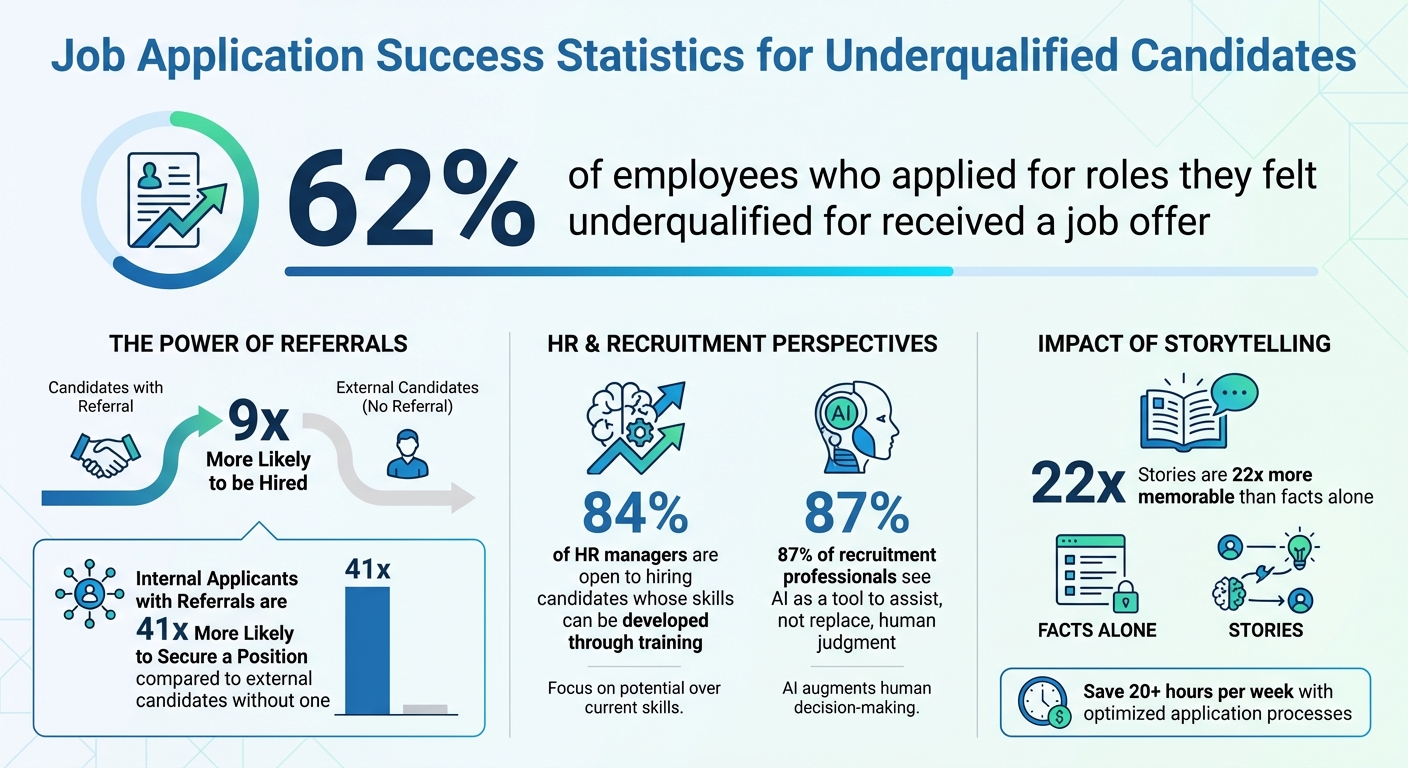
- Real human support. When you have questions or need to adjust your strategy, you’ll communicate directly with the same assistants managing your applications. Their experience and intuition bring a level of understanding that AI tools simply can’t replicate. Research shows that 87% of recruitment professionals see AI as a tool to assist, not replace, human judgment - and that’s exactly what Scale.jobs delivers.
Additionally, Scale.jobs includes free tools like an ATS resume checker, cover letter generator, application tracker, salary predictor, and interview question predictor. With everything in one place, you won’t need to juggle multiple subscriptions. This approach saves you over 20 hours a week, giving you more time to focus on networking and interview preparation - the activities that truly make a difference in landing a job.
Use Networking and Referrals to Your Advantage
Once your resume and cover letter are polished, it’s time to lean on your network to boost your chances. When you feel like you may not check every box on a job description, your network can often fill in the gaps. Networking isn’t just about making contacts - it’s about fostering genuine relationships that can advocate for your potential. Statistics back this up: candidates with a referral are nine times more likely to be hired, and internal applicants with referrals are 41 times more likely to secure a position compared to external candidates without one.
To make the most of networking, focus on three key groups: personal connections who can directly refer you, employees in your target department who can provide insights, and recruiters or hiring managers you can follow up with after applying. Approach each interaction with authenticity, ensuring it feels like a two-way conversation rather than a transaction. As recruiter Kyle Minton advises:
Do not just apply and hope to get a callback. I promise you are being buried. We are living in a new age.
With this in mind, let’s explore some focused networking strategies.
Reach Out to Industry Professionals on LinkedIn
Your LinkedIn profile is your digital handshake - make sure it’s working for you. Optimize your LinkedIn profile and update your headline to clearly reflect your expertise. For instance, instead of a generic title like "Sales Professional", use something more specific like "Enterprise Sales Account Executive Specializing in Marketing Automation." This not only makes you stand out but also increases your visibility in recruiter searches.
When reaching out to professionals, craft personalized messages. For example, if you’re contacting someone in a department you’re targeting, you might say: "I recently applied to a [job title] role at [company]. I’d love to learn more about your experience with the organization and any advice you might have." Following companies you’re interested in can also put you on recruiters’ radar, as it shows initiative and enthusiasm.
Dedicate just 15 minutes a week to engaging with posts and updates on LinkedIn. This keeps your profile active and visible to recruiters.
Ask for Referrals and Recommendations
When requesting referrals, frame it as a mutually beneficial opportunity. Many companies offer referral bonuses to employees, so mentioning this can make your request feel like a win-win. Be specific - highlight your accomplishments and explain why you’d be a good match for the role.
Ask for LinkedIn recommendations from past supervisors or colleagues that emphasize your ability to adapt and learn quickly. These endorsements serve as social proof of your skills and can help address any perceived experience gaps. A study by Robert Half found that 84% of HR managers are open to hiring candidates whose skills can be developed through training - recommendations that highlight your growth potential tap into this mindset effectively.
Even if a particular role doesn’t work out, maintain those connections. Send LinkedIn requests to interviewers and ask recruiters if you can stay in touch. This keeps you on their radar for future opportunities.
Build Your Professional Presence Online
In addition to leveraging referrals, a strong online presence can further validate your qualifications. Your LinkedIn profile should act as a dynamic showcase of your professional achievements. Use a professional headshot, customize your LinkedIn URL, and write an "About" section that highlights your top five skills relevant to your target roles. Include industry-specific keywords to ensure you show up in recruiter searches. Career expert Jaclyn Westlake from The Muse underscores the importance of this:
If you aren't on LinkedIn you don't exist.
Beyond LinkedIn, consider creating a simple personal portfolio or website. This can feature work samples, project proposals, or case studies that demonstrate your abilities, especially in areas where you lack formal experience. Your online presence should consistently support your professional brand.
Finally, use the #OpenToWork banner on LinkedIn to signal your availability. Many recruiters prioritize candidates who are actively seeking roles, so don’t hesitate to make your job search visible.
Perform Well in Interviews and Show Your Potential
Interviews are your chance to steer the conversation away from any gaps in your experience and shine a spotlight on your strengths. Avoid phrases like "Although I don't have..." or "While I've never..." - these only highlight what you lack. Instead, focus on what you can bring to the table and how your background equips you to excel in the role.
Research the Company and Position
Walking into an interview without thorough research is a missed opportunity. To stand out, you need to dig deeper than the company's website. Interview coach Frank Burgoyne stresses this point:
Right now there's an expectation that you have done extensive research... And that goes beyond the company website.
Seek out sales presentations on YouTube, browse recent news articles, and review LinkedIn posts from company leadership. Pay close attention to the job description, especially terms like "improve", "develop", "increase", or "build." These keywords often signal the challenges the company needs help solving. When you can address these issues directly and showcase how your skills solve them, you shift the focus away from credentials you may lack.
This level of preparation also lays the groundwork for demonstrating your ability to adapt and learn quickly.
Show Your Ability to Learn Quickly
Prove you’re a fast learner by sharing specific, structured examples using the STAR Method: describe the Situation, explain the Task, detail the Action you took, and share the Result. For instance, you might say: "I self-taught Salesforce in three weeks to support a product launch, reducing manual data entry by 25%."
Stories make a lasting impression - research shows they’re 22 times more memorable than facts alone. Prepare a "story spreadsheet" of your accomplishments using the STAR framework before your interview. Highlight examples where you mastered new technologies or processes under tight deadlines. If you’re switching industries, emphasize "additive skills" - unique insights or approaches you bring that others might not.
Address Skill Gaps with Confidence
When skill gaps come up, tackle them head-on with confidence. Frame gaps as areas of growth and share how you’re already addressing them. For example: "I haven’t used Python extensively in a professional setting, but I’ve been completing daily coding challenges on LeetCode for the past two months and built a data visualization project, which is on my GitHub."
Career expert Sara McCord highlights how a nontraditional background can be an asset:
If you're slightly under-qualified, there's a reason why... If you spent the first two years of your career in a different sector, you bring experience from that industry.
Keep the tone positive and redirect the discussion toward how your unique qualifications benefit the company. If you’re overqualified, position yourself as a "player-coach" - someone who can contribute individually while mentoring others. The goal is to make the interviewer see the value you bring, even if your resume isn’t a perfect match.
Conclusion
Feeling underqualified doesn’t have to hold you back. By following the steps outlined here - such as identifying transferable skills, customizing your applications, building meaningful connections, and preparing thoroughly for interviews - you can create a clear path toward your goals. In fact, 62% of employees who applied for roles they felt underqualified for ended up receiving a job offer.
Start taking action today. Update your resume to showcase your transferable skills, connect with someone in your desired field on LinkedIn, or explore Scale.jobs for ATS-optimized application support and one-time payment options that simplify the process. These tools and strategies can make a real difference in your job search.
Don’t wait for perfection. Apply for roles that challenge you, address any gaps with confidence, and highlight your ability to learn and grow. As Steve Knox, Global Head of Talent Acquisition at Dayforce, advises:
Show that you're taking initiative... Nine times out of 10, the manager will be curious enough to click on your LinkedIn profile.
Your next opportunity is closer than you think. Success isn’t about checking every box - it’s about making the first move.
FAQs
How can I recognize and showcase my transferable skills when applying for jobs?
To showcase your transferable skills effectively, start by reflecting on your previous experiences - whether from jobs, volunteer work, or personal projects. Look for abilities that can be applied across different roles, such as communication, problem-solving, teamwork, leadership, and adaptability. Pinpoint specific instances where you successfully used these skills to achieve meaningful outcomes.
When working on your resume or cover letter, shift the focus from listing responsibilities to emphasizing accomplishments. For example, instead of saying, "Handled team projects", try something like, "Led a team project that surpassed its objectives" or "Resolved customer issues, boosting satisfaction rates." This approach highlights your capabilities and potential, even if your background doesn’t perfectly align with the job description.
During interviews, be prepared to connect your transferable skills to the company’s goals. Discuss how these strengths can address their needs and add value to their team. By focusing on what you bring to the table, you can present yourself as a strong candidate, even if you don’t check every box on their requirements list.
What are the best ways to address skill gaps when applying for jobs?
To tackle skill gaps effectively, focus on leveraging transferable skills, customizing your application, and demonstrating your potential. Highlight experiences that showcase flexibility and a commitment to learning, even if they come from unrelated fields. This approach reassures employers that you can quickly adapt and make meaningful contributions, even if you don’t meet every listed requirement.
Create a well-crafted resume and cover letter that emphasize your strengths, soft skills, and ability to grow, rather than just ticking off qualifications. Tailoring these documents to each specific role can help your application stand out. When it comes to interviews, display enthusiasm, a proactive mindset, and a clear connection between your skills and the company’s objectives. These steps can help you bridge any perceived gaps and present yourself as a capable and motivated candidate.
How does networking help me get hired, even if I feel underqualified?
Networking can open doors to job opportunities, even if you feel you're not fully qualified. Building connections with professionals can lead to referrals, mentorship, and valuable job leads. In fact, many job offers stem from personal relationships, highlighting how essential networking is in the hiring process.
Engaging in industry events, refining your LinkedIn profile, and forming sincere connections can help you tap into opportunities that aren't always advertised. Beyond increasing your visibility, networking allows you to demonstrate your potential directly to hiring managers, bridging skill gaps and paving the way for career growth.