
How Recruiters Decide to Shortlist a Resume in 10 Seconds
Learn what recruiters scan in the first 10 seconds—job titles, companies, dates and metrics. Optimize titles, format, and keywords to pass ATS.

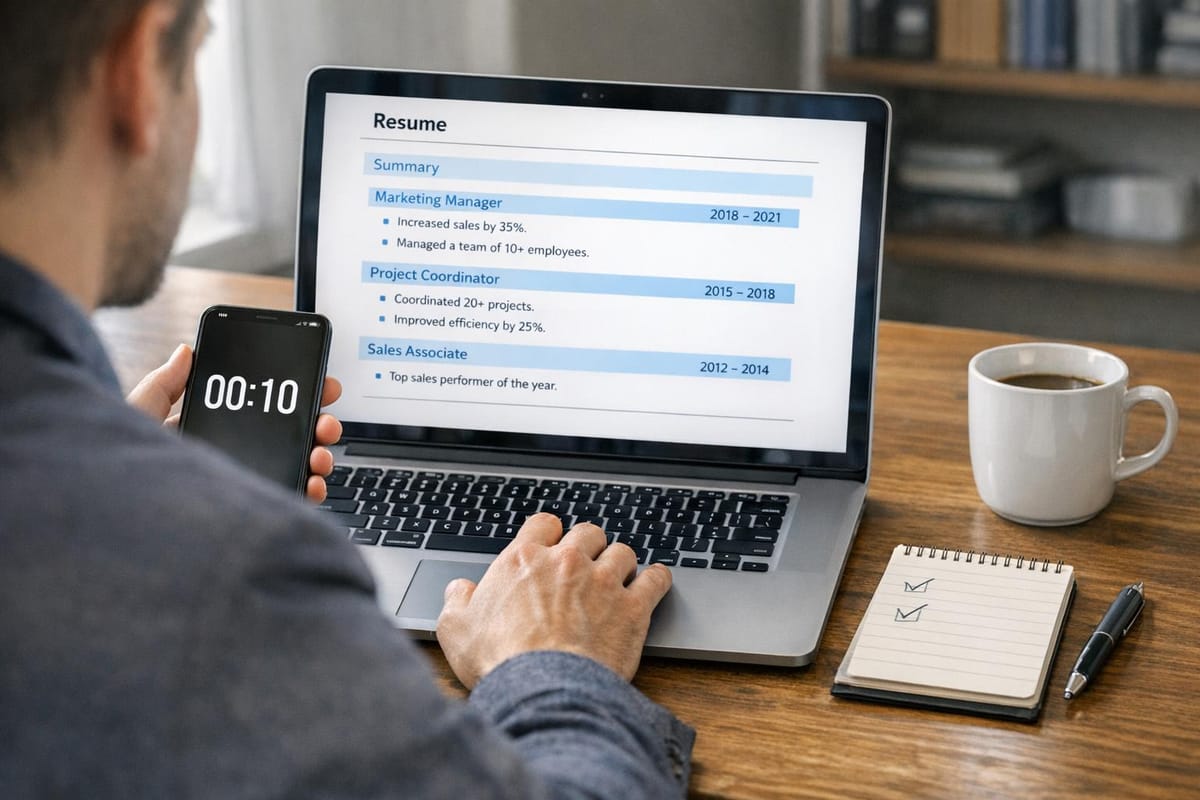
- Focus Areas: Name, current job title and company, previous job title and company, and employment dates. These account for 80% of their attention.
- Job Title Alignment: Use clear, industry-standard titles. Add clarifications if needed to match the role.
- Quantify Achievements: Showcase measurable results (e.g., "Increased sales by 20% in 6 months") to stand out.
- Clean Layout: Use single-column formats, bold headers, and white space to improve readability.
- Tailor for ATS: Match keywords from the job description, avoid graphics, and save resumes as
.docx.
A well-structured resume improves your chances of moving forward, but managing multiple applications can be time-consuming, but you can transform your job search. Services like scale.jobs handle resume optimization and applications, saving time and increasing efficiency.
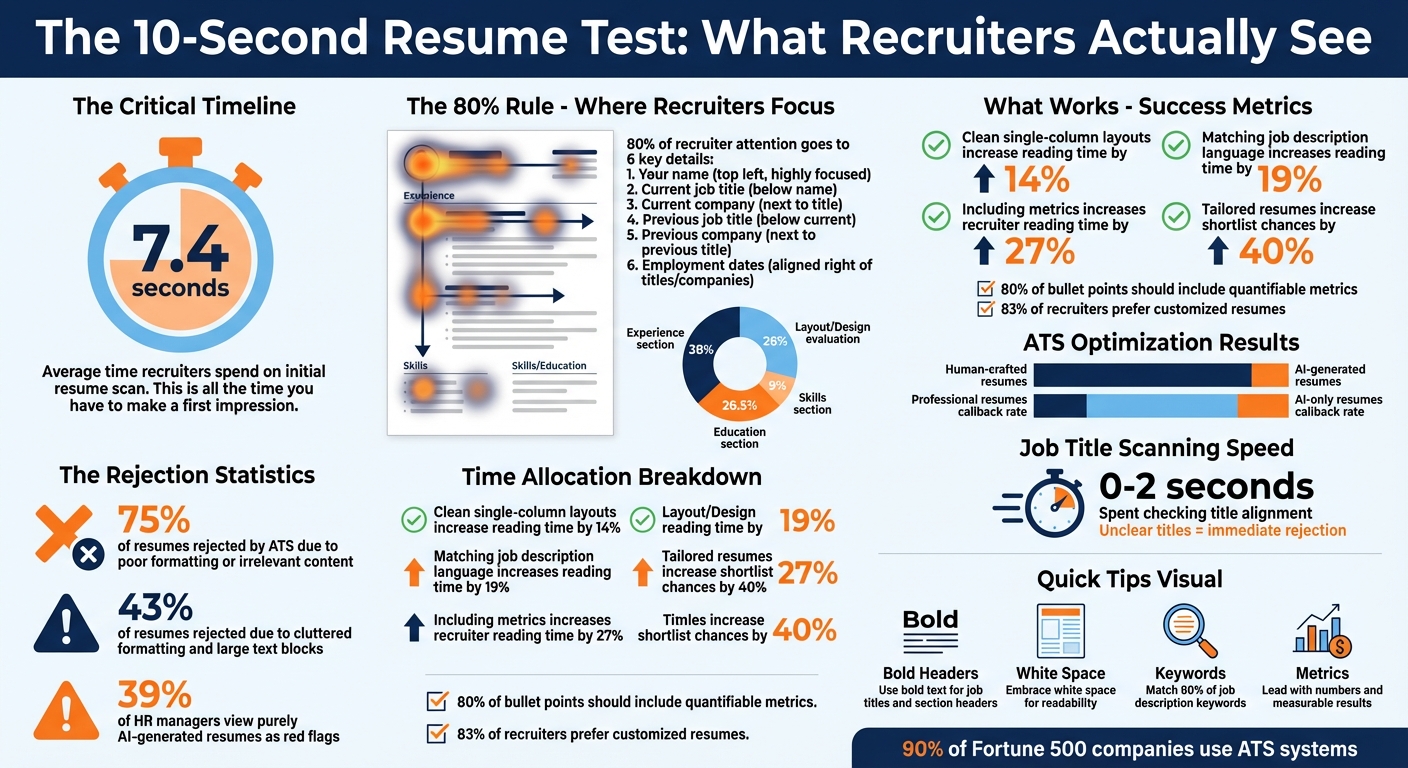
How Recruiters Scan Resumes in 10 Seconds: Key Statistics and Focus Areas
How Recruiters Actually Shortlist Resumes | ATS, AI Screening & Resume Tips | @SCALER
What Recruiters Look for in the First 10 Seconds
When recruiters review resumes, they don’t read every word - they scan. Eye-tracking studies reveal an F-shaped pattern: recruiters first glance horizontally across the top, then vertically down the left-hand side, focusing on job titles and section headers. This means that some parts of your resume naturally grab more attention than others.
During this quick scan, 80% of a recruiter's focus lands on six key details: your name, current job title and company, previous job title and company, and employment dates. Only after these elements pass the relevance test will they examine sections like skills, education, or your summary. Structuring your resume with this in mind, or using an AI resume builder to optimize layout, can make all the difference. The top-left corner of the first page is prime real estate, while the bottom-right and subsequent pages are often overlooked in the initial review.
Here’s a closer look at the resume elements that matter most in those critical first seconds.
Job Title and Role Match
Your current or most recent job title is often the first filter for relevance. Recruiters typically have a mental (or written) list of acceptable titles for the role they’re hiring. For instance, when hiring for a Principal, they might search for titles like "Head of School", "Dean", or "Assistant Principal."
Titles that are overly creative - like "Operations Ninja" or "Marketing Guru" - can confuse recruiters. Since they spend only 0 to 2 seconds checking title alignment, unclear titles can cost you the opportunity. If your official title doesn’t align with industry norms, consider adding a clarifying subtitle in parentheses to make your role clear.
Relevant Skills and Keywords
Specific hard skills, such as SQL, PMP certification, or financial modeling, act as magnets for recruiters. These keywords not only help your resume pass Applicant Tracking Systems (ATS) but also catch the recruiter’s eye during their quick scan.
However, it’s not just about listing keywords - it’s about showing how you’ve applied them. For example, instead of simply stating "SQL", write something like: "Used SQL to analyze customer behavior data, identifying trends that boosted retention by 18%." This demonstrates real-world application, which recruiters value far more than a simple mention.
"Recruiters become 'master keyword scanners,' zeroing in on exactly the elements of your resume that prove whether or not you should be moving along." – Simon Taylor, Former Recruiter, Disney
Avoid keyword stuffing, where you cram terms into your resume without context. This approach leads to cluttered formatting and results in rejection in 43% of cases. Instead, integrate 2–3 core qualifications naturally into your professional summary and accomplishments.
Resume Format and Visual Clarity
A clean, easy-to-read format can act as a time-extension trigger, encouraging recruiters to spend more than 7 seconds on your resume. Simple, single-column layouts are proven to increase reading time by 14% compared to complicated or overly decorative designs.
On the flip side, dense text blocks and inconsistent formatting are common reasons for immediate rejection. Recruiters often use "decision triage" to eliminate candidates quickly, and cluttered resumes make it harder for them to find the information they need.
To improve readability:
- Use bold text for job titles and section headers to guide the recruiter’s eye.
- Keep bullet points concise - ideally 1 to 2 lines each.
- Embrace white space to make your resume feel less crowded and easier to skim.
Recent Experience and Measurable Results
The Experience section gets the most attention, with 38% of a recruiter’s gaze time focused here - especially on your most recent role. They’re not just looking for a list of duties; they want measurable results that show your impact.
Lead with your strongest, metric-driven achievements. For example, instead of saying, "Managed social media accounts," say, "Increased Instagram following from 12,000 to 47,000 in six months, driving 230 qualified leads." This approach immediately demonstrates value and sets you apart from other candidates. Experts suggest that 80% of your bullet points should include quantifiable metrics, like percentages, dollar amounts, or time saved.
Resume Mistakes That Lead to Immediate Rejection
Even the most impressive qualifications can’t save a resume riddled with common mistakes. Recruiters often decide within 7.4 seconds whether to keep reading or move on. Knowing what to avoid is just as important as crafting a strong resume. Below, we’ll explore how generic content, errors, and design missteps can derail your chances before you even get started.
Generic or Off-Target Content
A one-size-fits-all resume is a fast track to rejection. Employers expect resumes that are tailored to the specific role, yet 75% of resumes fail to make it past applicant tracking systems (ATS) due to irrelevant or generic content.
Generic objective statements are a prime offender. These vague introductions fail to showcase your value or align with the role’s requirements. Instead of impressing recruiters, they signal a lack of effort and understanding.
"When you spam out the same generic resume and it doesn't match the job you're going for, it gets ignored." – Jonathan Javier, CEO/Founder, Wonsulting
To stand out, customize your resume by incorporating the job title and weaving in 2–3 key qualifications from the job description. This targeted approach can boost your chances of being shortlisted by 40%. Tailoring your content isn’t just a nice touch - it’s a necessity.
Typos, Grammar Errors, and Format Problems
Nothing screams "lack of attention to detail" like typos or inconsistent formatting. These errors can instantly sour a recruiter’s impression. A single misspelled word or formatting mishap can signal carelessness, a quality no employer wants in a candidate.
Formatting issues, such as inconsistent fonts, misaligned dates, or uneven bullet points, also make it harder for recruiters to scan your resume efficiently. Studies show that 43% of resumes are rejected due to poor readability caused by formatting errors or large text blocks. If recruiters can’t quickly find key details like job titles or dates, they’ll move on to the next application.
"Ensure there are no typos or formatting inconsistencies. These signal low effort and may cause the recruiter to abandon the document quickly." – InterviewPal
To avoid these pitfalls, stick to consistent formatting: bold job titles, left-align section headers, and proofread your resume multiple times. Small tweaks like these can make a big difference during the recruiter’s 10-second scan.
Distracting or Cluttered Design
Overcomplicated designs are another common resume killer. Fancy templates, unusual fonts, or multi-column layouts can disrupt the natural reading flow. Recruiters typically use an F-pattern scan - starting at the top left and moving downward - so a cluttered design buries essential information.
Dense text blocks without white space are equally problematic. When faced with a wall of text, recruiters are likely to skip over your resume entirely. On the flip side, clean single-column layouts with plenty of white space can increase reading time by 14%.
To create a recruiter-friendly design, opt for a simple, professional template. Use bold text sparingly to emphasize section headers and job titles, and avoid unnecessary colors or graphics. Since recruiters spend about 9% of their time evaluating layout and design, a clean, readable format ensures your qualifications take center stage.
How to Make Your Resume Pass the 10-Second Test
Now that you know what can sink a resume in seconds, let’s focus on how to make yours stand out. A few key adjustments can ensure your qualifications grab attention immediately, increasing your chances of getting shortlisted. Here’s how to make your resume work harder for you.
Customize Your Resume for Each Job
Using the same resume for every job application is a mistake. In fact, 83% of recruiters say they’re more likely to consider candidates who tailor their resumes to the specific role. The goal isn’t to work harder - it’s to work smarter.
Start by studying the job posting. Look for the top skills or qualifications mentioned, as these highlight the company’s priorities. If the listing emphasizes "compliance with tax regulations" instead of "financial planning", adjust your wording to reflect that focus. Matching your language to the employer’s keywords makes a strong impression.
"From a recruiter's perspective, a tailored resume shows that the candidate has taken the time to not only read but understand the job requirements and the company's needs." – Brittany Acosta, Senior Corporate Recruiter, Bisnow
A good strategy is to maintain a master resume that includes all your experiences and achievements. For each application, pull out the most relevant details. If a role values education over experience, move your education section to the top. Strive for an 80% match rate with the job description - this balance appeals to both ATS systems and human recruiters. Don’t forget to adjust your professional summary to highlight why you’re an excellent fit for the specific role.
Once your resume is tailored, the next step is to focus on measurable achievements.
Focus on Numbers and Outcomes
Recruiters spend mere seconds on a resume, and numbers can make those seconds count. Metrics act as visual anchors, breaking up text and drawing attention to your accomplishments.
Replace vague job duties with specific, measurable results. For example, instead of saying "Managed a team", write "Managed a team of 10 employees, increasing productivity by 15%." Including metrics can increase a recruiter’s reading time by 27%, giving you a better chance to make your case.
"Using real numbers is the best way to demonstrate your impact... Quantifiable achievements are more likely to make a real impression." – TopResume
Position key metrics at the start of each bullet point. For example, say "Increased revenue by 20% through a new sales strategy" rather than "Implemented a sales strategy that increased revenue by 20%." This aligns with the F-pattern scan recruiters naturally follow.
Use a variety of metrics to showcase your impact, such as percentages, dollar amounts, or time saved. Adding timeframes like "within six months" can further emphasize your efficiency and effectiveness.
| Metric Type | Vague Description | Quantified Achievement |
|---|---|---|
| Sales | Improved sales performance | Boosted quarterly sales by 12% and reduced client attrition by 32% |
| Efficiency | Made training faster | Cut employee training period in half by creating a new digital manual |
| Customer Service | Handled customer complaints | Resolved 300+ customer complaints per week with a 97% satisfaction rating |
Aim to include metrics or tangible outcomes in at least 80% of your bullet points. This gives hiring managers clear evidence of your value and makes it easier to compare you to other candidates.
Finally, make sure your resume is formatted to get past Applicant Tracking Systems (ATS).
Optimize for Applicant Tracking Systems
Before your resume lands in front of a recruiter, it often has to pass through ATS software. These systems can reject up to 75% of resumes that aren’t formatted correctly, so ensuring your resume meets ATS standards is critical.
Stick to standard section headings like "Experience", "Education", and "Skills." Creative alternatives like "My Journey" or "What I Bring to the Table" might confuse ATS software, which relies on conventional labels to parse your information.
Use a clean, single-column layout with standard fonts like Arial, Calibri, or Times New Roman. Avoid graphics, icons, or multi-column designs, as these can disrupt ATS parsing. A simple layout not only makes it through ATS but also increases reading time by 14% once a recruiter sees it.
Mirror the job description’s language. If the posting mentions "project management", don’t substitute "program coordination." Using the employer’s exact terminology can increase reading time by 19%, as it signals immediate relevance.
"Recruiters become 'master keyword scanners,' zeroing in on exactly the elements of your resume that prove whether or not you should be moving along." – Simon Taylor, Author and former Disney Recruiter
Incorporate keywords naturally within sentences rather than awkwardly stuffing them into lists. For example, write "Led cross-functional teams using Agile methodology to deliver projects 20% faster" instead of listing "Agile, cross-functional teams, project delivery" without context.
Finally, save your resume as a .docx file for maximum compatibility. While many ATS systems can handle PDFs, Word documents reduce the risk of parsing errors. Ensure your contact information is in plain text within the header - not buried in graphics or footers where ATS might miss it.
Resume Tools and Services: What Actually Works
When it comes to resumes, passing the 10-second test is just the beginning. The right job application service can make a huge difference in your job search. With 90% of Fortune 500 companies using ATS (Applicant Tracking Systems) and recruiters spending an average of 7.4 seconds on an initial glance, your resume needs to appeal to both algorithms and people. Unfortunately, most tools focus on either polishing your resume or helping with applications - not both.
There are plenty of options out there. Tools like Jobscan.co analyze your resume for ATS compatibility but leave the application process to you. Meanwhile, AI-driven builders like Rezi.ai can quickly create resumes but often lack the personal touch needed to stand out. Interestingly, 39% of HR managers see purely AI-generated resumes as a red flag, viewing them as low-effort. So, the real question is: which tools actually help you land interviews? This sets the stage for a comparison between scale.jobs and its competitors.
Why scale.jobs Stands Out Among Resume Services
Most resume services stop at creating a polished document. After that, you're left to customize it for each job and handle the tedious application process on your own. Scale.jobs takes a different approach by combining human expertise with AI to manage every step of the application process.
Here’s what makes scale.jobs different:
- Human-Powered Applications: Every job application is completed manually by trained assistants, ensuring forms are filled out accurately without triggering bot-detection systems.
- Real-Time Updates: You get WhatsApp updates with time-stamped screenshots for every submission, offering proof and transparency that self-service platforms don’t provide.
- Flat-Fee Pricing: Unlike subscription-based services that can cost over $300 annually, scale.jobs offers a one-time payment model.
- ATS-Optimized Resumes: Experts balance keyword optimization with natural, recruiter-friendly language.
- Refund Policy: If you don’t use all your application credits, you’re eligible for a refund - a level of transparency that’s rare in this space.
These features deliver measurable results. Human-crafted resumes achieve ATS pass rates of 90–98%, compared to 85–95% for AI-generated ones. Additionally, professionally optimized resumes have a higher callback rate - 15–22% versus 12–18% for AI-only resumes. When you’re up against hundreds of applicants, those small differences can make a big impact.
Jobscan.co vs scale.jobs: Which Delivers Better Results?
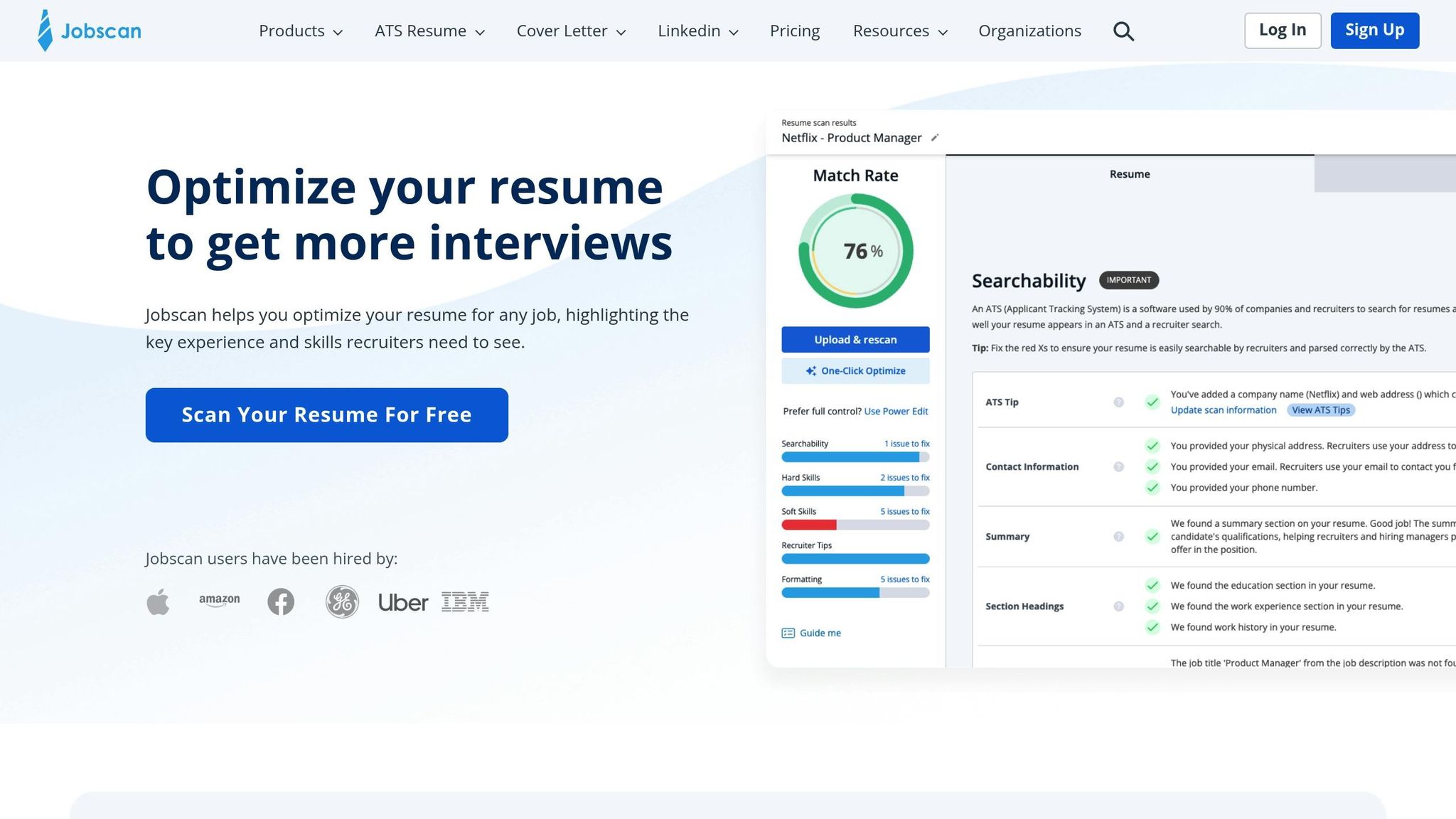
Jobscan.co is a popular tool for ATS optimization, earning a 4.5-star rating on Trustpilot for its ability to identify keyword gaps. It scans your resume against job descriptions to provide a match score, helping you spot missing keywords that could lead to ATS rejection. While effective for optimization, it only addresses part of the process.
The downside is what happens next: you’re left to manually revise your resume and submit each application. If you’re applying to 30 jobs a week, that can mean spending 7.5 to 10 hours just on applications - time that could be better spent networking or preparing for interviews.
"The focus on keyword optimization can sometimes lead to resumes that score well numerically but don't effectively tell your story." – LandThisJob Review
Scale.jobs eliminates this extra work. Instead of just giving you a score, the service customizes your resume for each job and handles the entire application process. While Jobscan operates on a monthly subscription, scale.jobs offers flat-fee packages starting at $199 for 250 applications. This means you’re paying for completed work, not just access to a tool.
The choice boils down to your priorities. If you have time to handle manual optimizations and submissions, Jobscan might work. But if you’d rather save 20+ hours a week to focus on interviews and networking, scale.jobs offers a better return on investment. These differences explain why many job seekers are moving from Jobscan.co to full-service solutions like scale.jobs.
Rezi.ai vs scale.jobs: AI Templates or Human Expertise?
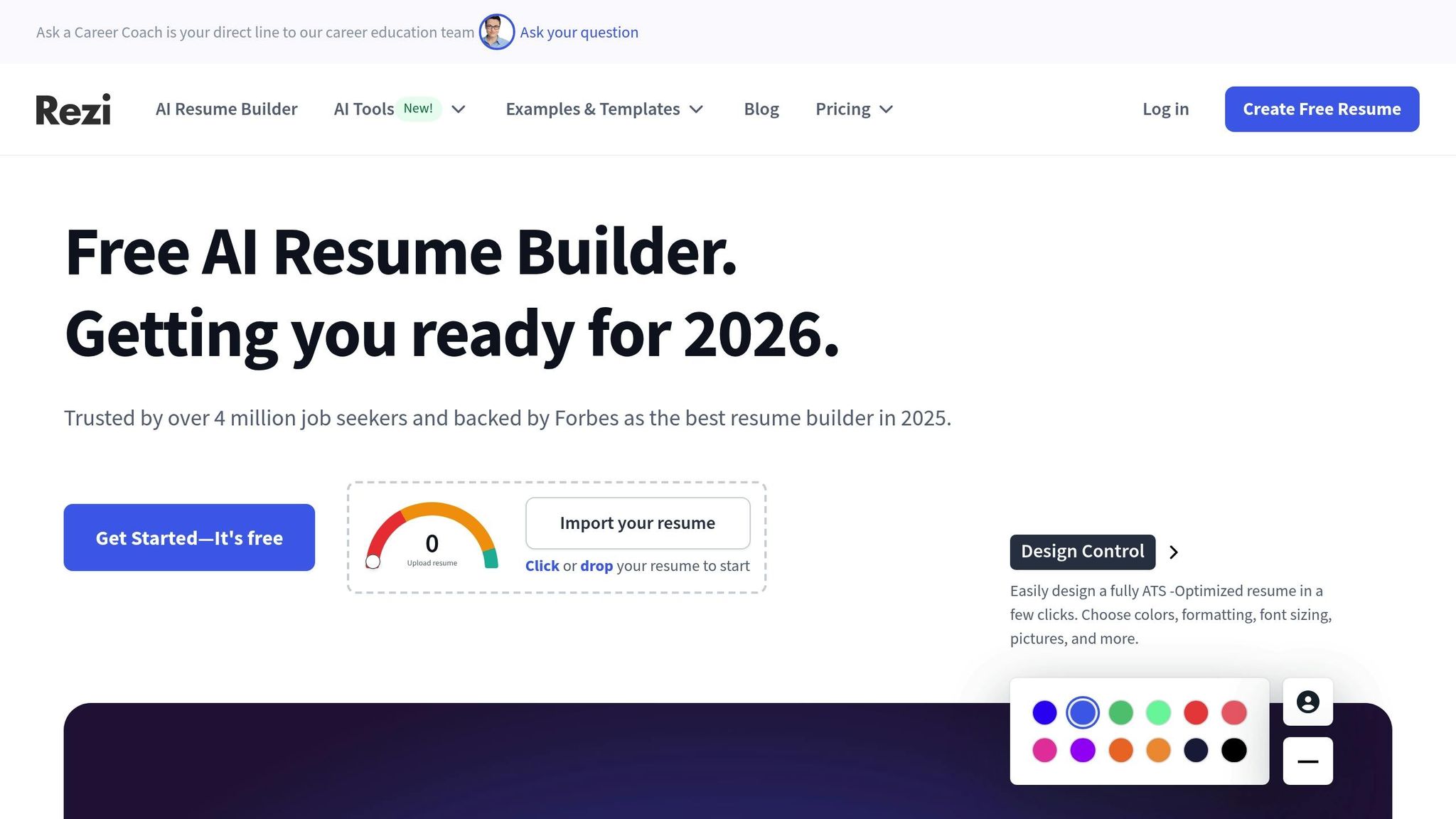
Rezi.ai is part of the new wave of AI-powered resume builders. It offers AI-generated templates and quick formatting for about $29 per month. It’s fast and ensures basic ATS compliance by using single-column layouts and standard fonts. For those who need a quick starting point, it’s a convenient option.
However, speed has its downsides. AI-generated resumes can come across as generic, making them less likely to stand out. Additionally, Rezi.ai stops at resume creation - you’re still responsible for submitting applications, and there’s no guarantee that a human has reviewed your resume.
Scale.jobs takes a hybrid approach. It starts with AI-optimized formatting but adds human expertise to tailor resumes for specific industries and roles. This combination achieves ATS pass rates of 90–98% while maintaining a personalized tone that resonates with hiring managers.
Beyond resume creation, scale.jobs provides hands-on support. A dedicated assistant manages your applications, tracks responses, and adjusts strategies to improve outcomes. Real-time updates via WhatsApp give you full visibility into the process, offering a level of service that purely AI-driven tools can’t match.
| Feature | scale.jobs | Jobscan.co | Rezi.ai |
|---|---|---|---|
| Primary Method | Human assistants + AI optimization | Automated scanning & keyword matching | AI-generated templates |
| Application Handling | Full submission with proof | Resume analysis only | Template building only |
| Support Type | Dedicated WhatsApp support | Self-service platform | Self-service platform |
| Pricing Model | One-time payment ($199–$1,099) | Monthly subscription (~$50) | Monthly subscription ($29) |
| Best For | High-volume, hands-off search | DIY keyword optimization | Quick template generation |
If your job search involves only a few applications, Rezi.ai might be enough. But for a serious job hunt - where you’re managing dozens of applications each week along with interviews and networking - scale.jobs offers the thoroughness, efficiency, and transparency that automated platforms simply can’t match.
Conclusion: Getting Your Resume Shortlisted
The 10-second recruiter test emphasizes the importance of tailored content, clear formatting, and easily accessible key details. Recruiters tend to scan resumes in an F-shaped pattern, paying the most attention to the Experience section and professional summary. Misaligned job titles or vague accomplishments can quickly lead to rejection.
The fix is simple: align your resume language with the job description. Highlight measurable achievements - percentages, dollar values, and timelines - to grab attention. Stick to clean, single-column layouts with standard fonts to ensure readability and compatibility with Applicant Tracking Systems (ATS).
By following these steps, you improve your chances of passing the initial scan and moving forward in the hiring process. However, using AI resume builders and submitting applications for multiple jobs can take over 20 hours a week. This is where services like scale.jobs step in. Their team of human assistants handles each application manually, ensuring ATS compliance and providing real-time WhatsApp updates with time-stamped proof for every submission. Their flat-fee model starts at $199 for 250 applications.
A polished resume can be the difference between being overlooked and landing an interview. Prioritize visual clarity, keyword alignment, and quantified achievements in the top third of your resume. For expert-level, ATS-friendly resume optimization and hands-on application support, consider scale.jobs.
"Your resume is marketing, not history."
Make every second count by presenting your most relevant and impactful information exactly where recruiters expect to see it.
FAQs
How can I make my resume stand out and pass ATS screening?
To get your resume through ATS screening successfully, focus on tailoring it to the job and ensuring clarity in its structure. Incorporate keywords directly from the job description, as ATS tools are programmed to search for these specific terms. Stick to a straightforward format with clear section headings like Work Experience, Education, and Skills. Avoid adding graphics, tables, or intricate layouts, as these can disrupt how the ATS reads your resume.
Always save your resume in a compatible format, such as .docx, to ensure it is easily processed by the system. By aligning your resume content with the job requirements and keeping the design simple, you improve your chances of passing the initial ATS review.
What are the biggest resume mistakes that can get you rejected?
The most frequent resume mistakes that lead to rejection often stem from poor formatting, missing keywords, and a lack of professional polish. For instance, using overly intricate layouts, inconsistent fonts, or excessive graphics can confuse Applicant Tracking Systems (ATS). When that happens, your resume might be filtered out before it even reaches a human recruiter.
Another common misstep is not including the right keywords that align with the job description. Since ATS software relies heavily on keyword matching, skipping essential terms can render your resume virtually invisible to hiring managers. Beyond that, errors like typos, grammatical mistakes, or failing to showcase measurable achievements and certifications can make your resume seem less refined and less competitive.
To sidestep these issues, stick to a clean, ATS-friendly format, use clear and precise language, and tailor your resume to emphasize relevant skills and accomplishments. A polished, well-optimized resume can greatly increase your chances of advancing past the initial screening.
Why should I include numbers and measurable results on my resume?
Including numbers and measurable results on your resume is essential because it highlights the value you bring to a company in a way that's easy to understand. Employers can quickly grasp the results of your efforts when you include specific data, like boosting sales by 20%, cutting costs by $10,000, or leading a team of 15 people.
By quantifying your accomplishments, you not only build trust and authority but also make your resume more noticeable in a crowded job market. Tangible metrics make your achievements stand out and show hiring managers that you can deliver results - exactly what they’re looking for.