
The Hidden Reasons Recruiters Ghost Candidates After Interviews
Why do recruiters ghost candidates? Learn the internal causes—overload, budget shifts, ATS filtering—and practical follow-ups, resume fixes, and tracking tools.


Recruiter ghosting - when communication abruptly stops after an interview - is a frustrating reality for many job seekers. Despite investing time and effort, 61% of candidates report being ghosted after meeting hiring teams, and 10% even after receiving verbal job offers. This silence often stems from internal issues like disorganized hiring processes, budget cuts, or shifting priorities, rather than reflecting a candidate's worth.
Key Takeaways:
- Why it happens: Overwhelmed recruiters, outdated systems, budget freezes, and stronger candidates entering the process are common reasons.
- How to respond: Send concise follow-ups, use application tracking tools, and optimize resumes for ATS compatibility.
- Tools to help: Platforms like scale.jobs offer human-powered application services, real-time updates, and ATS-friendly resume support to reduce ghosting risks.
By understanding these challenges, you can refine your approach, apply on the best job boards, and leverage tools like a job search virtual assistant to stay proactive and minimize frustration.
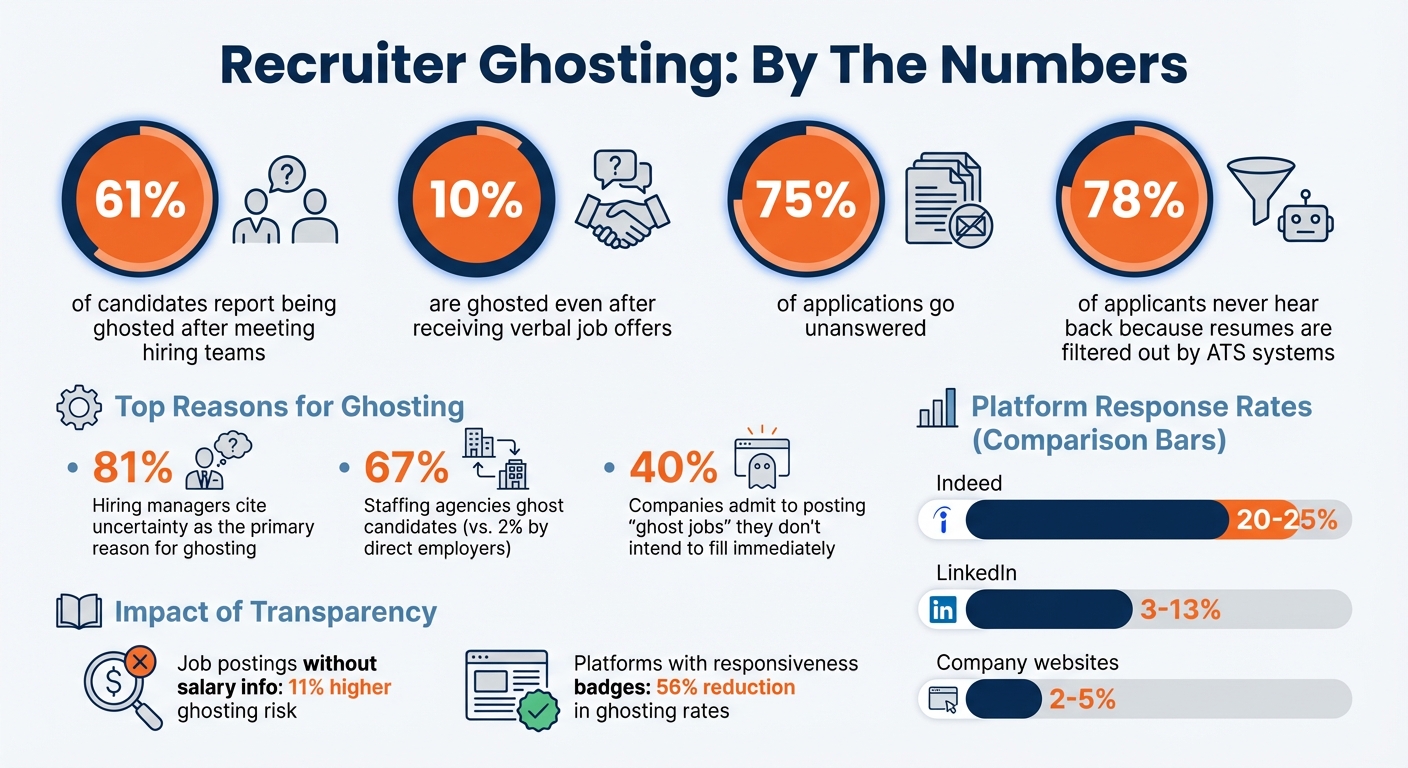
Recruiter Ghosting Statistics and Key Reasons Why Candidates Are Ignored
Ex-Google Recruiter Explains: Why You Get Ghosted After “Great” Interviews
The Real Reasons Recruiters Stop Responding
When recruiters go silent after an interview, it's often due to internal challenges like overwhelming workloads, budget issues, or outdated systems. These obstacles, ranging from unbalanced workloads to shifting priorities, can make consistent communication with candidates difficult.
Heavy Workloads and Prioritization of Top Candidates
Recruiters frequently juggle multiple open roles, which limits their ability to provide personalized updates. With high application volumes, their attention is often directed toward top candidates, leaving others in limbo. Agency recruiters, in particular, face added pressure since their success is tied to placements and revenue rather than communication. Michael Masek, Talent Acquisition Partner at DaVita Kidney Care, explains the competitive nature of agency recruiting:
Agency recruiters are in competition against other agencies, so they are trying to be first and might sacrifice a bit of quality work in order to win.
Statistics back this up: staffing agencies ghost candidates about 67% of the time, compared to just 2% by direct employers. Outdated Applicant Tracking Systems (ATS) worsen the situation. When a candidate’s status changes to "rejected" or "on hold", many older systems don’t prompt recruiters to send follow-ups. Masek further highlights the challenge:
Systems [are] the biggest beast to overcome; there are many Applicant Tracking Systems (ATS) that are used across different recruiting departments and agencies, and many of them are inefficient or outdated.
Budget Freezes and Internal Delays
Budget cuts or shifting priorities can halt hiring processes abruptly, leaving candidates in the dark about roles that may no longer exist. Recruiters often can’t provide updates because they’re waiting for feedback from hiring managers or executive approvals. Darley Coby, Senior Talent Partner at Fitch Group, Inc., sheds light on these delays:
Sometimes we get bogged down and we're chasing down hiring managers or waiting for intel before offering a candidate an update.
Organizations might also pivot mid-process, deciding to promote internally or seek entirely different skill sets. For instance, a company might shift its focus from hiring a marketing manager to a data scientist. This uncertainty is a major factor, with 81% of hiring managers citing it as the primary reason for ghosting candidates.
Stronger Candidates Enter the Picture
Sometimes, silence occurs when a more qualified candidate emerges. Instead of delivering a rejection, recruiters may avoid the uncomfortable conversation altogether. Sharon DeLay, Owner of GO-HR, emphasizes the importance of professional communication:
A good recruiter or HR person does not ghost people.
The issue of "ghost jobs" also plays a role. Around 40% of companies admit to posting roles they don’t intend to fill immediately - often to collect resumes or give the appearance of growth. These listings can remain active for months without any hiring activity. Additionally, job postings that lack salary information have an 11% higher ghosting risk compared to those with transparent details.
Staff Turnover and System Errors
When recruiters leave their roles or are promoted, their open positions often get overlooked, as new staff may lack the context of previous communications. Automated systems add another layer of complexity, sometimes rejecting candidates based on minor keyword mismatches without any human involvement. As Darley Coby notes:
I think ghosting will continue to happen in recruitment because people are people and there's always room for error.
What Job Seekers Can Do About Recruiter Ghosting
Experiencing radio silence from recruiters doesn’t mean you’re out of options. By refining your follow-up strategy and ensuring your application stands out, you can reduce the chances of being ghosted. The secret lies in knowing when to reach out, leveraging tools for better insights, and optimizing your resume to make it past both automated systems and human reviewers.
How to Follow Up After Interviews (With Email Templates)
A well-timed follow-up can make all the difference. Start with a thank-you email within 24 hours of your interview to show appreciation and reiterate your interest. Personalize it by referencing something specific from your conversation to avoid sounding generic.
If you haven’t heard back within 5–7 business days after the expected response date, send a short and positive follow-up email. Here’s a template to guide you:
Subject: Following up on [Position Title] interview
Hi [Recruiter Name],
I wanted to check in on the [Position Title] role we discussed on [Date]. I'm still very interested, especially after learning about [specific topic from interview]. Do you have an updated timeline for next steps?
Thanks,
[Your Name]
Should two weeks pass without a response, consider sending a final email to "close the loop." This email serves to take back control of the situation and might even elicit a delayed reply. Use this example:
Subject: Moving forward with my search
Hi [Recruiter Name],
Since I haven't heard back, I'm assuming your priorities have shifted. I appreciate the time you took to meet with me and wish you the best in finding the right candidate.
Best regards,
[Your Name]
Limit yourself to two follow-ups to maintain professionalism. Persisting beyond this can harm your image. If emails don’t work, consider a brief LinkedIn message or a polite phone call, as recruiters often miss emails in crowded inboxes. Darley Coby, Senior Talent Partner at Fitch Group, Inc., supports this approach:
"A candidate getting back in touch with me demonstrates their interest. It shows they are paying attention, and they will therefore be at top of mind."
Using Application Tracking Tools for Better Visibility
The platform you choose to apply through can significantly impact your response rate. For example, Indeed boasts a response rate of 20–25%, compared to LinkedIn’s 3–13% and company websites’ 2–5%. Opt for platforms offering features like employer responsiveness badges and clear timelines, as these can cut ghosting rates by up to 56%.
Tracking your application’s progress also helps you stay informed. scale.jobs offers a transparent solution by providing proof-of-work screenshots, real-time WhatsApp updates, and human assistants who monitor each application for you. This means you’ll know exactly when a company opens your resume and whether they’ve moved forward, eliminating the uncertainty of whether your application was even seen.
Additionally, scale.jobs provides hands-on support. If a recruiter goes silent, your assistant steps in to follow up strategically, using proven methods to elicit responses. This personalized, human-driven approach outperforms automated tools that often flood recruiters’ inboxes without meaningful follow-through.
While these tools improve visibility, it’s crucial to ensure your resume makes it past Applicant Tracking Systems (ATS) in the first place.
Making Your Resume Work with ATS Systems
A staggering 78% of applicants never hear back because their resumes are filtered out by ATS systems before reaching a recruiter. To avoid this, your resume needs to be both ATS-friendly and appealing to human reviewers.
Here are some tips for optimizing your resume for ATS systems:
- Use simple, standard fonts like Arial, Calibri, or Times New Roman.
- Avoid using complex graphics, tables, or unusual formatting.
- Match keywords exactly as they appear in the job description. For instance, if the job posting mentions "project management", use that phrase instead of alternatives like "managed projects."
scale.jobs takes this a step further by providing resumes tailored to pass ATS filters while impressing recruiters. Unlike Jobscan.co, which only scans and evaluates your existing resume, or Resume Genius, which charges extra for optimization, scale.jobs includes customized, human-reviewed, ATS-friendly resumes as part of its one-time service fee. Each application is fine-tuned to align with the job’s specific requirements, significantly increasing your chances of getting noticed.
If you’re still facing recruiter ghosting, it might be worth reevaluating your resume. Consider investing in professional resume writing services that understand how to balance ATS compatibility with the preferences of hiring managers. This dual approach ensures your application makes it past both automated systems and human scrutiny.
Why scale.jobs Beats Other Platforms at Reducing Ghosting
scale.jobs tackles the challenges of bot flags and ATS (Applicant Tracking System) pitfalls by combining human-powered submissions with real-time proof of application delivery. Unlike many job search platforms that rely entirely on automation - often triggering spam filters - or leave users in the dark about their application status, scale.jobs offers a unique approach. It ensures every application is manually submitted and provides immediate, verifiable proof of submission. Here’s a closer look at how scale.jobs outshines its competitors in minimizing ghosting.
Feature Comparison: scale.jobs vs. LazyApply vs. Simplify.jobs vs. Jobscan.co
| Feature | scale.jobs | LazyApply | Simplify.jobs | Jobscan.co |
|---|---|---|---|---|
| Application Method | Human assistants + AI | AI automation | AI automation | Resume scanning only |
| Ghosting Risk Reduction | Real-time proof-of-work | High (bot flags) | High (bot flags) | None (scanning only) |
| Pricing | One-time flat fees ($199–$1,099) | Subscription | Subscription | Subscription |
| Support | Dedicated WhatsApp assistant | Limited | ||
| Portal Compatibility | Any job board or ATS | Limited | Limited | N/A |
| Turnaround Time | 24 hours | Instant (but flagged) | Instant (but flagged) | N/A |
Unlike AI-driven platforms like LazyApply and Simplify.jobs, which send mass applications and often get flagged by recruiters’ systems, scale.jobs employs human assistants to manually complete applications. This approach avoids the pitfalls of bot-generated submissions that frequently result in ghosting or outright rejection.
5 Reasons scale.jobs Works Better Than Competitors
Let’s break down why scale.jobs is a more effective solution for job seekers:
Human-powered submissions bypass AI filters. Recruiters increasingly use software to screen out AI-generated applications. By having human assistants manually complete each submission, scale.jobs ensures your application is seen by the hiring team rather than being automatically discarded.
Proof-of-submission eliminates doubts. With scale.jobs, you receive screenshots showing exactly when and where your application was submitted. This transparency addresses the uncertainty many candidates face when their applications seem to vanish into the void - a common issue for 67% of agency applicants.
Real-time updates via WhatsApp keep you informed. Instead of waiting for delayed email responses, you’ll receive instant updates from your dedicated assistant through WhatsApp. This direct communication helps counter the frustrating "ghosting culture" where recruiters avoid follow-ups.
Flat pricing with no hidden charges. Starting at $199 for 250 applications, scale.jobs offers a one-time payment model with no recurring fees. Unlike subscription-based services like LazyApply and Simplify.jobs, you won’t face ongoing costs. Plus, unused credits are refundable, adding flexibility to your job search process. For additional support, consider pairing this with an AI resume builder to further enhance your chances.
Compatible with any job portal. Many applications are lost when redirected through multiple websites or incompatible ATS systems. scale.jobs works seamlessly across all platforms, including corporate ATS systems, niche job boards, and direct employer portals, ensuring that your application doesn’t disappear due to technical glitches.
Conclusion: How to Take Charge of Your Job Search
Recruiter ghosting is a frustrating reality - 61% of candidates face silence after interviews, and 75% of applications go unanswered. Understanding these statistics can help you adjust your approach, improve your follow-ups, and open the door to more opportunities.
Don’t sit back and wait. Be proactive with your follow-ups. Aim to send a thank-you email within 24–48 hours and follow up again after 5–7 days if you haven’t heard back. As Matt Semon aptly puts it:
Your career can't be held hostage by someone else's inability to type an email.
The right tools can also make a big difference. Platforms like Indeed show better response rates (20–25%) compared to LinkedIn (3–13%). While AI-only tools like LazyApply and Simplify.jobs focus on job search automation, Scale.jobs blends human expertise with real-time proof-of-work, ensuring your applications bypass bot filters. For crafting resumes that successfully navigate ATS systems, you might want to explore professional resume writing services.
Take charge of your job search by keeping multiple applications in play, verifying job postings directly on company websites, using platforms that prioritize transparency, and following up with intention. Remember, recruiter ghosting reflects systemic flaws, not your worth as a candidate. Stay persistent and strategic.
FAQs
How can I reduce the chances of being ghosted by recruiters after an interview?
To minimize the chances of being ghosted by recruiters, focus on maintaining clear and professional communication throughout the hiring process. After interviews, follow up politely to express your interest and confirm the next steps. Make sure your resume and cover letter are well-formatted and optimized for applicant tracking systems (ATS) to ensure they are easy to review.
Be sure to stay responsive and adaptable during the process. Reply promptly to interview requests, be open to scheduling adjustments when possible, and inform recruiters if your situation changes, such as accepting another job offer. Showing professionalism and courtesy not only builds a positive rapport but also helps keep communication lines open.
You might also find it helpful to use tools like personalized email templates for follow-ups. These can save time while ensuring your messages are professional and engaging. By staying proactive, transparent, and respectful, you can create stronger connections and reduce the risk of being ghosted.
How can I make sure my resume is optimized for ATS systems?
To ensure your resume gets through Applicant Tracking Systems (ATS), stick to a straightforward format. Use standard section headings like Work Experience, Skills, and Education to make it easy for the system to read. Avoid using elements like tables, graphics, or text boxes, as these can disrupt the ATS's ability to scan your resume properly.
Make sure to include keywords directly from the job description in your resume. Place them in critical sections such as your summary, skills, and experience to align your application with the role's requirements. When saving your resume, use widely accepted formats like .docx or PDF, but only choose PDF if the job posting explicitly allows it - this helps avoid any formatting issues.
For added confidence, you can use an ATS checker tool to scan your resume. These tools can help identify potential compatibility problems and give you a chance to correct them before submitting. By following these steps, you can improve your odds of passing the ATS screening and catching the attention of hiring managers.
Why do recruiters sometimes stop responding after interviews?
Recruiters might stop responding after interviews for a variety of reasons, and most of them have little to do with your qualifications or performance. One reason could be conflict avoidance - some recruiters find it difficult to deliver unfavorable news and, as a result, choose silence over confrontation. Another possibility is internal changes within the company, such as shifting hiring priorities or staff turnover, which can leave candidates waiting without updates.
Sometimes, inefficiencies or delays in the hiring process contribute to poor communication. In other cases, a recruiter might assume a candidate has lost interest if they don’t follow up quickly. While these situations can be frustrating, they often point to organizational issues like poor management or ineffective communication, rather than reflecting on you as a candidate.