
The Hidden Cost of AI Job Applications Nobody Talks About
AI application tools speed submissions but often create generic, ATS-flagged resumes and errors; human-assisted services provide tailored, ATS-friendly submissions and proof.


AI-powered job application tools like LazyApply, Simplify.jobs, and Jobscan.co promise efficiency by automating resume optimization and application submissions. However, relying solely on these tools can harm your job search. Common pitfalls include:
- Over-optimized resumes: ATS systems may flag keyword-heavy resumes as spam.
- Generic applications: AI tools often produce impersonal, template-based content that lacks depth.
- Errors in AI-generated cover letters: Mistakes like incorrect company names or outdated details can lead to rejections.
- ATS formatting issues: Many tools leave users to manually reformat resumes for ATS compatibility.
For professionals seeking tailored, high-quality applications, human-assisted services like scale.jobs offer an alternative. Unlike automated platforms, scale.jobs combines manual resume customization, ATS-friendly formatting, and direct application submissions with real-time updates. This approach minimizes rejection risks and ensures every application is uniquely crafted for the role.
Key takeaway: Automated tools work for high-volume, entry-level applications. For mid-to-senior roles or complex job searches, human-assisted services provide better outcomes.
3 Problems with AI Job Application Systems
Generic Applications That Blend In
AI-generated resumes and cover letters often look strikingly similar. Tools like LazyApply or Simplify.jobs tend to pull keywords from job descriptions and arrange them into predictable templates. While this might seem efficient, it results in applications that lack depth and individuality. The real problem lies in the absence of concrete, measurable achievements. Instead of highlighting specific accomplishments or outcomes, these tools prioritize keyword matching, which fails to convey your unique skills and value.
For instance, a resume that says "managed cross-functional teams" without explaining the scale, strategy, or results of that management can easily get overlooked. Unlike these automated tools, scale.jobs uses human expertise to dig deeper into your experiences, crafting applications that reflect your unique career story and accomplishments.
These cookie-cutter applications not only fail to grab attention but also face practical challenges, such as rejection by Applicant Tracking Systems (ATS).
ATS Systems Flag AI-Generated Applications
Modern ATS tools go beyond basic keyword matching. They’re designed to detect patterns that suggest machine-generated content, such as repetitive phrasing or overly generic language. This evolution in ATS technology means that many AI-generated applications are flagged before they even reach a recruiter.
| Feature | Fully Automated AI Tools | scale.jobs (Human-Assisted) |
|---|---|---|
| ATS Strategy | Relies on keyword stuffing and templates | Uses contextual, personalized narratives |
| Bot Detection Risk | High - often flagged as spam | None - manually submitted by humans |
| Submission Transparency | Limited - automated dashboards | High - provides WhatsApp submission updates |
Some ATS platforms even use filters specifically designed to identify patterns common in AI-generated text. If flagged, your application might not even make it to a human recruiter, no matter how qualified you are.
And if that wasn’t enough, the formatting demands of ATS systems can waste even more of your time.
Time Lost on Reformatting for ATS
Many job seekers spend hours reformatting their resumes to meet ATS requirements. This can mean removing tables, adjusting margins, avoiding graphics, and experimenting with file formats. While tools like Jobscan can provide guidance on ATS compatibility, they leave the tedious work of reformatting and submission entirely up to you.
The real cost here isn’t just the time spent on formatting - it’s the opportunity cost. Instead of focusing on crafting personalized applications or networking, you’re stuck tweaking layouts. Human-assisted services like scale.jobs eliminate this hassle by optimizing your resume for ATS and handling the submission process, freeing you up to focus on making strategic career moves.
Tech Companies Cracking Down on Job Applications (Avoid these Mistakes)
scale.jobs vs Competitors: Human-Powered vs Automated
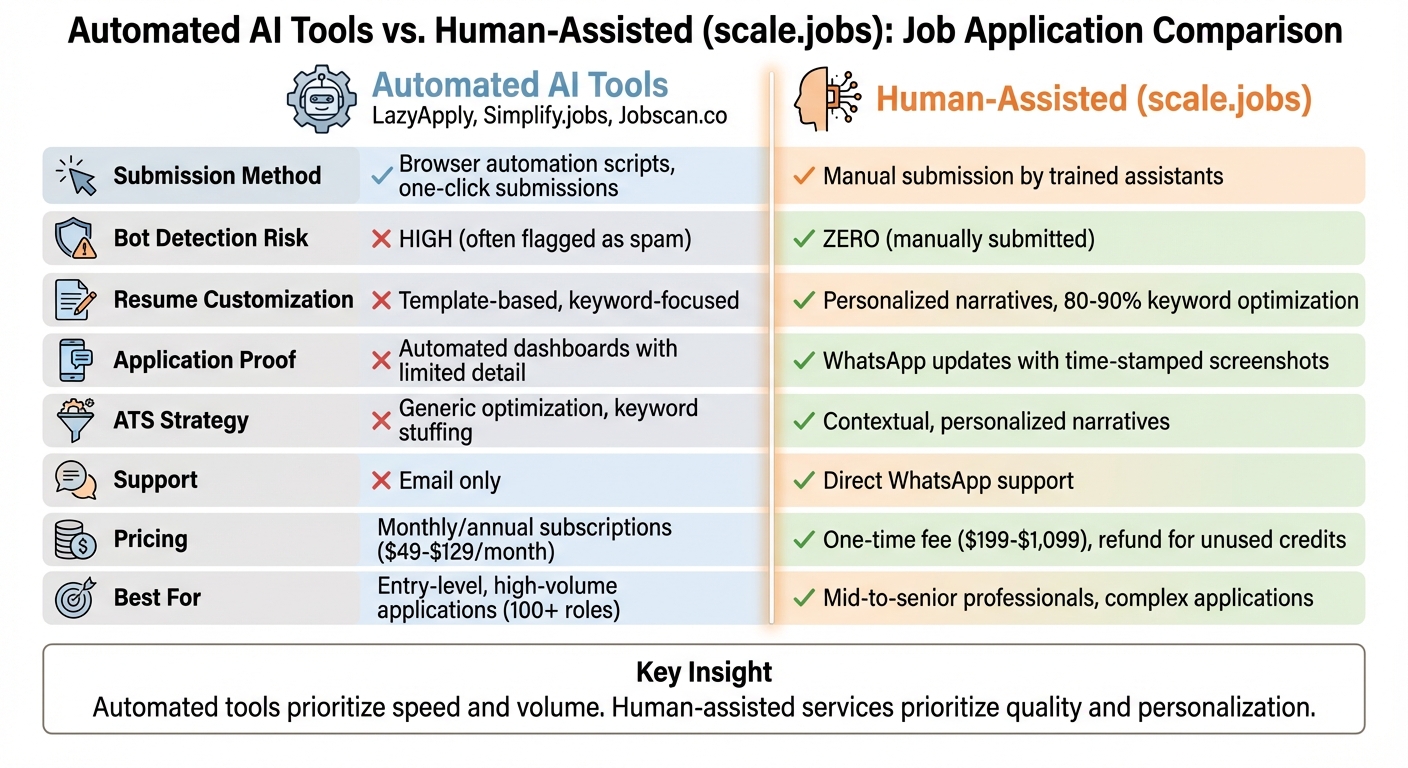
Automated AI Tools vs Human-Assisted Job Application Services Comparison
The core distinction between scale.jobs and its automated competitors lies in their approach to job applications. While platforms like LazyApply, Simplify.jobs, and Jobscan.co depend on automated systems, scale.jobs employs human assistants to personalize each submission. This method directly tackles issues like generic applications, ATS rejection risks, and formatting errors.
LazyApply vs scale.jobs: Automation Pitfalls vs Human Precision
LazyApply promotes itself as a time-saving tool by automating the application process through browser-based submissions. However, automated patterns often trigger ATS spam filters, reducing the effectiveness of applications. In contrast, scale.jobs eliminates this risk entirely. Human assistants carefully review each job posting, customize your resume and cover letter, and submit applications manually. They even provide WhatsApp updates with time-stamped screenshots, ensuring transparency and compliance with ATS requirements.
| Feature | LazyApply | scale.jobs |
|---|---|---|
| Submission Method | Fully automated | Manual by human assistants |
| Bot Detection Risk | High (spam-prone) | Zero |
| Application Proof | Automated dashboard | WhatsApp screenshots + tracker |
| Customization | Generic templates | Tailored for each job |
| Support | Email only | WhatsApp support |
This comparison underscores how automated bulk submissions often fail to meet ATS standards, a challenge scale.jobs resolves with its human-driven approach.
Who benefits from LazyApply:
Job seekers prioritizing high-volume applications for entry-level roles, where speed outweighs the need for customization, and they’re willing to accept higher rejection risks.
Who benefits from scale.jobs:
Mid-to-senior-level professionals who value personalized, high-quality applications designed to bypass automation pitfalls and deliver better outcomes.
Next, we’ll evaluate Simplify.jobs to explore the trade-offs of one-click submissions.
Simplify.jobs vs scale.jobs: Speed vs Personalization
Simplify.jobs simplifies the application process with a one-click system that auto-fills forms on supported platforms. It also offers AI-generated resume suggestions and submission tracking. While this method is quick for standardized applications, it often falls short when dealing with nuanced application requirements, such as detailed questions or custom fields.
scale.jobs, on the other hand, shines in managing complex application needs. For postings that demand specific examples or include non-standard fields, human assistants craft tailored responses based on your experience, ensuring ATS compliance. The added benefit of WhatsApp support ensures that every application is thorough and impactful.
This highlights a major drawback of automation: sacrificing quality for speed, which can lead to higher rejection rates.
Who benefits from Simplify.jobs:
Early-career professionals applying to roles with standardized forms, where a semi-automated, do-it-yourself approach is sufficient, and volume is the main priority.
Who benefits from scale.jobs:
Candidates targeting roles that require personalized responses or navigating unique application systems, where human oversight ensures quality and ATS compatibility.
Next, let’s compare Jobscan.co’s analytical focus to scale.jobs’ full-service solution.
Jobscan.co vs scale.jobs: Analysis Tools vs Comprehensive Service
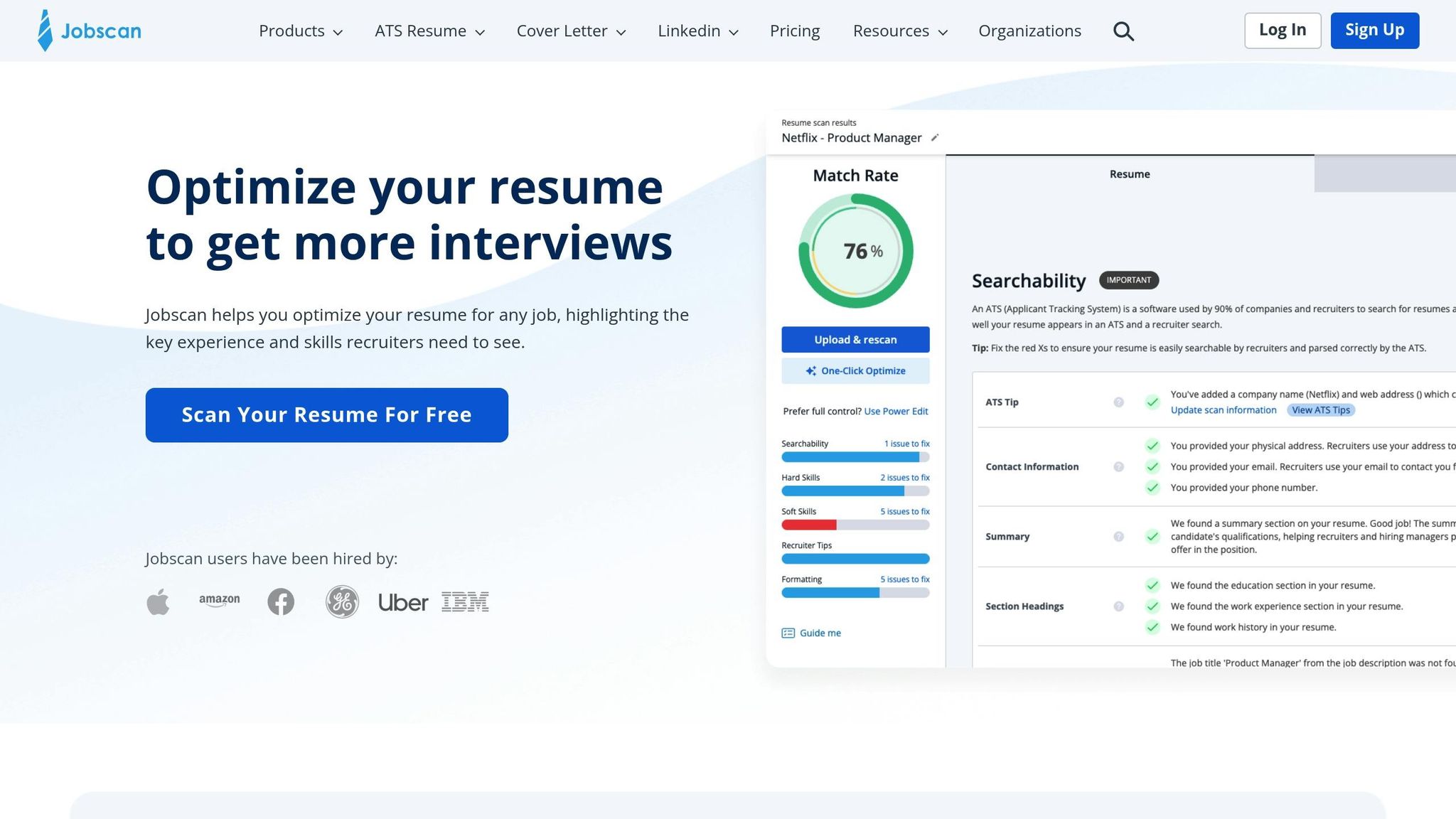
Jobscan.co is primarily an analytical tool, designed to evaluate your resume against job descriptions. It provides an ATS compatibility score and highlights areas for improvement, such as missing keywords or formatting issues. While this diagnostic information is helpful, it requires users to make the changes themselves and handle the submission process manually.
scale.jobs takes a more integrated approach. Human assistants not only optimize your resume for ATS compliance but also handle the entire submission process. This saves time and ensures that analytical insights are directly applied to real-world applications.
This approach eliminates the time-consuming gap between analysis and execution - a common frustration for job seekers.
Who benefits from Jobscan.co:
Individuals who prefer hands-on control over their resumes and have the time to implement optimization suggestions and manage manual submissions.
Who benefits from scale.jobs:
Busy professionals who need ATS-optimized documents and end-to-end application management. This service is particularly useful for those managing multiple applications or juggling tight schedules. For those considering a job application service, scale.jobs combines customization with full submission support in one seamless package.
How scale.jobs Fixes AI Application Problems
scale.jobs addresses common pitfalls of AI-driven job applications by blending human expertise with intelligent AI tools. This ensures that applications are optimized for ATS systems while appealing to recruiters - and avoids being flagged as spam. Let’s dive into how their human-centric approach, real-time updates, and straightforward pricing make a difference.
Human Assistants Customize Every Application
One of the biggest challenges with AI-only tools is the risk of submitting generic, error-filled, or flagged applications. scale.jobs tackles this by relying on human assistants to carefully tailor each application. These assistants manually review job postings, customize resumes and cover letters, and submit applications directly. This hands-on approach avoids the pitfalls of automated tools like LazyApply and Simplify.jobs, which can be detected as bots.
Human assistants aim for an ideal keyword match of 80–90% with job descriptions, ensuring ATS compatibility without triggering filters that flag 100% identical content. They also incorporate transferable skills, company-specific terminology, and personal touches that AI tools often overlook. Whether it’s handling unique details like visa requirements or addressing career transitions, this level of precision is especially helpful for those considering services like a resume writing service that go beyond document preparation to full application management.
Real-Time Updates and Application Proof
Transparency is a cornerstone of scale.jobs. Users receive real-time WhatsApp notifications, complete with time-stamped screenshots of every application submission. This proof-of-work approach eliminates the guesswork often associated with automated platforms, where users are left wondering if their applications were even sent.
Additionally, a dedicated WhatsApp channel connects users directly with their assistant. This allows for quick adjustments, clarifications, or updates - something that subscription-based services rarely provide. This level of communication ensures that your applications are not just sent but tailored to your exact specifications.
One-Time Payment and Free Tools
Unlike subscription-based models, scale.jobs operates on a one-time flat-fee system. Pricing ranges from $199 for 250 applications to $1,099 for 1,000 applications, with additional services included. There are no recurring fees, and unused credits are refunded - a stark contrast to subscription services where unused applications often expire at the end of the billing cycle.
Beyond application services, scale.jobs provides free tools such as ATS checkers, resume builders, salary prediction tools, interview preparation resources, and job application trackers. These tools eliminate the need for multiple paid subscriptions, making the platform a comprehensive solution for job seekers.
Which Service Should You Choose?
The right choice depends on the volume of applications you need to submit, how much control you want over customization, and the urgency of your job search. While automated platforms are often sufficient for entry-level, high-volume applications, human-powered services like scale.jobs provide solutions for challenges that automation alone can't address. Here's a breakdown to help you decide.
When Automated Tools Are Enough
Platforms like LazyApply, Simplify.jobs, and Jobscan.co are designed for job seekers who prioritize volume over personalization. These tools are most effective for entry-level roles or internships, where applications are often standardized and don't require extensive tailoring. They work best for candidates who are comfortable reviewing submissions themselves, can accept some automation-related risks, and are looking for a cost-effective starting point.
However, if you're targeting mid-level or senior positions, or you find that automated tools aren't leading to interviews, it might be time to explore a service that emphasizes tailored, human-optimized applications.
Who Should Use Automated Tools
- Applicants targeting 100+ entry-level or junior roles where quantity matters more than quality.
- Students or recent graduates applying for internships with standard application forms.
- Candidates willing to manually review and adjust automated submissions.
- Those with flexible timelines who can handle higher rejection rates.
Why scale.jobs Might Be a Better Fit
scale.jobs stands out when application rejections become frequent, customization is overwhelming, or you need proof of every submission. It's a strong choice for professionals navigating career shifts, visa complexities, or layoffs - situations where each application must be carefully crafted.
Key scenarios where scale.jobs excels:
- Frequent ATS rejections despite having relevant experience.
- Limited time to individually customize multiple applications.
- Verification needs, with real-time WhatsApp updates and time-stamped screenshots.
- Complex application processes involving nonstandard fields that automated tools can't handle.
- Career transitions or visa requirements requiring detailed, personalized narratives.
With a one-time fee ranging from $199 to $1,099, scale.jobs can be more cost-effective than ongoing subscriptions. It also offers an integrated resume writing service to support the entire application process. The human assistant model ensures precise handling across various platforms, from corporate ATS systems to niche job boards, where automated bots often fall short.
Who Should Choose scale.jobs
- Mid-to-senior professionals pursuing roles that demand tailored applications.
- Job seekers frustrated by frequent ATS rejections with automated tools.
- Individuals managing career changes, visa challenges, or employment gaps.
- Professionals who want transparent proof of submissions and direct support via WhatsApp.
- Those applying to jobs with complex or nonstandard requirements.
| Feature | LazyApply / Simplify.jobs / Jobscan.co | scale.jobs |
|---|---|---|
| Human Involvement | Fully automated | Human assistants review and submit every application |
| Resume Customization | Template-based, keyword-focused | Personalized narratives with 80–90% keyword optimization |
| ATS Handling | Generic optimization, higher bot-detection risk | Manual submission, no bot-detection risk |
| Application Method | Automated scripts or one-click | Manual submission by human assistants |
| Transparency | Automated dashboards with limited detail | WhatsApp updates with time-stamped screenshots |
| Pricing | Monthly/annual subscriptions ($49–$129/month) | One-time fee ($199–$1,099), with refund for unused credits |
This comparison highlights when automated tools are sufficient and when a more hands-on approach with scale.jobs can make a real difference in your job search.
FAQs
How can I tell if my resume looks AI-generated to an ATS?
AI-generated resumes can sometimes reveal their origins through common issues like overloading with keywords, using overly generic language, or including formatting styles (like graphics or multi-column layouts) that may trip up ATS (Applicant Tracking Systems). Additionally, these resumes might miss the mark on personalization, fail to highlight specific accomplishments, or include untailored content. Be cautious of placeholders or formatting glitches that haven’t been properly adjusted. To create a resume that is both ATS-compatible and reflective of your unique strengths, consider pairing AI tools with a thorough human review. This approach helps ensure your resume is polished, relevant, and professional.
What’s the safest way to use AI tools without hurting my chances?
Using AI tools for job applications works best when you pair automation with human oversight. While these tools can help speed up the process, depending entirely on them can result in generic applications that fail to make an impact. To stand out, combine AI-generated content with your personal touch to ensure your resume and cover letters are customized, engaging, and compatible with applicant tracking systems (ATS). Platforms like Scale.jobs integrate this balanced approach, offering both efficiency and clarity for job seekers.
When is human-assisted applying worth the extra cost?
When landing interviews for competitive or specialized roles, investing in human-assisted job applications can make a meaningful difference. Unlike automated tools, human involvement ensures that resumes and cover letters are carefully tailored to highlight the specific requirements of a role. This attention to detail can significantly improve callback rates. It's especially helpful in situations where job seekers face complex challenges, such as addressing visa requirements or emphasizing soft skills. In these cases, accuracy, personalization, and the ability to engage recruiters effectively become key factors in standing out.