
H1B Red Flags Hidden Inside Job Descriptions
Spot vague duties, wage-level mismatches, third‑party work, and missing employer details in job postings that can trigger H‑1B denials or RFEs.


When applying for H1B jobs, the job description is critical. It determines if the role qualifies as a "specialty occupation" and aligns with USCIS requirements. Vague duties, mismatched wage levels, or missing details can lead to denials, RFEs, or even scams. With the new wage-based lottery system, roles at higher wage levels have better chances of selection, making accurate job descriptions even more important. This article breaks down common red flags in job postings and offers actionable steps to avoid risky applications and improve your chances of success.
Key insights:
- Avoid vague job duties or generic titles, as they fail to meet USCIS standards.
- Ensure wage levels match the role's responsibilities to avoid scrutiny.
- Be cautious of postings mentioning third-party work without clear oversight.
- Missing details like salary, location, or employer name can signal compliance issues.
- Tools like O*NET OnLine and services like scale.jobs can help verify job compliance and improve your application process.
Learn how to identify these pitfalls and find reliable job search platforms to streamline your H1B journey.
H-1B Visa Misuse EXPOSED: Real Cases and Red Flags Every Professional Must Know!
H1B Red Flags Hidden in Job Descriptions
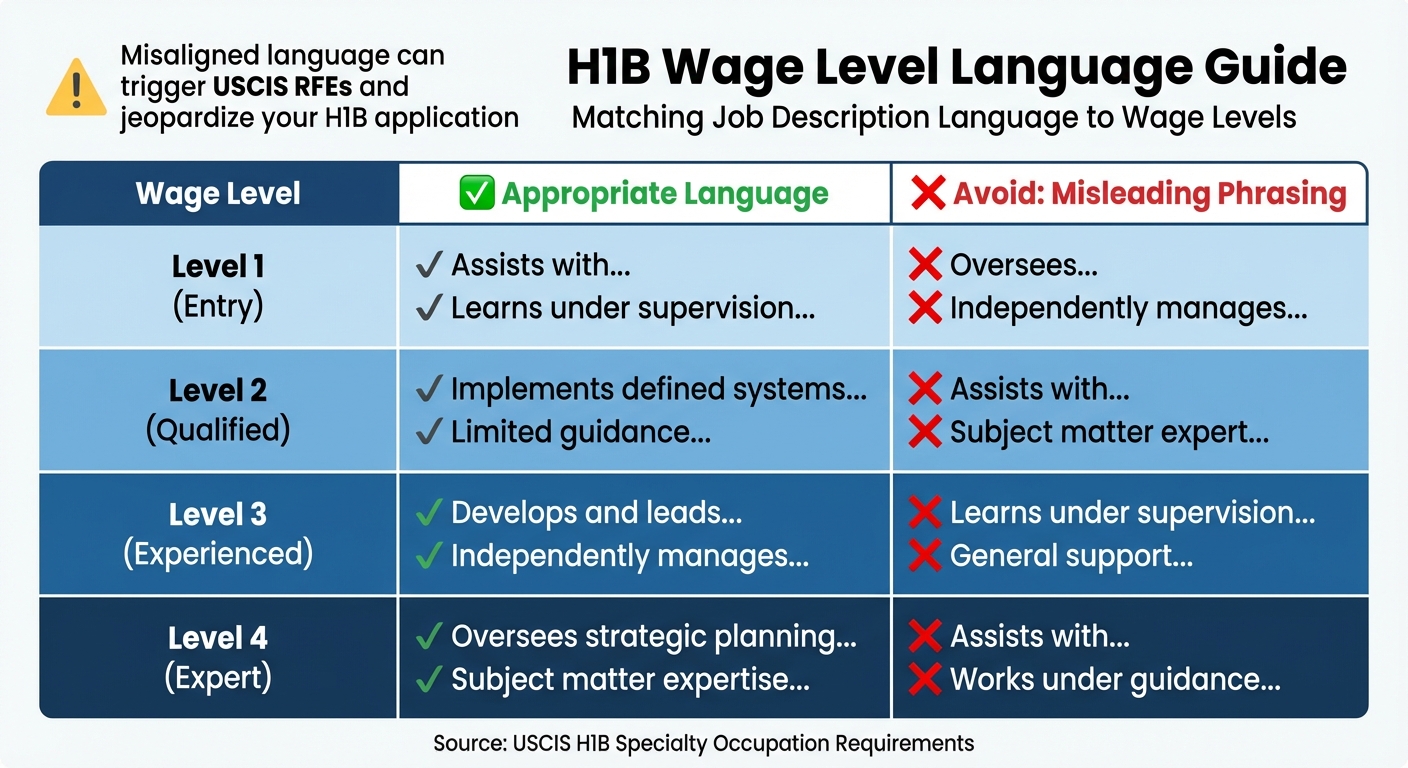
H1B Wage Level Language Guide: Appropriate vs Misleading Phrases
Unclear or Generic Job Duties
A job description that includes vague responsibilities like "various duties as assigned" or "handles merely administrative tasks" can be a major red flag. For H1B petitions, U.S. Citizenship and Immigration Services (USCIS) requires clear evidence that the role demands specialized knowledge, typically tied to a bachelor's degree in a specific field. For instance, instead of writing "team communication", the description should specify tasks like "designs software systems requiring advanced knowledge of object-oriented programming."
Generic descriptions that lack technical specificity often fail the "specialty occupation" test, which is critical for H1B approval. Immigration attorney Muhammed Uzum highlights the importance of this:
A well-crafted H-1B job description serves as a cornerstone in the immigration process, playing a pivotal role in demonstrating that the position qualifies as a specialty occupation.
If job duties seem too broad or applicable to entry-level roles, USCIS may issue a Request for Evidence (RFE) or even deny the petition. But unclear duties aren't the only issue - wage discrepancies can be just as problematic.
Low Wages for Senior or Specialized Roles
Another warning sign is when a job posting offers a Level 1 wage for a role that claims to require advanced expertise or senior-level responsibilities. This mismatch raises concerns about underpayment and compliance.
The language in the job description must align with the wage level being filed. For example, phrases like "assists with" or "learns under supervision" are appropriate for Level 1 roles but not for positions requiring advanced skills. In contrast, Level 3 roles should use terms like "develops and leads" or "independently manages." Misaligned language can result in RFEs and jeopardize the application.
| Wage Level | Appropriate Language | Avoid: Misleading Phrasing |
|---|---|---|
| Level 1 | "Assists with...", "Learns under supervision..." | "Oversees...", "Independently manages..." |
| Level 2 | "Implements defined systems...", "Limited guidance..." | "Assists with...", "Subject matter expert..." |
| Level 3 | "Develops and leads...", "Independently manages..." | "Learns under supervision...", "General support..." |
| Level 4 | "Oversees strategic planning...", "Subject matter expertise..." | "Assists with...", "Works under guidance..." |
Accurate wage levels and matching job descriptions are critical to avoid scrutiny and ensure compliance.
Third-Party or Client-Site Work Mentions
Job descriptions that reference "client locations" or "project-based assignments" without detailed itineraries or compliance documentation can also raise concerns. USCIS has increased its focus on verifying that employers genuinely oversee H1B workers, especially for roles involving off-site or client-based work. Site visits are often conducted to ensure the accuracy of the information provided in the application.
If the job description mentions off-site work but doesn’t explain how the employer will maintain control over daily tasks, it creates a compliance gap. This lack of clarity can lead to petition denial, especially if USCIS suspects the employer is a shell company filing fraudulent applications.
Generic Job Titles Without Specialization
Even the job title itself can raise red flags. Titles like "Consultant", "Analyst", or "Manager" without further context fail to demonstrate a clear link to specialized skills or degree requirements. For example, USCIS has denied petitions for broad categories like "computer systems analyst" or "financial analyst" due to insufficient evidence of specialization.
To avoid this, job titles must reflect specific expertise and align with the duties outlined in the job description. For instance, pairing "Data Analyst" with an SOC code for "Software Developer" creates an inconsistency that will likely trigger USCIS scrutiny. Using resources like O*NET OnLine can help ensure your job duties align with the appropriate SOC code before submission.
Missing Critical Job Details
A job posting that omits essential details - such as the exact salary, work location, or employment duration - can indicate compliance issues. Employers are required to maintain a Public Access File (PAF) for every H1B worker, which includes the Labor Condition Application (LCA), wage documentation, and proof of posted notices. Missing details often suggest incomplete documentation or attempts to conceal non-compliant terms.
Additionally, postings that prioritize H1B sponsorship over job specifics or qualifications are another red flag. Be wary of listings that hide the employer's name or use a fake company name, as these are often tied to shell companies filing fraudulent applications.
How to Spot and Avoid Risky Job Postings
Questions to Ask When Reading Job Descriptions
When evaluating job postings, ask yourself three key questions: Who will I report to? What does the day-to-day look like? Why is this role open now? If these questions aren't clearly answered, the posting might be leaving out critical details. To dig deeper, check whether the job title and responsibilities align with a specific SOC (Standard Occupational Classification) code using O*NET OnLine. For example, if a job is labeled as "Data Analyst" but lists responsibilities typical of a "Software Developer", this could raise red flags with USCIS.
Pay close attention to how the job's experience requirements match its wage-level language. For instance, if a role asks for 5+ years of experience but includes terms like "assists with" or "learns under supervision", this could indicate the employer is filing at an incorrect wage level. Also, make sure the salary, work location, and employer name are all clearly stated. These targeted questions can help you identify trustworthy postings and avoid potential pitfalls.
Tools and Services That Screen for Compliance Issues
After narrowing down your options using the questions above, consider tools and services that can help you screen for compliance issues. While some tools rely on keyword matching, they often miss more subtle problems like wage-level inconsistencies or signs of shell companies. Human-reviewed services offer a more thorough approach. They manually verify sponsorship policies, tailor applications to meet specialty occupation criteria, and provide time-stamped screenshots and proof-of-work records. This level of transparency ensures you know exactly where your application was submitted and whether the job description complied with USCIS standards at the time.
If you're also considering a professional resume writing service to boost your H1B applications, focus on those that understand ATS (Applicant Tracking System) optimization and can align your resume with the language specific to SOC codes.
How to Ask Employers About H1B Compliance
Clear communication with potential employers is crucial when navigating H1B applications. If a job posting raises questions, don't hesitate to ask the hiring manager or recruiter directly. Questions like, "Can you confirm the SOC code and wage level for this role?" or "Will the job duties listed in the LCA match what's described here?" can provide clarity. For roles involving client-site work, request a detailed itinerary outlining how the employer will maintain day-to-day oversight. Keep in mind that USCIS often conducts site visits to verify compliance.
Be cautious of certain red flags in job postings. Phrases like "Must be authorized to work in the U.S. without sponsorship now or in the future" are a clear stop sign for H1B applicants. Similarly, avoid postings that promise "Immediate start, no interview required" or ask for sensitive personal information like your Social Security Number or bank details upfront. These are almost always scams aimed at exploiting visa applicants. Staying vigilant can help you avoid risky situations while ensuring a smoother application process.
Simplify.jobs vs scale.jobs: Which Handles H1B Red Flags Better?
What Simplify.jobs Does Well and Where It Falls Short for H1B Applicants
Simplify.jobs stands out for its speed. Its browser extension can autofill application forms in seconds, which is perfect for those applying to a large number of positions, especially entry-level roles that don’t have strict H1B requirements. The platform also offers a dashboard to keep track of submissions and a one-click apply feature to streamline the process for multiple applications.
However, Simplify.jobs has some notable limitations for H1B applicants. It depends entirely on AI keyword matching and does not verify critical details like SOC codes, wage levels, or LCA (Labor Condition Application) history. For example, it won't confirm if a "Software Engineer" position aligns with the correct SOC code, if the salary meets the required prevailing wage, or if the employer has a record of successful LCA filings. Additionally, the autofill feature often struggles with applicant tracking systems (ATS), which can flag automated submissions. For visa applicants, this can mean missed opportunities if applications are rejected before reaching a recruiter. On Trustpilot, Simplify.jobs has a 3.0/5 rating from 9 reviews, with 67% of reviews being 1-star, citing issues like autofill errors, incorrect field entries, and privacy concerns regarding support conversations being made public.
Now, let’s see how scale.jobs addresses these challenges and offers a more tailored approach for H1B applicants.
Why scale.jobs Works Better for H1B Job Applications
Scale.jobs takes a different approach by using trained human virtual assistants to manually review and submit applications. This human-driven process is designed specifically to catch visa-related issues that automated tools often overlook. Here’s why scale.jobs is a stronger option for H1B applicants:
- Human verification of job details and SOC codes: Assistants directly contact recruiters to confirm H1B sponsorship policies and ensure job duties align with specialty occupation requirements.
- Real-time updates with proof: Applicants receive WhatsApp updates, including time-stamped screenshots of submissions, attached documents, and notes on any red flags in the job description.
- Transparent pricing: Instead of recurring fees, scale.jobs offers a one-time payment starting at $199 for 250 applications, with unused credits refunded if you secure a job early.
- Manual submissions to bypass ATS issues: Every application is entered manually into employer portals, reducing the risk of auto-rejections by ATS systems.
- Compliance checks for wage levels: Assistants flag any inconsistencies in wage levels or job descriptions that might jeopardize your H1B petition.
For those also interested in enhancing their application materials, scale.jobs offers a professional resume writing service. Their assistants tailor resumes and cover letters to align with SOC codes and ATS requirements, ensuring your materials are optimized for each job.
Feature Comparison: Simplify.jobs vs scale.jobs
| Feature | Simplify.jobs | scale.jobs |
|---|---|---|
| Primary Method | AI Autofill | Human Review |
| H1B/Visa Focus | General | Specialized (H1B, F1, O1, EB1A) |
| Red Flag Detection | AI keywords only | Manual expert review |
| ATS Handling | Automated; bot-flagged | Manual entry; bypasses detection |
| Transparency | Basic dashboard | WhatsApp updates & screenshots |
| Pricing | Monthly Subscription | One-time payment ($199–$399) |
| Best For | Entry-level & internships | Senior roles & H1B/OPT |
The table highlights the distinct advantages of scale.jobs for applicants with visa-specific needs.
Who Should Use Simplify.jobs
Simplify.jobs is a good fit for:
- Students and recent graduates applying to internships or entry-level jobs where H1B sponsorship isn’t a concern.
- Applicants focused on speed who need to submit a large number of applications quickly without requiring detailed visa compliance checks.
- Candidates with work authorization who don’t need to verify employer sponsorship or wage-level alignment.
Who Should Choose scale.jobs
Scale.jobs is ideal for:
- Visa-dependent applicants (H1B, OPT, etc.) who need confirmation of sponsorship and compliance checks before applying.
- Mid-to-senior-level professionals targeting specialized roles where accurate SOC codes and wage-level compliance are crucial.
- Applicants requiring documentation to support visa extensions, status changes, or immigration proceedings.
- Job seekers facing ATS challenges, as manual submissions help bypass automated rejections.
Decision Summary
If you’re applying to entry-level roles in bulk and don’t need H1B sponsorship, Simplify.jobs can help you save time. However, if you’re a visa-dependent applicant or targeting specialized roles where compliance matters, scale.jobs is the better option. Its human-led process ensures your applications meet visa requirements, reducing the risk of rejections and improving your chances of securing the right job.
Consider switching to scale.jobs if:
- You’ve experienced rejections due to inaccurate H1B screening.
- Your applications have been flagged or auto-rejected by ATS systems.
- You need documented proof of compliance for visa purposes.
- You’re applying to senior or specialized positions where wage-level alignment is critical.
- You want human verification to ensure job descriptions meet specialty occupation criteria.
Conclusion
Key Takeaways for H1B Applicants
When it comes to H1B petitions, every detail matters. Platforms like Simplify.jobs may rely on AI keyword matching, but a more thorough and meticulous approach is essential for success. Job descriptions are the backbone of your H1B petition, and the United States Citizenship and Immigration Services (USCIS) carefully examines them to ensure the role qualifies as a "specialty occupation" requiring a bachelor’s degree in a specific field. Issues like unclear job duties, incorrect SOC codes, or insufficient wages can lead to Requests for Evidence (RFEs) and potentially jeopardize your petition. Many applicants have even withdrawn applications after spotting vague or problematic language in job postings.
To avoid these pitfalls, it’s critical to identify red flags early. Watch out for signs like unnamed employers, generic job titles, or third-party work arrangements. Tools like O*NET OnLine can help confirm whether job duties align with the assigned SOC codes. And remember, never pay upfront "sponsorship fees", as these are often indicative of fraudulent activity. These challenges underscore the importance of choosing a job search tool that not only simplifies the process but also ensures compliance with H1B requirements.
Finding the Right Job Search Platform
While platforms like Simplify.jobs prioritize speed, they often lack the careful oversight needed for H1B compliance. For visa-dependent applicants, human verification and attention to detail are non-negotiable.
Why scale.jobs is a better fit for H1B applicants:
- Human-reviewed job details: Assistants manually verify job descriptions and confirm sponsorship policies with recruiters.
- SOC code and wage compliance checks: Ensures each job meets specialty occupation requirements.
- Manual application submissions: Avoids ATS rejections and bot-detection systems.
- Transparent proof of work: Time-stamped screenshots and WhatsApp updates document every submission.
- One-time payment model: Starting at $199 for 250 applications, with refunds for unused credits if you secure a job early.
scale.jobs employs trained virtual assistants to carefully review job postings, confirm sponsorship policies, and submit applications manually. This approach minimizes risks like triggering bot-detection systems and ensures compliance with OPT documentation requirements. The platform’s transparent pricing - starting at $199 for 250 applications - offers a straightforward, one-time fee, and any unused credits are refunded if you land a job sooner than expected. For applicants looking to refine their resumes, scale.jobs also provides access to a professional resume writing service tailored to align with SOC codes and ATS standards.
Making the Right Choice
Choose Simplify.jobs if: You’re applying to entry-level positions in bulk and don’t require H1B sponsorship verification.
Choose scale.jobs if: You’re a visa-dependent applicant targeting specialized roles where compliance is crucial, or you need documented proof for visa-related purposes.
When to Switch to scale.jobs
- Your current platform doesn’t verify H1B compliance details like SOC codes or wage levels.
- You’re experiencing ATS rejections with automated systems.
- You need time-stamped documentation for OPT or other visa requirements.
- You’re applying for senior or specialized positions where wage-level compliance is critical.
- You value human verification to ensure job descriptions meet specialty occupation criteria.
FAQs
How can I tell if a job qualifies as a specialty occupation?
To qualify as a specialty occupation under H-1B guidelines, a job must involve highly specialized knowledge and generally require at least a bachelor’s degree in a specific field. Indicators include industry norms mandating such a degree, job responsibilities that necessitate advanced expertise, or an employer’s established requirement for these qualifications. Importantly, the degree must align directly with the specialized tasks of the role to satisfy USCIS standards.
What wage level red flags should make me skip a posting?
Be mindful of job offers where the wages seem out of sync with the responsibilities. Roles offering salaries that are either unrealistically high without clear qualifications or too low for the job’s complexity can raise red flags. Such discrepancies often invite extra scrutiny during USCIS reviews and may even result in denials. To stay compliant with H1B requirements, it’s essential to ensure that the wage level corresponds appropriately to the job’s duties and responsibilities.
What should I ask employers to confirm H1B compliance?
To ensure H1B compliance, it's important to ask employers about their sponsorship policies and history. Focus on whether they currently sponsor H1B visas, support transfers or extensions, and maintain a reliable track record in doing so. Request tangible proof, like recent Labor Condition Applications (LCAs) or approval notices, to confirm their practices. For added clarity, reach out directly to their HR department or recruiters to verify their policies and past sponsorship activities.
Related Blog Posts
- Is the H-1B $100,000 Fee the End of Tech’s Global Talent Flow? Myths, Fears, and Facts
- Cracking the New H-1B Code: Legal Workarounds for Tech Firms Facing the $100K Fee
- 5 Ways the H-1B Fee Bomb Will Reshape IT Outsourcing Forever
- Inside the Boardroom: How U.S. Companies Are Pivoting After the H-1B $100K Surprise