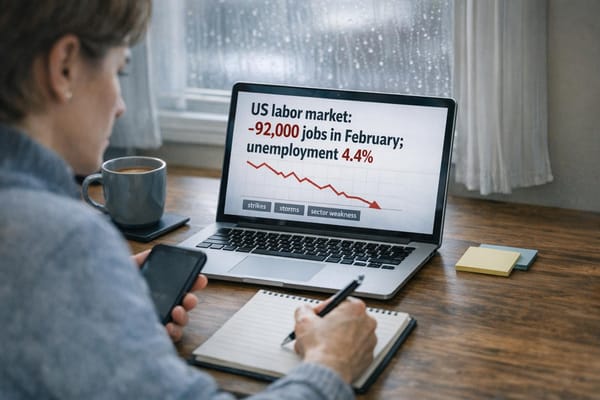
The H1B Cap Checklist Most International Students Miss
Step-by-step H1B cap guide for international students: deadlines, wage-weighted lottery odds, critical documents, SOC code checks, and cap-gap tips.


Securing an H1B visa can be a complex process, especially under the updated wage-weighted lottery system. A single mistake, like an incorrect SOC code or mismatched details, can jeopardize your petition. This guide breaks down the critical steps, deadlines, and documentation needed to maximize your chances of success for the fiscal year 2027 H1B cap.
Key Takeaways:
- H1B Registration Window: March 4–19, 2026.
- Wage-Weighted Lottery: Higher wage levels increase your odds (Level I: 15%, Level IV: 61%).
- Critical Deadlines: Selected registrations must file petitions by June 30, 2026, for H1B status starting October 1, 2026.
- Avoid Common Errors: Ensure consistency in registration details, LCA, and supporting documents.
- New Rules: Consular processing involves a $100,000 fee starting September 21, 2025, but Change of Status filings can avoid this.
This article outlines step-by-step instructions, critical documents, and strategies to navigate the H1B cap process effectively, ensuring you meet all requirements and deadlines.
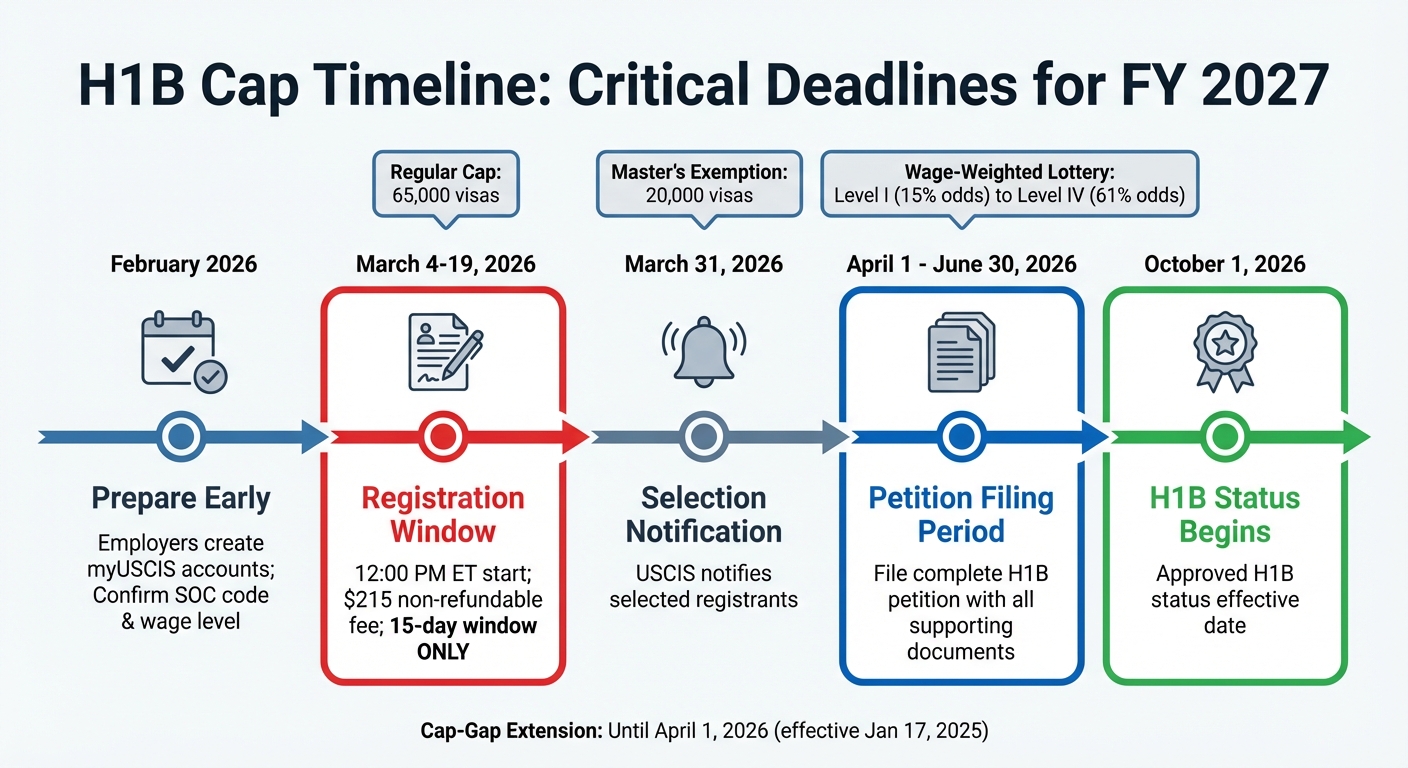
H1B Cap Timeline and Critical Deadlines for Fiscal Year 2027
H-1B Cap Registration Season Is Here: New Rules, New System - Get Ready Now!
H1B Cap Basics and Critical Deadlines
The H1B visa program is divided into two main categories: a 65,000-visa regular cap and a 20,000-visa master's exemption. The regular cap applies to individuals with a bachelor's degree or its equivalent, whether earned in the U.S. or abroad. In contrast, the master's exemption is reserved for those holding a master's degree from a U.S. accredited institution. Degrees from foreign institutions, even if they are master's level, do not qualify for this exemption.
For U.S. master's degree holders, the process offers a dual opportunity. They are first entered into the 20,000-slot master's exemption pool. If they are not selected there, they are then included in the 65,000-slot regular cap pool, effectively giving them two chances to secure a visa. As explained by Ahluwalia Law Offices:
You are first entered into the 20,000 master's-cap pool, and if not selected there, into the general 65,000-cap pool. Combined with a higher wage level, this creates a meaningful advantage.
Regular Cap vs. Master's Exemption: Which Category Fits Your Degree?
The category you fall into depends on where your degree was earned. If you hold a master's degree from an accredited U.S. institution, you qualify for the master's exemption. However, if your master's degree is from a non-U.S. institution, you will be placed in the regular cap, competing alongside bachelor's degree holders. It’s crucial to confirm your degree’s eligibility with your employer or an immigration attorney before the registration period opens on March 4, 2026. Misclassifying your degree during registration can lead to rejection later in the process.
For the 2026 H1B cycle, the selection process has been updated to include wage-weighted lotteries. Positions at Level I wages receive one lottery entry, while those at Level IV wages receive four. U.S. master's holders in Level IV positions can have up to eight entries - four in each cap pool. Depending on your wage level, your chances of selection can range from 15% to 61%. This makes your Standard Occupational Classification (SOC) code and prevailing wage level as critical as your degree type when preparing your application.
Once your filing category is determined, the next step is to meet the key registration deadlines.
2026 Registration Dates You Cannot Miss
The registration period for the fiscal year 2027 H1B lottery runs from March 4, 2026, at 12:00 PM ET, to March 19, 2026, at 12:00 PM ET. This 15-day window is the only time employers can submit registrations. During this period, your employer must pay the $215 non-refundable registration fee through a verified myUSCIS organizational account. Missing this deadline will disqualify you from the lottery, meaning you’ll have to wait for the next cycle.
USCIS will notify selected registrants by March 31, 2026. If selected, your employer will have from April 1 to June 30, 2026, to file a complete petition, including all supporting documents. If approved, your H1B status will begin on October 1, 2026.
To avoid errors, employers should create their myUSCIS accounts by February 2026. Additionally, confirm your SOC code and Occupational Employment and Wage Statistics (OEWS) wage level by late February. Any mismatch between the information submitted during registration and the details in the Labor Condition Application (LCA) could result in your petition being rejected. Preparing early ensures a smoother process and increases your chances of success.
Required Documents Employers and Employees Often Overlook
H1B petitions often face rejection due to missing or inconsistent documentation. To avoid these pitfalls, it's essential that both employers and employees ensure their documentation is complete and aligned with the registration details.
What Your Employer Must Provide
Employers are required to submit several key forms, including Form I-129 (Petition for a Nonimmigrant Worker), the H-Classification Supplement, and the H-1B Data Collection and Filing Fee Exemption Supplement. These forms are the foundation of the petition.
A certified LCA (Labor Condition Application), filed using Form ETA-9035, must also be included and posted at the worksite. To prevent delays, employers should pre-verify their Federal Employer Identification Number (FEIN).
Additionally, employers need to provide documentation proving their business identity, such as IRS EIN confirmation, business registration or incorporation certificates, and a company profile (e.g., a website or brochure). Financial statements are critical to show the employer's ability to pay the offered salary. For roles at client sites, client engagement letters or contracts must clearly define the employer-employee relationship, as third-party placements are frequently audited.
The job description must be detailed enough to demonstrate that the position qualifies as a "specialty occupation." Vague or generic descriptions can lead to denials, especially under rules effective February 27, 2026. Employers should also provide a support letter outlining the tools and technologies involved and explaining how the role requires a bachelor's degree in a specific field.
To stay prepared for audits - which are often triggered by employee complaints - employers must maintain a Public Access File. This file should include the LCA, prevailing wage documentation, and details about the wage pay system.
Now, let’s look at what you, as the employee, need to provide.
What You Must Provide as the Employee
As an employee, you’ll need to present a valid passport with at least six months of validity beyond your intended entry date. Make sure your I-94 record is accurate and up to date. You’ll also need to submit transcripts and degree certificates from all educational institutions you’ve attended. If your degree is from outside the U.S., include a foreign degree evaluation.
If you don’t hold a relevant degree, the "three-for-one" rule allows three years of progressive work experience to substitute for one year of college. Be prepared to provide thorough documentation of your experience, such as offer letters, promotion records, or detailed reference letters.
For those on OPT or STEM OPT, ensure you have complete copies of all I-20 forms (including those covering CPT and OPT periods), Employment Authorization Documents, and every page of your passport. Notify your Designated School Official (DSO) of any changes to your address or employment to keep your SEVIS record updated. It’s also wise to keep proof of job applications to show continuous employment eligibility.
Starting September 2, 2025, most H1B applicants will need to attend an in-person visa interview, as the "Dropbox" waiver program has been significantly reduced. Consular officers now review LinkedIn profiles and resumes for consistency. Steven Brown, Partner at Reddy Neumann Brown PC, advises:
A forgotten citation can trigger a visa refusal under current screening standards.
Disclose even minor legal issues, such as traffic violations or resolved charges, to your immigration attorney. Overlooked records can lead to visa complications under stricter screening rules in 2025 and 2026. Also, audit your online presence - ensure your LinkedIn profile matches your submitted resume and remove any content that could raise concerns during digital background checks.
Your documentation must align perfectly with your employer’s submissions to avoid rejection.
Documents That Improve Your Lottery Odds
Once both employer and employee documentation is in order, you can take steps to improve your chances in the H1B lottery.
Under the wage-weighted lottery system, effective February 27, 2026, your prevailing wage level plays a significant role in your selection odds. For example, a Level I position gets one lottery entry (about 15% odds), while a Level IV position gets four entries (about 61% odds). If you hold a U.S. master’s degree and are in a Level IV position, you could receive up to eight entries - four in each cap pool.
To maximize your chances, work with your employer’s attorney to identify the correct Standard Occupational Classification (SOC) code and prevailing wage for your work location. Moving from a Level I to a Level II position doubles your lottery entries. Ensure the SOC code, wage level, and work location match the final LCA and H1B petition, as inconsistencies can lead to rejection.
Provide evidence to justify a higher wage level. This could include job descriptions that highlight advanced tools, technologies, and specialized duties, which support a higher classification.
Be aware of costs, too. The $215 registration fee is non-refundable, and the $100,000 consular processing fee applies to beneficiaries outside the U.S. seeking consular notification. However, this fee typically doesn’t apply to F-1 students already in the U.S. filing for a change of status. Confirm your filing strategy with your employer to avoid unnecessary expenses.
OPT Cap-Gap and F-1 Status Management
If your OPT expires before your H-1B approval, an automatic cap-gap extension can preserve your F-1 status and work authorization. You won’t need to file a separate USCIS application or obtain a new EAD card during this time. Instead, your updated Form I-20, issued by your Designated School Official (DSO), serves as your proof of continued work authorization. Starting January 17, 2025, cap-gap extensions will last until April 1 (as reflected on your updated I-20), instead of October 1. Below, we’ll explore how filing H-1B as a Change of Status, managing your documents, and considering STEM OPT can help you stay compliant.
Filing H-1B as Change of Status
When your employer files your H-1B petition, they must request a "Change of Status" instead of "Consular Processing" to make you eligible for cap-gap benefits. This approach allows you to transition seamlessly from F-1 to H-1B status without leaving the U.S. Opting for consular processing instead will forfeit your cap-gap extension and terminate your work authorization.
It’s crucial to avoid international travel during this pending status change. Leaving the U.S. could result in USCIS treating your Change of Status request as abandoned, forcing your case into consular processing. Attorney Giselle Carson from Marks Gray cautions:
Travel during registration, selection, filing, or post-filing can jeopardize change of status, force consular processing, and trigger delays, uncertainty, and significant fees.
This filing method ensures your work authorization remains intact until your H-1B petition is processed. However, if your Change of Status request is denied but your H-1B petition is approved, you’ll need to leave the U.S. and apply for a visa at a consulate. For petitions filed after September 21, 2025, this could also involve a $100,000 supplemental fee.
Documents Required for Cap-Gap Extension
To obtain an updated I-20, you’ll need to provide your DSO with the full Form I-797C. A "Registration Selection" notice alone won’t suffice. If you haven’t received the receipt notice yet, you can temporarily use your mailing receipt with tracking information from FedEx, UPS, or USPS as proof.
Wait at least two weeks after USCIS confirms receipt before requesting your cap-gap I-20. Once you receive it, review page 2 to confirm it includes your H-1B receipt number and lists April 1 as the end date in the "Change of Status/Cap-Gap Extension" section.
You’ll also need to submit your current 12-month or STEM OPT EAD card. Be sure to report any address or employment changes to your DSO within 10 days to keep your SEVIS record active. Keep in mind that unemployment days during the cap-gap period count toward your 90-day limit for initial OPT or 150-day limit for STEM OPT.
STEM OPT as Your Backup Option
If the cap-gap extension doesn’t apply or you’re not selected in the H-1B lottery, the 24-month STEM OPT extension can be a fallback option - provided your degree qualifies as STEM and your employer is enrolled in E-Verify. USCIS now allows online Form I-765 applications, giving you instant electronic receipt confirmation.
Start the STEM extension process early rather than waiting for lottery results. If your employer isn’t already enrolled in E-Verify, they’ll need to register before you can apply. For situations involving multiple OPT periods or employment changes, consider using professional services like those offered by scale.jobs resume writing services. These services can help ensure your documentation aligns with USCIS requirements.
If your H-1B petition is filed during your 60-day grace period after OPT expires, you’ll receive an extension of status but not work authorization. Even with a cap-gap I-20, you cannot work during this time.
LazyApply vs. scale.jobs: Why Manual Applications Matter for H1B
When it comes to the H1B application process, especially for international students, accuracy is non-negotiable. This is where manual applications through scale.jobs can have a distinct edge over automated tools like LazyApply.
LazyApply relies on automated scripts to submit a large volume of job applications quickly. However, many H1B sponsor portals use bot-detection systems that can flag these automated submissions. For international students, even one flagged application could mean losing out on a crucial sponsorship opportunity. scale.jobs avoids this risk by employing trained human assistants who manually complete each form, mimicking genuine user input. This ensures that all your visa-related information is entered correctly and without raising red flags.
Why scale.jobs Stands Out Over LazyApply
With manual submissions, scale.jobs ensures that applications bypass bot-detection systems entirely. Trained assistants log into each employer portal, completing every field manually to meet the specific requirements of H1B sponsors. Additionally, they tailor ATS-optimized resumes for each role, focusing on the skills and qualifications H1B employers seek.
To keep you informed, scale.jobs provides real-time updates via WhatsApp, along with time-stamped screenshots as proof of each submission. These records are invaluable for verifying applications and ensuring accuracy in H1B documentation. And with a flat fee starting at $199 for 250 applications, you avoid recurring monthly costs, making it a cost-effective solution for those focused on precision.
What LazyApply Does Well
LazyApply’s strength lies in its ability to handle speed and volume. It can submit hundreds of applications quickly, making it a good choice for candidates who prioritize quantity over customization. At a monthly cost of $99 to $129, it’s an affordable option for those applying to roles that don’t require detailed visa-related answers or are less concerned about bot-detection risks. For individuals casting a wide net without focusing on H1B-specific opportunities, LazyApply can cover a lot of ground efficiently.
Who Should Use LazyApply
LazyApply is a good fit if you’re looking to apply to a large number of jobs quickly and don’t need tailored resumes or manual submissions. It’s suitable for candidates applying to roles that don’t involve complex visa requirements or who are willing to accept the risk of portal bans. If your main goal is maximizing application volume, LazyApply can deliver.
Who Should Choose scale.jobs
On the other hand, scale.jobs is ideal for those navigating the H1B sponsorship process. If you need ATS-compliant resumes customized to each job, manual submissions to avoid bot flags, and detailed proof of every application, this is the service for you. It’s especially beneficial for international students who can’t afford errors or disqualifications during the H1B cap filing period. For additional support, scale.jobs resume writing services can help fine-tune your documents to meet the standards of both USCIS and potential employers.
LazyApply vs. scale.jobs Comparison
Here’s a side-by-side comparison to help you determine which tool aligns with your application needs:
| Feature | LazyApply | scale.jobs |
|---|---|---|
| Human Involvement | Automated bots | Trained human assistants |
| Resume Customization | Standard templates | ATS-optimized per job |
| ATS Handling | High bot-flag risk | Manual entry bypasses filters |
| Application Method | Automated scripts | Manual portal submissions |
| Transparency | Limited logs | Time-stamped screenshots + WhatsApp updates |
| Pricing Model | $99–$129/month recurring | $199 flat fee for 250 applications |
For international students and H1B applicants, the stakes are high, and precision matters. Choosing the right tool can make all the difference in securing the opportunities you’re aiming for.
Teal HQ vs. Scale.jobs: ATS Scanning vs. Full Application Execution
Teal HQ provides tools for ATS scanning and job tracking, but scale.jobs stands out when it comes to handling the entire application process, especially for H1B sponsorship. This comparison highlights why scale.jobs is the better option for international students navigating the complexities of H1B applications.
Teal HQ operates as a self-service platform, offering ATS compatibility checks and a dashboard for tracking job applications. However, users must still manually submit each application. For international students facing the H1B cap deadline of March 19, 2026, this adds a layer of stress, requiring precise navigation of employer portals for error-free submissions.
On the other hand, scale.jobs combines ATS optimization with end-to-end application execution. Their human assistants create tailored, ATS-optimized resumes and manually submit applications, addressing nuanced visa-related questions such as OPT start dates, STEM OPT eligibility, and sponsorship requirements. Each submission is documented with time-stamped screenshots, ensuring a record for audits or proof of effort.
Why Scale.jobs Has the Edge Over Teal HQ
scale.jobs offers several advantages for H1B applicants:
- Manual submissions to bypass bot-detection systems: Human assistants handle applications directly on employer portals, avoiding automated submission flags that can jeopardize opportunities.
- Tailored resumes for H1B roles: Resumes are customized to meet USCIS "specialty occupation" standards, reducing the risk of Requests for Evidence (RFEs).
- Real-time updates and proof of submission: Through WhatsApp, users receive time-stamped screenshots of every application, critical for maintaining F-1 status.
- Flat-fee pricing: Starting at $199 for 250 applications, there are no recurring charges, making it a transparent and cost-effective solution.
For international students balancing OPT timelines and the H1B registration period, this hands-off approach ensures applications are submitted correctly and on time. If you also need help refining your resume for H1B roles, check out scale.jobs resume writing services.
What Teal HQ Gets Right
Teal HQ shines in providing ATS resume scanning and job tracking dashboards. Users value its LinkedIn integration and the ability to adjust resume sections for different roles. At $29/month (or free for basic features), it’s a budget-friendly option for those who prefer managing their own applications and leveraging optimization tools.
Who Should Use Teal HQ
Teal HQ is a good fit for those who:
- Prefer to manage and submit applications themselves.
- Need ATS feedback on their resumes.
- Are looking for a free or low-cost tool to organize and track job applications.
It’s ideal for candidates with the time to manually navigate employer portals and who don’t require assistance with complex visa-related details.
Who Should Choose Scale.jobs
scale.jobs is the better choice for those who:
- Want someone else to handle the application submissions.
- Need tailored resumes for H1B sponsor roles.
- Require proof of correctly completed applications.
- Are international students juggling OPT timelines and the H1B registration window (March 4–19, 2026).
With human assistants managing the process, you can focus on networking and interview preparation while ensuring every application is submitted accurately and meets both employer and USCIS standards.
Teal HQ vs. Scale.jobs Comparison
| Feature | Teal HQ | scale.jobs |
|---|---|---|
| Human Involvement | Self-service tools | Trained human assistants |
| Resume Customization | AI-generated templates | Human-crafted per job description |
| ATS Handling | Scans for compatibility | Manually enters data into employer portals |
| Application Method | User applies manually | VAs handle submissions |
| Transparency | Tracks submissions | Time-stamped screenshots + WhatsApp updates |
| Pricing Model | Free or $29/month | $199 flat fee for 250 applications |
Why Switching to Scale.jobs Makes Sense
You might want to switch to scale.jobs if:
- You need to avoid bot-detection issues: Many employer portals flag automated submissions, which can disqualify applicants.
- You require tailored resumes for H1B sponsors: Generic resumes increase the risk of RFEs and lower chances in the wage-weighted lottery.
- You value proof of completed applications: Time-stamped screenshots ensure transparency and eliminate recurring subscription costs.
- You’re managing tight timelines: Delegating application tasks frees up time to focus on cap-gap extensions and other visa concerns.
- You need accurate visa-related submissions: Human assistants ensure sponsorship-related fields are completed without errors.
For international students aiming to secure H1B sponsorship, choosing between self-service tools and full-service support can be the difference between meeting critical deadlines and missing out entirely.
Jobscan vs. scale.jobs: Keyword Analysis vs. Complete Application Service
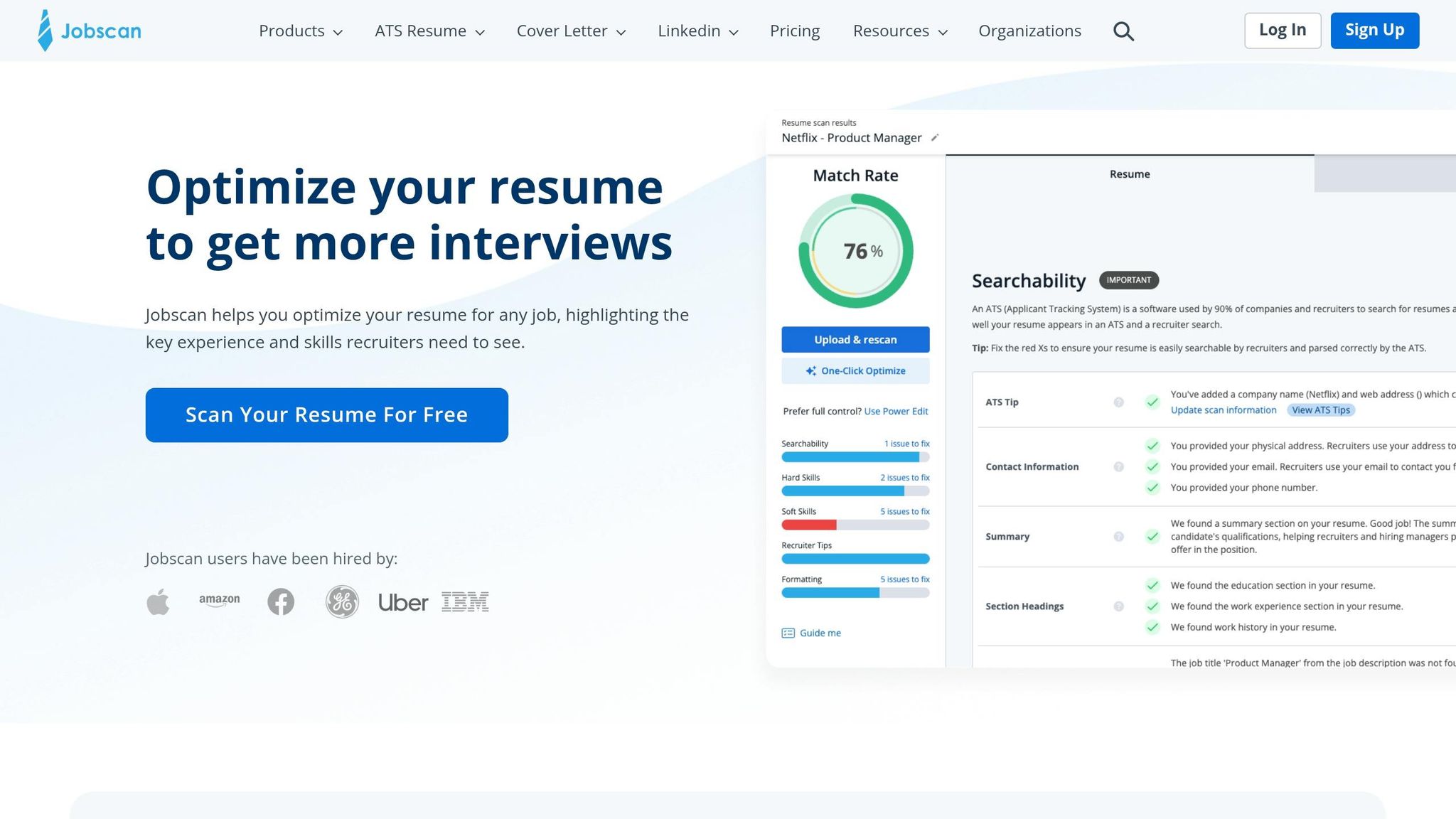
Jobscan provides keyword matching and ATS compatibility scoring, while scale.jobs offers a more comprehensive service by delivering ATS-optimized resumes and handling the entire application process. This comparison highlights why scale.jobs is a smarter option for international students aiming to secure H1B sponsorships before the March 19, 2026, cap deadline. If you’ve used Jobscan and appreciated its keyword analysis but found it lacking in full-service support, here’s why scale.jobs could be your ideal solution.
Jobscan functions as a self-service tool where users upload their resumes and job descriptions to receive ATS compatibility scores. While it provides keyword suggestions and formatting tips, users are left to manually locate H1B sponsor employers, navigate individual application portals, and handle visa-related questions. For international students working against tight visa deadlines, this creates unnecessary challenges.
scale.jobs, on the other hand, offers a complete solution by combining ATS optimization with full application execution. Its human assistants craft tailored resumes for H1B roles and handle application submissions directly to sponsor portals. They also complete crucial visa-related fields - like OPT start dates, STEM OPT eligibility, and sponsorship requirements - with precision, reducing the risk of errors that could jeopardize applications. Additionally, every submission is documented with time-stamped WhatsApp screenshots, ensuring transparency and providing proof for maintaining F-1 status. For those managing critical timelines, these features can be game-changing.
Why scale.jobs Outperforms Jobscan
scale.jobs stands out for H1B applicants due to its unique features:
- Manual submissions with precise visa-detail entry: Trained assistants bypass bot-detection systems and carefully handle sponsorship-related fields to avoid errors.
- Custom ATS-optimized resumes: Resumes tailored to specific job descriptions are delivered within 24 hours, reducing the likelihood of RFEs and enhancing lottery chances.
- Real-time updates via WhatsApp: Time-stamped screenshots provide transparent proof of every submission.
- Flat-fee pricing with refunds for unused applications: Starting at $199 for 250 applications, there are no recurring fees, and unused credits are refunded.
For international students juggling the H1B registration window (March 4–19, 2026) and OPT deadlines, delegating application tasks to professionals saves time and minimizes errors. If you need a resume tailored for H1B roles, consider using scale.jobs resume writing services to ensure compliance with both employer and USCIS standards.
What Jobscan Does Well
Jobscan excels in keyword analysis and ATS compatibility scoring. It provides detailed feedback on how well a resume aligns with a job description, offering suggestions for missing keywords and formatting tweaks. Priced at $49.95/month for premium features, it’s a budget-friendly option for those who prefer managing their own applications and need optimization advice.
Who Should Use Jobscan
Jobscan is ideal for individuals who:
- Prefer a hands-on approach to job applications.
- Want feedback on how their resume aligns with job descriptions.
- Have the time to independently navigate employer portals.
- Are looking for a low-cost tool focused on keyword matching.
Who Should Choose scale.jobs
scale.jobs is best suited for those who:
- Want a dedicated team to handle submissions to H1B sponsor portals.
- Need resumes customized for each job description within a short timeframe.
- Require proof of every application submission, complete with time-stamped updates.
- Are international students balancing OPT timelines and H1B deadlines.
- Need accurate completion of visa-related sections to avoid disqualifying errors.
With scale.jobs, you can focus on preparing for interviews and building networks while ensuring every application is submitted accurately and on time.
Jobscan vs. scale.jobs Comparison
Here’s a quick comparison of the two services to highlight their differences:
| Feature | Jobscan | scale.jobs |
|---|---|---|
| Human Involvement | Self-service software | Trained human assistants |
| Resume Customization | Offers keyword-based suggestions | Crafts tailored resumes for each role |
| ATS Handling | Scans for keyword matches | Manually completes ATS forms |
| Application Method | User applies manually | VAs handle submissions |
| Transparency | Provides optimization scores | Offers time-stamped screenshots via WhatsApp |
| Pricing Model | $49.95/month | $199 flat fee for 250 applications |
Why You Should Consider scale.jobs
Switch to scale.jobs if you:
- Need manual submissions to bypass bot-detection systems.
- Require resumes tailored to each application for better lottery odds.
- Want proof of submission through time-stamped WhatsApp updates.
- Prefer a one-time flat fee over recurring monthly payments.
- Need accurate visa-related field entries to avoid costly errors.
For international students facing the H1B cap deadline, choosing between keyword-focused tools and a full-service application provider can make all the difference in meeting critical deadlines and securing sponsorship opportunities.
Switch to scale.jobs If You Need These Features
Unlike platforms like LazyApply or Jobscan, which focus on automation or keyword optimization, scale.jobs takes a tailored approach to address challenges faced by international students during crucial H1B application cycles. These unique features can make a big difference in navigating the complexities of the H1B cap process, ensuring your application is handled with care and precision.
You Need Manual Submissions to Avoid Bot Flags
Many H1B sponsor portals use sophisticated bot-detection systems, which can easily flag automated submissions. While LazyApply relies on automated scripts that may trigger these systems, scale.jobs employs trained human assistants to manually complete applications. This approach ensures accuracy in navigating multi-page portals and uploading required documents. By avoiding automation errors, scale.jobs helps you meet critical registration deadlines without unnecessary risks.
You Want Flat-Fee Pricing for 250+ Applications
Subscription-based services often charge recurring monthly fees, which can add up quickly - especially during the H1B cap season when applicants may need to submit to over 250 sponsors. Unlike competitors like Teal HQ or Jobscan, scale.jobs offers a one-time flat fee starting at $199 for 250 applications. This pricing model eliminates recurring charges and even includes refunds for unused applications, making it a cost-effective choice for high-volume job seekers.
You Need Real-Time Updates on H1B Deadlines
Staying on top of OPT timelines, STEM OPT extensions, and H1B registration windows requires precise and timely updates. Missing even one deadline can jeopardize your visa plans. With scale.jobs, you receive dedicated WhatsApp support, complete with real-time updates on your application progress and time-stamped submission screenshots. While tools like LazyApply provide limited status notifications, scale.jobs ensures transparent communication, giving you the confidence that every critical deadline is met.
You Require Proof-of-Work Documentation
When processing cap-gap extensions or OPT applications, USCIS may ask for proof of your job search efforts. Without proper documentation, you could face complications with your visa status. scale.jobs provides time-stamped screenshots and detailed application dashboards for every submission, offering verifiable proof that supports USCIS requirements and employer verifications. This level of documentation helps safeguard your visa strategy.
You Want ATS-Optimized Resumes for Each H1B Sponsor
Generic resumes can struggle to pass the varied applicant tracking systems (ATS) used by H1B sponsors, as each employer may have unique keyword filters and formatting preferences. Unlike generic templates offered by services like FindMyProfession, scale.jobs creates tailored, ATS-optimized resumes for each job application. Human assistants fine-tune keywords, formatting, and content to align with specific job descriptions, increasing the likelihood of passing initial screenings and reaching human reviewers. For additional help with resumes, check out scale.jobs resume writing services.
Decision Summary: Choosing the Right Tool for H1B Applications
When navigating the complexities of H1B cap applications, selecting the right platform can make all the difference. Below is a breakdown of how various tools stack up, helping international students balance speed, accuracy, and compliance with visa requirements.
LazyApply is ideal for those focusing on high-volume internship or entry-level job applications where bot detection isn’t a major concern. While its automated scripts offer quick submissions, they fall short on precision for H1B sponsor portals that demand meticulous document handling and multi-page forms. Additionally, it lacks detailed proof-of-application documentation and operates on a recurring fee model.
Teal HQ and Jobscan cater to those who prefer a hands-on approach. These platforms excel in resume optimization and keyword analysis, helping users refine their applications to pass Applicant Tracking Systems (ATS). However, users must manually handle submissions, track deadlines, and manage documentation - a time-intensive process, especially when juggling OPT timelines and cap-gap extensions.
Now, let’s examine how scale.jobs compares to these options.
scale.jobs is tailored for international students dealing with H1B cap deadlines and visa-specific challenges. Unlike automated or DIY tools, human assistants handle every application manually, ensuring compliance with sponsor portal requirements and eliminating bot-flag risks. The service also includes ATS-optimized resumes customized for each employer, real-time WhatsApp updates, and time-stamped screenshots as proof of submission - critical for USCIS cap-gap documentation. With a one-time flat fee starting at $199 for 250 applications and refunds for unused submissions, it offers a straightforward pricing model without recurring charges.
Key Platform Comparison
| Feature | LazyApply | Teal HQ | Jobscan | scale.jobs |
|---|---|---|---|---|
| Human Involvement | Automated bots | Self-service tools | Self-service software | Trained human assistants |
| Resume Customization Depth | Standard templates | AI-generated templates | Keyword-based suggestions | Human-crafted per job description |
| ATS Handling | High bot-flag risk | Scans for compatibility | Scans for keyword matches | Manually completes ATS forms |
| Application Execution Method | Automated scripts | User applies manually | User applies manually | VAs handle submissions |
| Transparency and Proof-of-Work | Limited logs | Tracks submissions | Provides optimization scores | Time-stamped screenshots + WhatsApp updates |
| Pricing Model | $99–$129/month recurring | Free or $29/month | $49.95/month | $199 flat fee for 250 applications |
Why Choose scale.jobs?
- Manual submissions to bypass bot-detection systems on H1B sponsor portals
- Accurate handling of visa-specific fields, such as OPT dates, sponsorship requirements, and STEM eligibility
- Transparent proof-of-submission with time-stamped screenshots for USCIS cap-gap verification
- Flat-fee pricing that avoids recurring monthly subscriptions
- Tailored, ATS-optimized resumes designed to enhance lottery odds and minimize RFE risks
If precision, transparency, and dedicated support are your priorities, scale.jobs is the clear choice. It’s especially suited for those needing verifiable job search efforts and expert guidance on F-1 status management and H1B registration timelines. To further enhance your application, explore scale.jobs resume writing services for documents that meet both ATS and visa sponsor expectations.
For users comfortable managing their own submissions, Teal HQ or Jobscan provide excellent optimization tools. On the other hand, if speed outweighs accuracy and bot-detection risks are acceptable, LazyApply offers an option for bulk submissions. However, when visa status and compliance are on the line, scale.jobs delivers the precision and documentation required to meet your needs.
FAQs
How can I confirm my SOC code and wage level are correct?
When preparing your H-1B petition, it's crucial to ensure that the SOC code and wage level accurately reflect the job description and align with official prevailing wage data. The wage level must meet the standards set by USCIS and correspond to the specific role being offered. Employers should supply documentation verifying that the wage meets the prevailing rate for the designated SOC code to prevent potential delays or the risk of disqualification.
What can cause a cap petition to be rejected after selection?
When a cap petition is selected but later rejected, it’s often due to missing or incorrect documentation, inability to establish a valid employer-employee relationship, or failure to meet specific USCIS criteria. These criteria might include properly justifying wage levels or clearly outlining job duties. To minimize the risk of rejection, double-check that all forms are complete, accurate, and fully comply with the necessary standards.
Should my employer file Change of Status or consular processing?
If you're currently in the U.S. and wish to transition to an H-1B visa without leaving the country, your employer needs to file a Change of Status application on your behalf. However, if you're outside the U.S. or prefer to complete the process abroad, your employer should choose consular processing. This involves attending a visa interview at a U.S. consulate. It's always a good idea to consult with your employer or an immigration attorney to determine the best course of action for your specific situation.