
The "Ghost Job" Epidemic: How to Stop Applying to Roles That Don't Exist.
Spot and avoid ghost job listings, verify postings, and use simple checks or tools to focus your search on real roles.


Nearly one-third of online job postings in 2026 may not be real. These "ghost jobs" waste your time, drain your energy, and hurt your confidence. Companies post them for reasons like impressing investors, collecting resumes for future roles, or tracking salary trends. Recognizing these fake listings is key to avoiding frustration and focusing your efforts on real opportunities.
Key Takeaways:
- Ghost Jobs Defined: Fake postings fall into categories like phantom (for show), pipeline (future hiring), internal-candidate (already filled), and stale (outdated listings).
- Impact on Job Seekers: On average, ghost jobs waste 9 hours of effort per application cycle and contribute to burnout.
- How to Spot Them: Look for vague descriptions, overly broad salary ranges, repetitive postings, or listings older than 60 days.
Solutions:
- Verify postings on company career pages.
- Use tools like MintCareer or Jobstrack.io to filter active listings.
- Consider a job search virtual assistant like scale.jobs for human-verified applications.
Avoid wasting time on roles that don’t exist by focusing on verified job listings and leveraging platforms that prioritize accuracy.
1 in 5 Jobs Are FAKE: Spot Ghost Jobs Fast | Job Search Tips
sbb-itb-564272e
How to Identify Ghost Jobs Before You Apply
Ghost jobs can waste your time and drain your confidence. Here's how to spot and confirm their legitimacy before you hit "apply."
Warning Signs of Ghost Jobs
Keep an eye out for these red flags:
- Old job postings: If a listing is over 60 days old, it’s a red flag. Most legitimate roles are filled or removed within 30 days.
- Repetitive postings: Identical listings with the same job ID popping up repeatedly could mean the company is just collecting resumes, not actively hiring.
- Vague job descriptions: Real openings usually include specific tasks or goals like "manage Q3 product launch" or mention tools and teams. Ghost jobs, on the other hand, stick to generic phrases like "team player" or "self-starter" without offering any real details.
- Suspicious salary ranges: In states like California, New York, Washington, and Colorado, employers must disclose pay ranges. Listings with no salary, or an unreasonably broad range (e.g., $60,000–$180,000), may indicate a lack of genuine intent to hire.
- LinkedIn-only applications: Exclusive reliance on LinkedIn's "Easy Apply" without linking to the company’s own career page often correlates with a higher rate of ghost jobs.
- Unusual company activity: A small startup with 200 employees advertising 80+ open roles? A company posting jobs right after announcing layoffs? These could be signs of reputation management rather than actual hiring.
Once you spot these warning signs, take steps to verify the job before investing your time in a targeted job search.
How to Verify a Job Posting Is Real
Use these practical checks to confirm if a job is legitimate:
- Search the company’s careers page: If the job isn’t listed on the company’s official website, it’s likely inactive. Aggregators like LinkedIn or Indeed sometimes display outdated postings as "Just Posted" due to indexing delays.
- Check the recruiter’s activity: Look up the recruiter on LinkedIn to see if they’ve posted about the role recently. You can also message them directly: "I’m interested in the [Role Name] position. Is the search still active?" A quick response can save you hours of effort.
- Review company news: Use resources like Layoffs.fyi or recent press releases to check for hiring freezes or restructuring. These can render job postings obsolete even if they’re still visible online.
- Look for application confirmation: If the company’s applicant tracking system doesn’t send an automated confirmation email after you apply, it could indicate the job is no longer active.
If these manual checks don’t give you the clarity you need, consider using tools designed to weed out ghost jobs.
Tools That Help You Avoid Ghost Jobs
Several platforms can help you identify ghost listings:
- MintCareer and VantageCV: These platforms analyze job postings for signs of inactivity. MintCareer offers five free job scans per month, while VantageCV provides a detailed 15-point framework to assess legitimacy.
- Jobstrack.io and JobNab: These tools monitor company career pages in real time, ensuring you see only active listings without delays from aggregators.
- LinkedIn’s verified job badges: Although still being rolled out, these badges aim to reduce LinkedIn's ghost job rate, which currently stands at 27%.
For those seeking extra assurance, consider using professional resume writing services. Many of these services include job targeting and verification as part of their process, ensuring your applications are sent to real opportunities rather than phantom postings.
scale.jobs vs Competitors: Which Helps You Avoid Ghost Jobs?
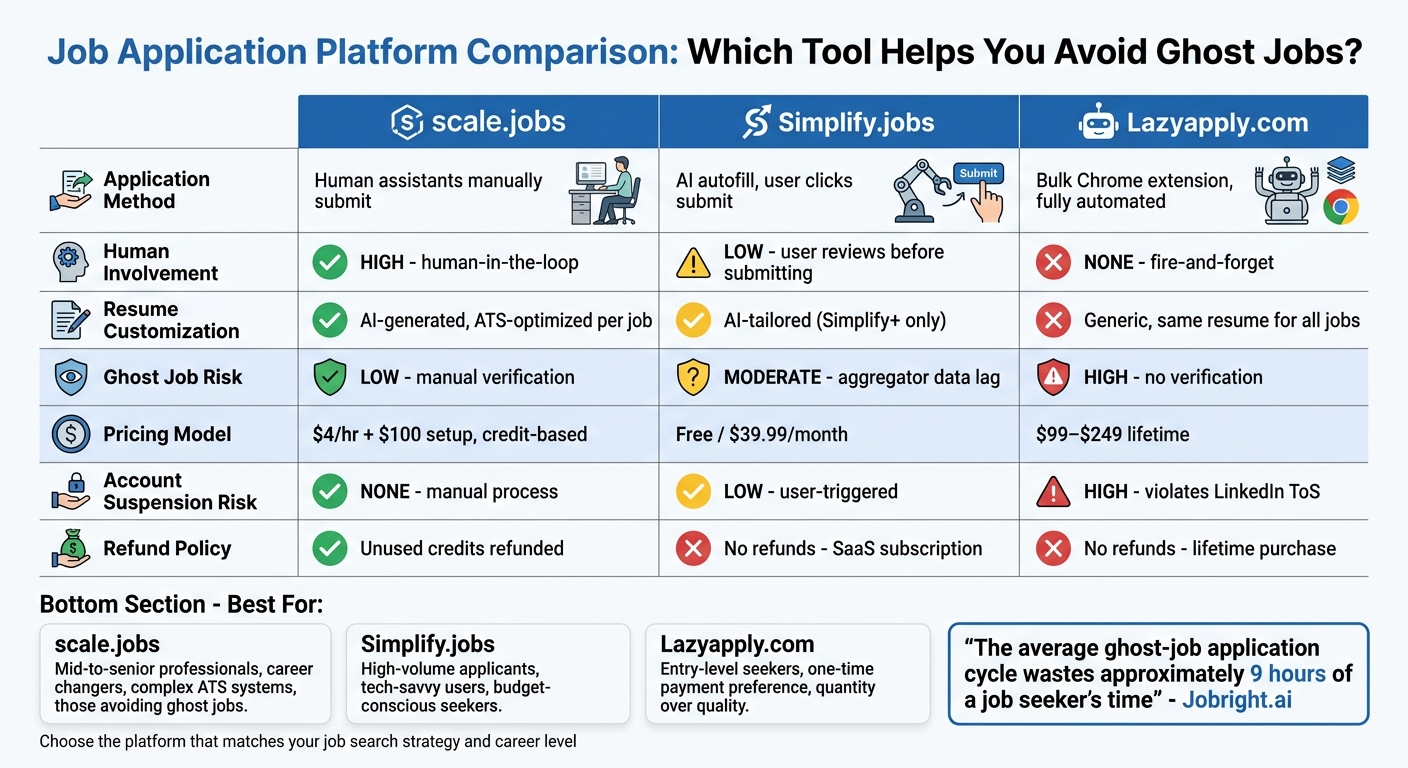
Job Application Platform Comparison: scale.jobs vs Simplify.jobs vs Lazyapply.com
When it comes to avoiding ghost jobs, selecting the right application tool can save you from wasting hours on job listings that aren’t even active. The method you use to apply is more important than the sheer volume of applications submitted. Automated tools often send resumes to outdated or irrelevant postings, while human-powered services provide a better safeguard by identifying potential red flags before you invest your time.
Simplify.jobs vs scale.jobs: Feature Breakdown
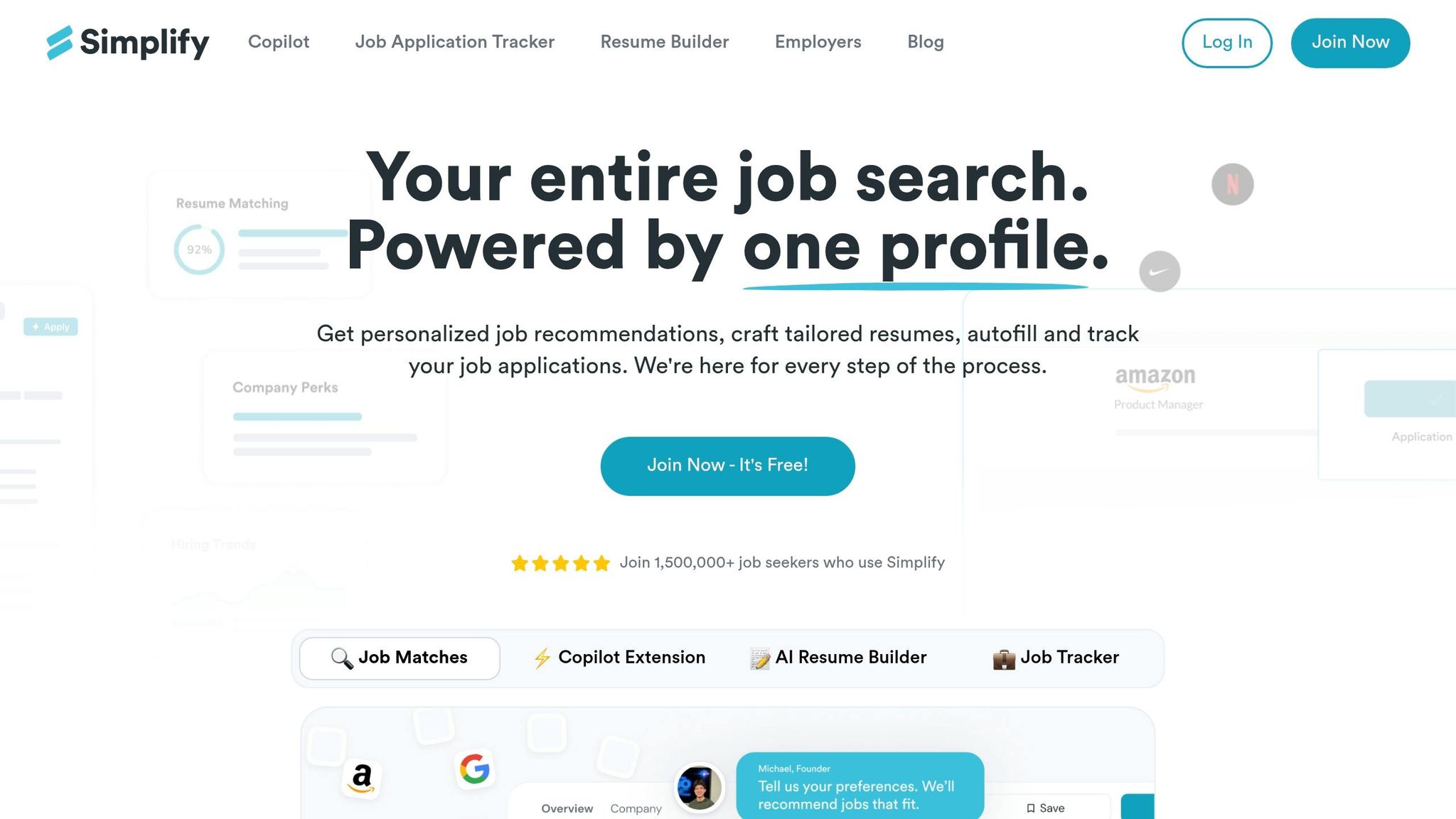
Simplify.jobs has earned a strong reputation with a 4.9/5 rating on the Chrome Web Store. Its autofill Chrome extension supports more than 100 ATS platforms, such as Workday, Greenhouse, and Lever, streamlining the process of filling out application forms. The free version offers basic autofill, while the premium Simplify+ plan ($39.99/month) includes AI-driven resume tailoring and custom Q&A responses.
However, Simplify.jobs relies on aggregated job board data, which can include outdated postings. While it speeds up the application process, it doesn’t always ensure that the jobs are still active.
In contrast, scale.jobs takes a more hands-on approach. Instead of relying solely on automation, it assigns you a dedicated human assistant who personally manages your applications. This assistant can:
- Confirm job availability on the company’s official career page before applying.
- Avoid "talent community" traps that only add you to mailing lists without offering real opportunities.
- Navigate complex ATS systems like Workday, Taleo, and iCIMS, which often require multiple steps or document uploads.
- Identify potential red flags, such as vague job descriptions or postings that have been up for over 30 days.
The process begins with a 15-minute onboarding call to align the assistant with your goals. From there, the assistant handles your applications, leaving you free to focus on networking and preparing for interviews. Pricing is $4 per hour with a one-time $100 onboarding fee, and any unused credits are refundable.
Scale.jobs prioritizes accuracy over speed, which is crucial in a market where nearly one-third of job postings might be ghost jobs. Its human verification process ensures you’re applying to active roles.
Lazyapply.com vs scale.jobs: Side-by-Side Comparison
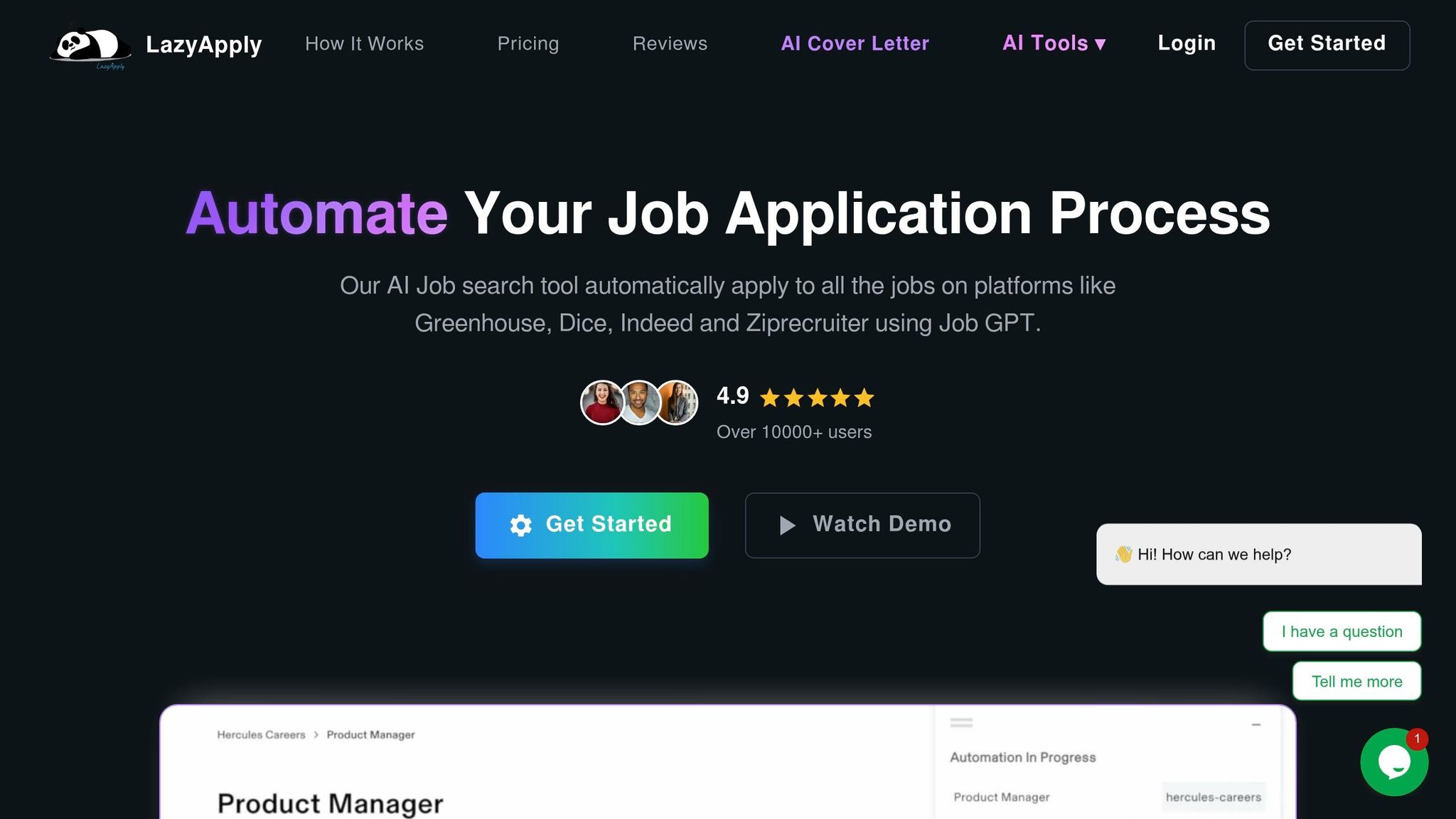
Lazyapply.com is designed for mass submissions, targeting "Easy Apply" buttons on platforms like LinkedIn, Indeed, and ZipRecruiter. It offers lifetime pricing plans ranging from $99 (Basic) to $249 (Ultimate).
The downside? Lazyapply.com doesn’t verify job postings, leaving users vulnerable to ghost jobs. One user reported submitting 14,000 applications, only to receive hundreds of rejections due to mismatches in skills and positions - many of which were likely ghost listings. Its low Trustpilot rating (2.1–2.3 stars) reflects user dissatisfaction, particularly with irrelevant applications and poor customer support.
Additionally, Lazyapply’s bulk automation can violate LinkedIn’s terms of service, risking account suspension - a significant drawback for users relying on LinkedIn for job searches.
In contrast, scale.jobs employs a human-in-the-loop system. A dedicated assistant verifies the relevance of each job before applying. While AI tools are used to create ATS-optimized resumes and cover letters, the final submission is handled manually, ensuring quality and avoiding generic, one-size-fits-all applications.
Scale.jobs also provides proof-of-work transparency, including time-stamped screenshots, real-time WhatsApp updates, and a dashboard to track your applications. If a job turns out to be a ghost listing, your assistant can skip it - something automated platforms can’t do.
The trade-off is that scale.jobs requires more upfront involvement, such as the onboarding call and clear communication about your target roles. However, for serious job seekers, this investment pays off in better results and a more efficient process.
Comparison Table: scale.jobs vs Simplify.jobs vs Lazyapply.com
| Feature | scale.jobs | Simplify.jobs | Lazyapply.com |
|---|---|---|---|
| Application Method | Human assistants manually submit | AI autofill (user clicks submit) | Bulk Chrome extension (fully automated) |
| Human Involvement | High (human-in-the-loop) | Low (user reviews before submitting) | None (fire-and-forget) |
| Resume Customization | AI-generated, ATS-optimized per job | AI-tailored (Simplify+ only) | Generic, same resume for all jobs |
| ATS Coverage | Full (Workday, Taleo, iCIMS, etc.) | 100+ platforms (autofill-compatible) | Limited to "Easy Apply" forms |
| Ghost Job Risk | Low (manual verification) | Moderate (aggregator data lag) | High (no verification) |
| Transparency | Proof-of-work screenshots, WhatsApp updates | Application tracker | Basic dashboard |
| Pricing Model | Credit-based ($4/hr + $100 setup) | Free / $39.99/month | $99–$249 lifetime |
| Account Suspension Risk | None (manual process) | Low (user-triggered) | High (violates LinkedIn ToS) |
| Refund Policy | Unused credits refunded | No refunds (SaaS subscription) | No refunds (lifetime purchase) |
"The average ghost-job application cycle wastes approximately 9 hours of a job seeker’s time." - Jobright.ai
Who Should Use Simplify.jobs
Simplify.jobs is best for:
- High-volume applicants who need to save time on repetitive form-filling across multiple ATS platforms.
- Tech-savvy users who are comfortable reviewing job postings and making quick decisions.
- Budget-conscious job seekers looking for a free or low-cost solution ($39.99/month) and don’t mind verifying postings themselves.
- Active LinkedIn users who apply primarily through autofill-compatible platforms like LinkedIn or Indeed.
Who Should Use Lazyapply.com
Lazyapply.com may work for:
- Entry-level job seekers applying to a large number of similar roles where customization isn’t a priority.
- Users seeking a one-time payment for a lifetime tool without recurring subscription fees.
- Job seekers willing to accept high rejection rates in exchange for maximum application volume.
Who Should Choose scale.jobs
Scale.jobs is ideal for:
- Mid-to-senior level professionals who need personalized applications that highlight their experience and skills.
- Career changers requiring tailored applications for different industries or roles.
- Busy professionals who want to delegate the application process while ensuring quality and relevance.
- Job seekers targeting complex ATS systems, such as Workday or Taleo, that demand precise navigation.
- Anyone frustrated by ghost jobs, valuing human verification to avoid wasting time.
- Users seeking transparency, with proof-of-work documentation and real-time updates via WhatsApp.
Switch to scale.jobs if…
You should consider switching to scale.jobs if:
- You’ve applied to 50+ jobs with little response, indicating your applications may need better optimization or are hitting ghost jobs.
- You’re targeting enterprise companies with complex ATS systems like Workday, Taleo, or SAP SuccessFactors.
- You need role-specific, ATS-optimized resumes instead of generic submissions.
- You value human verification to ensure postings are active.
- You’d rather focus on networking and interview prep than repetitive application tasks.
Decision Summary
- Choose Simplify.jobs if you’re applying to many roles each week, prefer to manage your own submissions, and want a quick, budget-friendly tool.
- Choose Lazyapply.com if you’re applying to entry-level roles in bulk, understand the risks of account suspension, and prioritize quantity over quality.
- Choose scale.jobs if you’re a mid-to-senior professional who values tailored applications, human verification, and transparency in the application process. With ghost jobs on the rise, a human-powered approach ensures your efforts are focused on real opportunities.
When to Choose scale.jobs Over Competitors
Scenarios Where scale.jobs Works Best
If you're looking to maximize the impact of your job applications, scale.jobs offers a tailored approach that stands out. The platform is particularly effective when managing 250 or more customized applications, a strategy proven to boost interview rates by 115% compared to generic submissions. Unlike automated tools such as Lazyapply.com, which often rely on a one-size-fits-all method, scale.jobs ensures each application is tailored to the specific job, increasing your chances of success.
This service shines for mid-to-senior level professionals who frequently encounter enterprise ATS systems like Workday, Taleo, or SAP SuccessFactors. These systems often involve complex requirements - like multi-step uploads, specific file formats, or detailed questionnaires - that can confuse automated tools. With scale.jobs, your assistant confirms each job posting directly on the company’s careers page, ensuring accuracy and bypassing the delays of job aggregators, which can lag behind the source by 24 to 72 hours.
Visa-dependent job seekers will also find scale.jobs invaluable. Automated tools often fail to distinguish between roles that offer H-1B sponsorship and those that require existing work authorization. A dedicated assistant ensures that irrelevant postings are filtered out, saving you from wasting time - especially since the average ghost-job application cycle consumes 9 hours of effort.
For those who need proof of application, scale.jobs delivers time-stamped screenshots and real-time updates via WhatsApp. This level of transparency is a game-changer in a job market where only 20% to 25% of applications on platforms like Indeed receive any form of response. It also helps alleviate the stress experienced by 72% of job seekers who report mental health challenges during their search.
The platform’s one-time payment model - offered at $199 for 250 applications, $299 for 500, and $399 for 1,000 - is ideal for those who prefer fixed costs over recurring subscriptions. If you're targeting roles with specific requirements, such as niche technical skills or detailed deliverables, the human-tailored approach ensures your applications include the precise details that automated tools might overlook. For additional support, such as expert resume writing, Resume Writing Services provide a comprehensive solution to help you stand out.
How scale.jobs Saves Time and Reduces Stress
The human-in-the-loop approach of scale.jobs can save job seekers over 20 hours per week by handling tedious tasks like form-filling, document uploads, and navigating complex ATS systems. This frees up your evenings for activities that truly matter, such as networking strategies or preparing for interviews, giving you a significant advantage in your job search.
By verifying postings directly on company career pages, the platform eliminates wasted effort on ghost jobs. This is especially helpful in industries with high ghost-job rates, such as government roles (60%) and tech positions (48%). For example, if a job appears on LinkedIn but not on the company’s Greenhouse or Lever portal, your assistant skips it, avoiding unnecessary applications.
Speed is another key advantage. With a 24-hour turnaround for custom resumes and cover letters, you can apply while roles are still fresh. This is critical since recruiter engagement drops sharply after three days. While automated tools may submit applications faster, they often produce generic submissions that are flagged as low-quality by modern quality-scoring engines. Scale.jobs avoids this pitfall with its personalized approach.
Real-time updates via WhatsApp and a tracked dashboard provide peace of mind, ensuring you know exactly when your application has been submitted. This transparency addresses the common frustration of the "application black hole", where 85% of hiring managers admit to interviewing candidates for roles they never intended to fill.
With hiring ratios dropping from 8 hires per 10 postings in 2019 to just 4 per 10 in 2024, efficient and targeted application strategies are more critical than ever. Scale.jobs helps you allocate your resources effectively, giving you a better chance in today’s competitive job market.
Conclusion: Focus Your Job Search on Real Opportunities
Navigating the challenges of today’s job market means prioritizing roles that are real and actionable. With the hires-per-posting ratio plummeting from 8 out of 10 in 2019 to just 4 out of 10 in 2024, job seekers face a growing struggle against "ghost jobs" - listings that waste time and erode confidence. To combat this, focus on verifying job postings directly at their source, target listings posted within the last 3 to 7 days, and steer clear of vague "always hiring" ads that often serve as resume collection bins rather than active openings.
If you’re tired of endless applications leading nowhere, scale.jobs offers a solution tailored to modern job seekers. Combining human verification with real-time updates via WhatsApp, this platform ensures every role is checked directly on the company’s career page - whether it’s hosted on Workday, Greenhouse, or SAP SuccessFactors. By eliminating the uncertainty of unverified postings, scale.jobs saves you time and effort while offering a predictable one-time payment structure, unlike many automated tools.
With a 24-hour turnaround, your resume and cover letter reach recruiters while the role is still fresh, giving you a competitive edge. For those needing a complete refresh, Resume Writing Services provide expert-crafted resumes paired with job application support, ensuring both your materials and strategy are polished and effective.
"The time I saved by not having to fill out countless applications allowed me to focus on preparing for interviews and networking." - Matthew Salerno, scale.jobs Client
In a market where 72% of job seekers report mental health struggles due to the application process, focusing on genuine opportunities is essential. Whether you choose to verify postings yourself or rely on a human assistant, the goal is the same: stop wasting effort on non-existent roles and start channeling your energy into positions that matter. With the right tools and strategies, you can streamline your search and focus on jobs that truly align with your goals. Adopting targeted job hunting strategies can further refine this process.
FAQs
What should I do if a recruiter never replies about a role?
If a recruiter doesn’t respond, it’s possible the position might be a 'ghost job' - a listing created without any real intention to hire. To avoid spending your energy on such roles, here are some tips:
- Investigate the company’s hiring trends: Look for signs of outdated or ambiguous job postings. A quick look at their career page or recent activity can provide clues.
- Pay attention to posting dates: If the same job has been reposted multiple times without updates, it could be inactive.
- Identify warning signs: Be cautious of listings with vague descriptions, unclear qualifications, or overly generic responsibilities.
- Verify the role’s status: Try reaching out directly through LinkedIn or mutual connections to confirm if the position is still open and being actively recruited.
These steps can help you focus your efforts on opportunities that are worth your time.
How can I confirm a job is still open before applying?
To ensure a job listing is still active, start by visiting the employer's official website to check if the position is listed. Another useful step is to look up the company on LinkedIn or similar professional platforms to assess their recent hiring activity. If you're still unsure, consider reaching out to the employer directly to confirm whether the role is open. Be cautious of postings that appear outdated, lack clear details, or have been reposted multiple times, as these could be signs of "ghost jobs."
How many days after posting is it still worth applying?
Applying for a job within 14 to 30 days of the posting is usually your best bet. Beyond this window, there's a higher chance the position may no longer be active or could even be a "ghost job" - listings that remain up despite no intention to hire. Staying within this timeframe helps ensure your application reaches a role that's still open and actively seeking candidates.