Generative AI for Resumes: How It Works
How generative AI analyzes job postings, reframes your experience, and creates ATS-friendly tailored resumes, plus pros, cons, and hybrid AI+human approaches.

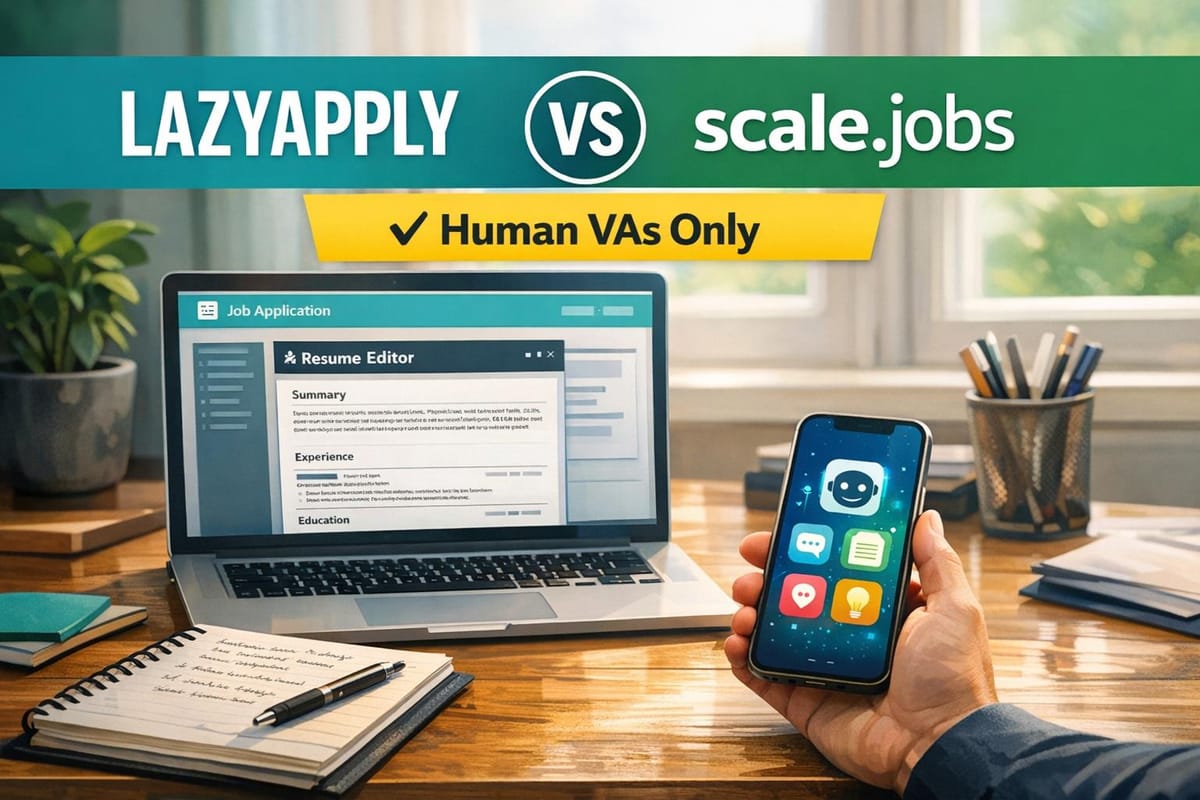
AI-powered resume tools make job hunting faster and more effective. They analyze job descriptions, match your experience to employer needs, and create tailored resumes optimized for applicant tracking systems (ATS). This technology is especially useful in today’s competitive market, where landing a job often requires submitting 100-200 applications.
Key Takeaways:
- Time-Saving: AI tools customize resumes in seconds, compared to manual edits taking 15–20 minutes per application.
- Better Results: AI-optimized resumes improve interview rates from 4-8 per 100 applications to 12-18.
- ATS Optimization: Ensures resumes pass ATS filters, increasing callback rates by up to 60%.
- Hybrid Models: Platforms like Scale.jobs combine AI with human assistance to avoid bot detection and refine resume quality.
Quick Comparison:
| Feature | Fully Automated Tools | Hybrid (AI + Human) Models |
|---|---|---|
| Personalization | Limited to keywords | Tailored storytelling |
| ATS Compatibility | Basic optimization | Verified for ATS systems |
| Submission Method | Automated (risky) | Manual to avoid bot flags |
| Pricing | $9-$49/month | Flat fee, starting at $199 |
| Success Rate | Lower | 93% placement in 3 months |
AI tools streamline repetitive tasks, but human input ensures accuracy and depth. Platforms like Scale.jobs combine both for faster, smarter job applications.

AI Resume Tools Comparison: Fully Automated vs Hybrid AI+Human Models
How to Write a Professional Resume 📄 Using AI | 2025
How Generative AI Creates Custom Resumes
AI-powered resume builders operate by analyzing two key inputs: your career history and the job description you're targeting. Using natural language processing (NLP), these tools scan both documents to identify what employers are seeking and how your experience matches those needs. This dual analysis lays the groundwork for creating resumes tailored to specific roles.
The technology doesn’t fabricate skills or achievements. Instead, it reframes your existing experience. For example, it might transform "managed a team" into "led a cross-functional team of 8, increasing sales by 20% in Q3 2024." By crafting personalized summaries, skills sections, and bullet points with action-oriented language, the system ensures your accomplishments stand out. This automated process helps refine your resume step by step.
The Step-by-Step Workflow
Here’s how the process works:
- Upload your current resume and the job description into the platform.
- The AI pinpoints gaps between your resume and the job requirements.
- It generates tailored suggestions for each resume section, offering multiple versions to choose from.
- You review and tweak the AI's suggestions to ensure accuracy and authenticity.
- Finally, download your polished resume as a PDF or share it digitally.
This iterative approach ensures that every section highlights your strengths while aligning with the job’s demands. According to Scale.jobs, users of AI-optimized resumes secure 12-18 interviews per 100 applications, compared to 4-8 interviews for those applying on their own.
How Natural Language Processing Works
Once the resume is generated, NLP takes it a step further. It analyzes job postings to extract industry-specific terms, key skills, and qualifications that employers prioritize. The system then compares these keywords to your resume, suggesting where they can be naturally integrated. This keyword alignment is crucial, as most companies use applicant tracking systems (ATS) to filter resumes. Without the right terms, many resumes are rejected before a human ever reviews them.
The AI also formats resumes to ensure ATS compatibility. It uses standard headers like "Work Experience", avoids complex layouts or decorative fonts, and saves the document in text-friendly formats. By studying thousands of successful resumes and job listings, the system identifies the formatting, phrasing, and keyword strategies that improve the chances of passing automated filters and reaching hiring managers. This combination of smart customization and ATS optimization helps your resume make it to the next stage.
Technologies Behind AI Resume Builders
AI resume tools are powered by a mix of technologies that work together to transform your career history into a polished, job-specific resume. Each piece of the puzzle plays a unique role: understanding employer needs, structuring resumes to navigate automated systems, and crafting content that showcases your achievements effectively.
The process begins with data collection, where the system gathers your profile details and the job description. Then, natural language processing (NLP) identifies key requirements from the job posting, while machine learning matches your experience to those needs. Finally, generative AI creates the content, and formatting algorithms ensure the final resume is compatible with applicant tracking systems (ATS). These technologies combine to create resumes that are not only tailored but also more likely to pass automated filters. In fact, industry data shows that optimized resumes can boost interview callback rates by up to 60%.
Natural Language Processing for Keyword Matching
NLP goes beyond simple keyword detection - it understands the meaning and context behind the words. For instance, it can recognize that "Java", "J2EE", and "JVM-based development" are related, even if the phrasing varies. This level of understanding ensures qualified candidates aren't overlooked because they used different terminology than what's in the job description.
Using named entity recognition (NER), NLP identifies critical details such as job titles, technical skills, certifications, and company names. It also standardizes variations of the same term, like converting "BSc", "BS", and "Bachelor of Science" into a single label that ATS systems can process accurately. This standardization is crucial because traditional ATS platforms can reject up to 75% of qualified applicants due to mismatched keywords.
"Traditional resume parsers often rely on a fixed list of terms, risking the exclusion of highly qualified candidates simply because they use different language or industry-specific phrasing." - Pravin Kumar, iCaptur
Advanced systems also perform skill equivalency mapping, linking broader skills to specific tools. For example, mentioning "CRM management" might prompt the AI to infer experience with platforms like Salesforce or HubSpot, even if they aren't explicitly listed. This ensures your resume reflects both general skills and the specific tools employers want, increasing your chances of landing an interview.
Machine Learning for ATS Formatting
Machine learning algorithms analyze thousands of successful resumes to identify formatting practices that help documents pass ATS scanners. They remove elements like complex graphics, tables, and unusual fonts, which often confuse these systems. Poor formatting is a common issue - 60% of resumes fail ATS parsing because of it. ML-driven tools address this by favoring reverse-chronological layouts and ATS-friendly file formats like .docx or text-based PDFs. Advanced parsers, such as BERT, improve accuracy by 40-50% compared to older methods.
| Feature | ATS-Ready Resume | Non-ATS Resume |
|---|---|---|
| File Format | .docx or text-based PDF | Image-heavy PDFs, custom formats |
| Layout | Single column | Multiple columns, text boxes |
The system also calculates match scores, comparing your resume to the job requirements. It highlights gaps and suggests where to naturally include missing keywords, ensuring your resume aligns with ATS priorities. Considering over 95% of Fortune 500 companies use ATS systems, this kind of optimization is critical for getting your application in front of a human recruiter.
Generative Models for Writing Content
Generative AI, powered by large language models (LLMs), turns basic job duties into compelling achievement statements. For example, instead of saying "managed a team", it might generate "led a cross-functional team of 8, achieving a 20% sales increase in Q3 2024." This shift from general descriptions to specific, quantified results grabs the attention of hiring managers, who typically spend less than 60 seconds reviewing each application.
These models are trained on millions of resumes and job postings, enabling them to identify patterns in language, tone, and structure. They create tailored professional summaries and bullet points that incorporate industry-specific terms and action verbs, making your resume more appealing to recruiters. On average, resumes now list around 15 skills, reflecting the growing emphasis on detailed skill mapping in AI-generated documents.
"The most successful AI-generated resumes combine algorithmic optimization with personal customization." - ResuFit
That said, generative AI isn't flawless. It's essential to review the content it produces, as it might occasionally misinterpret data or include irrelevant jargon. The key is to treat AI-generated content as a starting point, refining it to ensure it accurately represents your experience while maintaining a personal touch. This blend of technology and human input enhances your resume's quality and effectiveness, paving the way for further collaboration with human assistants on platforms like Scale.jobs.
Pros and Cons of AI-Generated Resumes
AI resume tools offer some clear advantages, but they’re not a one-size-fits-all solution. Understanding their strengths and limitations can help you make smarter choices in your job search.
Main Benefits
One of the biggest perks of AI-generated resumes is speed and efficiency. Customizing resumes manually for each application can take 15–20 minutes, but AI tools can cut that down to just 2–3 minutes. This makes it possible to submit over 150 tailored applications a month without exhausting yourself. And in today’s job market - where landing a role often requires sending out 100–200 applications - this can be a game-changer.
Another key benefit is ATS optimization. Many companies use Applicant Tracking Systems (ATS) to filter resumes before they even reach a recruiter. AI tools are designed to optimize your resume for these systems, increasing callback rates from just 2–6% to an impressive 25–47%. In other words, more of your applications make it past the initial screening.
Using a combination of AI and human input can also speed up the hiring process. Hybrid models boast a 93% placement rate within three months, compared to the five-month average for traditional job searches. This faster timeline can have financial upsides too - candidates juggling multiple offers often see salary increases of about $28,000. Plus, applying quickly (within 48 hours of a job posting) improves response rates by 15–20%, and AI tools make it easier to hit that window across multiple applications.
While these benefits are impressive, AI-generated resumes aren’t without their downsides.
Known Drawbacks
One major issue with AI-generated resumes is the lack of personalized narrative depth. These tools are great at keyword matching, but they often fall short when it comes to capturing unique career transitions, visa requirements, or standout achievements that require a human touch. Fully automated tools like Rezi or Teal rely heavily on algorithms, which can result in resumes that feel generic.
Even though AI can create strong drafts, a human review is essential for accuracy and authenticity. AI sometimes misinterprets data, includes unnecessary jargon, or creates bullet points that don’t truly reflect your experience. For example, Amazon’s Resume Optimizer provides a “match percentage” to show how well your resume aligns with a job description, but even a high match score doesn’t guarantee that the tone or details are spot-on. A final human edit ensures the content feels genuine and accurate.
Another potential pitfall is the risk of bot detection. Fully automated submission tools can trigger red flags, as many companies actively filter out applications submitted by bots. This means your resume might never reach a recruiter. Hybrid models, which combine AI-generated content with manual submissions by human assistants, can help avoid this issue. These models retain the speed benefits of AI while ensuring your application isn’t disqualified by anti-bot systems.
| Feature | Fully Automated AI Tools | Hybrid AI + Human Models |
|---|---|---|
| Personalization | Keyword matching only | Strategic storytelling + keywords |
| ATS Strategy | Algorithmic optimization | AI-driven with human verification |
| Submission Method | Automated (bot flagging risk) | Manual submission by assistants |
| Complex Scenarios | Struggles with nuance | Handles visa/career changes well |
| Hybrid Model Benefit | N/A | Ensures authenticity, avoids bot flagging |
AI tools can be incredibly helpful for drafting resumes quickly and optimizing for ATS. However, always take the time to review and refine the final product to ensure it accurately represents your experience and stands out to recruiters.
How Scale.jobs Combines AI and Human Support
AI-only tools like Rezi, Teal HQ, and Jobscan can churn out resumes quickly, but they often miss subtle details and may even trigger bot detection. Scale.jobs takes a different approach by combining AI's efficiency with human expertise to create tailored, genuine applications. This blend ensures applications are not only fast but also meet the nuanced demands of recruiters.
AI Tools Available on Scale.jobs
Scale.jobs builds on this hybrid model with a selection of AI tools designed for speed and ATS (Applicant Tracking System) compatibility. The AI Assistant Pro can generate resumes, cover letters, and application responses in just one click - all optimized to pass ATS filters. Starting at just $9 per month, Scale.jobs offers a more affordable alternative to competitors, which typically charge between $29 and $49 per month. Even the free plan provides two AI-generated resumes daily and access to a job board featuring over 2 million monthly postings.
What makes these AI tools stand out is their integration with human review. While the AI efficiently handles tasks like keyword matching and formatting, users are encouraged to refine the output themselves or combine it with Scale.jobs' human assistant services for more complex needs, such as career changes or visa-related challenges.
Human Assistant Services
Recognizing the limitations of fully automated systems, Scale.jobs' standout service is its reverse recruiter service. Here, trained virtual assistants handle the entire application process on your behalf. These assistants, selected through a rigorous process with only a 2% acceptance rate, are well-versed in U.S. ATS platforms like Workday, Greenhouse, and iCIMS. They create ATS-friendly documents and manually submit applications, even on portals like USAJobs.
This manual process eliminates the risk of applications being flagged by bots. Automated systems often fail to get past initial filters, but Scale.jobs' human assistants ensure your application reaches actual recruiters. Clients also enjoy perks like real-time updates via WhatsApp, time-stamped proof-of-work screenshots, and a guaranteed 24-hour turnaround for custom documents. According to Scale.jobs, 93% of clients secure a job within three months, with nearly half of these successes attributed to the time saved by outsourcing applications. On top of that, clients reportedly see an average salary increase of $28,000, thanks to multiple competing offers.
The pricing is straightforward and based on a flat-fee model: $199 for 250 applications, $299 for 500, $399 for 1,000, or $1,099 for the Ultimate Bundle, which includes a personal recruiter and LinkedIn profile makeover. Unlike subscription-based services, you pay once, and any unused credits are refundable - no recurring charges to worry about.
Scale.jobs vs. Competitors
Here’s how Scale.jobs stacks up against AI-only tools:
| Feature | Scale.jobs | Rezi / Teal / Jobscan |
|---|---|---|
| Approach | Hybrid (AI + Human) | AI-only Automation |
| Submission | Manual by humans (avoids bot flags) | Automated or DIY |
| Updates | Live WhatsApp updates & screenshots | Email or Dashboard only |
| Pricing | One-time flat fee (starting at $199) | Monthly subscriptions ($9–$49/mo) |
| Turnaround | Under 24 hours for custom documents | Instant (AI-only) |
| Support | Dedicated human assistant | Self-service / Email |
These differences highlight why Scale.jobs' hybrid approach delivers better results. While fully automated tools often achieve callback rates of just 1–3%, Scale.jobs’ combination of AI and human review boosts callback rates to 25–47%.
"The takeaway is that employers actually care about the writing in the resume - it's not just a correlation." - Emma van Inwegen, MIT Sloan PhD student
This quote underscores the importance of human refinement, even when AI handles the initial draft. For job seekers facing challenges like visa requirements, career shifts, or tight deadlines, Scale.jobs’ mix of AI speed and human precision can make all the difference between landing an interview and being overlooked by ATS systems.
Conclusion
Generative AI has transformed how job seekers approach applications by automating tasks like keyword extraction, aligning language with industry norms, and customizing content for specific roles. It shines when handling repetitive work - such as formatting and drafting - while leaving the fine-tuning and accuracy checks to humans. This collaboration allows for a swift 24-48 hour turnaround on tailored applications, helping candidates maintain both speed and quality at scale.
The real strength lies in blending AI's efficiency with human oversight. Fully automated solutions often result in generic, easily flagged content, but a hybrid approach ensures polished, targeted applications. In the 2024-2025 job market, where securing a position can require sending out 100-200 applications, this balance is essential for staying competitive without compromising quality.
Scale.jobs leverages this hybrid model to deliver standout results. Their offerings include free ATS tools and job boards, an AI Assistant Pro subscription for $9/month to craft personalized resumes and cover letters, and human support starting at $199 for up to 250 applications. The platform boasts a 93% placement rate within three months, far surpassing the national average of five months. On average, clients secure roles in just 2.3 months, benefiting from faster applications, improved placement rates, and stronger salary negotiations. The service claims an estimated 200x return on investment by accelerating job placement and enabling higher earnings.
Whether you're navigating visa challenges, shifting careers, or simply looking to save 20+ hours a week for networking and interview prep, Scale.jobs offers flexible, transparent options. Use their free tools to check ATS compatibility, upgrade to AI-powered assistance for speed, or opt for human experts to handle manual submissions and bypass spam filters. Your choice depends on your timeline and needs, but the tools are ready to help you succeed.
FAQs
How does generative AI help ensure my resume gets through ATS filters?
Generative AI works by dissecting job descriptions to pinpoint essential skills, keywords, and phrases that applicant tracking systems (ATS) tend to prioritize. It then weaves these terms seamlessly into your resume's experience and skills sections, all while keeping the format compatible with ATS requirements.
Some advanced tools even go a step further by including human review. This ensures the keywords are used appropriately and the formatting is polished, adding an extra level of precision to help your resume make it through ATS scans successfully.
What are the advantages of combining AI and human expertise for creating resumes?
Combining AI tools with human expertise for resume writing brings together the best of both worlds. AI efficiently scans job postings, picks out key terms, and ensures your resume aligns with Applicant Tracking Systems (ATS) - saving you the hassle of tedious manual adjustments. On the other hand, human professionals step in to polish the content, incorporate industry-specific terminology, and address personal details like employment gaps or visa considerations, making your resume stand out.
This two-step approach creates resumes that not only bypass automated filters but also leave a strong impression on hiring managers. With human oversight, you can count on accuracy, transparency, and a personalized touch - giving you confidence and an edge in securing interviews.
Can AI-generated resumes effectively highlight my unique career accomplishments?
AI-generated resumes do a great job of including the right keywords and presenting your experience in a polished, professional layout. But they often fall short when it comes to highlighting the finer details of your career achievements or crafting a narrative that truly reflects your professional journey.
To create a resume that stands out, consider blending AI tools with human insight. This approach ensures your resume is optimized for applicant tracking systems (ATS) while also showcasing your unique strengths and accomplishments in a way that connects with hiring managers.