
Stop Applying Everywhere: How Focused Applications Get Better Results
Ditch mass submissions—learn why tailored, ATS-friendly applications beat bulk applying and how human-powered services boost interview rates.


Applying to hundreds of jobs without hearing back? It’s a common mistake. Mass submissions often lead to rejection because they lack personalization and fail to meet the precise requirements of Applicant Tracking Systems (ATS). Instead of quantity, focus on creating fewer, tailored applications that highlight your skills and align with specific roles. This strategy improves your chances of passing ATS filters and catching the attention of recruiters.
Here’s why focused applications work better:
- Tailored applications resonate: Customizing resumes and cover letters for each role increases interview rates.
- ATS-friendly submissions: Using job-specific keywords ensures your application gets noticed.
- Recruiter preference: Personalized applications reflect genuine interest and effort, making you stand out.
For example, a job seeker who sent 47 generic applications with no results switched to a targeted approach and secured three interviews and a job offer in just six weeks. Tools like scale.jobs offer human-powered services to help manage and optimize your applications, leading to better outcomes compared to fully automated platforms like LazyApply or Simplify.jobs.
If you’re serious about landing interviews, focus on quality over quantity. Tailor your efforts to roles that truly fit your skills and goals, and leverage services that prioritize personalization and transparency.
Why Mass Applications Fail (And Focused Ones Work)
The Problem with Quantity Over Quality
Relying on mass applications often leads to repeated rejection. Sending out over 100 resumes a week might feel productive, but it typically results in generic submissions with minimal customization - and that’s something applicant tracking systems (ATS) are quick to detect. Studies show that up to 75% of resumes never make it past these automated filters because they fail to meet specific job description criteria. Alarmingly, 88% of employers admit to losing qualified candidates due to overly strict ATS filters.
ATS systems rely heavily on exact keyword matching, which can lead to qualified candidates being overlooked. Take the case of a software engineer who had years of experience but was ranked poorly because their resume used terms like "scripting" and "automation" instead of the specific keyword "Python" listed in the job description. Similarly, a tech lead was rejected for a role requiring "AngularJS" because their resume only mentioned "Angular", despite having extensive relevant experience. These examples highlight how ATS systems prioritize precision over interpretation, making it crucial to align your resume language with the job posting.
Recruiters are also growing wary of mass applications. With 90% of hiring professionals observing an increase in low-effort, spam-like submissions - often fueled by automated tools - they now spend just 6–7 seconds on an initial resume review. Moreover, 62% of employers reject AI-generated resumes that lack personalization. As Farah Sharghi, a Technical Recruiter, aptly explains:
"Chasing keywords is like writing for a robot that isn't even in the room."
These trends emphasize the importance of crafting applications that are both precise and personalized, ensuring they resonate with both ATS systems and human recruiters.
The Case for Focused Applications
A targeted application strategy offers a clear way to overcome these hurdles. By customizing your resume and cover letter for each role, you align your language with the job description - mirroring the exact terminology, tools, and titles that ATS systems are designed to identify. This isn’t about tricking the system; it’s about demonstrating that you truly understand the role and how your skills match the employer’s needs.
The benefits of this approach are clear. A Finance Director who applied to 47 CFO roles through generic ATS submissions over three months received no interviews. However, after shifting to a focused strategy that included personalized applications and direct outreach, they secured three interviews and a job offer within six weeks. The key difference wasn’t in their qualifications but in how they presented them.
Hiring managers notice these efforts. 78% of hiring managers say tailored applications reflect genuine interest and a strong fit, while 36% cite generic resumes as a primary reason for rejection.
If creating a handful of highly tailored applications each day feels daunting, consider using a job application service or a virtual assistant for job seekers to help manage the workload. These services ensure your applications maintain the level of quality and personalization needed to stand out and succeed.
4 SMART Job Search Tips to Finally STOP the Rejections!
One of the most effective ways to implement these tips is by working with a virtual assistant to handle the manual aspects of your search.
LazyApply vs scale.jobs: Why You Should Switch to Human-Powered Apply
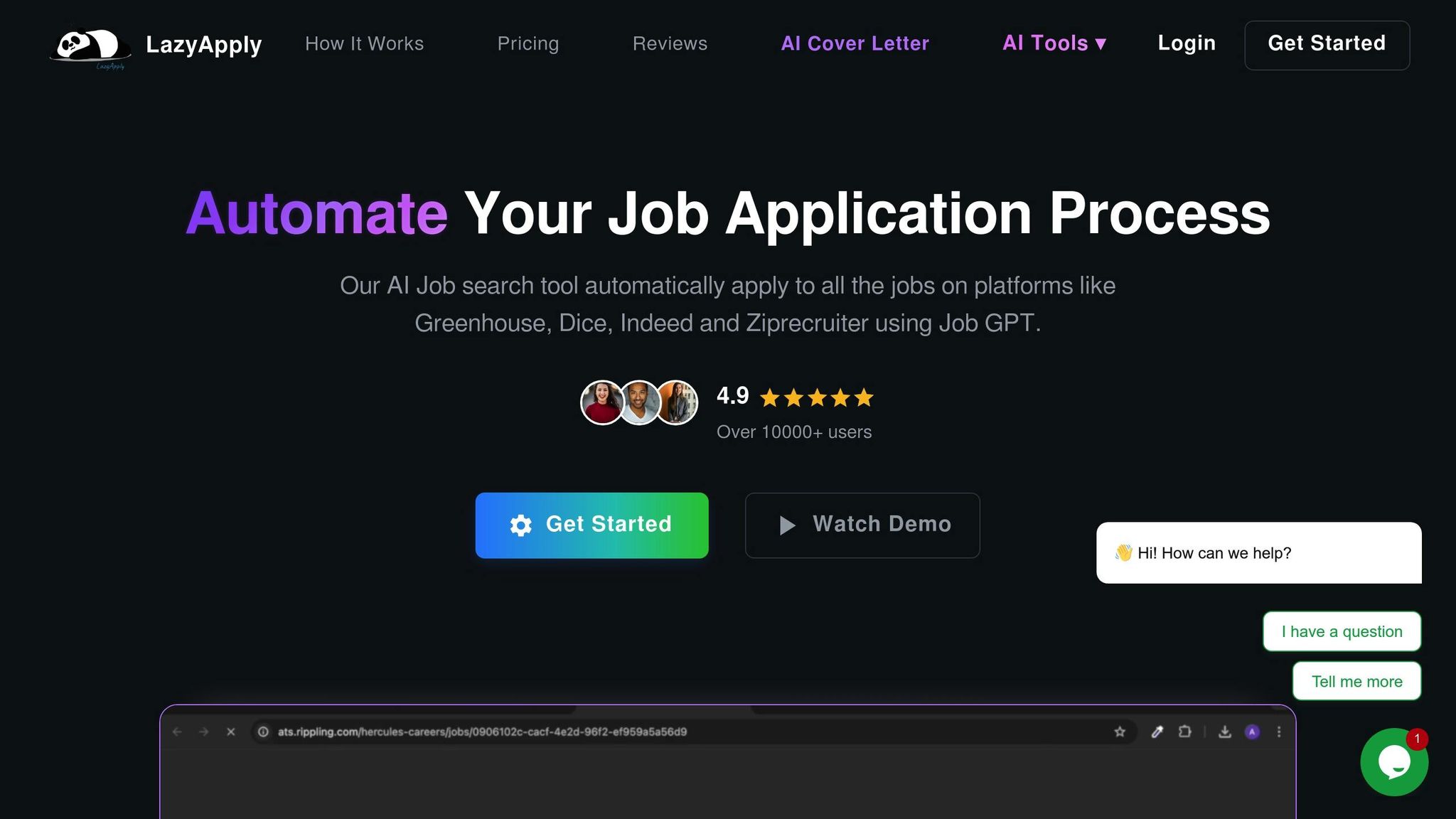
LazyApply emphasizes speed - its Chrome extension and automated bot can churn through hundreds of applications on various job boards in just hours. For anyone feeling swamped by the sheer number of job postings, this efficiency might seem like a lifesaver. However, automation often comes with trade-offs: generic applications that applicant tracking systems (ATS) might flag as spam and minimal personalization that recruiters can easily spot.
LazyApply Strengths
LazyApply’s strength lies in its ability to handle high-volume submissions. If you’re aiming to submit over 100 applications in a single day without manually entering data, it automates this process on major job boards. Its one-time pricing model, ranging from $99 to $249, eliminates ongoing fees, and its analytics dashboard helps track submission counts and basic metrics. For job seekers experimenting with multiple job boards early in their search, LazyApply’s speed might feel efficient. However, while LazyApply prioritizes speed, scale.jobs takes a different route by focusing on quality through human expertise.
Why scale.jobs Wins
scale.jobs replaces automation with expert human virtual assistants who approach each application thoughtfully. Here’s why this matters:
Tailored applications stand out. Every resume and cover letter is fine-tuned to match the specific job description. It’s not just about sprinkling in keywords - it’s about restructuring your application to highlight your most relevant experience and reflect the employer’s language. This method contributes to a 15% to 20% interview rate for those using strategic applications with follow-ups.
Manual submissions bypass ATS filters. Human assistants manually submit applications through each portal, avoiding the automated detection systems that often lead to rejections. This ensures your application gets in front of human reviewers.
Transparency builds trust. scale.jobs provides updates via WhatsApp, including timestamped screenshots, customized document versions, and confirmation of completed submissions. This level of detail ensures you know exactly what’s been done and eliminates any guesswork.
Flat-fee pricing simplifies budgeting. scale.jobs offers campaign bundles ranging from $199 to $1,099 for 250 to 1,000 applications. This keeps the cost per application low and predictable, unlike services with fluctuating fees. For those wanting extra assurance, pairing these services with a resume writing service ensures your documents are polished before customization begins.
Higher response rates from a strategic approach. While LazyApply users report an average response rate of around 6%, scale.jobs clients experience a much higher rate - 25% to 30%. This difference comes from personalized, strategic applications rather than sheer volume.
Comparison Table: LazyApply vs scale.jobs
The table below outlines the key differences between the two services.
| Feature | LazyApply | scale.jobs |
|---|---|---|
| Human Involvement | Fully automated bot | Trained human virtual assistants manage each application |
| Resume Customization | Basic AI adjustments or generic templates | AI-assisted and human-tailored for each job posting |
| ATS Compatibility | High risk of rejection due to automation | Manual submissions designed to bypass ATS filters |
| Application Method | Auto-filling with Chrome extension | Hand-submitted by human assistants on any platform |
| Proof of Work | Basic logs and analytics | Detailed WhatsApp updates with screenshots and confirmation |
| Pricing | $99–$249 (Lifetime access) | $199–$1,099 (Flat-fee bundles for 250–1,000 applications) |
| Response Rate | ~6% | 25–30% |
Who benefits from LazyApply: Job seekers who are just starting out and want to test multiple job boards quickly, or those comfortable with a high-volume approach despite lower response rates.
Who should choose scale.jobs: Those who need ATS-friendly, customized applications with clear proof of work, predictable pricing, and significantly higher response rates. It’s particularly suited for job seekers aiming for 40 to 50 well-targeted applications to land interviews instead of relying on mass submissions.
Simplify.jobs vs Scale.jobs: Human Oversight Beats Automation Limits
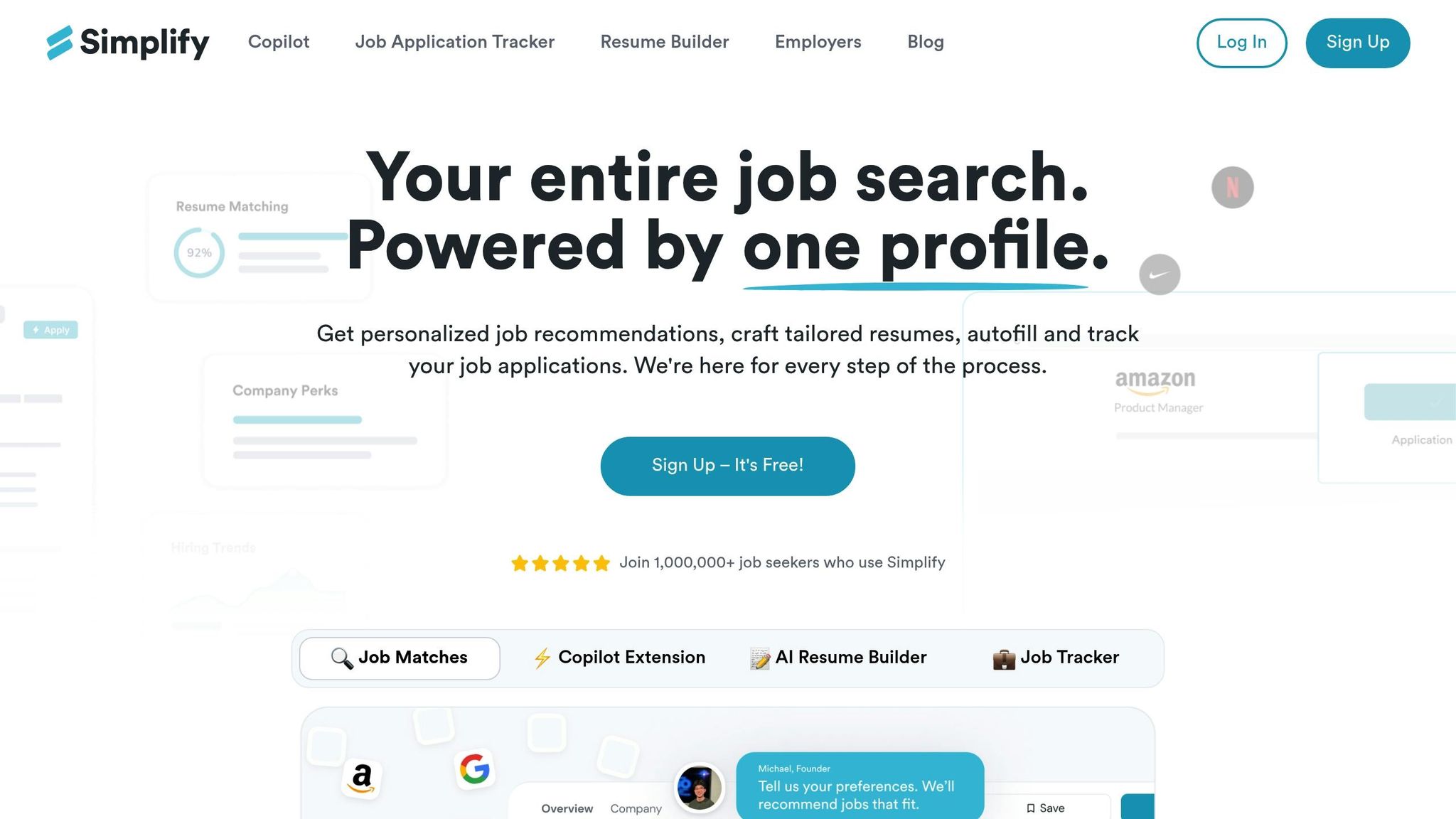
When it comes to job applications, a personalized, human-driven process often outshines high-volume, automated methods. Simplify.jobs focuses on one-click autofill for job applications across popular platforms, catering to those who want to submit 20+ applications quickly without repetitive manual effort. Its job tracking tools also help users stay organized by monitoring deadlines and application statuses. This makes it a useful option for individuals who prioritize speed and basic organization over customization.
Simplify.jobs Strengths
Simplify.jobs is particularly effective at minimizing repetitive tasks. Its one-click automation simplifies form-filling across various job boards, allowing users to save time. For those who value efficiency and basic tracking, this platform offers a practical solution. However, its automation-first approach lacks the depth and strategic focus that scale.jobs brings to the table.
Why Scale.jobs Stands Out
While Simplify.jobs focuses on automation, scale.jobs takes it a step further by integrating human expertise to address the limitations of purely automated systems. Here’s why scale.jobs has the edge:
-
Enhanced Customization for Higher Interview Rates
Scale.jobs employs human experts to review job descriptions and tailor resumes with real-life examples, ensuring they align with role-specific requirements and keywords. This personalized approach can significantly increase interview rates - from the average 2.9% with generic applications to around 5.95%. Many scale.jobs clients even achieve interview rates between 15% and 20% when strategic follow-ups are included. -
Guaranteed ATS Compatibility
Instead of relying on AI resume builder templates, scale.jobs ensures every application is manually submitted through the employer’s portal. This careful process improves keyword matching and avoids issues that often arise with automated submissions. Considering that 73% of hiring managers can identify flaws in AI-generated content, this attention to detail is crucial. -
Transparent Proof of Work
Scale.jobs provides timestamped screenshots, detailed logs, and real-time WhatsApp updates for every application. This level of transparency eliminates any guesswork, ensuring you know exactly what was submitted and when. -
Strategic Over Volume
While Simplify.jobs enables users to send hundreds of applications quickly, scale.jobs emphasizes quality over quantity. By focusing on 40 to 50 well-targeted applications, job seekers often find better results. In fact, one strategically crafted application can be as impactful as 40 generic ones. -
Flat-Fee Pricing Without Recurring Costs
Unlike Simplify.jobs’ subscription model, scale.jobs offers one-time payment bundles - for example, $199 for 250 applications, $299 for 500, or $399 for 1,000. This pricing structure aligns with the idea that most job seekers can achieve success within six months using targeted methods.
Comparison Table: Simplify.jobs vs Scale.jobs
| Feature | Simplify.jobs | Scale.jobs |
|---|---|---|
| Human Involvement | None (full AI automation) | Trained human virtual assistants oversee every application |
| Resume Customization Depth | Basic autofill using generic templates | Deep, personalized tailoring for each job posting |
| ATS Handling | Automated keyword matching (higher rejection risk) | 100% ATS-safe submissions with expert keyword matching |
| Application Execution Method | One-click browser automation | Manual, strategic submissions with follow-ups |
| Transparency & Proof | Basic tracking dashboard | Timestamped screenshots, detailed logs, real-time WhatsApp updates |
| Pricing Model | Free tool with subscription for premium features | One-time flat fee (e.g., $199 for 250 apps, $299 for 500, $399 for 1,000) |
Who Should Use Simplify.jobs
Simplify.jobs is ideal for job seekers who want to quickly explore multiple roles and platforms without customization. It’s best suited for those who are comfortable with lower response rates in exchange for speed and high-volume submissions.
Who Should Choose Scale.jobs
Scale.jobs is perfect for candidates who need ATS-optimized, personalized applications with human oversight. Its clear proof of work, strategic focus, and one-time pricing make it a strong choice for those who believe that 40 well-crafted applications can outperform 300 generic ones.
FindMyProfession vs scale.jobs: Flat-Fee Flexibility Over Per-Service Costs
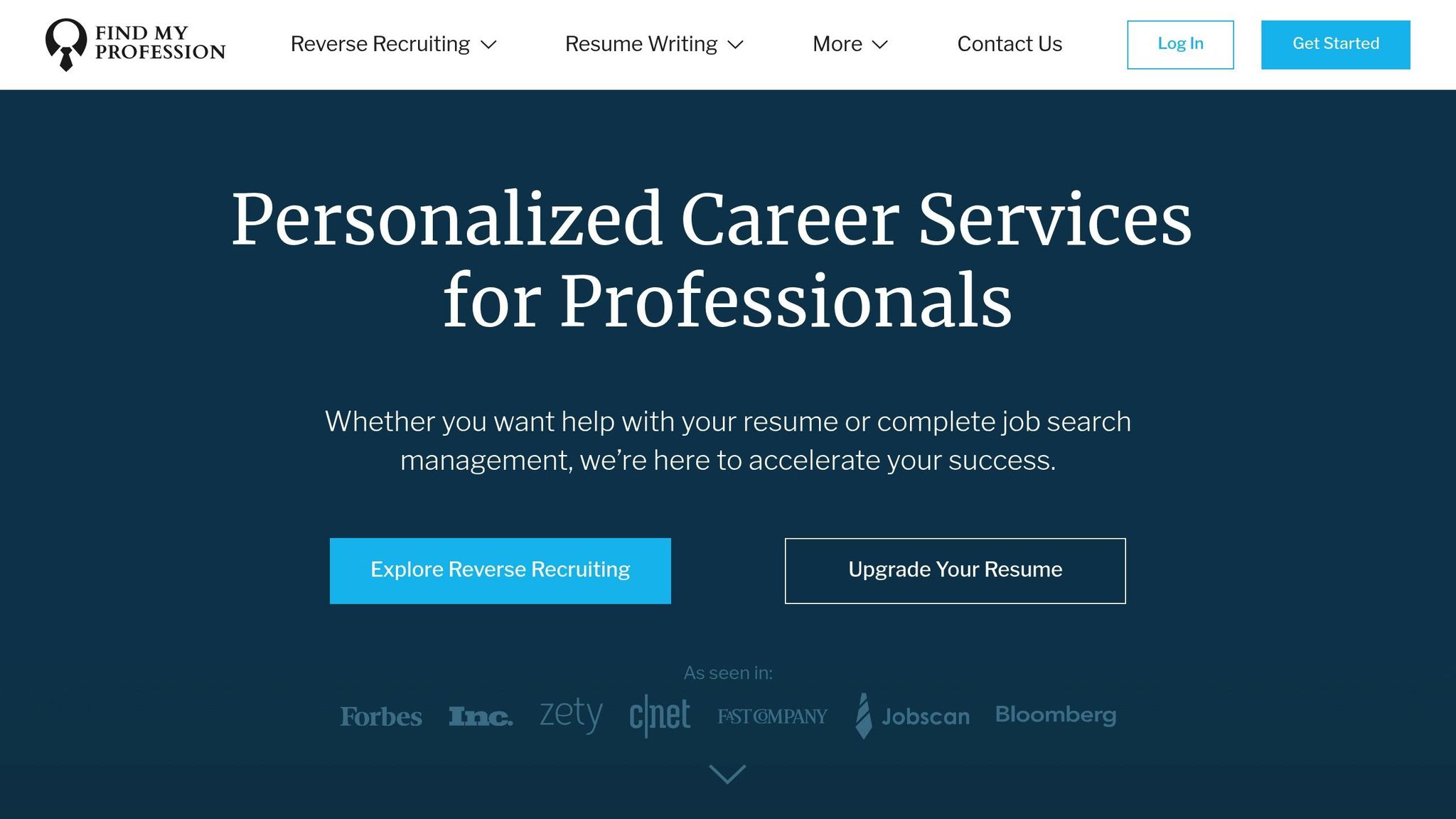
FindMyProfession focuses on crafting professional, industry-specific resumes through certified writers. Their pricing begins at $399 for a basic resume, with additional services like cover letters and LinkedIn optimization costing LinkedIn optimization costing $14949 and $199, respectively. For a more comprehensive package, costs can climb to $800+ or even $2,497 for premium career packages. While great for a one-time resume upgrade, their services stop at document creation. You’re still left to handle job applications, track submissions, and navigate applicant tracking systems (ATS) on your own.
While their resume writing services are polished, FindMyProfession doesn’t cover the full job application process.
FindMyProfession Strengths
FindMyProfession is known for delivering resumes tailored to specific industries and packed with measurable achievements. Their certified writers focus on incorporating quantifiable results and ATS-friendly keywords. Clients often report 30-50% higher interview rates, especially when resumes highlight achievements like "boosted sales by 40% in tech roles."
Why scale.jobs Stands Out
While FindMyProfession excels at resume creation, scale.jobs takes it a step further by managing the entire job search process.
-
Comprehensive Job Application Support
scale.jobs doesn’t just create resumes - they handle the entire application process. With human assistants tailoring resumes and cover letters for each job, manually submitting applications, and providing updates via WhatsApp, they save job seekers 20+ hours per week of repetitive work. -
Flat-Fee Pricing for Maximum Value
scale.jobs offers flat-fee bundles starting at $199 for 250 applications, scaling up to $399 for 1,000 applications. This pricing model often results in 70-80% savings for applicants targeting multiple roles. Plus, if you secure a job early, unused credits are refunded on a pro-rata basis. -
Higher Interview Success Rates
Generic applications typically yield 0.1-2% success rates, but scale.jobs achieves 15-20% application-to-interview rates through role-specific customization and strategic follow-ups. Many clients secure interviews within 2-4 weeks, compared to the 6-12 months it often takes with DIY efforts, even after using professional resume writing services. -
Transparent Process with Proof of Work
With scale.jobs, you get timestamped screenshots and detailed logs for every application. This level of transparency eliminates the uncertainty of whether your applications were submitted and addresses the 82% no-response rate often seen with automated systems. -
Optimized ATS Performance
While FindMyProfession ensures resumes are ATS-friendly, scale.jobs goes further by optimizing keywords for each specific job posting in real-time. This approach achieves an impressive 95% ATS pass rate, compared to the 60-70% rates common with generic documents.
This end-to-end solution makes scale.jobs a standout choice.
Comparison Table: FindMyProfession vs scale.jobs
| Feature | FindMyProfession | scale.jobs |
|---|---|---|
| Human Involvement | Certified writers for resume creation only | Virtual assistants for resume customization AND application management |
| Resume Customization | Single industry-specific rewrite | Tailored resume and cover letter for every job |
| ATS Optimization | General keyword optimization | Real-time, job-specific keyword adjustments (95% pass rate) |
| Application Management | None - user applies manually | Full application execution with updates |
| Transparency | Document delivery with revisions | Detailed updates with screenshots and logs |
| Pricing | Per-service pricing (e.g., $399 for resumes) | Flat-fee bundles ($199 for 250 apps, $399 for 1,000 apps) |
Who Should Use FindMyProfession
If you only need a polished resume and prefer to handle applications yourself, FindMyProfession is a solid choice. It’s best for those with smaller application volumes or strong professional networks who require a standout document for targeted use.
Who Should Choose scale.jobs
For job seekers looking for a complete solution, scale.jobs is the better option. Whether you’re applying to 50+ positions, want personalized oversight for each submission, or need transparent tracking and cost-effective pricing, scale.jobs provides unmatched value and efficiency.
Switch to scale.jobs If...
When it comes to job application services, there are clear scenarios where scale.jobs can make a meaningful difference.
You're Struggling with ATS Rejections
Are you qualified but still facing rejection after rejection from Applicant Tracking Systems (ATS)? You’re not alone - 63% of job seekers report being filtered out by these systems before their resume even reaches a human. The issue often lies in how applications are formatted or delivered. Automated tools can trigger bot-detection filters, especially on platforms like LinkedIn and Greenhouse, and generic resumes frequently fail ATS keyword scans.
scale.jobs tackles this head-on by using human assistants to manually submit your applications. This approach avoids bot-detection issues and ensures your resume is optimized in real-time for ATS keywords. It’s a process built to get your application past the filters and in front of decision-makers.
You Need Proof That Applications Are Reaching Employers
Submitting dozens - if not hundreds - of job applications without feedback can be frustrating. Many automated platforms operate like a "black box", offering minimal transparency. You’re often left wondering if your resume even made it to the employer.
At scale.jobs, transparency is key. They provide timestamped screenshots of every single submission. This proof not only shows when and where your applications were sent but also gives you actionable data to refine your strategy. Instead of guessing, you’ll know your efforts are reaching the right places.
You Prefer a One-Time Payment Option
For many job seekers, the search can stretch from months to nearly a year. Subscription-based services, which often cost $20–$50 per month or even more, can quickly add up. Some services charge over $800 for individual offerings, all while leaving you to handle much of the process yourself.
scale.jobs offers a more practical solution with flat-fee bundles. Starting at $199 for 250 applications and going up to $399 for 1,000 applications, their pricing eliminates recurring fees. Plus, if you land a job before using all your credits, their pro-rata refund policy ensures you only pay for what you’ve used. With a human-powered system that achieves a 15–20% application-to-interview success rate, this approach combines affordability with effectiveness, giving you a better return on your investment.
Decision Summary
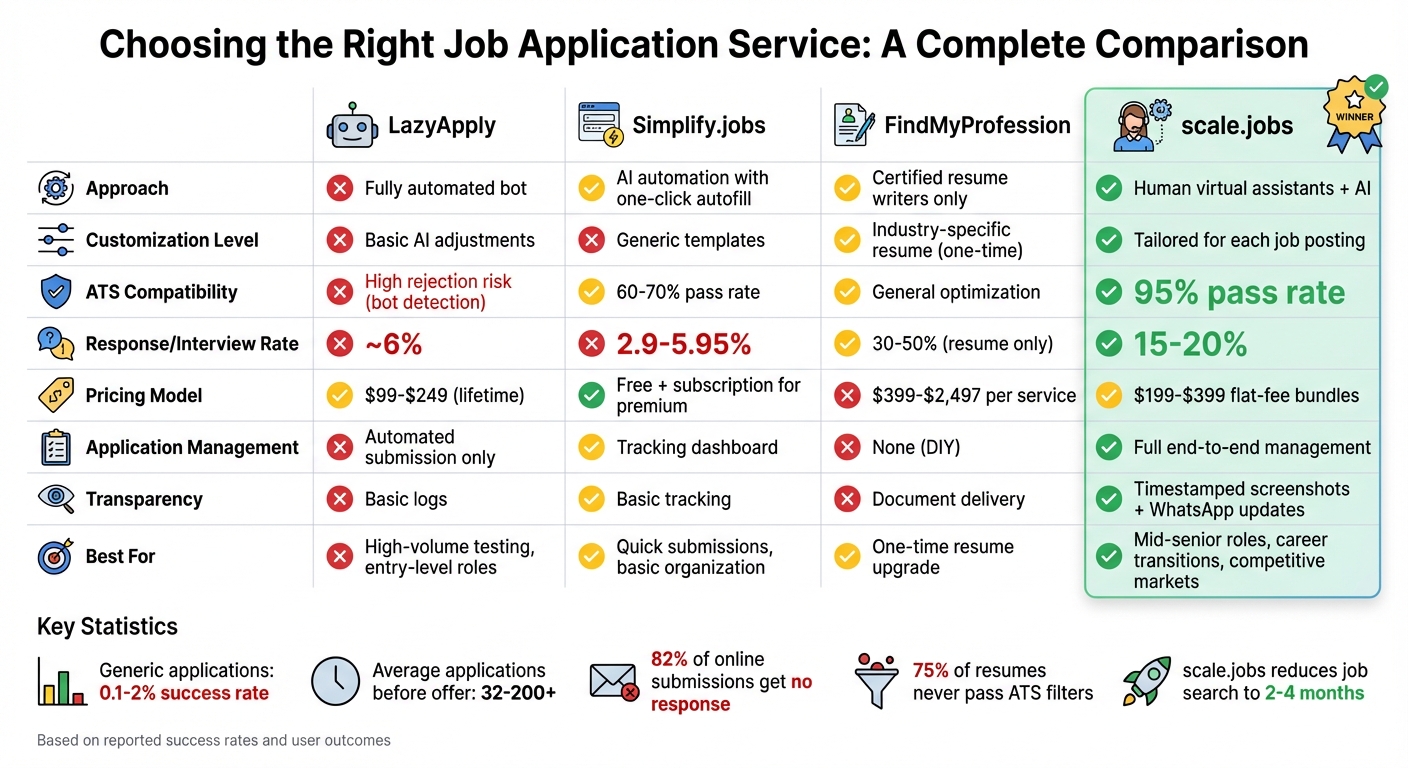
Job Application Services Comparison: LazyApply vs Simplify.jobs vs FindMyProfession vs scale.jobs
When deciding between automation tools and human-powered job application services, it’s essential to consider your job search goals and the type of results you’re aiming for. If you’re targeting entry-level roles or applying to a large number of similar positions on platforms like Indeed or ZipRecruiter, automation tools such as LazyApply or Simplify.jobs can help you submit applications quickly. These tools are most effective in high-volume scenarios where speed is more critical than precision. However, keep in mind that automation tools often struggle to bypass ATS filters due to bot-detection systems.
For mid-to-senior roles, career transitions, or competitive job markets, targeted applications consistently outperform bulk submissions. Statistics show that generic applications have a 0.1%-2% success rate, whereas tailored strategies, like those offered by scale.jobs, achieve 15-20% interview rates with far fewer applications. This highlights the importance of focusing on quality over quantity in a job search.
"I've seen job seekers apply to 300+ jobs and get ghosted, while others land interviews after just 20 targeted applications. The key is how you play the game, not just how many times you play." - Steven Mostyn
Services like scale.jobs are designed for job seekers who need a competitive edge. They provide ATS-optimized resumes, proof of work (with timestamped screenshots of every submission), and one-time payment options that avoid recurring fees. Unlike automation tools, scale.jobs uses human assistants to manually tailor applications, ensuring better customization, avoiding bot detection, and offering transparency. Real-time updates via WhatsApp further enhance the experience, making it an excellent choice for those navigating challenges like visa requirements, career changes, or extended job searches. This approach can significantly reduce the job search timeline to 2-4 months while improving outcomes.
On average, job seekers apply to 32-200+ roles before receiving an offer, with 82% getting no response from online submissions. By combining human oversight with a targeted strategy, you can connect with decision-makers more effectively and speed up your job search process.
FAQs
How many targeted applications should I send each week?
When applying for jobs, aim for 2–3 well-targeted applications per day, adding up to about 10–15 applications per week. Focus on quality rather than quantity by customizing your resume and cover letter for each position. This personalized approach significantly improves your chances of standing out to hiring managers.
How do I tailor my resume for ATS without keyword stuffing?
To make your resume ATS-friendly without resorting to keyword stuffing, focus on seamlessly incorporating relevant terms from the job description into your content. Highlight your skills and accomplishments in a way that aligns with the job requirements, ensuring the keywords fit naturally into your descriptions. Avoid cramming in unnecessary terms - clarity and relevance are key. This approach not only helps your resume pass ATS filters but also presents your qualifications effectively to potential employers.
When is an application service worth paying for?
When it comes to landing competitive or high-priority roles, paying for a job application service can be a smart investment. These services shine when they offer human-powered support, customized resumes, and clear transparency about the work they deliver. By tailoring applications to specific roles, they can help boost your chances of getting responses and securing interviews.