
Engineering Leadership Mentorship Programs
Ten mentorship programs that help engineers build leadership, executive presence, and team management skills across career stages.

Transitioning from a technical role to a leadership position is challenging. Mentorship programs can bridge the gap by providing guidance on skills like conflict resolution, executive presence, and team management. Here’s a quick look at 10 programs designed to help engineers grow into leaders:
- EMI Mentoring Program (ASCE): Focused on early-career engineers, offering structured mentor-mentee interactions.
- CUR Engineering Leadership Awards: Recognizes faculty mentoring undergraduates in research.
- Simpkins Family COMPASS Program: Peer mentorship for Cornell Engineering students.
- Develop for Good Mentorship: Connects students with professionals for technical and leadership growth.
- SAME Leader Development Program: Aims at young professionals in the A/E/C industry.
- JHU HopStart Mentorship: Supports entrepreneurial skills for Johns Hopkins students.
- NYU Tandon WoMentorship: Pairs female engineering students with experienced mentors.
- ACE Mentor Program of America: Introduces high school students to architecture, construction, and engineering.
- Johns Hopkins PROPEL Program: Matches undergraduates with alumni for leadership guidance.
- Goldman Sachs Emerging Leaders Series: Internal program with limited public details.
Each program caters to specific career stages and needs, offering opportunities to refine leadership skills, expand networks, and prepare for management roles.
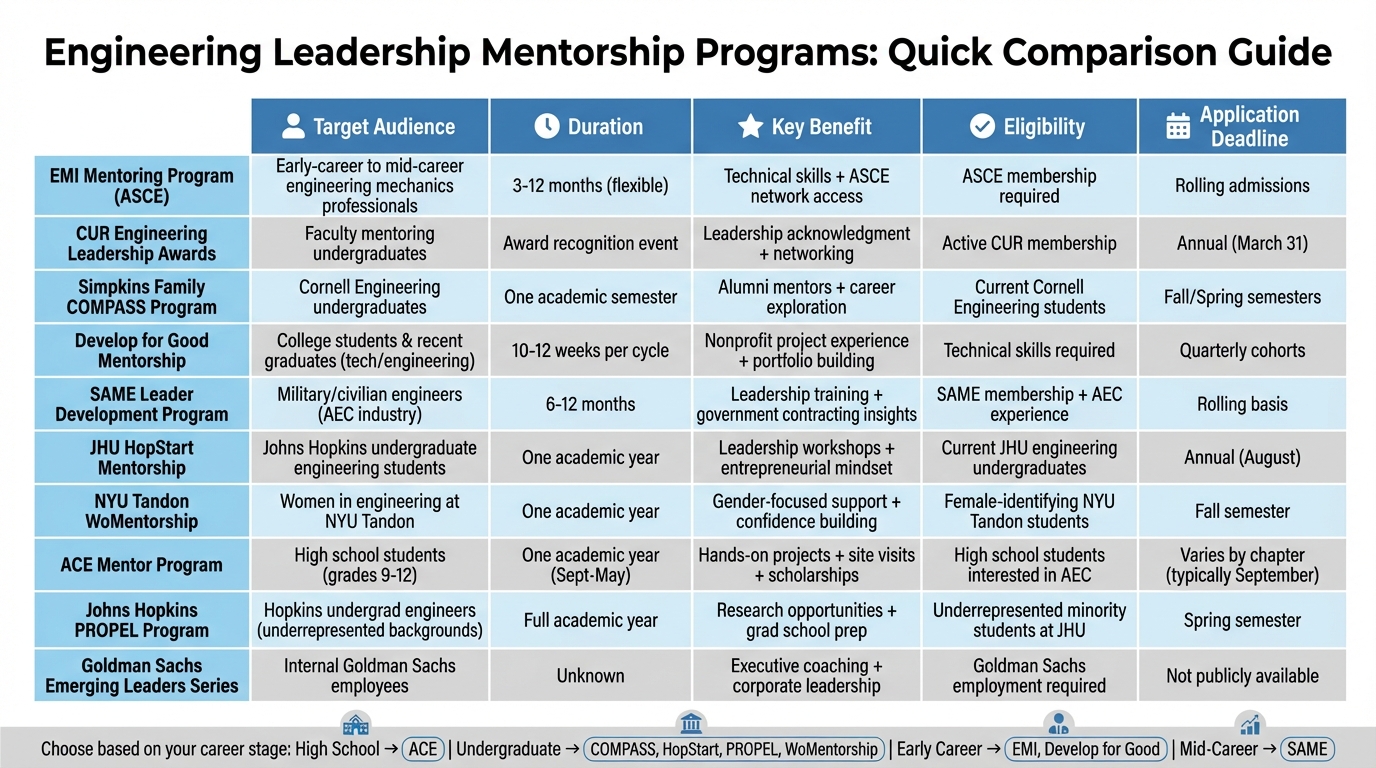
Engineering Leadership Mentorship Programs Comparison Chart
The 3 Levels of Mentorship and Why Engineers Struggle to Find Mentors
1. EMI Mentoring Program (ASCE Engineering Mechanics Institute)
The EMI Mentoring Program, organized by the American Society of Civil Engineers' Engineering Mechanics Institute, is designed to help engineers grow both technically and as future leaders. It bridges the gap between technical expertise and leadership, offering a structured path for engineers aiming to take on more responsibility in their careers.
Target Audience
This program is tailored for early-career engineers and graduate students who are preparing to move from technical roles into leadership positions. The schedule is crafted to fit the demanding routines of professionals at this stage of their careers.
Duration and Commitment
The program features a structured timeline with regular mentor-mentee interactions, ensuring participants can balance their professional responsibilities while engaging in meaningful development.
Key Benefits
Mentors have the chance to refine their leadership abilities while staying sharp in their technical fields. Meanwhile, mentees benefit from personalized career advice and insights that prepare them for leadership opportunities.
Eligibility Requirements
To participate, applicants must set specific, measurable goals for their growth. Membership in ASCE is required, with discounted rates available for students.
2. CUR Engineering Leadership and Mentoring Awards
The Council on Undergraduate Research (CUR) Engineering Division offers awards to recognize faculty who mentor undergraduates in research. These awards not only celebrate outstanding mentorship but also set clear expectations for faculty at different career stages.
Target Audience
This program is open to faculty members mentoring undergraduate researchers, regardless of where they are in their careers. The awards are divided into three categories based on career stage: Early Career (0–7 years of experience), Mid-Career (7–15 years), and Advanced Career (more than 15 years). By doing so, it ensures that faculty at all levels of experience are acknowledged.
Core Benefits
For faculty, these awards provide formal recognition of their mentoring efforts, enhancing their professional profiles and creating opportunities to expand their professional networks. For students, the program highlights exceptional teacher-scholar models, inspiring them to take on leadership roles in technical research and the broader industry.
Eligibility Requirements
Nominees must be CUR members and show a clear, measurable impact on their students' professional growth in undergraduate engineering research. The selection process focuses on how mentors have fostered research opportunities and helped students transition into leadership roles. Evidence such as student publications, conference presentations, or successful placements can significantly strengthen a nomination by demonstrating tangible mentorship outcomes.
3. Simpkins Family COMPASS Program (Cornell Engineering)

The Simpkins Family COMPASS (Community of Mentors and Peers Assisting Student Success) Program is a peer-mentoring initiative at Cornell Engineering designed to help new students settle into their academic and campus life. This program matches first-year and transfer students with experienced upper-level engineering students who act as mentors. These mentors provide insights and advice on managing Cornell's challenging academic environment while also creating a supportive community. Through this structure, the program nurtures leadership skills in students right from the start.
Target Audience
The program connects first-year and transfer students with upper-level engineering mentors. While mentees benefit from guidance and support, mentors gain valuable leadership experience.
Core Benefits
This peer-mentoring model benefits both mentors and mentees. Mentors sharpen their leadership abilities by offering advice and linking mentees to key resources. Meanwhile, mentees find a supportive network that helps them navigate the challenges of joining Cornell Engineering.
4. Develop for Good Mentorship

The Develop for Good Mentorship program bridges the gap between emerging talent and experienced professionals, offering an opportunity to grow leadership abilities and technical skills by tackling real-world challenges. Here's a closer look at who it's for, how it's structured, and what participants stand to gain.
Target Audience
This program is tailored for college students and recent graduates specializing in computer science, software engineering, or similar technical fields. Whether you're looking for guidance or eager to share your expertise as a mentor, this initiative welcomes both aspiring professionals and seasoned experts.
Duration and Commitment
Designed with flexibility in mind, the program fits seamlessly into the busy schedules of students and early-career professionals.
Key Benefits
Participants walk away with valuable industry insights, improved leadership and communication abilities, and meaningful connections with established professionals in their field. It's a chance to grow personally and professionally while building a stronger network.
5. SAME Leader Development Program
The Society of American Military Engineers (SAME) Leader Development Program is designed to help young professionals in the architecture, engineering, and construction (A/E/C) industry step into leadership roles. By combining a structured curriculum, mentorship, and hands-on experience, it equips technical experts with the skills needed to transition into management. This program bridges the gap between technical expertise and the responsibilities of leading teams and making strategic decisions.
Target Audience
The program is specifically aimed at SAME members under 40 who have shown strong leadership potential. It’s tailored for engineers ready to move beyond their technical roles and develop the interpersonal and strategic skills required to manage teams effectively.
Eligibility Requirements
To participate, candidates must meet specific criteria. They need to be current SAME members in good standing and secure an endorsement from a SAME Post. This endorsement highlights their commitment to both the organization and their professional field.
Core Benefits
Participants gain essential skills in communication, strategic thinking, and team management. The program helps build confidence, refine executive presence, and expand professional networks within the industry. The curriculum is focused on practical leadership tools, helping engineers navigate the challenges of transitioning from individual contributor to team leader, while tackling the real-world complexities of managing projects and people.
6. JHU HopStart Mentorship (Center for Leadership Education)
The HopStart Mentorship program, part of Johns Hopkins University's Undergraduate Startup Challenge through the Center for Leadership Education at the Whiting School of Engineering, is designed to nurture entrepreneurial skills in students. While its primary focus is entrepreneurship, the program also equips engineering students with the tools to launch ventures and lead groundbreaking projects. Each student team is matched with industry professionals and JHU alumni who provide tailored guidance throughout the competition - making it a standout opportunity for budding entrepreneurs.
Target Audience
This program is geared toward Johns Hopkins undergraduates who are diving into startup ventures, with a particular focus on engineering students working on technical innovations. It's especially valuable for those combining technical know-how with entrepreneurial leadership in areas like General Business, Medical Technology, and Social Impact.
Core Benefits
Participants get real-world experience in shaping business models, creating compelling pitch decks, and preparing for the final competition - a chance to showcase their work and ideas.
Duration/Commitment
The mentorship runs alongside the HopStart competition cycle, culminating in the final pitch event. The level of commitment depends on the availability of both the team and their mentor.
7. NYU Tandon WoMentorship
NYU Tandon WoMentorship is designed to connect female-identifying engineering students with experienced alumnae and industry professionals. This initiative aims to help women excel in technical fields where they are often underrepresented. Through personalized mentorship, networking events, and skill-building workshops, participants receive career advice and job application assistance and connect with role models who have navigated similar challenges. Here's a closer look at who can join and the benefits of participating.
Target Audience
The program is specifically for female-identifying students at NYU Tandon. It pairs them with mentors who understand the challenges of working in male-dominated technical fields, helping to boost confidence and build meaningful connections in STEM.
Eligibility Requirements
- Mentees: Open to first-year undergraduates and transfer students beginning their journey in engineering.
- Mentors: Available to sophomores, juniors, seniors, and graduate students who maintain strong academic performance.
Core Benefits
This mentorship program creates a welcoming community and broadens professional networks. Participants gain exposure to various engineering disciplines and practical strategies for handling gender-specific challenges in technical careers. By providing structured support, the program ensures women have access to guidance and opportunities, rather than leaving their career growth to chance.
8. ACE Mentor Program of America

The ACE Mentor Program of America connects high school students interested in architecture, construction, and engineering with industry professionals. Together, they work on real-world design projects, offering students a hands-on glimpse into these fields. Throughout the academic year, mentorship teams collaborate on projects that simulate industry workflows, providing a unique learning experience.
Who Can Participate?
This program is open to high school students in grades 9–12 who have an interest in exploring careers in architecture, construction, or engineering. No prior experience is needed - just a genuine curiosity and willingness to learn.
Time Commitment
Students commit to participating throughout the academic year, dedicating two to three hours each week. During this time, they work on design projects that reflect the teamwork and problem-solving found in professional engineering and design environments.
What Are the Benefits?
Participants gain firsthand experience in how professionals from different disciplines - engineers, architects, and construction managers - collaborate on projects. Beyond the technical exposure, students build valuable connections with industry mentors, who can offer guidance on career paths, internships, and even scholarships. These experiences help students refine their goals and make informed decisions about college and future careers.
How to Get Involved
To join, students must be enrolled in high school and able to attend regular after-school sessions. While the program is open to all, availability depends on whether there's an active ACE chapter in the student’s area.
9. Johns Hopkins PROPEL Program
The PROPEL (Professional Outreach Programs to Engineering Leaders) initiative at Johns Hopkins University's Center for Leadership Education connects undergraduate engineering students with alumni mentors. This program blends academic learning with real-world mentorship, guided by engineers who have transitioned into leadership roles.
Target Audience
The program is designed for undergraduate students in the Whiting School of Engineering at Johns Hopkins University who are eager to build leadership skills alongside their technical expertise. It welcomes participants from all engineering disciplines, whether their future lies in industry or academia.
Duration/Commitment
Students participating in the program are expected to maintain consistent communication with their alumni mentor throughout the academic year. At least one meaningful interaction per month is required, which can take the form of phone calls, video conferences, or in-person meetings. These regular conversations allow relationships to grow organically while providing students with ongoing career guidance.
Core Benefits
Participants gain valuable insights into career paths, workplace expectations, and leadership skills that go beyond technical knowledge. Alumni mentors offer firsthand advice on managing workplace challenges, leading projects, and honing communication abilities - skills often overlooked in textbooks. Additionally, students can expand their professional networks, potentially unlocking internship and job opportunities through their mentor's connections.
Eligibility Requirements
To join, students must be undergraduates in the Whiting School of Engineering at Johns Hopkins University, show a strong interest in leadership development, and commit to monthly mentor interactions.
10. Goldman Sachs Emerging Leaders Series

The Goldman Sachs Emerging Leaders Series doesn't have much publicly available information, which hints that it might be an internal initiative or possibly a rebranded program. This makes it a bit tricky to evaluate compared to more accessible mentorship opportunities.
For engineers looking for executive coaching or clear career development paths, exploring external programs might be a better bet. Programs like the ACE Mentor Program of America or the SAME Leader Development Program provide structured mentorship without the need to be tied to a specific company.
If you're also juggling leadership development with a job search, platforms like scale.jobs can simplify the process. Here's what it offers compared to corporate programs:
- Personalized recruiting support powered by real people
- AI tools for creating ATS-friendly resumes and cover letters
- Real-time updates via WhatsApp, complete with proof-of-work tracking
- A one-time payment model, so no recurring fees
- Time-saving support, freeing up over 20 hours a week for networking and interviews
For engineers aiming to grow their leadership skills while actively job hunting, this kind of external support can make all the difference.
Program Comparison Table
The table below provides an overview of various mentorship programs tailored to different career stages, professional needs, and time commitments.
| Program | Target Audience | Duration/Commitment | Core Benefits | Eligibility Requirements | Application Deadlines |
|---|---|---|---|---|---|
| EMI Mentoring Program (ASCE) | Early-career to mid-career engineering mechanics professionals | 3-12 months (flexible terms) | Build technical skills, collaborate on research, access ASCE network | Must be an ASCE member | Rolling admissions |
| CUR Engineering Leadership Awards | Faculty and administrators in undergraduate research | Award recognition event | Leadership acknowledgment, networking, institutional exposure | Active CUR membership and proven leadership in undergraduate research | Annual (typically March 31) |
| Simpkins Family COMPASS Program | Cornell Engineering undergraduates | One academic semester | Explore careers, connect with alumni mentors, develop professional skills | Open to current Cornell Engineering students | Fall and spring semesters |
| Develop for Good Mentorship | College students and recent graduates in tech/engineering | 10-12 weeks per project cycle | Gain nonprofit project experience, build a portfolio, contribute to social impact | Technical skills required; open to students and recent graduates | Quarterly cohorts |
| SAME Leader Development Program | Military and civilian engineers in architecture, engineering, and construction | 6-12 months | Leadership training across sectors, insights into government contracting, national security project involvement | SAME membership and professional AEC experience | Rolling basis |
| JHU HopStart Mentorship | Johns Hopkins undergraduate engineering students | One academic year | Leadership workshops, peer mentoring, entrepreneurial mindset growth | Must be a current JHU engineering undergraduate | Annual (typically August) |
| NYU Tandon WoMentorship | Women in engineering at NYU Tandon | One academic year | Gender-focused support, confidence building, industry networking | Female-identifying NYU Tandon students | Begins in fall semester |
| ACE Mentor Program | High school students interested in architecture, construction, and engineering | One academic year (September-May) | Work on hands-on projects, participate in site visits, access scholarships | Open to high school students (grades 9-12) | Varies by local chapter (typically September) |
| Johns Hopkins PROPEL Program | Hopkins undergraduate engineers from underrepresented backgrounds | Full academic year | Research opportunities, graduate school preparation, diversity-focused community | Underrepresented minority students at JHU | Apply during spring semester |
| Goldman Sachs Emerging Leaders Series | Internal Goldman Sachs employees (limited public info) | Unknown | Executive coaching, corporate leadership development | Must be employed at Goldman Sachs | Not publicly available |
Balancing job applications with mentorship commitments can be overwhelming. Scale.jobs simplifies the process with AI-optimized, ATS-friendly documents, real-time WhatsApp updates, and a one-time fee - giving you more time to focus on your career growth and networking efforts.
Conclusion
Today, engineers have access to well-defined pathways that guide them toward leadership roles. Programs like Cornell's COMPASS and JHU's HopStart cater to undergraduate students, while mid-career professionals can benefit from initiatives such as the ASCE EMI Mentoring Program and SAME Leader Development Program. These opportunities provide tailored support for technical professionals as they transition into management or executive positions.
Each program addresses specific needs, whether it's enhancing technical expertise, building executive presence, or tackling challenges unique to the industry. For example, mentorship programs often help bridge skill gaps and accelerate career advancement, as seen in numerous real-world success stories.
Choosing the right program depends on your career stage and goals. Early-career engineers might find foundational programs like Develop for Good or the ACE Mentor Program particularly helpful. On the other hand, seasoned professionals should consider advanced options that align with their experience. Don’t forget to check if your employer offers reimbursement for professional development - many companies are willing to invest in their employees' growth.
Managing mentorship commitments alongside job searching can feel overwhelming, but tools like Scale.jobs can help. With features like reverse recruiting approach, ATS-friendly resumes, and real-time WhatsApp updates, it can save you over 20 hours a week - time you can redirect toward networking and career growth.
FAQs
How can mentorship programs help engineers grow into leadership roles?
Mentorship programs offer engineers a structured way to move from technical roles into leadership positions. By connecting them with seasoned mentors, these programs focus on building key soft skills like communication, team motivation, and decision-making - areas that technical education often doesn’t emphasize.
With one-on-one support, engineers gain tailored advice on leading meetings, providing constructive feedback, and uniting teams around common objectives. This personalized guidance not only sharpens their leadership abilities but also boosts their confidence and helps them feel more connected in their new roles. Beyond skill-building, mentorship programs open doors to broader professional networks, making the shift to management roles smoother and more effective.
Who is eligible to join the EMI Mentoring Program?
Based on the information at hand, there doesn’t appear to be any specific details regarding the eligibility criteria for the EMI Mentoring Program. The available sources primarily cover general engineering mentorship programs, their advantages, and some examples, but they don’t reference a program specifically branded as EMI. If you have additional details or a specific source about the EMI Mentoring Program, feel free to share, and I can help provide more clarity.
What are the best mentorship programs for women in engineering who want to grow as leaders?
For women engineers aiming to step into leadership roles, WEST – Mentorship for Women Engineers is a standout option. Designed for women and non-binary technologists, WEST provides resources like a free "Mentee Starter Kit" to help participants set clear goals and expectations. Members can pair with mentors who align with their career aspirations, schedule personalized one-on-one sessions, participate in group events, and become part of a supportive professional community.
Other programs worth considering include the Society of Women Engineers (SWE) Mentor Network, which is available to active SWE members with a paid membership, and the NYU Tandon WoMentorship program, tailored exclusively for NYU students. While these programs offer valuable opportunities, WEST shines for its accessibility, practical mentorship approach, and commitment to uplifting women in technical careers.