
CSR in Talent Acquisition: Benefits for Job Seekers
How CSR-driven employers help job seekers: better value alignment, higher satisfaction, unique career paths, and tips to spot authentic CSR.


Corporate Social Responsibility (CSR) is reshaping how companies attract talent. For job seekers, working for CSR-driven employers offers clear advantages:
- Value Alignment: 87% of Gen Z professionals want to work for companies that reflect their beliefs. CSR efforts signal a company's priorities and culture, helping you find workplaces that match your values.
- Job Satisfaction: 74% of employees feel more fulfilled when their work contributes to societal or environmental improvement. CSR-focused employers often provide a sense of purpose beyond the paycheck.
- Career Growth: Companies with CSR initiatives create roles like Sustainability Analyst or CSR Manager, offering unique career paths. They also see 52% lower turnover among new hires, supporting long-term growth.
To identify genuine CSR commitments, look for third-party certifications (e.g., B Corp) and review ESG reports. Platforms like scale.jobs simplify the process by connecting you with purpose-driven employers and offering tools to automate your job search.
Key takeaway: Prioritizing CSR-focused companies can lead to a more meaningful and satisfying career while aligning your work with your personal values.
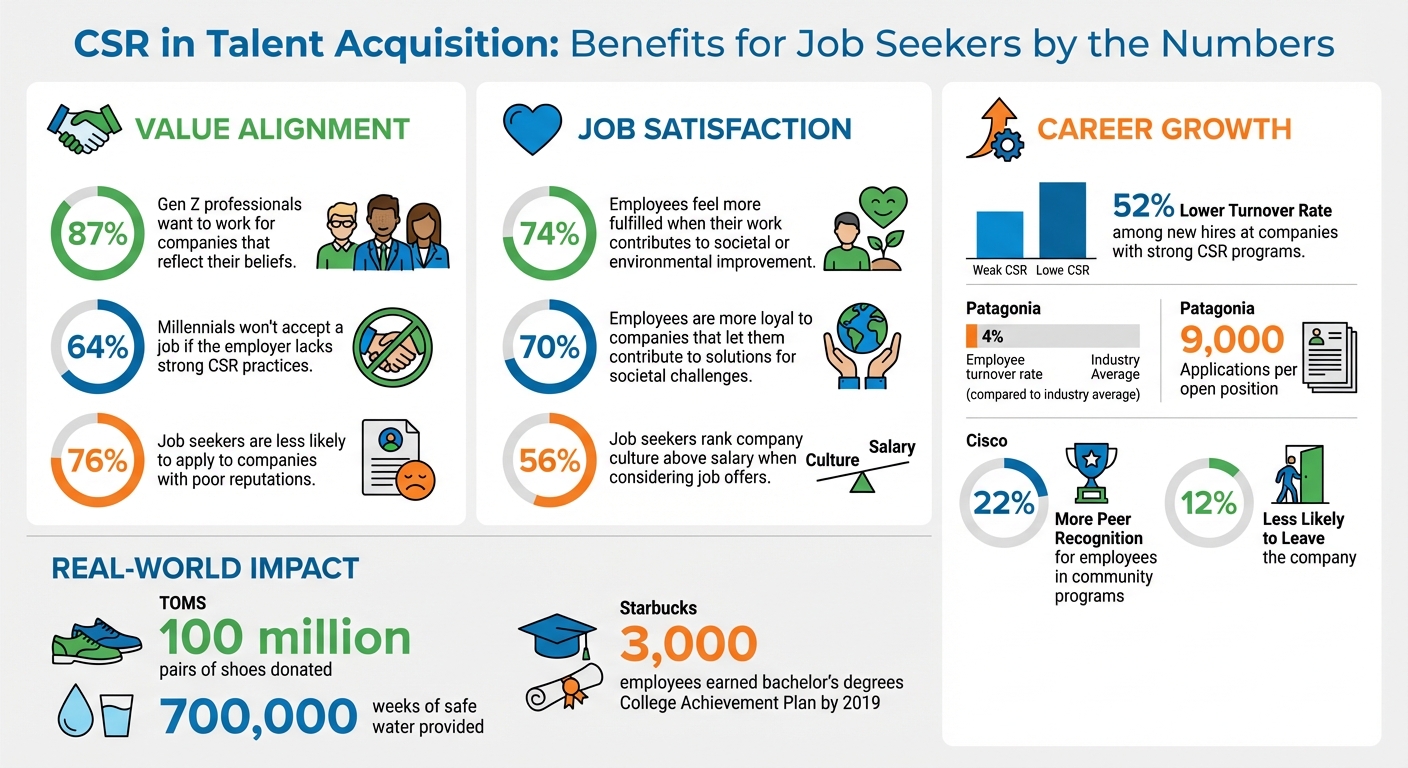
Key Statistics: How CSR Benefits Job Seekers in Talent Acquisition
What is CSR in Talent Acquisition?
What Corporate Social Responsibility Means
Corporate Social Responsibility (CSR) pushes businesses to consider how their actions affect society and the environment. The United Nations describes it as "a management concept whereby companies integrate social and environmental concerns in their business operations and interactions with their stakeholders." In simpler terms, it means companies aim to balance profitability with making a positive impact on employees, communities, and the planet.
CSR typically revolves around four main areas: ethical labor practices (ensuring fair treatment of employees), environmental sustainability (minimizing carbon footprints and waste), philanthropy (donating to important causes), and volunteerism (encouraging employees to contribute to their local communities). A great example is TOMS, which has donated 100 million pairs of shoes and provided 700,000 weeks of safe water to global communities as part of its mission-driven CSR efforts. Similarly, LEGO's CEO, Niels B. Christiansen, underscores the company's commitment by stating:
"Every day, employees at The LEGO Group are empowered to make decisions to do what's right for children, our fans, our partners, the environment, and our local communities."
This focus on doing good not only benefits society but also appeals to job seekers who value ethical practices and sustainable growth. By weaving CSR into their employer branding, companies can create deeper connections with potential candidates.
How Companies Use CSR to Attract Talent
With CSR clearly defined, companies are now using it as a key element in their recruitment strategies. By showcasing their values, businesses can attract candidates who share similar beliefs. Incorporating sustainability goals into job postings or career pages is one way companies demonstrate their commitment to CSR. These efforts are often embedded into employer branding, helping them stand out in a crowded job market.
Why does this work? CSR resonates with job seekers through three psychological signals: value alignment, anticipated pride, and trust in fair treatment. Starbucks illustrated this with its College Achievement Plan, launched in 2014, which covered tuition costs for thousands of employees. By 2019, around 3,000 employees had earned bachelor's degrees through the program, leading to a surge in job applications across all levels - from baristas to corporate positions.
Patagonia takes a unique approach by building its recruitment strategy around environmental activism. As of July 2020, the company attracted an average of 9,000 applications for every internship and full-time role, all while maintaining a remarkably low 4% employee turnover rate. Rose Marcario summed it up perfectly:
"When you do work that's good for the world, people want to be part of it."
How Job Seekers Benefit from CSR-Focused Companies
Working for Companies That Match Your Values
These days, finding a workplace that aligns with your personal values isn't just a bonus - it’s often a must. When your ethical beliefs line up with a company’s Corporate Social Responsibility (CSR) efforts, it creates a "perceived value fit" that feels more rewarding than just collecting a paycheck.
A growing number of job seekers are prioritizing this alignment, especially Gen Z. In fact, 87% of Gen Z professionals say it’s important to work for a company that reflects their values. This generation, and many others, see CSR as a window into a company’s internal culture. If an organization treats the environment and communities with care, it’s a good sign they’ll treat their employees with respect, fairness, and dignity. This alignment helps you gauge whether you’ll thrive in a workplace - before you even start.
When your values and your employer’s mission are in sync, it’s not just about finding a job; it’s about finding a place where you truly belong. And that connection can lead to greater satisfaction and a stronger sense of purpose.
Greater Job Satisfaction and Sense of Purpose
Working for a company that takes CSR seriously can transform how you feel about your job. When you’re part of something that contributes to meaningful social or environmental change, it creates a sense of emotional connection that goes far beyond the paycheck.
Here’s what the numbers say: 74% of employees report feeling more fulfilled when they can make a positive social impact through their work, and 70% say they’re more loyal to companies that let them contribute to solutions for societal challenges. This emotional engagement - sometimes called "anticipated pride" - comes from knowing your work is tied to a bigger mission. It’s also why 56% of job seekers rank company culture above salary when considering job offers.
The benefits don’t stop there. Being part of a socially responsible organization can boost your daily motivation, enhance your self-esteem, and make your workdays feel more meaningful. Whether it’s tackling issues like climate change or supporting community development, the chance to contribute to these causes adds a layer of fulfillment that traditional workplaces might not offer.
Career Growth in Purpose-Driven Organizations
CSR-focused companies don’t just offer meaningful work - they also open doors to exciting career opportunities. Many of these organizations create roles like Sustainability Analyst, CSR Manager, or Ethical Supply Chain Manager, providing specialized career paths that are hard to find in more traditional companies.
The impact of CSR on career growth is clear. For example, Cisco found that employees involved in community programs received 22% more peer recognition and were 12% less likely to leave the company. More broadly, companies with strong CSR programs see a 52% lower turnover rate among new hires. This kind of stability creates a solid foundation for long-term career development.
These organizations often foster environments where senior leaders actively support employee growth. Working on sustainability initiatives can help you develop skills like systems thinking, cross-functional collaboration, and even "green skills" that are increasingly in demand. Many companies also offer Volunteer Time Off (VTO), giving you the chance to build new skills, expand your network, and make a difference - all while growing professionally.
For Gen Z workers, this approach is especially appealing. 74% of them value purpose at work more than a paycheck, and 50% have turned down assignments that didn’t align with their ethics. In purpose-driven companies, you won’t have to compromise your values to succeed. Instead, you’ll find a workplace that supports both your career ambitions and your personal beliefs.
Why You Should Target CSR-Driven Employers
Better Employee Retention and Satisfaction Rates
Companies that prioritize corporate social responsibility (CSR) often create workplaces where employees feel valued and connected to a greater purpose. Take Patagonia, for example. With a turnover rate of just 4%, the company demonstrates how genuine CSR efforts can foster stability. When employees see their work contributing to something beyond just profits, it cultivates loyalty and dedication.
The numbers back this up: 74% of employees say their work feels more meaningful when they can make a positive social or environmental impact. Additionally, 70% of employees report being more loyal to companies that empower them to address societal challenges. This sense of purpose not only boosts job satisfaction but also supports long-term career growth. CSR-driven companies often enjoy the added benefit of a strong reputation, which further reinforces employee pride and retention.
Stronger Company Reputation in the Job Market
Employers with credible CSR programs naturally attract top talent. Why? Because their commitment to social responsibility resonates with job seekers. Patagonia, for instance, receives an impressive 9,000 applications for every open position - highlighting how a strong CSR reputation can make a company highly desirable.
On the flip side, 76% of job seekers are less likely to apply to companies with poor reputations. In today’s transparent job market, a company’s image directly affects its ability to hire and retain talent. Starbucks is a great example of how CSR initiatives can enhance reputation. Through its College Achievement Plan, launched in 2014, Starbucks covered full tuition for eligible employees. By 2019, about 3,000 employees had graduated through the program, which led to a surge in job applications across various roles. To take advantage of these benefits, it’s essential to evaluate a company's CSR initiatives carefully.
How to Evaluate a Company's CSR Commitment
Not all CSR programs are as genuine as they appear. Some companies engage in "greenwashing", spending more time and money promoting their social responsibility efforts than actually implementing them. To distinguish authentic CSR from superficial claims, look for third-party certifications like B Corporation (B Corp) status, social purpose corporations (SPCs), or low-profit limited liability companies (L3Cs). You can also review a company’s annual CSR or ESG reports for measurable data, such as reductions in carbon emissions, investments in local communities, or diversity statistics.
Campbell’s Soup Company sets a strong example of transparency. It maintains an "Impact Page" and blog called "Life at Campbell's", where it shares detailed metrics on responsibly sourced materials, charitable contributions, and greenhouse gas reductions.
When interviewing, ask specific questions to gauge a company’s commitment: How do they measure the success of their CSR programs? How are employees encouraged to get involved? What percentage of employees takes advantage of CSR-related benefits like volunteer time off? Additionally, platforms like Glassdoor can provide insights into whether employees feel the company’s efforts are genuine. Considering that 64% of millennials won’t accept a job if the employer lacks strong CSR practices, taking the time to evaluate a company’s dedication to social and environmental goals is a smart move for your career satisfaction.
Corporate social responsibility jobs: How do I start a career in CSR?
How scale.jobs Helps You Find CSR-Focused Employers
Finding companies that genuinely prioritize CSR (Corporate Social Responsibility) can feel like searching for a needle in a haystack, especially when you're busy with applications, interviews, and networking. That's where scale.jobs steps in. By blending free job search tools, AI-powered features, and human assistant services, scale.jobs streamlines the process of identifying and applying to CSR-focused employers. Let’s break down how their tools can simplify your search.
Free Job Search Tools for Targeting CSR Companies
scale.jobs offers a job board with a staggering 2 million monthly postings, specifically curated to include CSR-driven roles. Their ATS-ready Resume Builder ensures your resume is optimized to navigate applicant tracking systems (ATS) - a crucial step for standing out in competitive CSR-focused job markets. To stay organized, the Application Tracker helps you monitor your progress and manage your applications efficiently.
One standout tool is the ATS Score Checker, which fine-tunes your resume to achieve a success rate of 90% or higher, increasing your chances of passing CSR employers' rigorous screening processes. But that’s not all - scale.jobs also provides additional free resources like a Salary Predictor, Interview Questions Predictor, and Portfolio Website Generator to help you present yourself as a strong candidate.
AI and Human Assistant Services for Better Applications
While many platforms rely solely on automation, scale.jobs takes a hybrid approach that combines AI with human expertise. Their AI Assistant Pro - available for just $9/month during launch - creates unlimited, tailored resumes and cover letters for each job application. These materials are customized to emphasize how your personal values align with a company's CSR goals.
The real game-changer, however, is their Human Assistant service. Instead of leaving everything to algorithms, trained virtual assistants and reverse recruiters manually submit your applications, steering clear of automated pitfalls.
"We apply to jobs with REAL HUMANS, no AI Apply bullshit." - scale.jobs
This human-first approach gets results: 9 out of 10 job seekers using scale.jobs secure a position within 90 days. The average job search time shrinks from five months to just 1–3 months. Users like Sona Tambe have shared their experiences:
"Applying jobs everyday has been super daunting. But now with scale jobs, one can apply 100s of jobs per day as well as focus on prep for interviews."
By combining automation and human support, scale.jobs ensures your applications are not only efficient but also highly effective.
What Makes scale.jobs Different
Unlike subscription-based platforms like LazyApply or LoopCV, scale.jobs offers a straightforward pricing model: a one-time fee of $199 for 250 applications. There are no hidden costs, and 70% of customers receive refunds for unused credits because they land jobs before their campaigns are complete. Transparency is a priority, with real-time WhatsApp updates and time-stamped proof-of-work screenshots that show exactly when and where your applications were submitted.
With a 4.8/5 rating from over 1,500 users and endorsements from career experts like Melissa Grabiner and Linda Le, scale.jobs stands out for its personal touch. This approach is especially valuable for job seekers targeting CSR-focused employers, as 64% of millennials prioritize CSR practices when choosing where to work. If you're looking for a job search platform that blends technology with human insight, scale.jobs might just be your perfect match.
Conclusion
Opting to work for a company that emphasizes corporate social responsibility (CSR) can lead to greater job satisfaction and meaningful career growth. When your employer prioritizes social and environmental responsibility, it often aligns closely with your personal values, creating a more fulfilling work experience. Plus, research shows that CSR-focused companies tend to foster higher employee satisfaction and loyalty.
That said, finding these employers isn’t always easy. This is where scale.jobs steps in to simplify the process. With access to 2 million monthly job postings, free applicant tracking system (ATS) tools, and a unique hybrid approach combining AI customization with human support, scale.jobs makes your search more efficient. Unlike fully automated platforms, they rely on trained virtual assistants to ensure applications are submitted accurately, making it an ideal tool for job seekers aiming to build purpose-driven careers.
FAQs
How can I tell if a company's CSR efforts are authentic?
To gauge whether a company's CSR efforts are sincere, focus on transparency and tangible outcomes. Genuine initiatives often come with detailed reports, independent certifications, or clear data that showcase their impact. These efforts should align closely with the company's core values and business objectives, signaling a long-term dedication rather than a fleeting marketing ploy.
Look for consistent positive indicators - for instance, employees who take pride in their workplace and a strong reputation as an employer. On the flip side, be wary of programs that feel overly promotional or lack meaningful substance. Authentic CSR is about action, not just appearances.
What career opportunities are available at companies with a strong focus on Corporate Social Responsibility (CSR)?
Companies that focus on Corporate Social Responsibility (CSR) often establish roles dedicated to tackling social and environmental challenges. These positions cover areas such as environmental sustainability, responsible sourcing, diversity and inclusion, and community engagement. Job titles you might find include environmental sustainability managers, ESG analysts, community outreach coordinators, and diversity and inclusion leads.
Beyond these roles, many CSR-driven organizations also invest in professionals to promote their initiatives both within the company and to the public. Experts in employer branding, recruitment marketing, and internal communications play a key role in highlighting the company’s dedication to making a positive impact. For those eager to align their careers with meaningful causes, these organizations offer diverse and rewarding opportunities.
How does working for a company with strong CSR values benefit your career in the long run?
Working for a company that emphasizes Corporate Social Responsibility (CSR) can make a big difference in how satisfied you feel about your career over time. When your work aligns with your personal values and supports meaningful causes, it often brings a stronger sense of pride and purpose. This connection not only boosts job satisfaction but also encourages deeper engagement and loyalty to the company.
On top of that, companies with a CSR focus tend to prioritize their employees’ well-being and professional development. They create a workplace culture that feels supportive and driven by purpose. This kind of environment often leads to better employee retention and a more fulfilling career path overall.