Conflict Resolution Skills for Resumes: Examples
Highlight conflict resolution skills on your resume with action verbs, measurable bullet points, and ATS-friendly phrasing to boost hiring appeal.


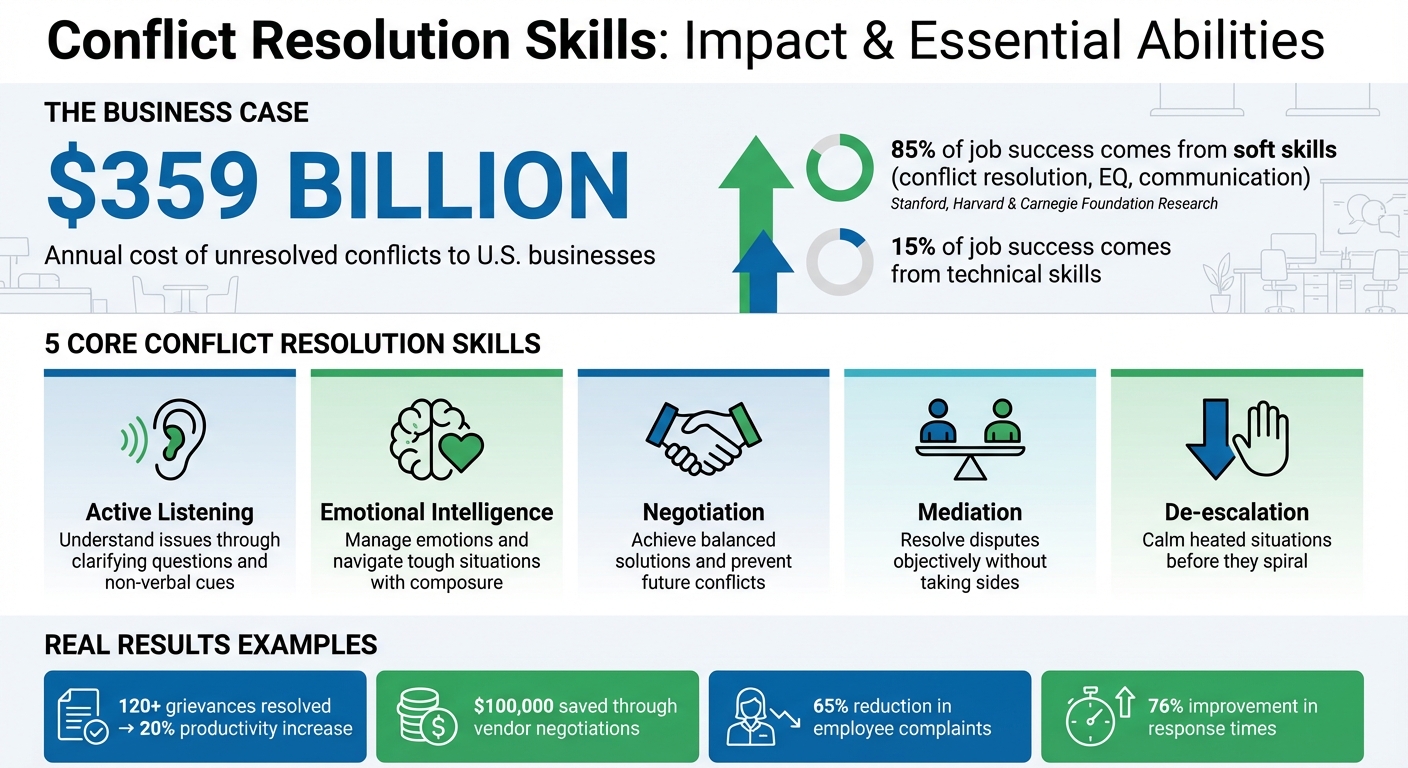
Conflict resolution skills make you stand out. Employers prioritize candidates who can manage workplace disputes effectively, as unresolved conflicts cost U.S. businesses up to $359 billion annually. Highlighting these skills on your resume demonstrates leadership, emotional intelligence, and problem-solving abilities.
Key skills to showcase include:
- Active Listening: Understand issues fully through clarifying questions and non-verbal cues.
- Emotional Intelligence: Manage emotions and navigate tough situations with composure.
- Negotiation & Mediation: Resolve disputes and achieve balanced solutions.
- Problem-Solving & De-escalation: Identify root causes and calm heated situations.
Use action verbs like mediated, resolved, or de-escalated, paired with measurable outcomes, to strengthen your resume. You can also use an AI resume builder to optimize these sections. For example:
- "Resolved 120+ grievances, improving team productivity by 20%."
- "Negotiated vendor contracts, saving $100,000 annually."
Employers value results, so quantify your impact wherever possible. Tailor your resume to align with job descriptions, and break down conflict resolution into specific sub-skills like mediation or de-escalation to pass Applicant Tracking Systems (ATS).
Key Conflict Resolution Skills and Their Impact on Job Success
Improve Your Conflict Resolution Skills With 3 Simple Tips | Indeed
Key Conflict Resolution Skills to Include
Want your resume to stand out? Highlighting conflict resolution skills can make all the difference. These skills not only show you can handle tough situations but also prove you’re a team player who can keep productivity on track. Here’s how to frame them effectively.
Active listening goes beyond hearing words - it’s about asking clarifying questions and picking up on non-verbal cues like tone and body language. It helps you understand the real concerns behind the words. Emotional intelligence (EQ), on the other hand, is your ability to recognize emotions - both yours and others’ - and use that understanding to guide your actions. According to research from Stanford, Harvard, and the Carnegie Foundation, 85% of job success stems from these soft skills, while technical expertise accounts for just 15%.
Negotiation and mediation are also key. Negotiation ensures balanced solutions, while mediation helps resolve disputes objectively. These skills show you can handle high-stakes conversations without bias - whether you’re managing teams, coordinating across departments, or working with vendors.
Problem-solving shifts the focus from pointing fingers to finding solutions. It’s about identifying the root cause and coming up with options that work for everyone. De-escalation, meanwhile, is like hitting the brakes on a heated situation before it spins out of control. As Andrei Kurtuy, Co-Founder of Novorésumé, puts it:
"A problem solver is someone who, instead of wasting time being angry or irritated when faced with conflict, will focus on understanding the problem and solving it in a way that benefits everyone involved."
Here’s how these skills break down and how to showcase them on your resume.
Active Listening and Emotional Intelligence
Active listening is about fully understanding before responding. By asking the right questions and observing non-verbal cues, you can prevent small misunderstandings from becoming major issues. On your resume, this skill tells employers you’re quick to get to the root of a problem and address it effectively.
Emotional intelligence, meanwhile, helps you navigate tricky situations with grace. It’s what keeps you from reacting defensively to criticism and instead lets you take a step back to understand someone else’s perspective. High EQ can help you lead teams through stressful projects, handle difficult clients, and maintain composure under pressure.
For example, you might write on your resume: "Applied active listening and empathy to resolve employee concerns, creating a more collaborative workplace." Or: "Led a team through high-pressure projects with sensitivity, boosting productivity by 20%." The key is tying these skills to measurable outcomes like reduced complaints, faster project completion, or improved client satisfaction.
Negotiation and Mediation
Negotiation is about more than just compromise - it’s about finding solutions that prevent future conflicts and strengthen relationships. Whether you’re negotiating vendor contracts or resolving internal disputes, this skill shows you can think strategically under pressure.
Mediation takes it a step further by requiring objectivity. As a mediator, you’re not picking sides; you’re helping both parties find common ground. This is especially important in management, HR, or roles involving cross-departmental coordination.
On your resume, you could say: "Negotiated vendor agreements, saving $100,000 annually, and mediated team conflicts to maintain project deadlines." Notice how these examples link the skill to tangible results, such as cost savings or improved collaboration.
Problem-Solving and De-Escalation
Problem-solving means digging deep to find the real issue instead of assigning blame. For example, two departments might argue over budget allocation, but the true problem could be unclear priorities. Or a client upset about a missed deadline might actually be worried about how it reflects on them. Identifying these root causes allows you to craft solutions that stick.
De-escalation is about stepping in before things spiral out of control. Whether it’s calming an irate customer, diffusing tension in a meeting, or resolving a minor disagreement before it escalates, this skill shows you can stay calm under pressure and redirect energy toward solutions.
For your resume, you might write: "Implemented de-escalation protocols, improving response times by 76%." Or: "Streamlined the customer complaint process, reducing resolution times by 12% and increasing retention by 11%." These examples demonstrate that you’re proactive and quick to act when conflicts arise.
Action Verbs for Conflict Resolution Skills
When crafting your resume with an AI builder, start your bullet points with strong action verbs. Using precise, impactful language makes your contributions clear and memorable. Action verbs immediately convey to hiring managers that you’re proactive, results-oriented, and capable of handling challenging situations. Instead of generic phrases like "responsible for" or "duties included", choose verbs that highlight real achievements.
Action verbs for conflict resolution typically fall into four main categories:
- Mediation and Neutrality: Words like mediated, arbitrated, facilitated, and reconciled emphasize your ability to act as an impartial third party.
- Negotiation and Sales: Verbs such as negotiated, settled, navigated, and persuaded showcase your skill in reaching agreements and driving outcomes.
- Crisis and De-escalation: Terms like de-escalated, intervened, mitigated, and handled demonstrate your ability to remain calm and effective under pressure.
- Management and Process Improvement: Use verbs like resolved, streamlined, reduced, and managed to highlight your problem-solving and system-improvement capabilities.
To amplify the impact of these verbs, pair them with specific metrics or outcomes. For instance, rather than saying, "Handled customer complaints", you could write: "De-escalated volatile situations with dissatisfied clients, maintaining 95% retention." Similarly, instead of "Worked on team disputes", try: "Mediated conflicts between department heads to align project goals, improving delivery time by 15%." These examples not only make your contributions clearer but also demonstrate measurable results.
Examples of Action Verbs in Use
Here are some examples of how to use action verbs effectively:
- "Negotiated a 15% reduction in material costs with major suppliers, saving $100,000 annually" highlights negotiation skills alongside financial impact.
- "Resolved 120+ staff grievances, leading to a 20% increase in team productivity" shows your ability to manage high volumes while driving positive outcomes.
- "Facilitated weekly team-building sessions to improve communication, increasing quality ratings by 100%" demonstrates a proactive approach to preventing conflicts.
For roles involving high-pressure situations, verbs like de-escalated and intervened are particularly powerful. For example: "De-escalated emergency situations with intervention training, improving response times by 76%" communicates both formal training and quick decision-making. Similarly, "Reduced employee complaints and compliance calls by 65% through proactive management" shows you’re not just resolving issues but actively preventing them.
Writing Work Experience Bullet Points
When showcasing your work experience, highlight conflict resolution by detailing what you did, how you did it, and the measurable outcomes. Below are examples tailored to specific roles, showing how conflict resolution can be effectively demonstrated.
Examples for Different Roles
Using strong action verbs and quantifiable results, craft bullet points that reflect how you resolved conflicts in real-world scenarios. Each role may require a unique approach.
For HR Specialists, focus on mediation and system improvements. For instance, Anne De Leon, a CS Team Leader at Teletech (November 2016 to May 2021), improved the quality rating of three teams by 100% and cut onshore hand-off rates by 78% by analyzing customer requests and collaborating with UK counterparts to resolve process conflicts. Another example: "Implemented a checks and balances system, reducing interdepartmental friction and cutting employee complaints by 15% in three months."
Project Managers should emphasize stakeholder management and meeting deadlines despite competing priorities. For example: "Facilitated cross-functional meetings to resolve timeline disagreements between engineering and marketing teams, delivering the project one week ahead of schedule."
For Sales Managers, highlight negotiation outcomes: "Closed $92,000 sale in a competitive industry against 85 competitors by addressing client concerns through active listening and tailored solutions."
Law Enforcement Officers can focus on de-escalation and community engagement. Aya Lee, serving at the Cityline Police Department (November 2020 to November 2025), reduced the local crime rate by 18% through community initiatives and conflict mediation. Similarly, an officer at the Springfield Police Department conducted proactive patrols, achieving a 15% drop in local crime rates over two years.
In Customer Support, retention is key. For example: "De-escalated volatile situations with dissatisfied clients through empathetic communication, maintaining a 95% customer retention rate."
For Social Work Assistants, emphasize volume and outcomes. Between January 2017 and May 2020, a Social Work Assistant at RW Center facilitated group and individual sessions to address juvenile concerns, successfully supporting over 50 juveniles and families in adapting to center obligations.
Team Coordinators might focus on resolving internal conflicts: "Mediated cross-departmental deadlock on resource allocation, enabling the team to exceed company KPIs by 14%."
Using Numbers to Show Results
Quantifying your achievements adds credibility. Numbers turn vague claims into concrete proof. For instance, instead of saying "handled customer complaints", write: "Resolved 120+ staff grievances, leading to a 20% increase in team productivity." Specific metrics make your contributions more impactful and memorable.
Identify metrics tied to business goals. For negotiation skills, include dollar amounts: "Negotiated 15% reduction in material costs with major suppliers, saving $100,000 annually." For mediation, highlight complaint reductions: "Reduced employee complaints and compliance calls by 65% through proactive management and feedback systems." Time savings also resonate: "De-escalated emergency situations with intervention training, improving response times by 76%."
If exact figures aren’t available, use conservative estimates based on your records. Track how often you handled conflicts (weekly, monthly), the number of people involved, or percentage improvements in satisfaction scores. For example, "over 50 families" or "120+ grievances" provides a clearer picture of your impact than generic statements.
"Hiring managers want solutions - not problems. Concentrate on highlighting transferable skills that you used to resolve conflicts." - Resume Worded
Adding Conflict Resolution Skills to Your Skills Section
When listing conflict resolution in your Skills section, break it down into specific sub-skills like Mediation, Negotiation, De-escalation, Active Listening, or Emotional Intelligence rather than just writing "Conflict Resolution." This approach makes your expertise clearer and more impactful.
Pair these skills with measurable achievements to back them up. For example, instead of just saying "Mediation", you could write: Mediation: Facilitated 50+ sessions between staff and management to resolve grievances. This format not only strengthens your resume but also makes it more likely to pass Applicant Tracking Systems (ATS).
To optimize for ATS, use the same terminology as the job description. For instance, if the role mentions "Conflict Mediation", use that phrasing instead of "Dispute Resolution." Group these skills under clear headings like "Interpersonal Skills" to make them easier to scan.
Examples of Skill Descriptions
Here’s how to present conflict resolution skills with measurable outcomes:
- Negotiation: Successfully negotiated vendor contracts, achieving a 15% annual cost reduction.
- De-escalation: Trained in emergency intervention, significantly reducing incident response times.
- Conflict Resolution: Mediated 70+ workplace disputes with a 90% success rate.
- Active Listening: Used empathy and listening techniques to reduce employee complaints by 65%.
For specialized roles, tailor the phrasing to match the industry with job application assistance. For example:
- Crisis Management: Conducted community engagement initiatives, reducing local crime rates by 18% (ideal for law enforcement).
- Workplace Mediation: Facilitated 10+ cross-departmental sessions to align project goals (great for HR professionals).
- De-escalation: Resolved high-pressure customer complaints, maintaining 95% satisfaction during peak times (perfect for customer support roles).
Avoid vague phrases like "Excellent at resolving conflict." Instead, use action verbs like Mediated, Negotiated, Facilitated, Resolved, or De-escalated, followed by specific results. Research from Stanford, Harvard, and the Carnegie Foundation shows that 85% of job success comes from soft skills, while only 15% is tied to technical skills. By quantifying your conflict resolution abilities, you not only validate your expertise but also create a stronger narrative that ties these skills to your achievements in both the experience and skills sections of your resume.
Conclusion: Making Your Conflict Resolution Skills Stand Out
Conflict resolution is a key skill that keeps workplaces productive and prevents unnecessary costs. Employers value individuals who can step in to solve problems rather than escalate them.
To showcase these skills effectively, tailor your resume to reflect the role you're applying for. Use keywords from the job description, such as "mediation", "de-escalation", or "interpersonal skills", to align your experience with the employer's needs. For example, resolving customer complaints as a retail manager involves a different approach than mediating team disputes as an HR professional. Adjust your examples to highlight the specific challenges and outcomes relevant to each role.
Soft skills often set candidates apart, even when technical qualifications are similar. Use action verbs like Mediated, Facilitated, or Negotiated and back them up with measurable results and real-life examples. Focus on the positive outcomes you achieved, steering clear of unnecessary details about the conflicts themselves.
If tailoring your resume feels overwhelming, tools like Scale.jobs can simplify the process. Their AI-powered resume builder adapts your conflict resolution examples to fit specific job descriptions, ensuring your application is ATS-compliant and reaches the right people. By using these strategies, you'll increase your chances of standing out to hiring managers and landing the job.
FAQs
How can I effectively highlight and quantify conflict resolution skills on my resume?
When highlighting conflict resolution skills on your resume, use specific examples backed by measurable results. For example, you might say: "Mediated 12 cross-department disputes, cutting project delays by 30% and saving $45,000," or "Resolved 95% of customer complaints within 24 hours, boosting satisfaction scores by 15%."
Including numbers, percentages, or financial impacts makes your accomplishments more concrete and shows employers the real value of your expertise.
What are the best action verbs to highlight conflict resolution skills on a resume?
When highlighting your conflict resolution skills on a resume, focus on using action-driven verbs that illustrate your ability to address disputes and encourage teamwork. Strong examples include: mediated, facilitated, negotiated, resolved, reconciled, de-escalated, arbitrated, collaborated, and coordinated. These terms emphasize your proactive problem-solving abilities and commitment to fostering cooperation.
Why are conflict resolution skills important for your career?
Conflict resolution is an essential skill in the workplace, helping employees handle disagreements, maintain strong relationships, and keep projects moving forward. With around 85% of U.S. workers encountering workplace conflicts, it's no wonder employers value candidates who can mediate disputes, encourage teamwork, and ensure everyone stays focused on shared objectives.
Resolving conflicts effectively stops small issues from growing into bigger ones that could disrupt timelines, damage morale, or create a negative work environment. Including examples on your résumé - like settling a team disagreement or addressing a customer concern - shows you know how to maintain productivity, build trust, and contribute to a healthy workplace atmosphere.
Employers appreciate candidates who can turn challenges into opportunities for collaboration and improvement. By highlighting specific results, such as meeting deadlines or enhancing team dynamics, you demonstrate your ability to handle conflict in a way that drives success and strengthens the team.