Common Mistakes AI Job Apply Tools Make
Five common failures of AI job-apply tools—keyword stuffing, fabricated claims, generic content, submission errors, and privacy risks—and how human review fixes them.

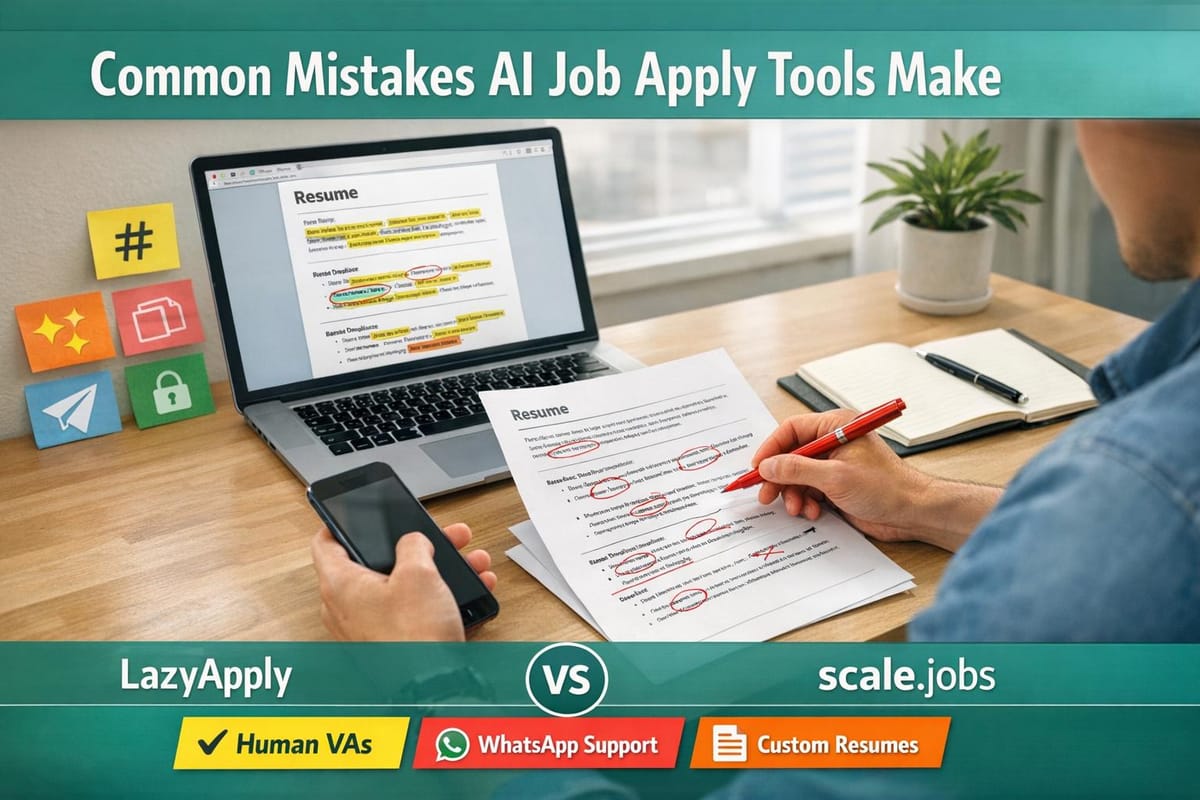
AI job application tools promise to simplify the job search process, but they often fall short. While they help optimize resumes for applicant tracking systems (ATS), they frequently produce generic, error-prone applications that fail to stand out. Common issues include:
- Keyword Overuse: Tools often cram resumes with irrelevant keywords, leading to ATS rejections.
- Fabrication Risks: AI-generated resumes may invent skills or achievements, causing problems during interviews.
- Generic Content: Automated resumes lack personal context and fail to tell a candidate’s unique career story.
- Technical Errors: Automation glitches can result in failed submissions or embarrassing mistakes.
- Privacy Concerns: Many platforms misuse personal data or lack transparency about how it’s handled.
Scale.jobs offers a better approach by combining human expertise with technology. Unlike fully automated tools, it ensures personalized, ATS-friendly applications without errors or privacy risks. With trained reviewers, real-time updates, and manual submissions, Scale.jobs helps job seekers apply for jobs effectively, increasing their chances of landing interviews.
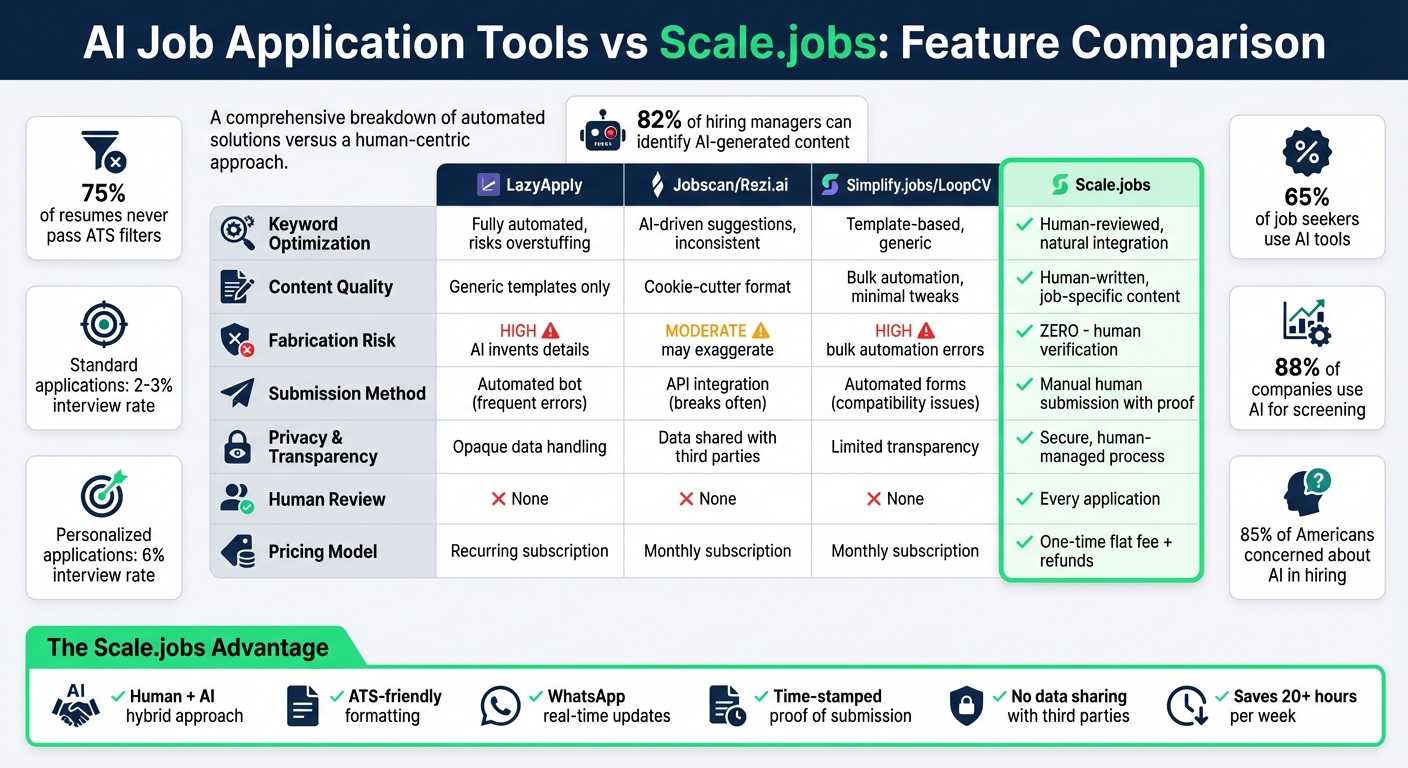
AI Job Application Tools vs Scale.jobs: Feature Comparison
5 Mistakes Job Seekers Make Using AI for Job Search
Mistake 1: Poor Keyword Matching That Triggers ATS Rejections
With applicant tracking systems (ATS) now playing a pivotal role in screening resumes, getting your keyword strategy right is more important than ever. Tools like Jobscan and Rezi.ai claim to fine-tune your resume by matching keywords from job descriptions. However, these tools often fall short by fabricating skills or work experience when your job title doesn’t align perfectly with the listing. Career coach Jen DeLorenzo, founder of The Career Raven, highlights this issue:
"When AI rewrites resumes for imperfect title matches, it often fabricates details."
This approach can result in resumes being flagged as generic or unoriginal. Fractional recruiter Jessye Kass Karlin describes the outcome as:
"What we end up getting is a lot of word salad. People who actually use their own words to tell me their impact are much more effective than people who are using AI."
The problem doesn’t stop there. Some AI tools encourage mimicking the job description too closely, which can lead to instant ATS rejections. Hilke Schellmann, assistant professor at NYU and author, points out:
"Some AI tools will throw you out because they think you just copied the job description."
For the best results, resumes should match about 70–80% of the job description. However, exceeding 15% keyword density or using problematic formatting - like images or multi-column layouts - can confuse ATS systems, preventing your resume from passing the initial screening.
Why Scale.jobs Stands Out
To address these challenges, a combination of human expertise and job search automation is essential - exactly what Scale.jobs provides. Unlike AI-only tools, Scale.jobs blends the precision of trained human reviewers with advanced technology. This ensures a balanced approach: enough relevant keywords to satisfy ATS filters without overloading your resume or making it sound robotic. Plus, every application comes with a free ATS compatibility check and actionable feedback, so you know how your resume will perform before submission.
Here’s how Scale.jobs rises above the competition:
- Human review ensures natural language and keeps keyword density below the 15% threshold, avoiding red flags.
- No fabricated details - every piece of information is verified by real people.
- ATS-friendly formatting with single-column layouts and standard fonts, eliminating design issues that confuse ATS systems.
- Optimized keyword integration for an ideal 80–90% match, striking the right balance for better interview chances.
- Proof-of-work transparency with time-stamped screenshots and real-time updates via WhatsApp.
Comparison Table
| Feature | LazyApply | Jobscan | Rezi.ai | Scale.jobs |
|---|---|---|---|---|
| Keyword Optimization | Fully automated, risks overstuffing | AI-driven suggestions | Proprietary scoring algorithm | Human-reviewed, natural integration |
| ATS Optimization | Limited by rigid automation | Inconsistent results | Often flagged for generic formatting | Consistently ATS-optimized |
| Fabrication Risk | High | Moderate, user-dependent | Occasional inaccuracies | Zero risk - human-verified details |
| Formatting Check | Basic or none | Basic scanner | Fixed templates | Comprehensive ATS check with feedback |
| Keyword Density Control | Unregulated | User-monitored | Automated, may exceed limits | Manually maintained under 15% |
| Pricing | Subscription-based, costly | Monthly subscriptions (varies) | Affordable plans | One-time flat-fee packages |
| Human Review | None | None | None | Every application reviewed by a human |
Scale.jobs bridges the gap between automation and personalization, ensuring your resume not only passes ATS filters but also stands out with authentic, well-crafted content.
Mistake 2: Generic Resumes and Cover Letters That Don't Stand Out
When platforms like Simplify.jobs and LoopCV promise to simplify your job search, they often fall short by producing applications that blend into the crowd. These tools rely heavily on keyword matching, often at the expense of crafting a compelling career narrative. The result? Resumes packed with buzzwords but lacking the personal touch that recruiters value. Dr. Serena Huang, founder of Data with Serena, puts it bluntly:
"AI-generated résumés read like they were written by a robot, because they were."
Another problem arises when automated tools fabricate details to match job descriptions. Career coach Jen DeLorenzo has seen candidates struggle in interviews because they couldn’t explain achievements or skills that AI had added to their resumes. This disconnect becomes glaringly obvious when hiring managers probe deeper into fabricated bullet points. Without a personal, authentic approach, these resumes fail to stand out.
With around 65% of job seekers using AI tools and 82% of hiring managers able to identify AI-generated content, this cookie-cutter approach is proving to be counterproductive. Recruiters are actively filtering out applications that lack authenticity. To truly differentiate yourself, you need more than just automation - you need a personal touch. That’s where Scale.jobs comes in.
Why Scale.jobs Stands Out
Unlike traditional AI tools, Scale.jobs combines technology with human expertise. Each application is crafted by trained writers who focus on telling your unique career story while aligning with the job’s requirements. Plus, their WhatsApp support ensures you can address specific challenges - whether it’s explaining a career gap, emphasizing transferable skills, or clarifying visa-related questions - in ways that automated tools simply can’t.
Here’s how Scale.jobs rises above the competition:
- Human-written content that reflects your true voice and career journey, steering clear of generic templates.
- No fabrication risks - all achievements and skills are verified for accuracy.
- Tailored solutions for career gaps, industry changes, or visa concerns.
- Real-time collaboration via WhatsApp, allowing you to refine your application with direct input.
- Transparency through time-stamped screenshots, showing exactly what’s submitted on your behalf.
Comparison Table
| Feature | LazyApply | Simplify.jobs | LoopCV | Scale.jobs |
|---|---|---|---|---|
| Customization Level | Automated templates only | AI-generated variations | Bulk automation with minimal tweaks | Human-written, job-specific content |
| Personal Branding | Generic, automated phrasing | Template-based structure | Cookie-cutter format | Authentic voice and unique story |
| Career Gap Handling | Cannot address | Limited AI suggestions | Ignored or flagged | Human writers reframe positively |
| Visa/Immigration Support | Not supported | Basic keyword matching | Not addressed | WhatsApp support for specific guidance |
| Fabrication Risk | High - AI invents details | Moderate - may exaggerate | High - bulk automation errors | Zero - human verification |
| Recruiter Detection Rate | Easily spotted (82% detection) | Obvious AI patterns | Identical multi-applicant format | Reads as authentic, human-crafted |
| Pricing Model | Subscription-based | Monthly subscription | Monthly subscription | One-time flat-fee packages |
Mistake 3: Missing Context and Human Details
AI tools like TealHQ and Sonara.ai are essentially "pattern detectors." While they excel at identifying trends and optimizing for keywords, they often fail to grasp the nuanced backstory behind your career journey. Whether you’ve been laid off, switched industries, or need to explain visa-related complexities, these tools struggle to capture the personal story that makes your resume authentic. Unlike formatting or keyword alignment issues, this lack of human context strips away the unique narrative essential for a strong first impression.
For example, when AI rewrites resumes, it often ignores the subtleties behind layoffs or career changes. This can leave you unprepared to explain fabricated achievements during interviews. Career coach Jen DeLorenzo highlights another pitfall: when AI aligns resumes with job descriptions, it may introduce inaccuracies if job titles or responsibilities don’t match perfectly. Similarly, employment gaps due to layoffs are flagged as "suspicious" because these systems lack the ability to interpret them as legitimate transitions. For international job seekers, particularly those navigating H1B or similar visa requirements, AI tools often oversimplify the intricate legalities involved. Alan Keogh, Immigration Programme Manager at Fragomen, explains:
"AI tools can oversimplify these legal nuances, risking incorrect advice. For example, AI may overlook specific client circumstances - such as prior immigration history or unique family dynamics - which are critical for certain applications."
This lack of context can turn resumes into impersonal, disconnected documents that fail to reflect your career journey. The result? A loss of trust and a missed opportunity to present yourself as a well-rounded candidate. Addressing these gaps requires a thoughtful combination of technology and human insight.
Why Scale.jobs Stands Out
These challenges highlight the need for a solution that combines AI efficiency with human expertise. That’s where Scale.jobs excels. Their approach integrates human insight with AI tools to address the complexities of career transitions, layoffs, and visa requirements. Their trained reverse recruiters work directly with you via WhatsApp to craft applications that are both ATS-compliant and reflective of your true story.
Here’s how Scale.jobs bridges the gap AI tools can’t:
- Layoff explanations: Their team reframes layoffs as strategic career moves, taking market conditions into account.
- Career change support: They identify transferable skills and present them in ways that resonate with hiring managers.
- Visa and immigration expertise: Through direct consultations, they ensure your application accurately addresses visa requirements without oversimplifying critical details.
- No fabrication risk: Every resume detail is verified by a human assistant before submission.
- Proof-of-work transparency: Time-stamped screenshots provide a clear record of what was submitted on your behalf.
Unlike platforms that treat resumes as mere data points, Scale.jobs recognizes that your career is a unique story. They ensure your applications reflect not just your qualifications but also the personal and professional journey that makes you stand out.
Mistake 4: Automation Errors and Failed Submissions
AI tools like LazyApply and Jobright.ai claim to streamline the job application process, but they often falter when faced with the technical intricacies of automated form filling. These platforms depend on APIs to connect with job boards, and when those connections fail, your application might be submitted with missing details - or worse, not submitted at all. This can lead to wasted time and missed job opportunities.
Beyond incomplete submissions, these tools can also introduce embarrassing content errors. For instance, recruiter Jessye Kass Karlin shared a cringe-worthy example where an applicant answered the question, "Why do you want to work here?" with "As an artificial intelligence, I do not have emotions." This type of error, known as prompt leakage, happens when internal AI instructions accidentally make their way into the application. Career coach Jen DeLorenzo emphasizes the potential damage of such mistakes:
"You really still have to take a look and double check before you send it over, because that could be embarrassing. It could ruin your chances for sure."
Formatting issues add another layer of complication. Automated systems often struggle with resumes that feature design elements like blue backgrounds or custom fonts. Amit Bhatia, cofounder of Datapeople, explains:
"When you have systems on the other end trying to transcribe and annotate these resumes, they often get tripped up on something as simple as a blue background that makes it impossible to read."
With around 83% of employers using automation to filter applications, these technical glitches - whether from formatting issues, broken hyperlinks, or parsing errors - can prevent your resume from ever being seen by a hiring manager.
Why Scale.jobs Wins
To address these challenges, Scale.jobs takes a completely human-powered approach. Instead of relying on automated tools, Scale.jobs employs trained human assistants to manually fill out every application. This ensures compatibility with any job portal, whether it’s a corporate ATS or a specialized industry board. Plus, they provide time-stamped screenshots as proof of successful submission.
Here’s why their human-first method stands out:
- No technical errors: Say goodbye to API glitches or form-filling bugs.
- Universal compatibility: Works seamlessly with any job portal.
- Proof of submission: Time-stamped screenshots verify every application.
- Human oversight: Every field is double-checked for accuracy.
- Quick turnaround: Custom resumes and cover letters delivered within one business day.
Comparison Table
| Feature | LazyApply / Jobright.ai | Scale.jobs |
|---|---|---|
| Submission Method | Automated bot filling | Human assistants (hand-filled) |
| Technical Error Rate | Frequent API/integration breaks | Zero errors |
| Form Compatibility | Often fails on non-standard fields | Works across any platform |
| Proof of Submission | Automated "success" message (may be false) | Time-stamped screenshots |
| Prompt Leakage Risk | High (AI instructions in application fields) | None (human oversight) |
| Formatting Issues | Struggles with complex layouts, hyperlinks | Human-verified for correct parsing |
| Pricing Model | Recurring monthly subscription | One-time flat fee per campaign |
These pitfalls highlight why a human-powered approach like Scale.jobs is a more dependable option for job seekers. By eliminating automation errors and ensuring every submission is accurate and complete, Scale.jobs provides the reliability you need in your job search.
Mistake 5: Privacy Concerns and Hidden Processes
When you upload your resume to AI resume builders like Rezi.ai or ResumeGenius, you're sharing sensitive personal details - your name, contact information, work history, and even references - with systems that often operate behind closed doors. Many of these platforms provide little clarity about how your data is handled. Regulatory audits have revealed that some AI-driven recruitment tools collect far more personal information than necessary and store it indefinitely, often without your knowledge or consent. This lack of transparency puts your personal information at risk.
Some AI systems even scrape social media to infer personal traits, further complicating privacy concerns. Many career platforms disclose in their privacy policies that your data could be shared with hundreds of third-party vendors for purposes like advertising or "service development." This means your resume and personal information might be sold or used to train AI models - without your explicit approval.
Real-world examples highlight the risks. For instance, iTutorGroup paid $365,000 to settle claims after its AI system rejected over 200 applicants based on age filters. Similarly, CVS Pharmacy faced a class-action lawsuit over undisclosed AI tracking of facial expressions. Hilke Schellmann, an Assistant Professor of Journalism at New York University, aptly points out:
"One biased human hiring manager can harm a lot of people in a year, and that's not great. But an algorithm that is maybe used in all incoming applications at a large company… that could harm hundreds of thousands of applicants."
With 88% of companies now relying on AI for initial candidate screening and 85% of Americans expressing concerns about AI's role in hiring, the lack of transparency in these systems is a pressing issue. You have a right to know how your data is being used, who has access to it, and whether it's being shared or sold to third parties.
Why Scale.jobs Stands Out
These privacy concerns highlight the importance of a human-centered approach, and that's where Scale.jobs excels. Unlike platforms that rely on opaque algorithms, Scale.jobs uses secure, human-managed processes. Your applications are handled manually by trained assistants, ensuring your personal information is never fed into a black-box system. Plus, you’re kept informed every step of the way with live WhatsApp updates, so you always know what’s happening with your data.
The platform’s financial model is equally straightforward. Scale.jobs operates on a one-time payment system with no hidden fees. If you don’t use all your application credits, you’ll receive a refund for the unused portion - a rare feature among job application services. This human-first approach ensures your data remains private, secure, and entirely under your control, without being sold or used to train third-party AI systems.
Conclusion: Why Human-Powered Job Applications Work Better
The combined impact of these five common errors highlights why relying solely on AI tools falls short in today’s competitive job market. Issues like poor keyword matching, generic content, lack of context, automation glitches, and privacy risks all stem from the same core problem: AI-only tools prioritize speed over quality. With 75% of resumes never making it past automated filters and 83% of employers using these systems, submitting applications that feel mass-produced can leave you invisible to both algorithms and recruiters. Many AI platforms churn out cookie-cutter resumes with repetitive structures and phrases, making it nearly impossible to stand out.
This is where a more balanced approach becomes essential. Scale.jobs addresses these challenges by combining the efficiency of AI with the insight and precision of human expertise. AI handles keyword optimization and formatting, while trained human assistants customize and submit each application. This thoughtful hybrid method ensures your applications avoid the pitfalls of automation - like impersonal language or formatting errors - while delivering the tailored touch that recruiters value. In fact, while standard applications see a 2% to 3% interview rate, personalized resumes can lead to nearly 6 interviews per 100 applications, effectively doubling your chances.
In a sea of generic, AI-generated applications, it’s harder than ever for your unique qualifications to stand out. Scale.jobs cuts through this noise by focusing on what matters most: showcasing your specific achievements, measurable results, and individual career narrative - elements that AI alone simply can’t replicate.
With human-reviewed applications, ATS-friendly documents, and a transparent, one-time payment model, Scale.jobs offers a stress-free solution. Features like proof-of-work screenshots and WhatsApp updates ensure you’re always in the loop, knowing exactly where your applications stand and how your data is handled. Plus, by delegating time-consuming tasks like form-filling to human assistants, you free up over 20 hours a week to focus on networking and interview prep. Take your job search seriously - opt for tailored job application assistance and give your career the attention it deserves.
FAQs
How does Scale.jobs protect my privacy and secure my data?
Scale.jobs takes your privacy seriously, implementing strong safeguards to keep your data secure. Using reliable methods like encryption, secure data storage, and adherence to privacy regulations, the platform ensures your personal details and job application information are well-protected.
What sets Scale.jobs apart is its focus on human-assisted processes and transparent proof-of-work. This approach ensures your data is handled responsibly and ethically. Plus, with dedicated support options like WhatsApp, you can easily address any privacy-related concerns or get direct assistance when needed. These efforts highlight Scale.jobs' dedication to earning your trust and securing your information throughout the hiring journey.
Why are human-reviewed resumes often better than those created by AI tools?
Human-reviewed resumes have a distinct advantage because they bring out the unique qualities of a candidate's experience, personality, and achievements in a way that connects with hiring managers. While AI tools can quickly produce keyword-heavy, ATS-friendly resumes, they often miss the mark when it comes to personalization and storytelling - two key elements that help candidates stand out in a crowded job market.
A human touch ensures that phrasing is polished, errors are corrected, and accomplishments are presented in a way that's both engaging and relatable. Unlike AI-generated resumes, which can sometimes feel overly stuffed with keywords or overly mechanical, a human-crafted resume strikes the right balance. This careful approach not only helps your resume sail through ATS scans but also leaves a memorable impression on recruiters.
How does Scale.jobs create ATS-friendly resumes without overusing keywords?
Scale.jobs takes a thoughtful approach to crafting resumes that work seamlessly with applicant tracking systems (ATS). Rather than cramming your resume with an overload of keywords, we focus on smart, targeted keyword usage. This ensures your resume is optimized for ATS while still sounding polished and professional.
Our process combines human expertise with technology to customize each resume for the specific job description. This means your resume not only meets ATS criteria but also remains clear and easy to read. By steering clear of keyword stuffing and prioritizing a natural flow, we aim to improve your chances of passing ATS filters and catching the attention of hiring managers.