ChatGPT Resume vs Human-Written Resume: Which One Passes ATS?
Compare ChatGPT, human, and hybrid resumes: ATS pass rates, callback odds, and practical fixes for ATS-friendly resumes.

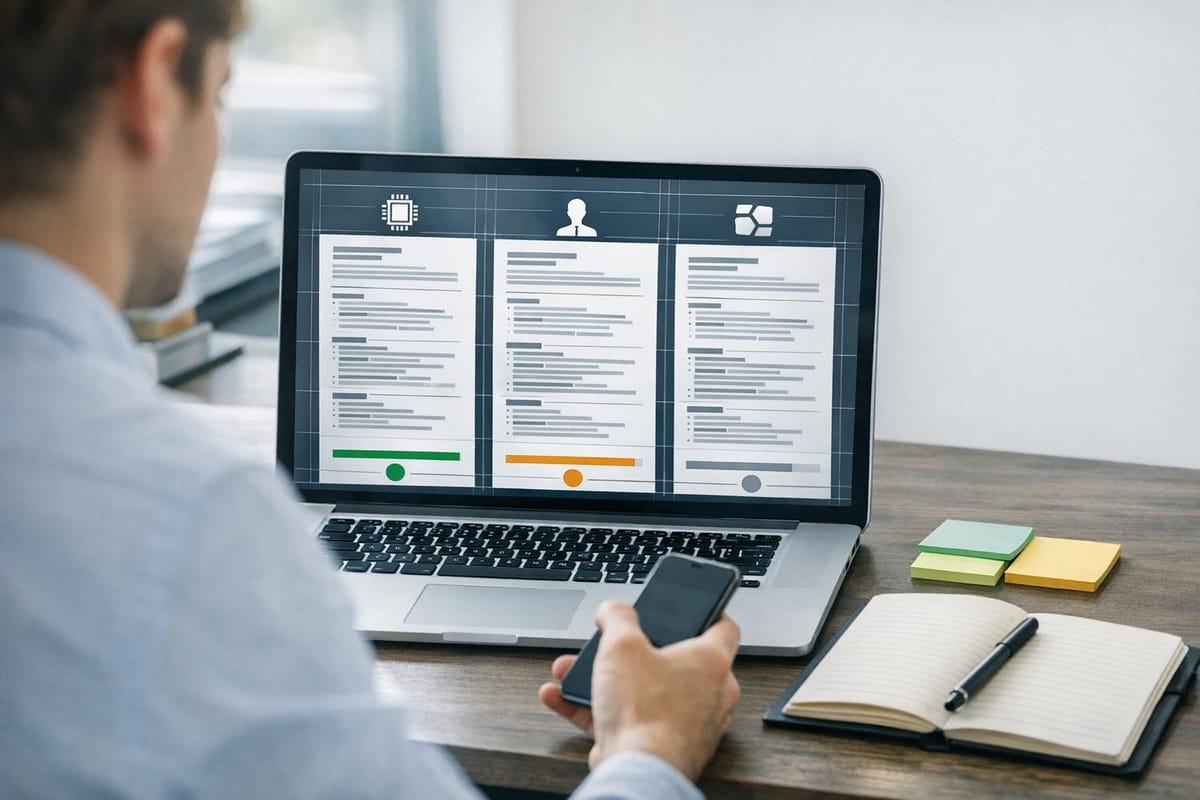
When applying for jobs, your resume must first pass through an Applicant Tracking System (ATS) before reaching a recruiter. ATS software scans resumes for keywords, formatting, and structure. Both ChatGPT-generated and human-written resumes can face challenges with ATS compatibility, but they excel in different ways:
- ChatGPT Resumes: Great for quickly generating content and optimizing for keywords. However, they often require manual formatting fixes to ensure ATS compatibility and may produce generic content.
- Human-Written Resumes: Offer tailored narratives and industry-specific language, but take more time and can be costly. Their ATS performance depends on the writer's expertise in formatting and keyword usage.
A hybrid approach - combining AI's speed with human refinement - delivers the best results, improving callback rates and ATS success. Using tools like scale.jobs can streamline this process by blending AI efficiency with expert oversight, ensuring your resume is polished, ATS-friendly, and effective in securing interviews.
Quick Comparison Table
| Feature | ChatGPT Resumes | Human-Written Resumes | Hybrid (e.g., scale.jobs) |
|---|---|---|---|
| ATS Keyword Match | 85-95% | 40-60% | 85-95% |
| Callback Rate | 12.3% | 16.1% | 21.5% |
| Creation Time | 2-5 minutes | 3-7 business days | <30 minutes |
| Cost | Low | High | Mid-range |
For more details on making your resume ATS-friendly or using a job application service, read on.
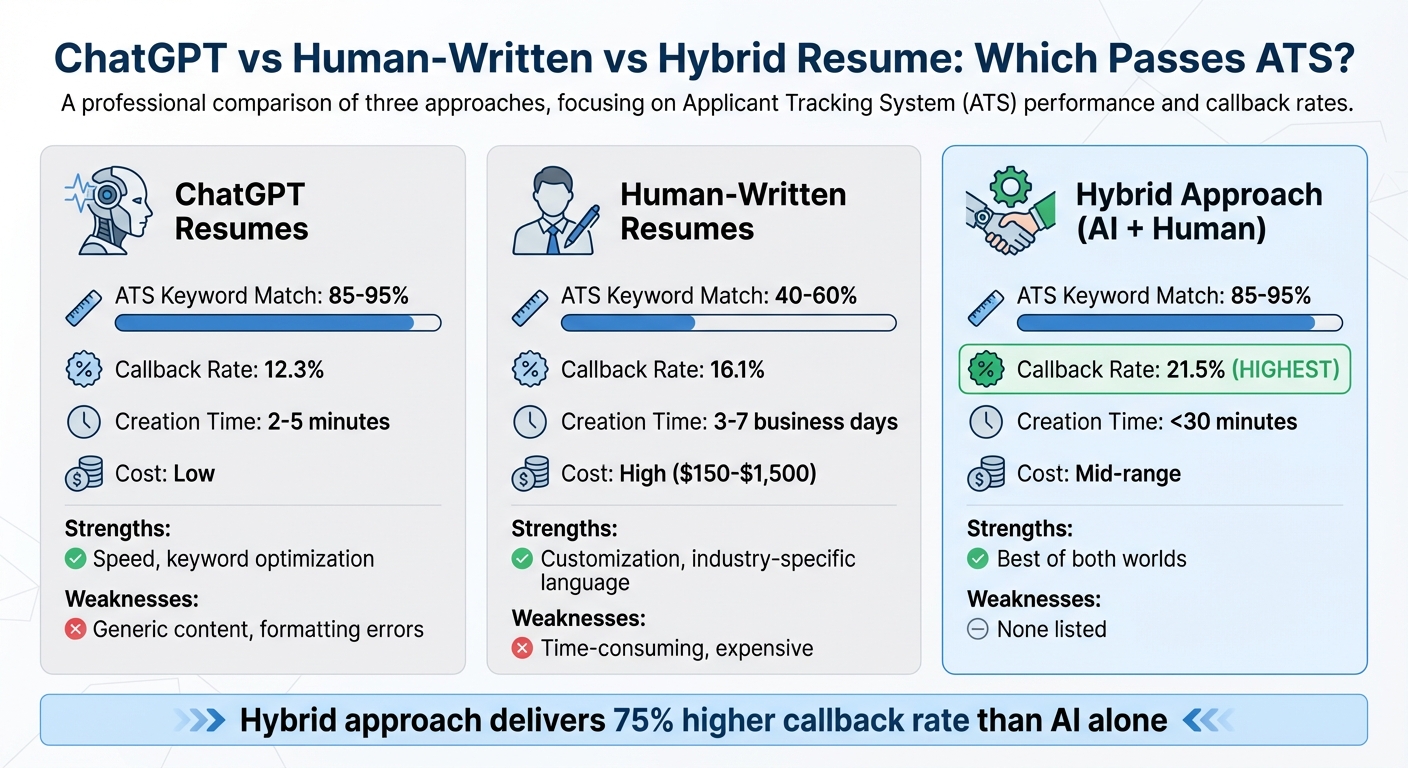
ChatGPT vs Human vs Hybrid Resume: ATS Performance Comparison
ChatGPT Resumes: What Works and What Doesn't
What ChatGPT Does Well: Speed and Keywords
One of ChatGPT's strengths lies in its ability to produce content quickly. If you're staring at a blank page or struggling to rewrite a bullet point, it can generate multiple options in seconds. When provided with specific prompts - like a job description paired with your experience - it can suggest keyword alternatives that align with the role. This is particularly helpful for improving your resume's keyword match score, a critical factor for passing Applicant Tracking Systems (ATS) during the initial screening phase. These quick adjustments can make a significant difference in getting your resume noticed.
However, the same speed and efficiency that make ChatGPT useful also come with notable limitations.
Where ChatGPT Falls Short: Generic Content and Format Errors
The challenges start to surface when you go beyond drafting. ChatGPT doesn't offer built-in resume templates or formatting tools, leaving you to handle the layout yourself. Copying AI-generated text into your document often leads to spacing inconsistencies or formatting errors, which can confuse ATS systems and hurt your chances.
"The limitation is operational: it still does not keep job applications, resume versions, and follow-ups organized. That workflow layer is where most job seekers lose time."
- Ashliana Spence, Marketing and Growth Operations Consultant
Another issue is content accuracy. Without detailed guidance, ChatGPT can make incorrect assumptions - adding skills you don't have, inflating metrics, or misrepresenting your responsibilities. These inaccuracies can be problematic during interviews if you're asked to elaborate on claims that aren't true. It's essential to carefully review and verify every detail the AI generates to ensure it reflects your actual experience.
These limitations underscore the importance of manual oversight when using ChatGPT for resume writing, particularly for tasks that require precision and organization.
When to Use ChatGPT for Your Resume
ChatGPT is most effective when you're applying to a smaller number of positions and need help with writing rather than managing the entire job search process. It’s great for drafting bullet points, refining job descriptions, or creating cover letter content when you're feeling stuck. If you're comfortable managing formatting and keeping track of file versions manually, ChatGPT can save you a lot of time.
However, for high-volume job searches or situations where you need help organizing applications and tracking progress, relying solely on ChatGPT can become cumbersome. In such cases, platforms or services like resume writing services that handle both content creation and workflow management may be more efficient and practical.
Human-Written Resumes: What Works and What Doesn't
What Human Writers Do Well: Customization and Context
Human resume writers bring an edge that goes beyond what AI tools can offer. Through in-depth discovery sessions, often lasting 60–90 minutes, they uncover key details that might otherwise be missed - like team sizes, budget responsibilities, performance metrics, and industry-specific terminology. These details are crucial for applicant tracking systems (ATS), especially in specialized fields.
This personalized approach pays off. Resumes crafted by human writers have a higher callback rate - 16.1% compared to 12.3% for AI-generated versions. Executives, in particular, benefit significantly, seeing 2.3 times more interview invitations. Career changers also experience a noticeable boost, with callback rates improving by 40–60%. The secret lies in tailoring resumes with ATS-friendly language that resonates with recruiters.
Another strength of human writers is their ability to frame accomplishments using the CAR (Challenge-Action-Result) method. Instead of listing generic job duties, they highlight measurable achievements, which 78% of recruiters say they prefer. This thoughtful approach stands in stark contrast to the often generic and quick outputs of AI tools.
Where Human Writers Fall Short: Time and Cost
While human-written resumes have clear advantages, they come with drawbacks. The process can take anywhere from 5 to 10 business days, which is significantly longer than the near-instant results from tools like ChatGPT. This extended timeline can be a disadvantage, especially since resumes submitted within 72 hours of a job posting are 34% more likely to get a response.
Cost is another hurdle. Hiring a professional resume writer can range from $150 to over $1,500. This price tag makes it less practical for those applying to multiple roles or needing quick results. For job seekers working under tight deadlines, the time and expense may outweigh the benefits.
When to Use a Human-Written Resume
Investing in a human-written resume is most worthwhile in high-stakes situations. This includes executive roles, significant career changes, or positions in fields like government, academia, or industries with strict regulatory requirements. If you're aiming for a job with a salary above $150,000 or need help showcasing achievements and transferable skills, the higher callback rates and tailored formatting make the cost and wait time worthwhile.
For mid-career professionals who have the time and budget, resume writing services that blend human expertise with ATS optimization can strike a balance between affordability and effectiveness. Weighing the pros and cons of human-written resumes helps set the stage for comparing AI vs human job application services and their ATS performance directly.
ChatGPT vs Human-Written Resumes: ATS Performance Head-to-Head
Feature Comparison Table
AI-generated resumes tend to excel in ATS keyword match rates, achieving 85-95%, while human-written resumes typically fall between 40-60%, unless paired with software assistance. This difference highlights AI's advantage in technical alignment with applicant tracking systems (ATS).
However, there's a trade-off. Despite their higher ATS scores, AI-generated resumes result in 23% fewer interview callbacks than human-written ones. Why? Hiring managers often recognize the generic, robotic tone of AI-generated content - 67% of recruiters report being able to identify resumes crafted by AI.
Interestingly, a hybrid approach - combining AI keyword optimization with human refinement - delivers the best results. Hybrid resumes achieve a 21.5% callback rate, surpassing both pure AI (12.3%) and human-written resumes (16.1%).
| Feature | Pure AI-Generated | Pure Human-Written | Hybrid (AI + Human) |
|---|---|---|---|
| ATS Keyword Match | 85-95% | 40-60% | 85-95% |
| ATS Compatibility | 85-92% | 60-70% | 85-92% |
| Callback Rate | 12.3% | 16.1% | 21.5% |
| Time to Interview | 18 days | 14 days | 11 days |
| Creation Time | 2-5 minutes | 3-7 business days | 45-90 minutes |
| Narrative Depth | Low/Generic | High/Strategic | High/Strategic |
This comparison underscores the value of blending AI efficiency with human insight. By doing so, job seekers can achieve both ATS compatibility and the strategic depth that appeals to hiring managers.
ATS Problems Both Approaches Share
Both AI-generated and human-written resumes face similar challenges when it comes to ATS compatibility. For instance, improper file formats can cause parsing errors, and using complex graphics, tables, or non-standard fonts can disrupt how ATS software reads the document.
Another shared issue is the tendency to produce vague or generic statements. An AI might generate something like "managed team projects", while a human writer in a hurry might write "responsible for team leadership." Neither approach satisfies the 78% of hiring managers who prefer specific, quantified achievements.
Recognizing these common ATS rejection reasons is crucial for improving the overall effectiveness of any resume, regardless of how it's created.
How to Fix ATS Issues with Either Approach
To maximize ATS performance, consider these steps:
- Use ATS-friendly tools: Platforms like Jobscan or Resume Worded can help align your resume with job descriptions, ensuring an 80% or higher match rate. These tools work effectively for both AI and human-created resumes.
- Focus on specific achievements: Replace generic phrases with results-driven statements. For example, instead of "led marketing initiatives", write, "increased lead generation by 47% in Q2 2025 through a LinkedIn campaign reaching 12,000 decision-makers."
- Simplify formatting: Avoid graphics, photos, or intricate layouts. Stick to standard fonts such as Arial or Times New Roman. If you're using AI-generated content, platforms like Overleaf can help structure it into an ATS-compatible format.
- Tailor for specialized roles: For fields like healthcare, legal, federal government, or academia, ensure all relevant certifications, clearances, and compliance terms are included. AI tools often overlook these nuances, and even human writers must double-check for accuracy.
If you're unsure about tackling these fixes on your own, consider using a professional resume service that combines AI tools with human expertise tailored to your industry.
Platforms like scale.jobs integrate these best practices, offering a blend of AI precision and human editing to deliver resumes optimized for ATS success. By addressing these challenges head-on, job seekers can improve their chances of landing interviews while maintaining a professional and polished presentation.
Why scale.jobs Beats Both ChatGPT and Traditional Resume Services
How scale.jobs Excels: 5 Key Differences
Job seekers often encounter issues with ChatGPT's formatting errors or the delays and high costs of traditional resume services. scale.jobs offers a solution by combining the speed of AI with the precision of human expertise, delivering job application materials that meet ATS (Applicant Tracking System) requirements and pass parsing tests effectively.
-
Personalized Customization
Unlike ChatGPT, which generates generic and often keyword-stuffed resumes, scale.jobs integrates AI content creation with expert human review. This approach ensures your resume tells a compelling story tailored to your career journey, rather than relying on a one-size-fits-all template. -
ATS-Optimized Documents
ATS compatibility is a common challenge. ChatGPT's formatting errors result in a pass rate of roughly 29% on systems like Workday and Lever. scale.jobs, on the other hand, provides human-verified, ATS-friendly layouts with success rates of 90% on Greenhouse, 80% on Lever, and 70% on Workday. -
Flat-Fee Pricing
Traditional services and tools like ChatGPT Plus ($20/month) or Jobscan (per scan fees) often come with ongoing costs. scale.jobs offers straightforward packages: $199 for a professionally written resume with three job applications included, or $399 for a full suite with 25 applications. This one-time payment model allows you to move forward without recurring fees. -
Real-Time Support
Instead of spending nearly 47 minutes fixing ChatGPT's formatting issues, scale.jobs provides direct, real-time support through WhatsApp. This on-demand guidance ensures quick adjustments tailored to specific ATS requirements, saving you time and effort. -
Transparent Workflow
ChatGPT can produce incomplete or inaccurate outputs without accountability. In contrast, scale.jobs offers full transparency with time-stamped screenshots of submitted applications, ATS compatibility reports, and verifiable metrics. This ensures you know exactly how your job materials are performing.
These distinctions highlight why scale.jobs stands out among competitors, offering a seamless blend of AI efficiency and human oversight.
scale.jobs vs ChatGPT vs Jobscan vs Rezi.ai: Full Comparison
Here's a detailed breakdown of how scale.jobs compares to other tools in the market:
| Feature | ChatGPT | Jobscan.co | Rezi.ai | scale.jobs |
|---|---|---|---|---|
| Human Involvement | None | None (AI audits only) | None | High (expert review + VAs) |
| Resume Customization | Generic, prompt-based | Keyword analysis only | Template-based | Job-specific tailoring |
| ATS Handling | 29% pass rate, manual fixes | Match score feedback | ~71% pass rate | Verified 71–74% pass rate |
| Application Execution | Self-service | Self-service | Self-service | Managed by human VAs |
| Transparency | No proof, risk of errors | Limited reports | Template previews | Proof-of-work screenshots, live chat |
| Pricing Model | $20/month (Plus) | Per-scan fees | Subscription-based | One-time: $199–$1,099 |
| Total Time | 69 min (22 min content + 47 min formatting) | Varies (audit only) | 12 min (self-build) | <30 min (delivered finished) |
This comparison underscores a key advantage: while pure AI tools may leave you spending extra time fixing errors, and traditional services often charge recurring fees, scale.jobs bridges the gap. It delivers polished, ATS-ready resumes with expert oversight, ensuring both compatibility and clarity. On average, hiring managers rate scale.jobs resumes at 8.6/10, compared to ChatGPT's 6.4/10.
For those navigating visa-related job searches - such as H1B, F1 CPT, TN, or O1 - human oversight becomes even more essential. ChatGPT often misses compliance keywords or critical certifications, which can lead to ATS rejections. scale.jobs ensures these details are included, reducing the risk of delays in your job search.
Switch to scale.jobs If You're Facing These Problems
scale.jobs is ideal for job seekers dealing with specific challenges:
- Frequent ATS Rejections: If your resume struggles to pass ATS filters, scale.jobs can boost your pass rate to 71–74%.
- Career Transitions: Transitioning to a new field? scale.jobs creates a tailored narrative that highlights transferable skills and aligns with your target role.
- Time-Consuming Formatting Fixes: Stop wasting hours fixing errors. scale.jobs handles the entire submission process, freeing up your time for networking and interviews.
- Unclear AI Outputs: Tools like ChatGPT often generate vague or inaccurate results. scale.jobs provides proof of performance with screenshots and ATS reports.
- Visa-Related Searches: For roles requiring specific compliance keywords, scale.jobs ensures your resume meets ATS standards, reducing the risk of parsing failures.
If you're struggling with any of these issues, consider a professional service like ATS-optimized resume writing services from scale.jobs. It blends the speed of AI with the reliability of human expertise, ensuring your job application materials are both effective and efficient. Don't let ATS compatibility or formatting errors hold you back - scale.jobs has you covered.
Decision Guide: Which Resume Approach to Choose
Quick Decision Framework
Deciding on the right resume approach depends on your specific needs and the volume of applications you plan to submit. Here's a breakdown to help you choose:
- ChatGPT: Ideal if you're applying to fewer than 10 positions and already have a system to track your applications. It's a great tool for quickly rewriting bullet points or drafting cover letters. However, you'll need to handle formatting issues manually.
- Traditional human writers: Best suited for senior roles that require tailored industry insights and a highly customized narrative. Be prepared for longer turnaround times and higher costs, but the personalized touch can make a difference for high-stakes applications.
-
Scale.jobs: Perfect if you're applying to 25 or more roles, dealing with frequent ATS rejections, or navigating visa-related job searches (like H1B, F1 CPT, TN, or O1). This platform combines AI efficiency with human oversight, offering a seamless solution. For instance:
- The $199 package includes a professionally written resume and three job applications submitted by trained virtual assistants.
- The $399 package covers 25 job applications, ensuring your resume and applications are handled end-to-end.
Additionally, scale.jobs stands out with features like real-time WhatsApp support and proof-of-work screenshots, ensuring transparency and reliability. Unlike tools like Jobscan or Rezi.ai, scale.jobs goes beyond document optimization by managing the entire application process.
"ChatGPT helps you write, while Huntr helps you run your job search."
- Ashliana Spence, Growth Operations Consultant
Scale.jobs builds on this concept by managing both the writing and submission aspects, allowing you to focus on networking and interview preparation.
Next Steps
If you're spending too much time fixing formatting issues or facing repeated ATS rejections, consider switching to a service that handles both resume creation and job submissions. You can explore scale.jobs' resume writing services, where your first five applications are free. This gives you a chance to test their effectiveness at no risk and see if it improves your ATS success rate.
Decision Summary: Use ChatGPT for quick, low-volume adjustments; rely on human writers for roles requiring specialized expertise; and choose scale.jobs for a streamlined, high-volume application process with minimal errors.
How to write an ATS-optimized Resume with AI (according to research)
FAQs
How can I tell if my resume is failing ATS parsing?
If you're applying to jobs but not hearing back, your resume might be struggling to pass ATS (Applicant Tracking System) checks. Common signs include low response rates even when you're targeting roles that match your skills, or using a layout that's too complex - think heavy graphics or multi-column designs. Another red flag is the absence of job-specific keywords, which ATS software relies on to match candidates with job descriptions.
Resumes with overly generic language or formatting errors can confuse these systems, causing your application to be overlooked. To avoid this, try running your resume through an ATS checker. These tools can highlight parsing issues and help you adjust your resume for better compatibility, increasing your chances of landing interviews.
What resume formatting choices most often break ATS scans?
When it comes to ATS (Applicant Tracking System) scans, overly complex resume designs can cause significant issues. Elements like tables, multi-column layouts, graphics, headers, footers, borders, and shading often confuse the software, resulting in important details being skipped or misread. To ensure your resume is ATS-friendly, stick to a straightforward, single-column Word document. Use standard fonts, clear section headers, and maintain consistent formatting throughout. It's also best to avoid PDFs, text boxes, or decorative symbols, as these can create additional parsing problems for the system.
How do I use AI without my resume sounding generic or inaccurate?
When using AI to craft your resume, avoid letting it come across as generic or impersonal. To achieve this, focus on incorporating specific achievements and personal details that reflect your unique career journey. While AI tools are great for optimizing keywords and formatting, they often overlook the nuances that make your resume stand out. Treat AI as a helpful starting point, but take the time to refine the content manually. Highlight your accomplishments and key skills to ensure your resume feels authentic. Combining AI-generated content with human insight - whether your own or from a professional - can strike the perfect balance between being ATS-friendly and showcasing your true career story.