
7 Career Change Stories Using Transferable Skills
Seven real career pivots that show how to map transferable skills, close technical gaps, and reframe experience to land roles in new industries.


Switching careers can feel overwhelming, but transferable skills - those abilities you've honed in one role that apply to another - can make the process smoother. From communication to problem-solving, these skills help professionals transition across industries successfully. This article highlights seven real-life examples of career changes, such as moving from teaching to sales or nursing to tech support, and provides actionable steps for showcasing transferable skills effectively.
Key takeaways:
- Highlight transferable skills: Skills like leadership, data analysis, and conflict resolution are valuable across industries.
- Address skill gaps: Upskilling through certifications or online courses can bridge technical knowledge gaps.
- Reframe experience: Tailor your resume to align past achievements with the expectations of your target role.
- Leverage job search tools: Platforms like Scale.jobs combine AI and human expertise to craft resumes and applications that stand out.
Whether you're aiming for a full-time role or exploring part-time opportunities, understanding how to present your skills effectively is crucial for a successful career pivot.
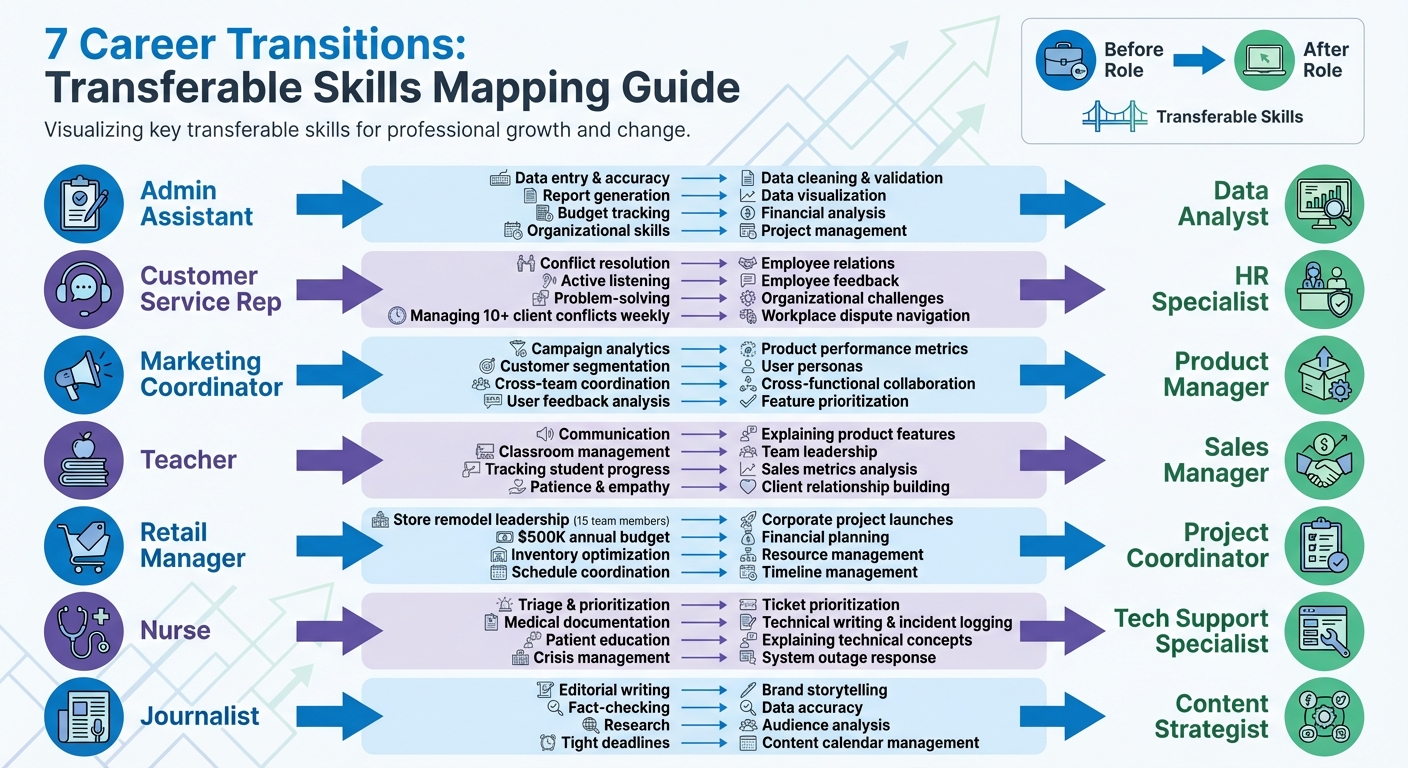
7 Career Transitions: Transferable Skills Mapping Guide
1. Admin Assistant to Data Analyst
Key Transferable Skills Utilized
Administrative assistants work with data regularly, whether it's managing budgets, organizing schedules, creating reports, or maintaining spreadsheet accuracy. These tasks align closely with the responsibilities of a data analyst. For instance, data entry and accuracy evolve into data cleaning and validation, while report generation transforms into data visualization. Similarly, budget tracking transitions into financial and trend analysis. The organizational skills used to manage office operations are easily applied to project management and aligning with stakeholders. Additionally, the ability to explain policies to non-technical colleagues mirrors the communication skills required for presenting data insights to business teams. However, despite these overlapping skills, the lack of technical expertise often becomes a stumbling block for many making this career shift.
Challenges Faced During the Transition
The biggest challenge is the technical skills gap. Employers often look for candidates proficient in tools like SQL, Python, Tableau, or Power BI. Without formal training in these areas, it can be difficult to pass applicant tracking systems that filter resumes for specific technical keywords. Moreover, effectively translating administrative experience into data analysis qualifications on a resume can be tricky, which may lead to missed opportunities with hiring managers.
Steps Taken to Reskill or Adapt
Bridging the technical gap often involves targeted learning efforts. Online courses in SQL and Python, certifications in Tableau or Power BI, and coding bootcamps are common paths to gain these essential skills. A practical approach is using a two-column skills map to connect administrative achievements directly to data analyst requirements - for example, linking "Managed $50,000 budget spreadsheet" to "financial analysis." Tools like Scale.jobs can help reframe administrative experience to better align with data analyst roles, making resumes stand out.
Outcomes Achieved in the New Role
With the right combination of upskilling and a well-crafted resume, administrative professionals transitioning to data analysis frequently find their strengths in organization and attention to detail give them an edge. Their experience in clearly explaining processes to colleagues translates seamlessly into presenting data insights to non-technical audiences. By combining technical training with these transferable skills, they emerge as well-rounded analysts capable of understanding both the data and the broader business context behind it. This blend of expertise makes them valuable contributors to any team.
2. Customer Service Rep to HR Specialist
Key Transferable Skills Utilized
Working in customer service builds a strong foundation in conflict resolution and active listening - skills that are indispensable in HR. Daily responsibilities like resolving disputes, mediating issues, and listening to client concerns mirror the tasks HR professionals handle with employees. For instance, managing over 10 high-pressure client conflicts weekly hones the ability to navigate workplace disagreements effectively. Similarly, the problem-solving required to address customer complaints parallels the analytical thinking needed to tackle organizational challenges. As Kristi Thompson, a seasoned customer support professional, insightfully notes:
"Which is harder to teach: technical skills or people skills? ...teaching people skills is way harder."
These interpersonal strengths not only make the transition smoother but also lay the groundwork for impactful contributions in HR.
Challenges Faced During the Transition
One of the main hurdles in this career shift is reframing customer service accomplishments in a way that aligns with HR roles. While both fields rely heavily on interpersonal skills, HR positions demand candidates to present their experience with clear, targeted examples that reflect an understanding of HR-specific responsibilities. Bridging this gap requires thoughtful communication and framing of past experiences.
Steps Taken to Reskill or Adapt
A practical approach to this transition is creating a skills-mapping table. On one side, list the key competencies required in HR, such as strong communication, conflict resolution, and data management. On the other side, align these with specific customer service experiences. For example, de-escalating customer disputes can be linked to managing employee conflicts, while maintaining accurate customer records demonstrates attention to detail - vital for handling sensitive HR data. This structured method ensures that transferable skills are clearly highlighted for HR hiring managers.
Outcomes Achieved in the New Role
Professionals who transition from customer service to HR often find their interpersonal expertise quickly translates into success. Their ability to handle tough conversations with empathy makes them adept at employee relations and training. Additionally, the precision developed through tasks like data entry or managing customer records becomes invaluable when dealing with confidential HR information. These strengths position former customer service reps as effective and reliable contributors in their new HR roles.
How to identify a list of transferable skills in a career change | 4 easy steps
3. Marketing Coordinator to Product Manager
This example highlights how marketing expertise can pave the way for a successful shift into product management. By leveraging transferable skills, marketing professionals can redefine their career paths and step into a more strategic role.
Key Transferable Skills Utilized
Marketing coordinators bring a unique set of skills to product management, particularly in understanding and addressing user needs. Their experience with campaign analytics directly translates to evaluating product performance metrics and conducting A/B testing. Customer segmentation work becomes the foundation for creating user personas, while their ability to coordinate with teams like designers, content creators, and sales mirrors the cross-functional collaboration required in product management. Additionally, their knack for analyzing user feedback proves invaluable when prioritizing product features and addressing user pain points.
Challenges Faced During the Transition
One common hurdle is the perception that marketing professionals lack technical expertise compared to traditional product managers. Product management often demands familiarity with concepts like APIs, software development cycles, and technical constraints - areas that may not be emphasized in marketing roles. Another challenge is reframing marketing experience from task execution to showcasing strategic campaign management and leadership. Hiring managers tend to focus on product lifecycle skills such as roadmap planning, process optimization, and cross-team collaboration rather than campaign-specific achievements. Addressing these gaps through targeted learning and reframing experience is crucial for a smooth transition.
Steps Taken to Reskill or Adapt
To bridge the gap, many professionals start with a skills audit, mapping their marketing accomplishments to product management competencies. This includes emphasizing measurable outcomes like campaign performance data and market research insights. Identifying areas for improvement allows for focused technical upskilling, such as learning the basics of APIs or agile methodologies. Demonstrating this proactive approach shows hiring managers a commitment to growth. For tailored support in translating marketing experience into product management language, services like tailored job application assistance can be invaluable for crafting resumes that resonate with tech recruiters.
Outcomes Achieved in the New Role
Once in the role, marketing coordinators often find their communication skills set them apart. Their ability to clearly articulate product vision to engineers, executives, and other stakeholders proves to be a significant asset. Data analysis skills honed through campaign tracking transition seamlessly into monitoring product metrics and user behaviors. Similarly, the focus on campaign optimization evolves into driving feature adoption and improving product growth strategies. This successful transition underscores how reimagined skills can lead to meaningful career advancement, showcasing the potential of transferable expertise.
4. Teacher to Sales Manager
Switching from teaching to sales management highlights how core interpersonal skills can drive success in a completely different field. This career pivot demonstrates how leading a classroom can seamlessly translate into managing sales teams and building strong client relationships. Teachers often possess advanced communication and leadership abilities that many sales professionals spend years cultivating, giving them a distinct edge in roles requiring both team management and persuasive interaction.
Key Transferable Skills Utilized
Teachers excel in communication, a skill that directly applies to explaining product features to clients and coaching sales teams. The patience and empathy developed through years of engaging with diverse student groups and parents serve them well in managing difficult clients or fostering stakeholder trust. Classroom management skills naturally align with team leadership, conflict resolution, and fostering collaboration. Additionally, teachers’ experience in tracking student progress equips them to analyze sales metrics, monitor pipeline health, and assess team performance effectively.
Challenges Faced During the Transition
One of the primary hurdles is the perception that teachers lack the technical and financial expertise necessary for sales management. Hiring managers may underestimate their ability to handle tools like CRM systems, sales forecasting, or revenue analysis, despite teachers’ regular use of data platforms and budget management in their prior roles. Another challenge lies in reframing classroom accomplishments into terms that resonate with corporate recruiters. For example, connecting curriculum planning to strategic sales initiatives isn’t always immediately apparent to hiring managers.
Steps Taken to Reskill or Adapt
The key to a successful transition lies in building a strong career narrative using an AI resume builder that bridges the gap between teaching and sales management. Highlighting transferable skills through comparison tables - for example, linking "analytical thinking" in sales to "analyzing student data to tailor teaching methods" - can help recruiters see the value teachers bring. Addressing technical skill gaps proactively is also crucial. Learning CRM platforms like Salesforce or HubSpot before applying to roles shows initiative and readiness. Displaying certifications or personal projects in resumes or portfolios can provide tangible proof of technical competence. For those struggling to articulate their experience in corporate terms, collaborating with a professional resume writer who specializes in career transitions can make a significant difference in securing interviews.
Outcomes Achieved in the New Role
Former teachers often thrive as sales managers because of their ability to coach underperforming team members. Years of identifying and addressing individual learning needs give them an edge in tailoring development plans for sales reps. Their calm demeanor, honed through managing classroom challenges, proves invaluable during tense client negotiations or team conflicts. Additionally, their daily practice of delivering lessons translates seamlessly into creating engaging sales pitches and delivering impactful presentations. Many former teachers also foster a collaborative team culture, prioritizing continuous improvement and feedback - a refreshing approach compared to managers who focus solely on hitting numbers. This unique blend of skills often leads to stronger team performance and healthier workplace dynamics.
5. Retail Manager to Project Coordinator
Retail management builds a solid foundation for project coordination. Retail managers are skilled at balancing multiple priorities, leading teams under pressure, and allocating resources effectively - key aspects of successful project coordination. The challenge lies in reframing retail experience into corporate project terms, showing how managing store operations translates into overseeing cross-functional initiatives.
Key Transferable Skills Utilized
Retail managers bring a wealth of experience that aligns with project coordination. For example, leading a store remodel with a team of 15 while maintaining daily operations mirrors the complexity of managing corporate product launches or software implementations. Handling a $500,000 annual budget demonstrates financial planning expertise, while inventory optimization showcases resource management and analytical skills. Their ability to resolve conflicts - whether between staff or with customers - directly applies to stakeholder management and risk mitigation. Additionally, coordinating schedules, seasonal peaks, and vendor deliveries sharpens time management, a critical skill for handling project timelines. Together, these operational abilities create a strong platform for tackling challenges in project coordination.
Challenges Faced During the Transition
One of the biggest hurdles in this transition is addressing the perception gap around technical skills. Employers may assume that retail professionals lack experience with tools like project management software or Agile frameworks. While retail managers often use workforce management systems and analyze sales data, translating this into corporate terminology can be tricky. For instance, "managed Black Friday operations for 30+ staff" may not immediately resonate as "coordinated a high-pressure, cross-functional project" without careful phrasing.
Steps Taken to Reskill or Adapt
To bridge this gap, many professionals pursue certifications like the Google Project Management Certificate or training in tools such as Asana, Monday.com, or Microsoft Project. Creating a resume with real-life examples is also essential - one that clearly maps retail responsibilities to project coordination tasks. For example, "shift scheduling" can be reframed as "project leadership and timeline management", while "inventory optimization" aligns with "resource allocation and data analysis." For those needing help with this transition, professional resume writing services, like those offered at scale.jobs, can be invaluable in crafting a compelling narrative.
Outcomes Achieved in the New Role
Former retail managers often thrive in project coordination roles, thanks to their ability to navigate fast-paced, unpredictable environments. Their experience in resolving supply chain disruptions or staffing challenges equips them with strong risk management and contingency planning skills. These qualities complement teams that excel in strategy but may lack hands-on execution capabilities, resulting in smoother project delivery. Additionally, their knack for motivating diverse teams and breaking down complex goals into actionable steps fosters collaboration and operational success. This career shift highlights how retail expertise, when effectively translated, meets the demands of corporate project roles, underscoring the value of transferable skills.
6. Nurse to Tech Support Specialist
Nursing and tech support may seem like worlds apart, but they share a surprising overlap in skills. Both require quick problem-solving, staying calm under pressure, and translating complex information into easy-to-understand terms. Nurses are accustomed to assessing patient symptoms, prioritizing critical cases, and documenting medical details - all of which align with the responsibilities of tech support specialists, such as troubleshooting software, managing support tickets, and maintaining detailed incident logs. Transitioning from nursing to tech support is about reframing clinical expertise in technical language and optimizing your resume for ATS and leveraging exceptional interpersonal skills. Let’s dive into the transferable skills, challenges, and steps involved in this career shift.
Key Transferable Skills Utilized
Many skills gained in nursing adapt seamlessly to tech support roles. Here are some examples:
- Triage and prioritization: Just as nurses determine which patients need immediate care, tech support specialists prioritize tickets to address urgent technical issues first.
- Documentation: Medical documentation experience translates into technical writing and incident logging, ensuring accuracy and preventing recurring problems.
- Patient education: Nurses break down complex medical terms for patients, a skill that easily applies to explaining technical concepts to non-technical users.
- Crisis management: Handling medical emergencies prepares nurses to respond calmly during system outages or technical crises.
Kristi Thompson from Help Scout's Customers Team highlights the value of these skills:
"Which is harder to teach: technical skills or people skills? ...teaching people skills is way harder."
This observation underscores why nurses, with their refined interpersonal abilities, are well-suited for tech support roles.
Challenges Faced During the Transition
One of the biggest hurdles nurses face is the perception that they lack technical expertise. Hiring managers may overlook the technical aspects of nursing, such as troubleshooting medical devices or navigating hospital information systems. Additionally, mid-career nurses might be viewed as overqualified or resistant to learning new technology, despite their daily use of advanced medical tools and software.
Steps Taken to Reskill or Adapt
To overcome these challenges, many transitioning nurses pursue entry-level IT certifications like CompTIA A+ or the Google IT Support Professional Certificate. These credentials help establish technical credibility. Nurses also emphasize their experience with hospital information systems, electronic health records, and medical devices on their resumes. Highlighting skills like problem-solving, documentation, and customer service helps bridge the gap between industries and demonstrates their readiness for tech support roles. To accelerate this process, some candidates use human assistants to land jobs faster by outsourcing the application phase.
Outcomes Achieved in the New Role
Former nurses thrive in tech support by staying composed under pressure, acting as a bridge between technical teams and users, and maintaining thorough incident records. Their empathy for frustrated users and disciplined approach to documentation often lead to smoother operations and fewer recurring issues. This career shift proves that strong communication, problem-solving, and crisis management skills can successfully transfer across industries.
7. Journalist to Content Strategist
Journalists and content strategists share a core talent: transforming complex ideas into engaging narratives. Both roles demand strong research abilities, a deep understanding of the audience, and the knack for creating content that captures attention. Journalists, accustomed to tight deadlines, factual accuracy, and writing for diverse audiences, are well-equipped to pivot into content strategy. This shift involves applying editorial expertise within a business framework and learning technical tools like SEO platforms and content management systems (CMS). It's a prime example of how storytelling skills can fuel brand growth and enhance customer engagement.
Key Transferable Skills Utilized
Journalists bring a wealth of skills that align perfectly with content strategy. Their editorial writing seamlessly transitions into brand storytelling and copywriting, while fact-checking ensures data accuracy and adherence to brand guidelines. Research skills evolve into audience and market analysis, and their experience with tight deadlines translates into managing content calendars and projects. Journalists' ability to simplify complex topics into easily digestible formats enables them to create strategies that resonate with a broad audience. Whether crafting a news article or defining a brand's voice, the art of storytelling remains at the heart of both professions.
Challenges Faced During the Transition
One of the most significant hurdles for journalists moving into content strategy is bridging the technical skills gap. Content strategists often need to be familiar with CMS platforms like WordPress or HubSpot, SEO tools like SEMrush or Ahrefs, and analytics platforms such as Google Analytics. Additionally, journalists accustomed to objective reporting may find it challenging to shift toward persuasive, results-driven content tailored to business goals. Hiring managers may also question whether journalists can adapt from independent reporting to producing brand-aligned messaging.
Steps Taken to Reskill or Adapt
To make a smooth transition, journalists often focus on filling specific technical skill gaps through certifications or short courses. Programs like Google Analytics training, HubSpot Content Marketing courses, or SEO fundamentals bootcamps help demonstrate their readiness for the role. Reworking resumes to emphasize transferable skills - such as audience analysis, content planning, and cross-platform storytelling - can also make a big difference. For those unsure how to position their experience effectively, a job application service can help refine resumes and highlight relevant skills in a way that appeals to hiring managers.
Outcomes Achieved in the New Role
Journalists who transition into content strategy excel at maintaining high editorial standards while achieving measurable business outcomes. Their research expertise leads to better audience insights, their fact-checking ensures top-notch content quality, and their ability to meet deadlines keeps projects on schedule. The analytical mindset honed in investigative reporting enables them to create data-informed strategies that improve campaign performance. This career shift highlights how skills like storytelling, research, and project management can thrive in a marketing environment, opening doors to impactful contributions in their new roles.
How Job Search Tools Support Career Changes
Changing careers is no small feat. It often requires convincing hiring managers that your skills from one field can seamlessly apply to a different industry. The right job search platform can make this process smoother by emphasizing your transferable skills or hinder it by relying on generic automation. Scale.jobs, LazyApply, Simplify.jobs, and Jobscan.co each offer distinct approaches to helping career changers, with differences in their use of AI, human involvement, and pricing. Below, we break down how these tools compare, so you can decide which one fits your needs.
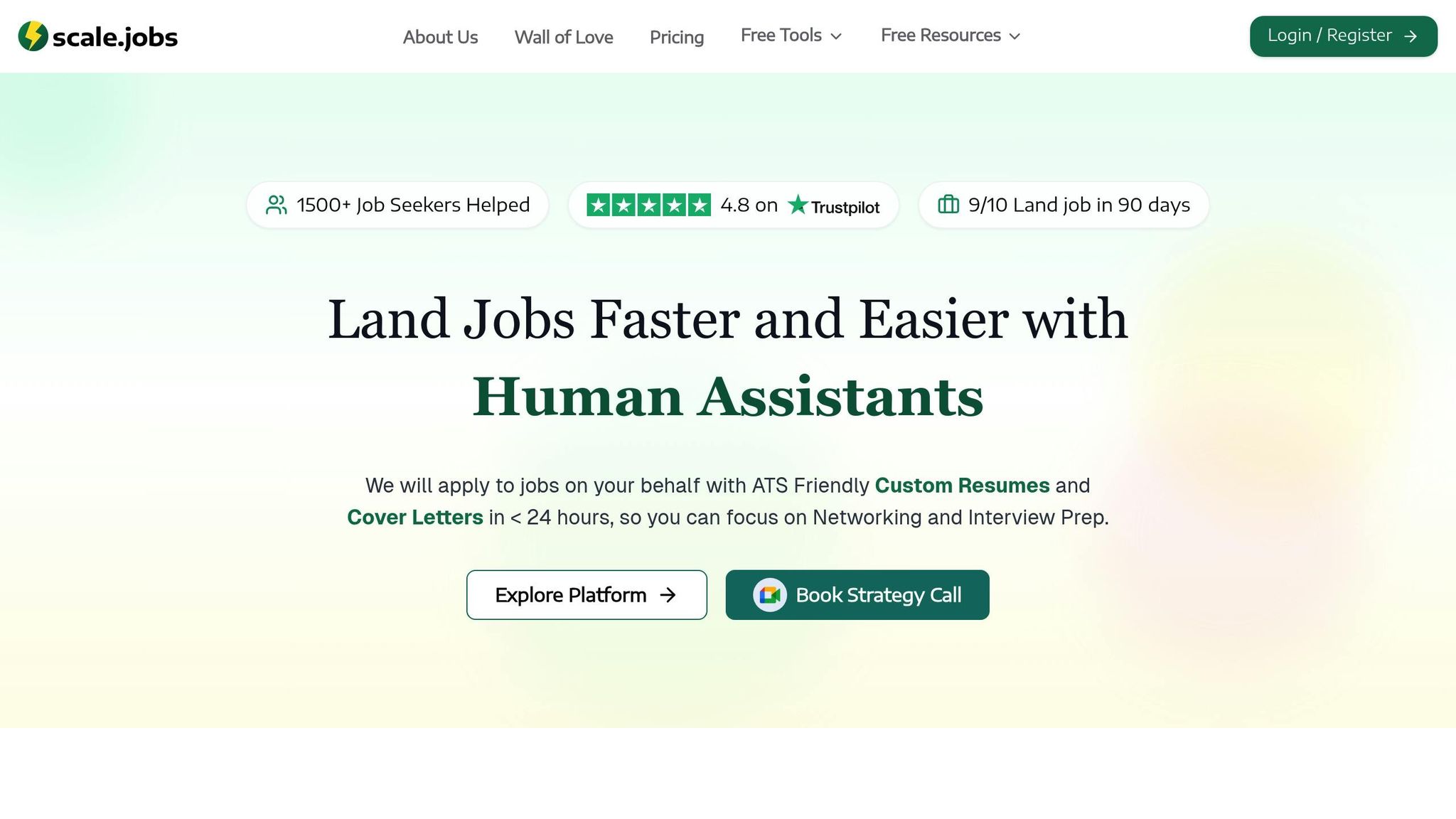
Scale.jobs is particularly helpful for those making significant career changes. It combines AI-powered resume optimization with the expertise of human virtual assistants who reframe your experience to match new roles. For example, they might translate experience in patient care into customer service or classroom management into leadership skills. With transparent updates via WhatsApp, proof-of-work screenshots, and a flat-fee pricing model starting at $199 for 250 applications, Scale.jobs offers several key benefits:
- Human virtual assistants who manually reframe career narratives instead of relying solely on keywords.
- Real-time WhatsApp support with time-stamped screenshots for transparency.
- ATS-optimized resumes and cover letters crafted by experts for each application.
- Flat-fee pricing that avoids the recurring costs of subscriptions.
- Manual application submissions to bypass bot-detection systems, saving over 20 hours weekly for networking and interviews.
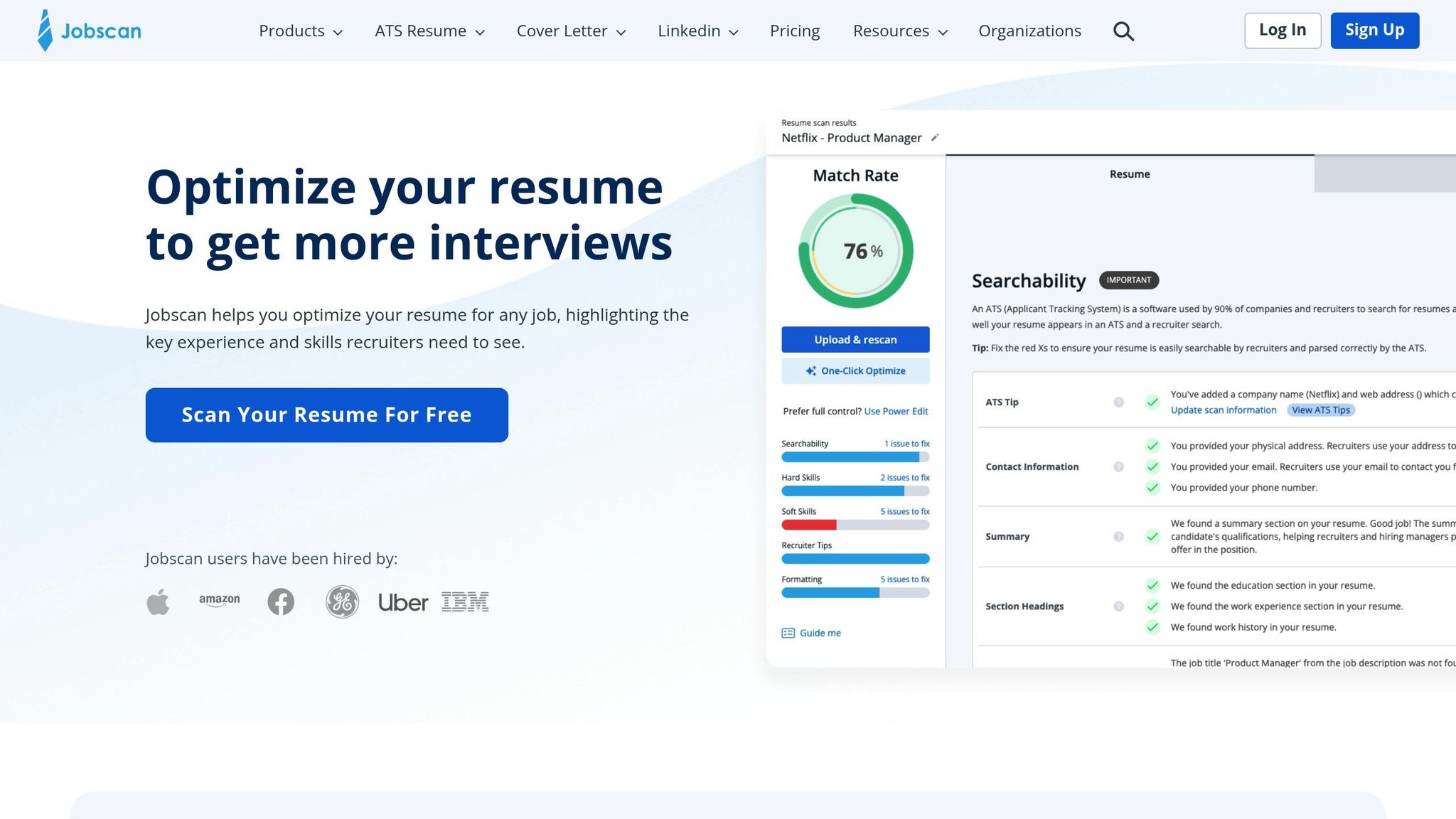
Jobscan.co, on the other hand, focuses on automated ATS keyword optimization. At $49.95 per month, it’s ideal for job seekers who already have a clear target role and need help passing technical filters. However, it lacks the human touch needed for complex career transitions. For instance, if a journalist wants to position their investigative skills as market research expertise, they won’t find strategic guidance here - something Scale.jobs excels at providing.
LazyApply (starting at $99 per month) and Simplify.jobs (subscription/freemium) prioritize speed by automating bulk applications. While efficient, these platforms don’t offer much support for identifying transferable skills or crafting personalized applications. Their focus on automation makes them better suited for straightforward job searches in high-demand fields.
Here’s how these platforms stack up:
| Feature | Scale.jobs | Jobscan.co | LazyApply | Simplify.jobs |
|---|---|---|---|---|
| Primary Method | Human Assistants + AI | ATS Keyword Scanning | Automated Bot Submissions | Browser Extension/Automation |
| Skill Identification | Human reframing of experience | Keyword matching to JD | Limited/Generic | Limited/Generic |
| Support | Real-time WhatsApp + Human chat | Email/Chat | Limited | Limited |
| Pricing Model | Flat-fee (One-time) | Monthly Subscription ($49.95/mo) | Monthly Subscription ($99+/mo) | Subscription/Freemium |
| Best For | Complex career pivots | Resume optimization | High-volume applications | Speed and DIY seekers |
Who Should Use Jobscan.co
- Professionals making straightforward career moves within the same industry.
- DIY users who are comfortable with self-service tools.
- Those with clear target roles needing help passing ATS filters.
- Job seekers on a budget who can handle strategic thinking independently.
Who Should Use LazyApply or Simplify.jobs
- Job seekers who prioritize volume over personalized applications.
- Professionals in high-demand industries where bulk submissions are effective.
- Users comfortable with minimal customization and human oversight.
- Applicants targeting roles with clear and straightforward skill requirements.
Who Should Choose Scale.jobs
- Career changers tackling major industry shifts, like moving from nursing to tech support or teaching to sales.
- Professionals needing expert help to reframe their transferable skills strategically.
- Job seekers who value transparency with real-time updates and proof-of-work documentation.
- Applicants looking to save time for networking and interviews by outsourcing application submissions.
- Those preferring a one-time payment over ongoing monthly fees.
Switch to Scale.jobs If…
- Your resume requires a strategic overhaul to highlight transferable skills across industries.
- Automated tools have failed to capture your unique career story.
- You want manual application submissions to avoid bot-detection systems.
- Real-time updates and proof of application submissions matter to you.
- You’re tired of paying monthly fees and prefer a flat-rate solution.
Decision Summary
Choose Jobscan.co if your career move is straightforward and you need affordable keyword optimization without human involvement.
Choose LazyApply or Simplify.jobs if you’re in a high-demand field where bulk applications can still lead to interviews, even with limited customization.
Choose Scale.jobs if you’re navigating a complex career pivot and need human expertise to reframe your skills, manually submit applications, and provide proof of work - all for a one-time fee.
For those making challenging career transitions, professional resume services that combine AI with human expertise offer a more tailored and effective solution compared to purely automated tools.
Conclusion
These career changes highlight how transferable skills, when presented effectively, can often outweigh the need for direct industry experience. Whether it's a teacher transitioning to a sales manager by leveraging their communication expertise or a nurse using problem-solving skills to excel in tech support, success often hinges on the ability to reframe past experiences in a way that aligns with a new industry. The examples above demonstrate how everyday work experiences can be repositioned to open doors in entirely different fields.
The real challenge isn’t identifying transferable skills - it’s translating them into terms that resonate with hiring managers in a new industry. For instance, a retail manager’s experience in operations can be reframed as expertise in cross-functional team coordination. This strategic repackaging of skills is where tools like Scale.jobs, which combine technology with human insight, can make a difference.
If you’re considering a career shift, start with the free Resume ATS Checker at Scale.jobs to quickly identify which skills to emphasize for your target role. From there, you can decide whether to use DIY tools, AI-driven assistance, or professional support. For more complex transitions - such as moving from nursing to tech or journalism to content strategy - the Virtual Assistant for Job Applications at Scale.jobs can help translate your experience into the language of your desired industry.
While career changes can be daunting, showcasing your transferable skills effectively makes them entirely achievable. These stories serve as a reminder that your next role doesn’t have to mirror your past - it’s all about connecting the dots in the right way.
FAQs
How can I prove my transferable skills without direct experience?
To demonstrate transferable skills effectively, focus on showcasing abilities such as communication, problem-solving, leadership, or skills acquired through work, education, or volunteering. Highlight specific achievements where these skills contributed to success, even if they were in roles unrelated to the job you're targeting. For instance, managing a team during a volunteer project can illustrate leadership and organizational abilities.
Use tools like self-assessments or feedback from colleagues and supervisors to identify your strongest skills. Then, tailor your resume and cover letter to reflect how these align with the requirements of the role you’re pursuing. Back up your claims with quantifiable results - like improving efficiency by a certain percentage or resolving a significant challenge.
By customizing your application and focusing on measurable outcomes, you can effectively demonstrate your potential, even if you lack direct experience in the field. Consider using tools like an AI resume builder or an AI cover letter builder to ensure your application is polished and targeted.
Which certifications matter most for a career pivot?
Certifications that can significantly boost your chances during a career pivot include those that are widely recognized across industries. Examples include the PMP (Project Management Professional) for project management, Google Professional Certifications for tech and digital marketing roles, and cybersecurity credentials like CCNA (Cisco Certified Network Associate). Additionally, field-specific certifications such as the CPA (Certified Public Accountant) for accounting or certifications in data analytics can validate your expertise. These not only demonstrate your skill set but also signal your readiness to transition into a new role effectively.
How should I rewrite my resume for a new industry?
To prepare your resume for a career shift into a new industry, emphasize transferable skills and experiences that align with your target role. Begin with a strong objective or headline that clearly states your intent to transition. Opt for a hybrid or functional resume format, which allows you to spotlight key abilities such as problem-solving or communication. Customize your language to include industry-specific keywords to ensure compatibility with applicant tracking systems (ATS). Additionally, showcase any certifications, training, or projects that demonstrate your readiness for the new field.