Cap-Exempt H1B Jobs: The Complete List of Employers Who Skip the Lottery
Which universities, research centers, nonprofits, and government agencies can sponsor cap-exempt H-1B visas, and how to find and apply.


Cap-exempt H1B jobs allow international workers to bypass the annual H1B lottery, offering year-round application opportunities and immediate work authorization upon approval by USCIS. These roles are tied to specific employers, such as universities, nonprofit research organizations, government research agencies, and nonprofits affiliated with higher education institutions. Unlike the standard H1B visa, which is capped at 85,000 slots annually, cap-exempt positions face no such restrictions, making them a reliable pathway for skilled professionals.
Key takeaways:
- Who qualifies: Employers include higher education institutions, affiliated nonprofits (e.g., teaching hospitals), nonprofit research organizations, and government research agencies.
- Advantages: Applications can be filed anytime, no lottery process, and faster start dates.
- Salary insights: Top employers like Stanford University and Johns Hopkins University report average salaries of $103,146 and $96,188, respectively.
- Application tips: Tailored resumes and ATS-optimized documents are essential for academic and research positions.
For job seekers targeting cap-exempt roles, platforms like Scale.jobs provide personalized assistance, ensuring applications meet specific employer requirements. Whether you're pursuing research opportunities or teaching roles, understanding cap-exempt employers and tailoring your applications can significantly boost your chances. Below, we explore employer categories, top sponsors, and actionable advice to navigate the process effectively.
H-1B Cap-Exempt Employers - Your Pathway to U.S. Employment Without the Lottery Hassle!
4 Types of Cap-Exempt H1B Employers
The U.S. Citizenship and Immigration Services (USCIS) identifies four employer categories eligible for cap-exempt H1B sponsorship. Each category has its own requirements, and understanding them can help you focus on the right opportunities.
Higher Education Institutions
Public or nonprofit colleges and universities that are accredited and meet certain educational criteria qualify for cap exemption. These institutions must require a high school diploma for admission and offer degree programs lasting at least two years. This category includes state universities, private colleges, and community colleges nationwide.
For example, Stanford University filed 434 H1B applications in Fiscal Year 2025, with 422 approvals and an average salary of $103,146. Similarly, the University of Michigan processed 488 applications, achieving 447 approvals with an average salary of $83,708. Platforms like scale.jobs can assist applicants by providing ATS-optimized documents and personalized support tailored to these institutions' requirements.
Nonprofits Affiliated with Universities
Nonprofit organizations with a formal written affiliation agreement with a university also qualify for cap exemption. This category often includes teaching hospitals and university-based research centers. However, the affiliation must be documented and verified - informal partnerships don’t meet the criteria.
The Icahn School of Medicine at Mount Sinai, for instance, filed 204 applications in Fiscal Year 2025, with 201 approvals and an average salary of $140,729. Indiana University Health Care Associates Inc. reported an even higher average salary of $299,549 for medical specialists. These organizations frequently sponsor roles like physicians, clinical researchers, and other healthcare professionals. While affiliated nonprofits typically have strong ties to universities, independent nonprofits focus exclusively on advancing research.
Nonprofit Research Organizations
Independent nonprofit organizations with 501(c)(3) status qualify for cap exemption if their primary mission involves advancing knowledge through basic or applied research. These organizations prioritize specialized research over general charitable activities.
For example, Battelle Memorial Institute filed 115 H1B applications in Fiscal Year 2025, with 95 approvals and an average salary of $99,895. St. Jude Children’s Research Hospital processed 269 applications, achieving 264 approvals with an average salary of $85,720. If you’re targeting these roles, using a professional resume service can help ensure your materials align with the technical and research-focused expectations of these institutions.
Government Research Agencies
Federal, state, or local government agencies that focus on research also qualify for cap-exempt H1B sponsorship. This includes entities like national laboratories, intramural research programs, and specialized government science facilities.
For instance, the National Institutes of Health (NIH) filed 184 H1B applications in Fiscal Year 2025, with an average salary of $109,896. NASA’s Jet Propulsion Laboratory and Los Alamos National Laboratory are other examples of government agencies sponsoring H1B workers under this category. Platforms like scale.jobs use precise employer data to craft application strategies, offering transparent guidance and dedicated support throughout the process.
A Key Note on Concurrent Employment
It’s worth noting that you can work simultaneously for both a cap-exempt and cap-subject employer without being restricted by the lottery, as long as your cap-exempt employment remains active. This flexibility can open additional opportunities for H1B applicants.
Top 25 Cap-Exempt Employers by LCA Filings
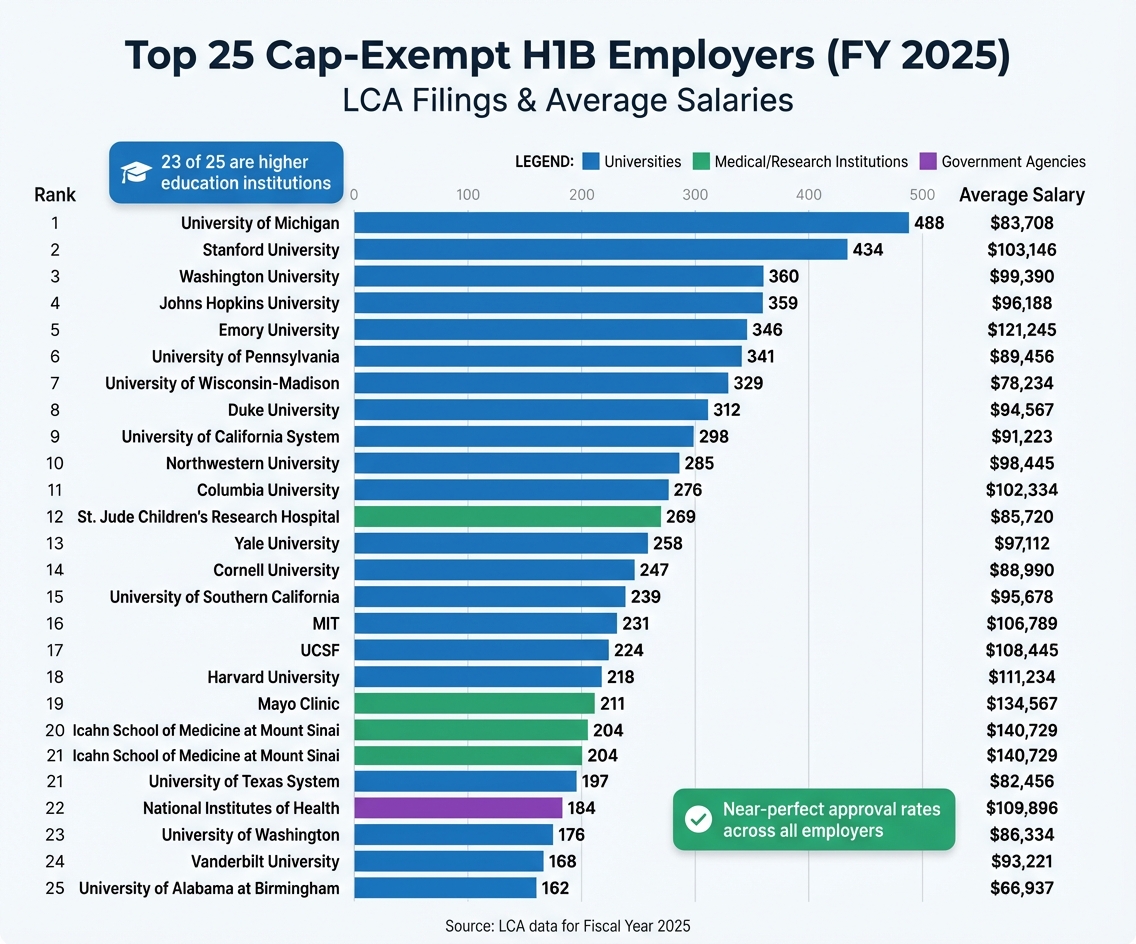
Top 25 Cap-Exempt H1B Employers by LCA Filings and Average Salary
Here’s a look at the top 25 cap-exempt employers based on LCA filings for Fiscal Year 2025. These organizations are known for their consistent H1B sponsorship and well-structured immigration processes, making them reliable options for international candidates.
At the forefront is the University of Michigan, with 488 LCA filings and an average salary of $83,708. Stanford University comes in second with 434 filings and a higher average salary of $103,146. Washington University secures the third spot with 360 filings, offering an average salary of $99,390. These high-volume filers present strong opportunities for those seeking cap-exempt sponsorships.
Employer Rankings Table
| Rank | Employer | LCA Filings | Avg Salary |
|---|---|---|---|
| 1 | University of Michigan | 488 | $83,708 |
| 2 | The Leland Stanford Jr University | 434 | $103,146 |
| 3 | Washington University | 360 | $99,390 |
| 4 | Johns Hopkins University | 359 | $96,188 |
| 5 | Emory University | 346 | $121,245 |
| 6 | Trustees of the University of Pennsylvania | 341 | $89,456 |
| 7 | University of Wisconsin-Madison | 329 | $78,234 |
| 8 | Duke University | 312 | $94,567 |
| 9 | University of California System | 298 | $91,223 |
| 10 | Northwestern University | 285 | $98,445 |
| 11 | Columbia University | 276 | $102,334 |
| 12 | St. Jude Children's Research Hospital | 269 | $85,720 |
| 13 | Yale University | 258 | $97,112 |
| 14 | Cornell University | 247 | $88,990 |
| 15 | University of Southern California | 239 | $95,678 |
| 16 | Massachusetts Institute of Technology | 231 | $106,789 |
| 17 | University of California, San Francisco | 224 | $108,445 |
| 18 | Harvard University | 218 | $111,234 |
| 19 | Mayo Clinic | 211 | $134,567 |
| 20 | Icahn School of Medicine at Mount Sinai | 204 | $140,729 |
| 21 | University of Texas System | 197 | $82,456 |
| 22 | National Institutes of Health | 184 | $109,896 |
| 23 | University of Washington | 176 | $86,334 |
| 24 | Vanderbilt University | 168 | $93,221 |
| 25 | University of Alabama at Birmingham | 162 | $66,937 |
Key Insights from the Rankings
Higher education institutions dominate this list, accounting for 23 of the top 25 employers. This underscores the critical role universities play in cap-exempt H1B sponsorship. Alongside them, medical research centers like St. Jude Children's Research Hospital and Mayo Clinic highlight the healthcare sector's demand for specialized talent in clinical and research positions.
Approval rates for these employers are almost perfect, with many reporting zero denials in 2025. This makes them excellent targets for job seekers pursuing cap-exempt opportunities.
How to Maximize Your Chances
If you’re aiming for positions at these high-volume sponsors, tailoring your application is essential. Platforms like Scale.jobs offer human-assisted services that go beyond the capabilities of automated tools like LazyApply or Simplify.jobs. With Scale.jobs, you can access ATS-optimized resumes and cover letters specifically designed for the technical and research-focused roles these organizations demand.
More Cap-Exempt Employers by Industry
A variety of industries offer cap-exempt opportunities, bypassing the H-1B lottery and opening doors for international talent. These sectors provide diverse roles that align with specific skills and expertise, making it easier for candidates to secure positions without the uncertainty of the lottery.
Universities and Colleges
Prominent academic institutions, including University of California campuses, Yale, Harvard, MIT, Princeton, and Cornell, actively sponsor cap-exempt roles throughout the year. These positions span across research, teaching, administrative, and technical support areas. Universities often seek international talent for their innovative research programs and educational initiatives, offering a consistent pathway for professionals to secure cap-exempt employment.
Teaching Hospitals and Medical Research Centers
Many university-affiliated medical centers are key players in healthcare sponsorship. Esteemed organizations like Memorial Sloan Kettering Cancer Center, Cleveland Clinic, MD Anderson Cancer Center, Dana-Farber Cancer Institute, and Mount Sinai Health System regularly offer roles for physicians, research scientists, and other healthcare specialists. Teaching hospitals such as UCSF Medical Center and UT Southwestern Medical Center leverage their affiliations with universities to maintain cap-exempt status, ensuring year-round flexibility in hiring international professionals.
Nonprofits and Think Tanks
Nonprofit research organizations also provide cap-exempt opportunities outside traditional academic settings. Institutions like the Broad Institute, Howard Hughes Medical Institute, Salk Institute for Biological Studies, Scripps Research Institute, Fred Hutchinson Cancer Center, and Battelle Memorial Institute qualify under USCIS guidelines for nonprofit research organizations. Policy-focused think tanks such as the Brookings Institution and World Resources Institute also sponsor H-1B workers, although typically in smaller numbers. When considering nonprofit roles, it’s important to confirm that the organization’s primary mission revolves around research or education, as general charities do not inherently qualify for cap exemptions. Additionally, government agencies often present valuable cap-exempt opportunities.
Federal Research Organizations
Government-funded research institutions are another avenue for cap-exempt employment, offering long-term stability and competitive benefits. Agencies like the National Institutes of Health (NIH), Los Alamos National Laboratory, Sandia National Laboratories, Argonne National Laboratory, and Oak Ridge National Laboratory frequently sponsor international researchers in fields such as physics, materials science, and energy research. NASA's Jet Propulsion Laboratory also provides opportunities in areas like aerospace engineering and planetary science. Some of these positions may require security clearance, but they remain an attractive option for those seeking cap-exempt roles in cutting-edge research fields.
How to Find and Verify Cap-Exempt Employers
If you're looking to work with cap-exempt employers, knowing how to identify and verify them is crucial. These opportunities often aren't clearly labeled on general job boards, so you'll need to dig a little deeper. Specialized databases like H1BGrader or H1BMetrics can be invaluable. They track historical Labor Condition Application (LCA) filings and allow you to filter by "H1B Cap Exempt" status, showing employer approval rates. For example, according to H1BMetrics data from 2025, the University of Michigan filed 488 cap-exempt applications with a 0% denial rate, while Stanford University filed 434 with similar success.
Check USCIS and Third-Party Databases
These platforms provide insights into how many LCAs an organization has filed, their approval rates, and even average salaries. Tools like the H1BGrader Chrome Extension can flag H1B sponsors directly on job platforms like LinkedIn and Indeed. For nonprofit employers, you can verify their tax-exempt status through IRS records. If a nonprofit is affiliated with a university, ensure there’s a formal written affiliation agreement in place. Reach out to HR or legal teams to confirm this documentation.
Filter Job Boards for Cap-Exempt Positions
Traditional job boards often don’t label positions as "cap-exempt", so you’ll need to search by employer type instead. On platforms like LinkedIn or Indeed, use terms such as "University", "Teaching Hospital", "National Laboratory", or "Research Institute" to find relevant roles. Because job postings rarely mention visa sponsorship details, you can cross-check the employer’s name in H1BGrader for their LCA history. For research institutions, reviewing their mission statement can also help, as USCIS requires their primary focus to be basic or applied research.
Cross-Check Job Listings with Verified Employers
When you find a job posting, compare it against known cap-exempt employer lists. For teaching hospitals, confirm their university affiliation by checking their "About" page or accreditation details. Be cautious with newer or online-only schools - ensure they qualify as an "institution of higher education" under 20 U.S.C. 1001(a), which includes being accredited or actively working toward accreditation. For complex cases, consult legal counsel to clarify exemption eligibility.
If you’re applying to multiple cap-exempt employers, tailoring your resume for each institution is crucial. Services like human virtual assistants can help you create customized applications that align with specific hiring standards. Once you’ve verified employer data and refined your materials, you’ll be ready to move forward with confidence.
How to Apply for Cap-Exempt H1B Jobs
Building on the employer insights shared earlier, here's how Scale.jobs simplifies the application process for cap-exempt H1B roles, offering a personalized approach compared to tools like LazyApply or Simplify.jobs.
Apply Anytime Without Lottery Restrictions
One of the biggest advantages of cap-exempt H1B petitions is their flexible timeline. Unlike the standard H1B process, which hinges on the March lottery and October 1 start date, cap-exempt applications can be filed year-round. For instance, if you land a research role at Johns Hopkins University in July or a teaching position at Stanford in December, your employer can submit your petition right away.
Processing fees are the same as standard H1B applications, with an option for premium processing at $2,805 (rising to $2,965 post-March 1, 2026) for a decision within 15 business days. This flexibility is a key area where Scale.jobs shines, offering ongoing support and strategic guidance to help you navigate this unique timeline.
Use Cap-Exempt Roles to Transition to Other Employers
Working for a cap-exempt employer can open doors to cap-subject opportunities. If you're employed by a cap-exempt institution - even part-time, for as little as 5 hours a week - you can have a cap-subject employer file a concurrent H1B petition without needing to go through the lottery. This allows you to maintain your academic or research role while exploring private-sector opportunities.
However, if you leave your cap-exempt employer entirely to join a cap-subject organization, you'll need to enter the lottery unless you've been counted against the cap within the last six years. This process highlights the importance of strategic planning, a key area where Scale.jobs' tailored approach offers an edge over automated tools.
Customize Applications for Cap-Exempt Organizations
Academic and research institutions prioritize candidates differently than corporate employers. To stand out, you’ll need to emphasize your academic credentials, published research, and technical skills that align with the organization's mission. For example, when the University of Michigan filed 488 cap-exempt applications in 2025 with an average salary of $83,708, they focused on candidates whose work directly supported their research goals.
Even for cap-exempt roles, it's essential to meet the "specialty occupation" criteria, which require at least a bachelor's degree in a specific field. This level of detail is where Scale.jobs excels, ensuring your application materials are perfectly aligned with the institution's expectations.
Why Scale.jobs Stands Out Compared to LazyApply and Simplify.jobs
LazyApply offers quick, high-volume application submissions but lacks the ability to tailor applications for specialized roles. Simplify.jobs provides basic autofill features for corporate applications but doesn’t cater to the nuanced requirements of academic and research institutions.
Here’s why Scale.jobs leads the pack:
- Human-powered customization: Expertly crafted resumes that highlight your academic achievements and research credentials.
- ATS optimization for academic systems: Documents designed specifically for university and research institution tracking systems.
- Detailed proof-of-work: Transparent reports showing exactly how each application was tailored.
- Direct support via WhatsApp: Access to a human assistant who provides guidance throughout the process.
- One-time payment: No recurring fees - just a single payment for comprehensive support.
Comparison Table: Scale.jobs vs. Competitors
| Feature | LazyApply | Simplify.jobs | Scale.jobs |
|---|---|---|---|
| Human involvement | None (fully automated) | Minimal (autofill only) | Full human assistance |
| Resume customization depth | Generic templates | Basic autofill | Institution-specific tailoring |
| ATS handling | Standard corporate ATS | Basic compatibility | Academic/research ATS optimization |
| Application execution method | Mass automation | One-click submission | Strategic, customized submission |
| Transparency and proof-of-work | Limited reporting | Application tracking only | Detailed customization reports |
| Pricing model | Monthly subscription | Freemium + subscription | One-time payment |
Who Should Use LazyApply
LazyApply is best for candidates applying to a large volume of corporate roles where speed matters more than personalized applications. If you're targeting 500+ positions in standard industries, its automation features might be sufficient.
Who Should Use Simplify.jobs
Simplify.jobs is a good fit for entry-level professionals applying to tech companies with straightforward processes. It’s a low-cost option for those who don’t require much customization.
Who Should Choose Scale.jobs
Scale.jobs is ideal for international candidates and those targeting cap-exempt employers, such as universities and research institutions. If your application success depends on showcasing research publications, academic credentials, and technical expertise, Scale.jobs provides the in-depth assistance you need.
Switch to Scale.jobs If…
- Your applications to cap-exempt employers aren’t getting responses: Automated tools often miss the mark when it comes to emphasizing academic qualifications.
- You need ATS optimization for academic systems: Academic ATS platforms require specialized formatting that differs from corporate systems.
- You want transparency in the application process: Scale.jobs provides detailed reports on how your materials were customized.
- You’re applying to fewer than 100 high-value roles: For competitive positions, quality beats quantity.
- You need ongoing support: Human assistants offer strategic guidance and personalized help that automation simply can’t match.
If you're ready to elevate your applications for cap-exempt roles, Scale.jobs offers professional resume services that ensure your academic and research credentials are presented in the best possible light. With their tailored approach, you can confidently pursue opportunities that align with your expertise.
Conclusion
Cap-exempt H1B positions provide a practical alternative for international candidates aiming to work at universities, research institutions, or affiliated nonprofits. Esteemed institutions such as the University of Michigan, Stanford, and Johns Hopkins file hundreds of cap-exempt H1B applications each year, avoiding the constraints of the 85,000-applicant cap.
The four main employer categories - higher education institutions, university-affiliated nonprofits, nonprofit research organizations, and government research agencies - offer unmatched flexibility compared to cap-subject roles. With the ability to file year-round, candidates can begin working as soon as their petition is approved. The option for premium processing ensures decisions within 15 business days. Additionally, these roles are financially appealing since they are exempt from the $100,000 Presidential Proclamation fee.
To confirm cap-exempt status, utilize resources like LCA databases, IRS records, or formal affiliation agreements. Keep in mind that job postings often do not explicitly mention cap-exempt status. Targeting employers like teaching hospitals or research institutions can significantly improve your chances by bypassing the uncertainty of the lottery system.
When applying, focus on quality over quantity. Tailor your applications to emphasize your research background and academic achievements. Institutions value credentials such as published work, technical expertise, and contributions that align with their mission. Scale.jobs enhances your application process by combining human expertise with ATS-optimized documents and dedicated support to help your profile stand out.
The numbers speak for themselves: leading cap-exempt employers such as Stanford, Johns Hopkins, and Emory University reported 0% denial rates in 2025. Use these insights to strategize your approach - verify employer eligibility, customize your applications, and highlight your research contributions effectively.
For personalized resumes that align with cap-exempt criteria, consider using Scale.jobs' professional resume services. With tailored support and transparent guidance, Scale.jobs can help you navigate the cap-exempt H1B process with confidence.
FAQs
How do I confirm an employer is truly cap-exempt?
To determine if an employer is cap-exempt, start by checking if they fall into categories like universities, nonprofit research organizations, or government research entities. These employers generally have the advantage of filing petitions year-round without needing to go through the lottery process. To confirm their status, consult trustworthy resources such as official directories or recognized guides. Common examples of cap-exempt employers include higher education institutions, nonprofits closely associated with them, and organizations focused on research.
Can I switch from a cap-exempt job to a regular H-1B employer without the lottery?
Yes, it is possible to transition from a cap-exempt H-1B job to a regular H-1B employer without needing to go through the lottery again. Cap-exempt H-1B visas are not subject to the annual cap, meaning they are available year-round and do not require participation in the lottery process.
What qualifies as a “university affiliation” for a nonprofit to be cap-exempt?
A nonprofit is deemed to have a university affiliation when it is linked to or partnered with a higher education institution, such as a university or college. This connection makes the nonprofit eligible for cap exemption under the H-1B visa program.