The Biggest Limitations of AI Applying to Jobs
AI tools speed up applications but produce generic, error-prone resumes and ATS issues; human-reviewed, hybrid approaches double interview rates.

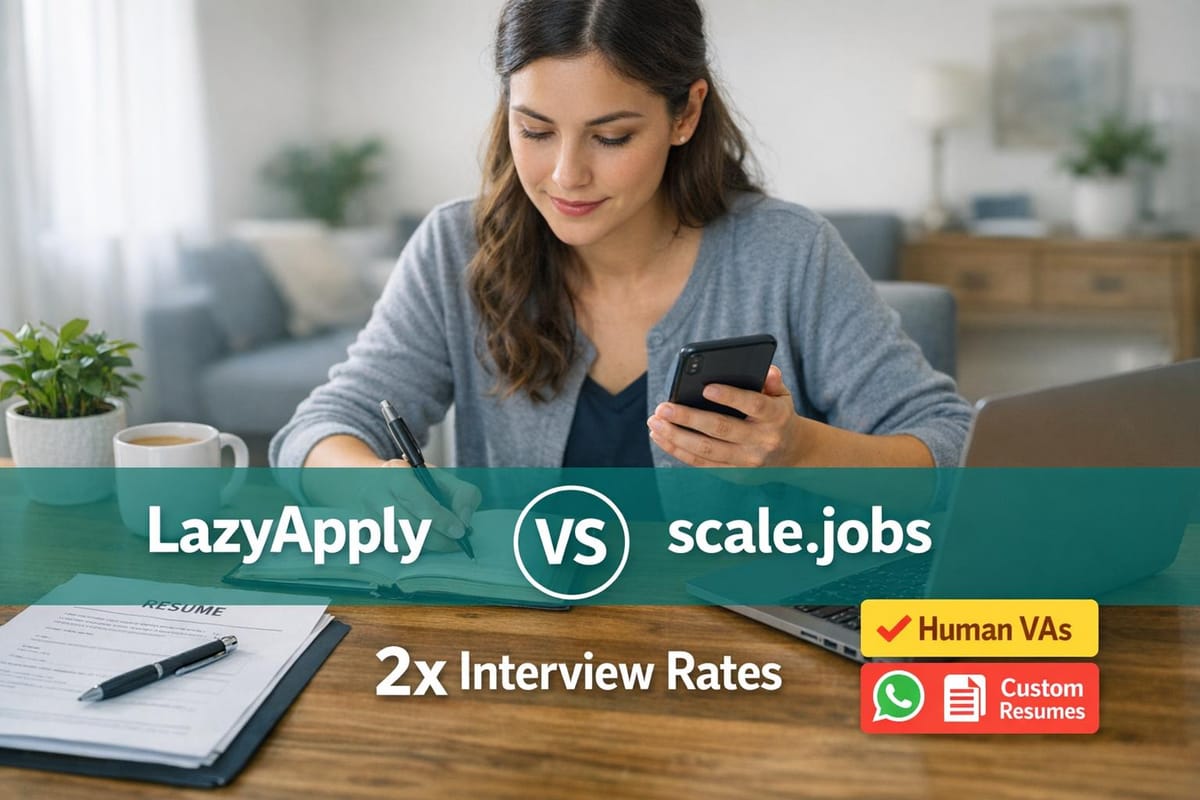
AI tools are transforming job applications by automating resumes and cover letters, but they come with major drawbacks. Recruiters often spot repetitive, generic content from tools like LazyApply or Simplify.jobs, which fail to highlight unique skills or accomplishments. These tools also risk inaccuracies, such as fabricating skills or misinterpreting job requirements, leading to lower success rates.
Key Issues with AI-Generated Job Applications:
- Generic templates that lack individuality.
- Errors, exaggerations, or irrelevant keyword stuffing.
- Poor compatibility with ATS systems, reducing visibility.
- Limited understanding of nuanced job descriptions.
Why Human Input Matters:
Services like scale.jobs combine AI’s efficiency with human review to create personalized, ATS-friendly applications. This approach doubles interview rates compared to AI-only tools, ensuring accuracy and relevance while avoiding common AI pitfalls.
Quick Comparison:
| Feature | AI-Only Tools | scale.jobs |
|---|---|---|
| Application Quality | Generic, repetitive | Tailored by humans |
| ATS Compatibility | Often problematic | Optimized for ATS |
| Pricing | Subscription-based | One-time flat fee |
| Success Rate | ~3 interviews/100 | ~6 interviews/100 |
AI alone falls short in job applications. A hybrid approach, blending AI with human expertise, is the smarter choice for standing out in today’s competitive job market.
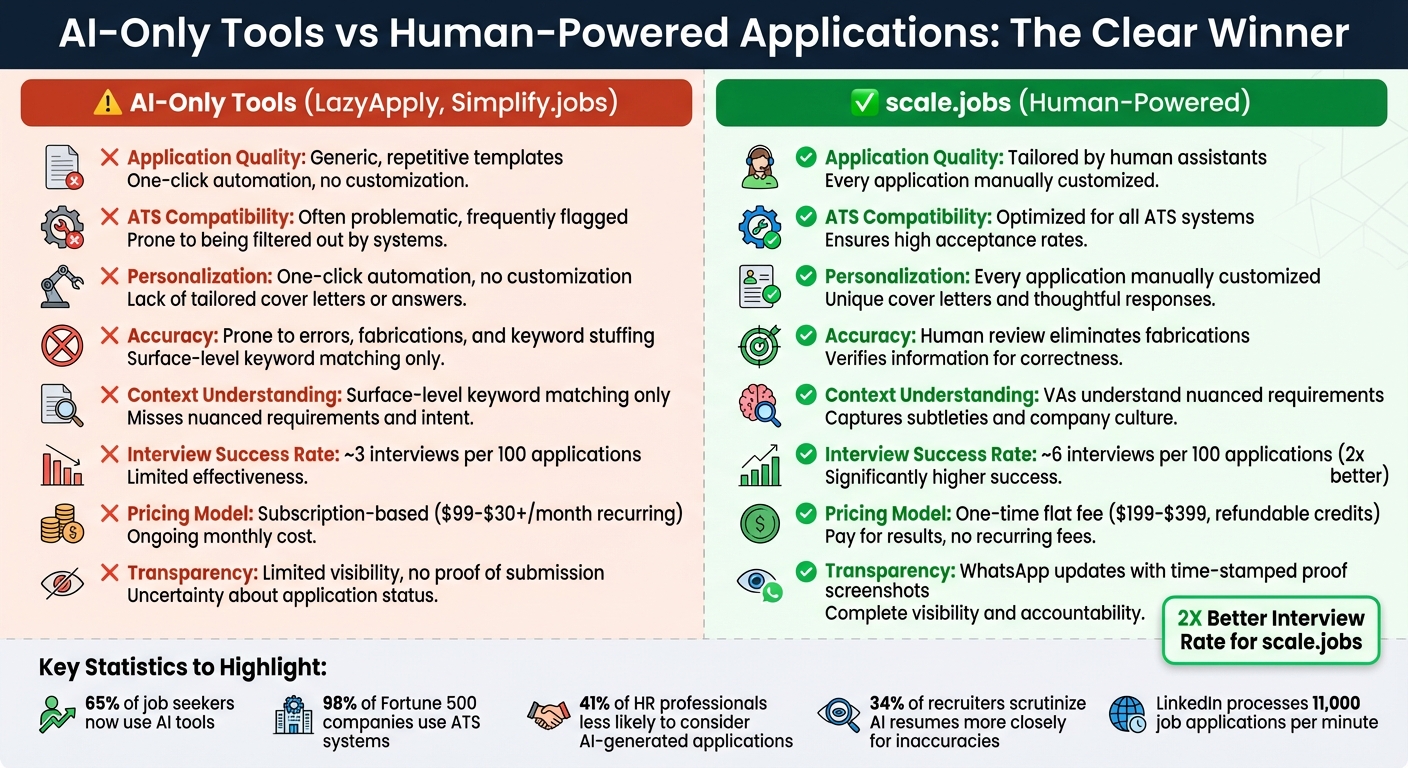
AI-Only vs Human-Powered Job Application Tools Comparison
Job searching SUCKS... and AI made it worse
AI Tools Produce Generic Applications
AI-generated applications often look polished but fall short where it matters most: individuality. They tend to follow the same templates, rely on overused buzzwords, and lack the personal touch that makes an application memorable. Recruiters reviewing hundreds of resumes from tools like LazyApply or Simplify.jobs quickly spot this sameness. Sofia Mishina, Talent Acquisition Director at AI Digital, shares her experience:
I see resumes that are perfectly formatted and perfectly forgettable - the same buzzwords, same tone, no proof of work.
This issue arises because AI tools draw from similar online sources and prompts, resulting in a flood of near-identical applications. With about 65% of job seekers now using AI tools, standing out has become a challenge. Recruiters often question the accuracy of these cookie-cutter documents, suspecting exaggerations or outright inaccuracies. This lack of originality not only weakens your unique appeal but also creates hurdles for both human reviewers and applicant tracking systems (ATS).
Why Generic Resumes Fall Short
Tools like LazyApply and Simplify.jobs promise convenience by automating applications, but they compromise the critical element of personalization. These platforms fail to highlight your specific achievements - like exceeding sales goals by 30% or driving a 50% increase in website traffic - and instead rely on vague, forgettable language. Jeremy Schifeling, Founder of The Job Insiders, explains the problem:
When I scan this, though, my first thought is 'Wow - this candidate is great at buzzwords, but not so great at actual marketing.'
The numbers tell the story: generic resumes result in just 3 interviews per 100 applications, while personalized resumes more than double that, yielding about 6 interviews. Automated tools that overlook your unique career accomplishments put you at a clear disadvantage. This is where scale.jobs steps in, pairing you with real human assistants who focus on your specific achievements to craft applications that genuinely reflect your experience. Unlike AI tools, this approach ensures your application resonates with both recruiters and ATS systems.
Why AI-Generated Resumes Struggle with ATS
Even when AI-generated resumes appear polished, they often fail to pass ATS filters effectively. Over 98% of Fortune 500 companies use ATS to screen candidates, and many AI tools produce resumes that these systems struggle to parse. For example, creative layouts with tables, columns, or graphics can disrupt ATS functionality. Contact details placed in headers might be ignored, and bullet points formatted as images may not be read at all.
Another common issue is keyword stuffing. AI tools often cram job description terms into resumes without considering context, resulting in awkward, robotic phrasing. Adam Karpiak, Co-founder of Karpiak Consulting, highlights this problem:
AI doesn't understand context. It doesn't know how you got results or what made your impact unique. Without that, your resume might check all the boxes for keyword searches, but it won't connect with a human reader.
scale.jobs offers a solution by creating ATS-friendly resumes that balance technical precision with a natural, human voice. Their team of professionals ensures your resume is error-free, contextually accurate, and optimized to navigate ATS systems seamlessly. With a one-time payment model and proof of work, they provide clear, standout resumes that avoid the pitfalls of generic, AI-generated documents.
AI Can't Understand Complex Job Requirements
AI tools often struggle to interpret job postings beyond a superficial level. When phrases like "strategic thinking" or "cross-functional collaboration" appear, these tools simply match keywords without grasping the deeper meaning. This surface-level approach can lead to applications that seem relevant on paper but fall apart under closer examination. It’s a clear sign that AI tools lack the ability to fully capture the nuanced demands of a role.
AI Misses Important Context
Platforms such as Jobscan.co and Sonara.ai are great at identifying keywords, but they fail to consider the actual priorities of a job description. These tools treat every word as equally important, unable to distinguish between must-have qualifications and nice-to-have skills. For instance, if a job posting mentions "Salesforce experience", AI tools might add it to your resume even if you don’t have any actual experience with the software.
In April 2025, recruiter Tom Powner encountered this issue firsthand. While interviewing a candidate for a Sales Director role requiring at least two years of Salesforce experience, he discovered that the AI-generated resume prominently listed this skill - but the candidate admitted during the interview that they had never used Salesforce. The AI tool had simply included it to match the job description, creating a false impression.
Dr. Megan Workmon Larsen dealt with a similar challenge in 2023 while overseeing hiring for ASU Tech Hubs. Her team received 2,309 applications for just 20 openings - a staggering 300% increase, largely fueled by AI-generated resumes. Many of these applications mirrored job postings so closely that it became nearly impossible to separate genuine qualifications from AI-suggested embellishments. Her team had to rely on manual rubrics and detailed interviews to verify candidates' actual skills.
These examples underline the critical flaw in AI-driven applications: they lack the ability to understand context, making human review essential.
Real Examples of AI Application Mistakes
The limitations of AI tools are often evident in the mistakes they make. Some have been caught responding to application questions like "Why do you want to work here?" with absurd answers such as, "As artificial intelligence, I do not have emotions." Others have included glaring errors, such as misnaming companies or fabricating details.
Jen DeLorenzo, Founder of The Career Raven, highlights the risks involved:
When AI is asked to rewrite a resume to coordinate with a job description, it is going to start to lie if the title doesn't 100% align.
For example, if your current role is "Marketing Coordinator" but you’re applying for a "Marketing Manager" position, AI might invent managerial experience to bridge the gap. This creates problems during interviews when you’re unable to substantiate claims made on your resume.
scale.jobs addresses this issue by involving real humans in the application process. Their team reviews your actual experience, asks clarifying questions, and ensures every claim on your resume is accurate and backed by real-life examples. With features like WhatsApp support and proof-of-work transparency, they deliver applications that genuinely reflect your skills - avoiding fabrications, embarrassing errors, and the contextual missteps that can harm your chances.
LazyApply vs scale.jobs: Why You Should Switch to Human-Powered Apply
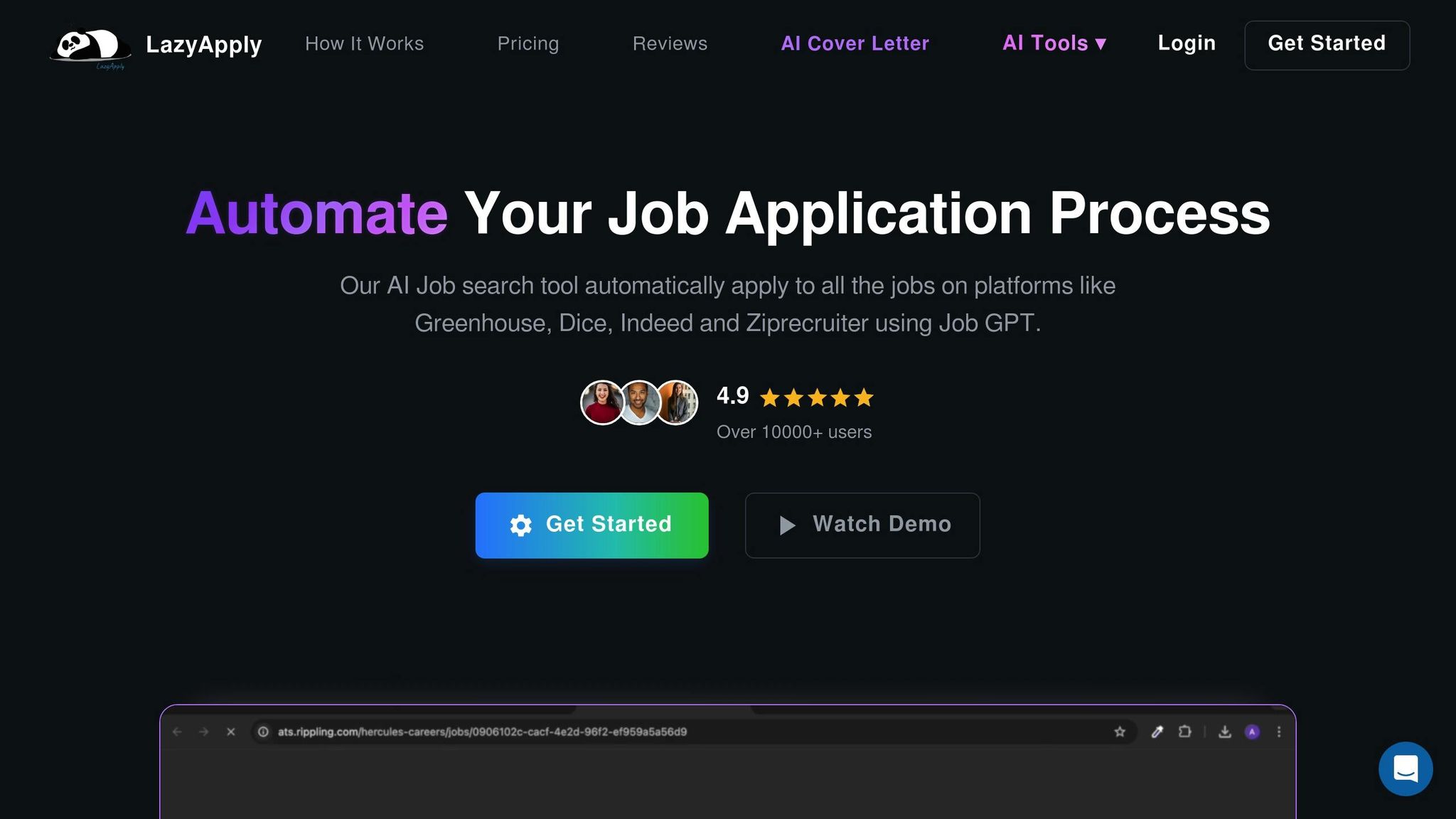
AI-only tools often churn out generic applications that recruiters can spot a mile away. Let’s break down how LazyApply and Simplify.jobs fall short compared to scale.jobs.
Is LazyApply Worth It? Reviews & Alternatives
LazyApply markets itself as a time-saver by automating job applications. However, this comes at the cost of quality. Recruiters, like Jessye Kass Karlin, quickly notice the cookie-cutter nature of these submissions:
"You can totally tell when someone has used AI, because suddenly I have six applications that all have the same sort of structure and format."
Many job portals flag these generic applications, reducing their chances of success. On the other hand, scale.jobs takes a different approach. Instead of automation, they rely on real human assistants who manually complete each application. This ensures every submission is unique, authentic, and more likely to pass through both human and automated reviews. Plus, you stay in the loop with WhatsApp updates, including time-stamped screenshots as proof of manual submissions.
| Feature | LazyApply | scale.jobs |
|---|---|---|
| Application Quality | Generic, identical across submissions | Human assistants tailor each application |
| Portal Compatibility | Often flagged by ATS systems | Manual entry works seamlessly on all platforms |
| Pricing Model | $99/month recurring subscription | Flat-fee campaigns: $199 (250 apps), $299 (500), $399 (1,000) |
| Transparency | No proof of where applications went | WhatsApp updates with proof-of-work screenshots |
| Accuracy | Prone to errors and mismatched skills | Human review eliminates fabricated information |
Over three months, LazyApply’s $297 subscription delivers automated, impersonal submissions. In contrast, scale.jobs' Standard plan for $299 offers 500 manually submitted, personalized applications, making it a far more effective option.
Similarly, other automated platforms like Simplify.jobs face similar issues, as we’ll explore next.
Simplify.jobs vs scale.jobs: Stop Using Simplify Until You Read This
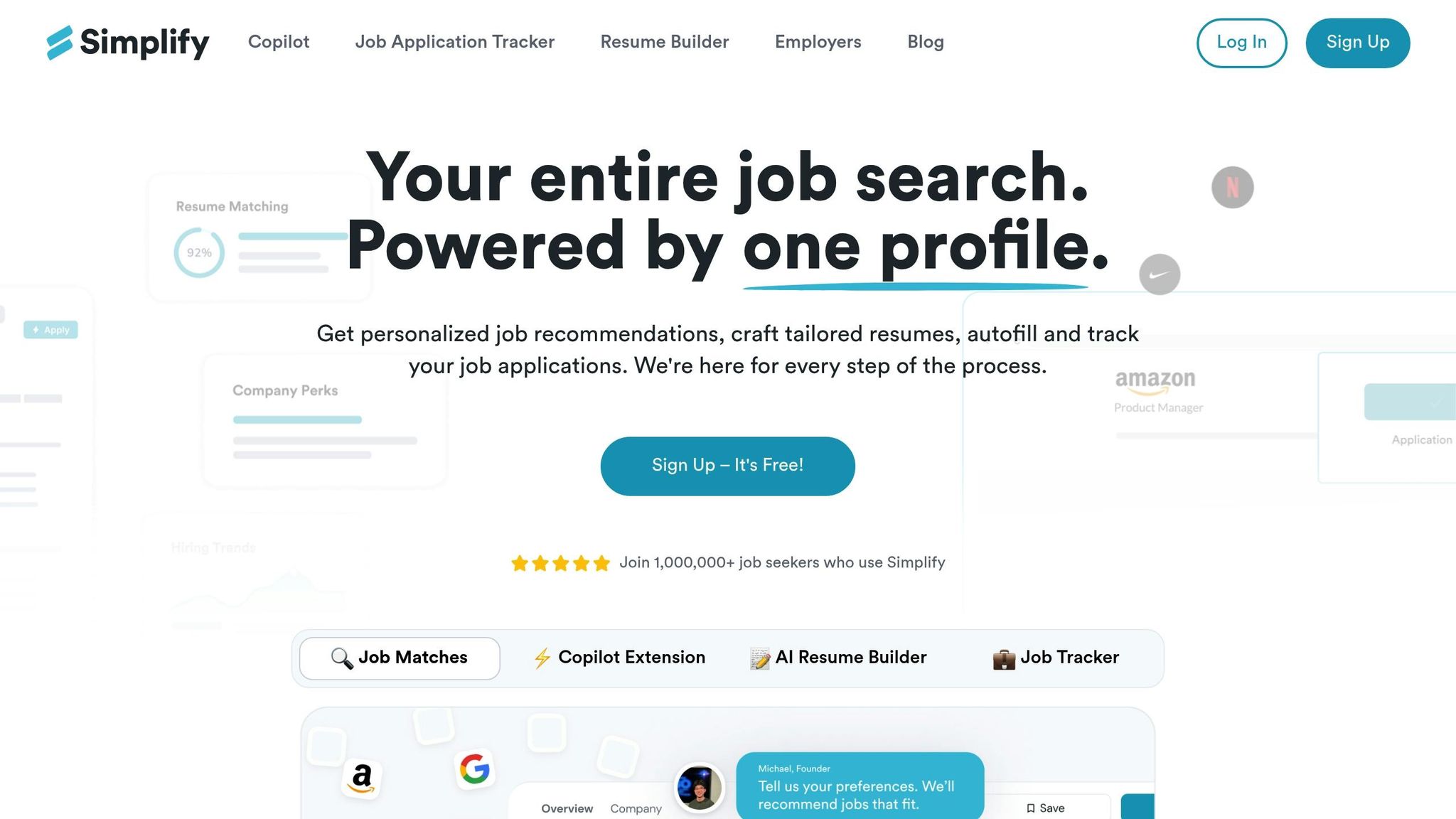
Simplify.jobs promises convenience with one-click applications, but that ease comes at a steep cost - personalization. Career coach Eliana Goldstein explains the downside:
"AI kind of creates a sea of sameness. It automates everything, and it makes everybody sound the same - and sound robotic."
Simplify.jobs relies heavily on keyword matching, which means it often misses the deeper nuances of job descriptions, such as requirements for "cross-functional collaboration" or "strategic thinking." This lack of context can make your application feel out of touch.
scale.jobs bridges this gap by blending AI’s speed with human insight. Their virtual assistants use AI to identify key terms but then manually craft each application to highlight how your skills align with the specific role. This personalized approach ensures your application stands out without losing authenticity.
| Feature | Simplify.jobs | scale.jobs |
|---|---|---|
| Personalization | One-click automation, no customization | Human assistants tailor every submission |
| Understanding Context | Relies on keyword matching | Trained VAs understand nuanced job requirements |
| Transparency | Limited visibility into application status | WhatsApp updates with proof-of-work screenshots |
| Pricing | Subscription-based (~$30+/month) | One-time flat fee, with refunds for unused credits |
| Interview Rate | Less than 3% per 100 applications | Approximately 6% per 100 applications |
One-click submissions through Simplify.jobs generate fewer than 3 interviews per 100 applications. Meanwhile, scale.jobs' human-powered service doubles that rate, delivering around 6 interviews per 100 applications. In a world where LinkedIn processes 11,000 job applications per minute, this difference can be the key to landing your next role.
These comparisons make it clear: scale.jobs' human-powered approach is the smarter choice for job seekers who want to stand out in today’s competitive market. By prioritizing personalized and authentic applications, scale.jobs helps you rise above the sea of sameness created by AI-only tools.
How scale.jobs Solves AI Limitations with Human Assistants
scale.jobs combines the efficiency of AI with the precision of skilled human assistants, creating a hybrid approach that overcomes the common pitfalls of AI-only tools. By addressing issues like generic outputs, factual inaccuracies, and a lack of contextual understanding, this model ensures job applications are both accurate and personalized.
What Human VAs Do for Your Job Applications
At scale.jobs, human assistants take the lead in crafting resumes and cover letters that are tailored to each specific job description while maintaining your personal tone and style. This human intervention avoids the awkward, keyword-heavy phrasing often found in applications generated solely by AI.
Another critical role of these human assistants is to eliminate inaccuracies. AI tools can sometimes fabricate details or exaggerate responsibilities, a risk career coach Jen DeLorenzo highlights:
It is going to start to lie if the title doesn't 100% align.
To prevent such errors, scale.jobs assistants carefully review every detail, ensuring your application reflects your true experience without overstatements that could cause issues during interviews. This meticulous process not only corrects AI's shortcomings but also significantly improves outcomes. On average, users see about 6 interviews per 100 applications - twice the success rate of AI-generated applications. This personalized approach is invaluable in a competitive job market flooded with generic, cookie-cutter applications.
In addition to crafting individualized applications, scale.jobs provides features that set its service apart.
Features That Make scale.jobs Different
scale.jobs goes beyond personalized application creation. Every document is designed to meet Applicant Tracking System (ATS) standards, ensuring your resume and cover letter get through screening processes. Applications are delivered within 24 hours, complete with instant WhatsApp updates and time-stamped screenshots that confirm manual submission. This level of transparency eliminates the guesswork often associated with automated tools, where it's hard to know if your application was even submitted or flagged by the system.
The service offers straightforward pricing: $199 for 250 applications, $299 for 500, and $399 for 1,000. Unused credits are refundable, giving users flexibility. Each package also includes a free job search toolkit, featuring an ATS Checker, Actionable Feedback Engine, and Cover Letter Generator. For those seeking even more customization, the optional AI Assistant Pro add-on provides unlimited AI-tailored resumes and cover letters for just $9/month during the launch period (regularly $19/month).
Conclusion: Why You Need Both AI and Human Help
Where AI-Only Tools Fall Short
AI-only tools come with some glaring shortcomings that can hurt your job search efforts. To start, they often create a "sea of sameness." With LinkedIn handling approximately 11,000 job submissions every minute, recruiters quickly recognize the repetitive structures and overused buzzwords typical of AI-generated applications. Recruiter Jessye Kass Karlin highlights this issue:
You can totally tell when someone has used AI, because suddenly I have six applications that all have the same sort of structure and format.
Another issue is positional bias. For example, ChatGPT (4.0) tends to favor the first resume it processes, even when other candidates are equally qualified. Then there’s the problem of hallucinations - AI tools sometimes invent job titles, inflate responsibilities, or include wrong company names. These errors can damage your credibility during interviews.
The numbers tell the story: tailored applications lead to about 6 interviews per 100 submissions - nearly double the success rate of generic AI-generated resumes. Adding to this, 41% of HR professionals are less likely to consider candidates who rely on AI for their applications, while 34% scrutinize AI-generated resumes more closely for inaccuracies. Clearly, a hybrid approach is the smarter choice.
How scale.jobs Solves These Issues
Recognizing where AI falls short, scale.jobs introduces human oversight to address these problems head-on. Their trained virtual assistants ensure that each resume and cover letter is tailored to specific job postings, while maintaining your unique voice and verifying every detail for accuracy. This approach eliminates the overuse of keywords and the robotic tone that AI often produces. As Adam Karpiak, Co-founder of Karpiak Consulting, puts it:
The smartest way to use AI is as an editor, not a ghostwriter.
With scale.jobs, you receive ATS-optimized documents within 24 hours, complete with time-stamped screenshots to confirm manual submissions - no hidden automation involved. Their flat-fee pricing starts at $199 for 250 applications, and they even offer refunds for unused credits. Unlike subscription-based AI-only services, this model ensures affordability and transparency. The result? A doubled interview rate compared to AI-generated applications, giving you the edge over competitors like LazyApply and Simplify.jobs.
FAQs
How do AI-generated job applications impact your chances of landing an interview?
AI-generated job applications can impact your chances of landing an interview in both positive and challenging ways. These tools make it easy to apply to multiple positions quickly, but they often generate resumes or cover letters that feel generic and lack the personal touch recruiters appreciate. In a crowded job market, this can make it harder to leave a lasting impression.
On top of that, many companies use AI-driven applicant tracking systems (ATS) to screen resumes, prioritizing those that are optimized with specific keywords. While this can help some candidates get noticed, it may also filter out highly qualified individuals whose applications don’t align perfectly with the system’s criteria. Overusing AI tools can also result in resumes that feel overly mechanical, potentially raising concerns for hiring managers.
To boost your chances, try combining the speed of AI with a human touch. Personalized edits and professional reviews can help you craft applications that not only meet ATS standards but also resonate with recruiters, making you stand out for all the right reasons.
What are the biggest challenges of using AI-only tools for job applications?
AI-only tools for job applications often miss the mark in some crucial areas. One of the biggest concerns is personalization. Resumes and cover letters generated by these tools can come across as generic, lacking the individuality that helps candidates stand out. When applications feel impersonal, they risk failing to catch a recruiter’s attention.
Another issue lies in accuracy and credibility. AI-generated resumes may contain errors or seem overly polished, which can raise doubts for hiring managers. These tools might also prioritize specific formats or keywords, potentially introducing bias and unintentionally sidelining qualified applicants.
Although AI can be a time-saver, these shortcomings emphasize the need for human involvement. A thoughtful review ensures that applications are not only tailored and authentic but also meet the expectations of potential employers.
Why is combining AI tools with human expertise the best approach for job applications?
Combining AI tools with human expertise strikes the perfect balance between automation's speed and the nuanced touch only humans can provide. AI excels at breaking down job descriptions, pinpointing relevant keywords, and simplifying the application process. However, it often falls short when it comes to grasping subtle employer expectations, workplace dynamics, and the importance of soft skills.
On the other hand, human input ensures that resumes and cover letters are customized for each role, showcasing an applicant's distinct strengths and experiences. This blend of technology and personal insight not only produces applications optimized for ATS systems but also maintains a genuine and engaging tone that resonates with recruiters. By working together, AI and human expertise create job applications that are efficient, tailored, and truly reflective of your qualifications.