
Best Way to Apply for Remote Tech Jobs Without Referrals
You can land remote tech jobs without referrals by using ATS-optimized resumes, niche job boards, tailored portfolios, and human-powered application services.


Applying for remote tech jobs without referrals is challenging but achievable with the right approach. Here’s what you need to know:
- ATS Optimization: Over 95% of large companies use Applicant Tracking Systems (ATS) to filter resumes. Ensure your resume is machine-readable, keyword-optimized, and contextually aligned with job descriptions.
- Job Boards: Use specialized platforms like We Work Remotely, RemoteOK, and Wellfound to target remote roles. These sites help you filter by skills, salary, and time zones, narrowing your search effectively.
- Tailored Applications: Customize your resume and cover letter for each job. Highlight measurable results and remote-specific skills like asynchronous communication or cross-timezone collaboration.
- Portfolio Showcase: Build a strong portfolio with 3-5 relevant projects. Developers can use GitHub, designers can leverage Behance, and marketers can showcase case studies.
- Application Services: For efficiency, consider human-powered services like scale.jobs, which provide tailored, ATS-friendly applications and updates via WhatsApp. Unlike automation tools like LazyApply, scale.jobs ensures personalized submissions that improve your chances.
How to Optimize Your Resume for ATS and Remote Tech Jobs
What is ATS and Why It Matters
Applicant Tracking Systems (ATS) are software tools that hiring teams use to sort, filter, and rank candidates based on keywords, skills, and experience. Think of ATS as the first checkpoint in the hiring process - it determines whether your resume makes it to a human recruiter or gets filtered out. With remote roles drawing in a larger pool of applicants, understanding ATS has become even more crucial.
By 2026, ATS technology has advanced significantly. These systems now use machine learning to evaluate career progression, verify that your skills align with your accomplishments, and even cross-check your resume against your LinkedIn profile or GitHub repositories. Any mismatch between your resume and online professional profiles could flag your application as unreliable. Knowing how ATS operates is key to crafting a resume that meets these standards.
Steps to Build an ATS-Friendly Resume
To ensure your resume gets past ATS and stands out for remote tech roles, follow these actionable steps:
Start with clean, machine-readable formatting. Stick to a single-column layout with standard headings like Experience, Education, and Skills. Avoid using text boxes, graphics, tables, or multi-column designs, as these can confuse ATS and lead to errors when parsing your information. Always submit your resume in a .docx or text-based PDF format.
Incorporate keywords specific to remote work to enhance your relevance for tech positions. Include terms like "asynchronous communication", "cross-timezone collaboration", "self-management", "distributed teams", and "virtual standups." Pair these with concrete examples, such as "proactive Slack updates" or "documented async processes", to demonstrate your experience in remote environments.
Use the PAR formula (Problem-Action-Remote Result) to structure your bullet points. Highlight measurable achievements that align with remote work. For example: "Coordinated a team across 3 time zones, increasing delivery speed by 20%." Apply the 3-2-1 rule: list 3 numerical values, 2 percentages showing improvement, and 1 standout metric per role. Research shows that resumes featuring remote-specific, quantifiable results are 67% more likely to pass ATS screening.
When applicable, include "Remote" in your job titles. For instance, instead of "Software Engineer", write "Remote Software Engineer" or "Software Engineer (Remote)." Add your location along with a note like "Available for Remote Work" and specify your time zone (e.g., "PST/PDT"). This helps ATS categorize your application correctly, even for fully remote positions.
Finally, test your resume with tools like Jobscan or Teal to identify keyword gaps and improve your match score. These adjustments not only optimize your resume for ATS but also show employers that you're well-prepared for remote work challenges.
Find Remote Tech Jobs Using Specialized Job Boards
Best Remote Job Boards for Tech Roles
Finding a tech job that’s genuinely remote can be much easier with specialized job boards that focus exclusively on remote positions. We Work Remotely, a pioneer in the remote work space since 2013, provides advanced filters for region, skills, and salary range. This makes it simple to find openings tailored to your tech stack without wading through hybrid or office-based listings. Companies posting here typically have established remote work practices, which can make for a smoother experience.
Another excellent option is RemoteOK, a platform dedicated entirely to remote opportunities, helping you avoid non-remote clutter. If you’re interested in startup roles, Wellfound (formerly AngelList Talent) is a great choice, especially with its filters for entry-level positions - perfect for those new to tech or making a career shift. Teal stands out by aggregating job listings from various sources while ensuring fair search results, as sponsored posts don’t dominate the top.
While LinkedIn remains a valuable networking tool, its "Remote" location filter can help you avoid hybrid roles that might sneak into your search. Keep in mind that remote roles often attract high competition - sometimes two to three times more applications than in-office jobs. Using niche boards can narrow the applicant pool, giving you a better shot. Many of these platforms also offer advanced filters to refine your search and save time.
How to Use Search Filters Effectively
When searching for remote tech jobs, using filters strategically can make all the difference. Instead of relying solely on the "remote" label, try filtering by time zone. Many companies specify availability requirements, such as "Americas time zones" or "PST/PDT overlap", to ensure smooth collaboration. Platforms like We Work Remotely include "Region" filters that help you find roles compatible with your schedule.
It’s also a good idea to filter by specific skills rather than just job titles. Searching for your tech stack - whether it’s React, Python, or AWS - can uncover roles that might use alternative titles but still require your expertise. Adding salary range filters can further streamline your search by excluding jobs that don’t meet your financial expectations. On platforms like Teal, you can even filter out postings that don’t disclose salary information.
To maximize your chances, sort results by "Date Posted" and aim to apply within the first 48 hours. Nearly 40% of job postings are filled within 30 days, and applications sent within the first two weeks have the highest likelihood of success. Setting up saved search alerts with terms like "Senior Developer", "Remote", and "Americas Time Zone" can help you stay on top of new listings.
"Any remote job is not a job title. The most successful remote job seekers know what they want and have a game plan." - We Work Remotely
Be sure to double-check the "remote" status in job descriptions, as some listings might only allow partial remote work or require you to live in a specific state. Reviewing a company’s social media profiles on platforms like X, Instagram, or LinkedIn can also offer insights into whether they genuinely support a remote-first environment before you commit to applying.
Write Custom Cover Letters and Build Work Portfolios
How to Write Cover Letters That Get Noticed
A well-crafted cover letter can set you apart, especially in a competitive job market. Keep it concise and focused, clearly expressing your interest in the company and why remote work aligns with your strengths. Use bullet points to directly tie your achievements to the job's requirements. For instance, instead of a vague statement like "managed a team", say something like, "coordinated a distributed team across PST and GMT time zones, launching a product 15% ahead of schedule."
Pay close attention to the job description. Look for specific tools or keywords the employer emphasizes, such as Slack, Jira, Notion, or Trello. Some companies even embed small tests, like asking you to include a specific word in your subject line or mention your favorite animal. Following these instructions shows attention to detail and can make a strong impression.
Adapt your tone to match the company’s style. If the job posting feels casual and startup-focused, keep your language conversational. For a more formal, corporate setting, maintain a professional tone. To quantify your achievements effectively, try the 3-2-1 approach: include three numerical values, two percentages of improvement, and one standout metric per role. Highlighting remote-specific accomplishments with measurable outcomes can boost your chances of passing AI screening systems by 67%. Using an AI resume builder can help ensure your documents are optimized for these filters.
Once your cover letter sets the stage, your work portfolio reinforces your capabilities with tangible examples.
Creating Portfolios That Prove Your Skills
For remote tech roles, a strong portfolio is essential - it’s your opportunity to showcase your skills in action. Like your cover letter, your portfolio should emphasize results and your ability to thrive in a remote environment. Include 3 to 5 carefully selected projects tailored to the specific roles you’re applying for, along with a short "About Me" section and clear contact details.
For developers, this could mean linking to GitHub repositories with clean, well-documented code, live demos, and polished README files. Designers might showcase UX case studies, interactive prototypes, and before-and-after redesigns on platforms like Behance or Dribbble. Marketers can use tools like Notion, Canva, or personal websites to present data-driven case studies, highlighting metrics like ROI, social media growth, or email campaign performance.
"A portfolio is more than a nice-to-have - it's proof of your skills, creativity, and results. Employers don't just want claims; they want evidence." - Gina Sapién, Career Coach and Hiring Manager
Each project should clearly explain your role, the challenges you addressed, and the final results. If you don’t have professional experience, create portfolio pieces based on volunteer work or simulated projects. For example, you could manage a Discord community or assist a non-profit with administrative tasks. Make sure to emphasize remote-friendly skills, such as working across time zones or leading asynchronous projects. Since nearly 75% of resumes are filtered by ATS systems before reaching a human reviewer, a strong portfolio can be the key to standing out in the hiring process.
How I Landed 2 Six-Figure Remote Tech Jobs in 2 Weeks (step-by-step)
LazyApply vs scale.jobs: Which Job Application Service Works Better
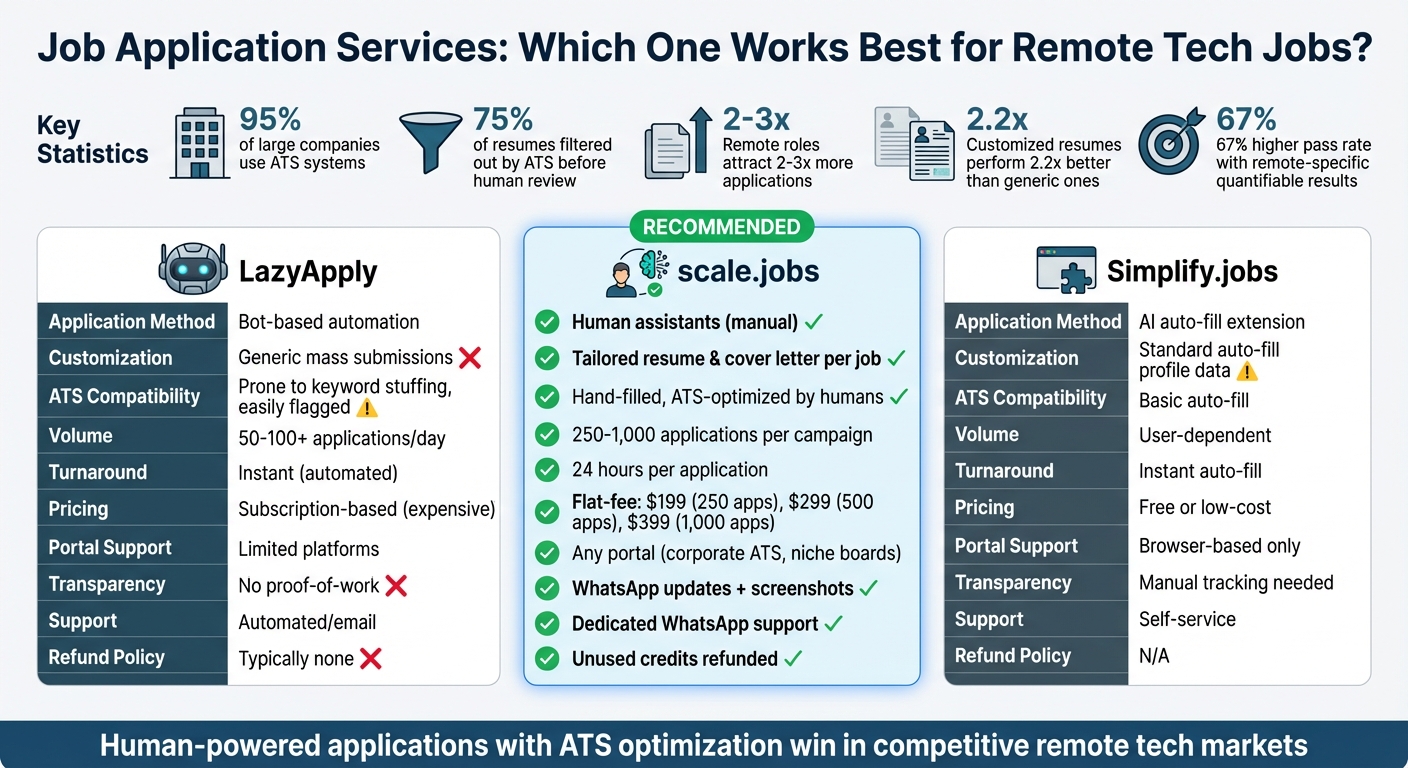
Job Application Services Comparison: LazyApply vs scale.jobs vs Simplify.jobs
After crafting a solid portfolio and a compelling cover letter, finding the right job application service can save you time and effort. LazyApply is a well-known bot-based tool that automates bulk job applications, but its lack of tailored submissions often falls short in competitive remote tech roles.
LazyApply relies on AI to autofill and submit applications, processing anywhere from 50 to over 100 applications per day. While the numbers may seem impressive, the results are often underwhelming. Adrian, the founder of BigDevSoon, explains: "LazyApply can increase your volume for a broader reach, ensuring you don't miss out on potential opportunities... however, it's quite expensive for what it does." The service's generic approach often fails to stand out, especially in remote tech job markets where hiring managers can quickly identify automated, one-size-fits-all applications.
Another critical concern is its compatibility with Applicant Tracking Systems (ATS). With over 90% of companies using ATS to screen applicants, and job postings often receiving more than 300 applications, bot-generated resumes and keyword stuffing can harm your chances. Applications flagged as automated are frequently dismissed before anyone reviews your qualifications.
scale.jobs offers a more personalized solution, leveraging trained human virtual assistants to handle each application manually. This approach eliminates the risk of bot-detection while ensuring every submission is customized for the specific role. scale.jobs also provides real-time updates via WhatsApp, including submission evidence, and delivers tailored resumes and cover letters within 24 hours. The service works seamlessly across all platforms, from corporate ATS to niche job boards.
Pricing is another area where the two services differ significantly. LazyApply operates on a subscription model that many users find expensive for its limited personalization. In contrast, scale.jobs uses a flat-fee structure: $199 for 250 applications, $299 for 500 applications, and $399 for 1,000 applications, all managed by human assistants. Unused credits are refundable, adding transparency and value. These features make scale.jobs a better fit for remote tech job seekers aiming to stand out in a crowded field. The human-driven approach directly addresses the challenges of ATS filtering and the need for personalized applications. Below is a feature-by-feature comparison to illustrate why scale.jobs is the superior choice.
LazyApply vs scale.jobs: Feature Comparison
The table below highlights the key differences between LazyApply and scale.jobs:
| Feature | LazyApply | scale.jobs |
|---|---|---|
| Application Method | Bot-based automation | Handled manually to ensure ATS compliance |
| Customization | Generic, mass submissions | Tailored resume & cover letter per job |
| ATS Compatibility | Prone to keyword stuffing, easily flagged | Hand-filled forms, ATS-optimized by humans |
| Volume | 50–100+ applications/day | 250–1,000 applications per campaign |
| Turnaround | Instant (automated) | 24 hours per application |
| Pricing Model | Subscription-based (expensive) | Flat-fee: $199–$399 one-time payment |
| Portal Support | Limited to supported platforms | Any portal (corporate ATS, niche boards) |
| Transparency | No proof-of-work | WhatsApp updates, screenshots, dashboard |
| Support | Automated/email | Dedicated WhatsApp support |
| Refund Policy | Typically none | Unused credits refunded |
This comparison underscores the importance of personalized, ATS-friendly applications, particularly for job seekers in competitive remote tech industries. scale.jobs clearly provides a more thoughtful and effective solution.
Simplify.jobs vs scale.jobs: Why Human-Powered Applications Win
When it comes to job applications, especially in competitive fields, personalized and ATS-friendly submissions often outperform generic, automated approaches. This comparison sheds light on why human-powered services offer a distinct advantage over auto-fill tools.
Simplify.jobs is an AI-powered browser extension designed to handle repetitive application tasks quickly. For example, job seeker Luke Hartzell relied on Simplify.jobs during his Big Tech job search in early 2024, submitting an impressive 532 applications to secure one offer from Amazon. While this tool excels in speed, it reveals a critical flaw: high volume doesn’t necessarily translate to quality or personalization.
The main drawback of Simplify.jobs lies in its reliance on the user to manually search for jobs, hit submit, and hope that their auto-filled profile aligns with the employer’s requirements. It doesn’t provide ATS-optimized resumes tailored to specific job descriptions, nor does it offer human oversight to catch errors or improve application quality. This is particularly problematic in remote tech roles, which often receive two to three times more applications than on-site positions, making generic submissions much easier to overlook.
On the other hand, scale.jobs takes a more hands-on approach by blending AI with trained human assistants to manage the entire application process. Instead of simply auto-filling fields, scale.jobs employs virtual assistants who manually submit each application. They craft custom ATS-friendly resumes and cover letters tailored to each job, ensuring compatibility with applicant tracking systems. Users also receive updates via WhatsApp, complete with time-stamped screenshots showing exactly what was submitted and when.
The pricing models for these services also highlight their differences. Simplify.jobs is either free or low-cost, making it a good option for those prioritizing volume over quality. However, scale.jobs offers flat-fee campaigns - $199 for 250 applications, $299 for 500, and $399 for 1,000. If you land a job before using all your credits, the unused portion is refunded. This approach not only saves over 20 hours per week but also allows users to focus on networking and interview preparation instead of tedious form-filling. The combination of cost efficiency and personalized service makes scale.jobs a compelling choice for job seekers.
Research from Huntr.co underscores the importance of tailored applications, showing that customized resumes perform 2.2 times better than generic ones. Additionally, about 75% of resumes are filtered out by ATS before reaching a recruiter. scale.jobs addresses these challenges head-on by offering human-verified customization and ATS optimization, making it especially effective in remote tech job markets where personalization is key.
Simplify.jobs vs scale.jobs: Side-by-Side Comparison
| Feature | Simplify.jobs | scale.jobs |
|---|---|---|
| Primary Model | AI-powered browser extension (auto-fill) | AI + Human Assistant (done-for-you) |
| User Effort | User finds jobs and clicks "submit" | Assistants find and apply to jobs for the user |
| Customization | Standard auto-fill of profile data | Custom ATS resumes and cover letters per job |
| Turnaround | Instant auto-fill | Applications submitted within 24 hours |
| Tracking | Manual or via third-party tools | Integrated daily updates and progress reports |
| Support | Self-service software | Dedicated WhatsApp support with proof-of-work |
| Pricing Model | Free or low-cost extension | Flat-fee: $199–$399 one-time payment |
| Refund Policy | N/A | Pro-rated refunds if hired early |
This comparison makes it clear why human involvement is crucial for remote tech job applications. While Simplify.jobs offers speed, scale.jobs provides the tailored, ATS-friendly applications that significantly improve your chances of standing out. By prioritizing quality over quantity, scale.jobs ensures your application doesn’t just get submitted - it gets noticed.
Track Your Applications and Follow Up
Organizing your job applications and following up at the right time can make all the difference between being overlooked and landing an interview. Remote tech roles often attract two to three times more applicants than in-office positions, which means your application could easily get lost in the shuffle if you don’t stay organized and proactive. Once you’ve logged your submissions, the next step is to follow up strategically.
Tools to Track Your Job Applications
A simple way to track your applications is by using a Google Sheet. Record details like the company name, job title, date applied, resume version, and follow-up dates. While this works well for a small number of applications, it can quickly become overwhelming if you're applying to multiple roles.
For a more streamlined approach, tools like Teal make the process easier. Teal’s free Chrome extension allows you to bookmark jobs directly from platforms like LinkedIn or Indeed and organizes them in a centralized dashboard. The tool automatically tracks application dates and sets follow-up reminders. The free version offers unlimited job tracking and basic resume analysis, while the premium Teal+ plan costs $13 per week. Alternatives like Trello or Notion can also help manage your application pipeline.
It’s important to log the specific resume and cover letter you used for each job. This not only keeps you consistent if you're asked about your application in an interview but also helps you identify which versions of your materials are yielding better results. If you’re using Scale.jobs’ Human Assistant service, this tracking is already integrated. You’ll receive daily updates via WhatsApp, complete with time-stamped screenshots of what was submitted and when, saving you the hassle of manual logging.
Once you’ve tracked your applications, the next step is engaging with recruiters through timely follow-ups.
When and How to Follow Up
Just as tailoring your resume is essential for passing ATS filters, consistent follow-ups help keep your application on a recruiter’s radar. Aim to send a professional follow-up email 7–10 days after submitting your application. Early follow-ups can significantly increase your chances of securing an interview.
When following up, keep your communication short and professional. Reference the job title, application date, and your interest in the position. For example, a concise email or LinkedIn message expressing enthusiasm for the role can go a long way. However, avoid being overly persistent - one follow-up is enough unless the recruiter responds and invites further discussion.
"The smartest remote candidates in 2025 are using AI to help them apply faster, tailor smarter, and track better - not just sending more resumes."
- David Kim, Career Strategist & Remote Work Advisor
Well-timed follow-ups can bring your application to the recruiter’s attention at the right moment, potentially doubling your chances of getting a response. With around 75% of resumes filtered out by ATS before reaching a human, a thoughtful follow-up ensures your application isn’t forgotten, even if it didn’t pass the initial screening.
Wrapping It Up
The strategies outlined here come together to streamline your approach to landing a remote tech job without referrals in 2026. Success hinges on fine-tuning your resume for ATS systems, focusing on specialized job boards, and using tools that ensure precision in your applications.
With remote roles attracting two to three times more applicants than traditional office jobs, staying competitive means submitting 25–40 well-targeted applications weekly. Relying solely on manual applications is time-consuming and often leads to generic results. On the other hand, AI-only tools may increase volume but can fall short in personalization, risking issues like bot-flags or poorly optimized submissions for complex platforms.
Scale.jobs bridges this gap by combining human expertise with ATS-optimized resumes to deliver high-quality, tailored applications. The service not only saves you time but also keeps you informed with real-time WhatsApp updates, complete with proof-of-work screenshots. Plus, its flat-fee pricing eliminates the hassle of recurring subscriptions. Whether you're a recent graduate, a professional facing layoffs, or dealing with visa challenges, Scale.jobs takes care of the repetitive tasks, leaving you free to focus on networking and preparing for interviews.
"Remote hiring in 2025 rewards people who combine volume, precision, and smart use of AI."
– GoApply
To stand out, highlight measurable achievements on your resume (e.g., "Boosted activation rate by 18%"), showcase a portfolio demonstrating your ability to collaborate asynchronously, craft a tailored cover letter for every role, and follow up within 7–10 days after applying. Winning at remote tech job applications requires deliberate, personalized, and well-tracked efforts.
FAQs
What’s the best way to make my resume ATS-friendly for remote tech jobs?
To craft an ATS-friendly resume for remote tech positions, focus on aligning your content with keywords from the job description and keeping the design straightforward. Steer clear of images, graphics, or decorative fonts, as these can confuse applicant tracking systems.
Customize your resume for each role by highlighting the skills and experiences that match the job requirements. Stick to standard section headings like Work Experience, Skills, and Education, which make it easier for ATS software to process your information. Additionally, save your resume as a plain-text PDF or Word document to ensure compatibility with most systems.
By following these guidelines, you’ll increase the likelihood of your resume passing ATS filters and landing in front of hiring managers.
What are the top job boards for finding remote tech jobs?
Some top platforms for finding remote tech jobs include We Work Remotely and AngelList. We Work Remotely specializes in remote job opportunities across industries, while AngelList is well-known for connecting professionals with startup and tech-related roles. Both platforms provide a broad range of remote positions, making them valuable tools for tech professionals seeking flexible work arrangements.
For even more targeted opportunities, consider exploring niche job boards that focus exclusively on remote work. By staying active on these platforms and customizing your applications to match each role, you can boost your chances of securing the ideal position in the tech field.
What makes Scale.jobs better than automated application tools like LazyApply?
Scale.jobs differentiates itself from automated tools like LazyApply by focusing on a human-driven, personalized approach to job applications. Unlike LazyApply, which sends out mass applications using generic templates, Scale.jobs employs trained virtual assistants (VAs) to craft customized, ATS-friendly resumes and cover letters tailored specifically to each job. This attention to detail leads to significantly higher callback rates - Scale.jobs reports rates as high as 47%, compared to the underwhelming 2% often associated with automated tools.
Another key advantage of Scale.jobs is its one-time payment model, along with real-time WhatsApp support and proof-of-work transparency. These features ensure that every application is not only high-quality but also strategically targeted. For job seekers serious about standing out in today’s competitive job market, Scale.jobs offers a more dependable and effective alternative to automation-based services.