
Best Way to Apply to Jobs in 2026 (Step-by-Step System)
A practical 2026 job-application system: target companies, build ATS-ready .docx resumes, use human-assisted submissions, and track results.

In 2026, job applications require a precise approach to stand out. Applicant Tracking Systems (ATS) dominate hiring processes, automatically filtering resumes for keywords and formatting before a recruiter even reviews them. Generic applications or automated tools like LazyApply often fail these systems, reducing callback rates to as low as 1–3%. Instead, targeted, ATS-optimized applications combined with human involvement, like those offered by scale.jobs, can achieve callback rates as high as 47%.
Here’s a quick overview of how to improve your job search process in 2026:
- Focus Your Search: Identify 15–20 companies and tailor your applications to one primary role and two related roles.
- Optimize Resumes: Use ATS-friendly formats (.docx), integrate keywords from job descriptions, and highlight metrics-driven achievements.
- Leverage Tools: Platforms like scale.jobs provide human-assisted submissions, real-time updates, and refunds for unused credits.
- Track and Adjust: Monitor application progress with free job seeker tools like ATS checkers and refine strategies based on results.
Key takeaway: Personalization and human input outperform generic automation in today’s competitive job market. Services like scale.jobs combine manual precision with AI tools to help job seekers succeed where automated platforms fall short.
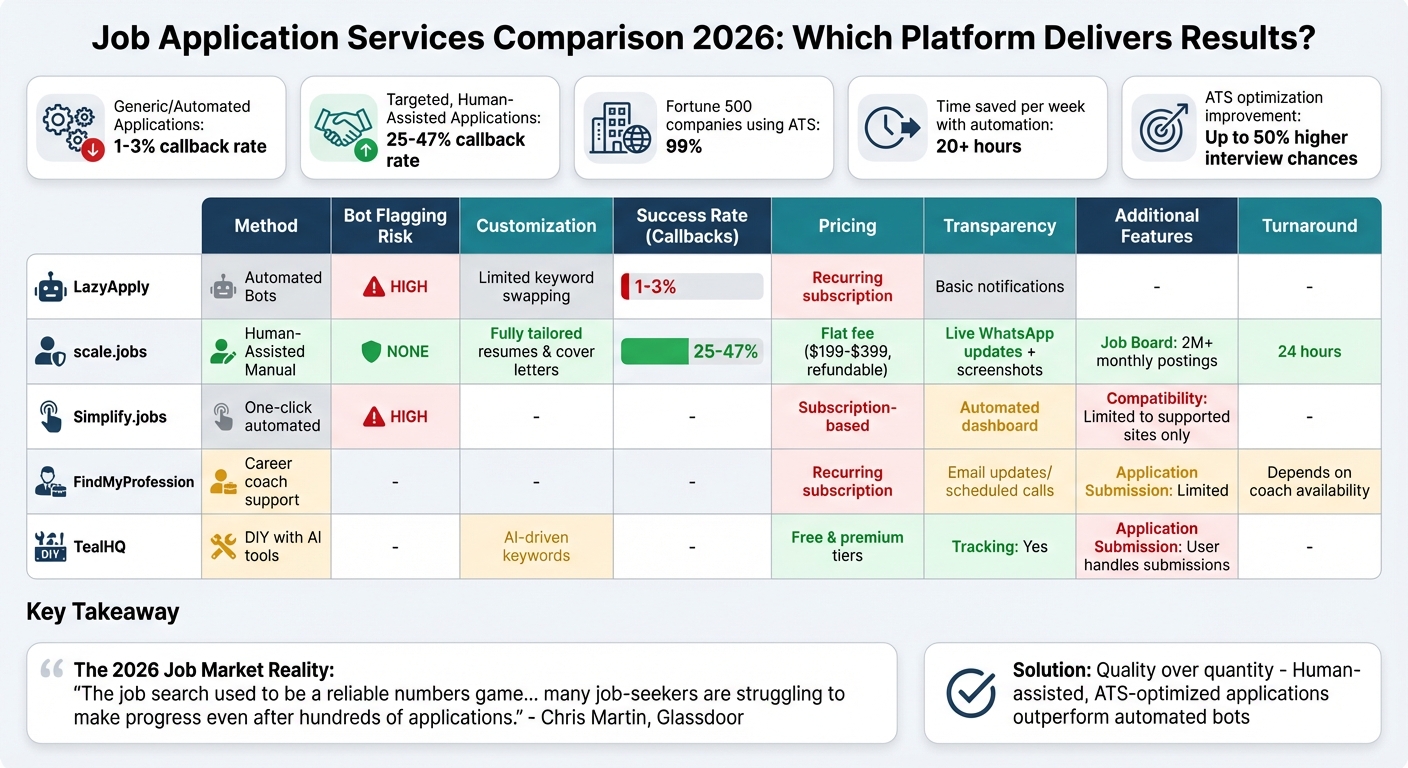
Job Application Services Comparison: scale.jobs vs LazyApply vs Simplify.jobs vs FindMyProfession vs TealHQ
How to Land Your Dream Job in 2026 (Step-by-Step Plan)
Step 1: Build Your Target Company List
Start by narrowing your focus to 15–20 companies that align with your career goals. This focused approach allows you to dive deep into researching each organization, tailoring your applications, and showing genuine interest - qualities that recruiters value. By doing this groundwork, you’ll be ready to craft ATS-friendly and personalized job applications.
When evaluating companies, consider the Five Ps: Purpose, Philosophy, Priorities, Practices, and Projections. Research shows that companies with strong cultures see 21% higher profitability, making them ideal places to grow and succeed over the long term.
Target one primary role and two closely related roles (e.g., Product Manager, Growth PM, Program Manager). This keeps your search specific but still broad enough to increase your chances. With 99% of Fortune 500 companies using ATS, make sure to customize your applications. Use AI tools to identify recurring keywords in job descriptions and create an "evidence bank" of your achievements, metrics, and skills that align with each company’s needs.
Use Social Media for Networking
LinkedIn is a powerful tool for connecting with your target companies. Start by following their official pages, engaging with their content, and sharing thoughtful comments. Build relationships by connecting with employees in roles you’re aiming for. When you reach out, reference specific projects or initiatives the company is working on to show that you’ve done your homework.
Statistics back up the importance of culture in job satisfaction. Employees who feel connected to their workplace culture are 4.3 times more likely to be engaged and 47% less likely to look for another job. To identify companies with strong cultures, look for signs like employee recognition posts, behind-the-scenes content, and active social media engagement. These are indicators of a workplace that values its people and fosters low turnover.
Build Your Online Presence
Optimize your LinkedIn profile and personal website to reflect your skills and accomplishments. Use keywords from job descriptions in your profile headline, summary, and experience sections to ensure recruiters can easily find you. Prepare 6–8 STAR stories (Situation, Task, Action, Result) that highlight how you’ve tackled challenges similar to those faced by your target companies. Showcase these examples on your personal website or portfolio, making it easy for recruiters to see your value at a glance.
"Culture is defined by what happens every day - not just what's written on a wall." - Table Space
This quote is a reminder to look beyond a company’s mission statement. Dive into employee reviews on platforms like Glassdoor, read testimonials, and observe social media interactions to find organizations where actions align with words.
These steps lay a solid foundation for creating ATS-optimized resumes and tailoring applications - a topic we’ll explore in the next section.
Step 2: Create ATS-Optimized Resumes and Cover Letters
Your resume and cover letter need to do more than just impress a recruiter - they have to first make it past Applicant Tracking Systems (ATS). These systems scan your documents for keywords, formatting, and relevance, filtering candidates before a human ever sees them. To succeed, your documents must appeal to both the algorithm and the recruiter.
When it comes to file formats, opt for .docx over PDFs, especially for older ATS versions, to ensure the system reads your keywords correctly. From there, focus on crafting content that balances ATS-friendly optimization with a human touch.
Use AI Tools for Keyword Optimization
AI tools have revolutionized the way job seekers approach ATS optimization. Platforms like Jobscan specialize in analyzing ATS algorithms, and users often report up to a 50% higher chance of landing interviews by targeting the right keywords. The trick is to identify the terms that show up repeatedly in job descriptions for your desired role.
Scale.jobs offers a free ATS checker and an AI-powered resume builder that goes beyond generic advice. It highlights keyword gaps and formatting issues while blending AI analysis with human input. This approach ensures your resume feels natural and engaging, steering clear of the robotic, keyword-heavy tone that might alienate recruiters. Unlike fully automated tools like Rezi or Teal, Scale.jobs focuses on maintaining a balance between ATS compatibility and readability.
However, keyword optimization is just one piece of the puzzle. Personalization is equally critical.
Customize Each Application
A one-size-fits-all resume won’t cut it. Tailor your resume for each job by focusing on achievements that align with the specific role. Start by building an "evidence bank" of your accomplishments, complete with metrics, and pull the most relevant examples for each application. For instance, if one job emphasizes "cross-functional collaboration" while another prioritizes "stakeholder management", adjust your language accordingly to match the employer’s focus.
Scale.jobs' AI assistant can simplify this process, helping you craft tailored resumes and cover letters that highlight your strengths while aligning with the job’s requirements. It adjusts your core content to reflect the priorities of each posting, ensuring your voice and achievements remain authentic while standing out to both algorithms and recruiters.
Step 3: Automation vs. Human Assistance
When you're sending out dozens - or even hundreds - of job applications, automation can seem like an easy solution. However, many companies now use sophisticated anti-bot filters that flag or automatically reject submissions made by bots. In the highly competitive 2026 job market, the focus has shifted from quantity to quality, making the decision between speed and personalization more critical than ever.
The trade-off here is clear. Automated bots can process applications quickly but often rely on generic templates and struggle with navigating complex application portals. On the other hand, human-powered services take more time but completely avoid bot detection, delivering tailored applications designed specifically for each role. This difference becomes even more apparent when comparing services like LazyApply and scale.jobs.
LazyApply vs. scale.jobs: Which One Delivers Better Results?
LazyApply positions itself as a time-saving tool, but its automated bots often fall short when dealing with application portals - especially since 99% of Fortune 500 companies use ATS (Applicant Tracking System) software designed to detect and block non-human submissions. In contrast, scale.jobs uses human-assisted submissions, ensuring applications are not flagged by bots while delivering customized resumes within 24 hours.
| Feature | LazyApply (Automated) | scale.jobs (Human-Powered) |
|---|---|---|
| Application Method | Automated Bots | Manual Submission by Humans |
| Bot Flagging Risk | High; frequently blocked | None; human-verified submissions |
| Customization | Limited keyword swapping | Fully tailored resumes and cover letters |
| Transparency | Basic notifications | Live WhatsApp updates & screenshots |
| Pricing Model | Recurring Subscription | One-time Flat Fee |
| Success Rate | Lower (1–3% callbacks) | Higher (25–47% callbacks) |
The pricing models also highlight a key difference. LazyApply charges recurring subscription fees, while scale.jobs offers flat-fee packages - $199 for 250 applications, $299 for 500 applications, and $399 for 1,000 applications - with refunds for any unused credits. This means you’re paying for actual results, not just access to a service.
These distinctions demonstrate why the human element can make a significant difference in your job search success.
Why Human Assistance Makes a Difference
Human assistants at scale.jobs don’t just optimize applications for ATS systems - they also address the finer details that algorithms often miss. Whether it’s explaining career gaps, highlighting transferable skills, or addressing a career pivot, their tailored approach ensures your application stands out. AI-generated drafts, while helpful, often lack the personal touch and can even introduce errors, such as fabricated skills or experiences. Human assistants eliminate these risks and ensure your application feels genuine.
Additionally, scale.jobs keeps you informed every step of the way with real-time WhatsApp updates and time-stamped proofs of submission. This level of transparency means you’re never left wondering about the status of your applications.
Step 4: Use Job Boards and Application Tracking
Job boards and tracking systems play a crucial role in a focused and effective job search. Since most job seekers submit numerous applications before securing an interview, it's essential to have both a steady source of job opportunities and an organized system to keep track of your submissions.
While job search automation platforms can save time, they come with risks, such as being flagged by bot-detection systems. On the other hand, manual submissions take more effort but are less likely to face such issues. This is where a platform like scale.jobs stands out, offering a blend of extensive job listings and reliable tracking to streamline your efforts.
Simplify.jobs vs. scale.jobs: Job Board Comparison
Platforms like Simplify.jobs aim to expedite the application process via automation, but this convenience comes with limitations. Their one-click application system works only on certain websites, leaving out more complex portals like Workday, Greenhouse, and USAJobs. Additionally, automated submissions can sometimes trigger bot-detection systems, which may result in applications being flagged or rejected before reaching a recruiter.
In contrast, scale.jobs offers a different approach. It combines an expansive job board with manual, human-verified application tracking. With over 2 million job postings monthly and advanced filters for visa sponsorships (H1B, TN, O1), scale.jobs provides access to a broader range of opportunities without the restrictions of automation.
| Feature | Simplify.jobs | scale.jobs |
|---|---|---|
| Application Method | One-click automated bots | Human-assisted manual submissions |
| Job Board Volume | Standard listings | 2M+ monthly postings with visa filters |
| Tracking Verification | Automated dashboard updates | Human-verified screenshots & alerts |
| Compatibility | Limited to supported sites | Works across all platforms (e.g., Workday, Greenhouse, USAJobs) |
| Pricing Model | Subscription-based | Free tier or flat-fee bundles ($199–$399) |
| Bot Flagging Risk | High (due to automation) | Low (manual submissions) |
scale.jobs also offers a free tier with unlimited access to their job board and tracking system. For those seeking extra help, flat-fee bundles are available: $199 for 250 applications, $299 for 500, or $399 for 1,000 applications. Unused credits are refundable, adding flexibility to the service.
Why Tracking Matters
Once you've submitted an application, keeping track of your progress is essential to avoid missed opportunities. Without an organized system, it's easy to lose track of where you've applied, when you applied, and what follow-up actions are needed. scale.jobs simplifies this process with a free application tracker that includes human-verified updates, ensuring accuracy and eliminating confusion.
For optimal results, aim for a 75% match between your resume and the job description keywords before submitting. scale.jobs even includes an ATS checker to help you refine your application before your human assistant takes over. This attention to detail can make all the difference in standing out to potential employers.
Step 5: How scale.jobs Compares to Competitors
Continuing our look at automation and personalized support, it's time to see how scale.jobs stacks up against its top competitors. In today’s competitive job market, the right service can make all the difference in streamlining your applications and landing that ideal role. Let’s break down how scale.jobs stands out.
FindMyProfession vs. scale.jobs: Application Services Breakdown
FindMyProfession focuses on premium resume and application support through career coaches. While their personalized assistance may appeal to some, their subscription-based model and slower turnaround times create limitations when compared to scale.jobs.
FindMyProfession’s recurring subscription requires ongoing payments, with an emphasis on resume optimization and consulting rather than the actual submission of applications. On the other hand, scale.jobs offers a flat-fee pricing model for bundles of 250, 500, or 1,000 applications. Plus, if you land a job early, any unused credits are fully refundable. Submissions are typically completed within 24 hours, providing speed and flexibility.
| Feature | FindMyProfession | scale.jobs |
|---|---|---|
| Payment Model | Recurring subscription | One-time flat fee ($199, $299, or $399) |
| Application Submission | Limited support | Manual, human-assisted submissions |
| Turnaround Time | Dependent on coach availability | 24-hour completion with tailored resumes and cover letters |
| Portal Compatibility | Requires client involvement | Works with all major platforms (e.g., Workday, Greenhouse, USAJobs) |
| Transparency | Email updates or scheduled calls | Live WhatsApp updates with time-stamped screenshots |
| Unused Credits | Expire at billing cycle’s end | Fully refundable if hired early |
With live WhatsApp updates and proof-of-work screenshots, scale.jobs keeps you informed every step of the way, ensuring you stay in control of your job search.
TealHQ vs. scale.jobs: Tools for Tracking and Networking
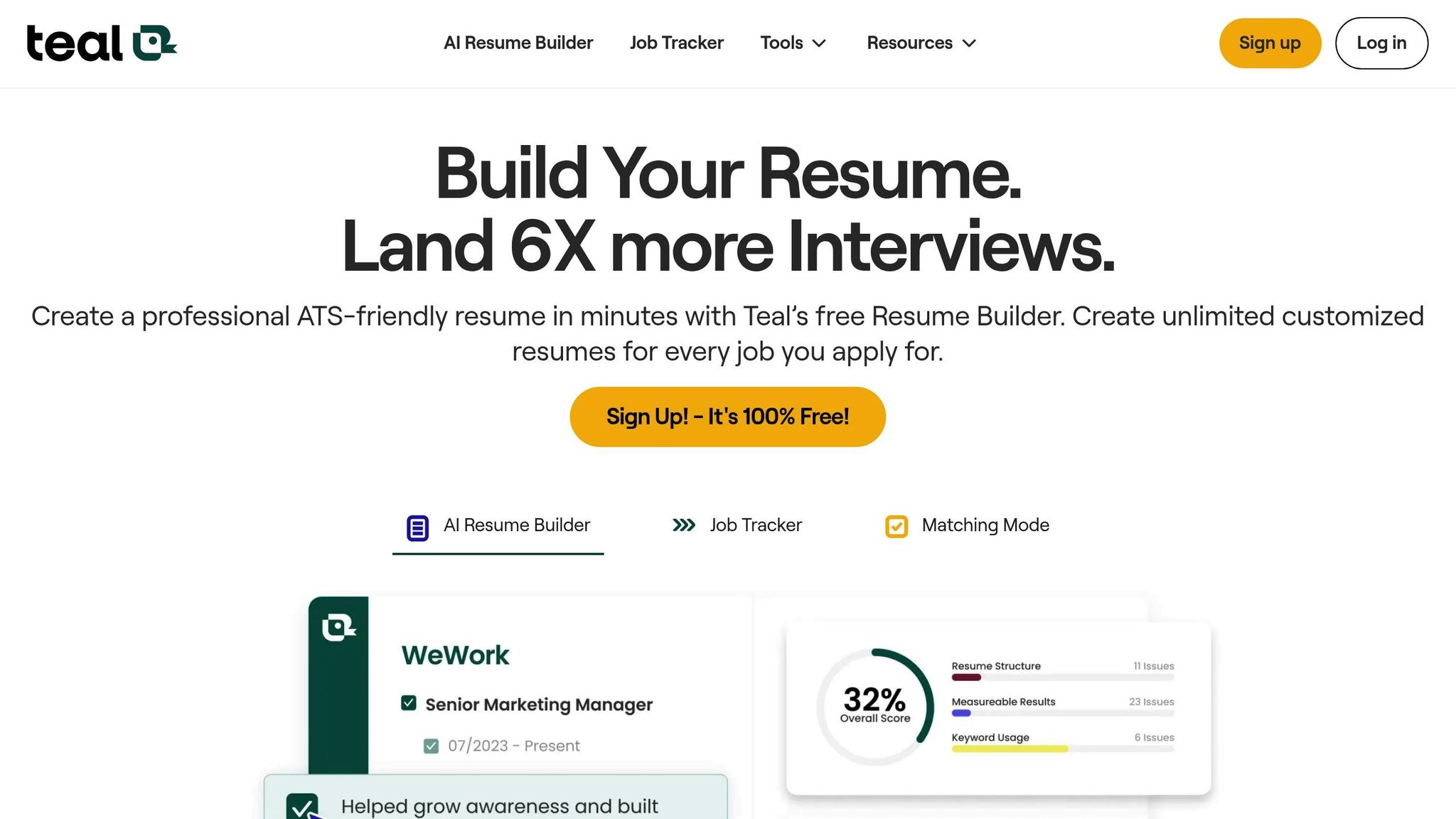
TealHQ is well-regarded for its job tracking and resume-building capabilities. Their platform offers both free and premium tiers, helping users track applications, organize job searches, and refine resumes with AI-driven keyword suggestions. However, TealHQ leaves the actual application submissions to you, which can be a time-consuming process.
In comparison, scale.jobs not only matches TealHQ’s tracking tools but also takes it further. The free tier provides access to a job board featuring over 2 million monthly postings, a tracker with real-time human-verified updates, and an ATS-compliant resume builder. For just $9 per month (launch offer), the AI Assistant Pro upgrade delivers unlimited AI-tailored resumes, cover letters, and application responses. Additionally, you can delegate submissions to trained virtual assistants who handle applications across all platforms, allowing you to focus on networking and preparing for interviews. Unlike subscription models that bind you to billing cycles, scale.jobs offers flat-fee bundles with refundable credits, ensuring you only pay for what you use.
Step 6: Monitor and Improve Your Results
Submitting job applications is just the starting line. The real game-changer lies in tracking your progress and fine-tuning your approach based on actual data. Personalized applications may get you noticed, but consistent monitoring and adjustments keep you ahead of the curve. In 2026, using dedicated application trackers has proven far more effective than relying on basic spreadsheets. These tools bring features like real-time updates, automated logs, and follow-up reminders, helping you stay organized and focused on your goals.
Leverage Dashboards for Real-Time Updates
With scale.jobs, transparency is built into the process. The platform provides time-stamped screenshots for every application submitted on your behalf, ensuring you have proof of work at your fingertips. You’ll also receive live WhatsApp notifications with time-stamped updates, eliminating the delays of traditional email notifications. This system gives you immediate clarity on where your resume has been sent, when it was received, and which documents were included.
Additionally, the scale.jobs dashboard tracks your Applicant Tracking System (ATS) score in real time. This means you can adjust keywords instantly, boosting your chances of passing ATS filters. Optimizing for ATS can improve your odds of landing interviews by up to 50%.
Fine-Tune Your Strategy with Data
Use the insights from your application tracker to review and refine your approach regularly. Dedicate 30 minutes each week to evaluate key metrics, such as how many applications you’ve submitted versus how many interviews you’ve been invited to. For example, if you’ve applied to more than 50 positions without securing any interviews, it might be time to revisit your resume. A keyword gap analysis can help identify missing skills, certifications, or industry-specific terms that ATS systems may require.
If your ATS score is consistently low, update your resume keywords immediately. On the other hand, if you’re landing interviews but not receiving offers, it’s a sign to focus on improving your interview skills. Consider practicing with mock interviews instead of simply increasing the number of applications you send.
Other practical tips include saving resumes in .docx format to ensure ATS compatibility and tracking LinkedIn outreach efforts. Pay attention to open and response rates for your personalized messages - this data can guide you in refining your networking strategy. Let the numbers guide your decisions, and avoid relying solely on gut feelings. Data-driven adjustments can make all the difference in securing your next opportunity.
Conclusion
Navigating today's competitive job market requires a strategy that combines efficiency with personalization, and scale.jobs is designed to do just that. By 2026, this platform simplifies your job search through a powerful mix of AI-driven keyword optimization and human-supported application submissions, bypassing the filters that often trip up tools like LazyApply and LoopCV.
With scale.jobs, you pay a one-time flat fee of $199 for 250 applications - no recurring subscriptions. You’ll also receive instant updates and proof of submission for every application, ensuring a level of transparency that services like TealHQ and Simplify.jobs struggle to offer. Plus, if you land a job before using all your credits, the remaining balance is refunded.
The platform goes beyond just submissions. It delivers ATS-friendly resumes in under 24 hours, access to over 2 million job postings each month, and visa filters to streamline your search. By saving you over 20 hours a week on repetitive tasks, scale.jobs lets you focus on what really matters - networking and preparing for interviews.
As Chris Martin, Lead Researcher at Glassdoor, highlights:
"The job search used to be a reliable numbers game, with more applications translating to more interviews and offers. As hiring rates have fallen over the past two years, however, many job-seekers are struggling to make progress even after hundreds of applications."
This shift underscores the importance of a balanced approach. In a world where recruiters spend just 5–7 seconds reviewing a resume, human verification ensures your applications stand out in an increasingly AI-dominated hiring process.
Whether you're managing visa complexities, switching career paths, or aiming to boost your callback rate, scale.jobs offers the clarity, efficiency, and personal touch that fully automated tools and traditional DIY methods simply can’t match. It’s your key to transforming your job search and landing your next opportunity in this ever-changing market.
FAQs
What’s the best way to make my resume stand out to ATS systems in 2026?
To ensure your resume grabs attention in ATS systems in 2026, focus on using the right keywords and maintaining simple formatting. Incorporate keywords directly from the job description to align with what the system is designed to detect. Stick to a clean, single-column format, using standard fonts like Arial or Calibri. Avoid tables, graphics, or headers/footers, as these can disrupt how the system reads your resume.
Save your resume in .docx format unless the job posting specifies a different requirement. Using standard section titles like "Work Experience" and "Skills" also helps the ATS process your resume more effectively. For extra accuracy, try running your resume through AI tools to spot any weak areas and confirm it meets ATS standards. These simple adjustments can boost your chances of getting noticed by recruiters.
What are the advantages of using human-assisted job application services?
Human-assisted job application services combine the precision of AI tools with the personal touch of professional expertise, offering a tailored approach to job seekers navigating today’s competitive landscape. These services go beyond basic automation by ensuring your resume and applications are not only optimized for Applicant Tracking Systems (ATS) but also crafted to emphasize your accomplishments, integrate industry-relevant keywords, and tell a compelling story - something purely automated tools often lack.
What sets these services apart is the personalized support they offer. You'll benefit from clear communication and detailed updates, giving you insight into how your application is being refined. Many providers even offer real-time features, like dedicated WhatsApp support, to help you adjust your approach quickly in response to changing opportunities. By blending automation with hands-on expertise, these services provide a powerful edge, increasing your chances of securing interviews and making a lasting impression on recruiters.
Why is a personalized approach better than using automation for job applications?
A tailored approach to job applications often proves more impactful than relying on automation. Why? Because it reflects genuine interest and effort, making you stand out to recruiters. Unlike automated submissions, a personalized application is crafted specifically for the role and company, signaling that you’ve taken the time to understand their unique needs and how your skills align.
Recruiters and hiring managers tend to respond more favorably to applications that feel sincere and relevant. Personalizing your application not only emphasizes your qualifications but also conveys your enthusiasm and drive - qualities that leave a lasting impression.