
Top 5 Virtual Assistant Platforms for Job Search
Human-assisted platforms often outperform mass-apply tools—compare automation, ATS compatibility, pricing, and when to switch for higher callback rates.


When searching for a job, finding the right tools can save you time and improve your chances of success. Virtual assistant platforms offer solutions ranging from automated application submissions to human-assisted services. This article reviews the top five platforms - LazyApply, Simplify.jobs, LoopCV, Sonara.ai, and Scale.jobs - based on critical factors like automation, pricing, ATS compatibility, and transparency. Here's what you need to know:
- LazyApply: Automates high-volume applications but lacks human oversight and ATS optimization.
- Simplify.jobs: Autofills applications with AI but struggles with personalized responses.
- LoopCV: Fully automated system with resume optimization tools but limited human involvement.
- Sonara.ai: AI-driven mass applications with minimal customization and transparency.
- Scale.jobs: Combines AI tools with human expertise for tailored, ATS-friendly applications and real-time updates.
Quick Comparison
| Platform | Automation Type | Pricing | ATS Compatibility | Transparency | Best For |
|---|---|---|---|---|---|
| LazyApply | Fully Automated | $99 (one-time) | Low | Minimal | Entry-level, high volume |
| Simplify.jobs | AI Autofill | $9.99/month | Medium | Limited | High-volume applications |
| LoopCV | Fully Automated | €9/month (~$9.50) | Low | Basic dashboard | Entry-level tech roles |
| Sonara.ai | Fully Automated | $19.99/month | Low | Limited metrics | Passive job seekers |
| Scale.jobs | AI + Human Assistance | $199–$399 (flat) | High | Real-time updates | Mid-to-senior, visa roles |
For entry-level roles, automated tools like LazyApply and Simplify.jobs may suffice. However, for tailored applications, ATS optimization, or complex job searches (e.g., visa sponsorships), Scale.jobs offers a more effective solution with its human-assisted services. Keep reading to find out which platform fits your job search needs.
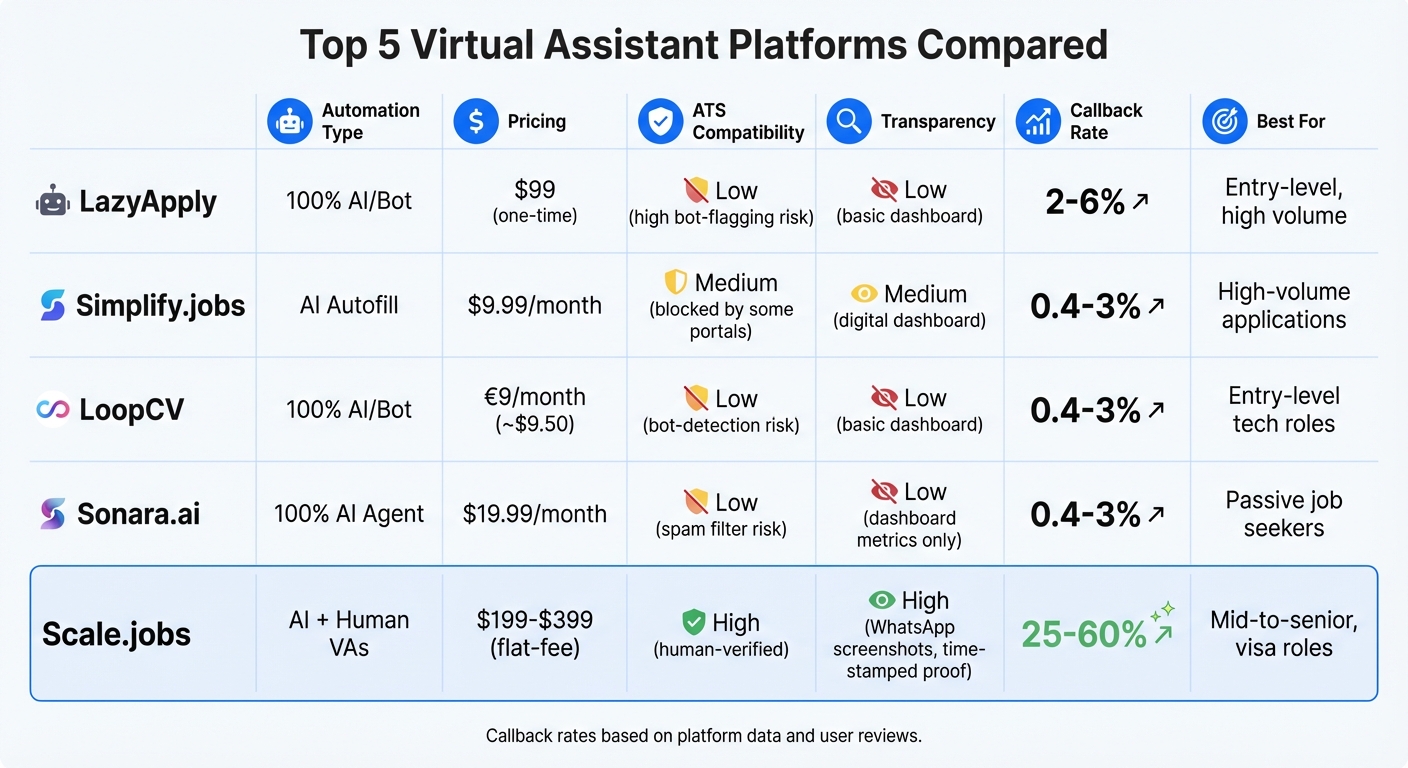
Comparison of Top 5 Virtual Assistant Platforms for Job Search
1. LazyApply
LazyApply aims to simplify the job search process by automating up to 750 applications daily through browser automation. Its AI bots fill out forms on popular job boards like LinkedIn, Indeed, and ZipRecruiter, focusing on high-volume submissions with minimal manual effort. However, platforms such as scale.jobs stand out by blending AI technology with human expertise for a more personalized and precise approach.
Features
LazyApply's main feature is a Chrome extension that auto-fills job applications using your stored profile data. It supports several job boards and handles basic form fields. However, users have noted that the software sometimes applies to irrelevant roles or selects incorrect demographic options, which can undermine the application process.
Unlike LazyApply, scale.jobs ensures human oversight, offering features like resume writing assistance and manual application reviews to improve application quality. While LazyApply's automation appeals to those who prioritize quantity, the absence of human review can lead to errors that reduce effectiveness.
Pricing
LazyApply offers a $99 lifetime plan, which may seem economical upfront. However, users should be cautious about hidden costs, such as account restrictions on platforms like LinkedIn or Indeed due to automated behavior. Studies show that high-volume applications can reduce response rates, with applicants sending the most applications being 39% less likely to hear back from employers. While LazyApply reduces manual effort, it risks compromising the quality of individual applications.
Why scale.jobs is a better alternative:
- Human oversight ensures applications are tailored to job requirements.
- ATS-optimized documents increase response rates from 2–6% to 25–60%.
- Flat-fee pricing avoids the hidden risks of account restrictions.
- Dedicated support, including WhatsApp updates and proof-of-work screenshots.
- Reverse recruiters ensure accuracy, avoiding errors like mismatched roles or incorrect demographic details.
Human vs AI Involvement
LazyApply operates entirely on automation without human checks, which can lead to errors like applying for irrelevant roles or inaccurate demographic entries. In contrast, scale.jobs employs trained professionals who manually review and optimize each application. This human involvement ensures accuracy, improves ATS compatibility, and minimizes errors before submissions are made.
ATS Compatibility
One of LazyApply's key limitations is its lack of ATS (Applicant Tracking System) optimization. With up to 90% of resumes failing ATS screening, LazyApply's generic submissions often don’t make it past initial filters. This is reflected in its low response rate of 2–6%. On the other hand, platforms like scale.jobs achieve response rates of 25–60% by tailoring resumes for ATS requirements, ensuring they meet specific job criteria and reach human recruiters.
Transparency
LazyApply's customer support is minimal, as reflected in its Trustpilot rating of 2.1/5, with over half of the reviews being one-star. In comparison, scale.jobs provides real-time support via WhatsApp, along with time-stamped submission records, offering greater transparency and accountability throughout the process.
Who Should Use LazyApply vs. Who Should Choose scale.jobs
LazyApply might work for you if:
- You’re applying to a large number of entry-level roles where quantity outweighs quality.
- You’re willing to manually verify and correct errors in automated submissions.
- You’re comfortable with the potential risks of account restrictions on major job boards.
scale.jobs is a better fit if:
- You need ATS-optimized applications that pass screening filters.
- Human oversight is important to ensure the quality and relevance of your applications.
- You’re targeting mid-to-senior level roles where tailored applications are crucial.
- Real-time support and proof-of-work are priorities for you.
- You’re dealing with visa requirements or specialized job searches that demand precision.
2. Simplify.jobs
Simplify.jobs has attracted over 1,000,000 job seekers with its browser extension that autofills application forms using your pre-saved profile. It acts more like a "copilot" rather than a fully automated service - you still need to manually select job postings to trigger the autofill function. Unlike Scale.jobs, which combines automation with expert human input, Simplify.jobs relies entirely on AI-generated templates. While this works for high-volume applications, it lacks the personalized touch that platforms like Scale.jobs deliver through trained virtual assistants.
Features
The Simplify Copilot extension stores your profile details and uses AI templates to complete application forms across various job boards. It can also help identify hiring managers and draft outreach emails. However, its AI-generated answers often fall short for long-form or behavioral questions. For instance, prompts like "Describe a time you led a project" often result in generic responses that fail to reflect your unique experience.
In comparison, Scale.jobs assigns trained reverse recruiters who tailor responses for each application. This distinction in customization and automation highlights the differences between the two platforms, especially when it comes to addressing specific application needs.
Pricing
Simplify.jobs offers subscription-based pricing, while Scale.jobs operates on a one-time flat-fee model, ensuring better long-term value. Simplify.jobs charges $19.99 per week or $89.99 for three months, with a six-month subscription costing around $180. On the other hand, Scale.jobs’ pricing ranges from $199 to $399 for a one-time fee, which includes a refund for unused credits.
Why Scale.jobs stands out:
- A single payment avoids recurring subscription costs.
- Human assistants manage the entire application process, not just autofill tasks.
- Professionally written, ATS-optimized documents instead of generic AI templates.
- Transparent WhatsApp updates with time-stamped proof-of-work screenshots.
- No risk of bot detection or account issues.
Human vs. AI Involvement
Simplify.jobs relies solely on AI automation, using pre-set templates and stored information. This means every application is treated the same, regardless of the specific role. While this approach works for entry-level positions where speed is critical, it falls short for competitive or specialized roles.
Scale.jobs, however, uses dedicated virtual assistants who carefully review job descriptions, tailor resumes and cover letters, and ensure applications are submitted through the appropriate channels. This human involvement guarantees accuracy and a level of personalization that AI-driven templates cannot achieve.
ATS Compatibility
Simplify.jobs often struggles with Applicant Tracking Systems (ATS) like Workday and Taleo, which can block or reject automated submissions. With an ATS pass rate of about 50%, many applications may never even reach a recruiter. Additionally, the reliance on generic templates means applications often fail to meet keyword and relevance requirements.
Scale.jobs avoids these challenges by having human assistants manually submit applications and optimize resumes for each job posting. This ensures higher ATS compatibility and avoids detection issues entirely.
Transparency
Simplify.jobs provides a digital dashboard to track application counts and status updates. However, it doesn’t offer detailed proof of what was submitted or when. In contrast, Scale.jobs provides real-time WhatsApp updates with time-stamped screenshots of every submission, offering full transparency and accountability in your job search.
Who Should Use Simplify.jobs vs. Who Should Choose Scale.jobs
Simplify.jobs might suit you if:
- You’re applying to 100+ entry-level roles weekly, where speed matters more than customization.
- You’re comfortable manually triggering applications and reviewing AI-generated content.
- The roles you’re targeting have straightforward applications without complex questions.
- You prefer managing your job search with AI assistance rather than delegating it.
Scale.jobs is a better option if:
- You’re targeting mid-to-senior level roles that require tailored applications.
- You need human-verified ATS optimization to pass screening filters effectively.
- You’re dealing with visa sponsorship requirements (H1B, F1, CPT, TN, O1) that demand precision.
- You want to save 20+ hours weekly for networking and interview prep.
- Transparency, proof-of-work, and dedicated support are key priorities for you.
3. LoopCV
LoopCV presents itself as a fully automated platform that handles your job applications. It scans major job boards like LinkedIn and Indeed to identify openings and applies to them on your behalf. Unlike Scale.jobs, which combines human expertise with AI tools, LoopCV relies entirely on automation. While this approach can help you send out a large number of applications quickly, it may lead to challenges like compatibility with ATS systems and potential issues with bot detection - problems that human-led services are better equipped to manage.
Features
LoopCV uses a system of "loops" to automate the job application process. These loops search for roles that match your criteria and submit applications using your stored resume and profile information. A standout feature is its AI CV Checker, which runs 16 checks to flag formatting problems, missing keywords, and ATS compatibility issues. The platform recommends you achieve a resume score above 80% before starting your loop. Additionally, you can test multiple resume versions to see which one gets better responses from recruiters.
For users who prefer more control, LoopCV also offers a manual review mode. In contrast, Scale.jobs takes a more personalized approach by assigning virtual assistants to review each job description, customize your resume and cover letter, and manually submit applications. This process ensures that applications are tailored and submitted through the most effective channels, whether that's a company career page, a niche job board, or a major ATS.
These differences in features set the stage for comparing LoopCV's pricing model with the value-driven structure of Scale.jobs.
Pricing
LoopCV operates on a freemium model, offering basic features for free while charging for premium tiers that allow for higher application volumes. These paid subscriptions are billed monthly, which can lead to recurring costs over time if your job search extends for several months. On the other hand, Scale.jobs uses a one-time payment model, with fees ranging from $199 to $399. Any unused credits are refunded, making this a more cost-effective choice for job seekers who want to avoid ongoing expenses.
Why Scale.jobs stands out:
- Human oversight ensures each application is tailored to the role.
- Manual submission avoids detection by ATS bot filters.
- ATS-ready documents crafted by skilled assistants.
- Real-time updates via WhatsApp with screenshots for full transparency.
- One-time payment eliminates the need for monthly subscriptions.
Human vs. AI Involvement
LoopCV's fully automated system relies entirely on algorithms to match jobs, fill out application forms, and submit documents. While this can be effective for entry-level positions where speed and volume are priorities, it lacks the customization needed for competitive roles. CEO George Avgenakis emphasizes the benefits of the AI resume checker, but the applications themselves remain standardized.
In contrast, Scale.jobs focuses on human involvement. Dedicated virtual assistants review job descriptions, customize resumes to meet specific requirements, and craft personalized cover letters. This hands-on process ensures a higher level of accuracy and personalization, which automated systems like LoopCV cannot achieve.
ATS Compatibility
One of LoopCV's challenges lies in its compatibility with ATS systems. While the platform claims that its applications mimic manual submissions, many modern ATS platforms - such as Workday, Greenhouse, and Taleo - use advanced bot-detection algorithms. These systems can flag and deprioritize applications that follow repetitive, automated patterns, often without notifying the applicant.
Scale.jobs avoids these pitfalls by having human assistants manually input information and upload documents at a natural pace. This approach reduces the risk of being flagged by ATS systems, increasing the likelihood that your application will reach a recruiter.
Transparency
LoopCV provides some metrics through its dashboard, such as the number of applications sent, email open rates, and reply statistics. However, it does not offer detailed proof of submissions, such as screenshots or receipts, leaving users uncertain about what was sent and when.
By comparison, Scale.jobs offers real-time updates via WhatsApp, complete with time-stamped screenshots of every application. This level of transparency ensures full accountability and gives job seekers peace of mind throughout the process.
Who Should Use LoopCV vs. Who Should Choose Scale.jobs
LoopCV might be a good fit if:
- You're applying for entry-level roles where speed and volume are more important than customization.
- You’re comfortable with AI-generated applications and can handle potential bot-detection risks.
- Your job search is focused on major boards like LinkedIn and Indeed.
- You prefer a free or low-cost solution and don’t mind managing follow-ups on your own.
Scale.jobs is a better choice if:
- You’re targeting mid-to-senior positions that require tailored, human-reviewed applications.
- ATS compatibility and avoiding bot-detection issues are priorities for you.
- You’re dealing with visa requirements (e.g., H1B, F1, CPT, TN, O1) that demand precision.
- You want to save over 20 hours a week for networking and interview preparation.
- Transparency, proof-of-work, and personalized support are essential to your job search strategy.
4. Sonara.ai
Sonara.ai presents itself as a fully automated job application platform. Unlike scale.jobs, which pairs you with trained virtual assistants to oversee your applications, Sonara.ai relies entirely on AI-driven automation. It scans job listings based on keyword matching and submits applications en masse. While this high-volume approach may seem efficient, it lacks the tailored, ATS-friendly submissions that human oversight can provide.
Features
Sonara.ai functions as a fully automated system. Users upload their resumes, set preferences like location, salary range, and desired job titles, and the AI takes over. It scans platforms like LinkedIn, Indeed, and ZipRecruiter, applying to matches using keyword-based templates. This model is geared towards passive job seekers or entry-level candidates who prioritize quantity over quality. However, for competitive mid-to-senior roles, the lack of customization can be a significant drawback.
In contrast, scale.jobs employs a more hands-on approach by assigning dedicated virtual assistants. These professionals review job descriptions, tailor resumes to highlight relevant skills, and craft personalized cover letters. This human involvement ensures that applications align with what hiring managers are looking for, offering a level of precision that automated systems simply can't match.
Pricing
Sonara.ai uses a subscription-based pricing model, though it doesn’t publicly share detailed pricing tiers. Typically, users face recurring charges for enhanced features and higher application volumes. On the other hand, scale.jobs offers a flat-fee structure ranging from $199 to $399. This one-time payment includes refunds for unused credits, providing a more predictable and budget-friendly option for job seekers navigating financial constraints during a career transition.
Why scale.jobs stands out:
- Human-led customization ensures every resume and cover letter is tailored to individual roles.
- Manual submission avoids the bot-detection risks associated with automated platforms.
- ATS-optimized documents crafted by professionals experienced with systems like Workday, Greenhouse, and Taleo.
- Real-time updates via WhatsApp, including time-stamped screenshots for transparency.
- Flat-fee pricing eliminates the stress of recurring costs, with refunds for unused services.
Human vs. AI Involvement
Sonara.ai operates without human involvement. Its AI scans job boards, matches keywords, and submits applications using pre-filled templates. While this allows for a high volume of daily applications - sometimes between 50 and 100 - it lacks the ability to address nuanced issues like career gaps, industry changes, or visa requirements. This makes it more suitable for straightforward job searches where volume is the main priority.
In contrast, scale.jobs focuses on human expertise. Their virtual assistants analyze job descriptions, identify transferable skills, and position your background effectively. For job seekers dealing with complex situations like visa sponsorship (e.g., H1B, F1, CPT, TN, O1) or career transitions, this personalized approach can make the difference between being overlooked and landing an interview.
ATS Compatibility
Sonara.ai’s approach to rapid, bulk submissions can trigger ATS (Applicant Tracking System) filters. Many companies use systems like Workday, Greenhouse, or Taleo to screen applications, and automated platforms often fail to bypass these filters. When applications are submitted in quick succession with identical formatting, they may be flagged as spam, sometimes without notifying the applicant. This is a major risk for those relying on Sonara.ai’s high-volume strategy.
scale.jobs, on the other hand, avoids these pitfalls with manual submissions. Their virtual assistants input data at a natural pace, vary submission timing, and upload documents individually. This human-paced process ensures your application passes ATS screenings and reaches the recruiter’s desk.
Transparency
Sonara.ai provides limited transparency, offering only basic dashboard metrics such as the total number of applications sent and estimated response rates. It doesn’t allow users to verify where applications were submitted or confirm whether they reached employer systems.
By contrast, scale.jobs provides complete transparency. Through WhatsApp updates, users receive time-stamped screenshots of every application submitted. These updates confirm when and where applications were sent and ensure they entered the employer’s system. This level of accountability offers peace of mind throughout the job search process.
Who Should Use Sonara.ai vs. Who Should Choose scale.jobs
Sonara.ai is a good fit if:
- You’re applying for entry-level positions where volume outweighs the need for customization.
- You’re a passive job seeker looking for background automation while employed.
- Your resume is straightforward, without gaps, career changes, or visa complications.
- You’re willing to accept lower response rates in exchange for high-volume submissions.
scale.jobs is the better choice if:
- You’re targeting mid-to-senior roles that require tailored applications.
- Avoiding ATS spam filters is a critical part of your strategy.
- You need support managing visa requirements like H1B, F1, CPT, TN, or O1.
- You want to save over 20 hours a week for networking or interview prep.
- Transparency, real-time updates, and personalized assistance are key to your job search.
5. scale.jobs
scale.jobs takes a hybrid approach that goes beyond purely automated systems by combining free tools, optional AI support, and expert human virtual assistants to streamline your job search. Let's break down how this platform stands out compared to other highly automated competitors.
Features
The platform offers three levels of service to cater to different needs. The free tier provides access to a job board featuring over 2 million monthly postings, an ATS-compliant resume builder, a job applications tracker, and networking tools. For those looking for more, the AI Assistant Pro plan (starting at $9/month during launch, later $19/month) includes unlimited single-click tailored resumes, cover letters, and AI-generated answers for job application questions and interview prep. At the top tier, the Human Assistant service assigns trained virtual assistants to handle your entire job search. This includes creating ATS-optimized resumes and cover letters, manually submitting applications, and keeping you updated via real-time WhatsApp messages with time-stamped screenshots. This service is designed to save job seekers over 20 hours per week, giving them more time to focus on networking and preparing for interviews.
Unlike platforms such as LazyApply or Sonara.ai, which rely on high-volume, automated submissions, scale.jobs employs human experts to ensure applications are tailored, accurate, and ATS-compliant. Virtual assistants carefully review job descriptions, customize materials to meet specific requirements, and submit applications at a natural pace to avoid ATS spam filters. This personalized approach is especially helpful for those navigating visa processes (H1B, F1, CPT, TN, O1) or transitioning to a new career.
Pricing
scale.jobs uses a flat-fee pricing structure for its Human Assistant service, eliminating recurring subscriptions. This model simplifies budgeting while emphasizing the value of personalized, error-free application management. Plans range from $199 for 250 applications (1 assistant) to $399 for 1,000 applications (2 assistants). For those seeking additional help, the Ultimate Bundle at $1,099 includes recruiter support and a LinkedIn profile optimization. Notably, unused credits are refunded, with 70% of customers reportedly receiving refunds because they secure a job before using all their credits. This one-time payment model stands in contrast to subscription-based competitors like LazyApply and LoopCV, offering more predictability and transparency for job seekers on tight budgets.
For those needing professional resume assistance, scale.jobs also offers resume writing services starting at $199. This package includes a professionally crafted resume, a 45-minute Zoom consultation, and three job applications submitted on your behalf.
Human vs. AI Involvement
Unlike fully automated services like LazyApply or Sonara.ai, scale.jobs assigns dedicated virtual assistants to manually review job postings, tailor application materials, and submit applications. This human touch ensures each application is personalized and steers clear of the risks tied to automated systems. As the platform succinctly puts it:
"Recruiters instantly see through & reject sloppy AI auto-filled applications. We apply to jobs with REAL HUMANS, no AI Apply bullshit or generic, impersonal applications." – scale.jobs
For job seekers facing challenges like career gaps, industry changes, or visa sponsorship requirements, this hands-on approach can be a game-changer. One satisfied client, Anuva Agarwal, shared:
"The associate assigned to me is trustworthy and sincere in their approach... it's good value for money." – Anuva Agarwal
ATS Compatibility
scale.jobs places a strong emphasis on ATS optimization, both through its free resume builder and Human Assistant service. Virtual assistants craft documents designed to pass applicant tracking systems and manually submit applications to avoid the spam filters that automated platforms often trigger. This careful, deliberate process ensures your application reaches the recruiter's desk instead of being filtered out - an issue frequently encountered with platforms like LazyApply, LoopCV, and Sonara.ai.
Transparency
Transparency is a cornerstone of the Human Assistant service. You'll receive real-time WhatsApp updates with time-stamped proof of when and where your applications were submitted. This level of accountability sets scale.jobs apart from competitors like LazyApply and Sonara.ai, which often only provide dashboard metrics without concrete proof of submission. With a 4.9/5 rating on major review platforms and a refund policy for unused credits, scale.jobs underscores its commitment to both transparency and delivering results.
Who Should Choose scale.jobs
scale.jobs is ideal for job seekers who:
- Are targeting mid-to-senior level roles that require tailored, human-reviewed applications.
- Need ATS-optimized documents that can pass screening systems and reach recruiters.
- Are navigating visa requirements (H1B, F1, CPT, TN, O1, EB1A) that demand precision and accuracy.
- Want to reclaim 20+ hours per week to focus on networking or interview preparation.
- Value real-time support, proof-of-work transparency, and dedicated WhatsApp updates.
Switch to scale.jobs if…
- You need manual, ATS-friendly applications instead of generic automated submissions.
- Your current platform's applications are being flagged by ATS spam filters or bot-detection systems.
- You require human oversight to manage career gaps, industry changes, or visa sponsorship challenges.
- You're frustrated with recurring subscription fees and prefer predictable, one-time pricing with refunds for unused credits.
- You want transparency and time-stamped proof for every application submitted on your behalf.
Strengths and Weaknesses
Here's a detailed breakdown of each platform's strengths and weaknesses based on their unique features and limitations.
LazyApply specializes in high-volume automation, allowing users to apply to numerous jobs on platforms like LinkedIn and Indeed with just one click. Priced at $99 for lifetime access, it’s particularly appealing to recent graduates looking to explore multiple opportunities quickly. However, its fully AI-driven system often generates generic applications, which are prone to being flagged by ATS as spam.
Simplify.jobs offers a seamless autofill experience and strong ATS compatibility, with pricing starting at $9.99 per month for premium features. It’s a great tool for job seekers who frequently apply across various job boards. However, its reliance on AI can sometimes result in mismatched applications, and the platform provides limited transparency about its processes.
LoopCV automates job applications to over 100 job boards, coupled with smart filtering and analytics, for €9 per month (approximately $9.50 USD). This makes it a solid choice for tech professionals who want to track their application performance. On the downside, its automation lacks the human touch needed for complex cases, such as visa sponsorships, and high-volume submissions can reduce visibility to recruiters.
Sonara.ai takes a proactive approach by identifying hidden opportunities and generating tailored applications, priced at $19.99 per month. It’s particularly suited for undergraduates seeking internships. However, its AI-only approach means there’s no real-time proof of work, and recurring costs combined with uncertain ATS success rates may limit its overall value.
scale.jobs stands out with its hybrid model, combining free tools, an optional AI assistant (starting at $9 per month), and human virtual assistants offering personalized application services. With one-time flat fees ranging from $199 to $1,099, it ensures ATS-optimized, manually submitted applications, and even provides refunds for unused credits. This approach is ideal for mid-to-senior-level professionals, career changers, and those requiring visa sponsorship. While the upfront cost is higher compared to fully automated tools, the transparency - through WhatsApp updates and time-stamped proof - along with the human touch, makes it an attractive option. For users needing expert-level documents, resume writing services can further enhance their applications.
When comparing these platforms, factors like human involvement, ATS compatibility, and pricing reveal key differences. Human-verified services, like those offered by scale.jobs, consistently achieve higher callback rates, ranging from 25% to 47%, compared to the 0.4% to 3% reported by AI-only platforms such as LazyApply and Sonara.ai. This is largely due to the risks of bot-flagging and the lack of personalization in AI-generated applications.
| Platform | Features | Pricing | Human vs AI Involvement | ATS Compatibility | Transparency |
|---|---|---|---|---|---|
| LazyApply | Mass auto-apply, Chrome extension, Job GPT | $99–$249 (One-time/Subscription) | 100% AI / Bot | Low (High bot-flagging risk) | Low (Basic dashboard only) |
| Simplify.jobs | Autofill extension, job tracking, Copilot | Free / $9.99/month Premium | AI-powered extension | Medium (Blocked by some portals) | Medium (Digital dashboard) |
| LoopCV | Automated submissions, board pulling, analytics | €9/month (~$9.50 USD) | 100% AI / Bot | Low (Bot-detection risk) | Low (Basic dashboard) |
| Sonara.ai | Auto-scanning, autonomous applying, interview prep | $19.99–$99.99/month | 100% AI Agent | Low (Risk of spam filters) | Low (Dashboard metrics only) |
| scale.jobs | Manual applications, custom resumes, WhatsApp updates, refunds | $199–$1,099 (One-time flat-fee) | Hybrid (AI + Human VAs) | High (Human-verified submissions) | High (WhatsApp screenshots, time-stamped proof) |
For job seekers targeting senior positions or navigating visa sponsorship complexities, a reverse recruiting approach offers a clear advantage. As scale.jobs aptly puts it:
"Recruiters instantly see through & reject sloppy AI auto-filled applications. We apply to jobs with REAL HUMANS, no generic AI auto-filled applications." – scale.jobs
Which Platform Should You Choose?
Deciding on the right platform depends on factors like your career stage, the number of applications you need to submit, and how complex your professional background is. Let’s break it down.
For recent graduates or those with straightforward resumes, automation tools such as LazyApply (a one-time fee of $99) or Simplify.jobs ($9.99 per month) can be a good starting point. These tools are particularly effective when you need to apply to a high volume of positions across various industries or roles quickly. Their strength lies in the ability to submit applications rapidly, making them ideal for those exploring multiple options at the same time.
However, if you’re a mid-to-senior professional, switching careers, or dealing with visa sponsorship challenges like H-1B, F-1 OPT, or TN, your needs are different. Automated tools often fall short in these cases, as they can trigger ATS (Applicant Tracking System) filters, leading to rejections. This is where scale.jobs (pricing ranges from $199 to $1,099) stands out. It offers a human-powered approach, with trained virtual assistants who manually handle applications. They craft personalized narratives to address gaps or career pivots, ensuring your submissions meet ATS requirements. To provide transparency, they even share WhatsApp screenshots of completed applications.
The results speak for themselves. Consultant Hang Zou, facing a tight 60-day H-1B deadline, used scale.jobs to secure three job offers and a 75% salary increase within a month. Similarly, software engineer Aubrey Smith relied on the platform for managing daily submissions and targeting priority roles, leading to multiple positive responses. For senior roles requiring expert-level documents, combining scale.jobs with a professional resume writing service can increase your chances of standing out to recruiters and hiring managers.
When to Switch to a Human-Powered Service
If you’re not seeing results with automated tools, it might be time to consider a more tailored approach. Here are some signs that a human-powered service like scale.jobs might be a better fit:
- Your callback rate is below 10% after four to six weeks.
- You’re applying for highly competitive technical or executive roles.
- You’ve experienced repeated ATS rejections.
- You’re spending over 20 hours a week on applications with little success.
- You want to prioritize networking while delegating application tasks to a virtual assistant.
Tracking your response rate is key. Automation tools typically yield callback rates between 0.4%–3%, while human-powered services often achieve rates between 25%–47%. This difference can guide your decision based on your timeline, budget, and the complexity of your job search.
Decision Summary
- Automation tools like LazyApply or Simplify.jobs work best for entry-level, high-volume applications where speed is your priority.
- Scale.jobs is ideal for competitive roles, visa-related challenges, or when automated platforms fail to deliver results. It offers a personalized, ATS-friendly approach that significantly increases your chances of landing interviews.
Choose the platform that aligns with your specific needs and job search goals.
FAQs
How do I choose between automation and human-assisted applying?
When it comes to selecting the right tool or service for your job search, it often boils down to your specific needs and the level of personalization you’re aiming for. Automation tools, such as LazyApply or Simplify.jobs, are great for handling a large number of applications quickly and at a lower cost. However, these tools often rely on generic resumes, which can lead to fewer callbacks.
On the other hand, human-assisted services like Scale.jobs focus on creating ATS-optimized and tailored applications. They also take care of managing submissions and provide real-time updates throughout the process. This makes them especially useful for roles that require a higher level of precision, such as senior positions, competitive roles, or jobs requiring visa sponsorship, where attention to detail and customization can make a big difference.
Will automated applying get my accounts or applications flagged?
Automated application tools such as LazyApply or Simplify.jobs may seem convenient, but they often rely on generic templates and lack sufficient human oversight. This can lead to applications being flagged or rejected by Applicant Tracking Systems (ATS). In contrast, services like Scale.jobs focus on minimizing these risks by using ATS-optimized resumes, ensuring submissions are managed by real people, and offering clear proof-of-work to guarantee accuracy and compliance throughout the process.
How can I tell if my applications are actually being submitted?
The most effective way to ensure your job applications are successfully submitted is by using platforms that offer clear evidence and real-time updates. For example, Scale.jobs provides timestamped proof of submissions along with WhatsApp notifications, giving you peace of mind and full transparency. Many automated tools fail to offer this kind of visibility, so it’s essential to choose solutions that include manual confirmations, timestamps, or notifications to verify your applications have been properly submitted.