
Best UK Cities for Visa Sponsor Jobs in 2026 (You'll Be Surprised)
Regional UK cities offer visa-sponsor jobs with lower costs and strong industries—find where your skills will stand out.


Looking for visa-sponsored jobs in the UK? While London dominates with over 40,000 sponsorship licenses, cities like Manchester, Birmingham, Leeds, Edinburgh, and Bristol are emerging as top alternatives. These cities offer lower living costs, growing industries, and less competition for roles. Here’s a quick breakdown:
- Manchester: A hub for e-commerce, cybersecurity, and healthcare with 2,000–5,000 sponsors.
- Birmingham: Strong in engineering, healthcare, and professional services with 2,000–5,000 licenses.
- Leeds: Known for FinTech and HealthTech, offering 1,000–2,000 sponsorship opportunities.
- Bristol: Specializes in aerospace, robotics, and tech with a niche sponsor network.
- Edinburgh: Focused on AI, renewable energy, and financial services with 1,000–2,000 sponsors.
These cities combine affordability with strong job markets, making them excellent choices for career growth. Learn how to navigate visa sponsorships and find the best opportunities in these locations.
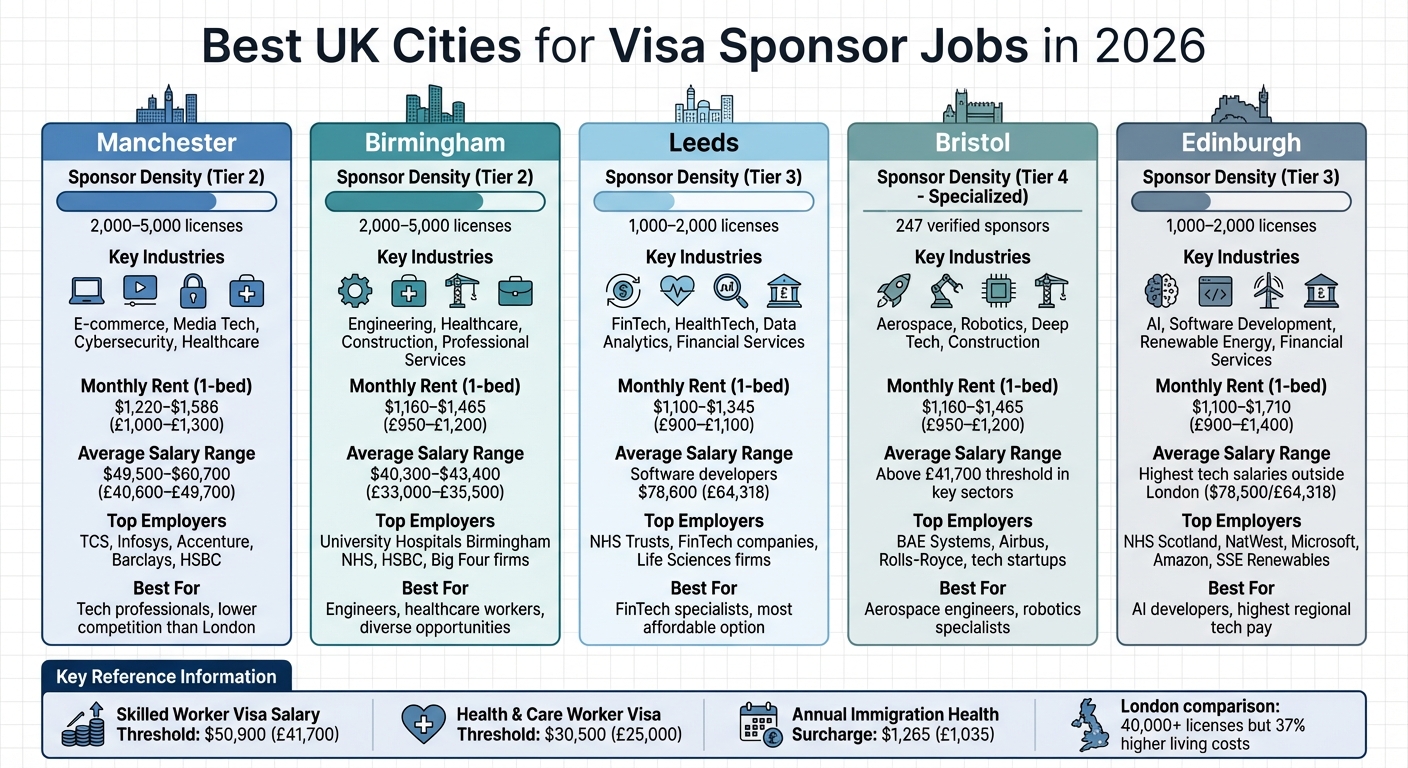
UK Cities Comparison for Visa Sponsor Jobs: Salary, Rent & Industry Overview 2026
1. Manchester
Sponsor Density
Manchester has emerged as a key Tier 2 visa sponsor hub, with 2,000–5,000 licenses projected for 2026. While it doesn't rival London's staggering 40,000+ licenses, it surpasses cities like Leeds and Edinburgh, which each have around 1,000–2,000 sponsors. As part of the Northern Powerhouse initiative, Manchester has seen substantial government investment, particularly in its digital technology clusters. For job seekers, this translates into a wealth of opportunities without the intense competition found in the capital.
In the tech sector, Manchester boasts 42 licensed computer programming employers, holding a 3.0% share of the national total. Although London dominates with 80.5% of programming sponsors, Manchester stands out as the strongest regional alternative for tech professionals. To ensure eligibility, candidates can check Manchester-based companies' licenses on the UK Home Office register. This solid sponsor base makes Manchester an attractive option for tech professionals seeking opportunities outside London.
Key Industries
Manchester's economy thrives on e-commerce, media technology, and cybersecurity, all of which are growing rapidly. The city has established itself as a hub for digital innovation, attracting companies looking for skilled talent at more competitive costs than in London. Beyond tech, the construction sector is another area of strength, supported by 106 verified sponsor companies. This growth is fueled by major infrastructure projects and green energy initiatives aligned with the UK's Net-Zero 2050 goals.
Healthcare is another high-demand sector, with NHS Trusts and private providers actively recruiting international medical staff to fill critical vacancies. In professional services, Manchester hosts regional hubs for the Big Four accounting firms - Deloitte, PwC, EY, and KPMG. For job seekers, focusing on these core industries, particularly e-commerce and cybersecurity, can significantly improve the chances of landing an interview. These sectors, as outlined below, consistently attract top-tier employers.
Top Employers
Global corporations have increasingly set up operations in Manchester, benefiting from the decentralization trend. IT consultancies like TCS, Infosys, and Accenture have a strong presence, alongside major banks such as Barclays and HSBC. For software developers, the average advertised salary in the UK is $78,500 (£64,318), comfortably exceeding the Skilled Worker visa threshold of $50,900 (£41,700).
Construction firms are actively hiring roles like electrical engineers and project managers, while healthcare providers continue to recruit nurses and clinical staff through NHS and private channels. Many regional sponsors also offer relocation packages. When considering job offers, ensure they meet the updated 2026 salary threshold and confirm that first-time applicants meet the B2 English language proficiency requirement, introduced on January 8, 2026. Platforms like scale.jobs can help candidates optimize their applications, offering a competitive edge over automated services like findmyprofession.com and lazyapply.com. With competitive salaries and Manchester's affordability, this city offers a compelling alternative to London.
Living Costs
Living in Manchester is significantly more affordable than in London. A one-bedroom apartment typically costs $1,100–$1,700 (£900–£1,400) per month, about half of what you'd pay in London. Monthly living expenses excluding rent range from $975–$1,160 (£800–£950), with utilities averaging $145–$245 (£120–£200) and council tax in the same range. A salary of $54,900 (£45,000) in Manchester provides a higher standard of living than a $73,200 (£60,000) salary in central London, thanks to the city's 37% lower cost of living.
Manchester's affordability, combined with competitive salaries, means greater disposable income for professionals. Average salaries for roles in the city range between $49,500–$60,700 (£40,600–£49,700). For those managing visa-related expenses - like the annual Immigration Health Surcharge of $1,265 (£1,035) and the Immigration Skills Charge of $1,610 (£1,320) for large sponsors - Manchester's lower living costs offer meaningful financial breathing room compared to London. This makes the city an excellent choice for both career growth and financial stability.
2. Birmingham
Sponsor Density
Birmingham stands out as a hub for Tier 2 visa sponsorship, with an estimated 2,000–5,000 active licenses in 2026. Its sponsor base is diverse, featuring 134 verified construction sponsors (4.8% of the UK's total) and 62 licensed computer programming employers (4.4% of the national market). Impressively, Birmingham ranks as the second-largest market for computer programming sponsorship in the UK, offering tech professionals a strong alternative to the competitive London job scene.
The city benefits from a trend of decentralization, with many large organizations setting up regional operations to tap into skilled talent while managing costs. For job seekers, this creates a less crowded market where applications are more likely to stand out. This vibrant sponsor network supports Birmingham’s varied industries and provides ample opportunities for international professionals.
Key Industries
Birmingham’s economy thrives on industries like automotive manufacturing, professional services, and healthcare. The Midlands, with Birmingham at its center, is known for its engineering expertise, particularly in the automotive and aerospace sectors. This creates a steady demand for roles such as mechanical engineers and project managers. Additionally, Birmingham is a strong alternative to London for finance and professional services, hosting regional offices of major banks like HSBC and top accounting firms.
Healthcare is another major sector, driven by both the NHS and private care providers. The Health and Care Worker visa, with its reduced fee of $347 (£284) compared to the Skilled Worker visa’s $879 (£719), is a compelling option for medical professionals. Construction also thrives in Birmingham, supported by large infrastructure projects across the Midlands. These industries present high hiring potential for skilled professionals.
Top Employers
Birmingham’s diverse sponsor network is reflected in its top employers across key industries. In healthcare, University Hospitals Birmingham NHS Foundation Trust actively recruits for roles such as registered nurses, doctors, and physiotherapists. The education sector features institutions like Global Banking School (GBS), while fintech and e-commerce are represented by BullionByPost and BarberBoss. Social care providers such as ExtraCare Charitable Trust are also significant sponsors. In the tech sector, companies like Immersum and Trexo Robotics offer opportunities for software engineers and DevOps specialists.
For Skilled Worker visa applicants, the general salary threshold is $50,900 (£41,700) as of 2026, though healthcare roles may qualify for lower thresholds starting at $30,500 (£25,000) under the Health and Care Worker visa. Many Birmingham-based employers provide relocation packages, including temporary housing or travel allowances, to attract international talent. During interviews, it’s worth asking if the employer covers the $1,265 (£1,035) annual Immigration Health Surcharge, which can significantly reduce upfront costs.
For those navigating the job market, platforms like scale.jobs offer tailored support, outperforming tools like findmyprofession.com and lazyapply.com in Birmingham’s competitive landscape. The platform’s personalized approach ensures applications are fine-tuned for the city's unique market demands.
Living Costs
Birmingham strikes a balance with its medium cost of living, making it more affordable than London but slightly pricier than cities like Leeds or Sheffield. Renting a one-bedroom apartment typically costs $1,160–$1,465 (£950–£1,200) per month, while monthly living expenses excluding rent range from $950–$1,100 (£780–£900). Compared to Manchester, where rents range from $1,220–$1,590 (£1,000–£1,300), Birmingham offers a modest financial edge.
The average annual salary in Birmingham is between $40,300–$43,400 (£33,000–£35,500), though sponsored roles are required to meet the $50,900 (£41,700) threshold. Opting for outer zones with lower rents and good transport links can help maximize savings. Additionally, Birmingham’s affordability makes the mandatory $1,265 (£1,035) annual Immigration Health Surcharge more manageable compared to London, supporting long-term financial stability.
Competitor Comparison: Who Should Use LazyApply vs scale.jobs
Choosing the right job application tool can make a big difference when applying in Birmingham’s competitive visa sponsor market. While LazyApply focuses on high-volume automated applications, scale.jobs offers a more tailored approach, ideal for professionals targeting specific sectors like automotive, healthcare, and fintech.
Key Features of scale.jobs
- Human-driven customization: Each application is tailored to the specific employer and role.
- ATS-optimized documents: Ensures compliance with UK visa sponsor requirements.
- Transparent process: Provides proof-of-work for every submitted application.
- Real-time support: Dedicated WhatsApp assistance for Birmingham-specific opportunities.
- One-time payment model: No recurring fees, with clear proof of application delivery.
LazyApply works well for entry-level roles with standardized requirements, while scale.jobs is better suited for specialized positions where customization can significantly improve interview rates.
Comparison Table
| Feature | LazyApply | scale.jobs |
|---|---|---|
| Human Involvement | Automated bot submissions | Human assistants customize applications |
| Resume Customization | Minimal tailoring | Employer-specific deep customization |
| ATS Handling | Basic keyword matching | Advanced optimization for UK sponsor criteria |
| Application Execution | Bulk automated submissions | Targeted, strategic applications |
| Transparency | Limited tracking | Full proof-of-work with receipts |
| Pricing Model | Subscription-based | One-time payment per campaign |
Who Should Use LazyApply
LazyApply is ideal for candidates who:
- Apply to a large number of entry-level positions with similar requirements.
- Prioritize speed and volume over application quality.
- Have standardized skills suited to template-based submissions.
- Prefer automated processes without human review.
Who Should Choose scale.jobs
Scale.jobs is the right choice for professionals who:
- Target specialized roles in Birmingham’s key sectors like healthcare, fintech, or automotive.
- Need applications that meet the £41,700+ salary threshold.
- Require ATS-optimized documents for competitive visa sponsorship.
- Value transparency with proof of application submissions.
- Focus on quality over quantity, targeting fewer but higher-value opportunities.
Switch to scale.jobs if…
Consider switching to scale.jobs if:
- You’re targeting specialized roles in Birmingham where tailored applications improve your chances.
- Your applications aren’t passing ATS filters at major employers like University Hospitals Birmingham or HSBC.
- You need assurance of salary compliance with the £41,700+ threshold.
- You want proof that your applications reached hiring managers.
- You’re prioritizing quality over bulk applications, aiming for roles that align with your skills and career goals.
3. Leeds
Sponsor Density
Leeds serves as a Tier 3 sponsor hub, hosting between 1,000–2,000 sponsor licenses. This lower density compared to cities like London means less competition for international candidates, offering better visibility for job seekers. While automated tools like LazyApply handle bulk applications across multiple cities, scale.jobs fine-tunes applications specifically for Leeds. This tailored approach ensures submissions align with the priorities of local employers.
The city has positioned itself as a growing center for FinTech and HealthTech, thanks to targeted incentives encouraging businesses to expand their operations. These initiatives have led to increased demand for international professionals, particularly in Data Analytics, FinTech, and HealthTech, creating opportunities for skilled workers to address critical gaps in these industries.
Key Industries
Leeds is a key player in FinTech, HealthTech, and Data Analytics, supported by significant digital investments. The financial services sector remains strong, with accounting firms and financial institutions frequently sponsoring roles for accountants, auditors, and compliance experts.
In the tech sector, Data Analytics and software development are thriving. Software developers in the UK earn an average of $78,600 (£64,318), well above the Skilled Worker visa's minimum salary threshold of $50,900 (£41,700). Leeds is also carving out space in Renewable Energy and Life Sciences, creating roles for sustainability consultants and laboratory researchers. Meanwhile, healthcare continues to be a major employer, with NHS Trusts actively seeking nurses, medical technicians, and senior care workers.
Top Employers
Leeds's sponsor network spans multiple industries, providing a wide range of opportunities for international professionals. NHS Trusts are among the largest employers, recruiting for roles such as nurses, senior care workers, and specialized medical staff. These positions often qualify for the Health and Care Worker visa, which lowers the salary threshold to $30,500 (£25,000) and exempts candidates from the $1,265 (£1,035) annual Immigration Health Surcharge.
In the financial and FinTech sectors, companies seek professionals for technical roles, banking, and data analysis. The growing digital clusters in Leeds are hiring software developers and engineers, while Life Sciences and HealthTech employers are looking for researchers and lab professionals. Many sponsors also offer relocation perks, such as temporary housing and travel allowances, to attract international talent.
Before applying, you should confirm that Leeds-based employers hold an active A-rated sponsor license by checking the Home Office register. For tailored applications that highlight your skills and align with Leeds's industry needs, consider using professional resume writing services.
Competitor Comparison: LazyApply vs scale.jobs
When aiming for specialized roles in Leeds's FinTech, HealthTech, or Data Analytics sectors, the choice of application tool can significantly influence your success. LazyApply is suitable for high-volume applications, but scale.jobs delivers a more focused approach for professionals targeting Leeds's competitive sponsor market.
Why scale.jobs Stands Out
- Customized applications designed for Leeds's FinTech and HealthTech industries
- ATS-optimized documents to meet UK sponsor criteria and salary requirements
- Proof of application submissions, ensuring transparency
- Real-time WhatsApp support for guidance on Leeds-specific opportunities
- One-time payment model, avoiding recurring fees
Comparison Table
| Feature | LazyApply | scale.jobs |
|---|---|---|
| Human Involvement | Automated submissions | Human-customized applications |
| Resume Customization | Basic adjustments | Tailored to Leeds industries |
| ATS Optimization | Basic keyword matching | Advanced sponsor compliance |
| Application Strategy | Bulk applications | Targeted and strategic |
| Transparency | Limited tracking | Full proof of submissions |
| Pricing Model | Subscription-based | One-time payment |
Who Should Use LazyApply
LazyApply works best for candidates who:
- Focus on entry-level roles with standardized requirements
- Prefer speed and volume over detailed customization
- Have general skills suited to template-based submissions
- Want a fully automated application process
Who Should Opt for scale.jobs
Scale.jobs is ideal for professionals who:
- Target specialized roles in Leeds's FinTech, HealthTech, or Data Analytics sectors
- Need applications that meet the £41,700+ salary threshold
- Require ATS-optimized documents for sponsorship success
- Value transparency with proof of application delivery
- Seek quality over quantity, focusing on high-value opportunities
Switch to scale.jobs if…
You should consider switching to scale.jobs if:
- You’re targeting specialized roles in FinTech or HealthTech, where tailored applications can improve your chances
- Your applications aren’t passing ATS filters at Leeds employers
- You need salary compliance assurance for the £41,700+ threshold
- You want proof that hiring managers received your applications
- You prioritize fewer, high-quality applications over bulk submissions
Living Costs
Leeds offers a great balance of affordability and professional opportunities, making it an attractive option for international workers. Renting a one-bedroom apartment typically costs $1,100–$1,345 (£900–£1,100) per month, while monthly living expenses (excluding rent) range from $915–$1,040 (£750–£850). These costs are significantly lower than Manchester ($1,220–$1,590 or £1,000–£1,300) and London ($2,440+ or £2,000+).
For professionals earning the standard $50,900 (£41,700) Skilled Worker visa salary, Leeds offers more disposable income compared to London. Shorter commutes also enhance work-life balance. Healthcare workers qualifying for the Health and Care Worker visa benefit from an even lower salary threshold of $30,500 (£25,000), making Leeds a financially viable choice for relocation.
"Leeds and Manchester offer strong salaries without London-level rent. These cities balance income and affordability better than southern hubs." – RKY Careers
When planning your move, consider the upfront costs, including the annual $1,265 (£1,035) Immigration Health Surcharge and visa fees of $879–$1,835 (£719–£1,500). Leeds's affordable housing helps offset these expenses, providing long-term financial benefits. Pairing these advantages with scale.jobs' human-driven, ATS-optimized application process can make your transition smoother and more successful.
With its growing industries, affordable living, and strong employer network, Leeds is an ideal destination for professionals ready to take their career to the next level. For those looking to make a lasting impression in this competitive market, switching to scale.jobs could be the game-changer you need.
4. Bristol
Sponsor Density
Bristol stands out as a Tier 4 sponsor hub, featuring a concentrated market with 247 verified sponsor companies across 17 industry sectors. Though London leads with over 40,000 licenses, Bristol has developed a strong presence, particularly in technology and engineering, offering international candidates a less crowded but highly specialized job market.
This focused environment means employers in Bristol are well-versed in the visa process and actively seek international talent to fill roles requiring unique expertise. The city's strongholds in high-tech engineering, robotics, and aerospace create opportunities for professionals in these fields. With a strategic approach, candidates can gain a competitive edge in this market, especially by leveraging platforms like scale.jobs to enhance their applications and stand out against local and automated competitors.
Key Industries
Bristol's sponsorship market is driven by several key sectors, including Construction (27 companies, 10.9% market share), Computer Programming (23 companies, 9.3%), Wholesale & Retail Trade (25 companies, 10.1%), Real Estate Activities (25 companies, 10.1%), and Management Consultancy (18 firms). The construction sector is particularly active, fueled by a robust pipeline of infrastructure projects slated for 2026, creating demand for engineers and project managers.
In the tech sector, companies are on the lookout for software developers and data professionals, solidifying Bristol's reputation as a tech hub outside London. Healthcare also plays a significant role, with 13 licensed medical care providers recruiting for clinical and support positions. Salaries in these high-demand sectors often surpass the general visa threshold of $50,900 (£41,700), making them attractive for international professionals.
Bristol's aerospace legacy is supported by major employers like BAE Systems, Airbus, and Rolls-Royce, all based in Filton. While creative industries such as the BBC and Aardman Animations contribute to the city's economy, their sponsorship activity is less frequent compared to tech and construction. For job seekers focused on Bristol's high-tech and engineering sectors, using scale.jobs can help tailor applications to meet the specific demands of these industries.
Top Employers
The 247 verified sponsor companies in Bristol span diverse sectors, with construction (27 firms), computer programming (23 companies), wholesale/retail (25 sponsors), real estate (25 sponsors), and consultancy (18 firms) leading the way. Many of these employers offer enticing relocation packages, such as temporary housing or travel allowances, alongside competitive salaries exceeding the $50,900 (£41,700) threshold.
In the technology space, firms prioritize roles in robotics, high-tech engineering, and deep tech due to local talent shortages, making them more familiar with the sponsorship process. Healthcare providers with 13 active licenses present opportunities for nurses, technicians, and support staff under the Health and Care Worker visa, which comes with a lower salary threshold.
To ensure your application aligns with Bristol's niche industries like aerospace, robotics, or construction, consider using a Virtual Assistant for Job Applications to create ATS-compliant documents. Bristol's employer network, combined with its relatively moderate cost of living, makes it an appealing choice for international professionals.
Living Costs
While Bristol is considered "Medium" in affordability, its cost of living is balanced compared to other UK cities. Renting a one-bedroom apartment typically ranges between $1,160–$1,465 (£950–£1,200) per month, with additional monthly living expenses (excluding rent) around $950–$1,100 (£780–£900). These figures are notably lower than London ($2,440+ or £2,000+) but higher than cities like Leeds ($1,100–$1,345 or £900–£1,100).
For professionals earning the standard $50,900 (£41,700) Skilled Worker visa salary, Bristol offers a reasonable balance of income and expenses. However, higher rents compared to northern cities may slightly reduce disposable income. That said, sectors like management consultancy and aerospace often provide salaries above the visa threshold, improving the overall cost-to-income ratio. Healthcare workers on the Health and Care Worker visa benefit from a lower $30,500 (£25,000) salary threshold, though housing costs could limit disposable income more than in less expensive areas.
When budgeting for a move to Bristol, keep in mind upfront costs like the annual $1,265 (£1,035) Immigration Health Surcharge and visa fees ranging from $879–$1,835 (£719–£1,500). Despite these expenses, competitive wages in Bristol's key industries make it an attractive destination for skilled professionals.
Competitor Comparison: LazyApply vs scale.jobs
Bristol's job market requires a tailored application approach, particularly for specialized sectors like aerospace, robotics, and high-tech engineering. This is where scale.jobs outshines LazyApply. While LazyApply focuses on high-volume, automated applications, scale.jobs offers a more targeted strategy to navigate Bristol's niche sponsor market effectively.
Why scale.jobs Stands Out
- Custom-designed applications for Bristol's specialized industries, including aerospace and robotics
- ATS-optimized documents tailored to meet UK sponsorship and salary requirements
- Proof of application submissions, ensuring transparency
- Real-time WhatsApp support to guide you through Bristol-specific opportunities
- One-time payment model, avoiding recurring subscription fees
Comparison Table
| Feature | LazyApply | scale.jobs |
|---|---|---|
| Human Involvement | Automated submissions | Human-customized applications |
| Resume Customization | Basic adjustments | Tailored to Bristol's niche sectors |
| ATS Optimization | Basic keyword matching | Advanced sponsor compliance |
| Application Strategy | Bulk applications | Targeted and strategic |
| Transparency | Limited tracking | Full proof of submissions |
| Pricing Model | Subscription-based | One-time payment |
Who Should Use LazyApply
LazyApply is best suited for candidates who:
- Are pursuing entry-level roles with straightforward requirements
- Prioritize speed and volume over detailed customization
- Have general skills that align with template-based applications
- Prefer a fully automated application process
Who Should Opt for scale.jobs
Scale.jobs is the ideal choice for professionals who:
- Are targeting specialized roles in Bristol's aerospace, robotics, or high-tech engineering sectors
- Need applications that meet the £41,700+ salary threshold
- Require ATS-optimized documents to improve sponsorship success rates
- Value transparency with proof of application delivery
- Prefer a quality-over-quantity approach, focusing on high-value opportunities
Switch to scale.jobs if…
Consider switching to scale.jobs if:
- You're applying for specialized roles in aerospace or robotics, where tailored applications improve your chances
- Your applications aren't passing ATS filters used by Bristol employers
- You need assurance of salary compliance for the £41,700+ threshold
- You want proof that hiring managers received your applications
- You prioritize fewer, high-quality applications over bulk submissions
5. Edinburgh
Sponsor Density
Edinburgh is carving out its niche as a Tier 3 sponsorship hub, with an estimated 1,000 to 2,000 active licensed sponsor companies as of 2026. While smaller than cities like London (with over 40,000 sponsors) or Manchester (2,000–5,000 sponsors), this creates a more tailored market for job seekers. The city's economy has shifted focus to high-growth industries like renewable energy, life sciences, and digital technology. Financial services and tech companies, in particular, are actively recruiting international talent for technical and specialized roles. On LinkedIn, there were 164 active visa sponsorship listings in March 2026, reflecting a competitive but manageable job market. For those looking to stand out, platforms like scale.jobs offer human-assisted, ATS-optimized applications specifically designed for Edinburgh's unique industry demands.
Key Industries
Edinburgh's sponsorship ecosystem thrives on industries such as Software Development, Artificial Intelligence, Financial Services, Renewable Energy, and Life Sciences. Together, technology and healthcare sectors account for around 46% of all Certificates of Sponsorship issued across the UK. Software developers in the UK enjoy average advertised salaries of $78,500 (£64,318), significantly higher than the Skilled Worker visa threshold of $50,900 (£41,700). Edinburgh, in particular, offers the highest average salaries for technical professionals outside London.
The city's financial institutions are major players, hiring for roles like quantitative analysts, risk managers, and financial analysts. Meanwhile, the renewable energy sector is creating opportunities for software engineers skilled in monitoring systems. Healthcare remains a prominent area for sponsorship, with NHS Scotland and regional boards actively hiring international medical and support staff under the Health and Care Worker visa, which has a lower salary threshold of $30,500 (£25,000). For those pursuing specialized roles in these sectors, scale.jobs provides tailored application services that align with employer requirements.
Top Employers
Edinburgh's 1,000–2,000 licensed sponsors represent a wide range of industries. Key employers include NHS Scotland, NHS Borders, University of Edinburgh, Heriot-Watt University, NatWest Group, Barclays, HSBC, PwC, Deloitte, EY, KPMG, Microsoft, Amazon, SSE Renewables, and Orsted. The Big Four accounting firms use Edinburgh as a regional hub, recruiting sponsored auditors, consultants, and tax specialists, often with relocation perks like temporary housing or travel allowances.
In healthcare, NHS Scotland and NHS Borders actively sponsor roles for nurses, doctors, physiotherapists, radiographers, and pharmacists. These positions often benefit from expedited visa processing during staffing shortages. Tech companies focus on hiring software engineers, data scientists, and DevOps specialists, while renewable energy firms look for engineers and sustainability consultants. Even academic employers like the University of Edinburgh offer support for visa fees, making academic positions more accessible. Before applying, always confirm an employer's license status on the official Home Office register to ensure they hold a valid A-rated license.
Living Costs
Edinburgh offers a moderate cost of living, with housing expenses significantly lower than London. Renting a one-bedroom apartment typically costs between $1,100 and $1,710 (£900–£1,400) per month - similar to Leeds but far more affordable than London, where rents are 40–50% higher. For professionals earning the Skilled Worker visa salary of $50,900 (£41,700), this translates to a favorable income-to-expense ratio, leaving more disposable income.
Monthly utility costs, including council tax, average between $147–$244 (£120–£200), while internet services range from $31–$49 (£25–£40). Visa-related expenses include an annual Immigration Health Surcharge of $1,265 (£1,035) and a Skilled Worker visa application fee of approximately $879 (£719). Health and Care visa applicants pay a reduced fee of $347 (£284) and are exempt from the health surcharge. For those planning a move, scale.jobs' professional resume writing services can help ensure your application meets UK sponsorship standards.
Competitor Comparison: LazyApply vs scale.jobs
When applying for specialized roles in Edinburgh's high-demand industries like AI, renewable energy, or financial services, the application tool you choose can make a big difference. While LazyApply focuses on high-volume submissions, scale.jobs provides a targeted and customized approach for professionals navigating Edinburgh's competitive sponsorship market.
Why scale.jobs Stands Out
- Custom applications tailored to Edinburgh's key industries, including AI and renewable energy
- ATS-optimized documents that align with UK sponsorship requirements
- Proof of submission, ensuring transparency in the process
- Real-time WhatsApp support for guidance on Edinburgh-specific opportunities
- One-time payment model, avoiding ongoing subscription costs
Comparison Table
| Feature | LazyApply | scale.jobs |
|---|---|---|
| Human Involvement | Automated submissions | Human-customized applications |
| Resume Customization | Basic adjustments | Tailored to niche sectors |
| ATS Optimization | Basic keyword matching | Advanced sponsor compliance |
| Application Strategy | Bulk submissions | Targeted and strategic |
| Transparency | Limited tracking | Full proof of submissions |
| Pricing Model | Subscription-based | One-time payment |
Who Should Use LazyApply
LazyApply is a good fit for candidates who:
- Are applying for entry-level roles with straightforward requirements
- Value speed and volume over detailed customization
- Have general skills suited to template-based applications
- Prefer a fully automated process
Who Should Opt for scale.jobs
Scale.jobs is ideal for professionals who:
- Are targeting specialized roles in Edinburgh's AI, renewable energy, or financial services sectors
- Need applications that meet the £41,700+ salary threshold
- Require ATS-optimized documents for better sponsorship success rates
- Value transparency with proof of application delivery
- Prefer a quality-over-quantity approach, focusing on high-value opportunities
Switch to scale.jobs if…
You should consider switching to scale.jobs if:
- You're applying for specialized roles in AI or renewable energy, where tailored applications are crucial
- Your applications aren't passing ATS filters used by Edinburgh employers
- You need assurance of salary compliance for the £41,700+ threshold
- You want proof of application submissions to hiring managers
- You prioritize precision over volume, focusing on fewer, high-quality opportunities
8 UK Websites with only Visa Sponsorship jobs. You should be using number 8
City Comparison: Advantages and Disadvantages
When deciding where to pursue opportunities, it's essential to weigh factors like sponsor density, industry focus, salaries, and living costs. For instance, Tier 2 cities such as Manchester and Birmingham offer between 2,000–5,000 sponsors, while Tier 3 cities like Leeds and Edinburgh have fewer sponsors, potentially reducing competition for each role. Bristol, on the other hand, serves as a niche hub, specializing in industries like aerospace and robotics, which may not suit generalist applicants. This breakdown helps identify which city aligns best with your skills and career goals in the UK visa sponsorship market.
Balancing salary and affordability is often the most significant challenge. Edinburgh, for example, boasts the highest average tech salaries outside London, but monthly housing costs range from $1,100 to $1,710 (£900–£1,400). In Birmingham, average salaries of $40,300–$43,400 (£33,000–£35,500) may fall short of the $50,900 (£41,700) Skilled Worker visa threshold, requiring applicants to focus on senior roles. Conversely, Manchester offers better disposable income on a $55,000 (£45,000) salary compared to $73,200 (£60,000) in London, thanks to housing costs that are 37% lower.
Here’s a quick comparison of the cities to help you assess their strengths and trade-offs:
| City | Sponsor Density | Key Industries | Monthly Rent (1-Bed) | Primary Trade-off |
|---|---|---|---|---|
| Manchester | High (2,000–5,000) | E-commerce, Media Tech, Cybersecurity | $1,220–$1,586 (£1,000–£1,300) | Strong tech growth but salaries 15% below London |
| Birmingham | High (2,000–5,000) | Engineering, Healthcare, Construction | $1,159–$1,464 (£950–£1,200) | Plenty of jobs, but many below visa threshold |
| Leeds | Medium (1,000–2,000) | FinTech, HealthTech, Data Analytics | $1,098–$1,342 (£900–£1,100) | Affordable living, but fewer sponsors overall |
| Bristol | Specialized High | Robotics, Aerospace, Deep Tech | $1,098–$1,708 (£900–£1,400) | High demand for specialists; fewer generalist roles |
| Edinburgh | Medium (1,000–2,000) | AI, Software Dev, Renewables | $1,098–$1,708 (£900–£1,400) | Top regional tech pay but higher living costs |
Industry focus plays a major role in determining where your expertise will shine. Birmingham, for instance, has 134 sponsors in construction and 62 in computer programming, making it a strong alternative to London for engineering roles. Manchester’s 42 programming sponsors are concentrated in e-commerce and digital media. Meanwhile, Bristol is a magnet for hardware engineering talent, with companies like Rolls-Royce and BAE Systems setting up shop there. Leeds has carved out a reputation in FinTech and data analytics, offering opportunities for those in these fields. Tailored resume services can help candidates stand out in these specialized markets, much like how Scale.jobs customizes applications for niche roles.
Competition levels also vary significantly between cities. London accounts for 80.5% of all computer programming sponsorship opportunities, leading to fierce competition. Regional cities, in contrast, offer a more focused and less crowded job market, with living costs that are 30–40% lower. Although gross salaries in these cities are typically 10–15% lower than in London, the overall cost-benefit can be more favorable. This shift toward regional hubs reflects a broader trend of decentralization, as companies relocate to access untapped talent pools while reducing operational costs.
Conclusion
When deciding on the best UK city for visa sponsorship, your choice should align with your career goals, financial considerations, and the specific requirements of your desired job. Unlike automated tools such as LazyApply, Scale.jobs provides human-driven, ATS-optimized applications tailored to these factors, giving you a more personalized approach.
Manchester is a top pick for tech professionals in fields like e-commerce or cybersecurity, with 2,000–5,000 licensed sponsors and lower living costs compared to London. For healthcare workers and engineers, Birmingham offers opportunities, but it's crucial to focus on roles that meet the £41,700 minimum salary threshold for visa eligibility.
If you’re an AI or software developer seeking high pay with manageable living costs, Edinburgh is an excellent option, offering the highest tech salaries outside of London. Meanwhile, Bristol is ideal for specialists in robotics, aerospace, or deep tech due to its concentrated industry clusters. Lastly, Leeds strikes a balance between affordability and opportunity, particularly for professionals in finance, FinTech, and data analytics, with average rental rates of £900–£1,100 per month.
To avoid wasting time on unsuitable applications, always verify that the employer holds an A-rated sponsor license from the Home Office. Additionally, compare the offered salary with local living costs to calculate your actual disposable income. For instance, a £45,000 salary in Manchester may stretch further than £60,000 in London.
Tailoring your resume to reflect the strengths of the local job market is essential. Highlight city-specific industry expertise - for example, Manchester’s media tech or Bristol’s robotics - to demonstrate your understanding of the region. Tools like Scale.jobs excel here, offering human oversight and customized applications, outperforming automated platforms like LazyApply. If resume customization feels overwhelming, professional resume services can handle the heavy lifting, ensuring ATS optimization and regional relevance while you focus on networking.
Who Should Use LazyApply vs Scale.jobs
- LazyApply: Best for entry-level candidates applying to high-volume roles with standardized requirements who prioritize speed over customization.
- Scale.jobs: Ideal for professionals targeting specialized roles in regional cities, especially when ATS-optimized documents, salary threshold compliance (£41,700+), and proof-of-work transparency are critical.
Decision Summary: Why Choose Scale.jobs?
- Opt for Scale.jobs if you need personalized, human-assisted applications that meet ATS standards for regional UK markets.
- Consider switching if your current tool, such as LazyApply, lacks proof-of-work transparency or dedicated support.
- Best suited for applicants pursuing roles in specialized sectors with salaries above the £41,700 threshold.
- Perfect for niche industries like aerospace in Bristol, FinTech in Leeds, or AI in Edinburgh.
- Essential for candidates prioritizing quality applications over bulk submissions to improve interview success rates.
FAQs
How do I verify a UK employer can sponsor my visa?
To determine if a UK employer can sponsor your visa, start by verifying if they have an active sponsor license under the Skilled Worker visa route. You can usually find this information on official sponsor directories or trusted platforms. It’s also helpful to examine their track record of sponsoring international workers in your field to confirm they meet the necessary criteria.
Which UK city is best for my industry’s sponsorship opportunities in 2026?
When considering the best UK city for visa sponsorship in 2026, your choice largely depends on your industry. London remains a top destination for careers in finance, technology, and retail, offering a wealth of opportunities in these sectors. However, cities like Manchester, Birmingham, and Bristol are emerging as prominent hubs for tech, engineering, and digital roles. These regional cities not only provide strong employer demand but also come with the added benefit of lower living expenses, making them appealing alternatives to London for professionals seeking work opportunities.
What total costs should I budget for a move with sponsorship?
When relocating with sponsorship, it's essential to plan for various expenses. These include visa application fees, which can differ based on the visa type, as well as relocation costs like airfare, shipping personal belongings, and temporary accommodations. Additionally, factor in living expenses such as rent, utilities, and daily necessities.
For instance, cities like Manchester and Birmingham tend to have more affordable housing compared to London, but you should account for both visa-related fees and the costs of settling in. The total expenses will depend on your specific destination and lifestyle choices.