Best Jobs You Can Get Without a Degree or Prior Experience
Build a stable, flexible career without a degree—entry-level roles like customer service, delivery, virtual assistant, and warehouse work offer fast growth.


You don’t need a degree to secure a rewarding job. Many industries now focus on skills and trainability over formal education. Roles like customer service representatives, delivery drivers, data entry clerks, and virtual assistants are accessible, offer growth potential, and can lead to higher-paying positions. Companies are also dropping degree requirements and emphasizing certifications or practical skills instead. Platforms like scale.jobs simplify the job application process by offering tailored resumes and ATS-optimized documents, and personalized support.
Key Highlights:
- Industries Hiring Without Degrees: Technology, customer service, logistics, renewable energy.
- Entry-Level Salaries: From $29,000 (customer service) to $60,000+ (specialized roles).
- Growth Potential: Certifications and on-the-job training can lead to six-figure roles.
- Flexibility: Many jobs now offer remote or part-time options.
Below, find a breakdown of roles, salaries, and growth opportunities to help you start your career today.
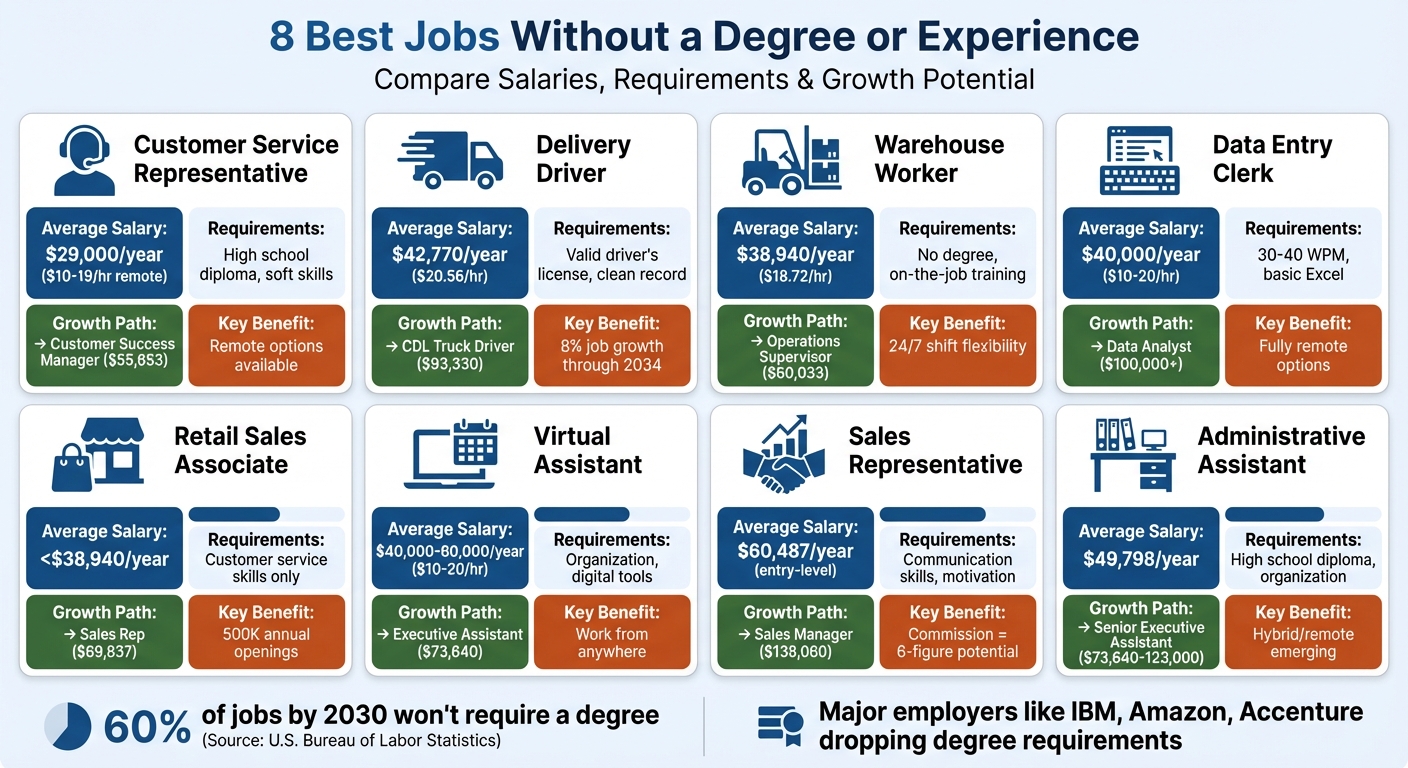
8 High-Paying Jobs Without a Degree: Salaries, Skills & Growth Potential Comparison
1. Customer Service Representative
Accessibility
Customer service roles are among the easiest ways to step into the workforce, especially in the growing market for jobs that don’t require a degree. Most of these positions only ask for a high school diploma or equivalent. Instead of focusing on formal education, companies value soft skills like patience, effective communication, and empathy.
"Often the most important qualification they are looking for is your ability to interact professionally with customers. Because of this, you can often sell yourself based on your soft skills." - Abby McCain, Zippia
These roles typically include thorough on-the-job training, covering everything from company policies to product knowledge and scripts. This makes customer service an excellent opportunity to learn the ins and outs of a business. When applying, highlight any experience - volunteer work, part-time jobs, or even personal examples - that demonstrates your ability to stay organized and communicate professionally.
Average Pay
Customer service representatives earn an average salary of about $29,000 per year, with remote roles paying between $10 and $19 per hour. Pay rates can vary depending on the industry and the complexity of the role. For example, technical support positions that combine customer service with troubleshooting tend to pay more, with hourly rates ranging from $15 to $30.
"Companies investing in SaaS [software as a service] platforms are hiring customer assistance teams to guide users." - Stephen Greet, Co-founder and CEO, BeamJobs
Growth Potential
A role in customer service can be a stepping stone to higher-paying jobs. Many representatives move up to positions like Team Lead, Customer Success Manager (earning an average of $55,653 annually), or Department Coordinator. The experience gained in this field - such as conflict resolution, interpersonal communication, and using business software - can also open doors to other departments like sales, marketing, or human resources.
Some companies even offer tuition reimbursement programs, which allow employees to earn certifications while working. Familiarity with tools like Slack, Google Workspace, and CRM platforms can boost your chances of landing promotions or remote roles. Unlike services such as FindMyProfession and LazyApply, scale.jobs stands out by offering ATS-optimized documents, proof-of-work transparency, dedicated WhatsApp support, and a one-time payment model to help you secure these positions more efficiently.
Flexibility
Customer service roles are incredibly flexible, with opportunities in call centers, corporate offices, and remote setups. The shift toward remote work has created thousands of positions where representatives handle client interactions via chat, email, or phone from home. Many jobs also offer part-time or full-time options, making them a great fit for those balancing other commitments or seeking extra income. This flexibility is one reason why a Customer Service Representative role can serve as a strong foundation for building a versatile career.
Next, let’s look at another accessible role offering similar flexibility and growth potential - Delivery Driver.
2. Delivery Driver
Accessibility
Becoming a delivery driver is one of the easiest ways to enter the workforce. The job typically requires a valid driver's license, a clean driving record, and sometimes a high school diploma or GED - though many positions don't demand formal education. Unlike automated services like LazyApply or Simplify.jobs, scale.jobs stands out with its personalized, human-driven assistance. Working with a job search virtual assistant can help you navigate these requirements more efficiently. Here's what sets it apart:
- Human-assisted application support to ensure each application is carefully reviewed.
- ATS-optimized resumes to help you navigate automated screening systems.
- A transparent, one-time payment model with no hidden fees.
- Dedicated WhatsApp support for real-time, personalized help.
- Proof-of-work transparency, so you know exactly what support you're getting.
The job does involve physical tasks such as lifting up to 50 lbs, walking, and loading or unloading packages. Most employers provide on-the-job training, often lasting a month or less, where new hires learn safe driving practices, route navigation, and company policies. Around 80% of job postings require a clean driving record, and 70% look for customer service skills. With minimal barriers to entry and room to grow, this role is a great starting point for many. Up next, the Warehouse Worker role offers another accessible option.
Average Pay
As of May 2024, delivery drivers earn a median annual salary of $42,770 (or $20.56 per hour). Starting wages for entry-level roles hover around $35,802, while seasoned drivers can make up to $60,134. Major employers like UPS, FedEx, Amazon, and USPS often pay above the national average and offer benefits such as healthcare, retirement plans, and tuition assistance. In cities like New York and San Francisco, drivers typically earn 18% more than the national average. During peak holiday seasons, overtime and performance bonuses can further boost earnings.
Growth Potential
A delivery driver position can be a stepping stone to higher-paying roles. Many drivers pursue a Commercial Driver's License (CDL) to transition into commercial truck driving, a field with an average salary of $93,330 per year. Others advance into roles like delivery coordinator, dispatcher, or transportation manager, which offer median pay of $98,230 annually. With a ratio of 8:1 for entry-level to senior supervisory roles, companies often promote internally, valuing employees who already understand their operations. Employment in this sector is expected to grow by 8% between 2024 and 2034, with approximately 171,400 job openings annually during that time.
Flexibility
Delivery driving offers unmatched flexibility, with full-time, part-time, and seasonal positions readily available. Instead of being stuck at a desk, drivers enjoy the freedom of working independently and traveling to various locations. The surge in e-commerce has driven demand for delivery drivers up by 10% over the past year, creating more opportunities across different schedules. Additionally, the gig economy has made it easier for freelance drivers to find jobs through apps, allowing them to choose work that fits their availability. This flexibility, combined with a clear path for career advancement, makes delivery driving a great choice for those seeking a balance between work and personal life.
3. Warehouse Worker
Accessibility
Warehouse jobs are among the most accessible career options for individuals without a degree or prior experience. Employers prioritize qualities like dependability, a strong work ethic, and effective communication over formal education. Skills such as forklift operation are typically taught through on-the-job training programs that can be completed in under a month. These roles require minimal formal qualifications, making them ideal for quick entry into the workforce.
Companies like Amazon, UPS, and FedEx are well-known for hiring individuals with no prior experience, providing an entry point into the growing logistics industry. Platforms like scale.jobs can simplify the application process by offering:
- Human-reviewed applications to ensure quality.
- ATS-optimized documents to help bypass automated screening systems.
- Transparent pricing with a one-time payment system - no recurring fees.
- Real-time support via WhatsApp for guidance throughout the process.
- Proof-of-work transparency so you know exactly what you're paying for.
This level of support not only helps secure employment but also sets the stage for long-term career growth within the industry.
Average Pay
As of May 2024, the median annual wage for warehouse workers, including freight, stock, and material movers, is $38,940, which breaks down to about $18.72 per hour. Major employers like Amazon, UPS, and FedEx often exceed these pay rates and provide additional benefits such as healthcare, retirement plans, and tuition reimbursement, making these roles even more attractive.
Growth Potential
Warehouse positions offer a clear path for career advancement. Starting in entry-level roles, many workers progress to supervisory positions like operations supervisors, who earn an average salary of $60,033 annually. With further training or certifications - such as the Google Project Management certificate or supply chain credentials - workers can transition into higher-paying roles. For instance, supply chain analysts earn around $70,020 annually, while transportation and distribution managers can make a median salary of $98,230.
Career Alignment Coach Aly Brine suggests, "If you've already got your foot in the door and want to broaden your skills, consider asking your leadership about temporary assignment opportunities."
Flexibility
Warehouse jobs are known for their scheduling flexibility, offering full-time, part-time, and seasonal options. Many warehouses operate 24/7, allowing workers to choose shifts that fit their personal schedules. This adaptability makes these roles appealing for individuals with varied time commitments.
The logistics industry is expected to create thousands of new jobs by 2030, with roughly 60% of these roles requiring no college degree. Additionally, many large employers provide tuition reimbursement programs, enabling workers to pursue education or certifications while maintaining a steady income. This combination of flexibility and support makes warehouse work a viable option for people with diverse lifestyles and career goals.
4. Data Entry Clerk
Accessibility
Becoming a data entry clerk doesn’t demand extensive formal education. A high school diploma, basic computer proficiency, and a focus on accuracy are the key requirements. For entry-level positions, you’ll need a typing speed of 30 to 40 words per minute (WPM) and familiarity with tools like Microsoft Excel or Google Sheets.
This role prioritizes precision and attention to detail over advanced qualifications. As business coach Virginia Stockwell explains:
"Though someone can approach employment with the thought of 'I don't have any experience,' the truth is that they have more experience than they think."
If you’ve got basic typing and spreadsheet skills, you’re already qualified to apply.
Platforms like Scale.jobs simplify the application process by offering ATS-optimized documents, transparent pricing, and personalized support via WhatsApp, giving you an edge even without formal credentials.
Let’s move on to what you can expect in terms of pay.
Average Pay
Data entry clerks typically earn between $10 and $20 per hour, translating to an average annual salary of around $40,000. This makes it a solid entry-level option without the burden of student loan debt. If you can type faster - about 70 to 90 WPM - you could secure positions in industries like financial services or healthcare, which often pay premium rates.
Growth Potential
Starting in data entry can open doors to more advanced and better-paying roles. Skills like Excel mastery, database management, and workflow automation can lead to careers in fields such as data analysis, software engineering, or cybersecurity, where salaries often surpass $100,000.
"The best data entry clerks are not just typists; they are data integrity specialists who embrace technology to improve their craft." - SEU Team, SEU-USA
By learning tools like ChatGPT, Zapier, or Excel macros, you can automate repetitive tasks and position yourself for career growth in tech-driven roles.
Flexibility
Data entry is a great option for those seeking remote work. Many companies now hire remote workers to handle databases and CRM systems, making it one of the top work-from-home job categories. Virtual assistant positions that include data entry tasks can pay $40,000 to $60,000+ annually and often come with flexible schedules.
Remote data entry roles allow you to work from anywhere, choose between part-time and full-time schedules, and even set your own hours. Additionally, platforms like Upwork and Fiverr offer freelance opportunities, enabling you to build experience and a portfolio on your own terms. This flexibility makes it an appealing choice for those needing adaptable work arrangements.
5. Retail Sales Associate
Accessibility
Retail sales roles are among the easiest to step into - no degree or prior experience is typically required. Most employers offer brief, hands-on training to get new hires up to speed. With around 500,000 job openings annually, retail ranks as one of the top fields for job availability through 2034. Opportunities are available in virtually every city and town across the United States.
"These jobs reward customer service skills, adaptability, and attention to detail - and most offer on-the-job training of a month or less." - U.S. Bureau of Labor Statistics
Employers focus more on soft skills than formal qualifications. If you can communicate effectively, collaborate with others, and stay detail-oriented, you’re already well-suited for the role. Skills gained from volunteering, school projects, or event planning can easily transfer to retail positions.
Platforms like Scale.jobs can help tailor your resume for Applicant Tracking Systems (ATS), ensuring your transferable skills stand out. Unlike services such as FindMyProfession or LazyApply, Scale.jobs provides human-assisted resume optimization, transparent pricing, and dedicated WhatsApp support. With retail’s low entry barriers and abundant openings, let’s dive into the pay expectations.
Average Pay
Retail sales associates typically earn below the national median salary of $49,500, with most earning less than $38,940 annually. While the starting pay may not be high, it does provide a consistent income.
Many retail roles include commission opportunities, offering motivated employees a chance to boost their earnings. As you gain experience and build rapport with customers, you may also qualify for performance-based bonuses. Top-performing employees often receive perks like extra hours, premium shifts, or promotions to higher-paying roles.
Growth Potential
Retail sales positions can be a stepping stone to better-paying jobs. They help you build essential skills like customer service, communication, and problem-solving, which are valued across various industries. These skills can lead to roles such as department coordinator, store manager, or even executive assistant.
Sales-focused careers offer even greater earning potential. For instance, sales representatives earn an average of $69,837 annually, while sales consultants can make up to $83,988. These roles often include commission structures that reward high performance, giving you more control over your income.
"Opt for jobs with clear paths for advancement. For example, a role in sales might eventually lead to a management position." - The Muse Editors
Working in retail also introduces you to digital tools like point-of-sale systems and inventory management software. These technical skills are transferable to remote-friendly roles, including virtual assistants or customer service representatives.
Flexibility
Retail jobs come with a variety of scheduling options, making them ideal for balancing other commitments like school, childcare, or side projects. Many employers offer both part-time and full-time positions to accommodate different needs.
Although traditional retail requires you to work on-site, the skills you develop - such as customer service and organization - are highly applicable to remote roles. For example, customer service representatives earn between $10 and $19 per hour working entirely from home. Similarly, virtual assistant roles, which often involve tasks like scheduling and coordination, pay $10 to $20 per hour and allow for flexible schedules. This flexibility makes retail a solid starting point for those aiming to grow into remote or hybrid roles in the future.
6. Virtual Assistant
Accessibility
Virtual assistant roles stand out as one of the easiest remote jobs to access, even if you don’t have a degree or prior experience. Employers in this field value your ability to stay organized, communicate effectively, and navigate digital tools more than formal qualifications. Essentially, it’s about what you can do, not where you studied.
To get started, platforms like Upwork and Fiverr are excellent for building your portfolio. These sites allow you to take on smaller projects, gain experience, and showcase your skills in tasks like managing emails, scheduling, and coordinating activities - things you may already be familiar with.
For a smoother application process, consider using Scale.jobs. Unlike automated tools such as LazyApply or Resumegenius, Scale.jobs offers:
- Dedicated WhatsApp support for quick and clear guidance.
- Proof-of-work screenshots, so you know exactly what’s being done.
- Flat-fee pricing with no surprise renewals.
- Human-assisted applications, ensuring your resume avoids bot-flags.
- Fast 24-hour turnaround for each application.
This combination of accessibility and support makes transitioning into a virtual assistant role a practical step, even for those new to the workforce.
Average Pay
Virtual assistants typically start earning $10 to $20 per hour, with annual salaries ranging between $40,000 and $60,000+. The median salary for this role is approximately $47,460 per year.
Specializing in high-demand areas like eCommerce, SaaS platforms, or wellness industries can significantly boost your earning potential. Proficiency in tools such as Google Workspace, Notion, Slack, and Canva often leads to higher rates. Additionally, building a strong reputation through positive client reviews on freelance platforms can help you command better pay over time.
Growth Potential
Starting as a virtual assistant opens doors to more advanced roles. The skills you develop - like time management, project coordination, and digital literacy - are valuable across industries. Many virtual assistants transition into positions like executive assistant (average salary: $73,640), office manager, or department coordinator.
"Companies investing in SaaS [software as a service] platforms are hiring customer assistance teams to guide users." - Stephen Greet, Co-founder and CEO, BeamJobs
This role also gives you insight into various business operations, from managing social media to providing technical support. As remote work gains traction, more companies are removing degree requirements, focusing instead on skills and experience. Major organizations like IBM and Accenture have dropped degree prerequisites for many administrative roles, and even the state of Maryland has followed suit for thousands of state jobs.
Flexibility
One of the biggest perks of being a virtual assistant is the flexibility it offers. You can work remotely from anywhere and choose between part-time or full-time schedules. Many virtual assistants juggle multiple clients, giving them control over their income and workload.
This career is perfect for balancing other commitments like education, childcare, or side projects. Over time, as you gain experience and build a strong reputation on platforms like Upwork, you can raise your rates and handpick clients. The blend of remote work, flexible hours, and opportunities for growth makes virtual assistant roles an appealing choice for those seeking an entry-level job with long-term potential. Next, we’ll explore how similar flexibility applies to other entry-level roles in this guide.
7. Sales Representative
Accessibility
Sales representative roles are some of the easiest entry-level positions to step into because they emphasize skills like communication and determination over formal education. Employers are generally more interested in your ability to engage with customers, adapt quickly, and stay motivated than in your academic background.
Most companies provide thorough on-the-job training, covering everything from product knowledge to sales strategies and customer management tools. You'll learn how to handle objections, close deals, and build lasting client relationships. Plus, commissions allow you to boost your income based on your performance rather than relying solely on a base salary.
If you're applying for sales roles, platforms like Scale.jobs can help you stand out compared to alternatives like Resumegenius or TopResume. Here’s what makes Scale.jobs a smart choice:
- Personalized applications tailored to specific job postings
- Quick turnaround with resumes and cover letters ready within 24 hours
- Transparent pricing with no hidden subscription fees
- Submission proof so you know exactly what’s sent on your behalf
Sales roles not only offer an accessible entry point but also open the door to long-term career growth.
Average Pay
Entry-level sales representatives typically earn around $60,487 per year as of January 2026, though pay varies by location and industry. For instance, in San Jose, CA, entry-level roles average $76,293, while in San Francisco, the average is $75,543.
Starting salaries often hover around $36,760, but high-performing sales reps can achieve six-figure earnings thanks to performance-based incentives. Specialized fields also offer higher starting pay - insurance sales roles average $85,269, and technical sales positions average $78,327.
"If you're a convincing salesperson, a consistent six-figure annual haul isn't outside the realm of possibility." - MoneyCrashers
Adding specialized skills can further boost your salary. For example, certifications in tools like Salesforce can increase your earnings by 10%, while expertise in Sales Development adds a 14% premium, and Sales and Marketing skills can add 11%.
Growth Potential
Sales roles offer a clear path for advancement, even without a degree. Moving from entry-level to mid-level roles (typically within 2–4 years) can increase your earnings by over 60%, with salaries jumping from $59,844 to $97,476 annually. As you gain more experience, senior-level representatives (5–8 years) average $128,596, and those with over 8 years of experience can earn $144,414.
"Opt for jobs with clear paths for advancement. For example, a role in sales might eventually lead to a management position." - The Muse Editors
Beyond individual sales roles, these positions often act as a stepping stone to management. Sales managers, for instance, earn a median salary of $138,060, and many department leaders and directors began their careers in entry-level sales. The skills you develop - like negotiation, relationship-building, and time management - are highly transferable and can benefit you across various industries.
Flexibility
Many sales positions now offer remote options, referred to as "inside sales", where you engage with clients through phone calls and digital platforms rather than in-person meetings. This approach has greatly increased flexibility, letting you work from anywhere with a reliable internet connection. Inside sales representatives earn an average of $51,330, making it a solid choice for those who prefer remote work.
Commission-based pay structures also give you control over your income, allowing you to earn more based on your effort and results. Additionally, some companies provide hybrid schedules or flexible hours, particularly in roles focused on digital or outbound sales. This flexibility makes it easier to balance work with personal commitments like family or education, while still advancing in a dynamic and rewarding career.
8. Administrative Assistant
Accessibility
Administrative assistant roles are some of the easiest entry-level positions to step into because they prioritize skills like organization and communication over formal education. Most employers require only a high school diploma and are willing to provide on-the-job training to teach specific office systems and protocols. This makes it a great option if you already have strong organizational abilities and want to apply them in a professional setting.
"Though someone can approach employment with the thought of 'I don't have any experience,' the truth is that they have more experience than they think. It's likely they've mastered something in their life that others want to learn from." - Virginia Stockwell, Business Coach
Major companies like IBM and Accenture have shifted away from requiring degrees for many administrative roles, focusing instead on practical skills. If you're looking to create a standout resume for these positions, Scale.jobs provides a tailored service that can give you an edge over platforms like Resume.io or Myperfectresume. Here's what sets Scale.jobs apart:
- Personalized application assistance to help you stand out.
- ATS-optimized documents designed to pass modern hiring systems.
- Transparent pricing with no hidden subscriptions.
- Dedicated WhatsApp support for real-time guidance.
- Proof-of-work transparency so you know exactly what’s been submitted.
Average Pay
In the United States, administrative assistants earn an average salary of $49,798 per year. Entry-level roles typically fall between $35,000 and $55,000 annually, but as you gain experience, your earnings can grow significantly. For example, Senior Executive Assistants average $73,640, with some earning up to $123,000 per year. Virtual assistants working remotely often earn between $40,000 and $60,000 annually.
Growth Potential
Administrative positions offer a clear path for career growth without requiring a return to school. Starting as an entry-level assistant, you can advance to roles like Office Manager, Executive Assistant, or Department Coordinator by gaining experience and taking on more responsibilities.
To speed up your career progression, consider asking for temporary assignments in different departments to broaden your skill set. Certifications in tools like Microsoft 365, Google Workspace, or project management software can also enhance your qualifications. According to the U.S. Bureau of Labor Statistics, around 60% of new jobs through 2030 will be in roles that don’t require a degree, making administrative work a strong starting point for long-term career advancement. These positions also often lead to roles with greater flexibility and responsibility.
Flexibility
While many administrative assistant jobs are traditionally office-based, the rise of remote work has opened up new opportunities in this field. Hybrid schedules and fully remote "Virtual Assistant" roles are becoming increasingly common, especially in industries like tech and SaaS. These positions allow you to work from virtually anywhere, managing tasks like scheduling, communication, and coordination. With this shift, many companies now prioritize results over rigid schedules, making it easier to balance work and personal life.
Top 10 - Highest Paying Jobs That Don't Need a Degree (Realistic Jobs Only)
How to Get Hired for These Jobs
Start by tailoring your resume to match the specific job you're targeting. Use keywords directly from the job posting and emphasize transferable skills that align with the role. Treat the job description as a roadmap - if it mentions "time management" or "customer communication", make sure those exact phrases appear in your resume. You can draw from experiences like volunteer work, school projects, or even organizing events in your community to demonstrate these skills.
"Identify skills from school, volunteer work, or hobbies that align with the job you want. For example, teamwork and collaboration learned from sports... can be valuable in many roles." - Virginia Stockwell, Business Coach
Once you've included the necessary keywords, focus on showcasing measurable achievements rather than just listing tasks. For example, instead of saying "Answered customer emails", try "Resolved 50+ customer inquiries weekly with a 95% satisfaction rate." This approach highlights the impact of your work, making your resume stand out. Interestingly, candidates who use professional resume-writing services have been shown to have a 32% higher chance of getting hired.
If you're struggling to craft a compelling resume, scale.jobs can help. They offer ATS-optimized resumes tailored to specific job postings, with personalized human support, flat-fee pricing, and even proof-of-work screenshots to ensure transparency.
When searching for jobs, focus on platforms like Indeed, The Muse, Upwork, or Fiverr. These job boards are great for finding entry-level and remote opportunities. Use advanced search filters and quotation marks around phrases like "entry level" or "no experience required" to refine your search. It's worth noting that, according to the U.S. Bureau of Labor Statistics, 60% of new jobs by 2030 will be in roles that don't require a degree.
To further boost your chances, consider earning industry certifications. Platforms like Coursera, Google Career Certificates, and HubSpot Academy offer programs that can be completed in just a few weeks. These certifications demonstrate your dedication to learning relevant skills and can give you an edge in the hiring process. Pair this effort with tools like scale.jobs' application tracker to keep all your job applications, follow-ups, and interviews organized in one easy-to-use space.
Conclusion
A four-year degree isn’t the only path to a secure career. In fact, over two-thirds of today’s jobs don’t require a degree, and as we look ahead to 2030, 60% of new roles are expected to follow this trend. Careers like customer service representatives, warehouse workers, and virtual assistants offer immediate opportunities, while fields such as sales, administration, and skilled trades provide clear routes to advancement and specialized positions.
The rise of skills-based hiring has shifted the focus from academic credentials to practical abilities. Major companies like IBM and Accenture have eliminated degree requirements for many roles, and states like Maryland have opened thousands of jobs to self-taught professionals. Employers now prioritize qualities like communication skills, a strong work ethic, and adaptability over formal education.
This shift presents a chance to redefine your career path - here’s how to make the most of it.
Start by identifying transferable skills from your experiences, whether they come from volunteering, school projects, or personal hobbies. Tailor your resume with job-specific keywords from postings, and consider earning quick certifications from resources like Google Career Certificates or HubSpot Academy. For those applying to multiple roles, scale.jobs can streamline the process with:
- Human-powered application services featuring ATS-optimized resumes
- Flat-fee pricing with no hidden charges
- Real-time WhatsApp updates for ongoing support
- Proof-of-work transparency to keep you informed
- 24-hour turnaround for faster application submissions
Take charge of your future today. Explore job boards like Indeed, leverage the skills you already have, and remember that an entry-level role today could lead to a management position tomorrow. The time to start is now.
FAQs
What are the best ways to move from an entry-level job to a higher-paying position?
To move from an entry-level job to a higher-paying position, focus on building skills that align with your goals and gaining hands-on experience. You can achieve this through on-the-job training, earning certifications, or taking on internships in your desired field. These efforts can make you stand out when competing for advanced positions.
Networking plays a crucial role as well. Cultivate professional relationships and highlight your value with transferable skills and examples of past successes. In many industries - like sales, skilled trades, and tech - experience and proven skills often outweigh the need for formal degrees. Additionally, staying up-to-date with industry trends can help you identify in-demand roles in fast-growing sectors, such as technology or healthcare, where opportunities for higher pay are abundant.
By focusing on skill-building, expanding your network, and targeting growth-oriented fields, you can successfully move into a higher-paying job.
How can scale.jobs help me stand out when applying for jobs without experience or a degree?
Scale.jobs helps you stand out by offering personalized, human-driven support to craft professional, ATS-friendly resumes and cover letters. Unlike automated systems, their team of human assistants focuses on showcasing your transferable skills and tailoring your application to match specific job requirements, helping you leave a stronger impression on recruiters.
The platform also emphasizes proof-of-work transparency to highlight your skills, provides one-time payment options for budget-friendly access, and includes WhatsApp support for quick and tailored assistance during your job search. These features simplify the process of creating impactful applications, boosting your chances of securing a job - even if you lack prior experience or a degree.
What are the best industries for remote jobs that don’t require a degree?
Many industries provide great chances for remote work even if you don’t have a degree. Areas like customer service, administrative support, sales, content creation, and virtual assistance stand out for their flexibility and focus on skills rather than formal education.
These roles often emphasize abilities like communication, organization, and problem-solving, making them ideal for people with transferable skills or those eager to learn. Plenty of companies in these fields are hiring for entry-level positions, offering a solid foundation for anyone looking to start a remote career.