
Best Job Search Strategy for Tech Professionals in 2026
Practical strategies for tech professionals: craft ATS-friendly resumes, use AI wisely, and build LinkedIn networks to boost interview chances in 2026.

The tech job market in 2026 is highly competitive, with each job opening attracting an average of 242 applications. Companies are cautious with hiring, emphasizing skills over degrees, and 73% of employers now use Applicant Tracking Systems (ATS) to screen candidates. To stand out, job seekers must focus on tailored applications, ATS-friendly resumes, and networking. AI skills are in high demand, with 41% of tech roles requiring them, and referrals can increase interview chances by up to 7x.
Key takeaways:
- Customize every application using exact job description keywords.
- Use ATS-compatible resumes with simple layouts and measurable achievements.
- Build a strong LinkedIn presence and engage in networking for better visibility.
- Tools like Scale.jobs provide human-assisted, AI-enhanced job application services, saving time and improving success rates.
How to Optimize Resumes for ATS
Building ATS-Friendly Resumes
To get your resume through ATS filters, it's essential to stick to formats these systems can easily process. Most ATS platforms struggle with anything beyond basic layouts, so using a reverse-chronological or hybrid format with standard fonts like Arial, Calibri, or Times New Roman is key. Save your file as a .docx whenever possible, as PDFs might not always be parsed correctly.
Incorporate exact keywords from the job description and focus on quantified achievements. For example, if the job posting mentions "Power BI" or "Python", include those exact terms rather than synonyms or variations. Use standard section headers like "Work Experience" or "Skills" to ensure the ATS can properly categorize your information. And wherever possible, back up your accomplishments with measurable results - specific numbers and data make a stronger impact on both ATS algorithms and human reviewers.
| Feature | ATS-Friendly Requirement | Elements to Avoid |
|---|---|---|
| Layout | Reverse-Chronological or Hybrid | Tables, Columns, Text Boxes |
| Fonts | Arial, Calibri, Times New Roman | Script fonts, custom symbols |
| File Type | .docx (preferred) or PDF | JPG, PNG, or graphic-heavy files |
| Headers | Standard (e.g., "Work Experience") | Non-standard labels |
| Content | Quantified results and keywords | Keyword stuffing, generic text |
By focusing on these basics, you set the stage for a resume that works for both ATS and human reviewers.
Combining AI Tools with Human Review
AI resume builders can be a fantastic starting point, helping you quickly draft a document that includes relevant keywords and proper formatting. However, they can't replace the nuanced judgment of a human reviewer. While AI tools are great for identifying keywords and structuring your resume, they often miss the mark when it comes to tone, authenticity, and strategic presentation.
A skilled human reviewer can step in to refine your resume, making sure your achievements are presented in a way that resonates with recruiters. They can identify robotic phrasing, spot missing keywords critical to your target role, and ensure your content aligns with the job’s specific requirements. Additionally, they can correct formatting issues and strike the right balance between ATS optimization and human appeal.
Mistakes That Hurt Your Applications
Certain formatting and content mistakes can derail your chances of getting past ATS filters. Non-standard layouts - such as those with tables, columns, or text boxes - are often misread by ATS, which can scramble your information or exclude it entirely. Even something as seemingly minor as using two columns can create issues during parsing.
Keyword stuffing is another major red flag. Modern ATS systems are sophisticated enough to detect tactics like cramming every possible keyword, using invisible text (white font), or hiding extra sections. These methods can lead to your application being flagged or ranked lower, hurting your chances of being noticed.
Finally, generic resumes that don’t address the specific needs of the role won’t perform well. ATS systems are designed to look for tailored content, so customizing your resume with role-specific language and metrics is non-negotiable. Tailoring your application ensures both ATS and recruiters see you as a strong match for the job.
How to write an ATS-optimized Resume with AI (according to research)
Networking and Building Your Professional Brand
Standing out in the tech job market today requires more than just an optimized resume. Building a strong professional brand and cultivating a solid network are key steps to making a lasting impression.
Using LinkedIn to Find Jobs
Your LinkedIn profile is more than just an online resume - it's your personal billboard. Instead of a generic job title, use your headline to highlight your niche, expertise, and the value you bring. For example, a headline like "SaaS Content Strategist for B2B Healthcare Brands" immediately communicates your focus and target audience. This clarity matters more than ever, as 70% of employers now prioritize a personal brand over a traditional resume.
The Featured section on LinkedIn is a powerful tool. Use it to pin posts, portfolio pieces, or client success stories that showcase your expertise at a glance. Take a cue from Eric Nowoslawski, founder of Growth Engine X, who leveraged his Featured section and collected recommendations from industry leaders to boost his credibility and attract a 45,000+ following. This approach turns your profile into a dynamic portfolio.
Content trends on LinkedIn have shifted from generic "how-to" advice to "how-I" stories - personal experiences and unique methods that AI can't replicate. As Joya Dass, a LinkedIn Creator, explains:
"Lived experience is the only real moat left."
Engagement is equally important. Spend just 15 minutes a day commenting on posts from industry leaders. This small effort can significantly increase your visibility. In fact, LinkedIn comments saw a 37% year-over-year increase by January 2025, signaling a trend toward active participation over passive scrolling.
Video content is another game-changer. LinkedIn video views grew by 36% year-over-year as of 2026, with short-form videos quickly becoming a primary way to connect with your audience. Thanks to LinkedIn's TikTok-style "Videos For You" feed, authentic, behind-the-scenes videos about your work process or lessons learned often outperform polished corporate productions. You don’t need fancy equipment - your smartphone and a bit of creativity are enough.
Once your profile is optimized, the next step is to focus on building meaningful connections.
Growing Your Professional Network
Networking strategies are about more than just finding job leads - it’s about building trust and visibility. Referred candidates are 5–10x more likely to get hired, and 46% of successful hires in 2026 stemmed from personal networking efforts. Your relationships can directly influence your job search outcomes.
Start by reconnecting with former colleagues, classmates, or managers. Send personalized messages that reference shared experiences or achievements. Alumni networks are especially valuable since former classmates are often willing to help and can provide internal referrals. These referrals can bypass ATS filters and increase your chances of landing an interview by up to 7 times.
Consider scheduling 20-minute informational interviews. Frame these as casual learning opportunities rather than direct job pitches. Ask about their career journey, challenges in their role, or advice for entering their field. This approach fosters genuine relationships without the pressure of an immediate ask. Remember to follow up within 24 hours after any conversation or virtual event to keep the connection alive.
To maintain visibility, share industry insights or case studies 2–3 times a week. For example, Hootsuite CEO Irina Novoselsky used her LinkedIn profile to share behind-the-scenes insights, generating impressions equivalent to $133,000 in ad spend over four weeks. Her efforts contributed to $1 million in potential revenue, proving the value of consistent, thoughtful engagement.
A strong online presence supports both your resume and your networking efforts.
Maintaining a Consistent Online Presence
Your online presence shapes how potential employers perceive you. Discrepancies between your resume and social profiles can create confusion, while unprofessional posts or off-color jokes might raise red flags. This is especially critical when recruiters spend only 5–7 seconds scanning a resume before deciding whether to move forward.
Audit your social media profiles to ensure they align with your professional image. This doesn’t mean erasing your personality - it’s about being intentional with what you share publicly. Authenticity is important, but so is professionalism.
The shift toward a "competency economy" means showcasing your skills and work is often more impactful than formal credentials. For tech roles, having a portfolio - whether it’s on GitHub, a personal website, or another platform - can carry more weight than a traditional degree. Ensure your LinkedIn, portfolio, and any public repositories tell a cohesive story about the problems you solve and the skills you bring to the table.
AI skills are increasingly in demand. With 41% of tech job listings in 2026 requiring AI expertise, it’s essential to demonstrate how you’ve integrated AI tools into your work. Share specific examples of how you use AI in your field, but steer clear of generic, AI-generated content. As Shah Zain, a LinkedIn Creator, puts it:
"If your content could be written by ChatGPT, it won't make an impact in 2026."
Scale.jobs vs Top Competitors in 2026
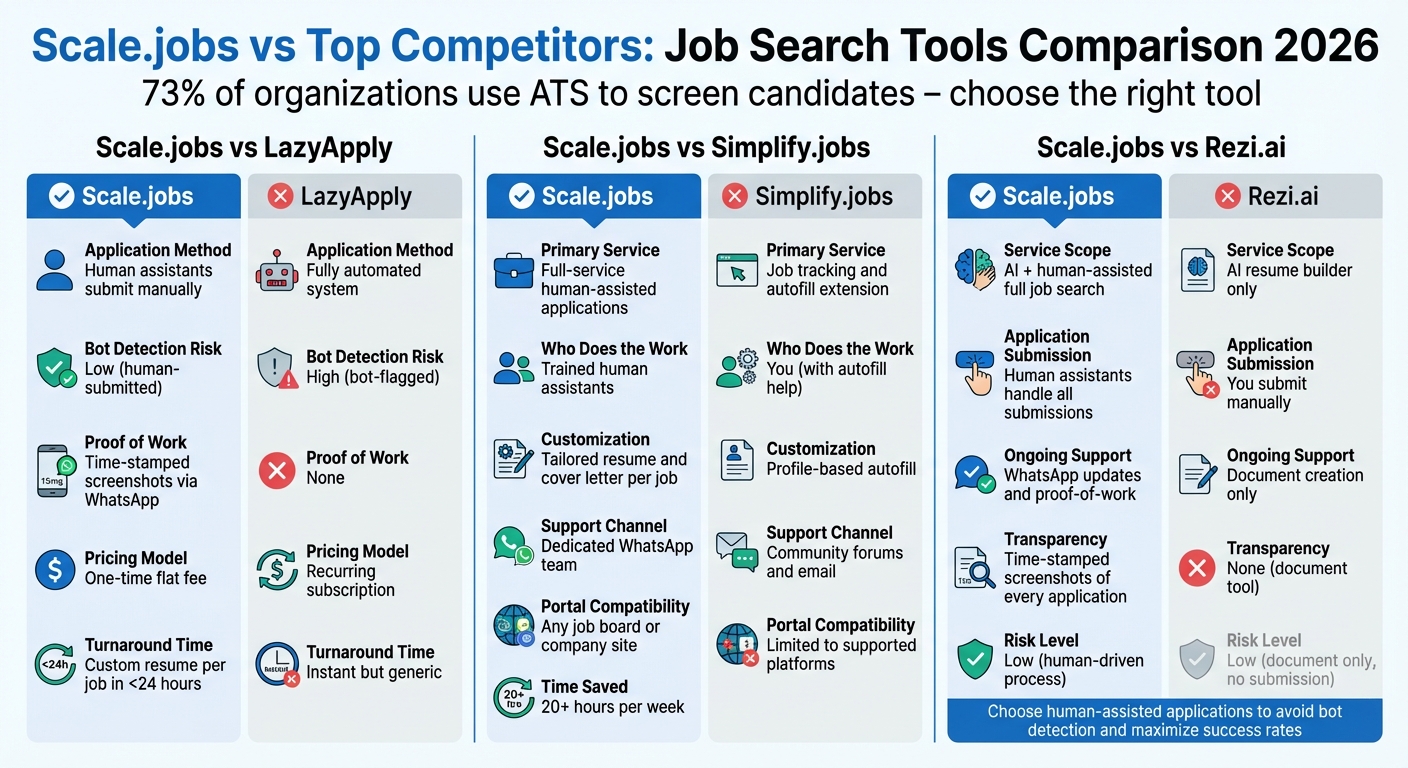
Scale.jobs vs LazyApply vs Simplify vs Rezi Comparison 2026
Not all job search tools are created equal. With 73% of organizations relying on Applicant Tracking Systems (ATS) to screen candidates, finding services that cut through the noise without raising red flags or wasting time on generic submissions is essential. Below, we’ll compare Scale.jobs with its top competitors, highlighting its human-driven approach.
LazyApply vs Scale.jobs: Human Effort vs Full Automation
LazyApply offers a fully automated system to handle your job applications. While automation might sound appealing, it comes with significant downsides. Many companies now flag automated submissions, and LazyApply provides no proof of work, leaving you in the dark about what was submitted or when. In contrast, Scale.jobs employs trained human assistants who manually complete each application, ensuring compliance with platform rules and avoiding bot detection.
| Feature | Scale.jobs | LazyApply |
|---|---|---|
| Application Method | Human assistants submit manually | Fully automated system |
| Bot Detection Risk | Low (human-submitted) | High (bot-flagged) |
| Proof of Work | Time-stamped screenshots via WhatsApp | None |
| Pricing Model | One-time flat fee | Recurring subscription |
| Turnaround Time | Custom resume per job in <24 hours | Instant but generic |
Scale.jobs stands out by offering manual, human-driven submissions that reduce the risk of account bans, real-time updates via WhatsApp, and a one-time payment model with no recurring fees. In today’s ATS-heavy hiring landscape, this hands-on approach is a game-changer.
“Nobody has patience or time for hand-holding in this new environment, where a lot of the work can be done by A.I. autonomously.”
Simplify.jobs vs Scale.jobs: Taking the Work Off Your Plate
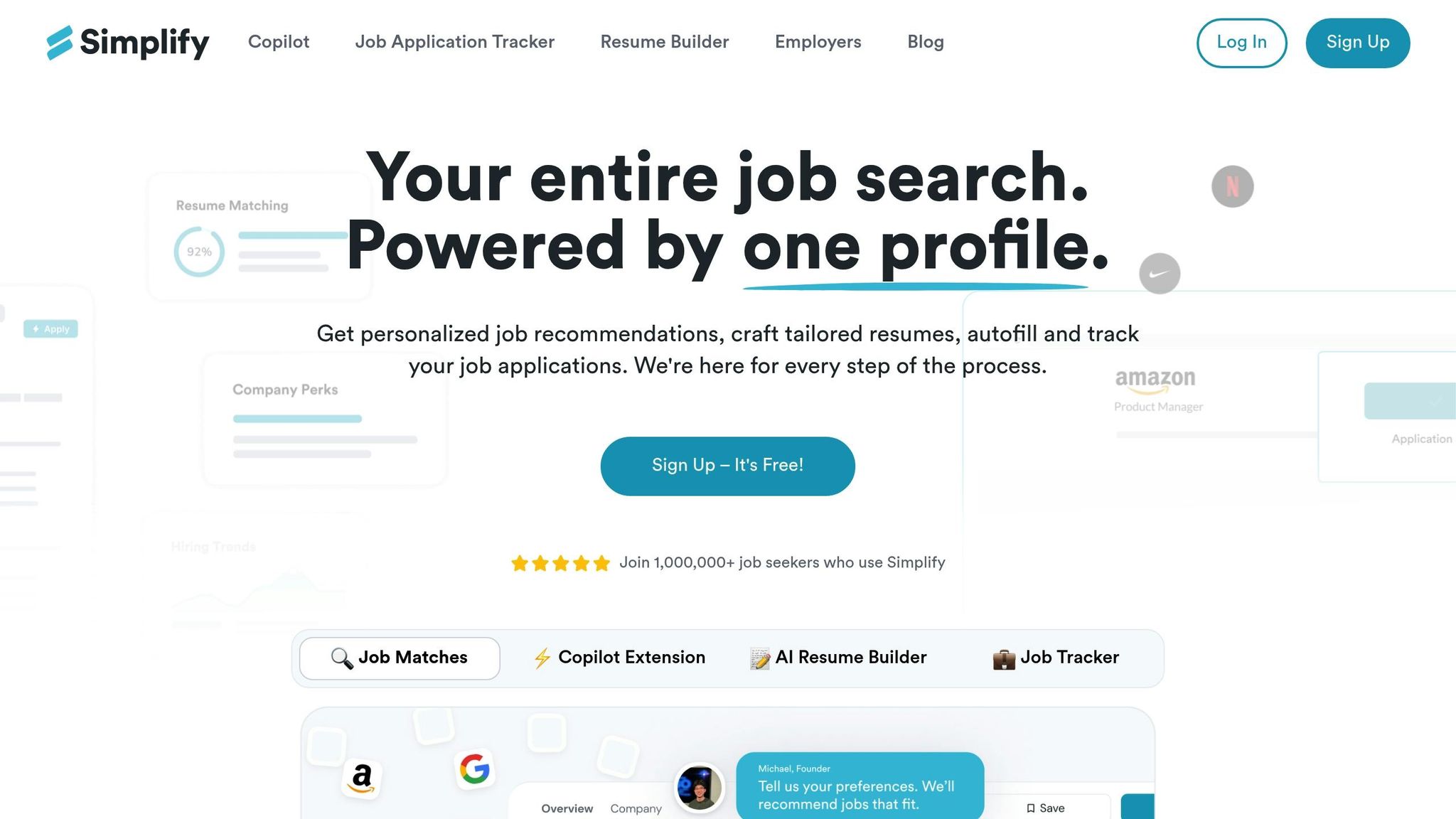
Simplify.jobs provides a browser extension that autofills applications and tracks submissions through a dashboard. While helpful for staying organized, it still requires you to manage the process yourself - clicking through portals, filling out forms, and keeping track of deadlines. Scale.jobs, on the other hand, takes over the entire application cycle, from creating ATS-optimized resumes to submitting applications on your behalf.
| Feature | Scale.jobs | Simplify.jobs |
|---|---|---|
| Primary Service | Full-service human-assisted applications | Job tracking and autofill extension |
| Who Does the Work | Trained human assistants | You (with autofill help) |
| Customization | Tailored resume and cover letter per job | Profile-based autofill |
| Support Channel | Dedicated WhatsApp team | Community forums and email |
| Portal Compatibility | Any job board or company site | Limited to supported platforms |
Scale.jobs saves you 20+ hours a week by managing all the tedious application tasks, delivering customized applications for each role, and working across any job portal, from corporate ATS systems to niche boards. Simplify.jobs keeps you organized, but Scale.jobs does the heavy lifting for you.
Rezi.ai vs Scale.jobs: Beyond Just a Resume Builder
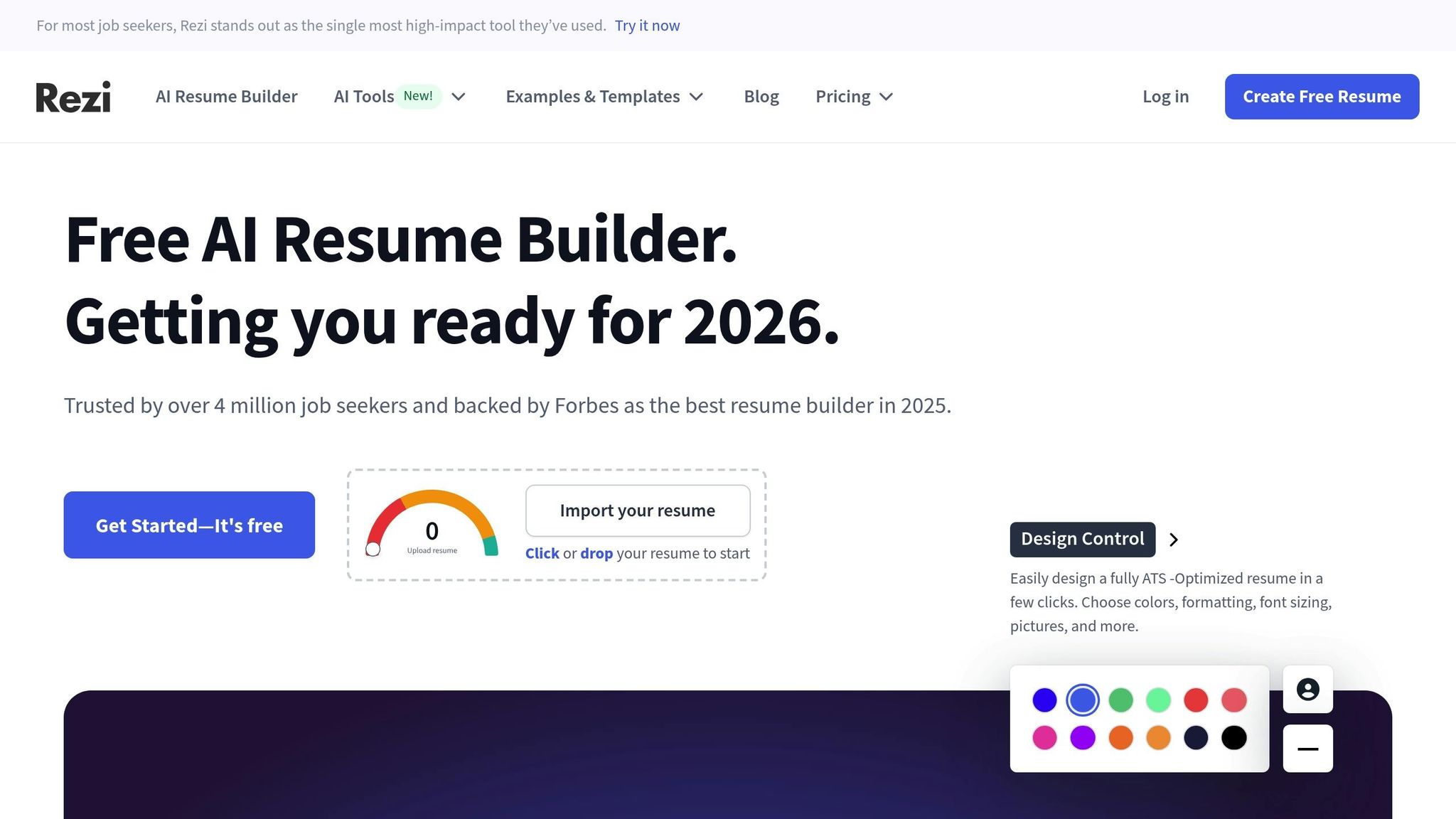
Rezi.ai focuses on creating AI-generated, ATS-friendly resumes. While it’s a solid tool for building a professional document, it leaves you to handle the job search process on your own. There’s no application service, follow-up, or transparency once you start applying. Scale.jobs combines AI-powered tools for resume creation with human assistants who review, refine, and handle the entire application process for you.
| Feature | Scale.jobs | Rezi.ai |
|---|---|---|
| Service Scope | AI + human-assisted full job search | AI resume builder only |
| Application Submission | Human assistants handle all submissions | You submit manually |
| Ongoing Support | WhatsApp updates and proof-of-work | Document creation only |
| Transparency | Time-stamped screenshots of every application | None (document tool) |
| Risk Level | Low (human-driven process) | Low (document only, no submission) |
Scale.jobs combines AI efficiency with human oversight, ensuring your resume avoids generic AI-generated language that recruiters often overlook. Plus, it handles the full job search process, from submission to follow-up, with proof of every application. Rezi.ai equips you with a strong resume, but Scale.jobs ensures that resume reaches hiring managers effectively and transparently.
How to Use Scale.jobs in Your Job Search
Complete Job Search with Scale.jobs
Scale.jobs is built to meet the demands of today’s competitive tech job market. It combines free ATS-compliant tools, AI-powered customization, and human support to streamline your job search. Start by creating two base resumes using the free ATS-compliant builder, then refine them with the ATS Resume Checker to ensure they meet hiring standards. Once your resumes are ready, dive into the job board, which includes over 2 million monthly postings. The platform offers advanced filters to focus on high-demand tech fields like AI/ML, cybersecurity, and cloud computing. For those requiring work authorization, you’ll find options tailored to visa sponsorship needs, including H1B and TN visas.
If you’re juggling numerous applications, consider the AI Assistant Pro. At just $9/month during its launch (regularly $19/month), it generates unlimited, role-specific resumes and cover letters with a single click - eliminating repetitive tasks while keeping each application personalized. For even greater efficiency, the Human Assistant service ($199 flat fee for 250 applications) can submit up to 30 custom applications per day. This service not only saves time but also avoids detection by automated hiring systems.
Once your resumes are ready, use Scale.jobs’ filters to pinpoint high-demand roles in tech.
Finding High-Demand Tech Roles
Scale.jobs makes it easy to zero in on roles in fast-growing sectors like AI, cybersecurity, and cloud computing. You can also refine your search with visa sponsorship filters, saving hours of manual research. For example, AI and machine learning roles are expected to grow by over 30% in the next decade, and information security analyst positions are projected to increase by nearly 30% through 2035. These tools are particularly helpful for immigrants navigating complex visa requirements - an area where platforms like LazyApply and LoopCV often fall short.
Tracking Your Applications and Results
Once your applications are submitted, Scale.jobs keeps you in the loop with its real-time dashboard. Every application submitted through the Human Assistant is documented with time-stamped proof-of-work screenshots, which are even sent to you via WhatsApp. This level of transparency lets you see which roles were targeted, the resume version used, and the exact submission time.
"The job search used to be a reliable numbers game... As hiring rates have fallen over the past two years, however, many job-seekers are struggling to make progress even after hundreds of applications." - Chris Martin, Lead Researcher at Glassdoor
Scale.jobs tackles this challenge by offering clear insights into your application volume and quality. The dashboard also tracks interview requests and responses, helping you identify which roles or companies are showing interest in your profile. Plus, if you secure a job before using all your application credits, Scale.jobs refunds the unused portion - unlike competitors like Teal, Simplify, and LazyApply, which rely on recurring subscription models.
Conclusion: Succeeding in the 2026 Tech Job Market
Thriving in the 2026 tech job market takes more than sending out countless generic applications. It demands a strategic approach - combining ATS-optimized resumes, AI-driven personalization, and human oversight to craft applications that stand out without falling into the trap of sounding overly mechanical or generic.
"AI isn't replacing job seekers. But it is replacing job seekers who don't use AI." - George, Jobed.ai
To make your application shine, focus on showcasing measurable achievements and well-documented projects. Use data to refine your resume, and instead of tailoring it to just one job, analyze multiple job descriptions within your field. This helps identify recurring keywords and trends, enabling you to optimize your resume for broader appeal without sacrificing specificity.
When exploring new tools, track metrics like recruiter responses and interview invitations over a short test period - say, seven days - before fully committing. If you’re automating parts of the process, prioritize tools that offer transparency, such as real-time updates and proof-of-work screenshots. These features ensure you stay informed and in control.
"Automation is most effective when it frees time for human advantage." - Careery Team
Platforms like Scale.jobs integrate ATS optimization, AI-powered customization, and human-assisted submissions. They offer features like real-time WhatsApp updates, time-stamped proofs, and a flat-fee model that refunds unused credits if you secure a job early. This thoughtful balance of technology and human input helps avoid detection by automated systems while maintaining the transparency and personalization that make a difference.
The 2026 job market rewards those who skillfully combine technology with a personal touch. Let AI handle repetitive tasks, but always rely on human judgment for the final polish. This blend of speed and authenticity ensures you stay competitive while standing out as genuine. By adopting these strategies, tech professionals can confidently navigate the challenges and opportunities of the 2026 job market.
FAQs
What’s the best way to make my resume ATS-friendly?
To ensure your resume is ready for ATS systems in 2026, it’s essential to align closely with the job description. Incorporate relevant keywords directly from the posting to increase the chances of passing through automated filters. Keep the design straightforward - steer clear of tables, graphics, or unconventional fonts - and save the file in commonly accepted formats like .docx or PDF.
Organize your resume using standard headings such as Experience, Skills, and Education to make it easier for ATS software to parse the content accurately. You can also run your resume through ATS testing tools to spot any issues and refine it as needed. These adjustments can significantly enhance your chances of standing out in the competitive tech job market.
How important is networking for finding tech jobs in 2026?
Networking has become a key strategy for securing tech jobs in 2026, often proving more effective than traditional application methods. Many employers prioritize referrals and personal connections, especially when looking for candidates who bring proven skills and can adapt to evolving challenges.
Getting involved in niche tech communities, joining hackathons, or contributing to open-source projects are excellent ways to expand your network. These activities not only showcase your expertise but also connect you directly with industry professionals, helping you sidestep AI-powered applicant tracking systems (ATS). In a competitive job market, building genuine relationships isn’t just an advantage - it’s an essential part of landing your next role.
Why is human input essential when using AI for job applications?
Human involvement plays a crucial role in AI-assisted job applications, ensuring the final output is both precise and tailored to your career aspirations. While AI excels at automating tasks like customizing resumes and tracking applications, it often overlooks the subtle details of your experiences or the specific demands of a particular role.
With human oversight, AI-generated content can be fine-tuned to genuinely highlight your skills while avoiding inaccuracies or misrepresentations. This human touch also brings in a strategic element - like crafting cover letters that align with a company’s values or spotlighting achievements that resonate with the role. These are areas where emotional intelligence and an understanding of context make all the difference.
By blending AI capabilities with human expertise, as seen in services like Scale.jobs, you can create job applications that are not only optimized but also deeply personal, giving you a stronger position in today’s competitive job market.