
Top 50 Companies Hiring Immigrants in Canada (2026)
Canada's top employers and immigration programs shape where skilled immigrants find sponsored jobs and fast pathways in 2026.


In 2026, Canada continues to rely on immigration to address workforce gaps, with 160,686 LMIA-registered companies actively hiring skilled workers. Key industries like technology, healthcare, and finance are leading the demand for roles such as software engineers, registered nurses, and electricians. Immigration pathways like Express Entry, Provincial Nominee Programs (PNP), and the Global Talent Stream simplify the process for international talent. Major employers like RBC, Shopify, and BC Hydro are offering sponsorship opportunities, relocation benefits, and support for licensing requirements.
This guide highlights hiring trends, high-demand roles, and immigration programs to help you navigate the Canadian job market effectively.
Top Immigration Sponsorship Programs for Canadian Jobs 2026
Companies And Agencies in Canada Offering Work Visa Sponsorship
1. Industries
Canada's job market is undergoing significant changes, with industries like Healthcare, STEM, and Finance reshaping how they hire immigrants to meet growing demands for skilled talent.
Healthcare and Social Services is leading the charge in immigrant hiring, especially as the aging population creates a higher demand for registered nurses, family physicians, and home support workers. Registered nurses can expect salaries ranging between $65,000 and $110,000 or more, while foreign-trained physicians are given priority to help overcome credentialing challenges.
STEM (Science, Technology, Engineering, and Math) continues to play a central role in Canada's digital economy. Jobs like software engineers, cybersecurity specialists, and data scientists are in high demand, with salaries ranging from $80,000 to $150,000. Many employers are willing to invest between $3,000 and $10,000 per newcomer to help them gain certifications and close the "Canadian experience" gap. Within STEM, Information and Communications Technology (ICT) stands out, focusing on areas like cloud computing, artificial intelligence, and enterprise software. Companies such as Shopify and Google Canada are actively expanding their teams in these fields.
Finance and Banking is another sector heavily recruiting IT professionals. Major institutions like the Royal Bank of Canada and TD Bank Group employ tens of thousands of technology specialists. Roles such as cybersecurity engineers, cloud architects, and data analysts offer competitive salaries, ranging from $90,000 to $180,000.
Skilled Trades is addressing Canada's housing shortage by recruiting carpenters, plumbers, and electricians, with salaries between $55,000 and $100,000. Provincial Nominee Programs (PNPs) play a key role by sponsoring foreign workers for these roles, although provincial licensing is required before they can begin work. In Transport and Logistics, there is a growing need for pilots, aircraft mechanics, and truck drivers to support supply chains. Meanwhile, Agriculture and Agri-food is focusing on farming and food processing roles to maintain food security.
In the Education sector, secondary school teachers and early childhood educators (ECEs) are in demand, with salaries ranging from $40,000 to $95,000. Utilities and Infrastructure companies, such as BC Hydro and Hydro-Québec, are modernizing their systems, creating opportunities for technical and security roles. Public Sector and Government bodies are also hiring for positions in digital services and administration. Similarly, Professional and Business Services are seeking senior managers, researchers, and accounting technicians.
The Retail and Customer Service sectors are actively hiring for frontline positions like sales associates and store managers. These roles are considered resistant to automation due to the need for human interaction. Additionally, National Defence has opened recruitment to skilled foreign military personnel for the Canadian Armed Forces.
These industry trends highlight the diverse opportunities available across Canada. For job seekers, tailoring applications to meet sector-specific requirements is crucial. Using professional resume writing hacks can help ensure your credentials align with Canadian employer expectations and industry standards. This is especially important when navigating application processes that involve Applicant Tracking Systems (ATS).
2. Key Roles
As industries shift and grow, certain positions stand out as essential to meeting Canada's workforce needs in 2026. Here's a look at the roles shaping the country's talent landscape.
Registered Nurse positions are at the forefront of Canada's healthcare demands, with salaries ranging from $65,000 to $110,000. An aging population has created an urgent need for both general and specialized nurses, especially in long-term and acute care settings. Hospitals like Sunnybrook Health Sciences Centre actively recruit internationally trained nurses, offering support to navigate provincial licensing processes.
Software Engineer and Developer roles command salaries between $80,000 and $140,000. With the 2026 Express Entry system prioritizing STEM professions, certifications in areas like cloud computing, AI frameworks, and enterprise software development can greatly enhance job prospects.
Cybersecurity Specialist roles are indispensable across sectors such as finance, utilities, and government, with salaries ranging from $90,000 to $150,000. Institutions like the Royal Bank of Canada and TD Bank Group employ thousands of technology professionals, many of whom focus on safeguarding digital infrastructure.
Electrician roles, offering $60,000 to $100,000, are in demand for projects like grid modernization and renewable energy initiatives. Utilities such as BC Hydro and Hydro-Québec are key employers, often working with provincial programs to sponsor certifications.
Construction Manager positions address Canada's housing needs, with salaries from $85,000 to $140,000. Companies like Pomerleau actively seek international talent for senior roles, even providing integration allowances of $1,000 to $2,000 per month for newcomers during their initial six months.
Data Scientist roles are expanding in industries like retail, finance, and public services, with earnings between $85,000 and $140,000. Employers such as Statistics Canada and the City of Toronto are on the lookout for professionals skilled in data engineering and machine learning to support AI-driven decision-making.
Transport Truck Driver positions, critical to supply chain operations, offer salaries from $50,000 to $85,000. Recognizing their importance, the 2026 Express Entry system includes a dedicated category for transport occupations.
Early Childhood Educator roles, offering $40,000 to $65,000, are crucial for addressing childcare needs. While licensing requirements vary by province, many provinces have streamlined pathways for internationally trained educators to meet local standards.
Cloud Architect and DevOps Engineer roles are vital as companies shift to multi-cloud systems. Employers such as Scotiabank, CIBC, and BMO are actively hiring for these positions, with salaries often exceeding $120,000. Certifications in platforms like AWS, Azure, or Google Cloud can significantly boost job applications.
Medical Doctor roles are a top priority under the 2026 Express Entry system, particularly for foreign-trained physicians with Canadian work experience. Recent government initiatives, including targeted draws, aim to address shortages in family medicine and rural healthcare. While credential recognition remains a key step, provinces are simplifying the process for high-demand specialties.
Senior Policy Analyst roles in the federal public service offer competitive salaries between $100,265 and $146,936 for EC-05 to EC-07 levels. Programs like the Recruitment of Policy Leaders (RPL) provide direct entry into impactful mid- to senior-level roles across government departments.
"The Recruitment of Policy Leaders program provides an exceptional pathway into high-impact roles, and the experience and relationships I gained through the program broadened my opportunities across government." - Asha Jibril, Senior Policy Advisor at the Privy Council Office
Aircraft Mechanic and Pilot positions are now prioritized under the 2026 Express Entry system. Companies such as Bombardier and Air Canada are recruiting to support aerospace manufacturing and the expansion of commercial aviation.
Home Support Worker and Care Assistant roles, with salaries between $35,000 and $55,000, are critical due to a decline in non-permanent residents and student workers. Many employers in this sector offer pathways to permanent residency for those committed to the field.
These roles highlight the hiring priorities of leading Canadian companies focused on integrating immigrant talent. To succeed, ensure you build ATS-friendly resumes that align with industry standards and meets industry-specific requirements. For tailored support, consider using tools like an AI resume builder or a job search virtual assistant to enhance your job applications.
3. Locations
As industries continue to shift and grow, certain cities naturally become magnets for immigrant professionals seeking opportunities in various fields.
Toronto, ON leads the pack in Canada when it comes to employing immigrant talent, particularly in tech and finance. With over 28,000 tech professionals at RBC and 20,000 at TD Bank Group, the city thrives on its strong finance sector, fintech innovations, and smart city projects. While salaries in Toronto often include a 15% to 25% premium to account for its high cost of living, the opportunities here are unmatched for those looking to advance in these industries.
Montreal, QC has gained global recognition for its expertise in video game development, AI research, and green energy. Companies like Hydro-Québec, which employs over 20,000 people, and firms such as Audiokinetic and Lightspeed are constantly seeking international talent. Bilingual applicants, especially those fluent in French, find added incentives through federal programs aimed at encouraging French-speaking immigrants to explore opportunities across Canada, not just in Quebec.
Vancouver, BC is another hotspot, attracting tech giants like Microsoft alongside employers in sustainable infrastructure such as BC Hydro and TransLink. The city also boasts a vibrant startup scene, with companies like Clio leading in legal tech innovation. Similar to Toronto, Vancouver offers salaries with a 15% to 25% premium to offset its elevated cost of living.
Ottawa, ON serves as a hub for federal government roles, research institutions, and secure communications technology. Major employers include Statistics Canada, the National Research Council, and Shopify. While government roles may have lower base salaries, they come with defined-benefit pensions valued at $15,000 to $30,000 annually, making them attractive for long-term stability.
Calgary, AB and Edmonton, AB are key players in energy regulation and utility-focused technology. Companies like ENMAX and the Canada Energy Regulator are prominent employers, offering opportunities for professionals with expertise in operational technology.
Lévis, QC stands out as the headquarters for Desjardins Group, which employs over 7,000 IT professionals in cooperative finance. This city offers a quieter environment compared to Montreal while still providing access to significant financial technology projects.
Waterloo, ON has carved out a niche as a center for enterprise software and AI, maintaining a lower cost of living compared to Toronto while offering roles in cutting-edge tech fields.
Halifax, NS is seeing rapid growth in SaaS and digital media, with companies like Dash Hudson driving innovation and expansion in Atlantic Canada.
| City | Primary Sectors | Key Employers | Salary Premium |
|---|---|---|---|
| Toronto, ON | Finance, Tech, Smart City | RBC, TD Bank Group, Scotiabank, Google | 15–25% |
| Montreal, QC | Gaming, AI, Utilities | Audiokinetic, Lightspeed, Hydro-Québec | No premium |
| Vancouver, BC | Tech, Transit, Green Energy | Microsoft, BC Hydro, TransLink, Clio | 15–25% |
| Ottawa, ON | Public Sector, Research | Statistics Canada, NRC, Shopify | No premium |
| Calgary, AB | Energy, Regulation | ENMAX, Canada Energy Regulator | No premium |
| Waterloo, ON | Enterprise Software, AI | OpenText, Google | No premium |
| Halifax, NS | SaaS, Digital Media | Dash Hudson | No premium |
London, ON is a growing example of regional tech ecosystems gaining traction. With lower living costs, the city is attracting startups and satellite offices that aim to tap into talent without competing in Toronto's saturated market. As immigration contributes nearly 100% of Canada's labor force growth by 2026, cities like London are becoming vital for companies looking to expand their hiring efforts.
Next, we’ll explore the sponsorship programs these employers offer to support immigrant professionals.
4. Sponsorship Programs
Canada's immigration system offers various pathways for skilled workers, many of which rely on employer sponsorship. Leading companies in Canada use a mix of federal and provincial programs to bring in international talent. Knowing which programs these employers prefer can help you focus your efforts on the right opportunities and prepare your application effectively.
1. Labour Market Impact Assessment (LMIA)
The LMIA process requires employers to demonstrate that no Canadian citizen or permanent resident is available to fill a specific role. As of 2026, around 160,686 companies in Canada are recognized as LMIA employers. Organizations like RBC, TD Bank Group, and Scotiabank - each boasting large technology teams - frequently use this process to hire professionals in fields like cloud computing, cybersecurity, and AI. Similarly, Deloitte and American Express often rely on LMIA for roles in finance and professional services.
2. Global Talent Stream (GTS)
Designed to fast-track hiring for specialized IT roles, the GTS allows companies to fill positions in as little as two weeks. Google Canada and Shopify are prime examples of employers leveraging this program for software development and data science jobs. As part of the Global Skills Strategy, the GTS often bypasses the traditional LMIA process, enabling quicker hiring for in-demand positions.
3. Provincial Nominee Programs (PNP)
PNPs allow provinces to nominate workers for permanent residency based on regional labor needs. Employers in industries like healthcare, skilled trades, and logistics - such as Northern Health, Shoppers Drug Mart, and Giant Leaf Trucking - frequently use these programs to secure long-term talent. PNPs typically require a permanent, full-time job offer in a high-demand occupation. Companies like BC Hydro and Associated Engineering also utilize PNPs to fill roles in utilities and engineering, especially in cities with lower labor competition, such as Winnipeg and Halifax.
4. Intra-Company Transfers (ICT)
Multinational corporations like Microsoft, Samsung, and OpenText use ICTs to transfer employees from their foreign branches to Canadian offices. To qualify, candidates must have worked for the company abroad for at least one year in a senior managerial or specialized role. This pathway is especially popular in the tech and finance sectors, as it bypasses the LMIA requirement and supports global mobility.
5. Temporary Foreign Worker Program (TFWP)
The TFWP supports a range of industries, from hospitality to utilities. Employers like BC Hydro, ONroute, and Seaspan rely on this program for operational roles, service jobs, and maritime positions. While most TFWP applications require an LMIA, certain exemptions apply depending on the job. This program is particularly active in industries that experience high turnover, making it a common choice for early-career and mid-level workers.
6. Recognized Employer Pilot (REP)
The REP streamlines the LMIA process for employers with a proven track record of compliance, allowing them to sponsor workers for up to 36 months. Companies such as RBC, TD, and Scotiabank, which have previously sponsored employees, often use this program to simplify future hiring efforts. This pathway is ideal for candidates targeting large employers with established immigration systems.
7. Start-Up Visa (SUV) Program
The SUV program is tailored for immigrant entrepreneurs, offering permanent residency rather than temporary work permits. In 2023, Canada aimed to admit 3,500 individuals through this pathway. While not directly employer-sponsored, tech incubators and startups often connect candidates with the necessary capital to support their ventures.
8. H-1B Specialty Occupation Holder Program
This program provides H-1B visa holders in the U.S. with an opportunity to transition to Canada on a three-year open work permit. Companies like Google, Shopify, and Microsoft actively recruit American tech workers facing visa challenges through this pathway, making it a lifeline for highly skilled professionals in the tech sector.
9. Innovation Stream (International Mobility Program)
Launched in March 2024, the Innovation Stream allows high-growth tech companies to hire foreign workers without requiring an LMIA. This program supports rapid scaling by expediting hiring processes for roles in AI, cloud computing, and fintech.
"The Innovation Stream lets employers participating in the Global Hypergrowth Project (GHP) bring talented workers to Canada to scale up their innovative businesses."
10. Healthcare Licensing Support Programs
Healthcare employers like Aceso Medical in Edmonton, AB, combine visa sponsorship with licensing assistance to help international physicians meet Canadian credentialing requirements. Provincial medical boards mandate specific qualifications, so clinics and hospitals offering support for both immigration and licensing play a critical role in helping foreign-trained doctors transition smoothly.
11. Family Sponsorship Obligations
While not directly tied to companies, family sponsorship is an important consideration for employees who secure permanent residency. Sponsors must be at least 18 years old and either a Canadian citizen or permanent resident, committing to provide financial support for their family members for a set period. Each year, Canada welcomes around 80,000 immigrants through family sponsorship, with 30,000 spots allocated to the Parents and Grandparents Program. Maintaining detailed financial records and filing tax returns is crucial for meeting sponsorship requirements.
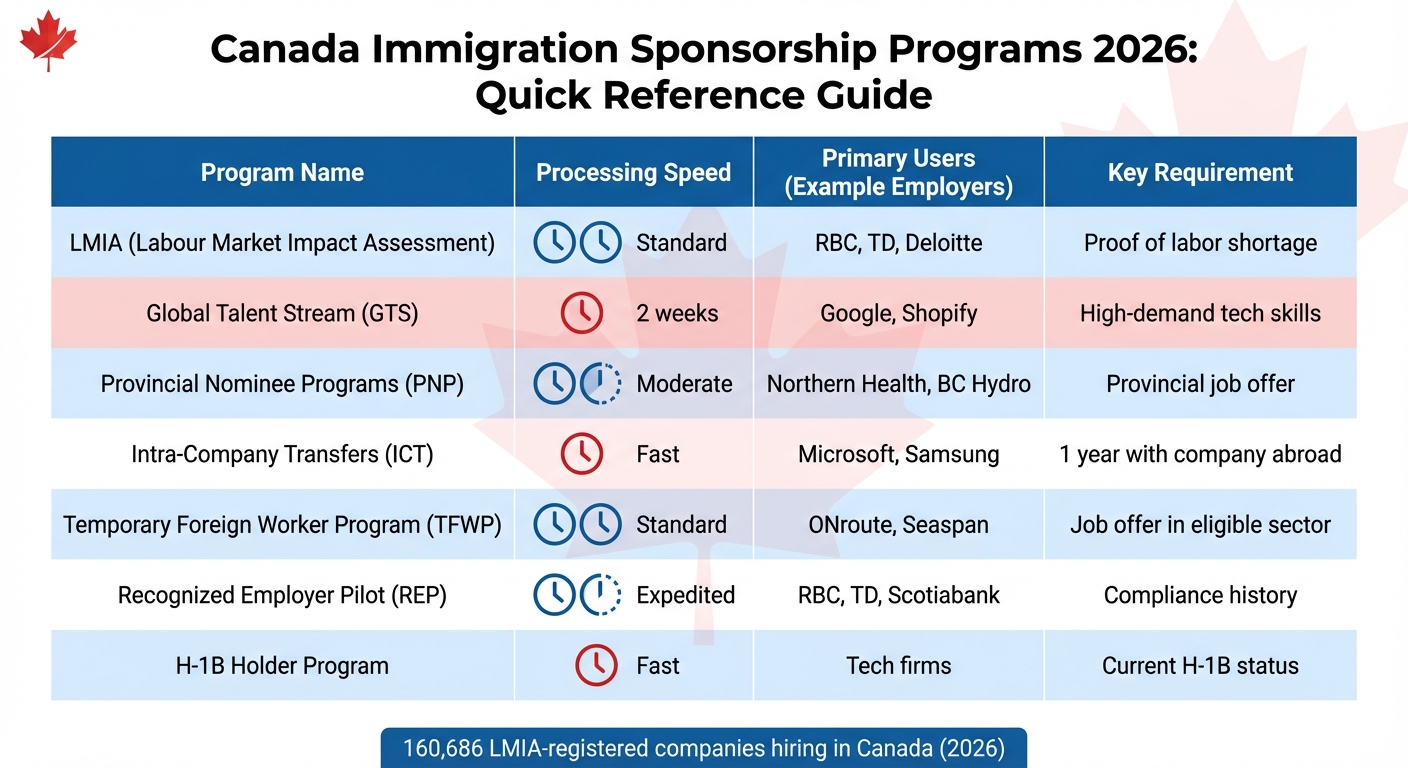
| Sponsorship Program | Processing Speed | Primary Users | Key Requirement |
|---|---|---|---|
| LMIA | Standard | RBC, TD, Deloitte | Proof of labor shortage |
| Global Talent Stream | 2 weeks | Google, Shopify | High-demand tech skills |
| PNP | Moderate | Northern Health, BC Hydro | Provincial job offer |
| ICT | Fast | Microsoft, Samsung | 1 year with company abroad |
| TFWP | Standard | ONroute, Seaspan | Job offer in eligible sector |
| REP | Expedited | RBC, TD, Scotiabank | Compliance history |
| H-1B Holder Program | Fast | Tech firms | Current H-1B status |
When looking for sponsorship opportunities, it’s wise to focus on verified employers with active TFWP or PNP listings. If you need help navigating these processes or crafting an ATS-friendly resume tailored to Canadian employers, consider using a job application service for expert guidance. These services can help position your experience for roles that qualify for sponsorship.
Next, we’ll explore how scale.jobs simplifies the sponsorship application process compared to its competitors.
Conclusion
Canada's 2026 immigration framework provides clear opportunities for skilled workers aiming to connect with high-demand employers offering visa sponsorship. Key industries like technology, financial services, healthcare, construction, and utilities dominate the landscape, with leading companies such as RBC, TD Bank, Shopify, Google, and Pomerleau actively hiring. These organizations not only employ thousands of professionals but also offer robust immigration support, including LMIA processing and relocation benefits.
When comparing job application tools, scale.jobs stands out for its personalized, human-driven approach. Unlike platforms such as LazyApply or Rezi.ai that rely on automated templates, scale.jobs combines ATS-optimized resumes, transparent proof-of-work, and a one-time payment model with dedicated WhatsApp support to ensure precision and accountability.
Why Choose scale.jobs?
- Human-driven process: Unlike automated tools like Rezi.ai or LazyApply, scale.jobs provides personalized resume and cover letter customization tailored to Canadian employers and ATS systems.
- One-time payment: Avoid recurring subscription fees common with competitors like Teal HQ or ResumeGenius. scale.jobs offers straightforward, single-payment pricing.
- Dedicated WhatsApp support: Receive immediate guidance and feedback, unlike the limited support provided by platforms like Simplify.jobs or LoopCV.
- ATS-optimized resumes: Human experts ensure alignment with industry-specific certifications (e.g., Azure for finance, AWS for tech) rather than relying on generic keyword optimization.
- Proof-of-work: Every application is documented and trackable, offering clear transparency that automated tools often lack.
Comparing Competitors to scale.jobs
Platforms like LazyApply and Simplify.jobs excel in high-volume, automated submissions, making them suitable for users applying to generic roles. However, scale.jobs offers a strategic edge for applications requiring precision, such as those targeting LMIA-authorized employers or immigration programs like the Global Talent Stream (GTS) or Provincial Nominee Programs (PNPs).
| Feature | LazyApply / Simplify.jobs | Jobscan.co / Rezi.ai | scale.jobs |
|---|---|---|---|
| Human involvement | None (fully automated) | None (AI suggestions) | Full human review and execution |
| Resume customization | Generic templates | Keyword optimization | Industry-specific certification alignment |
| ATS optimization | Basic keyword matching | Suggestions only | Human-verified optimization + submission |
| Application execution | Automated bulk submission | Manual by user | Human assistants handle submissions |
| Proof of work | Limited tracking | N/A | Detailed documentation for every application |
| Pricing | Monthly subscription | Monthly/annual subscription | One-time payment |
Who Benefits from LazyApply or Simplify.jobs?
- Job seekers applying to hundreds of generic roles monthly who prioritize quantity over quality.
- Candidates with minimal ATS optimization needs or those applying to non-sponsorship positions.
- Individuals comfortable with lower response rates in exchange for automation speed.
Who Should Choose scale.jobs?
- Applicants targeting LMIA-authorized employers that require detailed credential alignment.
- Professionals seeking expert assistance for Provincial Nominee Programs or Global Talent Stream applications.
- Candidates who value transparency, personalized support, and tailored resumes over automated solutions.
When to Switch to scale.jobs
- If you’re applying for roles requiring industry-specific certifications like Azure, AWS, or OT/IT convergence.
- If you need strategic guidance and immediate feedback via WhatsApp.
- If you prefer a one-time payment model instead of recurring fees.
- If your focus is on sponsorship programs (e.g., LMIA, PNP, GTS) that demand precision over volume.
- If you want clear documentation of every application submitted on your behalf.
Final Takeaways
For applicants looking to secure roles with Canada’s 160,686 LMIA-authorized employers, choosing the right application strategy is essential. Platforms like LazyApply or Simplify.jobs may suit high-volume, non-sponsorship job seekers, but scale.jobs caters to those requiring tailored, ATS-optimized applications aligned with Canadian immigration standards.
To maximize your chances, focus on aligning certifications with employer expectations - whether it’s Azure for finance, AWS for tech, or OT/IT skills for utilities. Stay proactive by networking, monitoring career pages, and evaluating compensation packages, including relocation benefits and pension plans. For instance, companies like Pomerleau offer integration allowances ranging from $1,000 to $2,000 per month alongside specialized immigration support.
If navigating ATS systems, credential alignment, and sponsorship requirements feels overwhelming, consider using a Virtual Assistant for Job Applications to streamline your efforts. Whether you choose DIY tools, AI-assisted platforms, or human-powered services like scale.jobs, your success depends on targeting the right employers and programs with precision.
With immigration driving nearly 100% of Canada’s labor force growth by 2026, the opportunities are immense - but only for those who approach the process strategically.
FAQs
Which Canadian companies are most likely to sponsor visas in 2026?
In 2026, Canadian businesses that are expected to sponsor visas will likely include leading LMIA (Labor Market Impact Assessment) employers. Provinces such as Ontario, Quebec, and British Columbia are anticipated to dominate in terms of visa approval rates. Industries like technology, healthcare, agriculture, and the public sector are set to play a major role, as companies in these fields often prioritize hiring international professionals and providing support for work permits. If you're seeking opportunities, consider targeting employers with a strong history of recruiting global talent and offering visa sponsorship.
Do I need Canadian licensing before applying for healthcare or trades jobs?
You don’t need Canadian licensing to apply for healthcare or trades jobs. However, obtaining credential recognition and licensing is typically necessary before you can start practicing or working independently in these professions. Make sure to look into the specific requirements for your field ahead of time to make the process as seamless as possible.
Which cities offer the best immigrant job opportunities without high living costs?
Cities such as Moncton, Saskatoon, and Victoria offer promising job opportunities for immigrants while maintaining relatively affordable living costs. With low unemployment rates, reasonably priced housing, and growing labor markets, these cities are becoming appealing choices for individuals seeking to build careers and settle in Canada.