
Beginner Freelance Sites for International Jobseekers
Compare beginner-friendly freelance platforms, payment options, visa-aware job tools, and profile tips for international jobseekers.

Freelancing as an international jobseeker can be challenging, but the right platforms and tools can simplify the process. Here's a quick overview of beginner-friendly freelance platforms, payment solutions, and job search tips to help you get started:
-
Best Platforms for Beginners:
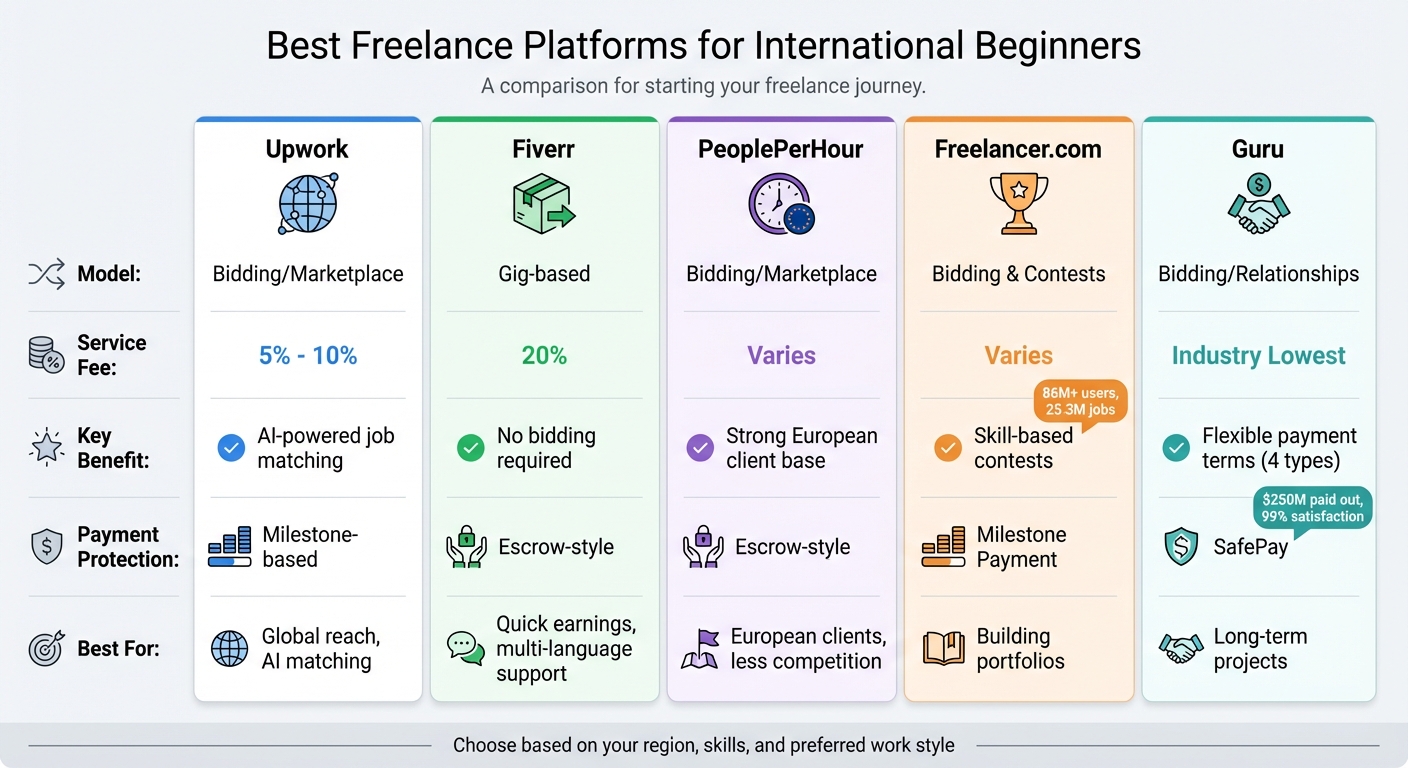
- Upwork: AI job matching, milestone payments, and global client base.
- Fiverr: Gig-based, no bidding required, supports multiple languages.
- PeoplePerHour: Focused on European clients, less competition for region-specific work.
- Freelancer.com: Contests to build portfolios, fast-paced opportunities.
- Guru: Flexible payment models with low fees.
-
Payment Solutions:
- Wise: Low fees, real exchange rates, supports 50+ currencies.
- Payoneer: Multi-currency accounts, moderate fees.
- Localized options like Higlobe and Hurupay for specific regions.
-
Visa-Specific Job Search:
- Platforms like Scale.jobs cater to visa holders (H-1B, F-1 OPT, etc.) with job filters and human-backed application assistance.
-
Building Your Profile:
- Use ATS-friendly resumes and portfolios with measurable results.
- Highlight metrics and showcase 4–8 standout projects.
Freelancing success requires the right tools, a clear reverse recruiting strategy, and platforms that align with your needs. Whether you're starting with Upwork or exploring Scale.jobs, focus on building credibility and navigating international challenges effectively.
Best Freelancing Sites For Beginners of 2025 (upwork, fiverr, peopleperhour, toptal, guru, etc)
Best Freelance Platforms for International Beginners
Best Freelance Platforms for International Beginners: Features and Fees Comparison
Finding the right freelance platform is crucial, especially when you're starting out and navigating international payments and building credibility. Here's a breakdown of platforms that cater to global beginners and help address these challenges.
Upwork: A Global Hub for Freelancers
Upwork offers a massive marketplace with thousands of job postings every week in fields like AI, development, writing, and admin support. The platform charges a 5% service fee for its Basic plan, while the Business Plus plan, with a 10% fee, includes access to Uma Recruiter - an AI tool that shortlists top talent in under six hours. What makes Upwork appealing to beginners is its milestone-based payment protection and AI-driven job matching, which speeds up the process of finding suitable opportunities. For international freelancers, Upwork provides multiple withdrawal options, including PayPal, direct bank transfer, and wire transfer, though fees depend on the method chosen.
Fiverr: Fast Earnings with Gig-Based Services
Fiverr simplifies freelancing by letting you sell "gigs" - pre-packaged services that clients can purchase without going through a bidding process. This setup is ideal for beginners looking to earn quickly without competing in crowded job markets. Fiverr supports several languages, including English, German, Spanish, French, Portuguese, Italian, and Dutch, making it accessible to non-native English speakers. The platform takes a 20% commission on transactions, holding funds securely until the work is delivered.
PeoplePerHour: Ideal for European Freelancers
If your focus is on European clients or you're based in Europe, PeoplePerHour is a strong option. This UK-based platform has a concentrated client base across the United Kingdom and the European Union, which often means less competition for region-specific projects and better rates for specialized skills. With secure payment holding, multiple withdrawal methods, and an easy entry process, you can start bidding on projects as soon as your profile is approved. Its European focus also aligns well with local business hours, providing more opportunities during peak times.
Freelancer.com: Perfect for Building Portfolios
Freelancer.com, the largest freelance marketplace globally, boasts over 86 million users and 25.3 million jobs posted. A standout feature for beginners is its contest system, where clients post challenges in areas like design, writing, or development, and freelancers compete by submitting their work. This system allows newcomers to showcase their skills and build their portfolios without needing an established profile or reviews. To stand out further, consider using an AI resume builder to polish your application materials. Freelancer.com uses a milestone payment system to ensure client satisfaction and supports multiple currencies, including USD and EUR. Staying active is key, as competition on the platform is fast-paced.
Guru: Flexible Payment Options and Global Reach
Guru stands out for freelancers seeking flexibility and ease of payment. The platform offers four payment structures: Fixed Price, Hourly, Task-Based, and Recurring payments, all safeguarded by its SafePay system. This flexibility is especially helpful for negotiating long-term projects.
"Guru.com is my favorite freelance platform... I love the integration with PayPal and the SafePay feature which makes the transfer of funds so easy." – Isabel Austin, Writer, Editor, Proofreader
Guru has paid out over $250 million to freelancers and boasts a 99% customer satisfaction rate. For international users, it allows non-U.S. bank accounts to be linked directly to your Guru Cash Account, making withdrawals simpler and reducing currency conversion hassles. The platform also claims to offer some of the lowest fees in the industry, though rates vary depending on membership levels.
| Platform | Primary Model | Service Fee | Beginner Benefit | Safety Mechanism |
|---|---|---|---|---|
| Upwork | Bidding/Marketplace | 5% – 10% | AI-powered job matching | Milestone-based |
| Fiverr | Gig-based | 20% | No bidding required | Escrow-style |
| PeoplePerHour | Bidding/Marketplace | Varies | Strong European client base | Escrow-style |
| Freelancer.com | Bidding & Contests | Varies | Skill-based contests | Milestone Payment |
| Guru | Bidding/Relationships | Industry Lowest | Flexible payment terms | SafePay |
Scale.jobs: Complete Job Search Platform for Beginners and Immigrants
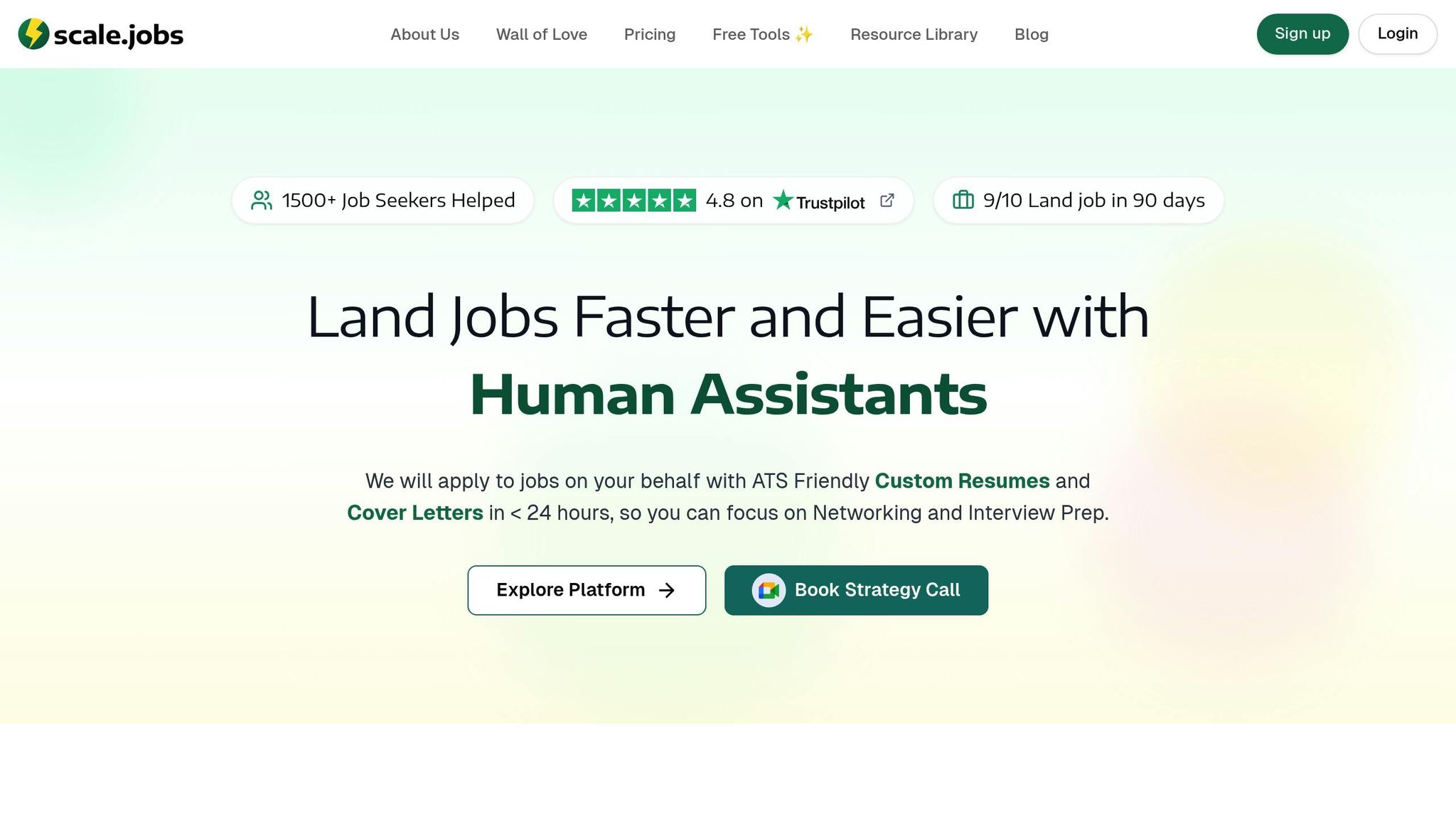
Freelance platforms like Upwork and Fiverr are great for finding gigs, but Scale.jobs offers something entirely different. Designed specifically for international jobseekers, it tackles the unique challenges of securing full-time roles while navigating visa requirements. Whether you're an immigrant balancing tight H-1B deadlines, an international student on F-1 OPT, or a newcomer struggling with Applicant Tracking Systems (ATS), Scale.jobs provides tools and services tailored to these needs. Let’s dive into their approach and why it stands out.
What Makes Scale.jobs Unique?
Scale.jobs employs a three-tier system: free tools, AI automation, and human assistants. Here’s what each tier offers:
- Free tools: Access a job board with over 2 million postings each month, an ATS-friendly resume builder, and an application tracker - all at no cost.
- AI Assistant Pro: For $9/month (launch price, regularly $19/month), you get unlimited AI-generated resumes, cover letters, and interview responses tailored to each job.
- Human Assistant service: This is where Scale.jobs truly shines. Trained virtual assistants handle job applications manually, ensuring they meet ATS requirements and bypass bot-detection systems. Unlike automated bots that risk rejection, these assistants provide accurate submissions and send you real-time WhatsApp updates with time-stamped screenshots for full transparency.
The results speak for themselves: as of mid-2025, Scale.jobs has helped over 1,500 jobseekers, with 93% landing jobs within three months. Impressively, 70% of users received refunds for unused credits because they secured roles before completing their application bundles.
For international jobseekers, Scale.jobs takes it a step further by offering visa-specific job filters. Whether you’re looking for H-1B, F-1 OPT, CPT, TN, O1, EB1A, Canadian PR, or UK Global Talent visa sponsorship, the platform identifies roles that match your needs - a rare and critical feature for those racing against visa deadlines.
"Facing a layoff during a recession with only 60 days left on my H1B visa, I was in a critical situation... 4 weeks down the line, I secured three job offers, with a 75% salary increase." – Apoorv Singh, Consultant
How Does Scale.jobs Compare to Competitors?
When stacked up against platforms like Simplify.jobs, LazyApply, and Jobscan.co, Scale.jobs stands out in several key areas:
- Human verification: Unlike Simplify.jobs and LazyApply, which rely on bots that risk ATS rejection, Scale.jobs uses human assistants to ensure compliance with each portal’s requirements.
- Real-time updates: Competitors like Jobscan.co and TealHQ only offer dashboard notifications. Scale.jobs, on the other hand, provides live WhatsApp updates, proof-of-work screenshots, and direct communication with your assistant team.
- Refundable pricing model: While Simplify.jobs, LazyApply, and Jobscan.co charge recurring monthly fees regardless of results, Scale.jobs offers flat-fee bundles with refunds for unused credits. If you land a job early, you get your money back for the unused portion.
Here’s a quick comparison:
| Feature | Scale.jobs | Simplify.jobs / LazyApply | Jobscan / TealHQ |
|---|---|---|---|
| Application Method | Human Assistants | AI/Bot Automation | Manual (User-led) |
| ATS Risk | Low (Human-verified) | High (Bot-flagging risk) | N/A (User applies) |
| Updates | Real-time WhatsApp | Dashboard only | Dashboard only |
| Pricing | Flat-fee (Refundable) | Subscription-based | Subscription-based |
| Visa Support | Specialized filters/help | Limited/None | Limited/None |
Pricing and Features Breakdown
Scale.jobs offers three pricing tiers, each catering to different needs:
- Free Tier ($0): Includes the job board, application tracker, ATS-compliant resume builder (up to 2 base resumes), and limited AI tools (2 tailored resumes and 1 cover letter per day). Ideal for those just starting out.
- AI Assistant Pro ($9/month launch price, $19/month regularly): Unlocks unlimited AI-generated resumes, cover letters, and interview responses. Perfect for high-volume applicants who prefer managing submissions themselves.
- Human Assistant Bundles: These one-time payment options are great for those who want hands-on support:
- Basic: $199 for 250 applications (1 assistant)
- Standard: $299 for 500 applications (2 assistants)
- Premium: $399 for 1,000 applications (2 assistants)
- Ultimate Bundle: $1,099 for 1,000 applications, 2 assistants, a personal recruiter, and a LinkedIn profile makeover
According to Scale.jobs, 47% of jobs secured by users come from applications submitted by their assistants, and the platform cuts the average job search time from five months to just one to three months. For international jobseekers transitioning to full-time roles or seeking visa sponsorship, this combination of speed, transparency, and tailored support fills a gap that other platforms simply don’t address.
"I moved from India to Canada and recruiting worked very differently... Scale.jobs helped me focus on the right things." – Teja Aditya Surabhi, Product Strategy & Growth
Payment and Visa Tips for International Freelancers
Payment Platforms for International Freelancers
International freelancers often face income challenges due to steep fees. Let’s break down some popular payment platforms and how they compare.
PayPal is widely available, operating in over 200 countries, but it comes with hefty charges - 2.9% to 4.4% per transaction, plus currency exchange fees. Over time, these fees can significantly eat into your earnings.
For a more wallet-friendly option, consider Wise (formerly TransferWise). It uses the real mid-market exchange rate and charges transparent fees ranging from 0.35% to 1%, supporting transfers in 50+ currencies across 170 countries. Payoneer is another option, offering multi-currency accounts in USD, EUR, GBP, and JPY. However, its fees fall between 1% and 3%, which can still add up.
In specific regions like Latin America, Asia, and Africa, localized platforms are stepping in to reduce costs. For example:
- Higlobe offers zero-fee USD transfers with instant local bank withdrawals.
- Hurupay uses blockchain for same-day settlements with a flat 1% fee.
- Grey provides virtual US, UK, and EU bank accounts, making it easier for freelancers in emerging markets to manage payments.
Some companies are also automating global payments to save time and ensure compliance. In 2025, the online education company Art of Problem Solving adopted Tipalti, which drastically reduced their payment processing time from 20 days to just one hour. It also streamlined tax compliance by handling IRS W-8BEN forms automatically.
"Our monthly close was slow because we couldn't record contractor expenses until we could figure out the payments. That was a 20‑day process... Now, with Tipalti, payments flow smoothly... it takes me an hour." – Jessica Hardy, VP of Finance, Art of Problem Solving
On the tax side, U.S. clients often require freelancers to submit Form W-8BEN to confirm nonresident status and avoid excessive tax withholding. Additionally, keep detailed records of your payments - many countries may require an Electronic Foreign Inward Remittance Advice (e-FIRA) as proof that funds were received for services rendered.
While understanding payment options is critical, visa regulations present another layer of complexity for international freelancers.
Freelancing with Visa Restrictions
Visa restrictions can significantly limit freelancing opportunities, particularly for those working with U.S.-based clients. For instance, F-1 students can only freelance under CPT (Curricular Practical Training) or OPT (Optional Practical Training) authorization, and even then, the work must align with their field of study. H-1B visa holders, on the other hand, are prohibited from freelancing altogether, as their authorization is tied exclusively to their sponsoring employer. Violating these rules can lead to severe consequences, including deportation or future visa bans.
Some freelance platforms also impose strict residency and tax rules. For example, ServiceScape excludes non-U.S. taxpayers living in the U.S. and U.S. taxpayers living abroad. Major platforms like Upwork require freelancers to verify their identity and maintain detailed profiles, ensuring they are classified as independent contractors rather than employees - an important legal distinction.
Navigating these restrictions often requires a combination of local and international expertise. Freelancers must comply with local export laws and international tax regulations, which can be daunting without proper guidance.
For those searching for work while managing visa restrictions, platforms like Scale.jobs can be a game-changer. They offer visa-specific job filters for categories like H-1B, F-1 OPT, CPT, TN, O1, EB1A, Canadian PR, and UK Global Talent visas. This feature allows you to find full-time roles that align with your work authorization - something most freelance platforms don’t address.
Understanding these payment and visa factors is essential for building a successful freelance career while staying compliant with legal and financial requirements.
How to Build a Strong Freelance Profile as a Beginner
Getting your first freelance client can feel like an uphill battle. 74% of clients check portfolios before reaching out, and recruiters typically spend less than six seconds glancing at profiles. So, how do you stand out without client reviews or a work history? It all starts with a well-structured profile that instantly communicates your ability to deliver results. Even without years of experience, you can establish credibility by crafting an optimized resume and creating a portfolio that highlights your skills.
Creating an ATS-Optimized Resume
Applicant Tracking Systems (ATS) are widely used by freelance platforms and clients to screen applications. Unfortunately, 75% of qualified candidates get rejected because their resumes aren’t ATS-friendly. To make sure your resume passes the initial screening, it needs to be readable by both machines and people.
Start with a Hybrid or Reverse-Chronological format, as these are the most ATS-compatible layouts. Stick to standard section headings like "Work Experience", "Skills", and "Education" instead of creative alternatives like "My Journey" or "What I Bring."
Mirror the job posting language. If a client lists "Search Engine Optimization", use that exact phrase instead of just "SEO." Including both the acronym and the full term (e.g., "Search Engine Optimization (SEO)") increases your chances of getting noticed. Resumes that match the job title from the posting are 10.6 times more likely to land an interview.
Keep the design simple - use single-column layouts and standard fonts like Arial or Calibri. Save your resume as a .docx file, unless the application specifically requests a PDF, as some older ATS systems struggle to read PDFs.
"The foundational rules of ATS optimization still apply. Your resume has to be readable by the machine, and then it has to impress the human recruiter." – Kelsey Purcell, CPRW, Jobscan
If you don’t have traditional work experience, add a "Projects" section. Describe your work in detail, including client names (or "Confidential Client" if bound by an NDA), goals, tools used, and measurable results. For instance: "Increased organic traffic by 30% for an e-commerce client through keyword optimization and content strategy."
Tools like Scale.jobs' free ATS-compliant resume builder can help you create resumes that meet these requirements. The tool automatically formats your information correctly, and their AI Assistant Pro plan ($9/month during launch, regularly $19/month) can generate tailored resumes for specific applications. This ensures your resume aligns with each freelance posting while emphasizing skills like remote collaboration and results-driven projects.
Building a Portfolio That Shows Your Work
Your portfolio serves as proof of your abilities, and 82% of clients prioritize portfolio quality when making hiring decisions. Many beginners make the mistake of waiting for paid projects to build their portfolio, but you can start with speculative projects instead.
Speculative projects demonstrate your skills by solving real-world problems in your target industry. For example, if you’re a web designer, redesign a local business’s outdated website. If you’re a copywriter, create sample email campaigns for a SaaS product you admire. These projects showcase your thinking and process, even if they weren’t for paying clients.
Focus on 4–8 standout projects that align with the type of clients you want to attract. Use a "Problem-Solution-Results" framework to present each project. Instead of saying, "Created social media graphics", describe your impact: "Designed 12 Instagram posts that increased engagement by 45% in two weeks."
Highlight metrics whenever possible - numbers build trust. Examples include: "Increased website traffic by 30%", "Reduced page load time from 4.2 seconds to 1.8 seconds", or "Improved email open rates from 18% to 32%."
For hosting your portfolio, Notion and Carrd are beginner-friendly and don’t require coding. Developers can use GitHub to showcase live code, while designers might prefer Canva for visual appeal or platforms like Behance and Dribbble for community exposure.
Scale.jobs' Portfolio Website Generator simplifies the process of creating a mobile-optimized portfolio. It uses proven case study frameworks and ensures your site is easy to navigate on mobile devices - essential since more than 50% of portfolio views happen on smartphones. The tool also helps you structure your projects using the Problem-Solution-Results format.
Add client testimonials or LinkedIn recommendations to reinforce your credibility. If you don’t have client feedback yet, ask professors, colleagues, or mentors to vouch for your skills. Including a 30–60 second video introduction can also personalize your profile and build trust with potential clients.
Finally, make it easy for clients to contact you. Add clear calls to action like "Hire Me", "Book a Call", or "View Availability", and ensure your contact details (email, LinkedIn, Calendly link) are visible at the top and bottom of your portfolio.
Networking for Remote Freelance Work
To attract clients, you’ll need to put yourself out there. Start by optimizing your LinkedIn headline to reflect your niche (e.g., "SaaS Copywriter | Helping B2B Companies Increase Conversions") instead of using generic titles like "Freelance Writer." Join industry-specific groups and engage with posts from potential clients - this builds visibility and credibility.
Promote your services across multiple platforms. Share your portfolio on X (formerly Twitter), create short case study videos for TikTok, or write LinkedIn articles showcasing your expertise. Don’t rely solely on one platform; instead, drive traffic to your portfolio or booking page.
Personalized cold outreach can also be effective. Research 10–15 companies or individuals you’d like to work with and send tailored messages. Reference their recent projects or challenges and offer a specific solution. For instance: "I noticed your blog hasn’t been updated since October - I specialize in creating SEO-optimized content for fintech companies and would love to discuss a content calendar strategy."
Engage in remote communities on Slack, Discord, or relevant subreddits related to your field. Many clients share freelance opportunities in these spaces before posting them on larger platforms. Be genuine - help others, share resources, and build relationships before pitching your services.
Scale.jobs can also assist with tracking connections and organizing outreach efforts. Their job board offers over 2 million postings monthly, many of which are remote-friendly. For freelancers dealing with visa restrictions, the platform includes filters for H-1B, F-1 OPT, CPT, and other work authorizations, making it easier to find suitable opportunities.
Make it a habit to refresh your portfolio quarterly. Update it with new skills, certifications, or testimonials, and reach out to past clients for feedback. In freelancing, maintaining relationships and staying visible are key to landing new opportunities.
Conclusion: Selecting the Right Freelance Platform
Choosing the ideal freelance platform depends on your skills, experience, and specific needs as a global professional. For a detailed breakdown of each platform - including options for beginners, payment systems, and international support - refer to the earlier sections of this guide.
The freelance industry is thriving, with a compound annual growth rate of 16% projected through 2030. Last year alone, 1.57 billion freelancers worldwide earned over $1.5 trillion collectively. With such growth comes intense competition, especially on major platforms. To stand out, you’ll need more than just an account. An ATS-friendly resume, a portfolio that showcases your expertise, and a strategy for reverse recruiting and networking across multiple platforms are essential tools for success. These factors highlight the importance of selecting a platform that aligns with your unique needs, particularly for international freelancers.
Platforms like Scale.jobs are tailored to address the challenges faced by global freelancers, especially beginners and those navigating visa complexities like H-1B, F-1 OPT, CPT, TN, and O1. Scale.jobs offers free tools, AI-driven customization, and a reverse recruiter service powered by real people - all with clear pricing and real-time updates to keep you informed.
For international freelancers, maintaining an active presence on two or three top platforms can help maximize opportunities. Narrow your focus by offering specialized services (e.g., "Webflow for SaaS" instead of general "web design"), emphasize time zone compatibility with your target clients, and use milestone-based billing for larger projects to ensure steady cash flow.
A great platform should provide strong support, secure payment systems, and tools to help you succeed. Whether you’re bidding on Upwork or exploring Scale.jobs' comprehensive offerings, your strategy should cater to your individual goals and circumstances. While landing your first client can be challenging, the right platform and approach can help you gain momentum and grow your freelance career.
FAQs
What are the top freelance platforms for beginners worldwide?
For those just stepping into the world of freelancing, a handful of platforms stand out for their simplicity, global reach, and beginner-friendly features.
Upwork is a go-to platform for a variety of job categories, including writing, design, and administrative support. With thousands of new job postings every week, it’s a fantastic starting point to build your portfolio without any upfront investment.
Fiverr caters to freelancers who prefer a gig-based setup. Here, you can list fixed-price services, and the platform supports multiple currencies, making it convenient to receive payments from clients worldwide.
Freelancer.com offers an extensive job board where you can search and filter opportunities based on your skills or location. With connections spanning over 120 countries, it opens doors to a truly global client base.
If you’re looking for more tailored opportunities, SolidGigs curates high-quality leads, focusing on well-paying clients. This saves you time and allows you to concentrate on securing meaningful projects.
These platforms provide a blend of broad exposure and specialized opportunities, making them excellent choices for freelancers eager to break into the international market.
What are the best ways for international freelancers to minimize payment fees and manage currency conversions?
To keep payment fees low and manage currency conversions smoothly, international freelancers should opt for smart tools and strategies. Cross-border payment platforms with low conversion rates - typically around 0.5% to 1% - can save you a lot compared to traditional banks, which often charge 1% to 3% or more. Additionally, using multi-currency accounts or credit cards with no foreign transaction fees can help you sidestep unnecessary exchange costs.
Here are some actionable tips:
- Combine payments: Group smaller invoices into a single transaction to cut down on per-transaction fees.
- Invoice in your client’s currency: A multi-currency account lets you avoid paying for double conversions.
- Shop around for providers: Compare fees and exchange rates to find the most affordable and transparent options.
By using these methods - consolidating payments, leveraging the right financial tools, and planning ahead - you can keep more of your income while navigating global freelancing.
What are the best strategies for creating a strong freelance profile as a beginner?
Building a strong freelance profile, especially as a beginner, is key to attracting clients and standing out in crowded marketplaces. Start by crafting a clear and professional headline that immediately highlights your expertise. Instead of something vague like "Freelancer", go for a title like "Graphic Designer Focused on Modern Branding" to make your skills pop.
Follow this with a compelling summary that highlights your experience - even if it’s from school projects, internships, or personal endeavors. The goal is to show how you can solve clients' problems. Be sure to weave in relevant keywords to boost your profile’s visibility in search results.
A portfolio of your best work is another must-have. For beginners, this can include mock projects, personal experiments, or volunteer work that showcases your abilities. And don’t underestimate the power of early reviews - offering competitive rates or taking on smaller jobs can help you build credibility and trust quickly.
These steps can help you create a strong, professional presence on platforms like Upwork, Fiverr, or scale.jobs, giving clients confidence in your abilities.