Why Applying to More Jobs with AI Doesn’t Work
Mass-applying with AI often reduces callbacks, causes factual errors, and gets flagged by ATS. Tailored, human-verified applications and networking perform better.

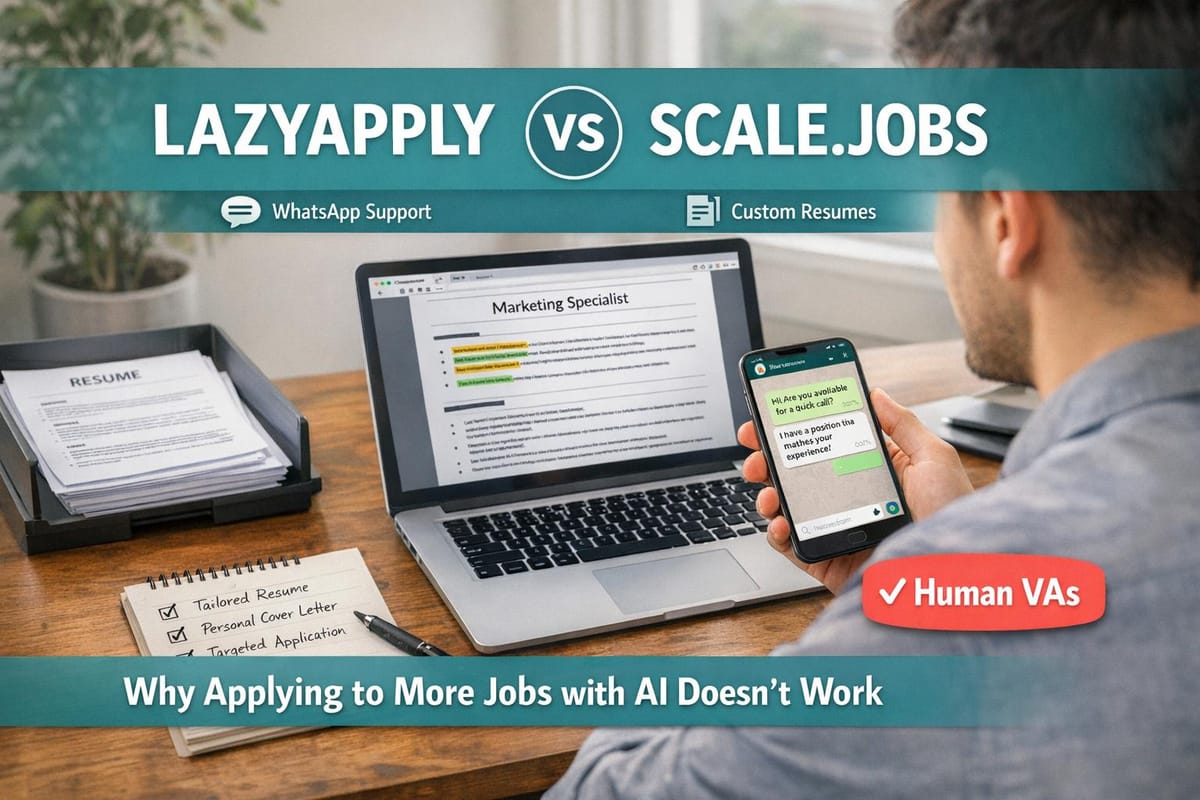
Applying to hundreds of jobs using AI tools like LazyApply or Simplify.jobs might sound like a shortcut, but it’s often ineffective. Research and recruiter feedback show that mass applications, especially those generated by AI, lead to lower callback rates, factual errors, and a lack of personalization that employers value. Here's what you need to know:
- Low Success Rates: Generic AI applications yield fewer than 3 interviews per 100 submissions, compared to 6 for tailored resumes.
- AI Detection: Applicant Tracking Systems (ATS) and recruiters can easily spot AI-generated applications, flagging them as inauthentic.
- Recruiter Preferences: Hiring managers prioritize personalized, meaningful applications over automated, repetitive ones.
- Networking Matters: 80% of jobs are secured through referrals and connections, not cold applications.
Tools like LazyApply and Simplify.jobs focus on volume but often produce error-filled, generic submissions that fail to stand out. In contrast, services like Scale.jobs emphasize human-powered, customized applications that align with job descriptions, increasing the chances of success.
Key Takeaway: Quality beats quantity. Fewer, well-crafted applications tailored to specific roles outperform mass submissions every time. If you're serious about landing a job, focus on personalization, accuracy, and networking rather than relying solely on AI tools.
The Main Problems with AI Mass Applications
ATS Systems Flag and Reject AI Applications
Applicant Tracking Systems (ATS) have become increasingly adept at identifying and discarding AI-generated applications before they even reach a recruiter. The first giveaway? Pattern recognition. When resumes flood in with identical layouts, overused buzzwords like "dynamic" or "cross-functional", and eerily similar sentence structures, it’s a dead giveaway for both ATS software and human recruiters. These patterns scream "automated", making it easy for systems to filter them out.
Another issue is keyword stuffing. AI tools often overload resumes with terms pulled straight from job descriptions, creating what recruiters describe as a "sea of sameness." While this tactic may align with ATS keyword-matching algorithms, it doesn’t demonstrate actual skills or qualifications. Worse, AI-generated resumes frequently include factual errors - incorrect dates, fabricated skills, or even outright "hallucinations" that conflict with a candidate's LinkedIn profile. These inaccuracies can irreparably harm your credibility with potential employers.
Recruiters are fighting back with their own AI detection tools. Some report that nearly half of the resumes they review each week are obviously AI-generated. Steve Levy, a seasoned recruiter, highlights the telltale signs:
"Every sentence is grammatically correct, evenly spaced, and emotionally vacant. Real résumés have scuff marks."
– Steve Levy, Recruiter
Quantity Over Quality Leads to Poor Results
The "spray and pray" method - sending out a high volume of generic applications - rarely yields results. Success rates for this approach hover between a dismal 0.5% and 1%. When you prioritize quantity over quality, you skip the essential step of researching companies and tailoring your application to their specific needs. This lack of effort makes it nearly impossible to stand out.
The surge of AI-generated applications has also led to "application fatigue" among recruiters. In July 2024, Jakob Knutzen, CEO of Butter, shared his experience of rejecting numerous applications for a product designer role because they all used the same AI-generated phrasing and awkward wording. In such cases, your application blends into the pile, becoming just another forgettable submission.
There’s also the risk of reputational damage. AI-generated errors - like claiming proficiency in a language you don’t speak or attaching the wrong cover letter - can permanently tarnish your image with top employers. Even if you make it to an interview, any discrepancies discovered during the process will likely end your chances. This lack of personalization not only reduces interview opportunities but also signals to recruiters that your application lacks genuine effort or insight.
Recruiters Prefer Personalized Applications Over AI-Generated Ones
Beyond poor outcomes, generic applications fail to meet recruiters’ expectations for thoughtful, personalized submissions. Hiring managers are increasingly adept at spotting what they call "AI slop" - applications that look polished but lack substance. Sofia Mishina, Talent Acquisition Director at AI Digital, encounters this problem daily:
"I see resumes that are perfectly formatted and perfectly forgettable - the same buzzwords, same tone, no proof of work."
– Sofia Mishina, Talent Acquisition Director, AI Digital
The problem isn’t just that these applications look alike - it’s that they lack the human touch recruiters rely on to identify strong candidates. AI struggles to articulate the "how" and "why" behind achievements. It can’t capture industry-specific nuances or highlight the unique impact you’ve made in a role. Adam Karpiak, Co-founder of Karpiak Consulting, explains:
"AI doesn't understand context. It doesn't know how you got results or what made your impact unique. Without that, your resume might check all the boxes for keyword searches, but it won't connect with a human reader."
– Adam Karpiak, Co-founder, Karpiak Consulting
What truly matters is building connections. Around 80% of people secure jobs through networking and referrals - not by sending out cold applications. A referral can boost your chances of landing an interview from about 2–3% to a staggering 40%. With recruiters spending mere seconds scanning each resume, they’re looking for authenticity and concrete evidence of your skills - qualities that AI-generated applications simply can’t deliver.
Applied for 1,000,000 Jobs...Got 3 Offers (AI RUINING JOB MARKET)
Why LazyApply and Simplify.jobs Don't Deliver Results
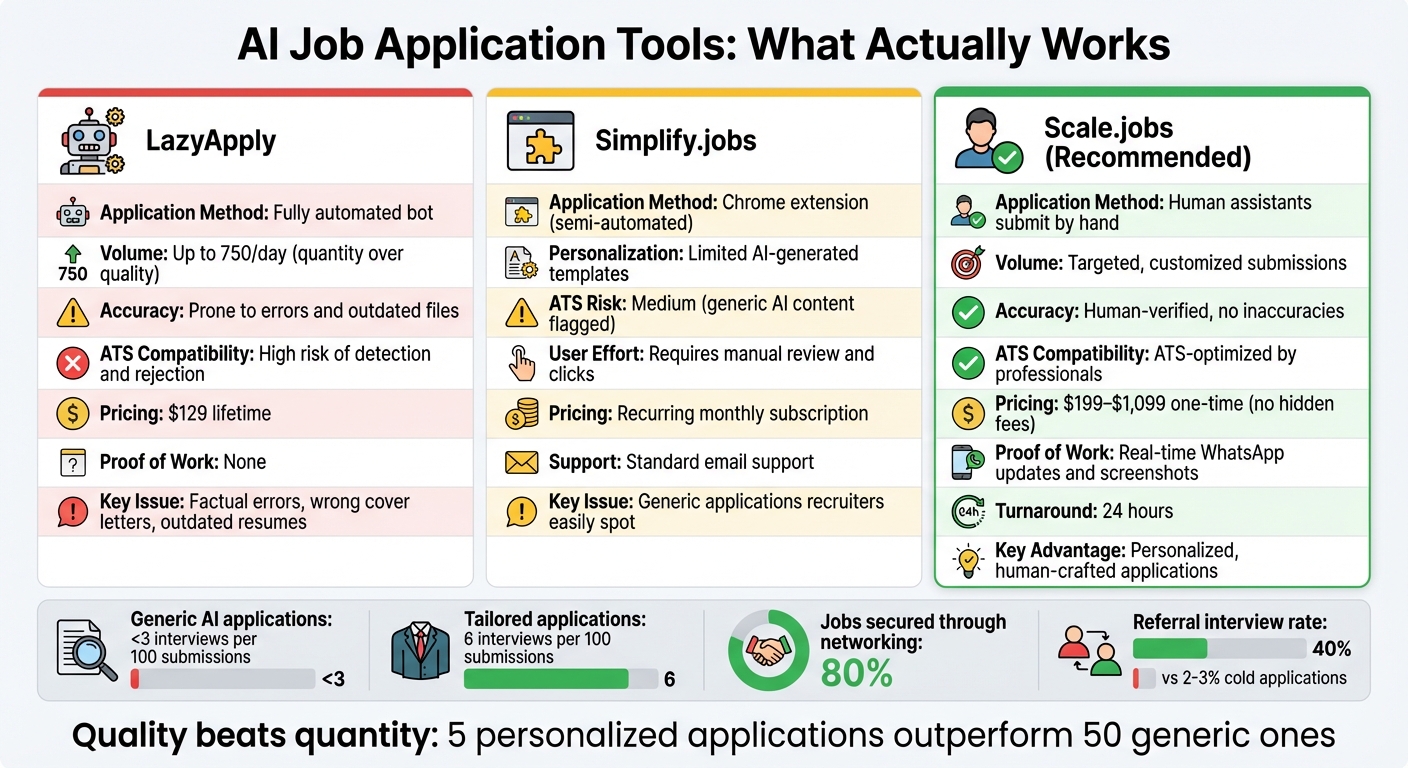
AI Job Application Tools Comparison: LazyApply vs Simplify.jobs vs Scale.jobs
LazyApply: High Volume, Low Success Rate
LazyApply claims to submit up to 750 job applications daily for a one-time fee of $129. While the idea of automating your job hunt sounds appealing, the outcomes often leave much to be desired.
In March 2024, Business Insider's Chief Correspondent, Aki Ito, tested LazyApply, and the results were alarming. The bot inaccurately listed her as conversational in Spanish, misidentified her race as African American (she is Asian), and sent an outdated cover letter addressed to a competitor - "Dear Mr. Carlson... at Insider" - to 27 employers, including The Boston Globe. To make matters worse, it ignored her updated resume and used outdated documents instead.
"LazyApply, I realized in horror, was living up to its name."
– Aki Ito, Chief Correspondent, Business Insider
These errors caused reputational harm, as LazyApply's "spray and pray" strategy floods recruiters with generic, error-filled applications that are often flagged by Applicant Tracking Systems (ATS). Recruiter Tony Riggins warns that such mistakes can seriously harm your chances with top employers.
This scattershot approach contrasts sharply with Scale.jobs, which focuses on human-powered, ATS-friendly applications tailored to each job.
| Feature | LazyApply | Scale.jobs |
|---|---|---|
| Application Method | Fully automated bot | Human assistants submit by hand |
| Volume | Up to 750/day (quantity over quality) | Targeted, customized submissions |
| Accuracy | Prone to errors and outdated files | Human-verified, no inaccuracies |
| ATS Compatibility | High risk of detection and rejection | ATS-optimized by professionals |
| Pricing | $129 lifetime | $199–$1,099 one-time (no hidden fees) |
| Proof of Work | None | Real-time WhatsApp updates and screenshots |
While LazyApply focuses on volume at the expense of quality, Simplify.jobs faces similar challenges due to limited human oversight.
Simplify.jobs: Fast Applications That Get Rejected
Simplify.jobs also struggles to meet the personalization standards recruiters expect. It relies on a Chrome extension that requires users to manually click "submit" for each application, adding a slight layer of human involvement. However, the core issue persists: AI-generated applications that recruiters can easily spot and dismiss.
Career coach Phoebe Gavin explains the problem: "100 of them look exactly the same because they all use the same ChatGPT prompt." Recruiters frequently encounter resumes that are well-formatted but generic, filled with overused buzzwords and lacking any real proof of achievements. Additionally, Simplify.jobs' recurring monthly subscription can become costly compared to Scale.jobs' one-time fee.
Even more critically, Simplify.jobs fails to address a key limitation of AI-driven applications: the inability to convey the context behind your accomplishments or highlight what sets you apart. As career expert Adam Karpiak notes, "AI doesn't understand context. It doesn't know how you got results or what made your impact unique."
This lack of nuance stands in stark contrast to Scale.jobs, which prioritizes human-crafted applications tailored to each role.
| Feature | Simplify.jobs | Scale.jobs |
|---|---|---|
| Application Method | Chrome extension (semi-automated) | Human assistants handle every field |
| Personalization | Limited AI-generated templates | Fully customized for each job |
| ATS Risk | Medium (generic AI content flagged) | Low (human-optimized for ATS and recruiters) |
| User Effort | Requires manual review and clicks | Completely hands-off for job seekers |
| Pricing | Recurring monthly subscription | One-time payment ($199–$1,099) |
| Support | Standard email support | Dedicated WhatsApp chat with proof of work |
Ultimately, both LazyApply and Simplify.jobs prioritize speed and quantity over the personalized, human-driven approach that truly makes a difference in landing a job.
How Human-Powered Applications Work Better: The Scale.jobs Approach
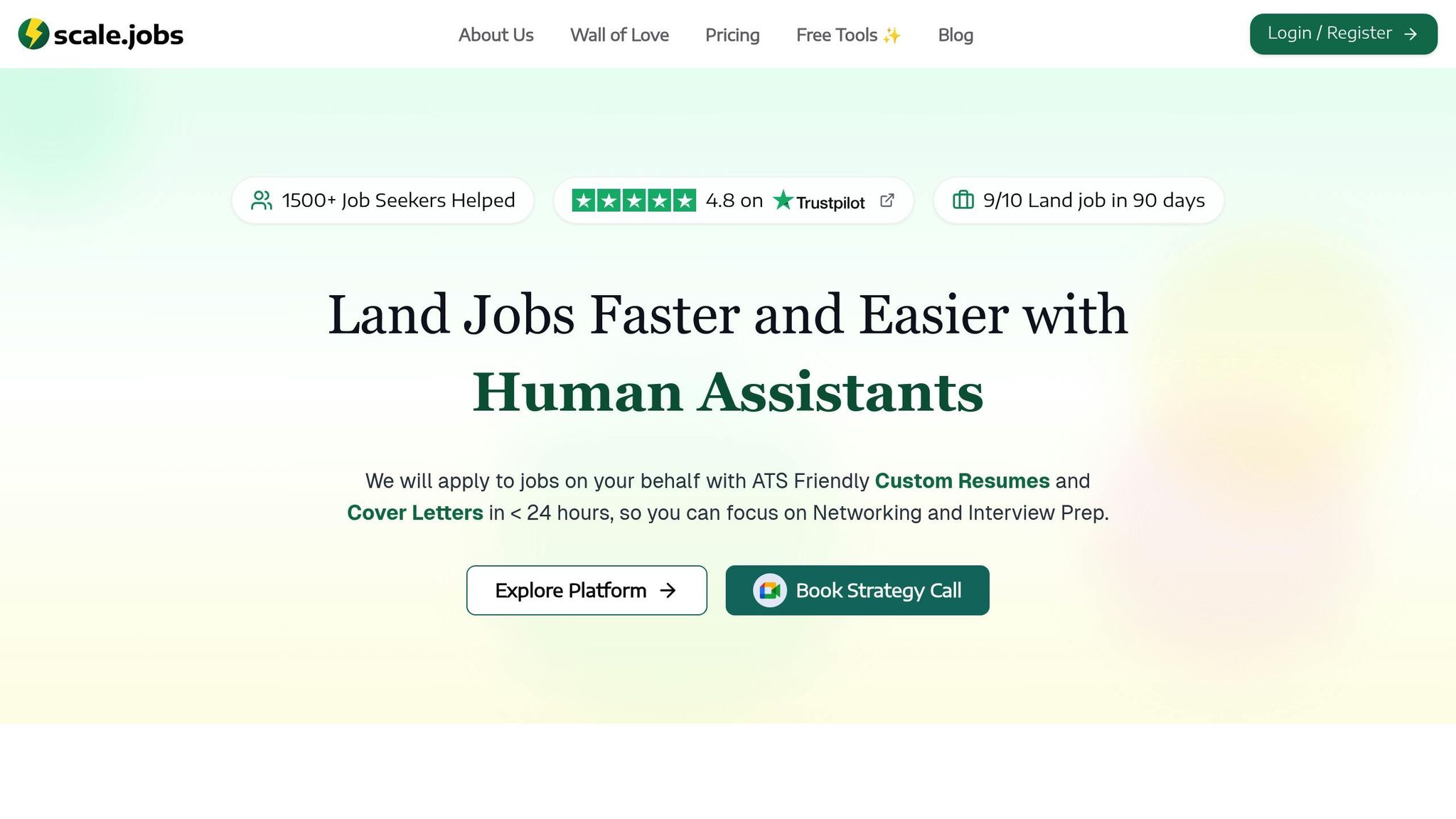
When comparing LazyApply and Simplify.jobs to Scale.jobs, it becomes clear that the right mix of human expertise and smart technology makes all the difference. Scale.jobs stands out by replacing impersonal automation with the precision of human-powered assistance.
Instead of relying on bots to flood recruiters with generic applications, Scale.jobs employs trained professionals who manually complete each application. This hands-on approach avoids the pitfalls of mass-produced content that often gets flagged by ATS systems or dismissed by recruiters for being too generic.
The result? Applications that resonate. While AI tools churn out cookie-cutter submissions, Scale.jobs’ human assistants bring a nuanced understanding of industry-specific language and company requirements. They know how to highlight what truly sets a candidate apart, going beyond matching keywords to crafting applications that feel personal and relevant.
Human Assistants Submit Customized Applications
At Scale.jobs, trained assistants take full control of your application process, ensuring every submission is tailored to the job. These professionals carefully review job descriptions, adapt your resume and cover letter to fit each role, and manually complete application forms across platforms - from large corporate ATS systems to smaller, niche job boards.
This meticulous approach eliminates the errors that often plague automated systems. With Scale.jobs, your applications are free from the generic phrasing that recruiters immediately recognize as mass-produced. Instead, they are customized and polished, increasing your chances of standing out.
Every application is completed within a 24-hour turnaround window, ensuring a fast and efficient process. Additionally, these assistants handle technical issues - like glitches in application portals - that automated tools can’t navigate. This ensures that qualified candidates aren’t disqualified due to software errors. With Scale.jobs, your applications are not only accurate but also designed to grab a recruiter’s attention.
Real-Time Updates and Proof of Work
Transparency is another area where Scale.jobs excels. Unlike AI tools that operate like black boxes, Scale.jobs provides real-time updates. Through WhatsApp notifications and a user-friendly dashboard, you can track every submission. The dashboard includes time-stamped screenshots as proof that your applications were completed.
This level of transparency eliminates the uncertainty of wondering whether your applications are actually being submitted. Instead, you have clear, documented evidence of every step in the process.
This is a stark contrast to competitors like LazyApply, which offer no visibility into what their bots are sending out. With Scale.jobs, you not only get personalized applications but also complete peace of mind knowing your job search is being handled with care and precision.
One-Time Payment vs. Monthly Subscriptions
The financial advantage of Scale.jobs becomes evident when you consider the typical length of a job search. As of August 2025, Americans were unemployed for an average of 24.5 weeks - nearly six months. The time from starting a job search to receiving a first offer reached 68.5 days in June 2025, up from 56 days in April.
For those using monthly subscription services, this extended timeline can become a financial burden. A $50/month tool adds up to $300 over six months, with no guarantee of results. Scale.jobs eliminates this ongoing cost with flat-fee pricing, offering packages like $199 for 250 applications, $299 for 500 applications, $399 for 1,000 applications, or $1,099 for the Ultimate Bundle, which includes extras like personal recruiter access and a LinkedIn makeover.
Tailored applications also yield better results. On average, personalized resumes generate 6 interview opportunities per 100 applications, compared to fewer than 3 for generic submissions. By investing in customized applications, you not only improve your chances of landing interviews but also avoid the recurring charges of subscription services. Plus, Scale.jobs offers refunds for unused credits, so you only pay for what you use.
| Feature | Monthly Subscription Tools | Scale.jobs |
|---|---|---|
| Cost for 6-month search | $300+ (ongoing charges) | $199–$1,099 (one-time) |
| Quality control | Automated, error-prone | Human-verified for accuracy |
| Interview rate | <3 per 100 applications | ~6 per 100 applications |
| Refund policy | Rarely offered | Unused credits refunded |
| Pressure to rush | Monthly billing urgency | No time pressure |
Scale.jobs not only saves you money but also ensures every application is crafted with care, giving you the best possible chance of success in your job search.
Conclusion: Quality Applications Get Better Results Than Mass Submissions
The numbers don’t lie - sending out hundreds of AI-generated applications rarely leads to job offers. In fact, resumes tailored to specific roles are far more likely to secure interviews than generic submissions. Adding to the challenge, 41% of HR professionals are hesitant to consider candidates who use AI tools, and 13% will outright reject AI-generated cover letters.
But the problem isn’t just about statistics; it’s about the impression you leave when recruiters actually read your application. As Sofia Mishina, Talent Acquisition Director at AI Digital, explains:
"I see resumes that are perfectly formatted and perfectly forgettable - the same buzzwords, same tone, no proof of work."
Tools like LazyApply and Simplify.jobs often flood the market with repetitive, impersonal applications. This lack of personalization can make it nearly impossible for your application to stand out, leaving you lost in a sea of sameness.
Scale.jobs takes a completely different approach by prioritizing personalization through human-assisted applications. Instead of relying on bots to churn out generic resumes or outdated cover letters, trained professionals carefully customize each application. This ensures your skills and experience are highlighted authentically, protecting your reputation while increasing your chances of catching a recruiter’s eye. With a 24-hour turnaround and clear proof-of-work, Scale.jobs delivers applications that are both polished and relevant.
And unlike subscription-based services that can cost over $300 during a typical six-month job search, Scale.jobs offers flat-fee pricing. Starting at $199 for 250 applications, you only pay for what you use, with any unused credits refunded. No hidden fees - just results.
Here’s the takeaway: Five well-crafted, personalized applications will always beat 50 generic ones. By focusing on quality over quantity, you can maximize your chances of landing interviews. With Scale.jobs, you get the advantage of human expertise combined with a transparent process, giving you the tools to succeed - without wasting time or money on mass, AI-driven submissions.
FAQs
Why don’t AI-generated job applications work as well?
AI-generated job applications often struggle to make an impact because they miss the personal touch that employers appreciate. These tools frequently produce generic resumes and cover letters that don’t effectively highlight your unique skills, experiences, or genuine enthusiasm for the position.
Hiring managers are drawn to applications that feel tailored and demonstrate a clear effort to align with the company’s needs. While AI tools can save time by generating multiple applications quickly, this emphasis on quantity often comes at the expense of quality - making it harder to stand out in a competitive job market. To improve your chances, invest time in creating resumes and cover letters that showcase your strengths and are specifically designed for each role.
How do Applicant Tracking Systems identify AI-generated resumes?
Applicant Tracking Systems (ATS) are designed to detect resumes that deviate from natural human writing patterns. They can pick up on telltale signs such as repetitive wording, awkward phrasing, or inconsistencies in tone and structure.
Many ATS tools also rely on advanced algorithms to identify specific linguistic and formatting cues often associated with AI-generated content. To make sure your resume passes through these systems successfully, prioritize crafting a personalized, well-structured document that highlights your distinct skills and experiences.
What are the advantages of using human-powered job application services like Scale.jobs?
Human-powered job application services, such as Scale.jobs, bring a personal touch that automated AI tools simply can’t match. By focusing on quality and personalization, these services ensure that every job application is carefully tailored to align with the specific role you're targeting. This means your resume and cover letter are not only polished but also emphasize your individual strengths while meeting the expectations of potential employers. Unlike AI-generated documents that often rely on generic templates, human experts create ATS-friendly applications crafted to grab attention in a crowded job market.
Another key advantage is the proof-of-work transparency these services provide. They keep you informed with clear updates and reports, giving you full visibility into the application process. Features like dedicated WhatsApp support and a straightforward one-time payment system make the experience smooth and hassle-free. Most importantly, these human-driven services tend to deliver better success rates, making them a standout choice for job seekers who are serious about landing the right opportunity.