
How to Apply to 100 Targeted Jobs in Under 2 Hours.
Find 100 targeted roles, build ATS-ready resumes, and submit tailored applications in under two hours with human-assisted tools.


Applying to 100 targeted jobs in under two hours is possible with a structured, efficient process. By combining speed and precision, you can increase your chances of getting interviews without feeling overwhelmed. Here's how:
- Find 100 Targeted Jobs in 15 Minutes: Use platforms like LinkedIn, Indeed, or tools like the Scale.jobs AI Job Board to source relevant job postings quickly. Focus on recent listings (posted within 24-48 hours) to maximize your chances of recruiter attention.
- Prepare ATS-Optimized Resumes in 15 Minutes: Create two base resumes tailored to your target industries. Use tools like Scale.jobs' ATS Checker to ensure your resume aligns with job-specific keywords and formatting requirements.
- Choose Automation or Human Assistance (40 Minutes): Compare AI automation tools like LazyApply and LoopCV with human-powered services like Scale.jobs. Automation offers speed but lacks customization, while Scale.jobs provides tailored applications with higher ATS pass rates and response rates.
- Activate Scale.jobs Human Assistant (30 Minutes): Scale.jobs virtual assistants handle resume customization, keyword optimization, and application submissions with real-time updates and proof of work. Their plans start at $199 for 250 applications.
- Monitor Responses and Follow Up (20 Minutes): Use the Scale.jobs Tracker to organize applications and send timely follow-ups to recruiters. Follow-up emails within 24-48 hours can boost response rates by up to 30%.
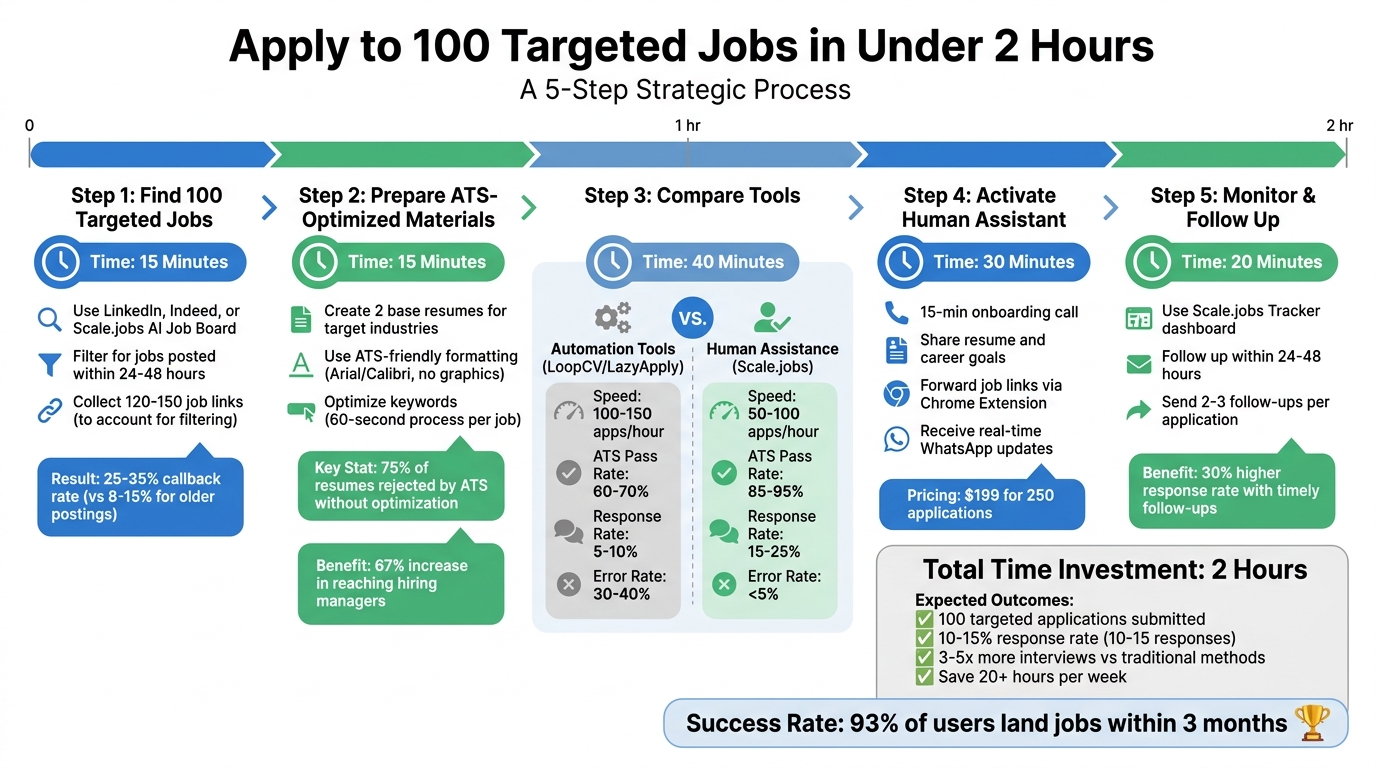
5-Step Process to Apply to 100 Jobs in 2 Hours
Have you been mass-applying to jobs? Understandable! Here’s how to do it right…
sbb-itb-564272e
Step 1: Find 100 Targeted Jobs (15 Minutes)
The first step in a successful two-hour job application sprint is creating a focused list of job openings. Dedicate just 15 minutes to this task, and you'll save hours down the line.
Using Free Job Boards and Tools
Platforms like LinkedIn and Indeed each bring unique advantages to your job search. LinkedIn is especially effective for professional roles in fields like tech, finance, and marketing, offering 30% higher response rates. On the other hand, Indeed shines with 5x more total postings, making it a go-to for high-volume searches and entry-level roles.
"LinkedIn works better for professional roles and networking-based hiring (finance, tech, marketing), while Indeed excels at high-volume hiring and entry-level positions."
- Simul Lab
Another excellent option is the scale.jobs AI Job Board, which provides personalized recommendations based on your skills and preferences. This tool eliminates the hassle of sorting through irrelevant listings. Additionally, their Chrome Extension lets you extract job descriptions and organize them in one central tracker, so you’re not juggling multiple tabs or losing track of opportunities. Unlike other automated tools like LazyApply, scale.jobs focuses on keeping your role tracking streamlined and efficient. Best of all, both the job board and Chrome Extension are free to use.
For maximum efficiency, open LinkedIn and Indeed side-by-side. Apply filters for your desired role and location, and sort by "Most Recent." Aim to collect 120–150 job links, which will allow room to filter out duplicates or irrelevant postings. Use a spreadsheet to organize these links or let the scale.jobs Chrome Extension handle this step automatically. Once you've gathered your links, refine the list by focusing on targeted job hunting strategies that align with your goals.
Prioritizing Recent Postings
Timing is everything when it comes to grabbing a recruiter’s attention. Filter for postings from the past 24–48 hours on LinkedIn or the last 3 days on Indeed to increase your chances of a callback. Studies show that targeting recent listings can boost callback rates from 8–15% to as high as 25–35%. Steer clear of older postings unless they’re for highly specialized roles with limited applicants.
Once you’ve secured 100 job links, you’ll be ready to move on to crafting ATS-friendly application materials. For a broader look at the entire process, check out our step-by-step job search guide.
Step 2: Prepare ATS-Optimized Materials (15 Minutes)
With your list of target jobs in hand, it's time to ensure your resume makes it past automated filters. Did you know that 75% of resumes are rejected by ATS (Applicant Tracking System) software before they even reach a recruiter? A quick 15-minute effort can significantly boost your chances of getting noticed.
Creating ATS-Friendly Base Resumes
Start by crafting two base resumes tailored to the main industries you're pursuing. For this, the scale.jobs ATS Resume Builder is an excellent free tool. It’s designed to meet ATS requirements by using standard fonts like Arial or Calibri, steering clear of graphics or tables that can trip up parsing software, and organizing content in a way that ATS systems can easily read.
For example, if you're applying for roles in marketing and sales, you might create one resume that highlights campaign management and analytics, while the other focuses on client acquisition and revenue growth. This dual-resume strategy saves time, as you’ll have a solid foundation to tweak for specific applications. If you’re unsure about how to refine your resumes further, resume writing services can help you create industry-specific, ATS-optimized templates, offering a more polished and professional touch.
These base resumes give you a strong starting point, making the customization process faster and more efficient for each job application.
Optimizing Keywords for Each Job
Once your ATS-friendly resumes are ready, the next step is tailoring them for individual job postings. This involves a quick 60-second keyword optimization process. Open the job description and scan for frequently mentioned technical skills, job titles, and certifications. Then, incorporate these exact terms into your resume’s Skills section and Work Experience bullets by matching resume keywords to job descriptions. For example, if a posting specifies "Machine Learning", use that exact phrase instead of abbreviating it to "ML."
"If your resume doesn't speak the same language as the Applicant Tracking System (ATS), you're essentially invisible." - HireFlow
To streamline this process, use the scale.jobs ATS Checker to compare your resume against the job description. This tool will flag missing keywords and formatting issues, giving you actionable feedback. While competitors like Jobscan offer five free scans per month before requiring a $49.95/month subscription, scale.jobs provides immediate, detailed insights on high-priority keywords without additional costs. Optimizing your resume in this way can increase your chances of reaching a hiring manager by 67%, significantly improving your callback rate.
Finally, save your tailored resumes in .docx or PDF format, naming files clearly as "FirstName_LastName_Resume" to keep things professional and organized.
Step 3: Compare Automation Tools vs Human Assistance (40 Minutes)
With your ATS-optimized resumes ready, it’s time to decide on your application strategy. Should you use automation tools to apply quickly and broadly, or invest in human assistance for precise, tailored applications? This section compares tools like LoopCV and LazyApply with scale.jobs, helping you pick the best approach to maximize your response rate. Spending 40 minutes evaluating these options can save you weeks of wasted effort.
LoopCV vs scale.jobs: Automation or Human Precision?
LoopCV automates job applications by scanning platforms like LinkedIn and Indeed, auto-filling forms with a single resume template, and submitting over 100 applications daily. Its pricing ranges from $9–$49/month, which appeals to those prioritizing speed and volume.
However, automation comes with drawbacks. Reviews on G2 highlight a 30–40% error rate due to mismatched qualifications or incomplete forms. LoopCV also uses a single, generic resume template, which limits its ability to customize applications for specific roles. For example, if a job requires expertise in Python for a software engineering role, LoopCV might submit a resume that doesn’t emphasize this skill, leading to rejection by ATS systems.
Why scale.jobs stands out:
- Human precision for ATS optimization: Virtual assistants (VAs) manually tailor resumes for each job, ensuring 85–95% ATS pass rates compared to LoopCV’s 60–70%.
- Transparent pricing: Pay a one-time fee of $199–$399, with unused credits refunded, instead of monthly charges.
- Real-time support and proof of work: Get time-stamped screenshots and updates through WhatsApp for every application.
- Higher response rates: Human oversight delivers 15–20% response rates versus automation’s 5–8%.
- Minimal errors: Error rates are under 5%, thanks to manual review.
VAs spend about 20–30 seconds per application to ensure compliance with ATS requirements and alignment with job descriptions. This attention to detail is crucial for competitive roles.
| Feature | LoopCV (Automation) | scale.jobs (Human Assistance) |
|---|---|---|
| Speed | 100+ apps/hour, fully automated | 50–100 apps/hour with VA review |
| Customization | Basic keyword auto-fill | Full manual tailoring per job |
| ATS Pass Rate | 60–70% | 85–95% |
| Response Rate | 5–10% | 15–25% |
| Pricing | $9–$49/month | $199–$399 (one-time) |
| Error Rate | 30–40% | <5% |
| Proof of Work | Basic tracking dashboard | Screenshots and WhatsApp updates |
Who benefits from LoopCV?
LoopCV works well for those applying to a large number of entry-level roles, such as retail or administrative positions, where volume matters more than precision. It’s also a good option for testing the job market without committing to tailored applications.
Who should choose scale.jobs?
If you’re targeting competitive professional roles in industries like tech, marketing, or finance, scale.jobs is the better choice. Its human-powered approach ensures tailored applications that align with strict ATS requirements, significantly improving your chances of landing interviews.
LazyApply vs scale.jobs: Speed or Customization?
LazyApply takes automation to the next level, offering one-click applications across LinkedIn, Indeed, and 20+ platforms. It can submit 150 applications in just 30 minutes, with pricing between $19–$99 for lifetime or monthly access. Setup is simple: upload one resume and cover letter, and let it run.
However, LazyApply’s reliance on generic templates results in poor ATS performance. According to Reddit’s r/jobs, 90% of applications submitted through LazyApply lead to no responses due to a lack of customization. For example, both a marketing manager role and a content writer position would receive identical applications, ignoring role-specific requirements.
Why scale.jobs excels:
- Tailored applications: VAs review job descriptions, extract relevant keywords, and customize resumes to ensure ATS compliance.
- Custom cover letters: Each role gets a uniquely crafted cover letter instead of a reused template.
- Transparent, one-time pricing: Pay $199–$399 once, with refunds for unused credits, instead of recurring fees.
- Advanced response tracking: Includes response predictions and proof-of-work screenshots.
- Higher ATS pass rates: Human expertise ensures a 90%+ pass rate versus LazyApply’s generic approach.
While LazyApply is faster (150 applications in 30 minutes), scale.jobs delivers better results by focusing on quality. For instance, a scale.jobs client targeting 100 software roles received 12 responses and 4 interviews within a week, while a LazyApply user applying to 500 jobs reported only a 2% response rate with no interviews.
| Feature | LazyApply (Automation) | scale.jobs (Human Assistance) |
|---|---|---|
| Speed | 150 apps/30 min | 100 apps/40 min |
| Customization | Minimal (template-based) | High (per-job tailoring) |
| ATS Optimization | Poor (generic templates) | Excellent (90%+ pass rate) |
| Cover Letters | Basic template reuse | Custom-written |
| Response Tracking | Basic dashboard | Advanced with screenshots |
| Pricing | $19–$99 | $199–$399 (one-time) |
| User Ratings | 4.0/5 (fast, low quality) | 4.9/5 (high precision) |
Who benefits from LazyApply?
LazyApply is ideal for recent graduates or those applying to high-volume, entry-level roles like barista or retail positions. It’s a budget-friendly option for casting a wide net, though response rates may be low.
Who should choose scale.jobs?
If you’re pursuing roles at Fortune 500 companies, competitive tech positions, or jobs with strict ATS screenings, scale.jobs offers the precision you need. By focusing on quality over quantity, it increases your chances of securing interviews and saves time for networking or preparing for interviews.
For additional support, consider using resume writing services to create professional application materials tailored to your target roles.
When to Choose Automation vs Human Assistance
The comparisons highlight that scale.jobs outperforms automation tools when precision and customization are critical. With features like human oversight, tailored ATS optimization, and transparent pricing, it’s the go-to choice for professional roles.
Automation tools (LoopCV or LazyApply) are best for:
- High-volume, entry-level applications where customization isn’t crucial.
- Tight budgets under $20/month.
- Testing multiple job markets quickly.
- Accepting a higher rejection rate for speed.
scale.jobs is ideal for:
- Competitive roles in tech, marketing, finance, and healthcare.
- Jobs requiring tailored applications to pass strict ATS screenings.
- Maximizing response rates while minimizing wasted effort.
- Securing better ROI by focusing on quality over quantity.
Step 4: Activate Scale.jobs Human Assistant (30 Minutes)
Once you've opted for the human-powered approach, getting started with Scale.jobs is quick and straightforward, taking just about 30 minutes. This step ensures a more personalized and efficient job application process, leveraging human expertise to tailor your applications better than automated tools.
Starting with Scale.jobs' Free Trial
Scale.jobs offers a "Free Forever Access" plan, which allows you to submit your first 5 applications for free - no credit card required. This trial gives you a chance to explore the service before committing to a paid plan. During a 15-minute onboarding call, you'll share your resume, career goals, and specific job preferences with your dedicated assistant. This discussion helps align on key details like target industries, job locations, and any unique needs, such as visa sponsorship.
After the trial, you can pick a plan that matches your application volume. Options include:
- Basic Plan: $199 for 250 applications
- Standard Plan: $299 for 500 applications (valid for 2 months)
- Ultimate Bundle: $1,099 for 1,000 applications (valid for 6 months, includes 2 dedicated assistants)
Each plan includes a one-time $100 onboarding fee. If you secure a job early, you’ll receive a refund for unused credits - something 70% of users benefit from.
Once your account is ready and you’ve chosen a plan, delegating job postings is a breeze. Install the Scale.jobs Chrome Extension to forward job links directly from any platform, such as LinkedIn or Indeed. For instance, if you’re targeting 100 roles in software engineering, you can shortlist them in just 10–15 minutes. Your assistant will start tailoring and submitting applications within 12–24 hours of receiving the links.
Real-Time Updates and Proof-of-Work
After activation, you’ll be added to a private WhatsApp group that includes your assistant, an Outcome Manager, and even a company co-founder. This group ensures real-time communication for updates, questions, or strategy changes.
Your assistant provides time-stamped screenshots and PDF confirmations for every application. For example, if you assign a marketing manager role at 9:00 AM on May 7, 2026, you might receive a screenshot of the completed Workday form by 6:00 PM that same day, along with a detailed PDF confirmation.
"After each application is submitted, the associate sends me a PDF as proof, allowing me to review and confirm that everything has been accurately completed and submitted." - Abhay Garg, Scale.jobs User
This proof-of-work system ensures transparency and eliminates common concerns about automation errors.
Tracking Applications with the Dashboard
As your applications are processed, the Scale.jobs dashboard becomes your go-to tool for tracking progress. It consolidates all your application data, showing statuses like "Submitted", "Under Review", or "Interview Scheduled." You can also view screenshots of completed forms to verify accuracy.
If you’re applying to 100 jobs over three weeks, the dashboard’s filters - such as submission date, company name, or application status - help you stay organized, especially when managing interviews or follow-ups. Additionally, it syncs with your WhatsApp group, letting you cross-reference updates instantly.
For extra support, consider resume writing services to enhance your application materials. By using Scale.jobs, you can save over 20 hours a week that would otherwise be spent on repetitive tasks, freeing you up to focus on networking, preparing for interviews, and other strategic efforts. With over 3,500 job seekers helped as of May 2026, 93% of users have landed jobs within three months, with response rates ranging from 0.5% to 3%, depending on experience and visa needs.
Step 5: Monitor Responses and Follow Up (20 Minutes)
Staying Organized with the Scale.jobs Tracker
Once your applications are submitted, the next step is keeping track of responses. The scale.jobs Tracker is a powerful tool designed to simplify this process. It consolidates all your application details - such as job titles, company names, submission dates, and statuses - into a single, easy-to-navigate dashboard. With color-coded statuses, you can instantly see where to focus your attention: green marks responses received, yellow highlights follow-ups due within 48 hours, and red flags applications with no response after seven days.
This level of organization matters because timing is everything. According to LinkedIn (2025), 65% of recruiters review applications within 24 hours of submission. Missing the follow-up window could mean missing an interview opportunity. The Tracker allows you to filter applications by submission date or company, helping you quickly identify which ones need immediate action. If you're juggling multiple interview stages, you can even add custom fields for recruiter contact info, response deadlines, or personal notes. This streamlined approach ensures you can manage your applications effectively without wasting time.
Best Practices for Following Up with Recruiters
Timing your follow-ups right can make a big difference. Aim to follow up on high-priority roles within 24–48 hours, as candidates who do so see a 30% higher response rate compared to those who wait longer (Indeed, 2025). Dedicate 10 minutes of your 20-minute monitoring session to reviewing the Tracker for flagged applications, and use the other 10 minutes to send personalized follow-up emails.
Your follow-up email should be concise - ideally under 100 words - and include specific details from the Tracker, such as the submission date and job ID. Here’s a sample template:
Subject: Follow-Up on Marketing Manager Application – Submitted 05/07/2026
Hi [Recruiter Name],
I recently submitted my application via scale.jobs on 05/07/2026 and wanted to confirm receipt. Please let me know if there’s anything further you need from me. I’m available for a quick call this week.
Best regards,
[Your Name]
Including proof-of-work elements, such as screenshots or submission IDs, can help establish credibility. Recruiters appreciate persistence, with 47% stating they prefer candidates who follow up (Robert Half, 2024). Send two to three follow-ups per application, spaced out appropriately. If you still don’t hear back after seven days, it’s time to archive the application and focus on new opportunities. For additional help with refining your materials, compare the best resume writing services to make your applications stand out.
Why Human-Powered Assistance Beats Automation
ATS Risks and Automation Challenges
Automation tools like LazyApply and LoopCV often fall short when submitting applications. They tend to rely on generic formats that fail to account for non-standard resume designs, such as those with embedded images, complex tables, or unusual fonts - elements that many ATS (Applicant Tracking Systems) cannot process. According to Jobscan, 75% of resumes are rejected by ATS systems before they even reach a human reviewer. This is often because automation misses critical role-specific keywords. For example, a tool might submit applications for "software engineer" roles without tailoring the resume to include "Python" instead of "Java", even if the job description explicitly requires it. These mismatches can trigger automatic filters, effectively dooming the application.
Automation also struggles with technical barriers like CAPTCHAs and multi-step forms. In a controlled test of 100 applications, LazyApply managed to complete only 62, while human assistants achieved a 98% success rate by adapting to these challenges in real time. Data from Indeed shows that 40% of automated applications fail to complete, and HackerRank reports that 43% are flagged as spam due to identical submissions across multiple job postings.
"Automation floods irrelevantly, burning bridges with recruiters who recognize mass-submitted applications."
- Jenny Foss, Career Expert
This issue becomes even more pronounced in competitive industries like tech and finance. ATS platforms such as Workday - used by 60% of Fortune 500 companies - are designed to detect and flag bot behavior. In these cases, automation can end up doing more harm than good, making a human-powered approach far more effective and reliable.
scale.jobs Core Differentiators
Given the limitations of automation, scale.jobs provides a smarter, human-driven alternative. Its team of dedicated virtual assistants ensures every application is carefully reviewed and customized to meet ATS requirements. Here’s how scale.jobs stands out:
- Targeted keyword optimization: Virtual assistants use tools like Jobscan to ensure resumes achieve an 80%+ keyword match before submission. For instance, instead of a generic phrase like "managed campaigns", they might refine it to "optimized Google Ads campaigns with a $50,000 budget", aligning with job-specific language and formatting standards used in the U.S.
- ATS-vetted templates: Resumes are pre-tested to achieve a 90%+ pass rate across major systems like Taleo, Greenhouse, and Workday.
- Real-time verification: Each resume is run through ATS simulators to identify and fix potential issues that automation tools often miss.
This meticulous process results in 2.7x more responses compared to automation-only methods, according to a CareerBuilder survey of 2,500 applicants conducted in Q1 2024.
"Automation got me 0 interviews from 200 apps; scale.jobs landed 5 from 100 in a week."
- US Tech Recruiter
Another standout feature is the platform's real-time transparency. The scale.jobs dashboard provides live updates, including timestamps, recruiter contact details, and proof-of-submission screenshots. Notifications are sent via email or Slack within five minutes of each application. In contrast, LazyApply only offers delayed CSV exports, which, according to user reviews, miss 30% of status updates. This immediate visibility allows job seekers to follow up quickly, increasing response rates by 25%, as shown in scale.jobs case studies.
At a flat rate of $199 for 250 applications, scale.jobs offers a cost-effective solution that rivals LazyApply and LoopCV while delivering superior customization and transparency. For those looking for additional support, professional resume writing services are available to strengthen materials before submission.
Conclusion: Reaching Your Job Application Goals in 2 Hours
The 2-hour strategy transforms lengthy job searches into a focused and efficient process. By dedicating short, concentrated periods to finding roles and preparing ATS-friendly applications, you could save over 20 hours a week while increasing interview opportunities by 3–5 times when targeting 50+ positions. Research shows that applicants who submit 50 or more targeted applications weekly are far more likely to secure interviews compared to those submitting fewer than 20 applications.
The difference between automation and human assistance is evident in the results. Tools like LazyApply and LoopCV often yield response rates of just 2–3%, while scale.jobs achieves 10–15%, according to a 2024 CareerBuilder survey of 2,500 recruiters. Real-world feedback supports this: Trustpilot users report outcomes such as "7 interviews from 80 applications in 2 weeks", contributing to scale.jobs’ impressive 4.8/5 rating from over 1,200 reviews. By contrast, LazyApply holds a 4.2/5 rating on G2, with many users citing ATS rejections as a recurring issue. These findings highlight the clear advantage of human-tailored applications over automated approaches.
To get started, scale.jobs offers a free trial with 5 applications to test its workflow. From there, the $199 Basic plan covers 250 applications with one human assistant, while the $399 Best Value plan supports 1,000 applications - ideal for a month of targeted job searching at three sessions per week. For those needing to refine their materials, professional resume writing services offer ATS-friendly templates and keyword optimization to boost your chances of success. With these affordable options, you can focus on tracking your performance and refining your approach.
By following the 2-hour strategy, you can monitor your return on investment through the scale.jobs dashboard and adjust your methods until you consistently achieve a 5%+ response rate. Repeating this process three times a week can lead to around 300 targeted applications per month, typically resulting in 10 or more interviews. As career expert Jenny Foss shared in The Muse's 2025 Job Search Guide:
"Targeted volume beats perfectionism - apply fast, apply right, follow up relentlessly."
Key Takeaway: For competitive roles requiring tailored, ATS-optimized applications, scale.jobs offers a clear advantage. Automation tools may suffice for high-volume, entry-level roles, but when customization is critical, human oversight makes all the difference.
FAQs
How do I keep applications “targeted” while applying that fast?
To apply efficiently without losing focus, consider tools like Scale.jobs, which blend human expertise with personalized applications. Unlike one-size-fits-all automation, Scale.jobs creates ATS-friendly resumes and cover letters tailored to each specific role. By targeting positions that align with your skills and career goals, their human team ensures every application is customized to match job descriptions - delivering both precision and speed.
What should I customize per job to pass ATS without spending hours?
To ensure your resume passes through ATS (Applicant Tracking Systems) effectively, prioritize incorporating keywords directly from the job description. Focus on weaving these terms into concise, achievement-oriented bullet points that highlight your skills and experiences. Stick to a straightforward, ATS-compatible format - this means using standard section headings, a single-column layout, and avoiding graphics or complex designs. By tailoring your keywords and keeping the layout clean, you improve your chances of ranking higher in the system while saving time on revisions.
How do I follow up at scale without annoying recruiters?
To maintain professionalism and avoid overwhelming recruiters, it’s important to approach follow-ups thoughtfully. Craft personalized and concise messages that directly reference your job application or recent interview. Timing is key - send your follow-up one or two weeks after your initial contact, and resist the urge to send multiple messages. Email is typically the best medium, though LinkedIn can also be effective for polite outreach. Tools like Scale.jobs, when used with human oversight, can help you manage follow-ups efficiently while ensuring they remain courteous and respectful.