
How to Apply for Jobs Without Burning Out
Avoid job-search burnout by focusing on 3–5 targeted, ATS-optimized applications daily, using human-assisted automation, tracking progress, and protecting your mental health.


Job hunting can feel overwhelming, but it doesn't have to drain your energy. By focusing on quality applications, using time-saving tools, and prioritizing your mental well-being, you can make the process more manageable and effective. Here's a quick breakdown to help you:
- Set realistic goals: Apply to 3-5 targeted jobs daily instead of mass submissions.
- Stay organized: Use tools like a job application tracker to monitor progress.
- Leverage automation wisely: Platforms like scale.jobs combine human oversight with automation to optimize applications for ATS (Applicant Tracking Systems), boosting your chances of success.
- Take care of yourself: Schedule breaks, set boundaries, and diversify efforts with networking and skill-building.
If you're spending hours on repetitive tasks like resume tailoring or follow-ups, outsourcing to a job search virtual assistant or using tools like an AI resume builder can save time and reduce stress. Platforms like scale.jobs offer tailored solutions that balance automation with human precision, ensuring your applications stand out.
Feeling Burnt Out? (How to Restart Your Job Search Properly)
If you're feeling overwhelmed, learning how to automate your job search can help you regain control and reduce manual effort.
How to Prioritize and Organize Your Job Applications
Staying organized and setting clear priorities can save you time and energy, ensuring you focus on roles that align with your skills and goals. Here are some strategies to help you stay on track.
Set Daily and Weekly Application Goals
Instead of applying to dozens of jobs at once, aim for 3–5 well-targeted applications per day. This keeps your efforts focused and prevents burnout. Mass applications often lead to missed opportunities because they lack personalization. By concentrating on roles where you meet the essential qualifications, you’re more likely to catch a recruiter’s attention.
Take time to thoroughly review job descriptions. If a role doesn’t match your skills or career goals, skip it. Create a list of companies you genuinely want to work for and prioritize openings with them. Remember, quality trumps quantity when it comes to securing interviews.
Use Tools to Track Your Applications
A job application tracker is a must for staying organized. Whether you use a spreadsheet or dedicated software, log details like the company name, position, application date, and next steps. This system helps you monitor your progress and ensures you never miss a follow-up.
For example, your tracker could include columns for:
- Company name and job title
- Date of application
- Contact information
- Follow-up reminders
- Feedback received
By analyzing your tracker, you can identify patterns - like which types of roles or companies are responding - and adjust your approach accordingly. Some tools even integrate with job boards, making it easier to manage multiple applications.
Batch Your Application Tasks
To maximize efficiency, group similar tasks into specific time blocks. This approach minimizes distractions and allows you to focus fully on each activity. For instance, you might dedicate your morning to reviewing job boards, your afternoon to tailoring resumes, and your evening to networking or research.
Here’s a breakdown of how batching can simplify your job search:
| Task Category | Suggested Time Block | Benefit |
|---|---|---|
| Job board review | Morning (30–45 minutes) | Quickly find suitable roles |
| Resume customization | Afternoon (60 minutes) | Tailor resumes for specific jobs |
| Networking outreach | Afternoon (30 minutes) | Build valuable connections |
| Company research | Before applying | Craft better cover letters |
By following this schedule, you’ll reduce decision fatigue and make steady progress. Additionally, updating your resume and cover letter in advance - possibly with the help of an AI resume builder - can help you stand out to recruiters.
These methods, combined with tools like scale.jobs, can streamline your job search and make the process far less overwhelming.
Time-Saving Tools That Reduce Manual Work
Finding tools that save time without sacrificing quality can make a huge difference in your job search.
ATS-Compliant Resume Templates and Customization
Did you know that most companies rely on Applicant Tracking Systems (ATS) to filter resumes before they even reach a recruiter? These systems scan resumes for specific keywords, standard fonts, and simple layouts. Overly designed resumes with fancy fonts or graphics often get rejected outright. ATS-compliant templates address this issue by sticking to one-column formats, standard fonts like Arial or Calibri, and clear section headings that easily pass through these filters.
With scale.jobs' AI Assistant, creating an ATS-friendly resume becomes a breeze. It identifies the right keywords and role-specific phrasing, helping you craft tailored resumes in minutes. This feature can save you 1 to 2 hours per application, allowing you to submit 3 to 5 targeted applications daily instead of spending hours tweaking each one. It’s not just about saving time - it’s about improving your chances of making it through the initial screening.
While the AI does the heavy lifting, you still have the opportunity to review and personalize your resume in just 10-15 minutes, striking the perfect balance between automation and personal touch.
But resumes are only one piece of the puzzle. How you submit them matters just as much.
Human-Powered Services vs. Automated Bots
When it comes to applying for jobs, not all tools are created equal. Automated bots like LazyApply (offering $99/lifetime for up to 100 applications per day) may sound appealing, but they often fall short. These bots send out generic applications that lack the context-specific tweaks ATS systems look for, resulting in only a 30% ATS pass rate. Many of these applications get flagged as spam, which can hurt your chances even further.
On the other hand, human-powered services like scale.jobs combine the speed of AI with the precision of human oversight. This approach ensures 99%+ accuracy in tailoring applications. Real assistants review each application, making sure keywords are used naturally and that your achievements align with the job requirements. Plus, you get proof-of-work documentation, including timestamped screenshots of submissions, email confirmations, and detailed logs. This transparency not only keeps you informed but also reduces the stress and uncertainty of wondering if your application was even submitted.
Here’s a quick comparison:
| Feature | Automated Bots (LazyApply) | Human-Powered (scale.jobs) |
|---|---|---|
| Application Method | Automated bot submissions | Manual completion by assistants |
| ATS Pass Rate | ~30% (often flagged as spam) | 99%+ (human-optimized) |
| Proof of Work | Basic confirmation emails | WhatsApp updates, screenshots, and detailed logs |
| Portal Coverage | Limited platforms | Any job board or company site |
This level of accountability can make your job search far less overwhelming. If you're exploring professional resume writing services, look for ones that provide this kind of transparency and customization.
Stay Informed with Real-Time Application Updates
Constantly refreshing job portals to check the status of your applications can be exhausting. Real-time updates can save you from this mental drain by notifying you the moment an application is submitted.
With scale.jobs, you’ll receive WhatsApp messages with status updates (e.g., "Application submitted to Company X at 2:15 PM EST"), along with timestamped screenshots and follow-up reminders. This not only gives you peace of mind but also frees up your time to focus on other important aspects, like preparing for interviews or networking.
For those who prefer a more hands-on approach, tools like Teal ($9/week premium) offer tracking dashboards with excellent reviews (4.9/5 on Product Hunt) for their intuitive design. However, Teal focuses on DIY tracking, while scale.jobs takes care of the entire submission process for you. The real benefit here is reclaiming the 5-10 hours per week you’d otherwise spend manually checking statuses and following up.
Protecting Your Mental Health During Job Search
Maintaining your mental well-being is just as important as optimizing your tools during a job search. Stress related to work and job hunting can take a toll on anyone. For example, work-related stress led to 16.4 million lost workdays in 2023/2024. While this statistic reflects data from abroad, the emotional strain of constant applications, rejections, and uncertainty is universal. The key lies in establishing habits that help you stay balanced and prevent burnout.
Schedule Breaks and Set Clear Boundaries
Treating your job search like a full-time job might feel productive, but it can quickly lead to exhaustion. Instead, create a schedule with dedicated hours for job search activities. A time-blocking method can work wonders - set aside specific intervals, like 45–60 minutes in the morning, 30 minutes during lunch, and 60–90 minutes in the evening, to focus on your tasks.
One crucial step is to set a daily "hard stop." For instance, if you decide your cutoff is 7:00 PM EST, make it a rule to turn off job notifications and close your work tabs at that time. This clear boundary allows you to switch gears and enjoy personal time. Tools like StayFocused can help by blocking job-related websites after your designated hours, keeping you from the temptation of "just one more search."
"Relaxation isn't doing nothing - it's activating your brain's recovery system." - Gowan Health
Incorporate quick relaxation techniques like box breathing to reset your mind. Try this: inhale for 4–6 seconds, hold for 4–6 seconds, exhale for 4–6 seconds, and hold again for 4–6 seconds. Repeat this cycle 3–5 times, which takes under two minutes. This technique engages your parasympathetic nervous system, helping your body shift from stress mode to a calmer state.
If repetitive tasks like tailoring resumes or tracking applications are wearing you down, consider tailored job application assistance to outsource them. This frees up your time for high-impact activities like preparing for interviews or networking.
Diversify Your Efforts: Network and Build Skills
Focusing solely on applications can lead to frustration and a sense of helplessness. Diversifying your job search efforts not only keeps things fresh but also opens up more opportunities. Dedicate 20–30% of your time to activities beyond hitting "submit" on applications.
For instance, reach out to three professionals each week on LinkedIn who work in roles or companies you're targeting. Keep your messages short and specific - reference a recent project they worked on or ask a thoughtful question about their experience. Additionally, attend virtual networking events or local meetups in your field to build connections that might bypass automated hiring systems.
You can also use this time to enhance your skills. For example, if you're pursuing marketing roles, consider earning a free Google Analytics certification. If project management is your goal, a short course on Agile methodologies could strengthen your resume. These activities not only make you a stronger candidate but also provide a welcome break from the monotony of applications.
Physical activity is another essential part of this balance. Research shows that walking just 5,000 steps a day can help combat depression. A 20-minute walk between job search sessions can lower stress hormones and improve your mood. These breaks aren’t wasted time - they’re an investment in your mental well-being and job search performance.
If managing all these aspects feels overwhelming, platforms like scale.jobs can help streamline your applications, making the process less stressful.
Track and Celebrate Progress Milestones
It's easy to get so focused on landing a job that you overlook the progress you're making along the way. Instead, take time to acknowledge smaller achievements. Did you land an interview? That’s proof your resume is working. Did you improve your cover letter with feedback? That’s skill development. Even completing 10 tailored applications in a week is a sign of consistent effort.
Keep a simple progress log, such as a Google Doc or a notes app, and jot down three job search-related accomplishments at the end of each day. This practice, often referred to as a brief reflection, shifts your focus from setbacks to progress.
Creating a visual tracker for your weekly goals can also be motivating. For example, if your target is 15 applications per week, mark each one off on a calendar or spreadsheet. Seeing your progress laid out can reinforce your hard work and counter feelings of inadequacy.
"Taking care of our own mental health is our civic duty. Prioritize your health, and you'll be better equipped to show up as your best self." - Sue Varma, M.D., Clinical Assistant Professor, NYU Langone Health
Don’t underestimate the importance of quality sleep - aim for 7 to 9 hours each night. If anxiety is keeping you awake, try the 5-4-3-2-1 grounding technique: name five things you see, four things you can touch, three things you hear, two things you smell, and one thing you taste. This simple exercise can calm racing thoughts and help you stay present.
scale.jobs vs. Other Job Application Services
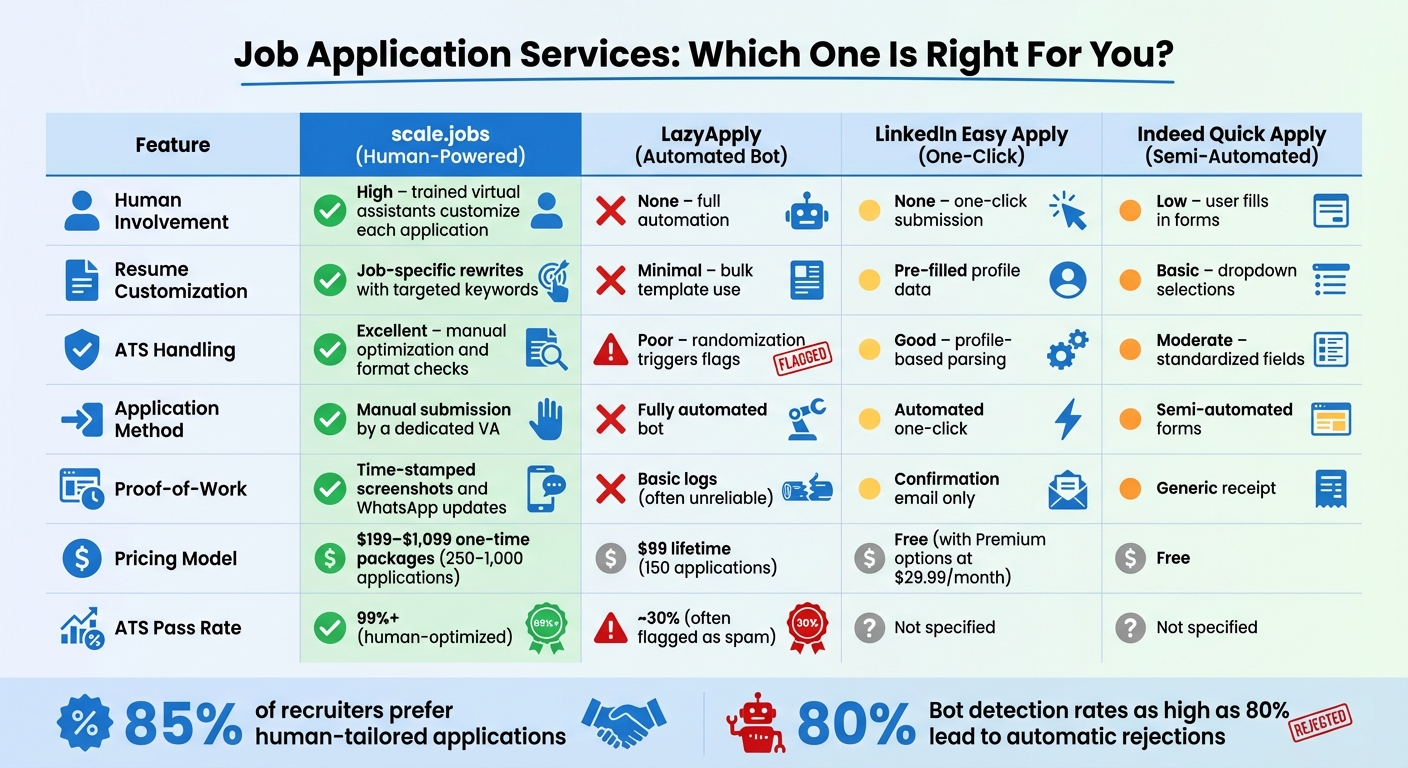
Job Application Services Comparison: scale.jobs vs LazyApply vs LinkedIn Easy Apply
When comparing job application platforms, it’s clear that services like LazyApply and LinkedIn Easy Apply prioritize speed and automation. However, this often comes at the cost of quality and effectiveness. For instance, LazyApply relies on bots for rapid submissions, which can trigger ATS (Applicant Tracking System) flags - recruiters report bot detection rates as high as 80%, leading to automatic rejections. Similarly, LinkedIn Easy Apply offers convenience with its one-click submissions but lacks the customization needed to make your application stand out. If you're not seeing results from generic, high-volume applications, it’s worth exploring what different services truly offer.
Why scale.jobs Stands Out
scale.jobs focuses on quality and transparency, providing features that address the shortcomings of automated platforms:
- Human-assisted customization ensures tailored resumes for each role.
- ATS-optimized documents improve your chances of passing initial screening.
- Proof of work is provided through WhatsApp updates with timestamped screenshots.
- A one-time payment model eliminates recurring subscription fees.
- Dedicated support helps tackle specific challenges in your application process.
scale.jobs vs. LazyApply & LinkedIn Easy Apply: A Feature Comparison
To understand these differences better, here’s a side-by-side comparison of key features:
| Feature | scale.jobs (Human-Powered) | LazyApply (Automated Bot) | LinkedIn Easy Apply (One-Click) | Indeed Quick Apply (Semi-Automated) |
|---|---|---|---|---|
| Human Involvement | High – trained virtual assistants customize each application | None – full automation | None – one-click submission | Low – user fills in forms |
| Resume Customization | Job-specific rewrites with targeted keywords | Minimal – bulk template use | Pre-filled profile data | Basic – dropdown selections |
| ATS Handling | Excellent – manual optimization and format checks | Poor – randomization triggers flags | Good – profile-based parsing | Moderate – standardized fields |
| Application Method | Manual submission by a dedicated VA | Fully automated bot | Automated one-click | Semi-automated forms |
| Proof-of-Work | Time-stamped screenshots and WhatsApp updates | Basic logs (often unreliable) | Confirmation email only | Generic receipt |
| Pricing Model | $199–$1,099 one-time packages (250–1,000 applications) | $99 lifetime (150 applications) | Free (with Premium options at $29.99/month) | Free |
Who Benefits Most from scale.jobs?
scale.jobs is a great fit for job seekers who prioritize customization and transparency over speed. Here’s who should consider it:
- Mid-career professionals applying to 50+ roles weekly and needing tailored submissions.
- Recent graduates without extensive networks who want every application to stand out.
- Executives in specialized fields like finance, tech, or marketing, where human judgment is crucial to highlight unique strengths and bypass ATS filters.
For example, a software engineer who initially applied to 200 roles using automated tools landed only 2 interviews (a 1% success rate). After switching to scale.jobs for 100 human-customized applications, they secured 12 interviews (a 12% success rate), eventually landing a $150,000 position - all while reducing the stress of manual tracking and customization.
When to Consider Switching to scale.jobs
If you're facing these challenges, it might be time to explore scale.jobs:
- High rejection rates (over 70%) despite strong qualifications, indicating issues with ATS filters.
- Bans or flags on platforms like LinkedIn or Indeed due to suspected bot activity.
- Lack of time for detailed customization, such as rewriting experience sections or adjusting keywords for each role.
- Burnout from repetitive tasks, leading to skipped applications or reduced quality.
- Need for accountability, with proof-of-submission updates that automated tools don’t provide.
With packages starting at $199 for 250 applications (about $0.80 per application), scale.jobs offers a cost-effective way to delegate repetitive tasks. This frees up your time for more impactful activities like networking and interview preparation, addressing the common burnout issues many job seekers face.
"Effectively delegating job search tasks can be a game-changer." – Amir Ajaz, Sales & Business Development Manager
Recruiters overwhelmingly prefer human-tailored applications, with 85% noting they value the authenticity and attention to detail these submissions provide.
Decision Summary
- Choose scale.jobs if you’re struggling with high rejection rates, ATS flags, or the mental toll of manual applications. Human-powered, ATS-optimized submissions deliver better results and save time.
- Opt for LazyApply or one-click tools if your priority is speed for high-volume, entry-level applications and you’re okay with a more generic approach.
For those ready to focus on quality over quantity, scale.jobs offers a reliable solution that helps you stand out in a competitive job market.
Wrapping Up
Navigating the job search process without exhausting yourself boils down to three essential strategies: setting realistic goals (like focusing on 3-5 well-crafted applications a day instead of mass submissions), leveraging tools that save time by automating repetitive tasks, and prioritizing your mental well-being through breaks and diversifying your efforts - like networking. On average, job searches in the U.S. can take up to six months, so it’s important to approach it with a steady, sustainable pace. Think of it as a marathon, not a sprint. While tools like LazyApply and LinkedIn Easy Apply emphasize speed, platforms like Scale.jobs focus on quality and human-guided precision.
The right tools can make a world of difference in reducing the workload while avoiding the pitfalls of fully automated services. For instance, ATS-friendly templates and tracking software can cut down on manual tasks, and human-powered services relieve the headache of constant resume and cover letter customization. If you’re spending over 40 hours a week applying for jobs or facing high rejection rates, it may be time to rethink your approach. Fully automated systems like LazyApply often trigger ATS flags, but Scale.jobs uses human oversight to create tailored applications, offering proof-of-work transparency and real-time WhatsApp support - all with a one-time payment.
Efficiency doesn’t have to come at the cost of your well-being. Networking is a non-negotiable strategy, as most jobs are filled through referrals rather than online postings. By delegating tasks like resume customization, you can free up over 20 hours each week to focus on interviews and networking opportunities.
When compared to one-click tools, Scale.jobs stands out for its transparency and human judgment. Starting at $199 for 250 applications (just $0.80 per application), it’s a smart investment if you value quality over sheer volume. On the other hand, if speed is your main priority, one-click tools may suffice - but if rejection rates are climbing, human-powered services often deliver better results.
Consider switching to Scale.jobs if:
- Your rejection rate exceeds 70% despite having strong qualifications.
- Automated tools have led to bans or flags on job platforms.
- You’re struggling to find time for detailed resume and cover letter customization.
- Burnout from repetitive tasks is affecting the quality of your applications.
- You want accountability with proof-of-submission updates.
Key Takeaways
- Choose Scale.jobs if you want human-assisted, ATS-optimized applications with complete transparency and dedicated support.
- Go with one-click tools like LazyApply if your focus is on volume and you’re okay with generic applications and lower success rates.
FAQs
How do I pick which jobs to apply to?
When searching for opportunities, it’s essential to focus on roles that truly align with your skills, experience, and long-term career goals. Instead of applying to every available position, aim to prioritize quality over quantity. Take time to carefully evaluate job descriptions to ensure they reflect your qualifications and interests. Beyond the job itself, consider aspects like the company’s values, location, and potential for growth within the organization.
Avoid wasting time on roles where you don’t meet the core requirements. Instead, target positions where your expertise can genuinely make an impact and where you’ll feel motivated to contribute meaningfully. By being selective and strategic, you’ll improve your chances of finding a position that’s both rewarding and aligned with your aspirations. For additional support in tailoring your applications, tools like an AI resume builder or a job application service can streamline the process and help you stand out.
What’s the safest way to automate applications?
The most reliable strategy involves blending AI technology with human expertise. Platforms such as Scale.jobs offer a solution by creating ATS-friendly resumes with the help of advanced tools while incorporating human review to ensure each application is tailored and polished. This approach minimizes the chances of rejection by applicant tracking systems (ATS) and increases the likelihood of callbacks by striking the right balance between automation and a personal touch.
When should I outsource my job applications?
If you're feeling swamped, exhausted, or simply pressed for time during your job hunt, outsourcing your job applications might be the relief you need. Handing off this task can free up hours in your week, ease the mental load, and allow you to concentrate on networking or preparing for interviews. Services like Scale.jobs offer personalized, human-driven assistance, including ATS-friendly resumes. This makes them an excellent choice for handling critical applications or ensuring steady, professional support to help you sidestep burnout in your career search.