
How to Apply for Jobs After a Layoff Without Looking Desperate
Treat a layoff as a career pivot: craft ATS-friendly applications, network strategically, and use human-powered tools to apply confidently—not desperately.


Facing a layoff can be tough, but it doesn’t diminish your professional worth. The key to bouncing back is presenting yourself as a confident, qualified candidate while avoiding common pitfalls like mass-applying or over-explaining employment gaps. Here's a quick guide to help you navigate the job search:
- Reframe Your Layoff: Explain it briefly and focus on your skills and future goals.
- Tailor Your Applications: Use ATS-friendly resumes and cover letters with examples.
- Leverage Networking: Build connections naturally rather than asking for jobs outright.
- Choose the Right Tools: Platforms like scale.jobs offer tailored, human-powered job application services to help you stand out.
What to do if you're LAID OFF! How to Get Your Next Job Fast!
Reframe Your Layoff Story
The way you tell your story shapes how recruiters perceive you. With layoffs in 2025 reaching their highest levels since 2009 - up 33% year-to-date - recruiters understand that these decisions often reflect business realities, not individual performance. Acknowledge the layoff briefly, then steer the conversation toward your skills and the value you can bring to a new role.
Position Your Layoff as a Career Shift
Frame your layoff as an opportunity for growth or a strategic career shift. Use neutral language like "position eliminated due to consolidation" or "role impacted by acquisition." By explaining that your departure was part of broader company changes, you avoid sounding defensive and keep the focus on your professional journey.
"In some cases, a layoff can be a blessing in disguise... it gives them a reason to look for something better." - Horst Govin, Career Coach, Job Hunt Bootcamp
When updating your resume, think about whether you want to stay in your current field or transition to a new one. If you're pivoting, tailor your resume and application materials to align with your desired direction. Highlight transferable skills and measurable accomplishments that underscore your value, regardless of how your last role ended. This shift in focus will help you craft a stronger narrative for interviews and networking conversations.
Prepare a Clear Explanation for Employment Gaps
Once you've reframed your layoff, prepare a concise explanation for any employment gaps that keeps the emphasis on your future potential. Use a simple three-part structure: briefly acknowledge the circumstance, highlight an achievement or productive use of the gap, and pivot to your excitement about the new role. For instance: "My position was eliminated during a company restructure. I used that time to earn my Google Cloud Professional Data Engineer certification, and now I’m eager to bring those skills to help your team tackle data pipeline challenges."
Stick to the 30-second rule - keep your explanation short and forward-looking. If your job search takes longer than expected, fill the time with meaningful activities like freelance work, certifications, or volunteering. These pursuits showcase your commitment to professional growth and turn the gap into an asset. On LinkedIn, use phrases like "Currently exploring new opportunities" or "Focusing on finding the right fit" to signal your availability without coming across as overly eager.
Improve Your Application Materials
After experiencing a layoff, it's crucial to ensure your resume and cover letter not only pass applicant tracking systems (ATS) but also leave a strong impression on hiring managers.
Create ATS-Friendly Resumes and Custom Cover Letters
Start by compiling a career inventory that highlights your key accomplishments. This list should include metrics and examples that showcase your value. Use this as the foundation to tailor your resume and cover letter to each job description. ATS systems are programmed to scan for specific keywords, so aligning your materials with the required skills and qualifications is essential.
Leverage tools like FitCheck's Chrome extension, which offers 10 free compatibility checks per month, to evaluate how well your resume aligns with a job posting. Similarly, Jobscan provides a free two-week trial that includes resume matching and LinkedIn optimization. These tools can help pinpoint areas for improvement before you hit "submit."
For a more in-depth approach, consider working with professional resume writing services. These services connect you with experts who understand ATS systems and industry-specific language, allowing for a more personalized and polished application that avoids common pitfalls of automated screenings.
Highlight Measurable Results and Work Samples
Once your resume is ATS-ready, focus on quantifying your achievements. Replace general statements with specific, measurable outcomes. For example, instead of saying, "Managed a team to improve performance", write, "Led a 12-person team that increased quarterly revenue by 34%." Numbers and concrete results make your experience stand out and demonstrate clear value to potential employers.
If applicable, create a personal website or portfolio to showcase your work. This is especially effective for roles in fields like marketing, design, engineering, or consulting, where tangible examples of your contributions can speak louder than a bulleted list. Be sure to include links to your portfolio in both your resume header and LinkedIn profile, making it easy for recruiters to access and verify your work.
"Never be afraid or embarrassed about the layoff. You still have the same value. Your value doesn't go away. You just have to get somebody who appreciates that value." – Ashley Watkins, Recruiter and Job Search Coach
With your achievements documented, the next step is to ensure your LinkedIn profile is working as hard as your resume.
Optimize Your LinkedIn Profile
LinkedIn plays a major role in modern recruiting, with 65% of recruiters citing it as their go-to social media platform and 53% saying it delivers the highest-quality candidates. To increase your visibility, optimize your profile with targeted keywords in your headline, summary, and experience sections. This will help you appear in searches when recruiters filter by job title, skills, or location.
Activate the "Open to Work" feature to discreetly signal your availability to recruiters. Use the private setting so only those using LinkedIn's hiring tools can see this status. Update your headline to reflect your current goals, such as "Product Manager | Exploring New Opportunities in SaaS", rather than keeping your previous job title, which might suggest you're still in that role.
Request personalized LinkedIn recommendations from former colleagues and managers. Fresh testimonials can quickly establish credibility and help address any concerns about your departure from your last position. When reaching out to your network, opt for individual messages rather than public posts. A direct, professional approach - like asking for introductions to hiring managers - tends to be more effective than a mass announcement.
Finally, maintain a weekly log of your job search activities. Include details like job titles, company names, and links to postings. This not only helps you stay organized but may also be required if you're claiming unemployment benefits, as many states mandate proof of at least three job search activities per week to remain eligible.
Network Without Appearing Desperate
After perfecting your resume and cover letter, the next step is to focus on building authentic professional relationships. Networking plays a role in 70% of all job placements, making it far more effective than sending out cold applications. The trick is to approach networking as a way to build meaningful connections, not as an opportunity to immediately ask for job leads. When reaching out to former colleagues or industry peers, aim for genuine conversations rather than broadcasting your job search. This approach allows you to strengthen relationships without coming across as overly eager.
Reconnect With Contacts in a Natural Way
Skip the mass emails or generic announcements. Instead, send personalized messages to trusted former colleagues, managers, or mentors. These individuals already know your work ethic and are more likely to support you. Start your outreach with something along the lines of, "I'm exploring my next career step and would love your perspective on [specific company or industry trend]." This positions you as thoughtful and curious rather than someone in urgent need of assistance.
To revive dormant connections, consider a light and friendly comment to break the ice. For example, complimenting their LinkedIn profile picture or congratulating them on a recent achievement can help reestablish rapport. Career coach Ashley Watkins explains:
"Networking can be as simple as complimenting a connection's headshot to spark a renewed dialogue."
This low-pressure approach creates a natural entry point for deeper conversations. Once you've reconnected, focus on gathering insights, like a company's work environment or future plans, rather than outright asking for open roles. Wrap up these conversations by requesting a referral to someone else they think you should meet, allowing your network to grow organically.
Set a manageable goal of connecting with two new people each week while maintaining regular contact with existing connections every month or two. LinkedIn's Alumni Tool can be a great resource for identifying people at your target companies who share your educational background, providing an easy way to start a conversation. If you've been part of a mass layoff, consider forming a support group with former coworkers to exchange job leads and keep each other motivated.
Join Industry Groups and Events
Go beyond generic job boards by engaging with niche communities tailored to your field. For instance, platforms like Dice cater to tech professionals, while Dribbble is ideal for creatives. These spaces allow you to network and showcase your expertise without coming across as overly focused on job hunting. Attending webinars, local meetups, or volunteering at industry events can also help you make memorable, face-to-face connections.
Before directly messaging new contacts, engage with them publicly. Comment thoughtfully on their LinkedIn posts or share an article they’ve written. This approach keeps you on their radar without putting pressure on them to respond immediately. When you do reach out, keep messages concise - under 400 characters - since shorter messages tend to get 22% higher response rates. Aim to send messages during weekday mornings (Tuesday through Thursday) for the best chance of engagement. If you don’t receive a response, follow up once after five to seven days, then move on.
Career coach Cynthia Pong emphasizes the importance of networking thoughtfully:
"If we're smart about leveraging our network, it goes a long way in cutting through the noise that is the pile of digital or paper resumes on [the] other person's side."
If you're feeling overwhelmed or unsure how to craft the perfect outreach message, consider enlisting the help of professional resume writing services. These services can not only refine your application materials but also guide you in crafting effective networking strategies. Combined with strong application documents, this approach reinforces your professional image and helps you stand out in a competitive job market.
Compare Job Search Tools and Services
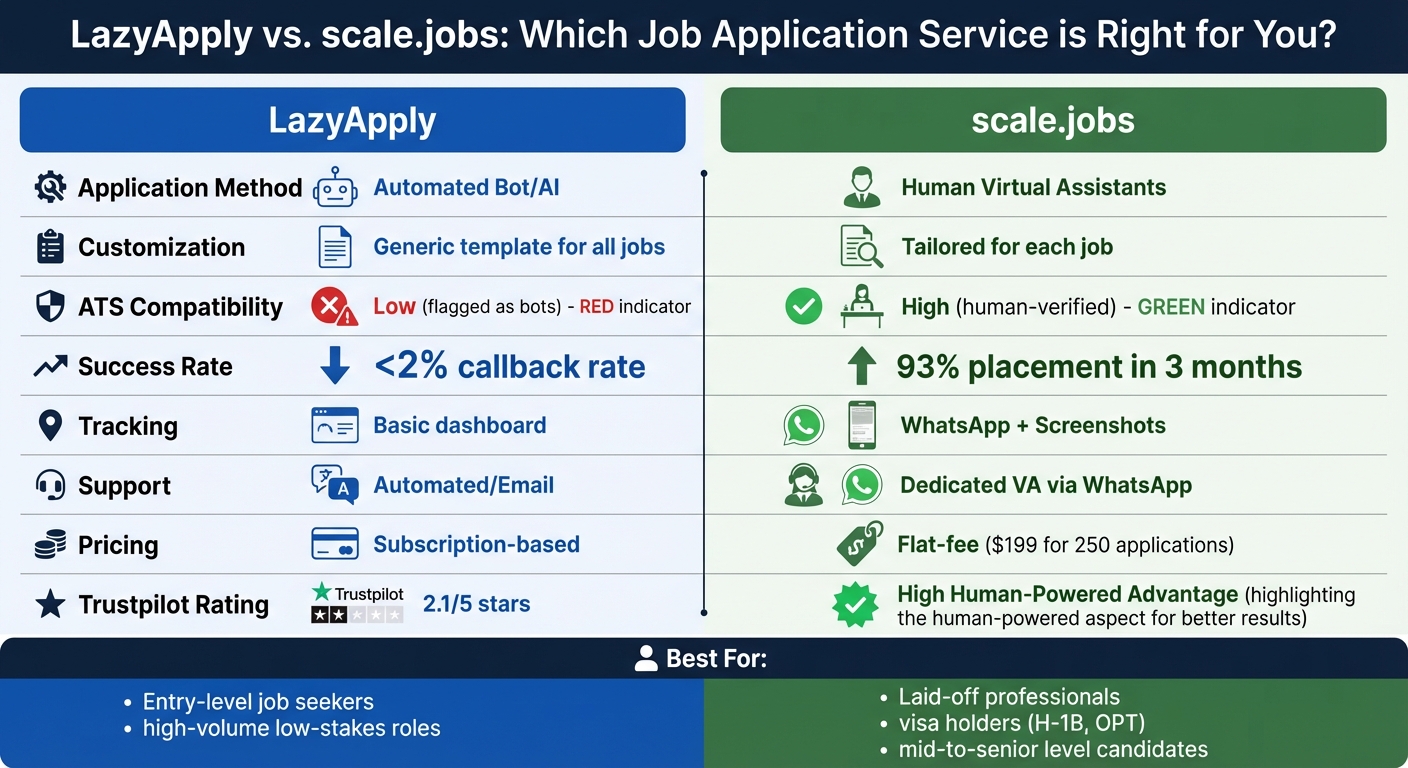
LazyApply vs Scale.jobs Job Application Service Comparison
After a layoff, every job application carries extra weight, and selecting the right job search tool can make a huge difference. The right platform can help you secure interviews quickly, while the wrong one might waste precious time. Automated tools like LazyApply, Simplify.jobs, and LoopCV promise to handle the heavy lifting by submitting countless applications on your behalf. However, modern Applicant Tracking Systems (ATS) often flag these bot-driven submissions, leaving many candidates frustrated. This is especially problematic for those on tight timelines, such as individuals on H-1B or OPT visas. Below, we’ll explore how scale.jobs stands out, particularly for professionals who need precision and human oversight in their job search.
LazyApply vs. scale.jobs: Why You Should Switch
Is LazyApply worth it? A closer look at reviews and alternatives reveals some major drawbacks. LazyApply relies on AI-driven bots to mass-apply for jobs using a single, generic resume. While this approach allows for high-volume submissions, it’s best suited for entry-level candidates applying to less competitive roles. Unfortunately, this efficiency comes at a cost. The platform has a 2.1/5 rating on Trustpilot and struggles with complex applications requiring custom fields or industry-specific keywords. Moreover, many enterprise ATS platforms now detect and reject bot-generated submissions, making this tool less effective for serious job seekers.
In contrast, scale.jobs assigns trained Virtual Assistants (VAs) to handle applications manually. These VAs customize your resume and cover letter for each specific job posting, ensuring keyword alignment and relevance. Applications are completed within 24 hours, and real-time updates, including timestamped screenshots, are sent via WhatsApp for transparency.
| Feature | LazyApply | scale.jobs |
|---|---|---|
| Application Execution Method | Automated Bot/AI | Human Virtual Assistants |
| Customization | Generic template for all jobs | Tailored for each job |
| ATS Compatibility | Low (flagged as bots) | High (human-verified) |
| Success Rate | <2% callback rate | 93% placement in 3 months |
| Tracking | Basic dashboard | WhatsApp + Screenshots |
| Support | Automated/Email | Dedicated VA via WhatsApp |
| Pricing | Subscription-based | Flat-fee ($199 for 250 applications) |
| Refund Policy | Limited | Pro-rated for unused credits |
Who should use LazyApply: Entry-level job seekers applying to high-volume, low-stakes roles where quantity matters more than quality.
Who should choose scale.jobs: Professionals who’ve been laid off, visa holders (H-1B, OPT), and mid-to-senior level candidates who need reliable, high-quality applications tailored to specific roles.
Consider switching to scale.jobs if:
- Your current tool risks ATS flagging.
- You’re applying to complex corporate portals that automated tools often fail to navigate.
- You need resumes customized with role-specific keywords.
- You prefer a transparent, flat-fee pricing model with proof of work.
This comparison highlights why scale.jobs is a better fit for job seekers who value precision and reliable results.
Use scale.jobs for Human-Powered Applications
One of the biggest advantages of scale.jobs is its compatibility with over 600 job boards and corporate portals. Whether it’s a standard ATS or a custom company website, your assigned VA can handle it all. As career coach Horst Govin from Job Hunt Bootcamp explains:
"The job hunt is a numbers game. For every job out there, if there are a hundred applicants, only one person is going to get the job." – Horst Govin, Career Coach, Job Hunt Bootcamp
This makes it essential to focus on quality applications. With a starting price of $199 for 250 applications, scale.jobs offers a cost-effective solution. Plus, their refund policy for unused credits provides peace of mind for job seekers who might land a new role sooner than expected.
Beyond application submissions, scale.jobs includes free tools like an ATS Resume Checker, Cover Letter Generator, Job Applications Tracker, and Salary Predictor. These features help you stay organized and informed while your VA takes care of the tedious application process. If you want to refine your resume or LinkedIn profile before starting your job search, their professional resume writing services can ensure your materials are polished and ready.
Decision Summary: Choose LazyApply if you’re targeting entry-level roles where volume is more important than customization. Opt for scale.jobs if you’re a laid-off professional, visa holder, or mid-to-senior level candidate who needs tailored, ATS-friendly applications with real-time updates and dedicated support.
Maintain a Structured Job Search Routine
After experiencing a layoff, the urgency to secure a new position can easily lead to burnout. Career coach Horst Govin offers a grounded perspective:
"Treat the job hunt like a marathon, not a sprint. You really need to preserve your energy and your time."
Adopting a structured approach not only keeps you productive but also creates opportunities for strategic networking and targeted applications.
Set Daily and Weekly Job Search Goals
To avoid the trap of endless scrolling, organize your job search into manageable tasks. For instance, dedicate a specific day each week - like Thursday - to review new job postings. This approach minimizes "doom scrolling" and allows you to focus the rest of your week on more impactful efforts, such as networking. In fact, networking should take up 70% to 80% of your time, as cold applications often yield fewer results than connections made through your professional network.
Establish clear boundaries for your job search. Once you've completed your daily tasks - whether that’s reaching out to three contacts, tailoring two job applications, or attending an industry webinar - step away from job-related activities. Use this downtime for exercise, hobbies, or quality time with family and friends. These boundaries are essential for maintaining a healthy mindset during your search.
If you’re receiving unemployment benefits, remember that many states, including Washington, require at least three documented job search activities per week to remain eligible. Keep a simple log with job posting URLs and dates to meet these requirements while staying organized and tracking your progress.
With a structured daily plan in place, the next step is to focus on maintaining confidence and tracking meaningful achievements.
Stay Confident and Focus on Progress
Facing rejection can be disheartening, but recruiter Ashley Watkins emphasizes a crucial reminder:
"Your value does not change after a layoff. You still have the same value. You just have to get somebody who appreciates that value."
This mindset is vital for aligning your efforts with a tailored and effective job search strategy. Document your measurable accomplishments - such as increasing revenue, completing major projects, or leading teams - and consider joining support groups to reinforce your sense of professional worth. Struggling to highlight your experience? A professional resume writing service or virtual assistant can help you present your qualifications in a way that resonates with hiring managers.
Focus on quality over quantity when applying. Ten well-crafted, personalized applications will have a far greater impact than 100 generic submissions. Tools like Scale.jobs can further streamline your efforts, offering a structured approach to help you stay organized and effective throughout your job search.
Conclusion
Navigating a layoff is never easy, but it’s important to remember that it doesn’t define your professional worth. Layoffs are a common part of the business world, often affecting highly skilled individuals. The key to moving forward lies in adopting a thoughtful and strategic job search approach. Unlike automated tools such as LazyApply, a personalized, human-driven strategy can make a significant difference in how you’re perceived by potential employers.
To stand out, focus on three essential practices: reframe your layoff as a career transition, customize every application to the specific role, and prioritize networking over generic submissions. Career coach Ashley Watkins highlights that your value remains intact despite a layoff - it’s all about how you align your narrative with your future goals. When you treat your layoff as a pivot rather than a setback, hiring managers are more likely to see it that way too.
Quality matters more than quantity in job applications. Submitting ten well-tailored applications will always outshine sending out 100 generic ones. If you’re unsure about crafting materials that pass ATS filters while showcasing your skills effectively, consider using an AI resume builder or professional writing service. For ongoing assistance, scale.jobs offers human-powered job application support, complete with real-time WhatsApp updates and proof-of-work transparency. This hands-on approach ensures that your applications are not only tailored but also optimized to bypass automated filters - something that automated tools like LazyApply often fail to achieve.
To maximize your efforts, combine targeted job board sessions with intentional networking. Tools like scale.jobs make this easier by providing updates and verified application submissions, enabling you to focus on building meaningful professional connections. Dedicate time to documenting your achievements and refining your narrative to rebuild confidence in your skills.
Key Takeaway: For tailored, human-verified applications and transparent processes, scale.jobs stands out as the better choice. Automated tools like LazyApply may suit entry-level, high-volume submissions, but they fall short for more strategic job searches.
Your next career move is within reach - approach it with a clear plan and confidence in your abilities.
FAQs
Should I list “laid off” on my resume or LinkedIn?
When updating your resume or LinkedIn profile, avoid directly stating that you were "laid off." Instead, emphasize your accomplishments and the value you brought to your previous roles. If the topic needs to be addressed, save it for your cover letter or interviews, where you can explain the situation professionally and provide context without overshadowing your skills and experience.
How do I explain a layoff in an interview in 30 seconds?
When discussing a layoff, it's wise to attribute it to broader industry shifts or company restructuring rather than personal performance. For instance, you might explain how changes in the market or organizational adjustments led to your position being affected. At the same time, make sure to spotlight your accomplishments during your tenure - whether that's meeting key goals, leading successful projects, or driving results. Shift the focus towards your readiness to contribute to new opportunities, showcasing your skills and enthusiasm. This keeps the tone optimistic and professional, leaving a positive impression.
How many applications should I submit per week after a layoff?
Submitting around 30 job applications per week is a practical goal after experiencing a layoff. Platforms like Scale.jobs can simplify this process by managing up to 30 applications daily on your behalf. This frees up your time to concentrate on networking, refining your interview skills, and staying prepared. By balancing these efforts, you can stay productive without feeling overburdened.