
More Applications Don’t Mean More Interviews: Here’s Proof
Sending mass applications rarely yields interviews; tailored, ATS-friendly resumes and human-assisted submissions outperform bulk automation.


When it comes to job applications, sending more doesn’t necessarily mean better results. Research shows that only 2–3% of applicants typically get an interview, even with hundreds of submissions. High-volume strategies often fail due to generic resumes, ATS filters, and recruiter overload. Instead, a tailored, quality-first approach is far more effective. Platforms like scale.jobs offer human-assisted, ATS-optimized applications to increase your chances of landing interviews, especially in competitive fields.
Key takeaways:
- Mass applications rarely work: Only 0.1–2% of cold applications result in offers, and sending over 81 applications can hurt your chances.
- ATS systems filter generic resumes: 75–88% of resumes are rejected before a recruiter sees them.
- Tailored resumes perform better: Candidates with customized applications see a 36.89% offer rate compared to 9.94% for scattershot methods.
- Human-assisted job application services like scale.jobs: These ensure applications bypass ATS filters and are optimized for each job posting.
If your inbox is empty despite relentless applications, it’s time to rethink your strategy. Focus on fewer, more targeted submissions to improve your results.
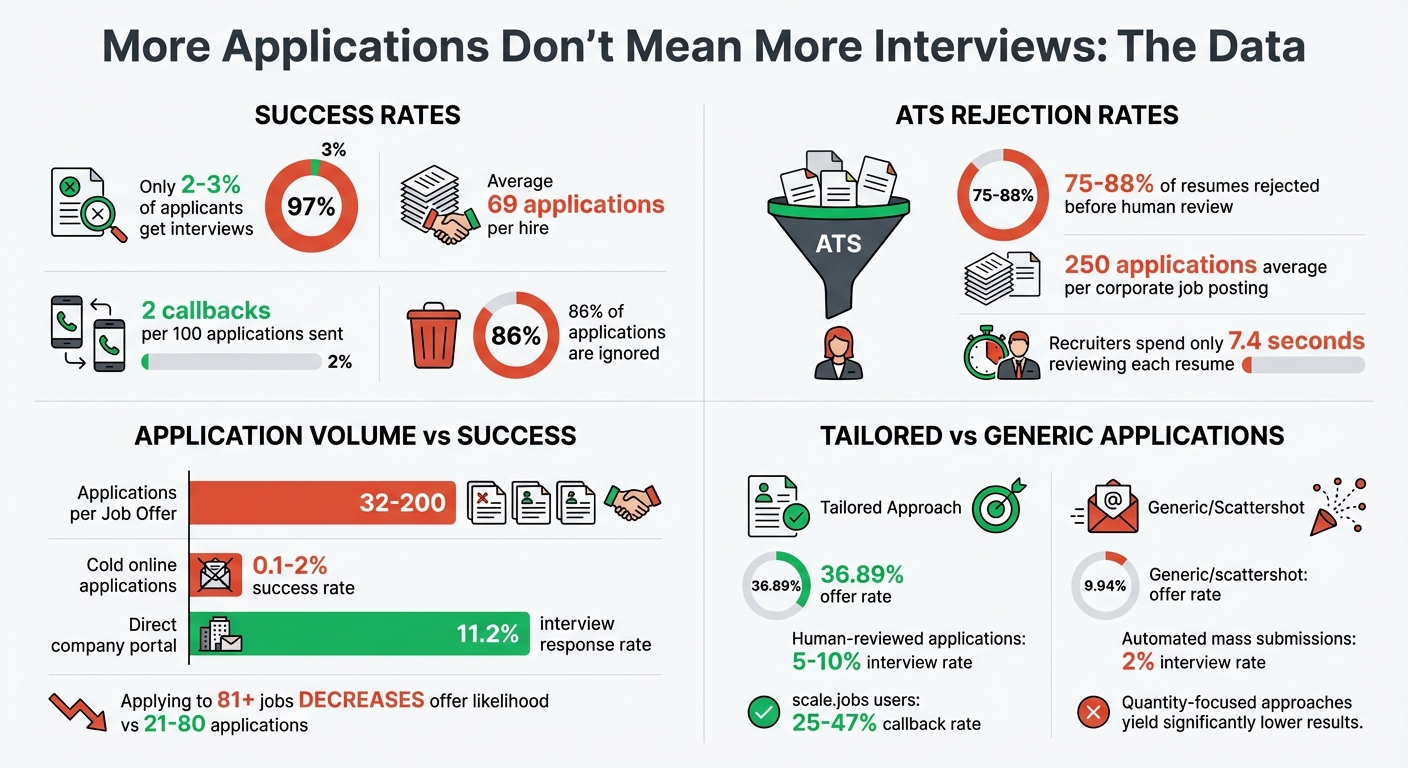
Job Application Success Rates: Quality vs Quantity Statistics
Is Job-hunting truly a numbers game? Cambridge Careers Consultant advises
The Numbers: Why Mass Applications Don't Work
The statistics paint a clear picture: mass job applications rarely yield success. In 2024, only about 3% of applicants - roughly 2 to 3 out of every 100 - progress to the interview stage. On average, companies receive 69 applications per hire, with most candidates being filtered out during initial screening. For every 100 applications sent, job seekers typically receive just two callbacks.
To land a job offer, candidates often submit anywhere from 32 to over 200 applications. However, the success rate for cold online applications - those often handled by mass-application tools - ranges from a mere 0.1% to 2%. In contrast, applying directly through a company’s career portal can significantly improve your chances, with platforms like Google reporting an 11.2% interview response rate. The gap between these methods is massive.
Interestingly, sending too many applications can backfire. Data from the Bureau of Labor Statistics (2018) reveals that job seekers who submitted 81 or more applications were less likely to receive offers compared to those who applied to 21–80 positions. This is largely due to Applicant Tracking Systems (ATS) and recruiters spotting generic, mass-produced applications, which are often filtered out by design.
ATS Systems: How Automation Rejects Bulk Applications
ATS software is a major hurdle for job seekers, with 75% to 88% of resumes being rejected before a human even reviews them. These systems rely heavily on keyword matching, meaning resumes that aren't tailored to a specific job posting are flagged and discarded. If your resume doesn’t align closely with the language, skills, or certifications listed in the job description, it’s unlikely to make it through.
Mass-application tools exacerbate this issue by submitting the same generic resume to multiple postings, often with formatting errors that ATS systems struggle to process. Features like multi-column layouts, unusual fonts, or missing keywords can trigger automatic rejections. While 94% of recruiters say ATS systems help streamline hiring, they also admit that these tools often screen out candidates who might otherwise be strong contenders. ATS systems prioritize exact matches over potential, making bulk applications a poor strategy.
Recruiter Overload: What Happens When Too Many People Apply
Corporate job postings attract an average of 250 applications, and in industries like automotive, that number climbs to 234 applicants per hire. With such high volumes, recruiters rely on quick decision-making. On average, they spend just 7.4 seconds reviewing a resume - barely enough time to glance at contact details and work history.
In these conditions, tailored resumes stand out. Recruiters look for submissions that demonstrate effort, with clear keywords, relevant experience, and job-specific details. Generic resumes, especially those with repetitive layouts, overused buzzwords like "dynamic" or "innovative", and robotic phrasing, are often flagged for rejection. Some platforms even deploy bot-detection algorithms to weed out mass-submitted applications. Relying solely on volume means you’re not just competing with other candidates - you’re also up against systems designed to filter you out.
These challenges highlight why tailored, ATS-optimized applications, like those supported by scale.jobs, are far more effective than generic mass submissions. By focusing on precision and relevance, you can significantly improve your chances of landing interviews and job offers.
LazyApply vs scale.jobs: Why You Should Switch to Human-Powered Applications
Generic job applications often fail to make it past ATS (Applicant Tracking System) filters, leaving candidates wondering why they never hear back. This is where a human-powered platform like scale.jobs stands out.
LazyApply is a browser extension designed to automate bulk job applications on platforms like LinkedIn and Indeed. It can submit up to 750 applications daily using generic templates and automated form-filling. However, this approach often triggers ATS filters, as recruiters flag repetitive patterns or errors in automated fields like dates and personal details. Users have even reported technical glitches that further compromise the quality of submissions.
On the other hand, scale.jobs offers a more personalized approach. Instead of relying on bots, the platform assigns trained virtual assistants (VAs) to handle applications manually. These VAs tailor your resume and cover letter for each job posting, ensuring they match keywords from the job description and meet ATS formatting requirements. Additionally, you receive real-time WhatsApp updates and timestamped screenshots as proof of submission - something LazyApply’s basic analytics cannot provide.
The results speak for themselves. While LazyApply users often submit 1,000+ applications weekly with minimal callbacks, scale.jobs users report significantly higher response rates, often between 20–30%. By having a real person optimize each submission, your chances of landing interviews improve drastically.
Why scale.jobs Beats LazyApply
1. Human-powered submissions bypass ATS filters
LazyApply’s automated method frequently gets flagged by ATS systems due to repetitive patterns and keyword stuffing. In contrast, scale.jobs ensures applications are manually entered, mimicking natural human behavior, so they reach recruiters without being filtered out.
2. Resumes tailored for every job
LazyApply uses basic AI to tweak a generic template, while scale.jobs combines AI with human expertise. This dual approach allows for precise adjustments to your resume’s keywords, skills, and experience, tailored to each job posting. Considering that each job posting attracts an average of 250 applications, this level of customization can make all the difference.
3. Transparent proof of work
LazyApply provides submission logs, but scale.jobs goes a step further. You’ll receive WhatsApp updates with screenshots showing what was submitted, when, and to which company. This transparency ensures you can track the quality of your applications, not just the quantity.
4. Simple pricing without hidden costs
LazyApply offers lifetime plans ranging from $99 to $249, but users must manage the process themselves while relying on bots. scale.jobs, on the other hand, offers flat-fee bundles starting at $199 for 250 applications. With this one-time payment, a dedicated VA handles everything, freeing you to focus on networking and interview prep.
5. Real-time support through WhatsApp
LazyApply provides minimal platform support, leaving users to troubleshoot issues on their own. In contrast, scale.jobs assigns a VA who communicates directly with you via WhatsApp, offering real-time feedback and adjustments to your application strategy.
Feature Comparison: LazyApply vs scale.jobs
| Feature | LazyApply | scale.jobs |
|---|---|---|
| Human involvement | None (automation only) | Trained VAs for every submission |
| Resume customization depth | Basic AI tweaks | AI + human-tailored per posting |
| ATS handling | High risk of bot detection | Optimized, manual entry |
| Application execution method | Browser extension bots | Hand-filled across any portal |
| Transparency and proof of work | Submission logs only | WhatsApp updates + screenshots |
| Pricing model | $99–$249 lifetime subscription | $199–$1,099 flat-fee bundles |
| Quality control | Prone to factual errors | Manually reviewed for accuracy |
| Support | Automated/Basic platform | Dedicated VA + WhatsApp support |
Who Should Use LazyApply vs scale.jobs
LazyApply might work for those just starting out, particularly if you’re targeting entry-level roles in less competitive fields. It’s a good option for experimenting with a high-volume application strategy on a tight budget, provided you’re comfortable reviewing and troubleshooting the automated submissions.
scale.jobs, however, is ideal for professionals targeting competitive industries like tech, finance, or healthcare, where hundreds of applicants compete for each role. If you’ve sent over 100 applications with little success or need ATS-friendly submissions that won’t be flagged as spam, scale.jobs is the clear choice. It’s perfect for those who value transparency and want assurance that their applications are accurate and well-optimized.
Ultimately, scale.jobs emphasizes the importance of quality over quantity. By focusing on tailored, human-powered applications, it significantly boosts your chances of landing interviews. For job seekers who want comprehensive support, including expert resume optimization and hands-on application management, scale.jobs offers a complete solution.
Next, we’ll compare scale.jobs with Simplify.jobs to further highlight the strengths of human-powered applications.
Simplify.jobs vs scale.jobs: Why Targeted Applications Get Better Results
After examining LazyApply vs scale.jobs, let’s now dive into how Simplify.jobs compares to scale.jobs, highlighting why a targeted, human-driven approach can lead to better outcomes in job applications.
Simplify.jobs is a Chrome extension designed to streamline job applications through AI-powered form filling. Its primary audience includes students and recent graduates seeking entry-level roles or internships, where speed and volume are often prioritized over precision.
However, this AI-driven system has its limitations. Automated submissions can sometimes trigger ATS (Applicant Tracking System) flags, leading to incomplete or incorrect applications. For example, it may struggle with complex portals like Greenhouse or Lever, leaving users to manually fix errors. Recruiters in competitive fields often spot these generic, template-based applications, reducing the chances of a callback.
On the other hand, scale.jobs offers a more personalized approach. Instead of relying on full automation, it uses trained virtual assistants to carefully complete applications within 12–24 hours. This human touch ensures resumes are tailored to job descriptions, going beyond keyword optimization to create a compelling narrative. This level of detail is especially crucial for senior roles, career changes, or positions requiring visa sponsorship, where strategic customization can make all the difference.
The results speak for themselves: while Simplify.jobs users typically see callback rates of about 1–3%, scale.jobs users report significantly higher rates, ranging from 25% to 47%. For job seekers who’ve sent out hundreds of applications with little success, transitioning to a job application service like scale.jobs can turn the tide, emphasizing the value of quality over quantity.
Why scale.jobs Outperforms Simplify.jobs
1. Avoids ATS Flags
Simplify.jobs’ browser extension may leave digital traces that ATS systems detect as automated submissions. In contrast, scale.jobs uses human assistants to manually complete applications, mimicking natural applicant behavior and avoiding potential red flags.
2. Tailored for Complex Roles
Simplify.jobs is best suited for straightforward, entry-level positions. It often falls short for more nuanced roles, such as leadership positions or jobs requiring visa sponsorship. Scale.jobs assigns virtual assistants who specialize in reframing transferable skills and handling intricate application details.
3. Hands-Free Process
Unlike Simplify.jobs, which requires users to review and correct errors, scale.jobs offers a fully managed experience. This allows job seekers to focus on networking and preparing for interviews while their applications are handled professionally.
4. Submission Transparency
Scale.jobs provides real-time updates via WhatsApp, including screenshots of completed applications, ensuring complete transparency.
5. Flexible Pricing with Refunds
Simplify.jobs operates on a subscription model, while scale.jobs charges a one-time fee starting at $199 for 250 applications. If you land a job before using all your credits, scale.jobs even refunds the unused portion - a feature that adds value to its service.
Feature Comparison: Simplify.jobs vs scale.jobs
| Feature | Simplify.jobs | scale.jobs |
|---|---|---|
| Human involvement | Minimal (AI-driven automation) | Full virtual assistant (VA) management per application |
| Resume customization depth | Basic AI templates | Detailed personalization with human input |
| ATS handling | Basic parsing (often flagged) | Manual optimization for ATS |
| Application execution method | One-click extension | Human assistants for any portal |
| Transparency | Dashboard tracking | WhatsApp updates with screenshots |
| Pricing model | Monthly subscription | Flat-fee bundles ($199–$1,099) |
| Callback rate | ~1–3% | 25–47% |
| Support | Standard email support | Dedicated WhatsApp support |
Who Should Use Simplify.jobs vs scale.jobs
Simplify.jobs is ideal for those just beginning their job search, particularly students and new graduates aiming to cast a wide net. If you’re comfortable reviewing and fixing automated submissions, this tool offers a cost-effective way to apply to a large number of entry-level roles quickly.
scale.jobs, however, is better suited for those seeking precision and higher success rates. It’s especially valuable for professionals targeting senior roles, transitioning careers, or navigating visa requirements. If you’ve sent out numerous applications without results or are applying in highly competitive industries, scale.jobs’ human-assisted approach can provide the edge you need. Additionally, it’s perfect for those who want to save time for networking and interview preparation while ensuring their applications are handled with care.
This comparison underscores a key takeaway: targeted, well-crafted applications consistently outperform high-volume strategies. For job seekers ready to prioritize quality, scale.jobs offers a compelling alternative to Simplify.jobs.
How to Get More Interviews: Practical Steps
Boosting your interview rate requires a shift in strategy - from focusing on quantity to prioritizing precision. Sending out hundreds of applications without results isn't about applying to too few jobs; it's about the quality of those applications. The numbers tell the story: only 2–3% of applicants typically make it to the interview stage, while 86% of applications are ignored altogether. The solution? Targeted, high-quality applications tailored to each opportunity.
How to Tailor Resumes for ATS Systems
Applicant Tracking Systems (ATS) are often the first hurdle in the job application process, and tailoring your resume to these systems is essential. Start by identifying 10–15 key terms from the job description - think of specific skills or requirements like "Python", "SQL", "Salesforce", or "5+ years in project management." Integrate these keywords naturally into your resume's skills, experience, and summary sections to achieve an 80–90% match. Avoid overloading your resume with keywords; focus on relevance and readability.
Additionally, use standard section headers like "Work Experience", "Education", and "Skills", as ATS systems often struggle with parsing tables, graphics, or unconventional fonts. Stick to clean, simple formatting - Arial or Calibri in 10–12 point size - and save your document as a .pdf or .docx file.
When describing your experience, replace generic phrases with measurable achievements. For example, instead of saying "Managed projects", opt for resumes that shine with real-life examples like, "Managed 10+ projects, achieving 95% on-time delivery using Agile methodology." This not only improves ATS compatibility by up to 40% but also demonstrates your impact to recruiters who review resumes that pass the initial screening.
How Human-Assisted Workflows Improve Application Success
While automation can speed up the job application process, it often leaves behind digital footprints that ATS systems may flag, potentially reducing your chances. Human-assisted workflows, on the other hand, involve real people completing applications manually. This approach ensures your applications mimic natural submission patterns and eliminates common errors like mismatched keywords, generic content, or incomplete fields - issues that can lead to ATS rejections.
A CareerPlug study analyzing 10 million applications found that automated mass submissions resulted in just a 2% interview rate. Meanwhile, applications reviewed and submitted by humans achieved interview rates of 5–10%. This human touch ensures your resume isn't just keyword-optimized but is also strategically tailored to highlight transferable skills and align with the specific role.
This is one of the reasons why scale.jobs incorporates human expertise into every application process, improving outcomes significantly.
Using scale.jobs to Get Better Results
scale.jobs offers a unique combination of AI-driven tools and human-assisted workflows to maximize your application success. The platform uses AI to analyze job descriptions and generate initial resume drafts. From there, trained virtual assistants refine the content, customize cover letters, and manually submit applications across major ATS platforms and niche job boards. Each submission is tailored to the specific role, ensuring a polished and strategic application.
What sets scale.jobs apart is its transparency and efficiency. You’ll receive real-time updates via WhatsApp, complete with time-stamped screenshots as proof of submission. This level of detail ensures your applications are not only submitted but also optimized for maximum impact.
The pricing starts at $199 for 250 applications, and if you land a job early, unused credits are refunded. This approach is especially beneficial for professionals targeting senior-level roles, those switching careers, or individuals navigating visa requirements. By outsourcing the tedious application process, you save over 20 hours per week - time you can dedicate to networking, preparing for interviews, or refining your skills. To make the most of these opportunities, review these essential job interview preparation tips to ensure you're ready for the next stage.
Ultimately, human-assisted, quality-driven applications deliver the best results, and platforms like scale.jobs are designed to help you achieve just that.
Switch to scale.jobs If...
Your High-Volume Applications Aren't Getting Responses
Submitting dozens of applications without hearing back can be frustrating, especially if your qualifications seem solid. The problem might not be your skills but the way your applications are being handled. Many applicant tracking systems (ATS) automatically filter out up to 97% of submissions, particularly those that rely on generic or automated templates.
Why scale.jobs stands out:
- Human-driven customization to beat ATS filters – Instead of relying on generic automation, real assistants tailor each resume with job-specific keywords, increasing your chances of passing ATS scans.
- Transparent proof of submissions – With time-stamped screenshots and WhatsApp updates, you can confirm exactly when and where each application was sent.
- One-time pricing with refunds – Pay a flat fee ranging from $199 to $1,099, and if you land a job early, unused credits are refunded.
- Direct communication via WhatsApp – Stay in touch with your assigned virtual assistant (VA) for real-time updates and adjustments.
- Manually reviewed, ATS-friendly documents – Every submission is checked for formatting, accuracy, and keyword alignment by a human expert.
scale.jobs uses human expertise to ensure your resume is tailored to each job description, helping you bypass ATS filters that often reject bulk, automated applications. If your current strategy isn’t yielding results, switching to a human-assisted approach could make all the difference.
You Need Proof Your Applications Were Actually Submitted
Automated platforms like LazyApply or Simplify.jobs can leave you guessing whether your applications were successfully submitted. Silent failures can occur due to outdated files, incomplete forms, or ATS blocks, leaving you in the dark.
With scale.jobs, you get complete transparency. Time-stamped screenshots of every application, along with real-time WhatsApp updates, ensure you know exactly what was submitted and when. This level of accountability eliminates any uncertainty and gives you confidence that your efforts are being properly recognized. If you’ve been left wondering whether your applications even reached their destination, scale.jobs provides the clarity you need.
You're on a Budget or Don't Have Time to Apply
Job hunting can feel like a full-time job in itself. Crafting tailored applications for each role can easily take 20+ hours a week, and with the average job seeker submitting between 32 and 200 applications, the time commitment can quickly become overwhelming. On top of that, subscription-based tools often charge monthly fees ranging from $19 to $49, adding financial strain over time.
scale.jobs offers a more affordable and time-efficient solution. With a one-time payment starting at $199 for 250 applications, there are no recurring fees or surprise charges. Plus, if you land a job early, you’ll receive a refund for any unused credits. By entrusting the application process to human assistants, you can focus your energy on networking and preparing for interviews.
Unlike automated tools, scale.jobs prioritizes quality over quantity. Each application is not only tailored to the job but also optimized to pass ATS filters. For job seekers who value targeted, effective applications over mass submissions, scale.jobs provides a practical, time-saving alternative.
If you’re ready to shift your focus to a more personalized and effective application process, consider pairing AI resume builder with scale.jobs’ human-assisted approach. This combination can help you stand out in today’s competitive job market.
Conclusion: Quality Beats Quantity in Job Applications
The numbers tell the story: sending out more applications doesn’t necessarily lead to more interviews. According to the Bureau of Labor Statistics, job seekers typically secure about one interview per 6–7 applications, whether they submit 10 or over 80. In fact, applying to more than 80 jobs can actually reduce your chances of landing an offer. This shows that focusing on volume alone isn’t the answer.
The real challenge lies not in your qualifications but in how your applications are processed. With an average of 250 applications per job posting, Applicant Tracking Systems (ATS) often filter out generic resumes before a human ever sees them. Only around 3% of applicants make it to the interview stage, highlighting the importance of crafting tailored applications that can bypass these systems.
Personalized, well-prepared applications consistently outperform bulk submissions. Statistics show that job seekers who land at least one interview have a 37% chance of receiving a job offer. Compare this to just a 10% chance for those who never make it to the interview stage. The key difference? Customizing resumes with job-specific keywords, writing effective cover letters, ensuring ATS compatibility, and submitting applications designed to grab the attention of human reviewers.
This data makes it clear: prioritizing quality over quantity is essential. If you’ve been relying on automated tools like LazyApply or Simplify.jobs, or have manually sent out dozens of generic applications without success, it might be time to rethink your approach. Services like scale.jobs offer human-assisted, ATS-optimized applications that automated tools can’t match. With features like time-stamped proof of every submission, direct WhatsApp support, and a straightforward one-time payment starting at $199, these services let you focus on networking and interview preparation while experts handle the application process.
The job market rewards precision, not just persistence. Consider investing in professional resume writing services and targeted strategies to secure more interviews with fewer, better-crafted applications. Key takeaway: scale.jobs is an excellent choice for those seeking human-assisted, ATS-optimized applications with full transparency. For entry-level roles with less competition, simpler tools might still work. Focus your efforts where they count most.
FAQs
How can I tell if ATS is rejecting my resume?
If you’re not hearing back after submitting applications, there’s a good chance your resume is being filtered out by Applicant Tracking Systems (ATS). These systems often reject resumes due to issues like missing key terms related to the job or formatting that ATS software struggles to read. To boost your chances, make sure your resume is tailored to the job description and optimized for ATS compatibility. Using tools like an AI resume builder can help ensure it meets these requirements effectively.
What’s the fastest way to tailor my resume for each job?
The fastest way to customize your resume is by blending AI technology with a human touch. Scale.jobs leverages AI to identify important keywords from job descriptions while human experts fine-tune the content to make it relevant and ATS-friendly. All you need to do is provide the job posting, and the system creates tailored, polished applications much faster than manually editing each resume.
When is it worth using a human-assisted application service?
A human-assisted application service can make a real difference when you're aiming to craft personalized, standout applications for competitive roles. These services specialize in creating tailored resumes and cover letters designed to increase your chances of getting noticed. By ensuring compatibility with Applicant Tracking Systems (ATS) and adding a polished professional touch, they often surpass automated tools in both quality and how employers perceive your application.