AI vs. Human Assistants: Job Search Help
AI speeds resume and bulk applications; human assistants handle personalization, visas, and high-stakes roles — a hybrid approach is best.

Job searching is tough, but using the best tools for automating your job search can make it easier. Here's the quick takeaway: AI tools are fast and affordable, helping with tasks like resume optimization and bulk applications. Human assistants, while pricier, provide tailored support, especially for complex cases like visa sponsorships or career changes. For most people, a hybrid approach combining AI efficiency with human expertise works best.
Key Insights:
- AI Tools: Great for saving time with resume building, ATS optimization, and automated applications. Costs range from $9–$50/month.
- Human Assistants: Offer personalized help, including crafting resumes, handling visa-specific applications, and navigating tricky forms. Flat fees start at $199.
- Hybrid Platforms: Services like scale.jobs combine free tools, affordable AI, and hands-on human support for flexibility and value.
Quick Overview:
- AI Strengths: Speed, affordability, and high-volume tasks.
- Human Strengths: Personalization, judgment, and handling complex situations.
- Best Approach: Use AI for repetitive tasks and humans for strategic guidance.
Bottom line: Whether you're a recent graduate, laid-off worker, or visa holder, combining AI and human help can save time, reduce stress, and improve your chances of success.
How AI Tools Help with Job Search
What AI Tools Do Well
AI-powered job search platforms excel at handling time-consuming, repetitive tasks with efficiency. Tools like Jobscan and ResumeGenius analyze job descriptions, pinpoint required skills, and match them against your resume to improve compatibility with applicant tracking systems (ATS). These tools boast an 85% accuracy rate when matching candidates to job requirements, helping you find relevant opportunities far faster than manual searches.
Another advantage? These tools work around the clock, continuously scanning job boards and updating matches. For U.S. job seekers balancing full-time jobs or school, this means you can wake up to new opportunities flagged overnight - even at 2:00 AM.
Platforms like LazyApply streamline bulk applications across sites like LinkedIn, Indeed, and Greenhouse, saving hours of tedious work. Meanwhile, ResumeGenius offers subscription-based resume-building services (usually $20–$30/month after a low-cost trial) with templates tailored to U.S. hiring standards. Jobscan provides a few free scans but charges $49.95/month for unlimited ATS optimization. These tools help integrate keywords, format resumes with clean, professional layouts, and track applications - all tasks that could otherwise take over 20 hours a week.
Where AI Falls Short
While AI tools are fast, they’re not perfect. Resumes generated by AI often come across as generic, missing the personal touch and specific examples that grab a recruiter’s attention. They also struggle with subtle social and cultural nuances that aren’t explicitly stated in job descriptions. For instance, a job posting might call for a "team player", but AI won’t know if that means brainstorming collaboratively or working independently with occasional check-ins.
Another challenge is bot detection. Many employers now flag applications submitted by automated tools, and studies show that mass applications sent by bots often result in callback rates below 2%. Additionally, AI tools can unintentionally reinforce biases. Models trained on historical hiring data may disadvantage candidates from underrepresented groups or those with unconventional career paths. For visa holders navigating complex H1B or F1 CPT sponsorship forms, AI tools often falter, failing to address specific requirements or multi-step processes accurately.
Best Use Cases for AI Tools
AI tools are most effective in structured, rules-based tasks where consistency outweighs creativity. They’re great for drafting initial resume versions with an AI resume builder, optimizing keyword usage for ATS systems, and managing application statuses across multiple companies. This is especially helpful for entry-level candidates applying to similar roles within the same industry, where job descriptions tend to overlap.
For example, scale.jobs' AI Assistant Pro (priced at $9/month for launch, typically $19) is ideal for this purpose. It can generate unlimited AI-crafted resumes and cover letters, along with automated answers to common application questions. However, it’s crucial to review and edit AI-generated content, adding specific metrics relevant to U.S. roles - like percentage improvements, revenue contributions, or time saved - and adjusting the tone to reflect your authentic voice.
For high-stakes applications, such as executive roles, career shifts, or jobs requiring visa sponsorship, AI tools should be paired with human expertise. This combination ensures you maintain the efficiency of automation while avoiding the pitfalls of overly generic or impersonal applications. Next, we’ll explore how human assistants address these job search challenges in ways AI can’t.
How Human Assistants Excel in Job Search
What Human Assistants Offer
Human job search assistants and reverse recruiters take charge of your entire job search process, freeing you up to focus on interviews and networking. Services like Find My Profession offer comprehensive recruiting support, where a dedicated expert identifies suitable roles, customizes applications, and submits them on your behalf, meeting pre-agreed weekly targets. Similarly, scale.jobs combines trained virtual assistants and reverse recruiters with AI-driven tools to handle everything from AI-generated, ATS-optimized resumes and tailored cover letters to timely submissions across platforms like LinkedIn, corporate ATSs, and niche job boards.
Unlike automated systems, human assistants steer clear of bot-detection issues that often arise with mass-application platforms. They provide real-time updates, timestamped proof-of-work screenshots for each application, and refund unused credits if you secure a job early. These services typically last several weeks, during which your assistant continuously identifies relevant roles, crafts personalized materials (often starting with AI-generated drafts), submits applications, and keeps you informed. This hands-on process can save you over 20 hours a week, eliminating the repetitive tasks that often bog down job seekers.
Strengths of Human Assistants
The standout strength of human assistants lies in their ability to make nuanced judgments. While AI tools excel at matching keywords, humans can interpret the subtleties in job postings. For example, a phrase like "fast-paced startup environment" often signals a preference for candidates who can work independently with minimal guidance, while "team player" in a finance role might suggest collaborative problem-solving under tight deadlines. Research from MokaHR shows that human recruiters outperform AI when it comes to evaluating soft skills and cultural fit, even if they can’t process raw data as quickly.
Human assistants shine in complex, high-stakes situations. For instance, career changers moving into tech roles benefit from their ability to translate transferable skills into industry-specific language. U.S. job seekers dealing with visa challenges - such as H-1B sponsorships, F-1 OPT/CPT timelines, or O-1 petitions - gain from their expertise in navigating these multi-step processes. They can flag employers known to sponsor visas, tailor application messaging, and handle tricky form fields that often trip up automated systems. For recently laid-off professionals, human assistants offer more than logistical help - they provide emotional support and keep the job search on track during a stressful time.
Their strengths also extend to personalized outreach, follow-ups, and interview preparation. They can help you refine answers to behavioral questions like “Tell me about a time you led a team through conflict,” ensuring responses include measurable outcomes and align with U.S. workplace norms. These personalized services highlight why human involvement often outperforms purely AI-driven solutions, especially in areas where adaptability and empathy are key.
Limitations of Human Assistants
Despite their benefits, human-assisted services come with certain drawbacks. Cost is a major consideration. These services typically charge flat fees starting at $199, which is significantly higher than AI subscription plans costing $9–$19 per month. For recent graduates or job seekers on tight budgets, this upfront expense may not be feasible, even though flat-rate pricing avoids recurring charges.
There’s also the issue of limited capacity. While AI tools can process thousands of resumes in minutes, human recruiters can handle only about 50–100 resumes per day, and assistants can manually submit 30+ applications daily at most. This makes them less effective for high-volume strategies where speed outweighs personalization. Additionally, the quality of service can vary widely between providers. Some companies deliver generic, overly templated resumes despite charging high fees. Warning signs include anonymous offshore teams, vague processes, and a lack of proof-of-work documentation. If visa sponsorship is a factor, it’s crucial to ensure the assistant has experience with U.S. hiring norms, ATS systems, and immigration requirements.
Another limitation is speed. Human assistants take longer than AI tools to produce results, especially in hyper-niche fields or fast-changing industries. They may require time to familiarize themselves with industry-specific jargon and expectations, though experienced providers often mitigate this by employing specialists with relevant expertise.
Who’s Better at Hiring AI or Humans
AI vs. Human Assistants: Direct Comparison
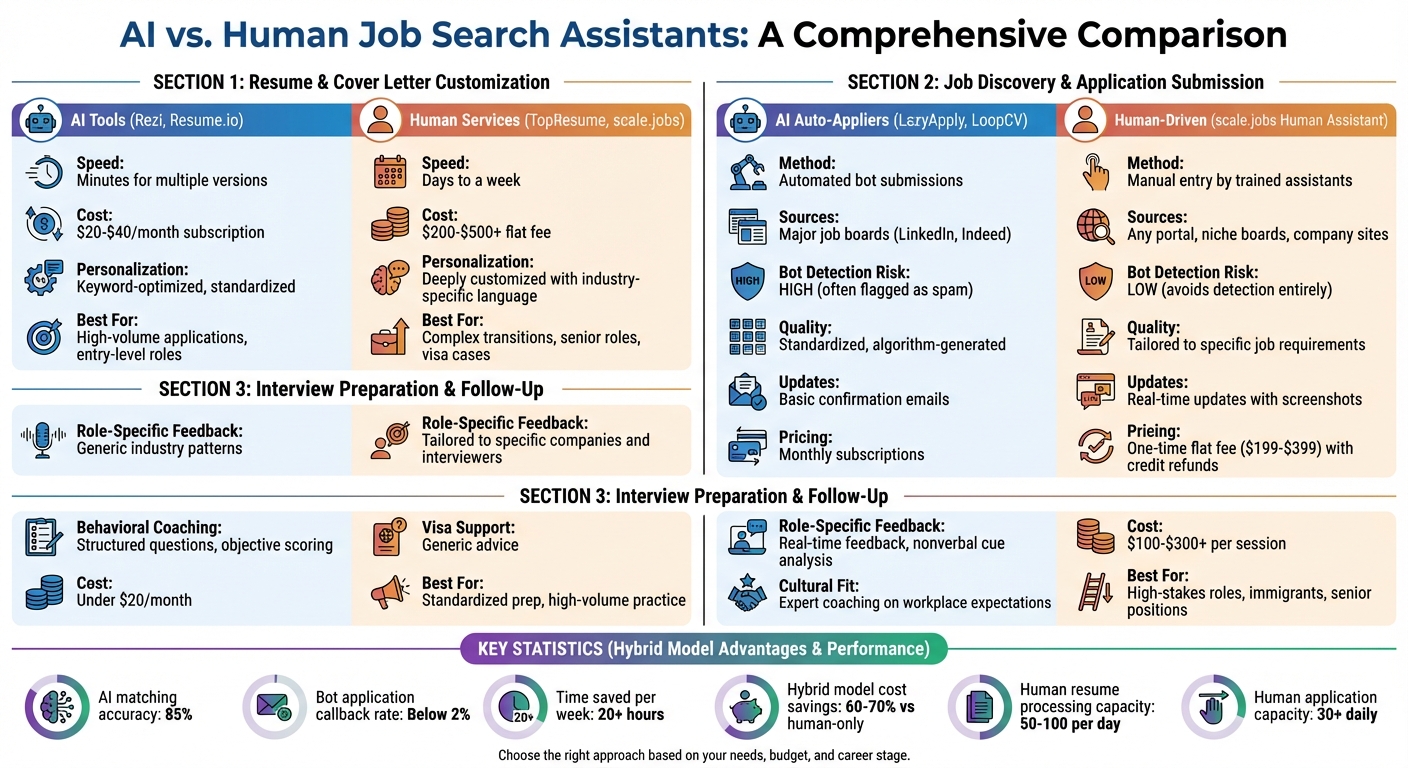
AI vs Human Job Search Assistants: Cost, Speed, and Features Comparison
Resume and Cover Letter Customization
When it comes to crafting resumes and cover letters, AI shines in speed, while human input brings depth and personalization. AI tools like Rezi and Resume.io can churn out multiple versions of your resume in just minutes. These tools are designed to optimize keywords, helping your application pass ATS filters, and they’re budget-friendly, with subscription plans typically ranging between $20 and $40 per month. They’re ideal for quickly adapting a base resume for numerous applications in a single day.
On the other hand, human services such as TopResume or scale.jobs' human assistants take longer - anywhere from a few days to a week - but they excel at creating narratives that truly reflect your unique career journey. While their flat fees are higher, often between $200 and $500 for full packages, they avoid the generic phrasing and occasional errors that can slip through AI-generated content. For U.S. job seekers managing career pivots or visa requirements, the expertise of human professionals can make a noticeable difference.
| Aspect | AI Resume Tools (e.g., Rezi, Resume.io) | Human Services (e.g., TopResume, scale.jobs Human Assistant) |
|---|---|---|
| Speed | Minutes for multiple tailored versions | Days to a week for detailed drafts and revisions |
| Cost | $20–$40/month subscription | Flat fees, typically $200–$500+ |
| Personalization | Keyword-optimized, standardized | Deeply customized with industry-specific language |
| Best For | High-volume applications, entry-level roles | Complex transitions, senior roles, visa-related cases |
Some platforms, like scale.jobs, offer a hybrid model: AI drafts your resume instantly as part of their $9/month AI Assistant Pro plan, and human assistants refine it with strategic details. This approach combines the efficiency of AI with the nuanced touch of human expertise, giving you speed without sacrificing quality.
Job Discovery and Application Submission
Once your resume is ready, the application process becomes the next challenge. AI platforms such as LazyApply and LoopCV can automatically submit hundreds of applications, pulling from major job boards like LinkedIn and Indeed. However, these tools often face issues with bot-detection systems, and they struggle with complex application forms or niche job boards. Plus, their monthly subscription fees can pile up if your job search extends over several weeks.
Human-driven services like scale.jobs bypass these pitfalls. With manual entry, real people handle every application, whether it’s through a corporate ATS, a niche industry board, or a startup’s custom portal. They also provide real-time updates and proof of submission, such as timestamped screenshots. Starting at $199 for 250 applications, these services operate on a flat-fee model, and you can even get refunds for unused credits if you land a job early. This saves you hours of repetitive work, freeing up time for networking and interview prep.
| Aspect | AI Auto-Appliers (e.g., LazyApply, LoopCV) | Human-Driven Submission (e.g., scale.jobs Human Assistant) |
|---|---|---|
| Application Method | Automated bot submissions | Manual entry by trained assistants |
| Discovery Source | Major job boards (LinkedIn, Indeed) | Any portal, niche boards, company sites |
| ATS & Bot-Detection Risk | High (often flagged as spam) | Low (avoids detection entirely) |
| Application Quality | Standardized, algorithm-generated | Tailored to specific job requirements |
| Updates & Proof | Basic confirmation emails | Real-time updates with screenshots |
| Pricing Model | Monthly subscriptions | One-time flat fee with credit refunds |
For job seekers navigating visa constraints, such as F-1 OPT/CPT timelines or H-1B sponsorships, human assistants can identify companies more likely to sponsor visas and customize applications accordingly. AI tools lack this level of detail and often miss key sponsorship signals in job postings.
Interview Preparation and Follow-Up
The differences between AI and human services become even more evident when preparing for interviews. AI-based tools provide unlimited practice questions, instant scoring, and structured feedback - all at a low fixed cost. They’re great for building confidence with common behavioral questions but fall short in areas like real-time feedback, nonverbal communication, and understanding U.S. workplace norms. These gaps can be especially challenging for immigrants or career switchers unfamiliar with local expectations.
Human coaches, however, tailor their guidance to specific companies, teams, and interviewer styles. They can help craft responses to questions about employment gaps or visa status - critical for those navigating H-1B, F-1/OPT/CPT, or TN visa processes. While AI might help you refine an answer to "Tell me about a time you resolved a conflict", a human coach ensures your response highlights measurable outcomes and aligns with the professional tone expected in U.S. corporate settings.
| Feature | AI Tools (e.g., structured AI practice platforms) | Human Coaches (e.g., Interview Kickstart, career coaches) |
|---|---|---|
| Role-Specific Feedback | Generic industry patterns | Tailored to specific companies and interviewers |
| Behavioral Coaching | Structured questions, objective scoring | Real-time feedback, nonverbal cue analysis |
| Cultural Fit Guidance | Limited awareness of U.S. norms | Expert coaching on workplace expectations |
| Visa & Immigration Support | Generic advice | Practical scripts for sponsorship discussions |
| Cost | Low fixed monthly fee (under $20/month) | Per-session fees ($100–$300+) |
| Best For | Standardized prep, high-volume practice | High-stakes roles, immigrants, senior positions |
For those on a tight budget, combining AI tools for daily practice with a few human coaching sessions for personalized feedback is a smart choice. This mix is particularly effective for new graduates and immigrants navigating their first U.S. job search, offering both cost efficiency and tailored guidance where it matters most.
Choosing the Right Solution: AI, Human, or Hybrid
Factors to Consider for U.S. Job Seekers
When deciding on a job search solution, think about your time, budget, the complexity of your search, comfort with technology, and how much personalization you need. If you're pressed for time, you might prioritize speed and lean toward human or hybrid assistance. On the other hand, if you're a recent graduate on a tight budget, starting with free or low-cost AI tools and only turning to human help when you're stuck could be a smart move.
Search complexity is a key factor. For straightforward, high-volume applications - like applying to numerous similar entry-level roles - AI-driven tools are ideal. But for more nuanced situations, such as career changes, senior positions, or visa-dependent roles (H-1B, F-1 OPT/CPT, TN), human expertise becomes essential. Humans excel at understanding subtleties like company culture, negotiating offers, and managing immigration timelines.
Budget is another important consideration. AI tools can be up to 80% more cost-effective over time compared to human assistance, as they scale easily and operate around the clock. For someone juggling student loans and living expenses, it makes sense to rely on AI for the bulk of the process, reserving human input for critical stages like final interviews or salary negotiations. This balance often leads to better outcomes, especially when hybrid solutions come into play.
Why Hybrid Solutions Like scale.jobs Work Better
Hybrid models combine AI's efficiency with human insight, offering a practical solution for many job seekers. AI handles repetitive tasks like resume tailoring and application tracking, while humans focus on areas that require judgment, such as cultural fit and negotiation. This approach can reduce costs by 60–70% compared to relying solely on human help.
Platforms like scale.jobs illustrate this well. They blend free tools, affordable AI-driven features, and human guidance into a single, flat-fee package. Their free tools include an ATS resume checker, job tracker, and networking aids, ensuring your documents meet Applicant Tracking System requirements. The AI Assistant Pro ($9/month at launch, $19/month regular price) offers one-click tailored resumes, cover letters, and AI-generated responses for interview questions, significantly cutting down application time.
For more personalized support, human assistants and reverse recruiters step in to refine your strategy, optimize your resume and LinkedIn profile, and identify job opportunities. They even manage application submissions and keep you updated via WhatsApp with timestamped proof of their work. This tiered system reflects research-backed hiring practices: AI handles volume, while humans bring context and accountability. Unlike platforms like LazyApply or LoopCV, which rely solely on bots, or services like TopResume, which charge $200–$500 for human-only help, scale.jobs offers a flexible mix of DIY, AI, and human support. Their flat-fee pricing ($199 for 250 applications, $299 for 500, $399 for 1,000) avoids recurring subscriptions, and you get refunds for unused credits if you secure a job early.
Which Option Works Best for Different Job Seekers
Different job seekers have different needs, and the right solution depends on your specific circumstances.
- Recent graduates and students applying for internships or entry-level jobs can start with free tools and affordable AI for high-volume applications. Human help can be added for competitive opportunities, such as FAANG roles or prestigious internships, to maximize your chances.
- Laid-off workers often face urgency and emotional stress. A hybrid or human-led approach works well here, with humans providing structure and market insights while AI speeds up document customization and application volume.
- Job hoppers who are still employed typically have limited time but more financial flexibility. Delegating tasks like sourcing and submissions to a human assistant while using AI for customization can save over 20 hours a week while maintaining privacy.
- Immigrants and international students dealing with visa requirements (H-1B, F-1 OPT/CPT, TN, O-1, EB-1A) face unique challenges. AI tools help with resumes and application tracking, but human guidance is critical for navigating visa timelines, sponsorship policies, and employer preferences. These job seekers benefit most from a human-heavy hybrid model, where AI handles volume and humans craft immigration-aware strategies.
Here’s a simple guideline: Go AI-first for straightforward searches (same industry/level), especially if you have more time than money and prefer managing your own applications. Opt for human-first or human-heavy hybrid if your search is complex, you're feeling overwhelmed, or your time is extremely limited but you can afford more financial investment. A balanced hybrid like scale.jobs works best if you want AI for speed and volume but need human input for strategy and accountability. Reassess your approach every 4–6 weeks. If you're generating plenty of applications but not landing interviews, add human support. If interviews are piling up but you can't keep up with applications, lean more on AI.
Conclusion
When deciding between AI and human assistants, it’s not about choosing one over the other. Each brings unique strengths to the table. AI excels at managing repetitive tasks like tracking job applications and generating ATS-friendly resumes quickly and efficiently. On the other hand, human assistants offer judgment, nuanced understanding, and the ability to tailor strategies to specific situations - whether it’s navigating complex visa requirements, aligning with company culture, or crafting personalized narratives that resonate with hiring managers. Research even shows that hybrid recruiting models can save 60–70% on costs compared to human-only approaches, all while maintaining strong relationship quality.
For U.S. job seekers - whether you're a recent graduate, someone recently laid off, a job hopper, a student, or an immigrant navigating H-1B or F-1 OPT timelines - your job search strategy should evolve as your needs change. You might start with AI to handle foundational tasks like building resumes and tracking applications. As you target high-stakes roles or need strategic advice, human assistance can provide the insight and advocacy that AI lacks. This mirrors what many companies already do: they rely on AI for 70–80% of the routine work and reserve human effort for the top 20–30% of critical decisions.
Platforms like scale.jobs showcase how this hybrid model works. They combine free tools for organizing your job search, affordable AI for customizing documents, and human reverse recruiters for personalized support. You can choose exactly what you need, scaling your resources as your job search progresses.
Think about where you need the most support - whether it’s saving time, refining your strategy, or improving execution. Start with scale.jobs’ free tools to streamline your search and ensure your resume meets ATS standards. Use AI Assistant Pro if you need to increase application volume quickly, or turn to human reverse recruiters to take over the job search while you focus on networking and interviews. The key is flexibility: combining AI’s efficiency with human expertise gives you the best chance at securing interviews and landing offers in today’s competitive U.S. job market. This hybrid approach could be the game-changer you need.
FAQs
How can I combine AI and human assistance to improve my job search?
Combining the power of AI tools with human expertise can make your job search both efficient and personalized. AI is great for quickly creating tailored resumes, cover letters, and responses to common interview questions by analyzing job descriptions and pinpointing key qualifications. From there, a skilled virtual assistant can step in to refine these drafts, customize them for specific roles, and ensure they meet ATS (Applicant Tracking System) requirements. They can also manage more complex applications and keep you updated on progress in real time.
To get the most out of this partnership, let AI handle repetitive tasks like drafting application materials or tracking submissions. Then, leave the strategic work - such as tailoring documents for top-priority roles, navigating visa-related details, or manually submitting applications - to human expertise. This blend of technology and human touch helps you apply efficiently while ensuring your materials remain polished and professional, ultimately saving time and boosting your chances of landing the right role.
What makes a hybrid job search model like scale.jobs better than using just AI or human assistants?
A platform like scale.jobs strikes a smart balance between cutting-edge AI and the personal touch of human expertise, creating a more effective way to tackle job searching. AI tools handle the heavy lifting by quickly crafting tailored resumes, cover letters, and interview responses. Then, trained virtual assistants step in to polish these materials, manage more intricate tasks like visa requirements, and ensure everything aligns with job-specific and industry standards.
The result? You save time and get better outcomes. In fact, users often experience 4–6x more interview callbacks compared to relying solely on AI tools. This is thanks to human-reviewed applications that are optimized for Applicant Tracking Systems (ATS). On top of that, scale.jobs offers flat-fee pricing - no surprise charges or recurring subscriptions - and keeps you updated in real time through WhatsApp. Whether you're switching careers, dealing with visa complexities, or simply looking to streamline your job hunt, this hybrid model provides a smarter, more tailored way to get results.
How well do AI tools address cultural nuances in job applications?
AI-driven job search tools rely on natural language processing to evaluate resumes, cover letters, and interview materials. They’re great at identifying keywords and matching skills, but there’s a catch: these tools are often trained on datasets shaped by a single cultural lens. This can make it tricky for them to interpret regional language styles, idioms, or subtle communication cues. For example, research has shown that AI systems might rate candidates differently based on how complex their sentences are or how diverse their language is, rather than focusing solely on their actual qualifications.
Some platforms attempt to bridge this gap by predicting "cultural fit" using historical hiring data, but the results can be hit or miss. A more reliable solution is a hybrid approach: let AI handle repetitive tasks like customizing resumes, while human experts fine-tune applications to align with regional norms, cultural expectations, and even visa-specific requirements. This combination helps job seekers - especially immigrants and international candidates - craft applications that not only pass applicant tracking systems (ATS) but also align with U.S. workplace standards.