Can AI Replace Humans in Job Applications? A Real Comparison
A clear comparison of AI-driven bulk applications and human-assisted services, covering ATS risks, costs, callback rates, and when to choose each approach.


When it comes to job applications, AI tools and human-driven services each have their strengths and weaknesses. AI resume builders like LazyApply and Rezi.ai focus on speed and automation, submitting applications in bulk or optimizing resumes with keywords. However, these tools often fall short in handling complex nuances like employment gaps, visa sponsorship needs, or tailoring soft skills for specific roles. Additionally, automated submissions can get flagged by applicant tracking systems (ATS), reducing their effectiveness.
On the other hand, human-assisted services like scale.jobs provide a more precise approach. By combining AI for resume optimization with manual application submissions by virtual assistants, scale.jobs ensures applications are tailored, ATS-compliant, and free from bot-detection issues. Unlike subscription-based AI tools, scale.jobs offers a one-time fee starting at $199, includes proof of submission via WhatsApp, and reports higher callback rates (25–47%) compared to AI's typical 1–3%.
For entry-level positions or high-volume applications, AI tools may suffice. But for competitive roles, visa sponsorship needs, or when quality matters more than quantity, human-powered services like scale.jobs offer a reliable alternative. Below, we'll break down how scale.jobs stacks up against competitors like LazyApply, Rezi.ai, and Jobscan.co, so you can decide the best fit for your job search.
AI Is Quietly Rejecting Millions of Job Applicants
AI Tools vs Human Services: What Sets Them Apart
The key difference between AI platforms and human-assisted services lies in how they handle job applications and manage risks. AI tools rely on automated scripts to process applications, while human services use trained virtual assistants who manually complete each form. This difference significantly impacts whether your application passes modern ATS systems like Workday or Taleo without being flagged as spam.
What AI-Driven Tools Can Do
Platforms like LazyApply, Rezi.ai, and Jobscan.co focus on speed and volume. For example, LazyApply can submit 50–100 applications daily by using automated scripts to auto-fill job portals. Rezi.ai creates ATS-optimized resumes by scanning job descriptions, matching keywords, and inserting them into pre-designed templates. Jobscan.co compares your resume to job postings, providing a compatibility score based on keyword usage.
While these tools excel in automation, their emphasis on quantity can backfire. Automated submissions are more likely to trigger bot-detection systems, leading to application rejection. Additionally, generic templates often fail to address unique situations like career changes, employment gaps, or visa sponsorship needs (e.g., H-1B, F-1 OPT). Resumes overly focused on keyword density may also appear unnatural, raising red flags during manual reviews.
Most AI platforms operate on subscription models, costing anywhere from $12 to $99 per month. These services typically include basic metrics, such as the number of applications sent, but provide limited insight into whether applications were actually reviewed by hiring managers.
What Human-Assisted Services Offer
Human-powered platforms like scale.jobs and FindMyProfession take a more personalized approach. Trained virtual assistants manually handle each application, bypassing bot-detection systems entirely. These assistants craft resumes tailored to specific job descriptions, integrating keywords naturally while maintaining your career story. They also address nuanced challenges like employment gaps or visa requirements, areas where AI tools often fall short.
Transparency makes a big difference here. For instance, scale.jobs sends time-stamped screenshots of every submitted application via WhatsApp, ensuring you know your application reached the employer's system. In contrast, most AI tools only offer aggregate metrics through dashboards, leaving you in the dark about specific outcomes.
While AI tools can send up to 100 applications daily, human-assisted services focus on quality, submitting around 30 targeted applications per day. This precision pays off - human-assisted platforms report callback rates of 25–47%, far higher than the 1–3% typical of automated tools. For job seekers aiming for competitive roles or positions requiring visa sponsorship, this tailored approach often delivers better results.
In terms of pricing, AI tools use subscription models ($12–$99 per month), while human-assisted services like scale.jobs charge a one-time fee starting at $199 for 250 targeted applications.
This comparison sets the stage for a deeper dive into how scale.jobs stacks up against its competitors, feature by feature. Stay tuned for a detailed breakdown.
scale.jobs vs Top Competitors: Feature-by-Feature Breakdown
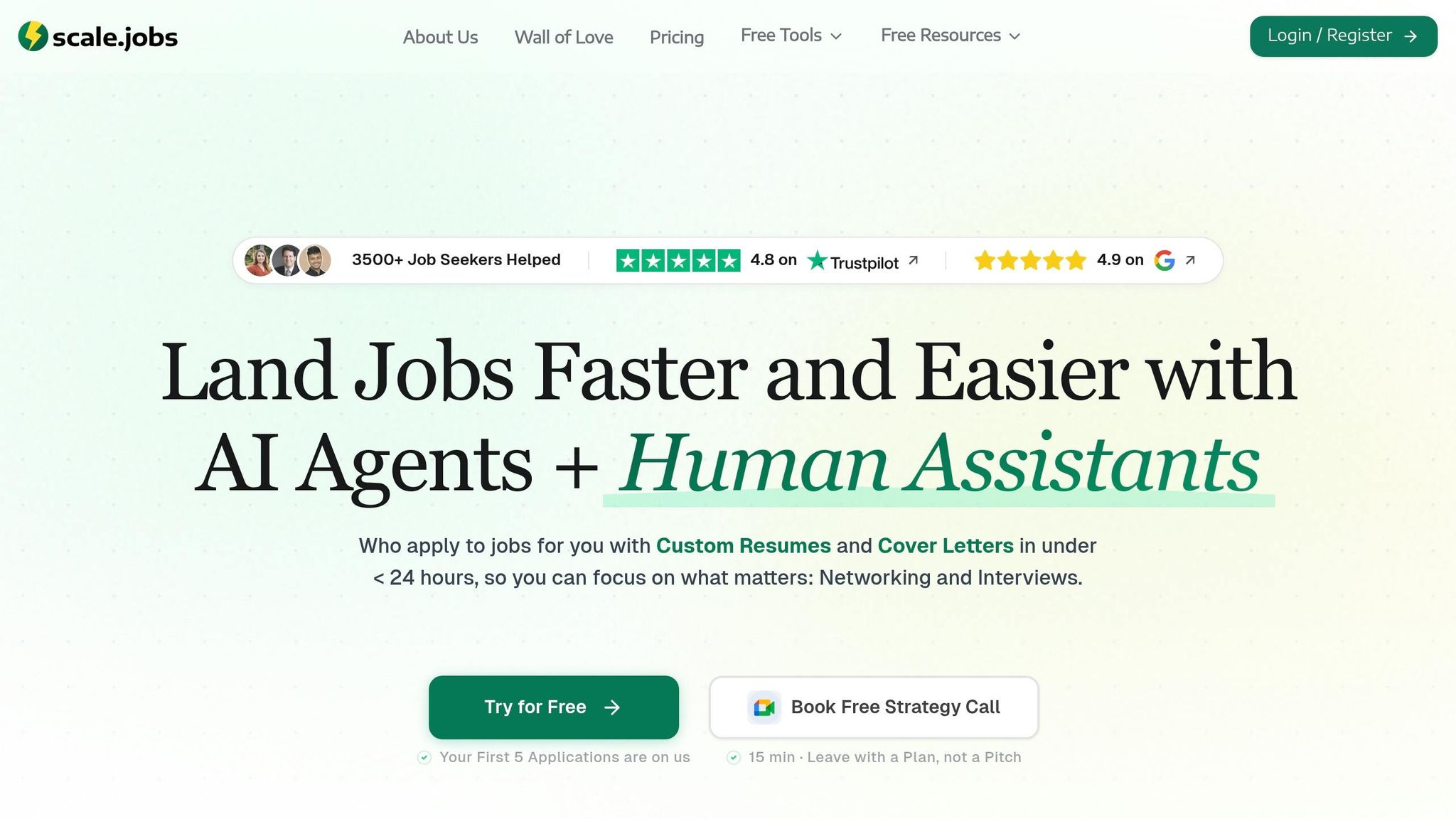
Here’s a detailed comparison of scale.jobs and three major competitors, focusing on how human-powered application management addresses the challenges of fully automated or DIY tools.
LazyApply vs scale.jobs: Bulk Automation vs Personalized Applications
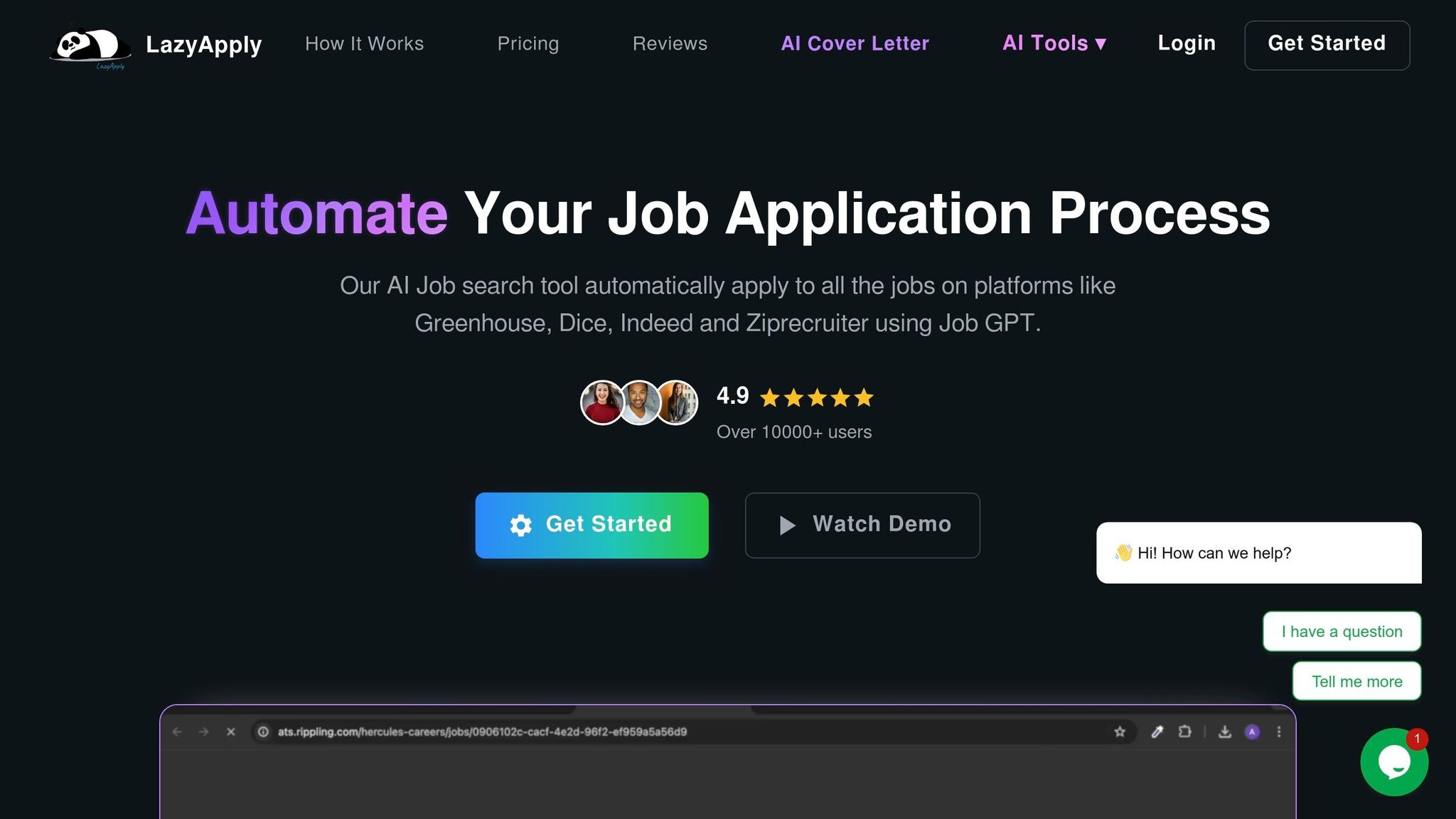
LazyApply relies on a Chrome extension to auto-fill and submit up to 100 job applications daily across various portals. Priced at $99 for a lifetime subscription, it’s geared toward entry-level job seekers prioritizing quantity over quality. However, its automated scripts often trigger bot-detection systems on platforms like Workday and Taleo, leading to callback rates below 2%.
Why scale.jobs stands out:
- Human virtual assistants manually handle each application, avoiding bot-detection issues.
- Resumes are tailored to match specific job descriptions, not generic templates.
- You receive time-stamped WhatsApp screenshots as proof of submission - LazyApply only provides dashboard metrics without confirming employer review.
Who benefits from LazyApply: Those applying to 500+ entry-level roles where high rejection rates are acceptable, and customization isn’t a priority.
Who should opt for scale.jobs: Ideal for competitive roles requiring tailored applications, such as positions with visa sponsorship (H-1B, F-1 OPT), or when aiming for callback rates above 25%. Pricing starts at $199 for 250 applications, with unused credits refunded.
Next, we’ll explore the contrast between Rezi.ai’s DIY tools and scale.jobs’ managed services.
Rezi.ai vs scale.jobs: Do-It-Yourself vs Comprehensive Support
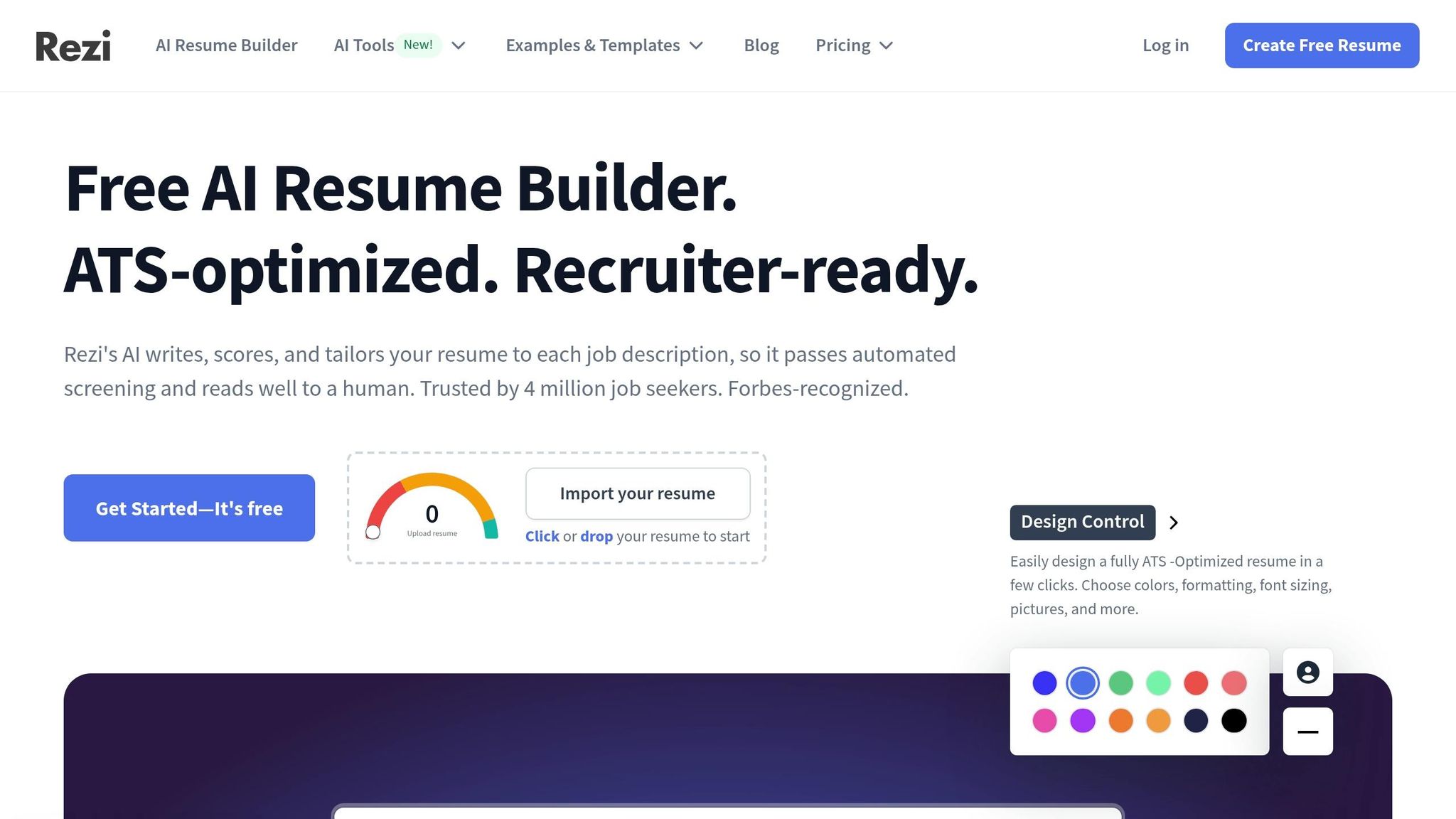
Rezi.ai offers AI-driven resume templates and keyword optimization tools for $29/month. Users build their resumes using its interface, which analyzes job descriptions and suggests bullet points. It’s a good fit for those comfortable crafting and managing their own applications.
How scale.jobs outperforms Rezi.ai:
- Trained assistants handle everything - from creating resumes to submitting applications - saving you time and effort.
- Human expertise ensures deeper customization, addressing nuanced details like career gaps or job transitions that AI tools may overlook.
- Unlike Rezi.ai, which only provides templates, scale.jobs manages the entire application process and supplies proof-of-work screenshots via WhatsApp.
- A one-time payment model eliminates the need for recurring fees.
Who should use Rezi.ai: Those who prefer hands-on control and don’t mind dedicating time to applying manually.
Who should choose scale.jobs: Professionals balancing demanding schedules who want to reclaim 20+ hours weekly, or those seeking end-to-end application management. For those weighing their options, resume writing services combined with application management can offer a better return on investment than DIY tools.
Now, let’s compare ATS-focused platforms with complete application management solutions.
Jobscan.co vs scale.jobs: ATS Optimization vs Full-Service Applications
Jobscan.co specializes in analyzing resumes against job descriptions to provide a compatibility score based on keyword alignment. Priced at $49.95/month, it’s effective for identifying areas to improve your resume but requires users to manually update and submit applications.
Key advantages of scale.jobs over Jobscan.co:
- Human assistants craft ATS-optimized resumes tailored to each role, rather than just analyzing existing ones.
- They handle application submissions across all platforms, including complex systems like Workday that demand manual data entry.
- The one-time payment model ($199–$399) avoids recurring fees, and real-time updates via WhatsApp replace the need to check another dashboard.
Who should use Jobscan.co: Those looking to refine their resume and manage applications independently.
Who should choose scale.jobs: Professionals seeking a full-service solution, verified proof of submissions, or a one-time payment option. The human-driven approach ensures resumes resonate with hiring managers while still meeting ATS requirements.
Feature Comparison: AI Platforms vs scale.jobs
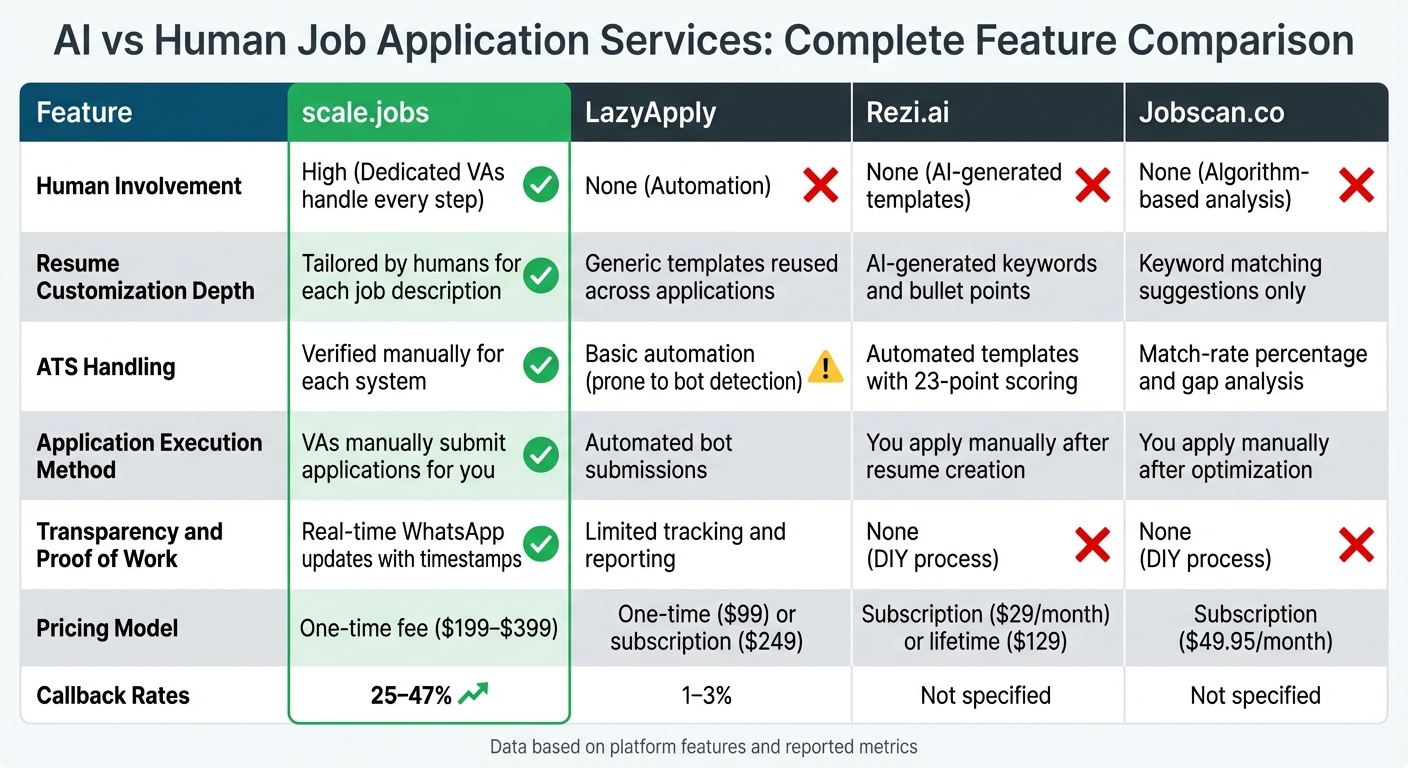
AI vs Human Job Application Services: Feature Comparison Chart
Below is a breakdown of how scale.jobs, LazyApply, Rezi.ai, and Jobscan.co compare across key features. The distinctions in human involvement, customization, and execution methods can have a direct impact on your job application outcomes.
Platform Comparison Table
| Feature | scale.jobs | LazyApply | Rezi.ai | Jobscan.co |
|---|---|---|---|---|
| Human Involvement | High (Dedicated VAs handle every step) | None (Automation) | None (AI-generated templates) | None (Algorithm-based analysis) |
| Resume Customization Depth | Tailored by humans for each job description | Generic templates reused across applications | AI-generated keywords and bullet points | Keyword matching suggestions only |
| ATS Handling | Verified manually for each system | Basic automation (prone to bot detection) | Automated templates with 23-point scoring | Match-rate percentage and gap analysis |
| Application Execution Method | VAs manually submit applications for you | Automated bot submissions | You apply manually after resume creation | You apply manually after optimization |
| Transparency and Proof of Work | Real-time WhatsApp updates with timestamps | Limited tracking and reporting | None (DIY process) | None (DIY process) |
| Pricing Model | One-time fee ($199–$399) | One-time ($99) or subscription ($249) | Subscription ($29/month) or lifetime ($129) | Subscription ($49.95/month) |
This comparison highlights why scale.jobs stands out. LazyApply focuses on automation to handle volume, while Rezi.ai and Jobscan.co provide tools for users who prefer a hands-on, DIY approach. However, for those with complex application needs, human-verified ATS optimization and resume writing services from scale.jobs offer a distinct edge.
Unlike subscription-based models, scale.jobs provides a one-time fee and real-time proof of work through WhatsApp updates, ensuring transparency and eliminating recurring costs. This personalized, human-driven approach can make a significant difference when precision and tailored applications matter most in your job search.
When to Switch to scale.jobs
Situations Where scale.jobs Works Best
Switching to scale.jobs can make a big difference if you're dealing with these challenges:
Handling 250+ applications with precision. If you're applying to a large number of positions, accuracy is key. While tools like LazyApply and Sonara.ai focus on speed, their automated submissions often raise red flags with applicant tracking systems (ATS) and produce generic results. scale.jobs takes a different approach by assigning skilled virtual assistants to manually complete each application. They tailor your resume for every job and provide WhatsApp timestamps as proof of submission. With a one-time fee ranging from $199–$399, you avoid the recurring monthly costs that can pile up over a longer job search.
Facing repeated ATS rejections despite using tools like Jobscan.co or Rezi.ai. While keyword-focused platforms can guide you on what to tweak, they often miss formatting and contextual issues that lead to rejections. At scale.jobs, human reviewers optimize your application for compatibility with various ATS platforms like Workday, Greenhouse, and Taleo, ensuring your materials are adjusted before submission.
Needing documentation for visa applications, unemployment claims, or personal records. Many AI-driven platforms provide basic dashboards, but they rarely meet the transparency needed for official documentation. scale.jobs stands out by offering real-time updates via WhatsApp, including timestamps, portal screenshots, and confirmation records. These features are especially helpful for H-1B transfers, OPT extensions, or state unemployment verifications.
Applying to competitive mid-to-senior roles where generic templates fall short. While entry-level tools work well for high-volume junior positions, they often fail to convey the depth required for director-level roles, technical specialties, or career pivots. scale.jobs addresses this with customized resume writing services and dedicated virtual assistants who craft applications that resonate with hiring managers, not just ATS systems.
Dealing with a prolonged job search that’s draining your budget. Subscription-based services like Rezi.ai and Jobscan.co can become costly over time. scale.jobs offers a flat-fee pricing model that caps your expenses upfront. Plus, any unused application credits are refunded, ensuring a cost-effective solution for maintaining quality and oversight during an extended job hunt.
If you're navigating these scenarios, scale.jobs might be the right tool to streamline your job search and improve your outcomes.
Which Option Fits Your Job Search?
When deciding between human-assisted solutions and AI tools for your job search, the right choice depends on your unique needs and goals. Platforms like LazyApply and Rezi.ai offer automated solutions that prioritize speed, while scale.jobs provides a human-powered alternative focused on precision and personalization.
AI tools like LazyApply or Rezi.ai are ideal for entry-level candidates applying to high-volume, less competitive roles. These platforms are budget-friendly, typically costing under $50 per month, and are designed for those submitting 100+ applications to similar positions. If you're comfortable handling your own resume tweaks and can accept a response rate below 10%, these tools can be a practical starting point. However, for situations that demand more tailored applications, such as visa sponsorship cases or competitive roles, the precision of scale.jobs becomes invaluable.
Why Choose scale.jobs for Precision?
For job seekers who need a higher level of customization, scale.jobs offers several standout features that automated tools can't match:
- Tailored Applications: Every application is manually customized to align with specific job requirements.
- ATS-Compliance: Documents are crafted to bypass applicant tracking system (ATS) filters, ensuring they aren't flagged by platforms like Workday, Greenhouse, or Taleo.
- Transparent Process: Real-time WhatsApp updates with time-stamped screenshots provide complete visibility into each application.
- Flat-Fee Model: Avoid recurring subscription costs with a one-time fee ranging from $199 to $399.
- Expert Assistance: Human assistants handle every detail, offering a level of care that automated dashboards lack.
This approach is particularly beneficial for mid-to-senior professionals, career changers, or international candidates requiring H-1B or OPT sponsorship. The hands-on support ensures applications stand out to both ATS systems and hiring managers.
When Automated Tools Make Sense
Automated platforms are best suited for job seekers targeting entry-level positions where casting a wide net is more important than fine-tuned messaging. These tools work well if you're:
- Managing your own resume edits
- Comfortable with lower response rates
- Seeking a cost-effective solution with minimal upfront investment
For those just starting their job search or applying to a large volume of similar roles, AI tools can provide an efficient way to get applications out quickly.
When to Choose scale.jobs
If your job search has stalled - whether due to low response rates, recurring subscription fees, or repeated ATS rejections - it's time to consider a more tailored approach. scale.jobs is especially effective for:
- Competitive director-level or technical roles
- Career pivots requiring personalized storytelling
- Extended job searches where quality matters more than quantity
The flat-fee model ensures cost efficiency, especially for long-term searches, and pro-rata refunds for unused credits mean you only pay for completed applications. For job seekers aiming to make a strong impression in competitive fields, scale.jobs delivers the expertise and transparency needed to achieve better outcomes.
For additional support, explore their professional resume writing services designed to enhance your application strategy and help you stand out in a crowded job market.
FAQs
How can I tell if my applications are being flagged as automated?
If you're noticing a low callback or interview rate despite submitting a large number of applications, or if you're consistently being rejected by Applicant Tracking Systems (ATS), your applications might be flagged as automated. Many automated tools send out generic applications, which can trigger ATS systems to mark them as spam. To avoid this, consider using a service that incorporates human oversight and creates tailored, ATS-friendly submissions. This approach can help your application stand out and increase your chances of catching a recruiter's attention.
What parts of my background need human customization most?
Your resume, cover letter, and other application materials achieve the best results when tailored by a human touch. While AI tools can help craft ATS-friendly resumes, they often overlook the subtle details that make your skills, experiences, and goals shine. Human experts can identify and emphasize your key accomplishments, align your application with specific job descriptions, and create a compelling narrative. This is particularly important for career changes or senior-level roles, where personalized storytelling and deep industry knowledge can make all the difference.
How can I tell if quality-based applying is working for me?
When evaluating the success of your job search, it’s more effective to track callback or interview rates rather than just the sheer number of applications you’ve submitted. Why? Because the quality of your applications often matters more than the quantity.
For example, personalized and human-assisted job applications - like those crafted through platforms such as Scale.jobs - tend to yield higher callback rates, typically ranging between 12–18%, compared to the 1–3% success rate of generic, automated submissions. This difference highlights the importance of tailoring your applications to stand out in a competitive market.
To truly measure your progress, pay attention to metrics such as:
- The quality of responses you receive from employers.
- The number of interview invitations you secure.
- The overall job offers you land over time.
Additionally, tools that provide transparency and proof of submission can be invaluable. They allow you to keep track of your tailored applications and better understand what’s working in your job search strategy. By focusing on these aspects, you can fine-tune your approach and improve your chances of landing the right role.