AI Matching vs Traditional Hiring: Key Differences
AI brings speed and scale; traditional hiring brings judgment and cultural fit — a hybrid approach often delivers the best results.


AI has transformed hiring by automating tasks like AI resume screening and candidate ranking, while human-led methods rely on judgment and interpersonal evaluation. Both approaches have strengths and weaknesses, making their suitability dependent on hiring goals. Here’s a quick breakdown:
- AI excels in speed and scalability, processing thousands of applications in minutes. It’s ideal for high-volume roles and reduces costs over time.
- Human-led hiring shines in evaluating soft skills and aligning candidates with team dynamics, making it better for leadership or specialized roles.
- Hybrid models combine both, using AI for efficiency and humans for nuanced decisions, offering a balanced approach.
For example, platforms like Scale.jobs merge AI tools with human oversight, optimizing efficiency while maintaining a personal touch. Whether you're hiring for volume or precision, understanding these methods helps you choose the right strategy.
How AI Is Redefining Recruiting & Hiring in the Modern Workforce
What AI Matching Offers
AI matching has brought a new level of efficiency to the hiring process, offering both notable strengths and some limitations. These systems are designed to analyze thousands of resumes in a fraction of the time it takes a human recruiter, comparing them against specific job requirements. By scanning for keywords, skills, and experience patterns, AI tools can quickly rank and score candidates based on how well they align with the role.
One of the standout advantages of AI matching lies in its processing power. Unlike humans, AI applies the same criteria across every application, eliminating inconsistencies caused by fatigue or subjective judgment. This is particularly useful for companies hiring for standardized roles in industries like tech, healthcare, retail, and sales. For organizations making 50 or more hires annually, AI can automate up to 70% of manual HR tasks, significantly speeding up hiring cycles and reducing costs - without needing to expand the recruiting team.
Where AI Matching Performs Well
AI shines in high-volume screening scenarios. For instance, when a Fortune 500 company receives tens of thousands of applications for entry-level positions, AI can cut screening time by up to 90%. Beyond just matching keywords, advanced systems can identify transferable skills and find candidates for adjacent roles, making them especially effective for skills-based hiring strategies that value demonstrated abilities over formal degrees.
Another clear benefit is cost savings. Tools like Exa.ai ($800/month) and LinkedIn Recruiter ($900/month) help companies reduce the need for additional screening staff during peak hiring periods. Organizations using AI matching often report hiring efficiency improvements of 30–40%, which translates into shorter hiring timelines and lower overall costs.
AI also has the potential to address bias in hiring. Properly designed algorithms apply consistent criteria across all applicants, reducing the influence of unconscious preferences for certain schools, backgrounds, or demographics. However, this benefit depends heavily on the quality of the training data, which must be free from bias - a challenge we'll explore further in the next section.
Where AI Matching Falls Short
Despite its strengths, AI matching has some notable weaknesses. One major limitation is its inability to assess soft skills, emotional intelligence, and cultural fit. Traits like adaptability, teamwork, and leadership often require human interaction and contextual understanding, which algorithms simply can't replicate. A candidate who looks ideal on paper might lack the interpersonal skills needed for success in certain roles, especially those requiring collaboration or client engagement.
Another ongoing issue is algorithmic bias. For example, Amazon abandoned an internal AI recruiting tool after discovering it penalized resumes containing the word "women's" (e.g., "women's chess club captain") because it was trained on a dataset dominated by male hires. Research also shows that some AI systems disproportionately favor white-associated names over Black-associated names, with even small scoring differences significantly impacting a candidate's chances of advancing.
The "black box" problem adds to these challenges. Many AI systems operate with proprietary algorithms that lack transparency, making it difficult for employers or candidates to understand why certain individuals are ranked lower or rejected. This lack of visibility not only raises ethical concerns but also poses legal risks, especially as regulations like the EU's AI Act and Illinois's Artificial Intelligence Video Interview Act demand greater accountability and disclosure from AI systems used in hiring.
To address these challenges, platforms like scale.jobs offer a balanced approach. They combine AI-driven resume optimization with human oversight, ensuring applications are both ATS-compliant and personalized. This hybrid model provides the speed of AI while retaining the nuance and judgment that only human review can deliver - an essential advantage in competitive, high-volume applicant pools where algorithmic decisions play a critical role in determining who moves forward.
Traditional Hiring: What Works and What Doesn't
Traditional hiring methods, such as manual resume reviews, phone screenings, and in-person interviews, remain common, especially among small to midsize businesses. These approaches rely heavily on human judgment, offering certain strengths while also presenting notable inefficiencies.
What Traditional Hiring Does Well
Human recruiters bring a level of understanding and adaptability that automated systems often lack. For instance, when evaluating resumes with employment gaps, experienced recruiters can recognize situations like caregiving, sabbaticals, or career changes as signs of resilience rather than red flags. They also excel at identifying transferable skills in candidates with unconventional backgrounds - think of a former teacher transitioning into corporate training - something keyword-based systems might miss entirely.
Another area where traditional hiring shines is in assessing interpersonal dynamics and alignment with company values. Through face-to-face interactions, recruiters can evaluate subtle cues and nuances that automated tools simply can't capture. This is particularly important for executive roles or creative positions where trust, vision alignment, and interpersonal chemistry are critical. In such cases, the personalized, relationship-driven approach often outweighs the time savings provided by automation.
Traditional hiring also offers real-time adaptability. Skilled recruiters can tailor interviews and evaluation criteria on the fly as they gain deeper insights into a candidate’s strengths and potential. This flexibility is especially useful for niche roles where a standard job description might not adequately cover all necessary skills. For smaller businesses, traditional methods are often practical due to lower upfront costs and the benefit of providing personalized attention to each candidate.
However, while these strengths are valuable, they often come at the cost of efficiency and scalability.
What Traditional Hiring Struggles With
Traditional hiring methods face significant challenges, particularly when it comes to speed and handling high volumes of applications. As one recruiter from Robert Walters Australia put it, "Manual screening is one of the tedious aspects of a recruiter's job. To bypass these bottlenecks, some candidates use human assistants to apply for jobs on their behalf, ensuring their applications are submitted even when recruiters are overwhelmed." Unlike AI-driven systems, traditional processes don’t scale efficiently. Reviewing more applications requires more recruiter hours, which slows down decision-making and increases the risk of losing top candidates to faster-moving competitors. Additionally, as the number of open positions grows, so does the need for additional recruiters, which can raise costs and complicate coordination.
Another persistent issue is unconscious bias. Despite good intentions, human evaluators may be influenced by factors such as a candidate's alma mater, previous employer, or even demographic cues like names. These biases, often unconscious, can lead to inconsistent evaluations and fairness concerns, potentially exposing organizations to legal risks.
Traditional methods also tend to have a narrower reach for talent. Relying on personal networks and job board postings often limits the pool to active job seekers, overlooking passive candidates who might be highly qualified but aren’t actively searching for opportunities. In competitive labor markets, this limited reach can put companies at a disadvantage compared to those using broader, technology-driven sourcing strategies.
Combining traditional hiring with tools like applicant tracking systems (ATS) or AI-driven platforms can help address these challenges, improving both efficiency and fairness in the hiring process. For example, using free job application tools like an AI resume builder or a job search platform may streamline processes while expanding access to a more diverse talent pool. This hybrid approach balances the strengths of human judgment with the efficiency of modern technology.
AI Matching vs. Traditional Hiring: Direct Comparison
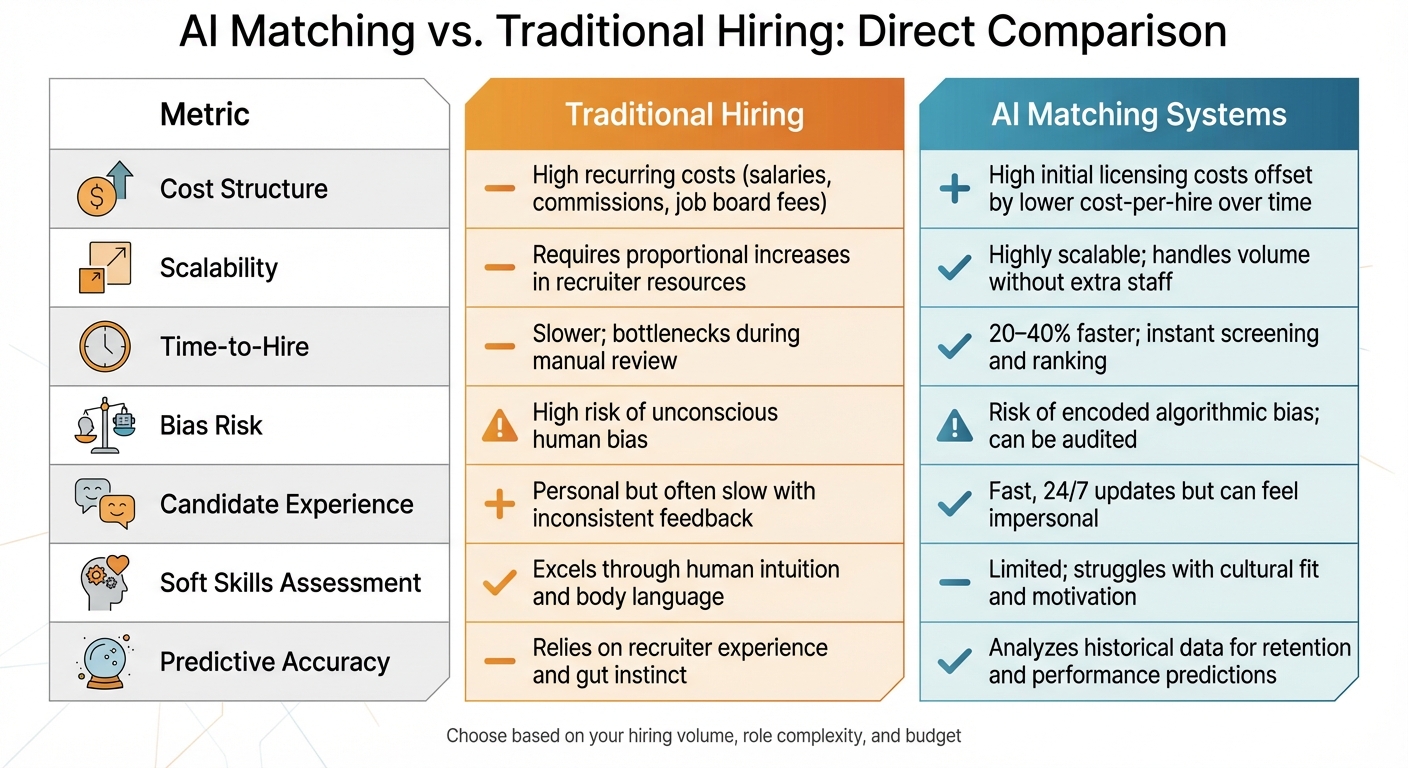
AI vs Traditional Hiring Methods Comparison Chart
Choosing between AI matching and traditional hiring methods isn't just about preference - it’s about understanding how each approach impacts your hiring goals, budget, and efficiency. These methods differ in critical ways, influencing everything from cost structure to the candidate experience. For instance, while competitors like LazyApply focus on basic automation, Scale.jobs combines advanced AI with human oversight, offering a hybrid approach that balances speed and quality. This blend ensures faster hiring results with transparent pricing and proof-of-work, making it a compelling option for organizations looking to streamline their recruitment process.
Cost structures highlight one of the most noticeable differences. Traditional hiring often involves recurring costs, including recruiter salaries, agency fees (usually 15–25% of a candidate's first-year salary), and ongoing job board subscriptions. In contrast, AI-driven platforms have higher upfront licensing fees but reduce the cost-per-hire over time by automating repetitive tasks like resume screening. For companies hiring at scale, this cost efficiency becomes a clear advantage.
Scalability is another key area where AI platforms outshine traditional methods. As the number of open positions increases, traditional recruitment demands more recruiters, coordination, and resources, resulting in proportionally higher costs. AI systems, however, can process thousands of applications simultaneously without additional human resources, making them especially valuable during hiring surges or periods of rapid growth. That said, this scalability often comes at the expense of the personalized touch that human recruiters provide.
When it comes to time-to-hire, AI platforms deliver a significant edge. By automating screening and ranking, they can reduce hiring timelines by 20–40%, eliminating bottlenecks caused by manual resume reviews. However, this speed may sacrifice deeper insights into a candidate’s compatibility with company culture or their motivation - areas where traditional methods excel.
Comparison Table
| Metric | Traditional Hiring | AI Matching Systems |
|---|---|---|
| Cost Structure | High recurring costs (salaries, commissions, job board fees) | High initial licensing costs offset by lower cost-per-hire over time |
| Scalability | Requires proportional increases in recruiter resources | Highly scalable; handles volume without extra staff |
| Time-to-Hire | Slower; bottlenecks during manual review | 20–40% faster; instant screening and ranking |
| Bias Risk | High risk of unconscious human bias | Risk of encoded algorithmic bias; can be audited |
| Candidate Experience | Personal but often slow with inconsistent feedback | Fast, 24/7 updates but can feel impersonal |
| Soft Skills Assessment | Excels through human intuition and body language | Limited; struggles with cultural fit and motivation |
| Predictive Accuracy | Relies on recruiter experience and gut instinct | Analyzes historical data for retention and performance predictions |
Bias handling is another critical factor to consider. Traditional hiring is prone to unconscious bias - whether it’s influenced by a candidate’s alma mater, previous employer, or demographic characteristics. In contrast, AI systems face risks of algorithmic bias, but these can often be identified and corrected through audits, offering a level of transparency that’s harder to achieve with human decision-making.
The candidate experience also varies significantly between these approaches. Traditional hiring offers personal interactions, which can be reassuring for candidates, but it often leaves applicants waiting for weeks without feedback. AI platforms, on the other hand, provide instant updates via chatbots and automated alerts, ensuring 24/7 communication. This responsiveness is particularly appealing to job seekers managing multiple applications or urgent timelines, such as those looking for full-time jobs or navigating visa requirements. However, for candidates who value relationship-building and want to showcase qualities beyond their resume, traditional methods may feel more fulfilling despite the slower process.
Each approach has its strengths and trade-offs, making it essential to weigh what matters most for your hiring strategy. Whether prioritizing speed, scalability, or personal connection, understanding these differences can guide you toward the right solution for your organization. For those seeking a blend of efficiency and quality, platforms like Scale.jobs offer a promising middle ground.
Combining AI and Human Recruiters
When it comes to recruitment, the most effective strategies don't pit AI against human recruiters - they combine their strengths. A hybrid model leverages AI for repetitive, high-volume tasks like resume parsing, initial candidate screening, and scheduling interviews, while human recruiters focus on areas where their judgment and empathy shine, such as relationship building, assessing cultural fit, and handling negotiations. This division of responsibilities ensures the efficiency of automation without losing the human touch, creating a balanced and effective hiring process.
Organizations adopting AI-assisted recruitment are seeing tangible benefits, including 40–50% faster hiring times and 30–50% reductions in hiring costs, according to recent industry data. It's no surprise that 93% of Fortune 500 CHROs have already started integrating AI tools into their recruitment strategies. The trick lies in using AI as a tool to assist - not replace - human decision-making. For instance, AI can rank candidates based on predictive analytics and skill matching, but humans bring in the critical elements of intuition, context, and alignment with company values.
"AI handles the heavy lifting so your team can focus on what humans do best: building relationships, assessing cultural fit, and making final hiring decisions." – Matthew Bennett, Technical Writer
A successful hybrid model ensures that AI tools provide real-time updates while human recruiters manage essential tasks like negotiations and personalized communication. For job seekers, platforms like Scale.jobs demonstrate this balance well. They combine AI-powered resume optimization tools with hands-on human support, manually submitting applications to avoid bot flags and providing proof-of-work screenshots along with WhatsApp updates. This thoughtful blend ensures that applications are ATS-compliant while retaining a personal touch.
AI excels in speed and scale, but humans bring nuance and connection. To avoid pitfalls like algorithmic bias, regular audits of AI systems are crucial. Keeping humans involved ensures that decisions are not solely based on algorithms, which can sometimes miss the bigger picture. For employers managing large volumes of applications or job seekers applying to multiple roles, this hybrid approach is a win-win.
Up next, we'll explore how to select the hiring method that best suits your specific needs.
How to Choose the Right Hiring Method
Selecting the right hiring method depends on several factors, including the number of roles, their complexity, your budget, and how quickly you need to fill positions. Whether you're considering AI-driven tools, traditional approaches, or a mix of both, each method has its strengths and is suited to specific scenarios. For job seekers evaluating platforms like LazyApply and Scale.jobs, understanding these methods can help you make informed decisions.
When AI Matching Works Best
AI matching shines when you're hiring for high-volume or standardized roles and need to move quickly. For positions like customer service, retail, or entry-level tech roles, AI can process hundreds of applications in minutes, reducing hiring time by 20–40%. Companies making 50 or more hires annually often see a significant cost advantage because the upfront investment in AI tools lowers the cost per hire over time.
AI is particularly effective at filtering large applicant pools based on measurable criteria, such as certifications or specific experience levels. It also ensures a consistent and unbiased screening process, though regular algorithm audits are necessary to maintain fairness.
When Traditional Hiring Is Better
Traditional hiring methods are ideal for executive or highly specialized roles where evaluating soft skills and cultural alignment is critical. If you're making just a few strategic hires annually, avoiding the upfront costs of AI technology might be more practical.
Human recruiters bring unique value when assessing candidates with unconventional career paths or interpreting nuanced resume details. They excel in face-to-face conversations, gauging a candidate’s motivation, emotional intelligence, and ability to manage relationships. For roles requiring skills like stakeholder management or creative problem-solving, the human touch is indispensable.
When a Hybrid Approach Makes Sense
Platforms like Scale.jobs illustrate the benefits of a hybrid model, combining AI efficiency with human judgment. This approach is particularly effective for mid-level roles or scaling teams where both speed and quality are priorities. AI can handle tasks like resume parsing, initial screenings, and scheduling interviews, while human recruiters focus on evaluating cultural fit, conducting final interviews, and negotiating offers.
With 96% of senior hiring professionals in the U.S. now using AI for recruitment tasks, many organizations are adopting this hybrid strategy. AI takes care of repetitive, time-consuming tasks, leaving humans to make critical decisions. For job seekers, platforms like Scale.jobs embody this approach by pairing AI-powered tools with human virtual assistants. This combination ensures applications are optimized for ATS systems while avoiding pitfalls like bot flags.
Here’s a quick comparison of the three hiring methods:
| Feature | AI Matching | Traditional Hiring | Hybrid Approach |
|---|---|---|---|
| Best For | High-volume, entry-level, standardized roles | Executive, niche, leadership positions | Mid-level roles, scaling teams |
| Speed | Fastest (instant screening) | Slowest (manual review) | Balanced |
| Cost Structure | Upfront tech investment, lower per-hire at scale | Linear (more hires = more staff) | Mid-range, balanced |
| Primary Strength | Speed and scalability | Cultural fit and soft skill assessment | Efficiency + quality control |
| Primary Weakness | Lacks context and nuance | Slow and prone to human bias | Requires integration effort |
AI is perfect for handling large volumes and tight deadlines, while traditional hiring is better suited for relationship-driven, strategic roles. Many companies find that a hybrid model offers the best of both worlds, providing efficiency without sacrificing quality.
Conclusion: Choosing Your Hiring Strategy
When weighing the benefits of AI-driven hiring versus traditional methods, it’s clear that each approach caters to different recruitment needs. AI thrives in handling large volumes of applications, cutting time-to-hire by 20–40% for standardized roles. Meanwhile, traditional hiring methods remain indispensable for executive positions, where judgment around soft skills and team dynamics plays a pivotal role. The right choice depends on your specific hiring goals, whether it’s filling numerous entry-level roles or securing top-tier leadership talent.
For organizations hiring at scale - 50 or more roles annually - AI tools often offer the most cost-effective solution. On the other hand, for leadership or specialized technical roles, human recruiters excel by bringing the nuanced understanding that algorithms cannot replicate. Increasingly, businesses are combining these methods to strike a balance between speed and quality.
A hybrid hiring model bridges the gaps between these approaches. AI efficiently manages tasks like resume parsing and initial screenings, while human recruiters focus on interviews, assessing team alignment, and negotiating offers. This synergy ensures a faster process without compromising on the quality of mid-level hires or team expansion efforts.
For job seekers, platforms like Scale.jobs embody this hybrid philosophy. They combine AI-driven tools for optimizing applicant tracking system (ATS) performance with human virtual assistants who manually submit applications. This approach avoids the pitfalls of fully automated systems - which often face callback rates under 2% - while maintaining the efficiency to handle over 30 applications daily. With transparent pricing starting at $199 for 250 applications, real-time updates via WhatsApp, and proof-of-work screenshots, Scale.jobs stands out for its reliability and efficiency compared to purely automated tools.
Ultimately, the decision comes down to aligning your hiring strategy with your needs. AI offers unmatched speed for high-volume hiring, while human oversight ensures thoughtful decisions for leadership and specialized roles. A blended approach often yields the best results, leveraging the strengths of both methods.
Decision Summary
- Leverage AI tools for high-volume, standardized positions.
- Choose traditional methods for leadership and highly specialized roles.
- Opt for a hybrid approach when scaling teams or hiring for mid-level positions.
FAQs
How can I audit AI matching for bias?
To assess AI matching systems for bias, it's important to determine whether their algorithms exhibit racial, gender, or intersectional biases that could impact how candidates are ranked. Carefully review outputs across a range of diverse profiles to identify trends, such as higher rejection rates for certain groups. Consistent testing with diverse datasets, alongside clear and transparent decision-making processes, plays a crucial role in addressing these concerns. Platforms like Scale.jobs tackle bias by integrating AI with human oversight, ensuring fair practices and delivering personalized, ATS-friendly applications that prioritize equity.
How can I avoid the AI “black box” problem?
To steer clear of the AI "black box" problem in recruitment, it’s essential to choose platforms that blend AI efficiency with human oversight. For instance, tools such as Scale.jobs prioritize transparency by combining AI-driven optimization with human review. This approach helps minimize biases and ensures applications are both relevant and impactful. Features like proof-of-work screenshots and real-time updates offer clear visibility into the process. Additionally, the involvement of human assistants adds a layer of accountability, ensuring decisions are guided by thoughtful, personalized judgment rather than solely relying on algorithms.
What’s the ideal balance between AI and human input?
The best approach merges AI's efficiency in managing repetitive, high-volume tasks with human expertise for more nuanced decision-making. AI can take care of tasks like sourcing candidates, optimizing keywords, and initial screening, reducing the time-to-hire by an impressive 20–40%. Meanwhile, humans bring their skills to areas like assessing soft skills, evaluating team compatibility, and fostering personalized interactions. Platforms like Scale.jobs highlight this combination, using AI-powered automation alongside human oversight to boost efficiency while maintaining high standards and transparency.