
What AI Job Apply Tools Promise vs What Job Seekers Experience
High-volume AI apply tools trade speed for personalization, raising ATS flags—human-assisted, tailored submissions outperform automation in competitive searches.


AI-powered job application tools like LazyApply, Simplify.jobs, Sonara.ai, and Jobscan.co claim to simplify the job search by automating applications, optimizing resumes for ATS, and increasing callback rates. However, user experiences often reveal shortcomings, including generic applications, errors, and risks of being flagged as spam by ATS systems. These tools prioritize speed and volume but may compromise quality and personalization, which are critical for competitive roles.
For professionals seeking tailored applications, scale.jobs offers a human-driven alternative. Unlike automated tools, scale.jobs employs virtual assistants to create personalized, ATS-friendly applications, ensuring accuracy and transparency with verified submission proofs. This approach is ideal for mid-to-senior-level positions and roles requiring a customized touch.
Key Takeaways:
- LazyApply: High-volume automation (up to 750+ applications/day) but lacks customization and risks ATS rejection.
- Simplify.jobs: Semi-automated with AI templates but struggles with complex ATS forms like Workday.
- Sonara.ai: Fully automated with 50-100 daily submissions but prone to generic results and spam flags.
- Jobscan.co: Focuses on ATS keyword optimization but requires manual application.
- scale.jobs: Combines human expertise with ATS optimization, offering verified, tailored applications without recurring fees.
Quick Comparison:
| Tool | Volume (Apps/Day) | Customization | ATS Risk | Pricing Model | Best For |
|---|---|---|---|---|---|
| LazyApply | 150-750+ | Low | High | $99-$249 (Lifetime) | Entry-level, high volume |
| Simplify.jobs | 5-20/hour | Medium | Medium | $39/month | Tech/startups |
| Sonara.ai | 50-100 | Low | High | $19.99-$99.99/month | Remote/entry-level roles |
| Jobscan.co | N/A | High (DIY) | Low | $49.95-$89.95/month | DIY optimizers |
| scale.jobs | 30 (targeted) | High | Low | $199-$399 (One-time) | Competitive roles |
For job seekers prioritizing quality and transparency, scale.jobs stands out by offering a hands-on, human-verified process tailored to individual needs. Choose the tool that aligns with your career goals, timeline, and the level of personalization you require.
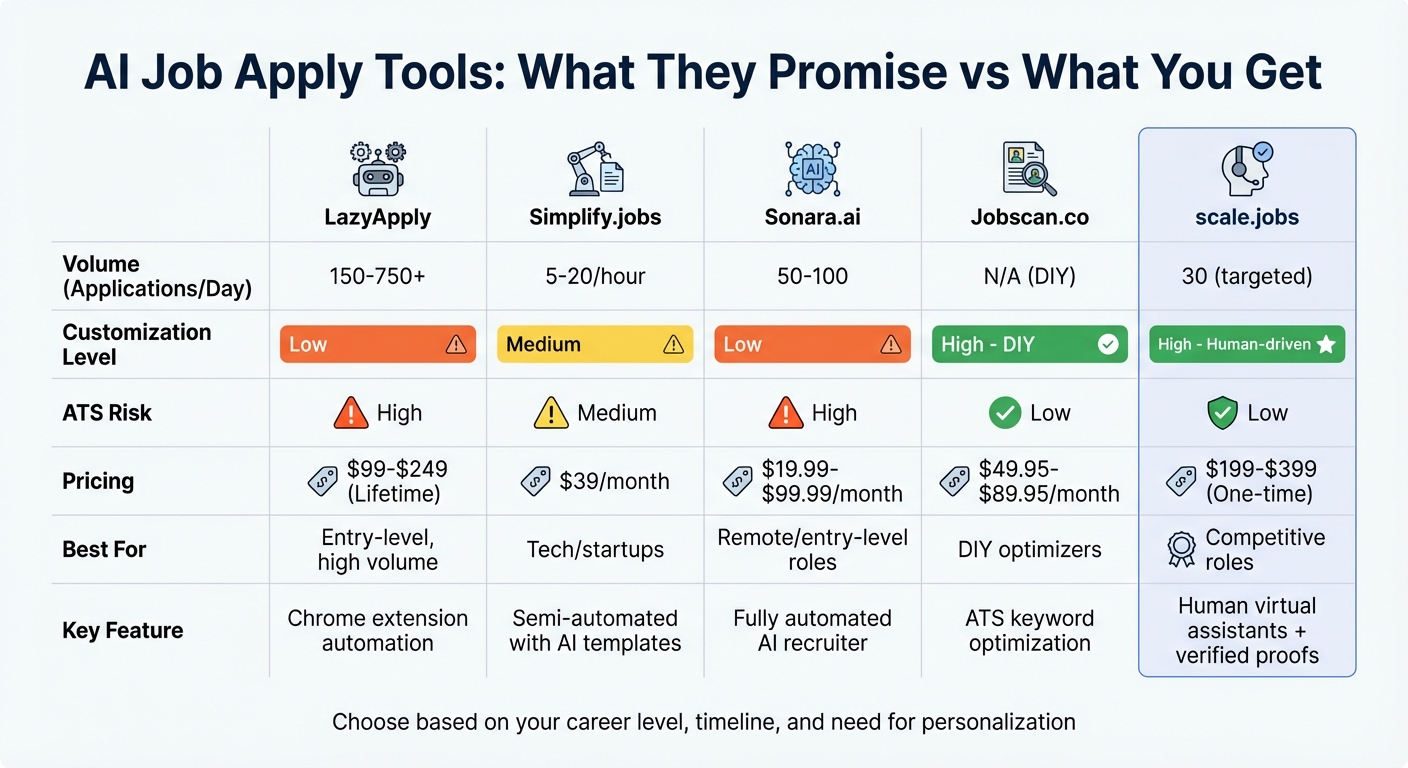
AI Job Application Tools Comparison: Features, Pricing & Best Use Cases
Find & Apply to 1000+ Jobs With AI (Like ChatGPT but BETTER)
1. LazyApply
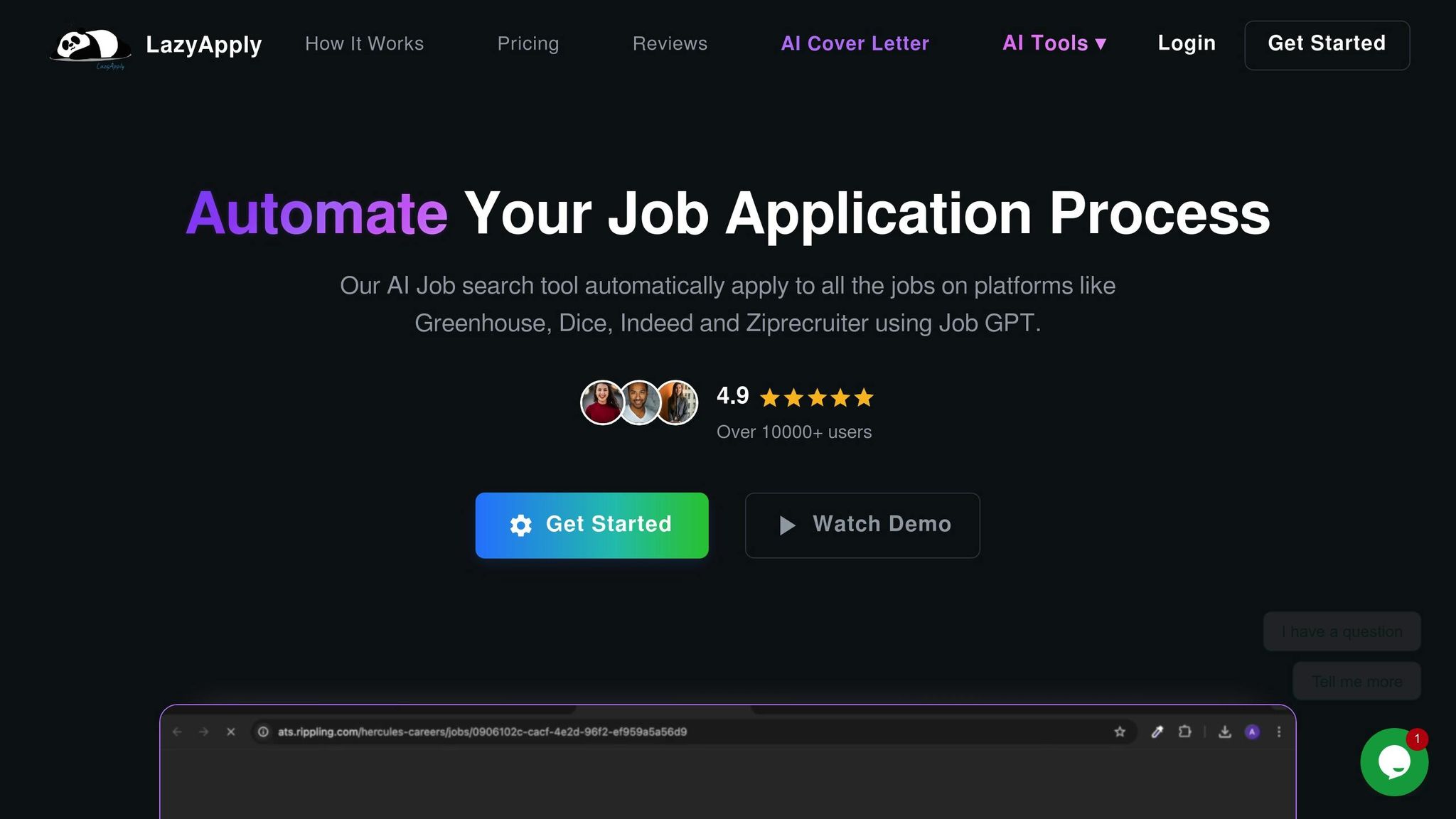
LazyApply functions as a Chrome extension designed to automate job application processes on platforms like LinkedIn Easy Apply, Indeed, and ZipRecruiter. Its main appeal lies in speed, allowing users to submit anywhere from 150 to unlimited applications daily. Pricing is straightforward, with a lifetime fee structure: $99 for the Basic plan (150 applications/day, 1 resume), $129 for Premium (750 applications/day, 5 resumes), and $249 for Unlimited (unlimited applications/day, 10 resumes).
However, LazyApply relies on a high-volume, low-customization strategy. While it uses "Job GPT" to create template responses for screening questions, it doesn’t tailor applications to specific roles. User feedback is mixed, with common complaints about automation errors, payment difficulties, and subpar customer support.
This approach comes with risks. High-volume submissions can lead to account warnings or profile flagging, as platforms like LinkedIn and Indeed increasingly detect bot-like activity. Recruiters may also view mass applications to unsuitable roles as a sign of poor judgment, potentially damaging your reputation. Additionally, many Applicant Tracking Systems (ATS) now include "copycat filters", rejecting applications that show clear signs of heavy automation. In contrast, platforms like scale.jobs emphasize human-assisted, personalized applications, offering a more thoughtful approach.
LazyApply may be suitable for entry-level job seekers applying en masse to less competitive roles. However, for mid-to-senior positions or industries where personalization matters, its lack of human oversight and limited transparency can be major drawbacks.
For those seeking tailored, ATS-optimized applications, platforms offering human assistance - like scale.jobs resume writing services - ensure higher quality and reduce the risk of being flagged as spam.
Why scale.jobs Outshines LazyApply
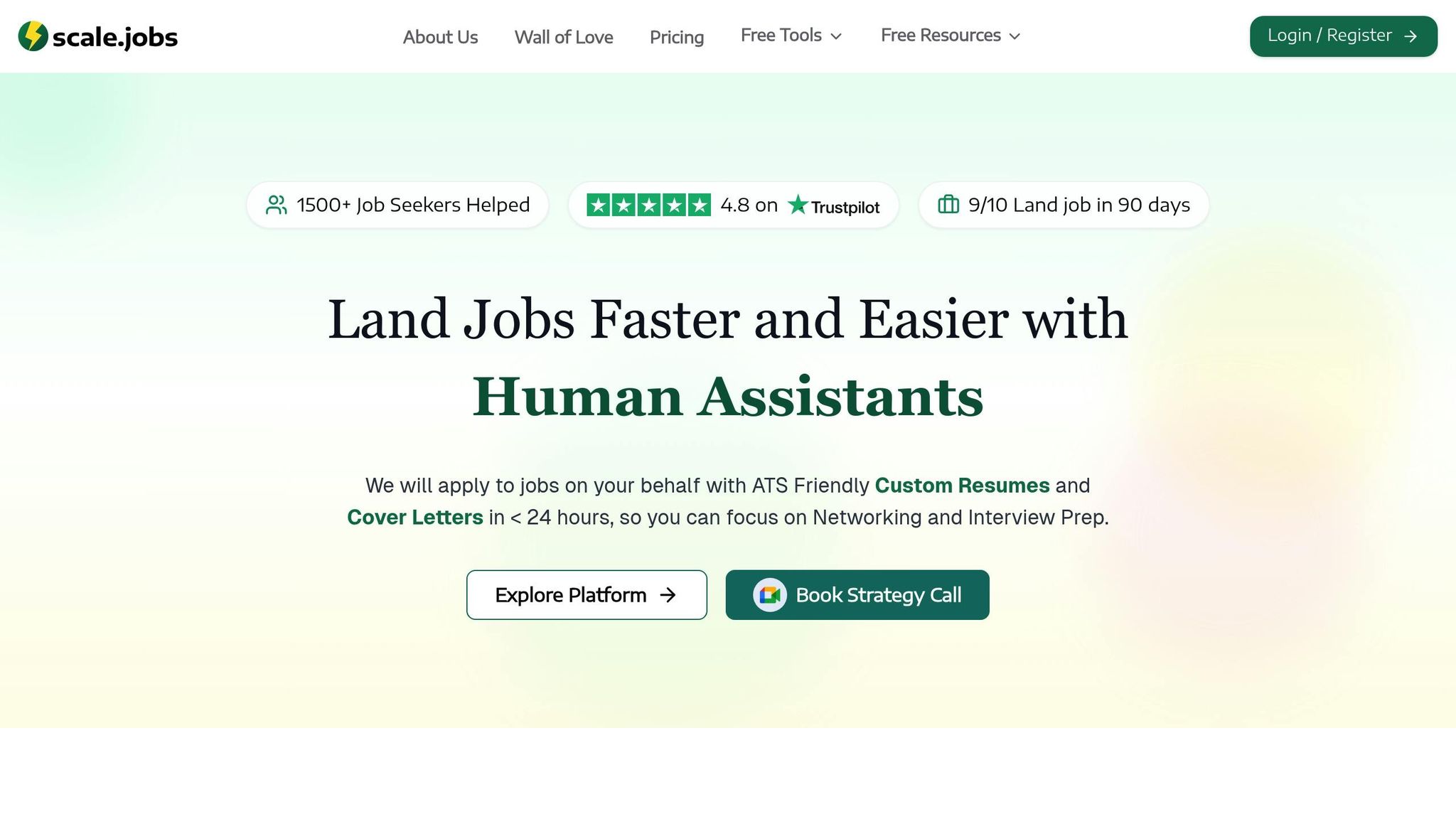
When you compare LazyApply to scale.jobs, the differences are striking:
- Human Expertise: scale.jobs employs human virtual assistants to create personalized, ATS-friendly application materials, avoiding LazyApply’s generic approach.
- Application Transparency: scale.jobs provides time-stamped screenshots of each submission, offering clear proof of work - something LazyApply lacks.
- Reliable Support: Dedicated WhatsApp support ensures real-time assistance, addressing LazyApply’s common customer service complaints.
- Clear Pricing: A one-time payment model eliminates the need for ongoing costs, unlike LazyApply’s tiered lifetime pricing.
These distinctions highlight why scale.jobs is a stronger choice for job seekers who value quality and personal attention.
Who Benefits From LazyApply vs. scale.jobs
- LazyApply: Ideal for entry-level candidates who prioritize speed and volume over customization.
- scale.jobs: Best for professionals targeting mid-to-senior roles or highly competitive industries, where personalized applications and ATS optimization are critical.
Comparison Table: LazyApply vs. scale.jobs
| Feature | LazyApply (Automated) | scale.jobs (Human-Assisted) |
|---|---|---|
| Human Involvement | Minimal automation | High – with dedicated human support |
| Resume Customization Depth | Generic, low customization | Tailored, ATS-optimized resumes |
| ATS Handling | Risk of rejection | Professionally optimized |
| Application Method | Automated via extension | Human-assisted |
| Transparency | Limited insights | Verified submission proofs |
| Pricing Model | Lifetime plans | One-time payment |
Why You Should Consider Switching to scale.jobs
- You need personalized, human-crafted application materials.
- Your resumes must pass strict ATS filters.
- You value transparency with verifiable proof of every application.
- You want real-time support from a dedicated team.
- You’re applying for roles where tailored applications can set you apart.
Decision Guide
- Choose LazyApply if speed and volume are your top priorities, especially for entry-level positions.
- Go with scale.jobs if you want quality, personalized applications crafted with human expertise - perfect for mid-to-senior roles or competitive industries. By focusing on these factors, you can pick the platform that aligns best with your career goals and application needs.
2. Simplify.jobs
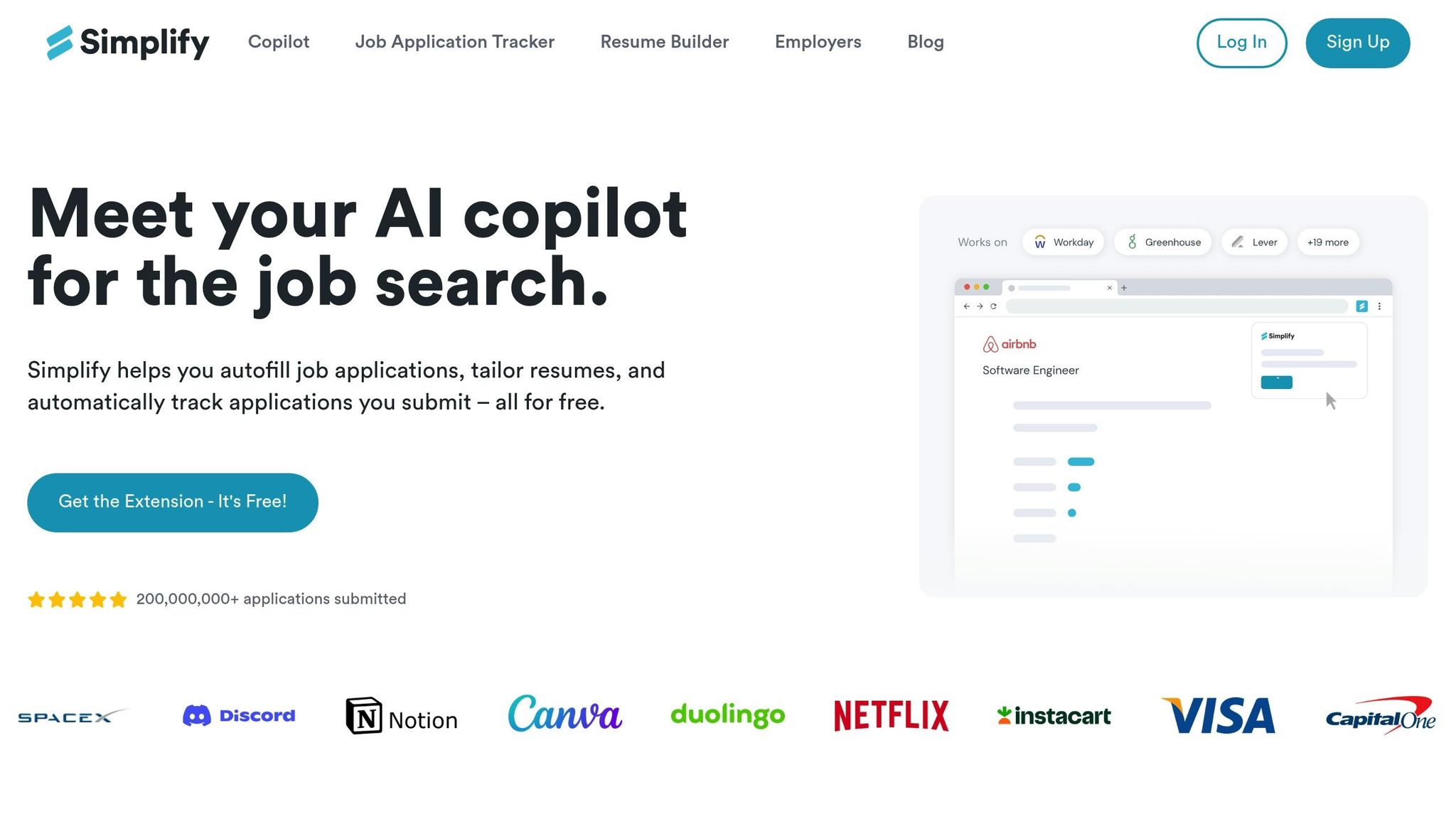
Simplify.jobs functions as a browser extension designed to partially automate job applications on platforms like LinkedIn, Greenhouse, and Lever. It offers a middle-ground solution between full automation and manual applications, featuring AI-generated templates and a digital dashboard for tracking submissions. The pricing includes a free tier allowing 20 applications per month and a Pro plan at $39/month for unlimited applications with AI-generated suggestions.
However, its performance reveals some notable drawbacks. In speed tests, Simplify.jobs managed an average of 5.1 applications per hour, often requiring manual corrections. The tool struggles significantly with Workday forms, achieving only about a 50% accuracy rate, which underscores its challenges with more complex ATS systems. Additionally, it does not support Taleo, which limits its utility for professionals aiming at large organizations. While it has a 4.3/5 rating on the Chrome Web Store, many users highlight its issues with Workday forms and the lack of detailed submission verification on its dashboard. There’s also a medium risk of LinkedIn bot detection, which could impact profile visibility. These limitations make scale.jobs a more dependable option for those seeking a human-assisted, precise approach.
For professionals aiming for competitive roles where ATS optimization is critical, scale.jobs provides a very different experience. Instead of semi-automated tools, human virtual assistants handle each application, ensuring ATS-friendly materials and eliminating compatibility issues. You also receive time-stamped screenshots of every submission and dedicated WhatsApp support, which stands in contrast to Simplify.jobs' generic dashboard. By relying on human expertise, scale.jobs ensures higher accuracy and compatibility, particularly with systems like Workday and Taleo.
Simplify.jobs is better suited for tech-savvy individuals targeting startups on platforms like Greenhouse or Lever, where the extension’s functionality is more reliable. However, for mid-to-senior professionals or those applying to large companies requiring Workday or Taleo applications, Simplify.jobs’ accuracy issues and bot-detection risks make it less suitable. In roles where application quality can make or break opportunities, scale.jobs' human-driven approach consistently outperforms the limitations of semi-automated tools.
Why scale.jobs Outperforms Simplify.jobs
Here’s how scale.jobs addresses the limitations of Simplify.jobs:
- Expert ATS Handling: Human-written applications avoid the accuracy problems Simplify.jobs faces with Workday forms.
- No Automation Risks: Without relying on browser extensions, there’s no chance of LinkedIn flagging your account for automation.
- Verified Transparency: You receive time-stamped proof of every submission, unlike the generic estimates on Simplify.jobs’ dashboard.
- Personalized Support: Direct WhatsApp access to a dedicated team ensures tailored assistance, rather than generic customer service.
- One-Time Payment: Forget monthly subscriptions - pay once and focus entirely on your job search.
Who Should Use Simplify.jobs vs. scale.jobs
- Simplify.jobs: Ideal for early-career tech professionals targeting startups on platforms like Greenhouse or Lever, where speed matters more than deep customization.
- scale.jobs: Perfect for professionals applying to roles that demand reliable ATS compatibility, especially for companies using Workday, Taleo, or other complex systems.
Comparison Table: Simplify.jobs vs. scale.jobs
| Feature | Simplify.jobs | scale.jobs |
|---|---|---|
| Application Method | Semi-automated browser extension | Human virtual assistants |
| Customization | AI-generated templates | Job-specific, human-written |
| ATS Compatibility | Medium (≈50% on Workday) | High (professionally optimized) |
| Bot Detection Risk | Medium | Zero |
| Transparency | Digital dashboard | Proof-of-work screenshots |
| Pricing Model | $39/month recurring | One-time payment |
Consider Switching to scale.jobs If…
- You’re applying to companies that use Workday or Taleo, where Simplify.jobs struggles.
- Reliable ATS compatibility is critical, and you can’t risk a 50% failure rate on key platforms.
- Verifiable proof of each application is important to you, rather than relying on dashboard estimates.
- You’re targeting competitive roles that demand tailored, high-quality applications.
- You prefer a single one-time payment over recurring monthly fees.
Decision Summary
Simplify.jobs works well for startup roles where speed is key. However, for competitive positions requiring tailored applications and reliable ATS optimization, scale.jobs offers a superior, human-driven solution.
3. Sonara.ai
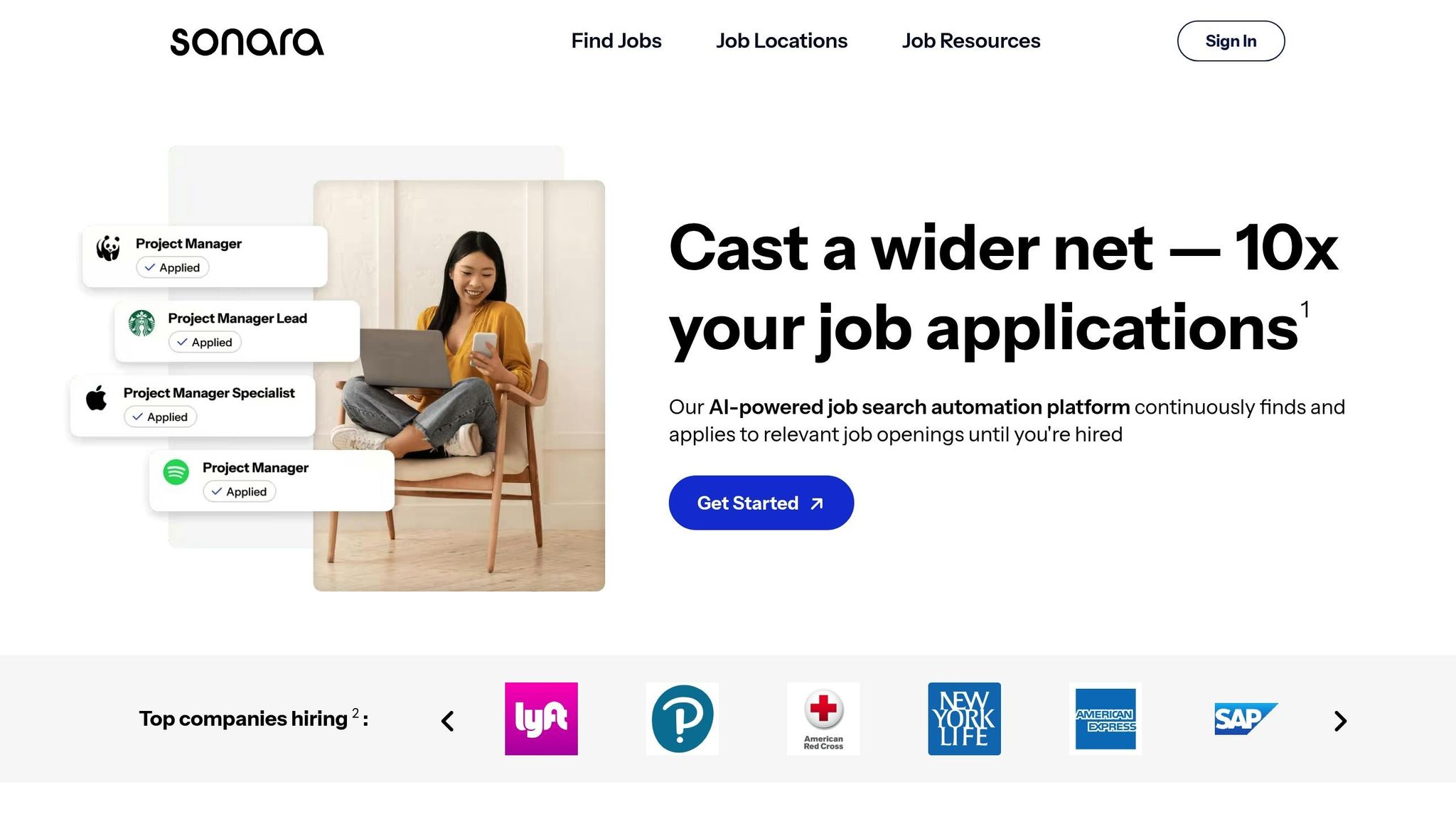
When comparing Sonara.ai to scale.jobs, the differences in their approach to job applications stand out. While both services aim to simplify the job hunt, their methods and results diverge significantly.
Sonara.ai operates as a fully automated AI recruiter, scanning over 50 job boards, tailoring resumes, and submitting applications around the clock. The platform claims to apply to 50-100 jobs daily, focusing on roles with an 80%+ match score. Pricing starts at $19.99/month for 10 daily applications and goes up to $99.99/month for unlimited submissions, complete with analytics. This setup appeals to job seekers looking for a hands-off, high-volume solution.
However, the reality is more nuanced. While Sonara.ai excels at keyword optimization and boasts a 95% ATS pass rate, it struggles with more complex aspects of job applications. It functions primarily as a pattern detector, which means it doesn’t handle career transitions, employment gaps, or industry changes effectively. In February 2024, Sonara.ai faced financial challenges, temporarily halting operations before being acquired and relaunched by BOLD LLC. Users report a 25–40% rejection rate, often attributed to errors or generic applications that go unnoticed due to the lack of pre-submission review. This has led to hiring managers flagging submissions as spam.
In contrast, scale.jobs takes a more deliberate, human-driven approach. Instead of blasting out 100 applications daily, human virtual assistants handle 30 carefully tailored submissions that reflect your career story. They provide time-stamped proof of submissions, ensuring transparency, and offer dedicated WhatsApp support to address unique career situations. This human involvement ensures that applications are not only accurate but also customized for specific roles. Additionally, the one-time payment model eliminates the stress of recurring fees, a relief for job seekers between roles.
Sonara.ai may work well for entry-level tech professionals or those seeking remote roles where volume matters more than precision. However, for mid-to-senior-level professionals or those navigating career changes, its lack of human oversight and high rejection rates can be a drawback. If you need to explain a layoff, switch industries, or apply for roles where resume writing services are crucial, Sonara.ai’s automation may fall short in meeting employer expectations.
Why scale.jobs Stands Out Over Sonara.ai
Here’s how scale.jobs addresses the shortcomings of Sonara.ai:
- Human Understanding: Applications are crafted to address career gaps, transitions, and pivots, going beyond simple keyword matches.
- Error-Free Submissions: Human review ensures applications are accurate and free of errors.
- Transparent Proof: Time-stamped screenshots replace vague dashboard metrics, offering clear evidence of application submissions.
- No Spam Concerns: Thoughtfully written, customized submissions reduce the risk of being flagged as spam.
- One-Time Payment: A single payment removes the burden of monthly subscriptions during unemployment.
Who Should Choose Sonara.ai or scale.jobs?
- Sonara.ai: Ideal for early-career professionals in tech or remote roles who prioritize speed and volume over customization. Users should also be prepared to monitor for spam flags.
- scale.jobs: Best for professionals with complex career paths, those applying for competitive roles, or anyone who cannot afford a high rejection rate.
Comparison Table: Sonara.ai vs. scale.jobs
| Feature | Sonara.ai | scale.jobs |
|---|---|---|
| Application Method | Fully automated AI | Human virtual assistants |
| Daily Volume | 50-100 applications | 30 targeted applications |
| Customization | Keyword-based templates | Job-specific, human-written |
| Pre-Submission Review | None | Human-verified |
| Transparency | Dashboard estimates | Time-stamped screenshots |
| Pricing Model | $19.99-$99.99/month | One-time payment |
Consider scale.jobs If…
- You need to explain career changes, layoffs, or industry shifts that require a personal touch.
- A 25–40% rejection rate is not acceptable for your job search timeline.
- Verifiable proof of application submissions is important to you.
- Your target employers are likely to flag bulk, automated applications as spam.
- You prefer a single payment over recurring monthly fees during your job search.
Decision Summary
Sonara.ai offers speed and volume, making it suitable for entry-level tech roles, but it compromises on accuracy and context. For more competitive positions that demand tailored applications and human oversight, scale.jobs delivers higher quality and transparency. Up next, we’ll explore how these differences influence overall user satisfaction.
4. Jobscan.co
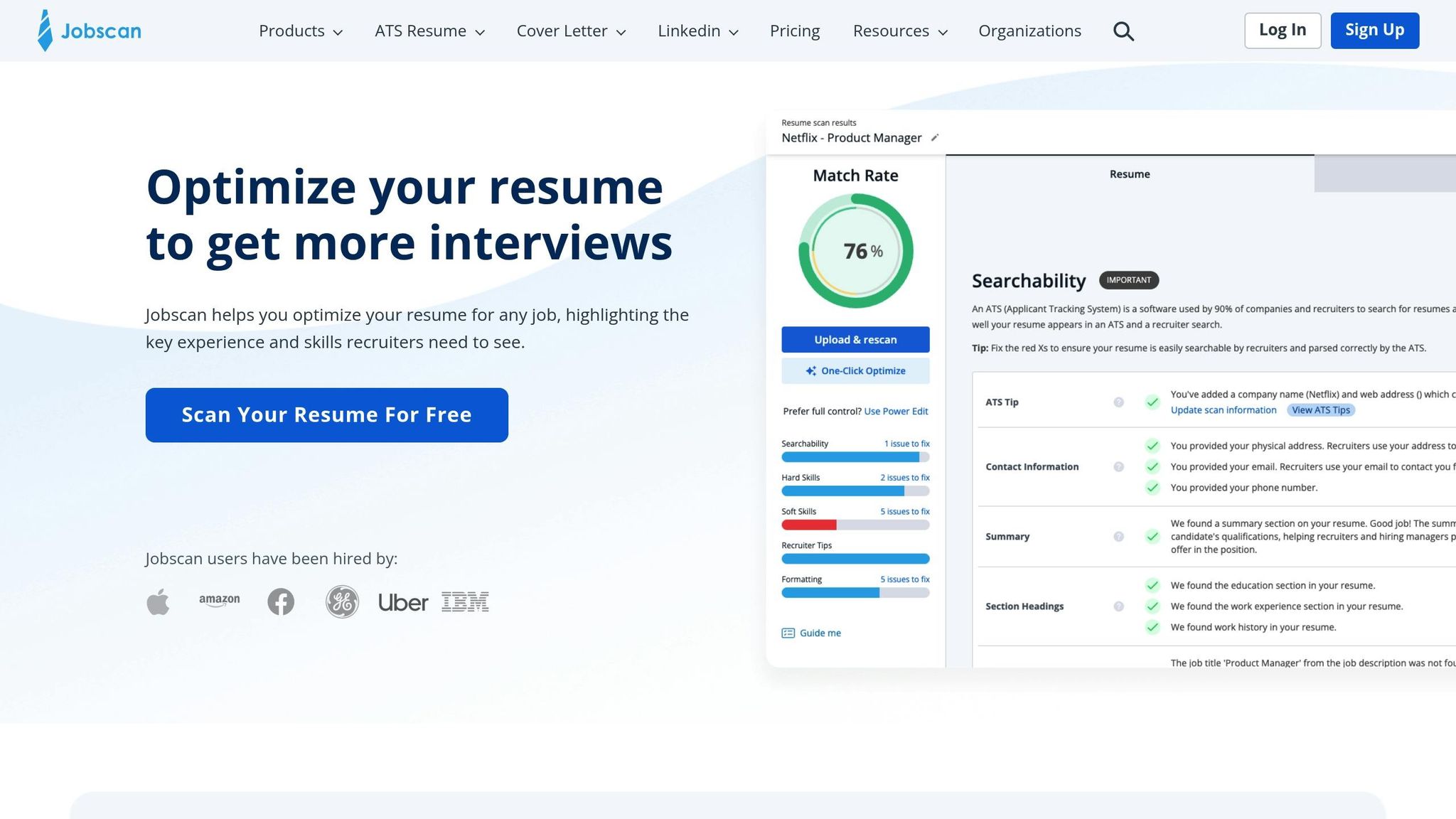
Jobscan.co offers a specialized service focused on analyzing your resume against job descriptions to provide a match score. Unlike scale.jobs, it doesn't handle applications for you. Instead, it identifies missing keywords, highlights formatting suggestions, and flags compatibility issues with Applicant Tracking Systems (ATS). While this can help pinpoint why your resume might not be getting noticed, the platform stops short of taking actionable steps on your behalf. You'll still need to rewrite your resume, manually apply to jobs, and hope the changes make a difference.
One of Jobscan's key strengths is its precise keyword analysis. For roles in tech or other fields with specific skill requirements - like "Python, AWS, Docker" - this can be helpful. However, the tool doesn't address more nuanced challenges, such as explaining employment gaps, reframing layoffs, or tailoring your resume for hiring managers who value storytelling over keyword optimization.
The pricing for Jobscan.co ranges from $49.95/month for basic scans to $89.95/month for unlimited scans and advanced features. Over time, this subscription cost can add up, especially since the platform doesn't assist with the actual application process, leaving you to spend additional time navigating job boards.
In contrast, scale.jobs offers a complete solution. Its human virtual assistants not only refine your resume with naturally integrated keywords but also handle application submissions for you. They even provide time-stamped proof of every submission via WhatsApp. Instead of a dashboard with match scores, you receive verified application submissions tailored to each job description. Additionally, the one-time payment model eliminates the hassle of recurring fees. For those needing deeper resume support, resume writing services ensure your materials are both ATS-friendly and appealing to hiring managers. This comprehensive approach highlights why scale.jobs stands out as a more practical option for job seekers.
Why scale.jobs Outperforms Jobscan.co
- End-to-End Service: Applications are submitted for you, not just analyzed.
- Human Expertise: Virtual assistants address career gaps, transitions, and other nuances algorithms can't handle.
- No Recurring Fees: A one-time payment replaces monthly subscriptions.
- Proof of Submission: Receive time-stamped screenshots instead of abstract match scores.
- 24/7 Support: Real-time WhatsApp support offers personalized assistance.
Who Should Choose Jobscan.co or scale.jobs?
- Jobscan.co: Suitable for job seekers who prefer a DIY approach, want to understand ATS mechanics, and have time to apply manually. It's particularly effective for straightforward roles with clear keyword requirements.
- scale.jobs: Ideal for professionals who need a hands-off approach, especially those with complex career histories or limited time to manage applications.
| Feature | Jobscan.co | scale.jobs |
|---|---|---|
| Primary Function | Resume analysis | Full application management |
| Human Involvement | None (algorithm-based) | Virtual assistants manage submissions |
| ATS Optimization | Keyword suggestions | Human-reviewed integration |
| Application Submission | Manual (user applies) | Fully handled by assistants |
| Support Model | Self-service | 24/7 WhatsApp support |
| Pricing | $49.95-$89.95/month | One-time payment |
Switch to scale.jobs If…
- You need assistance with both resume optimization and application submission.
- Recurring subscription fees are a concern during your job search.
- Your resume requires a human touch to address career gaps or transitions.
- You want verifiable proof of application submissions, not just diagnostic scores.
- You lack the time or energy to manually apply after analyzing your resume.
Decision Summary
Jobscan.co provides valuable insights into ATS compatibility but leaves the execution entirely to you. For job seekers who need a seamless solution that includes both optimization and submission - with human expertise and transparent proof - scale.jobs delivers a more comprehensive service tailored to real-world job application challenges.
5. scale.jobs
scale.jobs stands out in a sea of automated job application tools by combining the precision of human expertise with the efficiency of AI. Unlike platforms such as LazyApply, Simplify.jobs, or Sonara.ai, scale.jobs focuses on creating tailored, ATS-friendly applications that avoid the pitfalls of generic submissions. Here’s why it excels:
- Human virtual assistants ensure every application is customized and optimized for ATS systems.
- Time-stamped proof-of-work via WhatsApp offers clear, verifiable updates on application submissions.
- One-time payment model eliminates the hassle of recurring subscription fees.
- Manual form completion minimizes the risk of triggering ATS or bot-detection systems.
- 24/7 WhatsApp support provides instant assistance, far outpacing the slow email response times of competitors.
This platform manages the entire job search process, from crafting ATS-optimized resumes to submitting verified applications. Trained assistants manually handle application forms, and each submission is backed by time-stamped screenshots sent via WhatsApp, ensuring transparency. This approach is particularly effective for addressing career gaps or transitions that automated tools often mishandle.
Pricing and Services
scale.jobs offers three pricing tiers:
- $199 for 250 applications
- $299 for 500 applications
- $399 for 1,000 applications
For those needing additional support, the platform also provides professional resume writing services. While the pricing reflects the quality of service, the process is slower than fully automated systems, with a 24-hour turnaround per application. However, this deliberate pace ensures that each submission is carefully tailored, reducing the likelihood of spam flags or generic responses from hiring managers.
Another key advantage is compatibility. scale.jobs handles applications across all platforms, including Workday, Taleo, and specialized job boards, sidestepping the compatibility issues that often plague fully automated tools.
Who Benefits Most from scale.jobs?
scale.jobs is a great fit for:
- Mid-to-senior professionals targeting competitive roles where attention to detail is critical.
- Candidates with career gaps, layoffs, or industry transitions that require thoughtful presentation.
- Job seekers applying to companies with complex ATS systems like Workday or Taleo.
- Individuals who value proof of submission for each application.
- Those who prefer a one-time payment instead of monthly subscriptions.
- Busy professionals who need a time-saving, hands-off approach to job applications.
When Competitors Might Be a Better Fit
Platforms like LazyApply, Simplify.jobs, or Sonara.ai may be more suitable for:
- Entry-level candidates applying to a high volume of similar roles.
- Tech professionals focusing on startups using systems like Greenhouse or Lever.
- Job seekers with straightforward career paths who prioritize speed over customization.
- Those who are comfortable monitoring their applications for potential errors or spam issues.
Ultimately, scale.jobs is designed for job seekers who value quality and transparency over speed, making it an excellent choice for professionals navigating complex job searches or seeking roles where every detail matters.
Pros and Cons
This comparison sheds light on why scale.jobs stands out from its competitors by examining factors like speed, personalization, and reliability.
Each tool in the lineup offers its own balance of benefits and drawbacks. LazyApply allows users to apply to over 100 jobs in minutes, but its generic, bot-like submissions often get flagged by ATS systems, leading to high ghosting rates. Simplify.jobs speeds up applications by as much as 80% using its Chrome extension, but it struggles with parsing errors on complex forms, particularly for senior-level roles requiring more tailored applications.
Sonara.ai automates job matching, submitting up to 50 applications per week, and claims users experience three times as many interviews through targeted outreach. However, its $80/month subscription often delivers mixed results - some users report no interviews after months of use. Additionally, its algorithm occasionally suggests roles that don’t align with the user’s profile. Jobscan.co shines in ATS keyword optimization, with users reporting 2–3 times more interviews after implementing its feedback and achieving 90%+ match scores. Still, its $49/month fee and generic keyword recommendations can make resumes feel robotic, especially in creative fields where ATS rules are less critical.
scale.jobs, on the other hand, bypasses bot detection by using manually completed applications, verified through time-stamped WhatsApp screenshots. While it requires a 24-hour turnaround and has higher upfront costs ($199–$399 for 250–1,000 applications), it ensures compatibility across major ATS platforms like Workday and Taleo. For those needing additional help with career transitions or employment gaps, professional resume writing services can further enhance applications before submission.
Here’s a side-by-side breakdown of these tools:
| Tool | Key Strength | Key Weakness | Best For |
|---|---|---|---|
| LazyApply | High volume (100+ apps/day) | High ghosting; flagged as spam | Entry-level, high-volume job seekers |
| Simplify.jobs | Fast applications via Chrome (80% faster) | 15–20% form errors; limited customization | Tech roles on supported platforms |
| Sonara.ai | Automated matching (50 apps/week) | Inconsistent results; $80/month cost | Hands-off seekers with simple profiles |
| Jobscan.co | 90%+ ATS match; 2–3× more interviews | $49/month; doesn’t submit applications | DIY optimizers needing keyword guidance |
| scale.jobs | Human-verified accuracy; zero bot risk | 24-hour turnaround; higher upfront cost | Mid-to-senior roles needing precision |
Switch to scale.jobs if…
- You need human oversight to address career gaps, layoffs, or transitions that automated tools can't handle effectively.
- ATS spam flags or bot detection are a concern that could harm your professional image.
- You want verifiable proof of every application, rather than relying on dashboard estimates.
- You prefer a one-time payment instead of ongoing monthly fees during your job search.
- You're applying for competitive roles that demand personalized, error-free applications to stand out.
Ultimately, your choice will depend on whether speed or quality is your priority. Automated tools are ideal for straightforward career paths or high-volume entry-level job searches. In contrast, a service like scale.jobs offers the precision and personalization necessary for landing competitive roles. Carefully weigh these factors to determine if scale.jobs aligns with your job search goals.
Conclusion
Selecting the right job application tool depends on where you are in your career, your timeline, and how much attention to detail your search requires. Tools like LazyApply and Sonara.ai are ideal for entry-level candidates who benefit from a high-volume approach. Similarly, Simplify.jobs caters to tech professionals aiming for platforms like Greenhouse or Lever, where speed is valuable, and minor errors are less critical. On the other hand, Jobscan.co is a great choice for individuals who prefer a hands-on approach, fine-tuning their resumes for ATS systems before manually submitting applications. However, when your job search demands more nuanced judgment, scale.jobs stands out as a stronger alternative.
scale.jobs is particularly effective for job seekers whose profiles require a personal touch - whether due to career gaps, visa sponsorship needs (like H-1B, F-1, TN, or O-1 visas), or mid-to-senior-level roles where generic applications may fall short. Automated tools often struggle with complexities such as explaining career pivots, addressing layoffs, or navigating ATS systems that flag bot submissions. If you've experienced low responses from automated submissions or are targeting roles where every detail matters, scale.jobs provides human-verified applications that reduce the risk of spam flags while maintaining a high ATS compatibility rate (80–90%). This human oversight offers a strategic edge in competitive job markets.
For job seekers facing visa deadlines or employment gaps, combining scale.jobs with professional resume writing services ensures your application materials are polished and ready to make an impact. With a one-time payment model ranging from $199 to $399, this approach is cost-effective for a focused job search lasting 4–8 weeks, unlike the recurring fees charged by most automated platforms.
Consider switching to scale.jobs if:
- Your career involves gaps, transitions, or visa sponsorship complexities.
- ATS optimization and precision are non-negotiable.
- You need human-reviewed, verifiable application submissions.
- You prefer a one-time payment over ongoing subscription costs.
While automated tools are excellent for high-volume, straightforward applications, scale.jobs is better suited for job seekers targeting 50–100 carefully chosen positions where tailored storytelling and flawless submissions are essential. By aligning your tool with your job search strategy, you can significantly improve your chances of landing interviews.
Key Takeaway: Use automated tools for quick, high-volume applications. Opt for scale.jobs when your search calls for personalized, precise applications with human oversight.
FAQs
Will using an AI auto-apply tool get my applications flagged as spam?
Using AI auto-apply tools might seem like a time-saver, but they can backfire by increasing the chances of your applications being flagged as spam. These tools often generate generic resumes overloaded with keywords, which applicant tracking systems (ATS) and recruiters can recognize as artificial or insincere. This approach may lead to higher rejection rates. To improve your chances, focus on creating personalized applications that align with ATS requirements while staying genuine and tailored to the role.
When does a human-assisted apply service make more sense than automation?
A human-assisted job application service is perfect for roles where personalized, high-quality applications make all the difference. While AI tools are great for managing bulk applications and ensuring ATS compliance, they often miss the subtle details that recruiters are looking for. Human involvement brings a tailored touch, ensuring the content is specific, details are accurate, and the application aligns closely with the job's requirements. This approach is particularly valuable for senior-level roles, niche industries, or highly competitive positions where standing out and demonstrating authenticity are key to securing an interview.
How can I verify applications were actually submitted correctly?
To ensure your job applications were submitted successfully, start by checking for confirmation emails from the employer or platform. These emails typically include details about your application and may even provide next steps. If you're applying through a company's portal, log in to track the status of your submission directly.
For email-based applications, if you don’t receive a confirmation after a reasonable amount of time, consider sending a polite follow-up to confirm receipt. Some employers may also use tools like background check services during the hiring process, but your best bet for verification is to rely on official tracking systems or reach out respectfully when in doubt.