
AI Job Apply Tools Look Cheaper, Until You Do the Math
Cheap automated apply tools often fail ATS and produce low callbacks; human-reviewed, one-time services raise interview rates and cut hidden costs.


AI-powered job application tools like LazyApply, Simplify.jobs, and Sonara.ai promise affordability and convenience, but their actual value diminishes when considering their low success rates. These tools often rely on generic, automated processes that fail to pass Applicant Tracking Systems (ATS) or garner meaningful responses, leaving job seekers with extended unemployment periods and hidden costs.
In contrast, scale.jobs takes a human-led approach, tailoring applications to specific roles and optimizing them for ATS systems. While scale.jobs charges a one-time fee starting at $199, it delivers higher callback rates (40–60%) and faster job placements, making it a better choice for professionals targeting competitive or specialized roles. This article breaks down the costs, success rates, and features of these platforms to help you choose the best job application service for your needs.
Quick Comparison
| Feature | LazyApply | Simplify.jobs | Sonara.ai | scale.jobs |
|---|---|---|---|---|
| Human Involvement | None (Automated) | Minimal (User-led) | None (AI-only) | High (Human-led) |
| Customization | Generic templates | AI-generated | Keyword-based | Tailored to roles |
| ATS Compatibility | Low (70–90% fail) | Medium (50% pass) | Moderate (95% pass) | High (Optimized) |
| Pricing | $99–$249 lifetime | $39.99/month | $20–$100/month | $199–$399 one-time |
| Response Rates | 2–6% | 5–10% | 5–10% | 40–60% |
For job seekers prioritizing quality and results, scale.jobs offers better outcomes by combining human expertise with technology. Read on for a detailed breakdown of each platform's strengths and weaknesses.
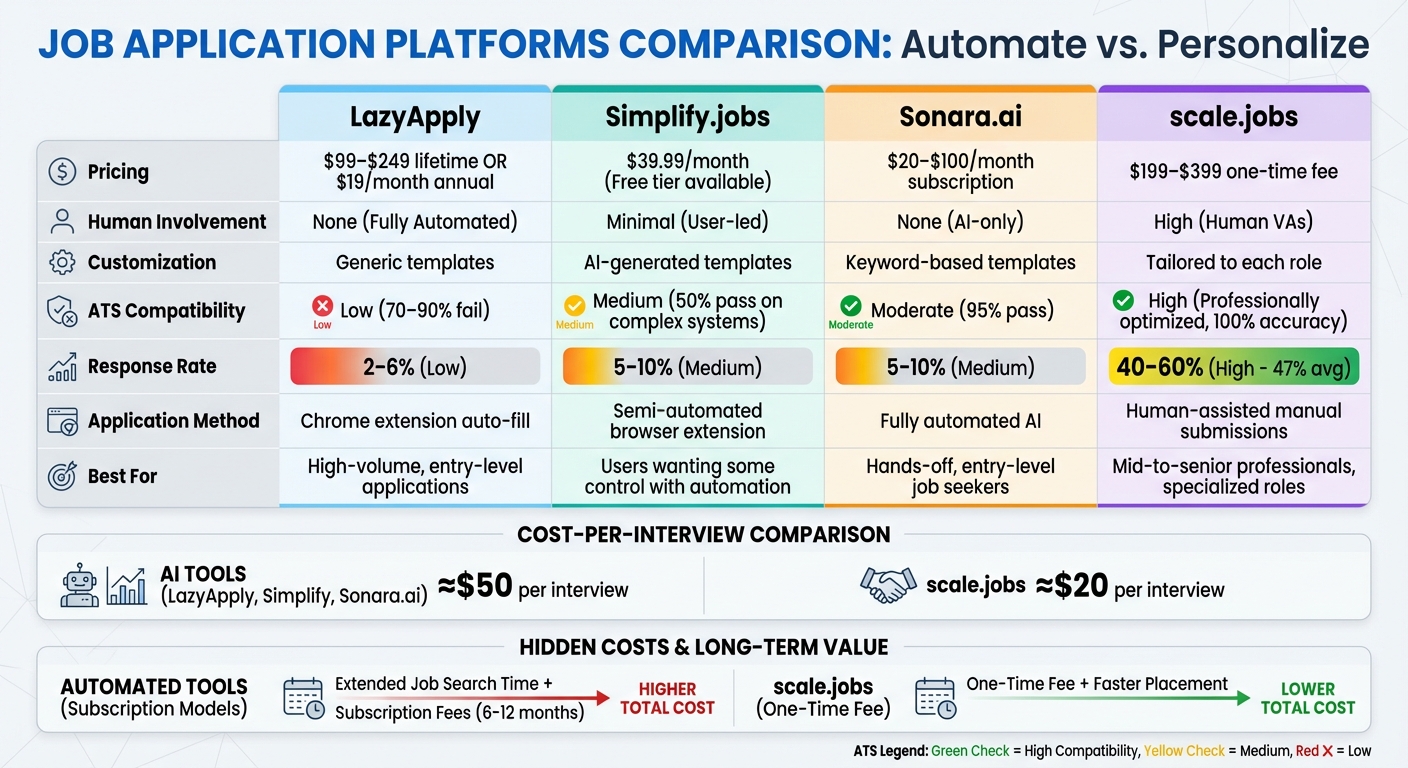
AI Job Application Tools Comparison: Cost vs Success Rates
Automate Your Job Search Through AI Agent Ft. Jobright AI | Find Jobs - Custom Resume - Auto Apply
1. LazyApply
LazyApply markets itself as an automation tool for job applications, offering lifetime access plans ranging from $99 to $249, or an annual subscription starting at $19 per month. It uses a Chrome extension to auto-fill and submit applications across various job boards, sometimes processing hundreds of applications at once. However, the appeal of its low cost fades when you consider how these applications are handled and their overall effectiveness.
Human Involvement
While the pricing may catch your attention, the execution leaves much to be desired. LazyApply relies entirely on automated processes with no human review or oversight. Its Chrome extension scrapes job postings and auto-fills forms using a single stored resume. Unfortunately, this approach disregards the specific requirements of individual roles. For instance, the same generic resume might be submitted for both an entry-level position and a senior engineering role, resulting in mismatched applications and frequent rejections.
Resume Customization & ATS Optimization
LazyApply’s system uses one uploaded resume for every application, regardless of the job's unique requirements. This generic, one-size-fits-all strategy often struggles to navigate applicant tracking systems (ATS), which prioritize resumes tailored with keywords specific to the job description. Moreover, many companies now flag applications that appear to be generated by bots. On the other hand, professional resume services ensure resumes are customized for each role, increasing the chances of passing ATS filters and conveying genuine interest in the position.
Pricing Model & True Cost
At first glance, the $99 lifetime plan might seem like a steal. However, with a response rate of just 6%, you’d need to submit about 17 applications to secure a single callback. This low response rate can significantly extend your job search, making the initial savings less impactful. In comparison, scale.jobs charges $199 for 250 applications and achieves a higher response rate of 25–30% through human-reviewed, tailored applications. This means you're more likely to land interviews within the first 50–100 applications, effectively reducing the time spent job hunting.
Why scale.jobs Wins Over LazyApply
LazyApply’s automation-first approach has clear limitations, but scale.jobs addresses these shortcomings with key advantages:
- Personalized Human Involvement: Unlike LazyApply’s bots, scale.jobs employs human assistants who carefully match applications to job requirements.
- Tailored Resume Customization & ATS Optimization: Instead of submitting the same resume repeatedly, scale.jobs creates role-specific documents designed to pass ATS filters.
- Real-Time Transparency & Support: Offers WhatsApp updates and timestamped screenshots as proof of work, ensuring you’re always informed.
- Higher Response Rates: While LazyApply hovers around a 6% success rate, scale.jobs achieves 25–30%, leading to faster interview opportunities.
- Better Long-Term Value: Though LazyApply might seem cheaper upfront, scale.jobs’ higher success rates and reduced job search time provide greater overall value.
2. Simplify.jobs
Simplify.jobs offers itself as a semi-automated assistant for job applications, providing a free version with basic autofill features and a premium option (Simplify+) priced at $39.99 per month. The platform uses a browser extension to autofill applications on major job boards. However, unlike scale.jobs, which uses a human-powered approach, Simplify.jobs relies heavily on automation, which limits its effectiveness.
Human Involvement
Simplify.jobs functions as a reactive tool, meaning you still need to manually search for job listings and initiate the autofill process. The browser extension fills out forms using your saved information, but there’s no human intervention to ensure your application is tailored to the specific job. In contrast, scale.jobs assigns real human assistants who actively research job postings, customize applications to match job descriptions, and verify that each submission aligns with the role’s requirements. This lack of human oversight in Simplify.jobs also impacts the quality and relevance of resume adjustments.
Resume Customization & ATS Optimization
The premium tier of Simplify.jobs includes AI-generated resumes and a keyword tool, but these features rely on templates that often result in only partial compatibility with applicant tracking systems (ATS), especially for complex platforms like Taleo. Over-reliance on templates might help resumes pass ATS filters, but they often lack the polish needed to impress human recruiters. On the other hand, scale.jobs focuses on creating highly tailored resumes crafted by human writers, ensuring both ATS compatibility and readability for hiring managers.
Pricing Model & True Cost
Simplify.jobs charges $39.99 per month for its premium plan, which can become costly over time. While its free tier provides autofill capabilities, it does not include features like AI-generated resumes or advanced keyword tools. In comparison, scale.jobs offers a one-time fee starting at $199 for up to 250 applications, eliminating the recurring costs associated with subscription models. Over a year, Simplify.jobs can cost more than $400, making scale.jobs a more cost-effective choice for many users.
Why scale.jobs Wins Over Simplify.jobs
- Proactive Human Assistance: Unlike Simplify.jobs, scale.jobs employs human assistants who actively search for jobs, tailor applications, and ensure ATS optimization. This proactive service goes beyond the reactive autofill approach of Simplify.jobs.
- Personalized Resume Creation: Resumes created by scale.jobs are job-specific and strike a balance between ATS compatibility and human readability, avoiding the pitfalls of generic, template-based AI resumes.
- No Bot Detection Risks: With manual application submissions by real people, scale.jobs eliminates the risk of bot detection that can arise from using browser extensions.
- Clear Proof of Work: Clients receive timestamped screenshots via WhatsApp, showing exactly where and how applications were submitted - a level of transparency not offered by Simplify.jobs' digital dashboard.
- Flat Fee Model: By charging a one-time fee, scale.jobs provides better long-term value compared to Simplify.jobs’ recurring subscription costs.
For those seeking a more personalized and efficient job application process, scale.jobs stands out as a stronger alternative. Its human-powered approach, tailored resume services, and transparent pricing make it a compelling choice for job seekers.
3. Sonara.ai
Sonara.ai positions itself as an automated job search assistant, promising to apply for jobs on your behalf using AI to match your profile with relevant opportunities. While the idea of full automation might sound appealing, the absence of human oversight can hinder the quality of applications. Unlike Scale.jobs, which blends AI with human expertise, Sonara.ai relies solely on algorithms. The platform operates on a monthly subscription model, with pricing varying based on features and application volume. However, this reliance on automation often leaves room for errors that human involvement could address.
Human Involvement
Sonara.ai’s approach is entirely automated - it scans job boards and submits applications without any human intervention. This means there’s no one verifying whether your application aligns with a job's requirements or ensuring your resume is tailored to the specific role. By contrast, Scale.jobs integrates human assistants into the process. These assistants research each position, customize your materials, and ensure that every application is relevant and optimized. This human touch is particularly valuable when you consider that 90% of employers use Applicant Tracking Systems (ATS) to filter candidates. A human-verified application is far more likely to stand out in such systems.
Resume Customization & ATS Optimization
Sonara.ai uses a template-based approach for resumes, automatically inserting keywords to align with job descriptions. While this may work for generic roles, it lacks the nuanced adjustments that human writers can provide. For specialized positions or career pivots, a resume tailored by a professional who understands ATS requirements delivers better results. As Tomas Chamorro-Premuzic aptly states:
AI performs best when it imposes structure where humans are prone to improvisation... but there is still no convincing independent evidence that AI outperforms established, science-based assessment tools on accuracy.
This highlights the importance of human expertise in crafting resumes that not only pass ATS filters but also appeal to hiring managers.
Pricing Model & True Cost
Sonara.ai’s subscription-based model charges users monthly, regardless of whether applications yield results. This can lead to unpredictable and ongoing costs. In contrast, Scale.jobs offers a one-time fee structure, providing a clear and predictable expense without the burden of recurring payments. For job seekers mindful of their budget, this distinction can make a big difference.
Why Scale.jobs Wins Over Sonara.ai
- Human Verification: Applications are reviewed by real people, ensuring alignment with job requirements and reducing irrelevant submissions.
- Tailored Resumes: Human assistants customize resumes to fit specific roles, offering a level of personalization that automated systems cannot match.
- Accountability: Clients receive timestamped proof of application submissions, such as WhatsApp screenshots, ensuring complete transparency.
- Cost Efficiency: A one-time fee eliminates the uncertainty of monthly charges, offering better cost control.
- Dedicated Support: Access to a human assistant allows for personalized adjustments and real-time support, something automated platforms lack.
Who Should Use Sonara.ai vs. Scale.jobs
Sonara.ai is best for you if:
- You’re looking for a fully automated, hands-off solution.
- You’re applying to entry-level roles where generic applications may be sufficient.
Scale.jobs is the better choice if:
- You need customized applications designed to pass ATS filters and appeal to recruiters.
- You’re targeting mid-to-senior roles, specialized positions, or transitioning careers.
- You value transparency and want proof of where your applications are submitted.
- You prefer a predictable, one-time payment over recurring monthly fees.
For job seekers who want a balance of technology and human expertise, Scale.jobs stands out as the more comprehensive option. Whether you're aiming for specialized roles or simply want higher-quality applications, the added human involvement can make all the difference.
4. scale.jobs
Scale.jobs stands out by emphasizing human expertise in every job application. Instead of relying on automated systems to send out generic resumes in bulk, the platform assigns dedicated human assistants to handle each application. These assistants manually research positions, tailor your application materials, and submit them individually. This method avoids the pitfalls of bot-detection systems - used by 83% of employers to flag mass-submitted AI applications - and ensures each submission feels personalized and genuine. Let’s take a closer look at how scale.jobs leverages human involvement to surpass automated competitors.
Human Involvement
At scale.jobs, every application is carefully handled by a human virtual assistant (VA), who manually completes forms to ensure compatibility with even the most complex systems, such as Workday and Taleo. Unlike Simplify.jobs, which reports only 50% accuracy with these platforms, scale.jobs achieves 100% accuracy because a real person checks every detail. These VAs also address tricky nuances that AI often overlooks, such as employment gaps, career changes, or visa requirements like H-1B and L-1. To provide transparency, the platform offers time-stamped WhatsApp screenshots as proof of submission - a feature that many competitors lack, as they only provide application counts without verification.
Resume Customization & ATS Optimization
Rather than relying on generic templates or keyword stuffing, scale.jobs focuses on creating resumes that excel in both ATS (Applicant Tracking System) filters and recruiter reviews. Dedicated assistants craft resumes with achievement-focused bullet points, seamlessly incorporating relevant keywords. This avoids the robotic feel of AI-generated resumes, which recruiters can often spot immediately. For mid-to-senior-level or specialized roles where generic submissions are quickly dismissed, this tailored approach significantly improves outcomes. Users have reported callback rates of approximately 47%, a stark contrast to the 2-6% rates typical of fully automated platforms.
Pricing Model & True Cost
Scale.jobs operates on a one-time fee structure with four pricing tiers:
- Basic: $199 for 250 applications
- Standard: $299 for 500 applications
- Best Value: $399 for 1,000 applications
- Ultimate Bundle: $1,099 for 1,000 applications, including LinkedIn optimization and personal recruiter support
The platform also offers pro-rated refunds for unused credits if you secure a job early, making it a lower-risk investment compared to recurring subscription fees. While submissions take 24 hours instead of being instant, the time saved - over 20 hours per week - lets you focus on networking and preparing for interviews.
For job seekers who need more than just volume, scale.jobs combines resume writing services with human-led applications to deliver a thorough and effective job search experience that automated tools simply can’t replicate.
Side-by-Side Comparison
Looking at these four platforms side by side, their unique approaches become apparent. LazyApply and Sonara.ai prioritize speed and volume through full automation, while Simplify.jobs offers a mix of automation and user control. On the other hand, scale.jobs stands out by relying entirely on trained human assistants to handle every job application manually. This contrast emphasizes the trade-off between automation and human-led precision - something worth considering if you're thinking about switching platforms. Below is a table summarizing the differences to help you make an informed decision.
| Feature | LazyApply | Simplify.jobs | Sonara.ai | scale.jobs |
|---|---|---|---|---|
| Human Involvement | Minimal (AI Bot) | Semi-automated (user-initiated) | None (AI-only) | High (Human VAs) |
| Application Method | Automated via extension | Semi-automated extension | Completely automated by AI | Human-assisted manual |
| Customization | Generic templates | AI-generated templates | Keyword-based templates | Job-specific, tailored |
| ATS Optimization | Automated (High risk) | Medium (50% Workday) | Automated (95% pass) | Professionally optimized |
| Transparency | Limited analytics | Digital dashboard | Dashboard summary | Proof-of-work via WhatsApp |
| Pricing Model | Lifetime ($99–$249) | Subscription ($39/mo) | Subscription ($20–$100/mo) | One-time ($199–$399+) |
The pricing structures also reflect the platforms' philosophies. LazyApply offers a one-time lifetime fee ranging from $99 to $249, while Simplify.jobs and Sonara.ai operate on subscription models at $39 per month and $20–$100 per month, respectively. Scale.jobs, however, opts for a higher upfront cost of $199–$399, covering 250–1,000 applications. This one-time payment includes human-led services such as tailored resumes, ATS-friendly optimization, and proof-of-work delivered via WhatsApp. Unlike subscription-based models, this approach eliminates recurring fees, offering a cost-effective solution for those seeking quality over quantity.
For job seekers aiming to enhance their application strategy, combining scale.jobs with professional resume writing services can create a comprehensive plan. With human assistants, ATS-optimized documents, one-time pricing, and transparent proof-of-work, scale.jobs provides a distinct edge over fully automated competitors.
Which Tool Should You Choose?
After comparing LazyApply, Simplify.jobs, and Sonara.ai, the decision ultimately comes down to whether you prioritize quantity or quality in your job applications. If you're an entry-level candidate casting a wide net - perhaps applying to over 100 roles across multiple industries - tools like LazyApply (with a one-time fee ranging from $99 to $249) or Sonara.ai (costing $20 to $100 per month) might be more suitable. These platforms excel in speed and volume, making them ideal for recent graduates exploring fields like retail, hospitality, or general tech roles. However, since they use generic templates, response rates often hover below 5%, and many applications may not pass ATS (Applicant Tracking System) keyword filters.
Why scale.jobs Stands Out
For mid-to-senior professionals or those targeting highly competitive positions, automation alone often falls short. This is where scale.jobs shines by addressing the pitfalls of fully automated tools. Here's what sets it apart:
- Human-crafted applications: Each application is manually tailored to match specific job requirements, ensuring relevance and quality.
- ATS-optimized documents: Professionally written resumes and cover letters increase the chances of passing ATS filters and impressing recruiters.
- One-time fee model: With costs ranging from $199 to $399, scale.jobs eliminates the need for recurring subscriptions, which can add up over time.
- Proof of submission: Transparent updates via WhatsApp screenshots show exactly where and when applications are submitted.
- Better cost-per-interview: While a $29.90/month AI tool might generate hundreds of applications but only two interviews (at $50 per interview), scale.jobs delivers 15 interviews from 500 targeted applications at a cost of roughly $20 per interview.
This breakdown highlights how human-assisted applications can deliver better results with less waste.
When AI-Driven Tools Make Sense
AI-driven tools like LazyApply or Sonara.ai are best suited for:
- High-volume applications (200+ per month) across various industries.
- Job seekers prioritizing speed over detailed customization.
- Exploring multiple career paths without committing to a specific field.
- Individuals on tight budgets who need a low-cost way to apply broadly.
These tools are particularly useful for entry-level roles or positions where competition is less intense.
When to Choose scale.jobs
Consider scale.jobs if you're:
- Targeting 50–100 selective, competitive roles at well-established companies.
- Applying for mid-to-senior positions that demand personalized, high-quality applications.
- Managing visa-related job applications (e.g., H1B, TN, O1) requiring precise documentation.
- Earning $80K+ annually, where even a short period of unemployment can lead to significant financial losses.
- Seeking ATS-optimized documents tailored for competitive industries.
- Looking for transparency and accountability in the application process.
Pairing scale.jobs with their resume writing services can further enhance the quality of your applications, ensuring you stand out in competitive job markets.
When to Switch to scale.jobs
You might want to switch from AI-driven tools to scale.jobs if:
- You've applied to 500+ roles using automated tools but received fewer than 10 callbacks.
- Your subscription costs for automated tools have exceeded $200 without meaningful results.
- You're applying for specialized roles where generic templates consistently fall short.
- You need clear proof of where your applications are being submitted.
- You're spending 20+ hours per week managing automated submissions and want to reclaim that time.
Decision Summary
AI-driven tools are a good fit for entry-level applicants who need to apply to a large number of roles quickly and affordably. On the other hand, scale.jobs is ideal for professionals targeting competitive or specialized positions, where quality and ATS optimization are critical. The one-time fee not only eliminates ongoing costs but also frees up time for more productive activities like networking or preparing for interviews.
FAQs
How do I calculate the real cost per interview of an application tool?
To figure out the actual cost per interview, take the total amount you spent on the service and divide it by the number of interviews it helped you land. For instance, if you invest $199 in a human-assisted service and it results in 20 interviews, your cost per interview comes out to $9.95. Now, compare this to an AI-driven tool with lower callback rates; the need for a higher volume of applications could end up driving your overall cost higher.
What are the fastest signs my applications are failing ATS screening?
Signs that your resume might not make it past ATS systems include delayed or inaccurate sorting, missing essential keywords, improper formatting like the use of graphics or tables, inconsistent date formats, and the omission of crucial details such as job locations or standard headers. These problems can result in your application being automatically rejected or simply ignored.
When should I switch from automation to a human-led application service?
For competitive or high-stakes roles where tailored, ATS-friendly applications are a must, consider opting for a human-led application service. This approach is particularly useful if you prioritize personalized guidance, higher callback rates, and clear communication throughout the process. Unlike automated systems, human expertise ensures the level of customization and attention to detail that these critical opportunities often require.