What AI Job Apply Tools Get Wrong About Hiring
AI job-apply tools produce copycat, forgettable resumes and miss human-fit; blending AI with human judgment boosts interview success.

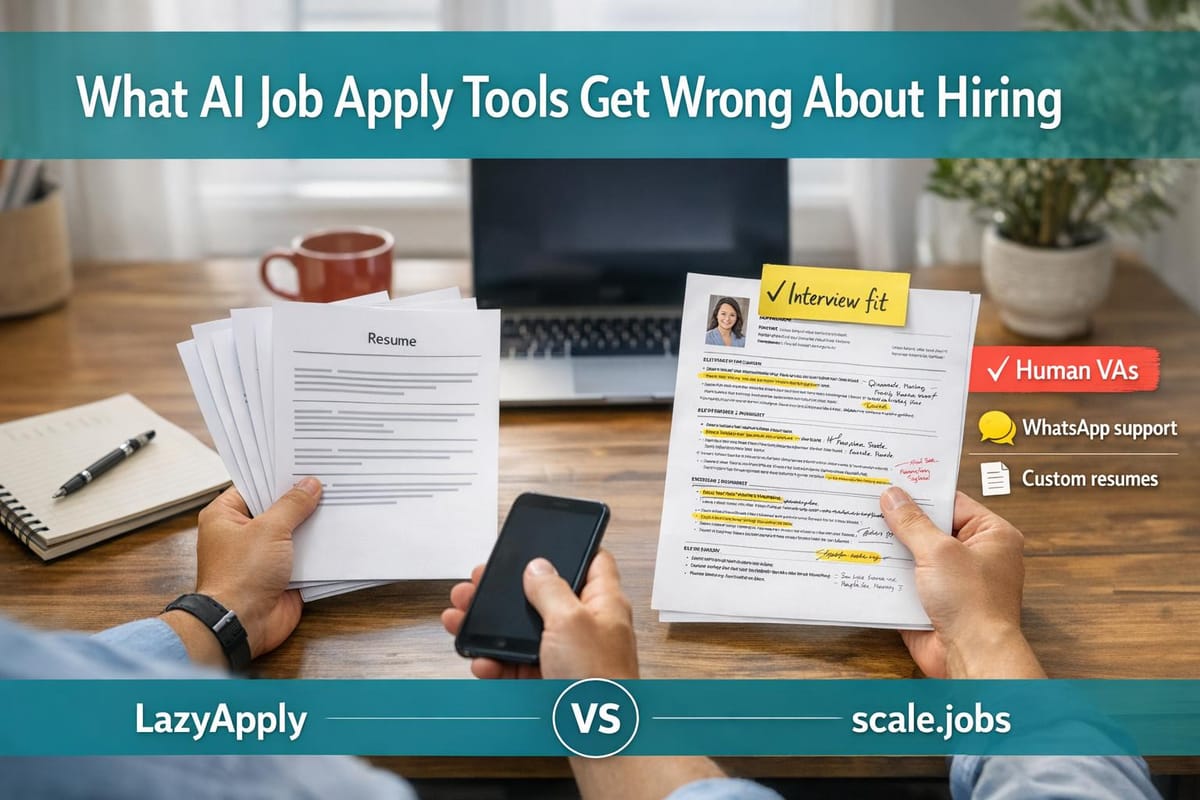
AI job application tools like ChatGPT and Jobscan promise to simplify job searches but often fail where it matters most: delivering resumes that resonate with human recruiters and applications. While these tools focus on keyword matching and automation, they miss the nuances of hiring, leading to generic, impersonal applications that fail to stand out.
Key takeaways:
- Over-reliance on keywords: Tools often prioritize keyword density without considering context, which can trigger ATS "copycat filters" or produce robotic, forgettable resumes.
- Lack of personalization: AI-generated resumes and cover letters often feel generic, with 62% of employers rejecting applications that lack individuality.
- Formatting and privacy issues: AI tools may create visually appealing resumes but often fail ATS compatibility checks. Additionally, some platforms raise concerns about data privacy and security.
The result? AI-driven applications yield fewer than 3 interviews per 100 submissions, compared to 6 for tailored, human-centric approaches. Platforms like scale.jobs address these gaps by combining AI with human expertise, ensuring applications are both ATS-friendly and engaging for recruiters.
Quick Tip: Use AI as a helper, not the sole creator. Blend automation for efficiency with a human touch for personalization to maximize your job search success.
Allowing AI Agents to Apply for Jobs Is a Mistake
Problem 1: Why Generic Keyword Matching Fails
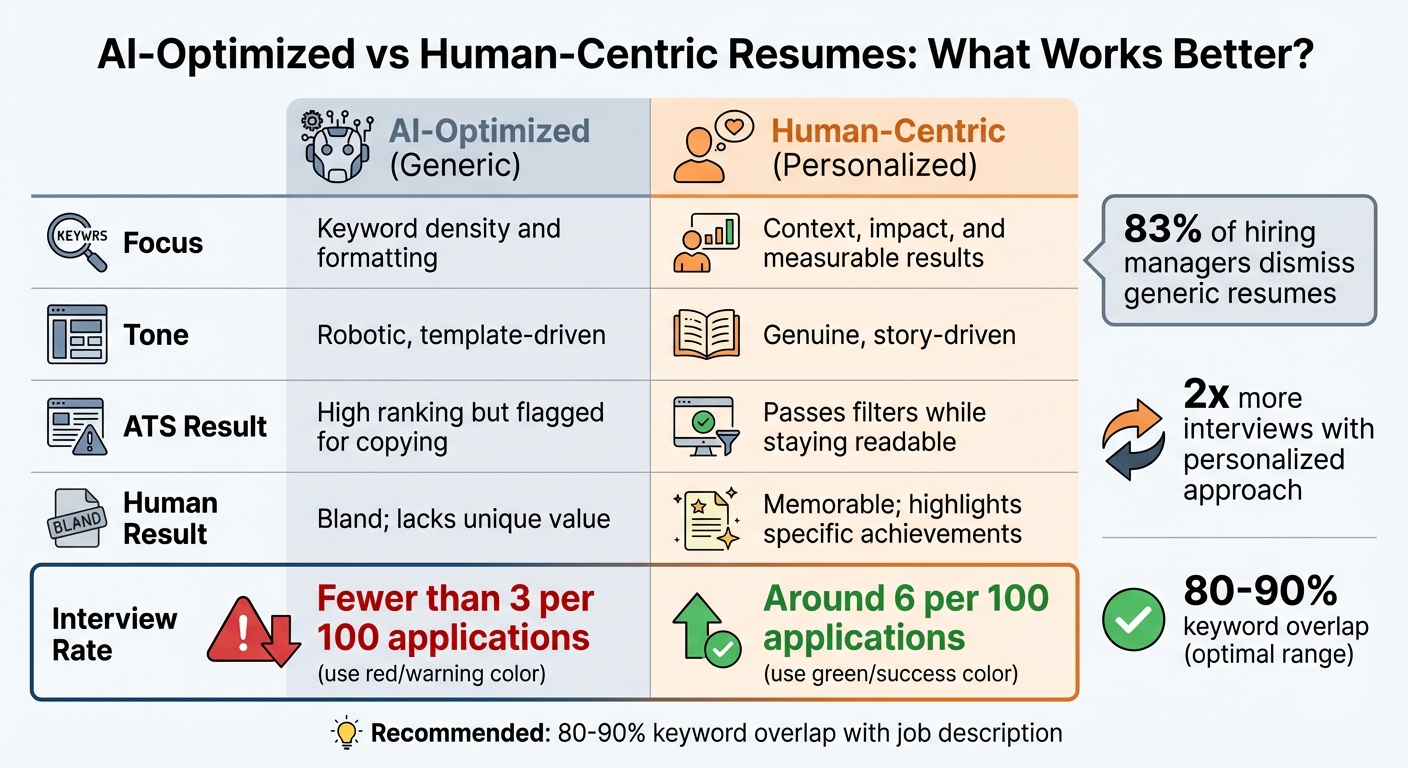
AI-Optimized vs Human-Centric Resume Comparison: Interview Success Rates
Many AI-powered job application tools - like Jobscan and Resume.io - rely on a straightforward strategy: scan the job description, identify frequently used words, and mirror them in your resume. This method assumes that simply aligning keyword counts will help you pass Applicant Tracking Systems (ATS), which are used by over 98% of Fortune 500 companies to filter resumes.
The issue? These tools prioritize quantity over quality. They produce resumes that, as Sofia Mishina, Talent Acquisition Director at AI Digital, describes, are "well-formatted yet forgettable, filled with generic buzzwords and lacking tangible proof." When resumes all mimic the job posting, recruiters struggle to differentiate between candidates with real skills and those who just know how to outsmart the system.
When Too Many Keywords Backfire
Keyword stuffing - cramming your resume with job description terms - has become ineffective. Modern ATS systems now use contextual parsing and semantic matching to catch unnatural repetition and detect when keywords are forced into resumes. In fact, exceeding a natural keyword density - even achieving a perfect match - can activate the "copycat filter" in advanced ATS software.
"Some AI tools will throw you out because they think you just copied the job description." - Hilke Schellmann, Journalist and Author
Tools like Jobscan often encourage users to aim for high keyword match scores, but this can backfire. Overloading your resume with keywords can lower your ranking instead of boosting it. A good rule of thumb? Keep keyword density around 2–3% of your total word count. Anything beyond that risks raising red flags, which could get your application rejected before a recruiter even sees it.
Moreover, resumes overloaded with keywords often become nothing more than a list of buzzwords. This makes it harder for recruiters - who typically spend just 6–8 seconds scanning each resume - to quickly identify your unique qualifications. Statistics reveal that 83% of hiring managers dismiss resumes that feel generic or untailored, regardless of how many keywords they contain.
Striking a balance between keyword use and meaningful content is the key to standing out.
ATS vs. Human Readers: Striking the Right Balance
While algorithms might rank your resume initially, it's the human recruiter who decides if you move forward. ATS systems are great at identifying keyword matches, but they can't evaluate the context or significance of your achievements. That’s where many AI tools fall short. As Adam Karpiak, Co-founder of Karpiak Consulting, explains:
"AI doesn't understand context. It doesn't know how you got results or what made your impact unique. Without that, your resume might check all the boxes for keyword searches, but it won't connect with a human reader."
The data is clear: resumes tailored for both ATS and human readers perform better. Tailored resumes generate approximately 6 interview opportunities per 100 applications, while generic ones yield fewer than 3 per 100. The secret lies in strategic keyword use - aiming for 80–90% overlap with the job description while avoiding direct copying - and replacing vague statements like "improved efficiency" with concrete metrics and real-life examples such as "reduced processing time by 30%."
| Feature | AI-Optimized (Generic) | Human-Centric (Personalized) |
|---|---|---|
| Focus | Keyword density and formatting | Context, impact, and measurable results |
| Tone | Robotic, template-driven | Genuine, story-driven |
| ATS Result | High ranking but flagged for copying | Passes filters while staying readable |
| Human Result | Bland; lacks unique value | Memorable; highlights specific achievements |
| Interview Rate | Fewer than 3 per 100 applications | Around 6 per 100 applications |
In short, keyword matching alone won't land you the job. To succeed, your resume must appeal to both the algorithms screening it and the person making the final decision.
Problem 2: Missing Personalization and Human Judgment
AI tools often excel at technical precision but fall short in delivering what truly matters to recruiters: personalization. Platforms like ResumeGenius and TealHQ may produce well-formatted documents, but these often lack the individuality that makes a candidate stand out. As Sofia Mishina, Talent Acquisition Director at AI Digital, explains:
"I see resumes that are perfectly formatted and perfectly forgettable - the same buzzwords, same tone, no proof of work."
Although 93% of job seekers now use AI tools like ChatGPT to craft resumes and cover letters, 62% of employers admit they’re likely to reject applications that feel impersonal or generic. This kind of content suggests a lack of genuine effort or research, making it harder for candidates to differentiate themselves. When recruiters encounter the same templated language across multiple applications, it diminishes the perceived sincerity of the applicants, often leading to outright dismissal.
The Problem with Recycled, Generic Content
AI-generated resumes often create what career coach Eliana Goldstein calls a "sea of sameness." By mirroring job descriptions too closely, these tools churn out documents that sound interchangeable. This doesn’t go unnoticed - 36% of hiring managers rank generic content as one of the top reasons for rejecting applications outright.
While these tools are adept at including technical keywords like "Python" or "project management", they struggle to convey the nuanced qualities that make a candidate truly stand out. Traits like problem-solving, strategic thinking, and interpersonal skills - qualities that often set exceptional candidates apart - are lost in the monotony of AI-generated text.
"When someone submits a resume or cover letter that sounds like a generic template, it becomes obvious and that lack of authenticity can be a dealbreaker."
– Kimberly Brown, Career and Leadership Expert
What Recruiters Actually Look For
Recruiters prioritize evidence of genuine effort and understanding. They want to see that you’ve taken the time to research their company’s values, challenges, and overall fit - not just a regurgitation of the job posting. In fact, 78% of hiring managers consider personalized applications a key indicator of genuine interest and alignment with the company.
This is where AI’s efficiency becomes a double-edged sword. While tailored resumes can lead to approximately 6 interview invitations per 100 applications, generic AI-generated submissions result in fewer than 3 interviews per 100 - a 50% drop in success rate due to the lack of a personal touch.
Cover letters, in particular, are increasingly viewed as writing samples that showcase your communication style and personality. Submitting AI-generated content that feels formulaic can signal laziness rather than capability. 90% of hiring professionals report a surge in low-effort applications driven by AI tools, and many actively filter these out.
These issues with personalization not only undermine your application but also spill over into other aspects of quality, which we’ll explore in the next section.
Problem 3: Overlooking Formatting, Privacy, and Real-World Details
AI job application tools may promise efficiency, but they often falter on technical and security fronts, creating obstacles in your job search. By focusing on speed and automation, these platforms sometimes ignore how hiring systems truly operate. The result? Missed opportunities and a lack of alignment with the nuances of human hiring processes.
Formatting Problems in AI-Generated Resumes
AI tools like Rezi and Simplify.jobs are known for producing sleek, visually attractive resumes. However, these designs often clash with Applicant Tracking Systems (ATS). Features like tables, text boxes, multi-column layouts, graphics, and non-standard fonts can confuse ATS, leading to skipped information or garbled text. This formatting oversight can make your resume unreadable to hiring systems.
The stakes are high. Around 75% of resumes are filtered out by ATS before they ever reach a recruiter, and over 99% of Fortune 500 companies rely on these systems. Adhering to ATS-friendly formatting can boost your chances of passing the initial screening by 40–60%. Unfortunately, many AI tools prioritize aesthetics over functionality, leaving candidates at a disadvantage.
A quick test? Open your resume in a plain text editor to see if text appears jumbled or missing. Multi-column layouts, for example, often confuse ATS algorithms. While these tools excel at creating polished documents, they frequently overlook the fundamental requirement of machine-readability - a critical first step in today’s hiring process.
Privacy and Security Risks with AI Tools
AI-driven platforms like Sonara.ai often require users to upload sensitive personal data, including employment history, contact details, and educational background. Despite this, many of these tools lack transparency about how they handle your information. Alarmingly, 62% of CEOs identify security and privacy as major concerns when using AI and machine learning.
There have been cases where sensitive data was unintentionally exposed, highlighting vulnerabilities in these systems. Open-source AI models may even use your uploaded information to improve their algorithms, putting your personal and professional details at risk.
Some platforms go further, scraping your social media profiles to infer personal attributes like gender identity, political views, or other characteristics. This can inadvertently affect hiring decisions. For example, in January 2026, a class-action lawsuit was filed against Eightfold AI in California, alleging its "match score" system violated the Fair Credit Reporting Act by not providing candidates with transparency or the ability to dispute inaccuracies. Such practices underscore the risks of relying on opaque algorithms in hiring.
Handling Subjective Recruiter Preferences
AI tools also struggle to account for the human side of hiring. While they excel at analyzing data, they often miss critical factors like emotional intelligence, creativity, and leadership potential - qualities that are difficult to quantify but highly valued by recruiters.
"The danger is when companies start treating hiring like a data problem instead of a people problem."
– Adam Karpiak, Co-founder of Karpiak Consulting
Recruiters look beyond technical skills to assess cultural fit, genuine interest in a company’s mission, and problem-solving abilities. These subjective elements require empathy, intuition, and human judgment - traits that algorithms simply cannot replicate. When AI tools reduce candidates to data points, they risk penalizing those with non-traditional backgrounds or unique experiences.
This overly mechanical approach to hiring has left many feeling uneasy. In fact, 85% of Americans express concern about the role of AI in hiring decisions. The disconnect between what AI measures and what recruiters value highlights the importance of integrating human insight into the process. Platforms like scale.jobs bridge this gap by combining technology with the nuanced understanding that only humans can provide.
How scale.jobs Solves These Problems with Human Support
The challenges posed by AI-driven job applications call for a more thoughtful solution. scale.jobs takes a different approach by combining advanced technology with real human expertise. This hybrid model delivers what automated platforms often lack: personalized attention, transparency, and alignment with recruiters' expectations. Instead of relying on bots to mass-apply, scale.jobs employs trained reverse recruiters who actively manage your job search. They address common issues like ATS errors, privacy concerns, and impersonal application content.
Each application is carefully tailored to meet ATS requirements while remaining clear and engaging for recruiters. Plus, you receive time-stamped proof-of-work that shows exactly how and when your applications were submitted. This eliminates the "black box" uncertainty often associated with AI-only platforms. With dedicated WhatsApp support, you’re never left in the dark - real people provide timely updates and guidance throughout your job search.
This human-first strategy tackles critical issues, such as formatting errors that confuse ATS systems, privacy risks from opaque algorithms, and the inability to highlight subjective qualities like alignment with company culture. While AI excels at keyword matching, it’s the human touch that refines each application, ensuring it reflects your unique experience and fits the specific role you’re targeting. The result? Applications that not only pass ATS filters but also resonate with hiring managers.
To better understand how scale.jobs stands out, let’s compare it to other services.
scale.jobs vs. LazyApply: Why Human Beats Automation
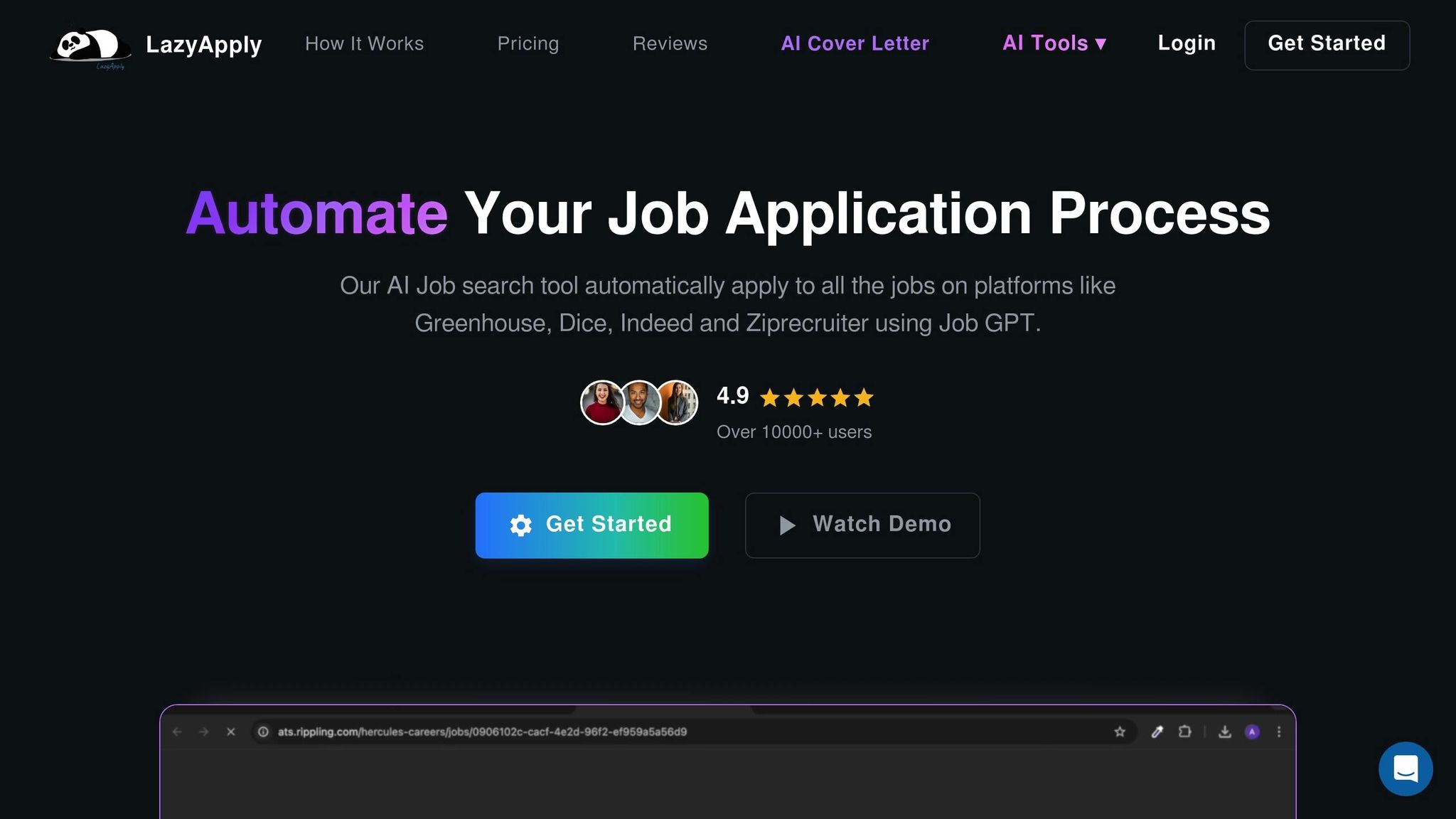
LazyApply promises to submit hundreds of applications automatically, but this approach often backfires. Automated mass submissions risk being flagged as spam by recruiters or sophisticated ATS systems, which can detect bot-like patterns. When you’re competing for meaningful roles, being labeled as "lazy" or irrelevant is a risk you can’t afford.
scale.jobs, on the other hand, takes a hands-on approach. Human assistants submit each application individually, tailoring resumes and cover letters to match the specific job requirements. This ensures every submission appears professional and intentional, avoiding bot detection entirely.
| Feature | scale.jobs | LazyApply |
|---|---|---|
| Application Method | Manually tailored submissions | Automated bot submissions |
| Personalization | Reverse recruiters customize each application | Generic templates applied in bulk |
| Bot Detection Risk | None - human handling avoids flags | High - automated patterns trigger spam filters |
| Transparency | Proof-of-work screenshots for every application | Limited visibility into submissions |
| Support | Dedicated WhatsApp chat | Generic or no support |
With scale.jobs’ method, tailored applications result in 6 interviews per 100 submissions compared to fewer than 3 for generic, automated submissions. Additionally, scale.jobs offers a one-time flat fee starting at $199 for 250 applications, eliminating the recurring subscription costs associated with LazyApply while delivering higher-quality results.
scale.jobs vs. Simplify.jobs: Real Personalization That Works
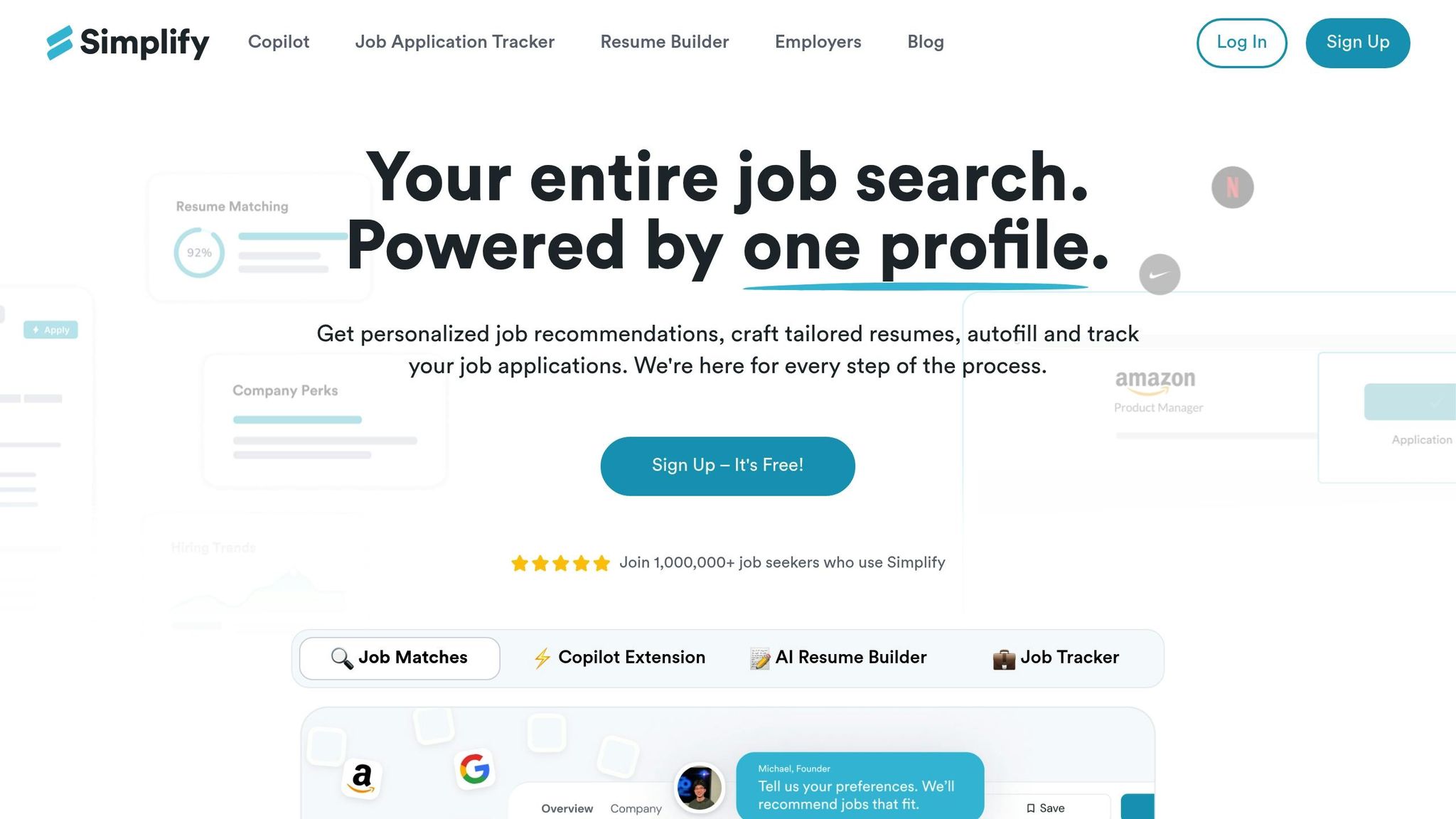
Simplify.jobs relies on AI to auto-fill application forms and generate cover letters. However, the output often feels generic or overly polished - qualities that recruiters frequently criticize. While Simplify.jobs' browser extension can save time, it lacks the nuanced judgment needed to align your background with a company’s specific culture and needs.
In contrast, scale.jobs assigns dedicated reverse recruiters who take the time to understand your career goals and the roles you’re targeting. They don’t just match keywords; they craft personalized narratives that showcase why you’re the perfect candidate. This approach highlights both your qualifications and your alignment with the company’s values from the very start.
| Feature | scale.jobs | Simplify.jobs |
|---|---|---|
| Primary Method | Human reverse recruiters | AI-powered browser extension |
| Content Quality | Personalized narratives with authentic voice | AI-generated text often flagged as generic |
| Cultural Fit Assessment | Humans evaluate company culture and role nuances | Algorithm focuses mainly on keyword matching |
| Proof of Work | Screenshots and dashboard tracking | Limited visibility into submissions |
| Support Channel | Direct WhatsApp access to your recruiter | Self-service or generic help desk |
| Application Scope | Compatible with any portal, including complex forms | Limited to supported platforms |
"AI can be a great tool in helping you demonstrate on a resume that you have the competence to do the job... In the interview, for me to hire you, you've got to display that you'll have character (integrity) and will fit in with the culture."
– Scott Pooch, President, Integrated Retirement Solutions, LLC
scale.jobs ensures your applications reflect both competence and character, with human assistants maintaining your authentic voice while optimizing for ATS requirements - something AI alone cannot achieve.
scale.jobs vs. Jobscan: From Analysis to Full Application Management
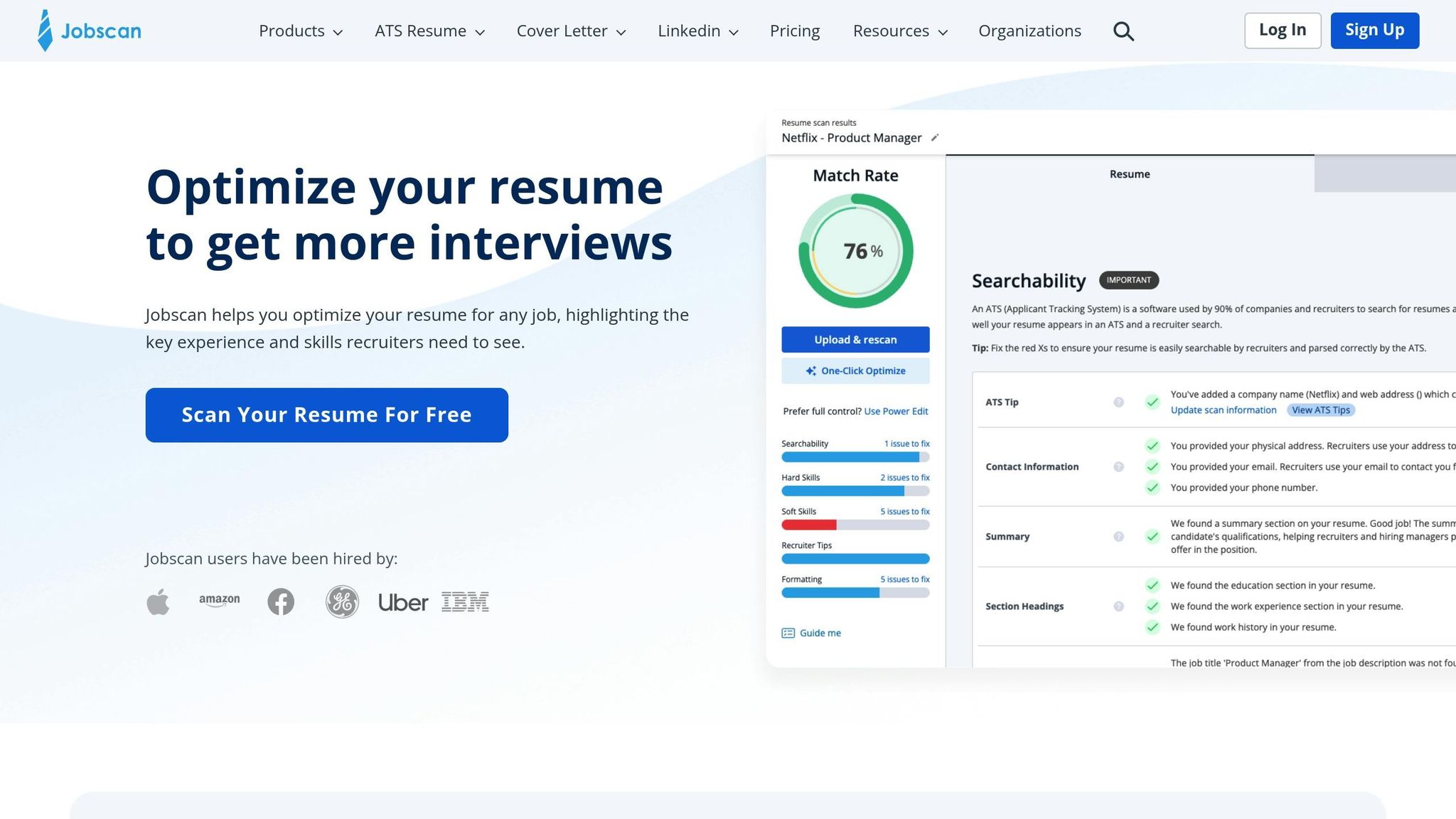
Jobscan specializes in analyzing how well your resume matches a job description’s keywords. It provides an ATS score and suggests improvements, but leaves the actual implementation and submission of applications up to you. For many job seekers, this analysis-only approach solves just part of the problem while adding extra work to their plates.
scale.jobs takes it a step further by not only analyzing but also acting on your behalf. While Jobscan stops at recommendations, scale.jobs starts there. Applications are ATS-optimized with a strategic 80–90% keyword overlap, and human assistants handle everything - from customizing documents to filling out forms and submitting them. This full-service approach saves you over 20 hours each week, freeing up time for networking and interview preparation.
| Feature | scale.jobs | Jobscan |
|---|---|---|
| Core Function | Full application management plus ATS optimization | ATS analysis and keyword matching only |
| Human Involvement | Reverse recruiters manage the complete process | Self-service; you execute the recommendations |
| Scope | Resume, cover letter, form completion, and submission | Resume scanning and scoring |
| Actionable Output | Completed applications submitted to employers | Recommendations you must implement |
| Time Savings | Reclaims 20+ hours per week | Minimal - analysis is quick but work remains |
| Ongoing Support | Direct WhatsApp chat with dedicated team | Self-service knowledge base |
Unlike Jobscan, which only provides a percentage score, scale.jobs offers time-stamped proof-of-work screenshots that show exactly when and how each application was submitted. This transparency eliminates the uncertainty many job seekers feel when using AI-driven tools.
For those navigating complex visa requirements like H-1B, F-1, TN, or O-1, scale.jobs’ human support is even more essential. Their assistants know how to properly highlight work authorization credentials and can navigate intricate application portals that automated tools often mishandle. With a one-time flat fee ranging from $199 for 250 applications to $1,099 for comprehensive services, scale.jobs avoids recurring subscriptions while significantly boosting your job search efficiency.
Combining AI and Human Help for Better Job Search Results
The most successful job seekers know how to combine the speed of AI with the insight of human expertise. While AI shines in tasks like keyword optimization and grammar improvements, it struggles with more nuanced areas like storytelling, assessing cultural fit, and crafting applications that truly stand out. Many people use AI for drafting resumes and cover letters, but relying solely on automation often leaves them falling short of landing interviews. The key is to balance AI's efficiency with the human touch needed to create a personalized and compelling narrative.
The smartest strategy treats AI as an editor, not a ghostwriter. For example, you can start with scale.jobs' free ATS checker to ensure your resume meets key metrics for applicant tracking systems. Then, a human recruiter can refine your resume to highlight your unique achievements and tell a story that resonates with hiring managers. As Adam Karpiak, Co-founder of Karpiak Consulting, explains:
"The smartest way to use AI is as an editor, not a ghostwriter. Let it help you tighten your language... but make sure the content, the how and why behind your achievements, comes from your own experience."
scale.jobs bridges this gap by combining free AI tools with human-powered services. You can use the free ATS checker to ensure your resume is machine-readable, track your job applications with the job tracker, and draft cover letters with AI assistance. When you're ready to take your applications to the next level, human assistants step in. They customize each application to meet specific job requirements, address employer needs, and even submit applications directly on your behalf. This hybrid approach has been shown to significantly increase interview rates.
It's important to remember that while 75% of recruiters rely on ATS systems to screen resumes, the final hiring decision always involves a human assessing your "character" and "culture fit." AI can help prove your qualifications through keyword matching, but only a personalized approach - whether from you or a professional recruiter - can showcase the qualities that truly make you stand out. This method not only streamlines your job search, saving you over 20 hours a week, but also ensures your applications connect with hiring managers on a deeper level.
The future of job searching isn't about choosing between AI and humans - it’s about using them together. Let automation handle repetitive tasks and initial drafts, and focus human effort on areas that matter most: tailoring your story, building referrals (which can boost interview chances from 2-3% to 40%), and ensuring every application reflects your authentic voice. With scale.jobs' transparent proof-of-work screenshots and direct WhatsApp support, you get the perfect blend of efficiency and personalization without the guesswork of fully automated platforms.
Conclusion: Why Human Insight Matters in Hiring
AI-driven tools for job applications promise speed and convenience, but they often miss the mark on what truly matters to hiring managers. While 88% of companies now use AI for initial screening, these systems have been criticized for inherent biases. Beyond that, they generate resumes that, while polished, often feel impersonal - lacking the depth and authenticity recruiters look for when assessing character and team compatibility. This highlights the need for a job search strategy that balances technology with the irreplaceable value of human insight.
The core issue is that AI struggles to grasp the subtleties of human experience. Automated tools excel at tasks like keyword matching and grammar checks, but they fall short when it comes to showcasing emotional intelligence, storytelling, and the nuanced details that make each candidate unique. Moreover, the opaque algorithms behind many AI systems have sparked legal concerns. As former EEOC chair Jenny R. Yang explains:
"Qualified workers across the country are being denied job opportunities based on automated assessments they have never seen and cannot correct."
This underscores the importance of a more balanced approach. Unlike LazyApply’s automated submissions or Simplify.jobs’ workflows, scale.jobs takes a human-first approach to job applications. Trained virtual assistants manually complete every application, bypassing bot detection systems and ensuring each submission feels personalized. With ATS-optimized resumes crafted by experienced recruiters, proof-of-work screenshots for transparency, and real-time WhatsApp support, scale.jobs empowers job seekers to reclaim over 20 hours per week for networking and interview preparation.
The future of job searching lies in blending AI efficiency with human expertise. AI can assist with initial drafts and keyword optimizations - tools offered for free by scale.jobs - but it’s the personal touch that truly sets candidates apart. In a world where 99% of Fortune 500 companies rely on automation, standing out means combining technology's speed with the authenticity only humans can provide.
Stop relying solely on automated systems. The hiring process, at its heart, is a human one. With scale.jobs, you get the best of both worlds: fast, AI-powered tools paired with the human insight that makes a lasting impression. Transparent workflows, proven results, and straightforward pricing ensure you’re equipped to succeed in today’s competitive job market.
FAQs
How can I make my AI-generated resume stand out to recruiters?
To make your AI-generated resume shine, strike a balance between keyword optimization and a personal, human touch. Incorporate relevant keywords directly from the job description to ensure your resume gets through ATS (Applicant Tracking Systems), but keep the layout clean and easy to read. Highlight your unique skills and achievements in a way that feels authentic and professional.
Customize your resume for each application by focusing on accomplishments that match the job requirements. Adding a concise personal summary or objective statement can help convey your enthusiasm and motivation. Avoid intricate designs or overly elaborate formatting - clarity and professionalism should be your priorities. Including measurable results or concrete examples of your work can also add weight to your application.
For a polished, standout resume, you might want to explore human-assisted tools or services like scale.jobs. These platforms can refine your resume to appeal to both AI systems and human recruiters, giving you a stronger edge in the competitive job market.
What are the privacy risks of using AI tools for job applications?
AI-driven tools for job applications come with notable privacy concerns, primarily because they require access to a wide range of personal information. This can include resumes, social media profiles, and even recordings of interviews. Such extensive data collection significantly heightens the chances of data breaches or cyberattacks, which could leave sensitive details vulnerable to unauthorized access.
Another key issue lies in how these tools handle consent. Many may process personal data without obtaining clear permission, potentially running afoul of privacy regulations such as GDPR or CCPA. Moreover, once personal information becomes part of intricate systems, fully removing it can be a complicated, if not impossible, task - adding another layer of difficulty to safeguarding privacy.
To protect your information, look for tools that emphasize transparency, explicitly request your consent, and adhere to strong data governance standards.
Why is it important to combine AI tools with human expertise in job applications?
Combining AI tools with human expertise creates a more effective approach to job applications. While AI excels at tasks like scanning resumes and matching keywords, it often struggles with the subtleties of hiring. For instance, AI might miss the significance of certain soft skills, unique experiences, or the broader context behind a candidate's qualifications - things that a human recruiter would naturally pick up on. Additionally, AI systems can sometimes introduce biases or misinterpret information, potentially leading to missed opportunities for well-qualified applicants.
Human recruiters bring a much-needed layer of insight to the process. They can assess candidates more holistically, recognize nuances that AI might overlook, and address potential biases. By combining the speed and efficiency of AI with the critical thinking and contextual awareness of human judgment, job seekers can navigate the application process in a way that feels both fair and effective. This partnership ensures that applications are not only processed quickly but also evaluated thoughtfully.