AI Job Apply Costs More Than You Think: A 6-Month Reality Check
AI application tools add subscription fees and hours fixing errors, lowering ROI; human-assisted services use one-time fees and tailored, ATS-friendly submissions.


AI tools like LazyApply and Sonara.ai promise to simplify job applications, but their hidden costs and inefficiencies can outweigh the benefits. Over six months, subscription fees range from $180 to $480, with additional time spent correcting errors and dealing with ATS rejections. These tools often prioritize quantity over quality, leading to mismatched applications and missed opportunities.
In contrast, human-assisted services like Scale.jobs offer a one-time fee model starting at $199, focusing on tailored, ATS-friendly applications. They provide proof of submission, avoid recurring costs, and deliver higher callback rates. If you're serious about landing interviews without wasting time or money, understanding these differences is crucial.
Key takeaways:
- AI tools can cost $720+ in lost productivity due to error corrections.
- ATS filters often flag automated submissions, reducing effectiveness.
- Scale.jobs provides customized, error-free applications with transparent pricing.
Below, we’ll explore the drawbacks of AI tools, compare costs, and evaluate why personalized services may be a smarter choice for your job search strategy.
Job Search Challenge: Applying With and Without AI Tools | Indeed
What You'll Actually Spend on AI Job Applications in 6 Months
AI Job Application Tools vs Human-Assisted Services: 6-Month Cost Comparison
Monthly Fees Add Up: 6-Month Subscription Totals
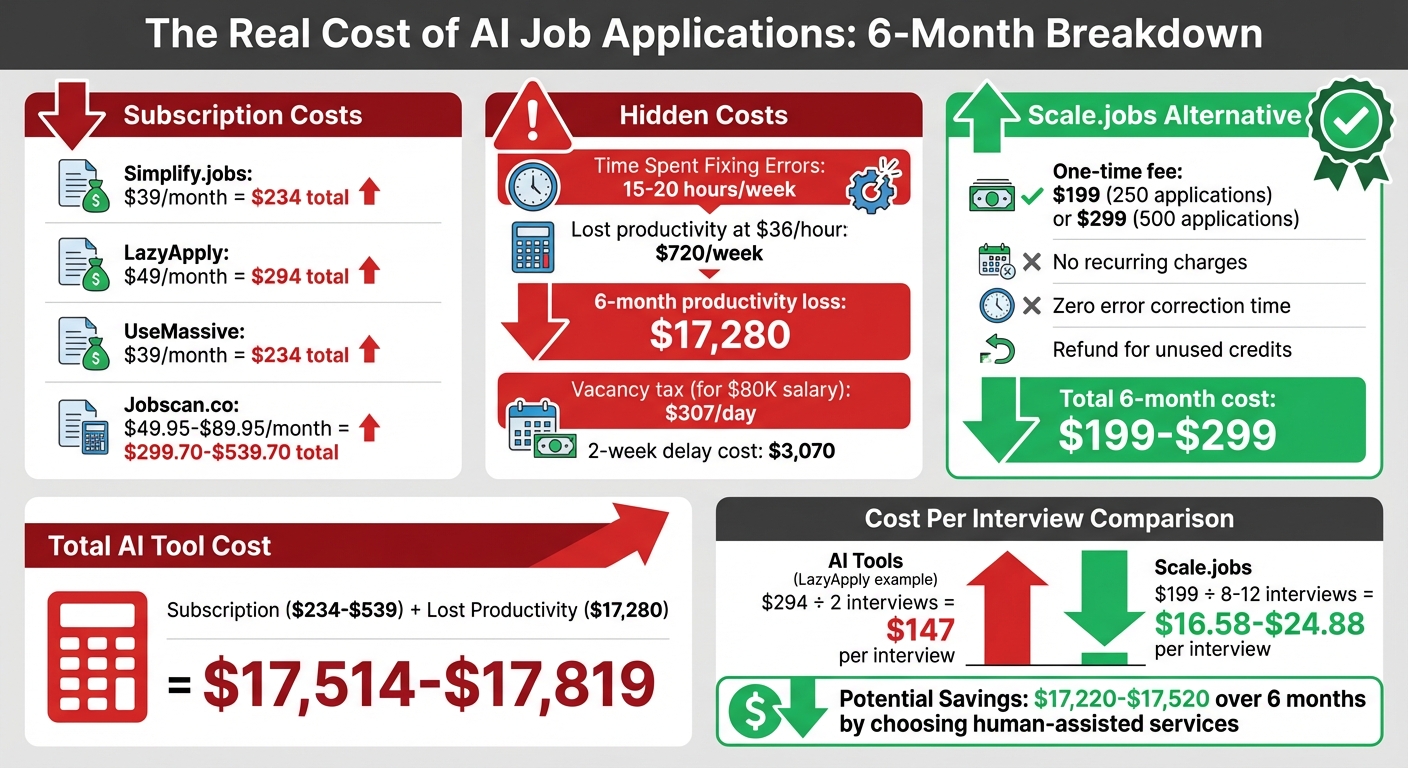
AI job application tools often come with recurring monthly fees ranging from $39 to $89.95, which can quickly accumulate over a six-month job search. Let’s break it down: Simplify.jobs charges $39/month (totaling $234), LazyApply costs $49/month (totaling $294), Jobscan.co ranges between $49.95 and $89.95/month (totaling $299.70 to $539.70), and UseMassive is priced at $39/month (totaling $234). Regardless of when you land a job, these subscription costs stick around.
In contrast, Scale.jobs offers a straightforward pricing model with a one-time fee of $199 for 250 applications or $299 for 500 applications. There are no recurring charges, and if you land a job early, any unused credits are refunded. This refund policy is a rarity among job application services. Unlike subscription-based tools, Scale.jobs eliminates the risk of escalating costs, offering a more predictable and efficient alternative.
Inefficient Outputs and Manual Corrections
The financial burden of subscription fees is only part of the story. Hidden costs, such as time spent fixing errors, significantly increase the overall expense. Many AI tools generate low-quality applications, forcing users to spend 15–20 hours per week correcting formatting issues, rewriting generic cover letters, or manually completing applications that automation tools fail to finish. At a modest hourly rate of $36, this adds up to $720 per week in lost productivity - or an eye-watering $17,280 over six months.
"Most organizations underestimate integration costs by 40–60% because they focus primarily on the AI solution itself rather than the ecosystem required to support it." – Dejan Markovic, Co-founder, Hype Studio
For job seekers, this means less time for networking, interview preparation, or using services like human-assisted resume writing that eliminate the need for tedious rework. The inefficiencies of AI tools not only extend your job search but also drain your time and energy.
Time Wasted: When Automation Fails
Another hidden cost is the vacancy tax - the financial hit you take for each day without a paycheck. For someone aiming for an $80,000 annual salary, every workday unemployed costs approximately $307. If automation errors delay your search by just two weeks, that’s a loss of $3,070 - far exceeding the cost of a human-assisted service that delivers precise, error-free applications.
Automated tools often fail to deliver on their promise of efficiency. Instead of focusing on strategic networking or interview preparation, you might find yourself auditing AI-generated errors, verifying submissions, or wondering if your resume even reached the right person. High-volume tools, which send out mass applications daily, can also trigger ATS flags or bot-detection systems, leading to account warnings on platforms like LinkedIn and skepticism from recruiters. Unlike these tools, services like Scale.jobs prioritize accuracy and personalization, ensuring your applications are both effective and compliant.
| Tool | 6-Month Subscription Cost | Primary Method | Risk Level |
|---|---|---|---|
| Jobscan.co | $299.70 – $539.70 | DIY Optimization | Low (Manual Submission) |
| Simplify.jobs | $234.00 | Semi-automated | Medium (Bot Detection) |
| LazyApply | $294.00 | AI-only | High (ATS Flagging) |
| UseMassive | $234.00 | AI-only | High (Generic Content) |
| Scale.jobs | $199.00 (One-time fee) | Human-assisted | Zero (Manual Submission) |
The takeaway is clear: subscription-based tools can drain your wallet while automation errors waste your time. With its transparent pricing and tailored, error-free applications, Scale.jobs offers a more effective solution that avoids the pitfalls of recurring costs and automation mishaps.
Where AI Automation Fails in Job Applications
Generic Applications vs. Custom Applications
AI tools often boast about submitting hundreds of applications daily, but sheer volume doesn’t guarantee success. Most automated platforms simply plug your resume into a standardized template, rarely tailoring it to match specific job requirements or the company’s ethos. As a result, recruiters can easily spot these mass-produced submissions, and in many cases, they flag them as spam.
This approach overlooks the nuances of job postings. Instead of aligning your experience with the job's unique demands, these tools rely on basic keyword matching. This leads to applications that feel generic - cover letters that could apply to any company, resumes that fail to emphasize relevant skills, and submissions that overlook key qualifications. Recruiters can quickly identify this lack of effort, which often works against you.
Unlike platforms like LazyApply or Sonara.ai, which rely heavily on templates, Scale.jobs takes a different path. Every application is reviewed and customized by a trained assistant who carefully reads the job posting. They adjust your resume to highlight relevant experience and craft a cover letter that resonates with the company’s specific needs. This personalized touch is something AI struggles to replicate, and recruiters are far more likely to respond positively to tailored submissions. Without this level of detail, generic applications not only hurt your chances but also increase the overall cost per interview.
Cost Per Interview: Measuring AI Tool ROI
The drawbacks of generic applications become glaringly obvious when you consider the cost per interview. The true expense of any job application method isn’t just the subscription fee - it’s how much you’re paying for each interview you land. For instance, let’s say you spend $294 for six months of an AI service like LazyApply. If that service submits 1,000 applications but only lands you two interviews, your cost per interview skyrockets to $147.
By contrast, Scale.jobs offers a $199 package for 250 applications, which typically results in 8 to 12 interviews. That brings your cost per interview down to a much more reasonable $16.58 to $24.88. This stark difference highlights the value of a human-assisted approach.
Why Scale.jobs outperforms AI-only tools:
- Human-assisted customization: Each application is reviewed and tailored to the job’s requirements, avoiding generic submissions.
- ATS-optimized documents: Resumes are crafted to pass automated screening systems, which often reject AI-generated content.
- Transparent pricing: A one-time payment of $199–$1,099 eliminates the ongoing subscription fees that can drain your budget during a lengthy job search.
- Real-time support: Dedicated WhatsApp communication keeps you updated and connected with your assistant throughout the process.
- Proof of submission: Timestamped screenshots confirm your applications were sent to real hiring managers, providing peace of mind.
The better ROI comes from precise, personalized applications that are more likely to grab a recruiter’s attention. With Scale.jobs, the process is designed to save you time and effort - there’s no need for costly manual corrections or endless follow-ups. By focusing on quality over quantity, this human-assisted approach ensures your applications stand out, ultimately improving your chances of landing interviews.
For more tips on refining your job application strategy, explore our human-assisted resume writing services.
Simplify vs. scale.jobs: Side-by-Side Comparison
Simplify: Strengths and Limitations
Simplify is a browser extension designed to streamline job applications by auto-filling forms with your details. It shines when used on platforms like Greenhouse and Lever, where the application process is relatively straightforward. The tool is easy to install and can save time by reducing repetitive data entry, particularly for early-stage companies. Its subscription cost is also manageable compared to some other services.
However, Simplify falters with more complex systems. For example, its accuracy drops to about 50% on Workday, and it doesn't support Taleo at all. Additionally, it relies on AI-generated templates for cover letters and screening questions, which often require manual adjustments to meet professional standards. Recruiters may also detect these automated submissions, and platforms like LinkedIn might flag the extension for bot-like behavior. Let’s see how scale.jobs addresses these challenges.
Why scale.jobs Offers More Value
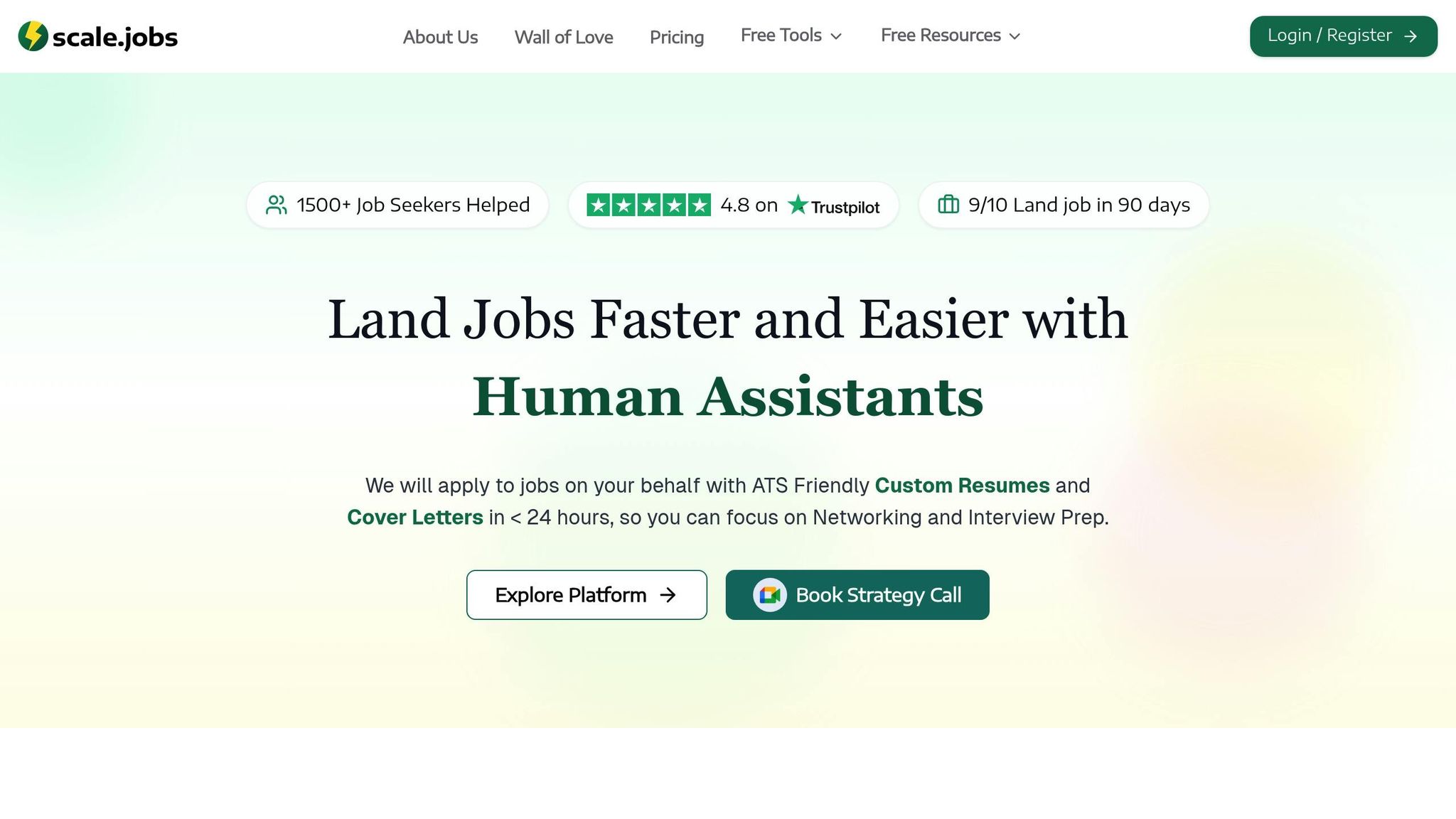
scale.jobs takes a completely human-driven approach to job applications, ensuring precision and customization. Instead of using templates, each resume and cover letter is tailored to the specific job posting. A dedicated assistant reviews the job description, refines your resume to emphasize relevant experience, and submits the application manually. This minimizes the risk of being flagged as automated while maximizing ATS (Applicant Tracking System) compatibility.
Both Simplify and scale.jobs aim to make the application process efficient, but scale.jobs stands out by delivering personalized, error-free applications that align with each job's requirements.
Key benefits of scale.jobs include:
- Expert customization: Applications are crafted by professionals who understand what hiring managers and ATS systems look for.
- High ATS compatibility: Assistants successfully navigate platforms like Workday, Taleo, and others with precision.
- One-time payment model: A flat fee starting at $199 for 250 applications eliminates recurring subscription costs.
- Verified submissions: Time-stamped screenshots sent via WhatsApp provide proof of every application.
- No bot-related risks: Since applications are handled manually, there’s no chance of being flagged for automation.
scale.jobs is an affordable solution for those seeking tailored, high-quality applications. It also offers add-on services, such as resume writing and LinkedIn optimization, without tying you to monthly fees.
| Feature | Simplify.jobs | scale.jobs |
|---|---|---|
| Method | Semi-automated browser extension | Human virtual assistants |
| Human Involvement | Minimal (user-driven) | High (assistant-led) |
| Customization | AI-generated templates | Job-specific, human-written |
| ATS Accuracy | ~50% on Workday; no Taleo support | High; supports all major platforms |
| Proof of Work | Dashboard estimates | Time-stamped screenshots via WhatsApp |
| 6-Month Cost | $234 | $199 (Basic Plan) |
| Bot Risk | Medium | Zero |
When to Choose scale.jobs Over Simplify
- You need applications tailored to complex corporate systems like Workday or Taleo.
- You prefer a flat, upfront fee instead of recurring subscription costs.
- Your career path includes unique challenges, such as employment gaps or industry changes, that require human expertise.
- You value transparency through verified submission proof and real-time updates via WhatsApp.
Who Benefits Most from Simplify vs. scale.jobs?
Simplify is ideal for early-career professionals applying to startups that rely on platforms like Greenhouse or Lever. If speed and high-volume applications are your priorities, and you're okay with manually fixing AI-generated content, Simplify can be a helpful tool.
scale.jobs, on the other hand, is better suited for mid-to-senior level professionals targeting larger organizations, especially those using systems like Workday or Taleo. It's a smart choice for anyone who values personalized applications, verified submissions, and a predictable pricing structure.
Final Thoughts
Pick Simplify if you’re focused on rapid, high-volume applications for startups and don’t mind tweaking AI-generated content. Opt for scale.jobs if you want tailored, ATS-friendly applications for larger companies, along with transparent proof of work and a cost-effective flat fee. This comparison can guide you toward the best application strategy for your career goals.
Why Human-Assisted Applications Beat AI Tools
Human Review Prevents ATS Rejections
AI tools often stick to generic templates, which can fail to meet the specific needs of individual companies. For instance, services like LazyApply primarily rely on these standardized formats, which might not align with the unique criteria of Applicant Tracking Systems (ATS). This can lead to your resume being filtered out before it even reaches a recruiter. On the other hand, human reviewers at scale.jobs take a more tailored approach. They analyze each job description in detail and adjust your resume to fit the specific ATS algorithms of the target company. Additionally, they spot errors - such as date mismatches or formatting issues - that automated tools might miss.
By manually handling each application, scale.jobs minimizes the risk of your submission being flagged as spam or bot-generated. This hands-on process not only ensures accuracy but also addresses the shortcomings of automated services like LazyApply, giving you a better shot at getting noticed by hiring managers.
One-Time Payment vs. Monthly Subscriptions
Cost is another key area where human-assisted services stand out. AI-driven platforms like LazyApply and Simplify.jobs often charge recurring monthly fees, which can add up over time. In contrast, scale.jobs offers a one-time payment starting at $199, with the added benefit of refunding any unused portion if you secure a job early. This straightforward pricing model aligns their success with yours, making budgeting easier and avoiding the risk of ongoing subscription costs.
Real-Time Updates and Proof of Work
Transparency is a major strength of scale.jobs. Unlike AI platforms where progress can be unclear, scale.jobs provides real-time, verifiable updates. For every application, you receive time-stamped WhatsApp screenshots as proof of submission, eliminating any uncertainty.
Additionally, you have direct access to your assigned assistant via WhatsApp, allowing you to request changes or updates to your resume quickly. This combination of real-time updates, accountability through proof-of-work, and open communication creates a level of clarity and reliability that subscription-based AI tools simply cannot offer.
How to Choose the Right Job Application Method
Selecting the best method for job applications can make a big difference in avoiding unnecessary costs and boosting your chances of landing interviews.
When AI Automation Works Best
AI tools are a great choice when speed and volume are your priorities. For instance, if you're applying for entry-level roles at tech startups using platforms like Greenhouse or Lever, automation can help you submit applications quickly and efficiently. These platforms often have straightforward parsing systems, making it easier for AI-generated applications to meet their requirements.
This method is particularly useful for high-volume campaigns targeting roles like customer service or junior developer positions, where job descriptions follow standard formats. Even with callback rates of just 1% to 3%, AI tools can still generate enough interviews to justify their cost, typically ranging between $39 and $79 per month.
However, AI automation isn’t the best option in every scenario. Platforms like Workday or Taleo, known for their more complex Applicant Tracking Systems (ATS), can present significant challenges for AI tools. Additionally, if platforms like LinkedIn or Indeed flag your account for automated activity, resolving these issues can negate the time savings offered by automation.
When application quality becomes more important than quantity, human-assisted services offer a more effective alternative.
When Human-Assisted Services Are a Better Fit
For roles where tailored applications and precision are key, human-assisted services like scale.jobs shine. These services are especially valuable for mid-to-senior level positions, competitive industries, or jobs at large corporations with rigorous ATS filters. In these cases, customized resumes that avoid generic templates can make all the difference.
Here’s why human-assisted services often outperform AI tools:
- Higher callback rates: Achieving between 25% and 47%.
- Personalized applications: Tailored to specific roles and industries.
- One-time fees: No ongoing subscription costs.
- Transparency: Proof of work provided through platforms like WhatsApp.
If you’re dealing with employment gaps, recent layoffs, career changes, or visa sponsorship needs (like H-1B or O1), human oversight is crucial. AI tools often mishandle detailed screening questions about work authorization, which can lead to automatic rejections and raise unnecessary concerns.
From a financial perspective, human-assisted services can also offer better value. With one-time fees ranging from $199 to $399, they often provide a better return on investment compared to AI subscriptions, which can cost $234 to $480 or more over six months. Additionally, the higher callback rates (25% to 47%) mean fewer wasted applications and quicker job placement. Services like scale.jobs also offer pro-rated refunds if you secure a position early, emphasizing their focus on delivering ATS-optimized, human-reviewed applications.
FAQs
How can I tell if my applications are getting blocked by ATS or bot detection?
If you're noticing a sudden decline in callbacks or interviews despite consistently submitting applications, it might be a sign that your resume isn't making it past ATS (Applicant Tracking Systems) or other automated filters. Resumes that are too generic or not tailored to the job posting often get flagged or overlooked.
One clue is if you’re not receiving acknowledgment emails or responses after a reasonable period. This could mean your application wasn’t successfully processed. To tackle this, consider using tools that provide real-time tracking or confirmation that your application has been correctly submitted and parsed. These can help you pinpoint potential issues and ensure your efforts aren't going unnoticed.
What should I track to compare cost per interview across application methods?
To get a clear picture of your recruiting expenses, start by tracking all costs involved: application fees, human effort, and technology-related charges. Once you’ve totaled these, divide the sum by the number of interviews you’ve secured. This calculation gives you the cost per interview, a useful metric to assess and compare how effective various application strategies are.
How can I stop wasting time fixing AI application errors each week?
To save time addressing errors in AI-driven applications, consider pairing AI tools with human oversight. Platforms like Scale.jobs provide services that combine AI with human assistance for tasks like resume and cover letter customization, reducing mistakes and ensuring compatibility with applicant tracking systems (ATS). Look for platforms that offer transparent features, such as real-time updates or proof-of-work, to track progress effectively. Additionally, keep your AI prompts and documents updated to maintain accuracy. A hybrid approach - leveraging AI for speed and manual review for precision - can deliver more reliable outcomes.