AI Apply Vs Virtual Human Assistant For Job apply: Which is better
Compare AI bulk-apply tools vs virtual human assistants: trade-offs in cost, speed, ATS compatibility, and callback rates to find the best fit.

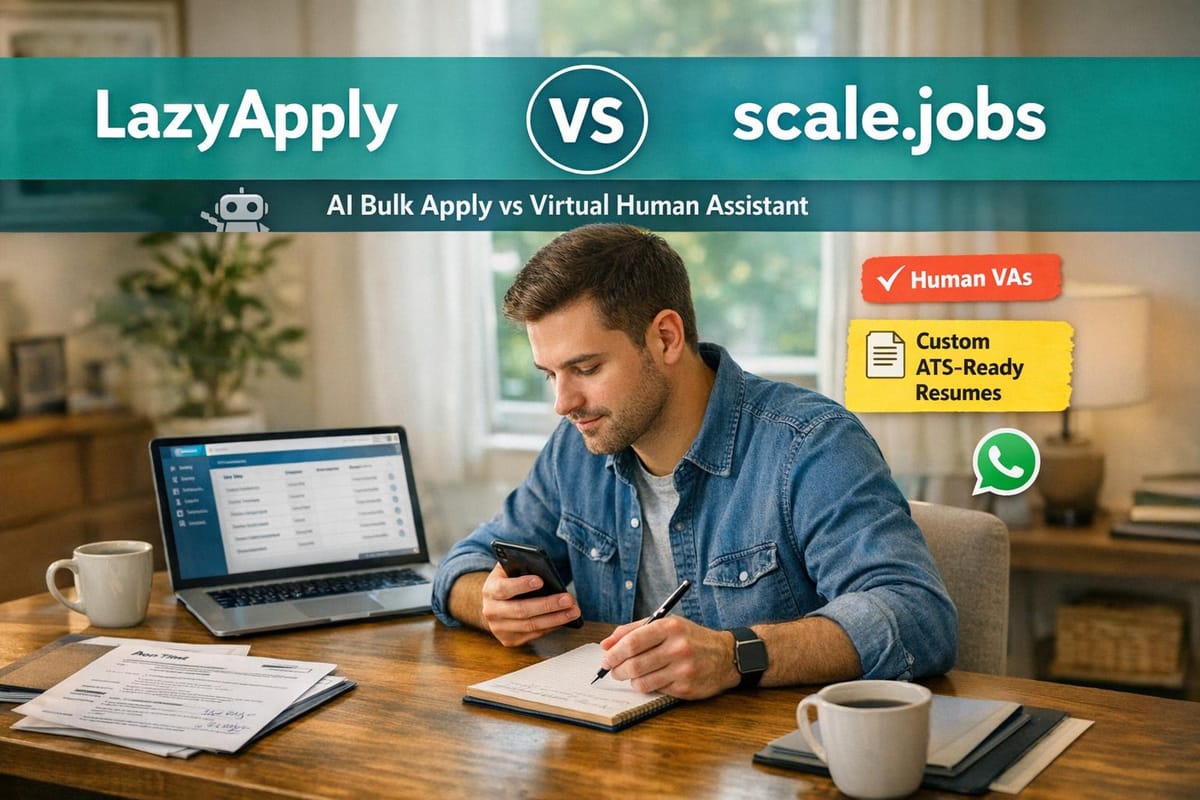
In today’s job market, job seekers face a choice: AI tools for high-volume applications or virtual human assistants for personalized, targeted submissions. AI platforms like LazyApply and Simplify.jobs offer speed and affordability, but their generic templates often lead to low callback rates (1-3%). On the other hand, virtual human assistants, such as those from scale.jobs, focus on crafting tailored applications with significantly higher callback rates (25-47%), though at a slower pace and higher upfront cost.
Key Takeaways:
- AI Tools: Best for entry-level roles or high application volume. Affordable but prone to ATS flagging and low success rates.
- Virtual Assistants: Ideal for senior roles, career changes, or visa-specific applications. Higher quality but slower and costlier.
Quick Comparison Table:
| Feature | AI Tools (e.g., LazyApply) | Virtual Assistants (e.g., scale.jobs) |
|---|---|---|
| Best For | Entry-level roles | Senior roles, career transitions |
| Cost | $12-$50/month | $199+ one-time fee |
| Callback Rate | 1-3% | 25-47% |
| Volume | Hundreds/day | ~30/day |
| Customization | Low | High |
| ATS Optimization | Automated | Human-verified |
| Support | Chatbots | 24/7 WhatsApp |
If you need speed and quantity, AI tools may suffice. But for roles requiring precision and personalization, virtual assistants or hybrid services like scale.jobs deliver better results.
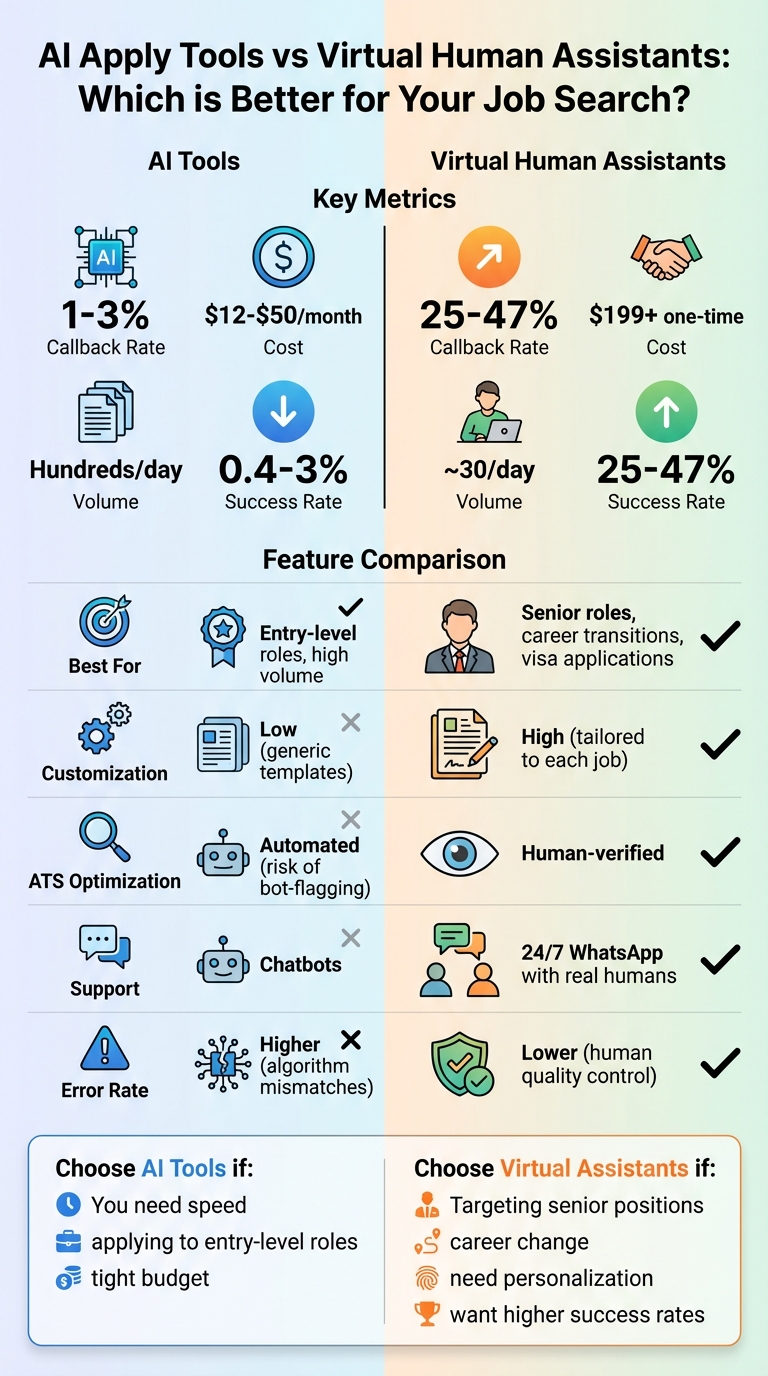
AI Tools vs Virtual Human Assistants for Job Applications: Complete Comparison
Job Search Challenge: Applying With and Without AI Tools | Indeed
AI Apply vs Virtual Human Assistants: Main Differences
The key difference between AI-powered job application tools and virtual human assistants boils down to volume versus precision. AI tools like LazyApply and Simplify.jobs excel at submitting a high number of applications quickly, often sending out hundreds of generic applications daily. Virtual human assistants, however, focus on a more targeted approach, crafting fewer applications that are tailored to specific job descriptions and your unique career background. This contrast forms the foundation for a deeper comparison.
When it comes to cost, the two options differ significantly. AI tools generally operate on a subscription model, costing anywhere from $12 to $50 per month. Over time, this can accumulate to over $600 annually if your job search stretches across several months. Virtual human assistants, such as those offered by scale.jobs, charge a one-time flat fee starting at $199, making them a more cost-effective solution in the long run.
The personalization and quality of applications also vary widely. AI tools often rely on generic templates, which can lead to applications being flagged by Applicant Tracking Systems (ATS) for bot-like patterns. In contrast, virtual human assistants create highly customized applications designed to meet the specific requirements of both ATS systems and human reviewers. For example, a LazyApply user reported sending out 5,000 applications but only receiving 20 interview opportunities - a success rate of just 0.4%, highlighting the limitations of automation.
Another critical factor is error rates and ATS compatibility. AI tools can struggle with complex application portals, mismatching skills with job requirements, or submitting incomplete applications. Virtual human assistants, on the other hand, manually verify every submission, ensuring proper formatting and accurate alignment with job requirements. They also handle intricate multi-step application processes that can confuse AI systems.
The table below provides a clear side-by-side comparison of these differences:
Comparison Table: AI Apply vs Virtual Human Assistants
| Feature | AI Apply Tools | Virtual Human Assistants |
|---|---|---|
| Best For | High-volume, entry-level roles | Senior roles, career changes, visa sponsorship |
| Personalization | Low: Generic templates | High: Tailored to career story |
| ATS Optimization | Automated (Risk of bot-flagging) | Expertly crafted (Human-verified) |
| Cost Structure | Monthly subscription ($12–$50) | One-time flat fee ($199+) |
| Error Rate | Higher (Algorithm mismatches) | Lower (Human quality control) |
| Scalability | Hundreds of jobs per day | ~30 strategic jobs per day |
| Support | Limited or automated chatbots | Direct WhatsApp support with real humans |
| Success Rate | 0.4–3% callback rate | 25–47% callback rate |
This comparison highlights the trade-offs between speed and precision, cost and quality, and automation versus human expertise. While AI tools may work for entry-level roles or those seeking high application volumes, virtual human assistants are better suited for those aiming for senior positions or navigating career transitions.
AI Apply Tools: Pros and Cons
AI-powered job application platforms like LazyApply, Simplify.jobs, and Rezi.ai have reshaped how people approach job hunting. By automating repetitive tasks, these tools aim to streamline the process and save time. This analysis weighs the strengths and weaknesses of these tools, comparing them to personalized services like scale.jobs. Knowing their advantages and limitations can help you decide if they align with your job search needs.
What AI Apply Tools Do Well
One of the biggest advantages of AI tools is their ability to handle a large number of applications in a short time. For instance, LazyApply and Simplify.jobs can submit hundreds of applications daily, making them particularly useful for entry-level positions where quantity often matters.
Simplify.jobs offers a Chrome extension that autofills repetitive fields, reducing manual effort. However, it struggles with more complex application requirements. On the other hand, Rezi.ai stands out in optimizing resumes for Applicant Tracking Systems (ATS). By using clean, professional templates that avoid graphics and tricky formatting, it ensures better compatibility with ATS software. Rezi.ai also includes a "Resume Score" feature, which analyzes resumes in real time to highlight missing skills or incomplete sections. As Lauren Bedford from Rezi explains:
Rezi's AI Resume Builder creates simple, professional, and ATS-friendly resume templates. Our AI technology generates job-specific bullet points and optimizes resumes for readability.
These tools excel in speed and efficiency but come with certain limitations that users should consider.
Where AI Apply Tools Fall Short
While these platforms shine in processing volume, they often compromise on the personal touch that can make or break applications for mid-to-senior roles. For example, one case showed that out of 5,000 AI-submitted applications, only 20 interviews were secured. This highlights the challenge of using generic templates for roles that demand tailored applications.
Another concern is the risk of detection by job boards like LinkedIn, which monitor accounts for automated behavior. Overuse of automation could lead to account restrictions or lockouts, adding an extra layer of risk.
Additionally, while these tools handle basic forms well, they often struggle with nuanced application questions. This lack of depth can leave users vulnerable to scams or missed opportunities. As AI researcher Hemanth Babu points out:
None delivers both deep personalization and full automation - yet. Until that unicorn appears, smart job seekers mix and match.
Virtual Human Assistants: Pros and Cons
Unlike AI-driven platforms, virtual human assistants - offered by services like FindMyProfession and ResumeSpice - focus on crafting applications that are uniquely tailored to meet the specific demands of today’s job market. Instead of relying on algorithms, these services employ real career professionals who handle resumes, cover letters, and job applications with a level of personalization and strategic insight that automated tools simply can’t match. However, the human touch comes with its own challenges, particularly in terms of speed and cost, which job seekers must carefully consider.
What Virtual Human Assistants Do Well
One of the biggest strengths of virtual human assistants is their ability to understand context and nuance in ways that automated tools cannot. For example, when a job posting emphasizes qualities like "strategic thinking" or "cross-functional collaboration", a skilled professional knows how to craft responses that stand out to hiring managers. They can interpret job requirements and tailor applications to highlight the most relevant skills and experiences.
ATS optimization is another area where human expertise shines. Unlike automated systems that rely on algorithms, human assistants manually review resumes to ensure they not only pass Applicant Tracking System (ATS) filters but also appeal to recruiters. They understand which keywords matter for specific roles and industries and incorporate them seamlessly, avoiding the pitfalls of keyword stuffing.
What truly sets human assistants apart is their high level of customization. Their tailored approach leads to a 25-47% callback rate, far surpassing the sub-2% callback rate often seen with bulk AI-generated submissions.
Transparency is another key advantage. Human assistants provide real-time updates via platforms like WhatsApp and share proof-of-work screenshots, so you always know what’s being submitted and how it’s being customized. This eliminates the uncertainty that often accompanies AI tools, where users may be left wondering what was actually sent on their behalf.
That said, these benefits come with certain limitations that job seekers should weigh against their goals and resources.
Where Virtual Human Assistants Fall Short
The most notable drawback is processing speed. While automated platforms can submit hundreds of applications in a single day, human assistants typically require 12-24 hours per application to ensure materials are properly customized. This means you might only see around 30 applications per day, a far cry from the volume promised by AI tools.
Cost is another factor to consider. Human-assisted services often come with an upfront price tag of around $199 per application, which can be a significant investment for job seekers on a tight budget. While the tailored approach often delivers better results, the cost can feel prohibitive for recent graduates or those facing extended unemployment.
Scalability is also a challenge. If your goal is to apply to hundreds or even thousands of positions across various industries within a short timeframe, human assistants may struggle to keep up. Their careful and methodical process, while effective, simply doesn’t allow for the high-volume campaigns that job search automation tools can handle with ease.
Next, we’ll explore how services like scale.jobs aim to strike a balance between the personalized approach of human assistants and the efficiency of AI-driven tools.
LazyApply vs scale.jobs: Why You Should Switch to Human-Powered Apply
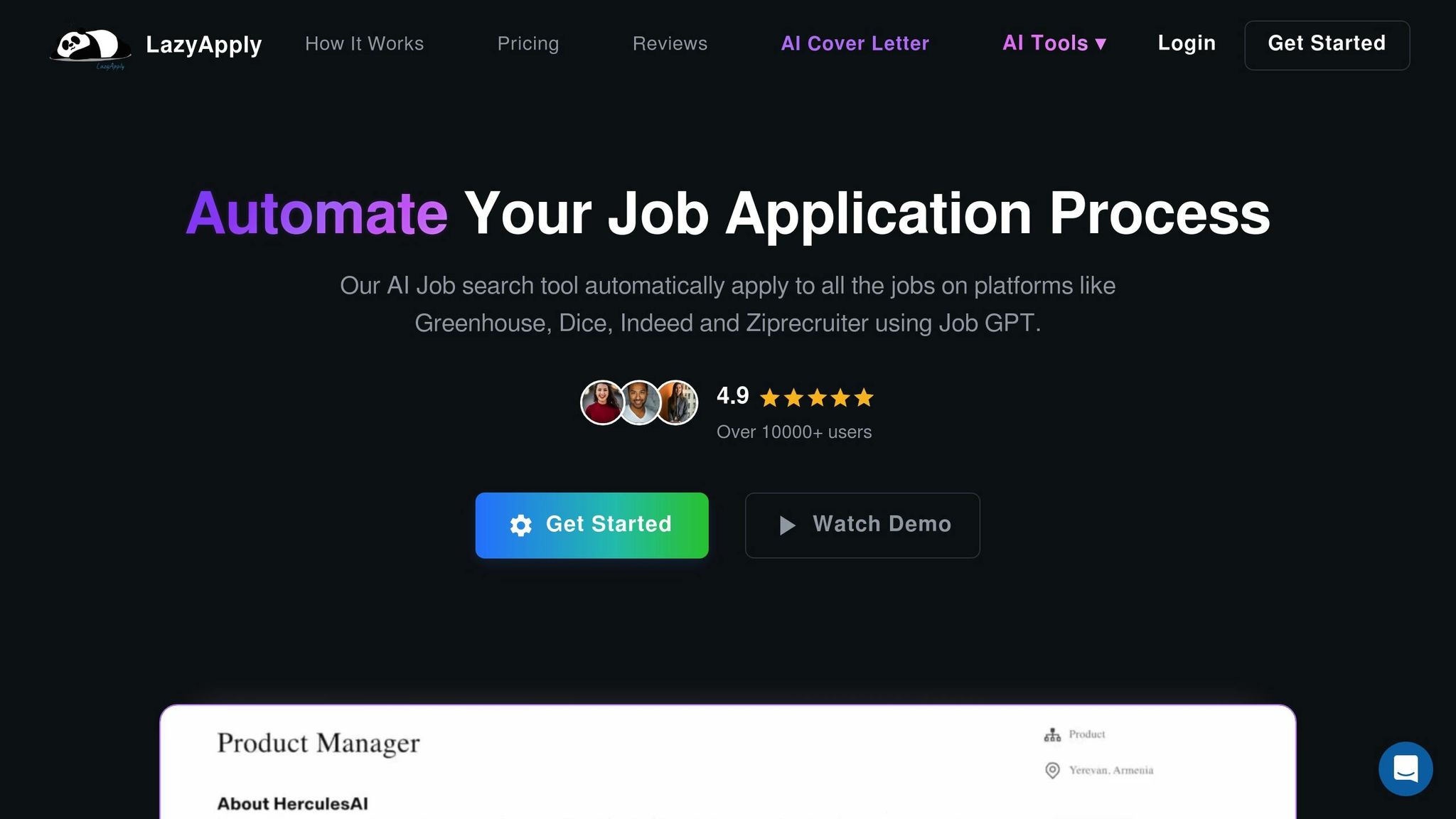
LazyApply offers to simplify your job search by using AI-powered bots to submit hundreds of applications daily. For $99, you get 150 applications, or you can opt for unlimited submissions at $249. However, these bulk submissions often trigger ATS spam filters, leading to callback rates of less than 2%. When your applications look like countless others generated by bots, recruiters tend to overlook them.
scale.jobs, on the other hand, takes a completely different route. Instead of relying on automation, they employ trained virtual assistants who manually complete every application. This includes tailoring your resume and cover letter to match the specifics of each job. The result? A 47% callback rate - more than 20 times higher than automated services. With scale.jobs, it’s not about how many applications you send; it’s about sending applications that actually get noticed.
The contrast becomes even more apparent when handling complex job application requirements. LazyApply struggles with custom questions, visa-related fields, and company-specific portals. It also limits you to certain job boards, preventing you from applying directly on company career pages. In comparison, scale.jobs assistants can navigate any portal or company site, even tackling intricate forms that require detailed answers about work authorization, salary expectations, or situational prompts.
While automation might seem appealing for its speed, the lack of personalization severely impacts success rates. Here are five clear reasons why scale.jobs outperforms LazyApply.
5 Reasons to Switch from LazyApply to scale.jobs
1. No ATS Flags, Higher Success Rates
scale.jobs assistants handle each application manually, ensuring your materials pass ATS filters and appeal to human recruiters. This means your application doesn’t vanish into a digital void - it actually lands in front of hiring managers.
2. Customization for Every Job
LazyApply relies on generic templates with minimal adjustments between applications. In contrast, scale.jobs customizes every resume and cover letter based on the specific job description. If a role highlights "cross-functional leadership" or "data-driven decision making", your application will emphasize those exact skills, avoiding cookie-cutter submissions.
3. Proof You Can Trust
LazyApply offers a basic dashboard that tracks submission numbers but doesn’t show you what was actually sent. scale.jobs provides time-stamped screenshots via WhatsApp for every submission. You can see exactly how your application was tailored, which questions were answered, and how your profile was presented.
4. Real-Time Human Support
LazyApply’s support is limited to chatbots and email, which can take days to resolve issues. With scale.jobs, you get 24/7 WhatsApp access to a dedicated virtual assistant. Whether you need to tweak your strategy, update your documents, or ask questions, you’re working with someone who understands your career goals - not a pre-programmed script.
5. Better Value with Transparent Pricing
LazyApply’s unlimited plan at $249 offers little return due to low callback rates. scale.jobs provides clear, one-time pricing: $199 for 250 applications, $299 for 500 applications with two assistants, and $399 for 1,000 applications with priority processing. With a 47% callback rate, you get measurable results without being locked into recurring fees.
| Feature | LazyApply | scale.jobs |
|---|---|---|
| Primary Driver | AI / Bots | Human Virtual Assistants |
| ATS Success | Low (often flagged) | High (human-optimized) |
| Support | Automated / Email | 24/7 WhatsApp |
| Proof of Work | Basic Dashboard | Time-stamped Screenshots |
| Platform Coverage | Limited to job boards | Any job portal or site |
| Success Rate | < 2% callback rate | 47% callback rate |
| Pricing | $99–$249 (recurring) | $199–$1,099 (one-time) |
When choosing a job application service, it’s critical to ensure it avoids sending duplicate or incorrect applications that could harm your reputation. LazyApply lacks these safeguards, while scale.jobs assistants manually review each submission to eliminate errors and mismatched applications. This hands-on approach ensures your efforts lead to real opportunities, making scale.jobs the smarter choice for job seekers looking for results.
Simplify.jobs vs scale.jobs: One-Click AI vs Human-Managed Applications
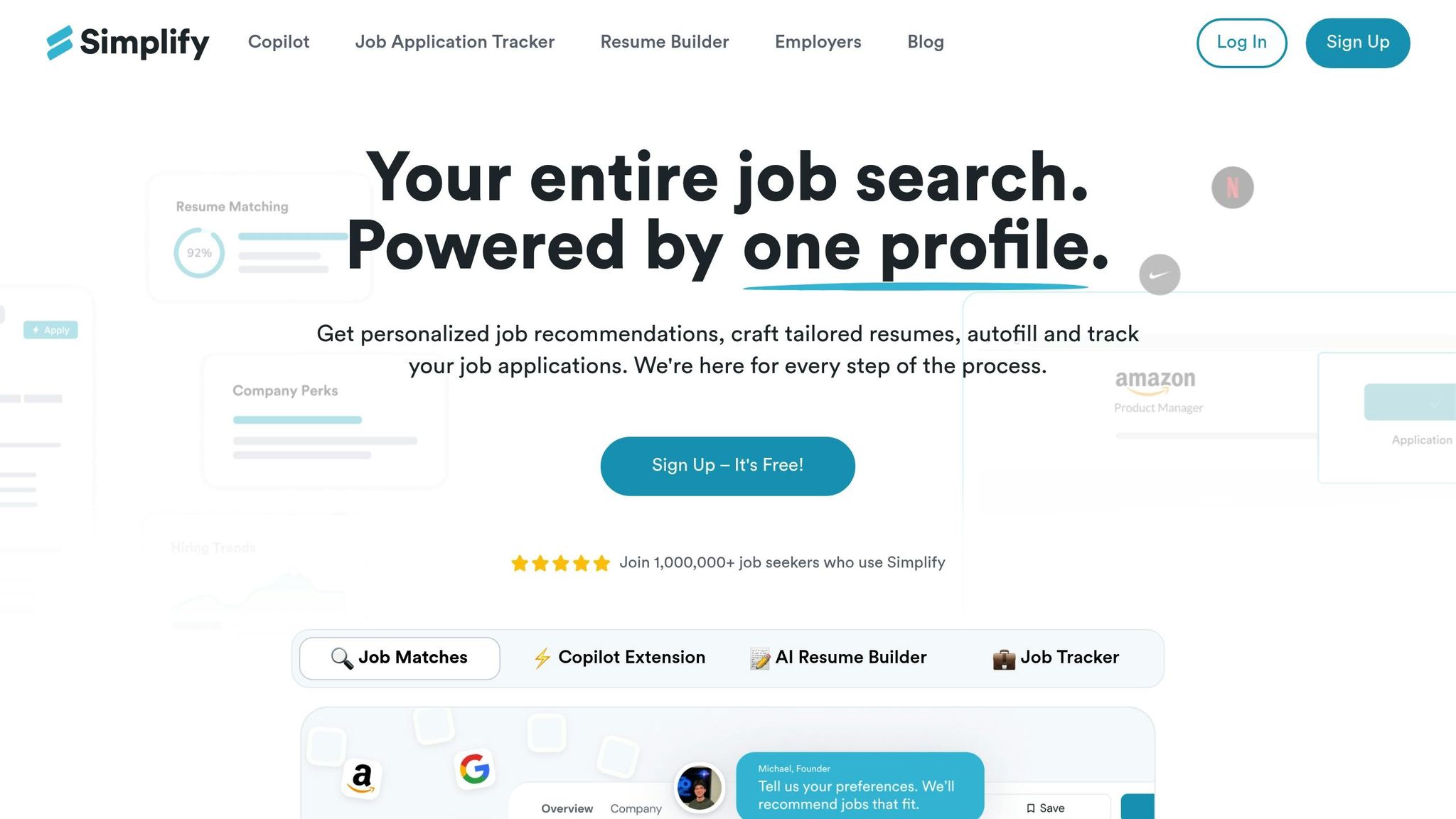
Simplify.jobs offers a Chrome extension called Simplify Copilot, designed to speed up your job search using AI-powered autofill and automation. It simplifies straightforward applications by filling out forms with your saved details. While the tool is free and effective for standard job boards, it requires you to manually visit each job posting and activate the autofill feature yourself. Essentially, it's a "copilot", not a fully automated solution.
On the other hand, scale.jobs takes a human-managed approach by assigning trained virtual assistants (VAs) to oversee every aspect of your applications. These assistants provide real-time updates through WhatsApp, ensuring transparency and a hands-on approach.
The distinction between these two services becomes especially important when dealing with complex corporate application systems like Workday or Greenhouse. Simplify's autofill scripts often hit roadblocks with these platforms, particularly when long-form questions are involved - questions like, "Describe a time you led a project." As Hemanth Babu, a LinkedIn reviewer of AI tools, explains:
"Simplify Copilot glides through repetitive forms... but struggles with long-form essay questions."
In contrast, scale.jobs' VAs manually handle these nuanced sections, crafting tailored responses that align with the job's requirements and company expectations.
While Simplify.jobs does offer a digital dashboard to track applications, it doesn't provide visibility into the exact content submitted. scale.jobs takes transparency to the next level by sending timestamped WhatsApp screenshots for every application. Below are five key reasons why scale.jobs delivers a more effective job application experience.
Why scale.jobs Outshines Simplify.jobs
1. A Completely Hands-Off Experience
Simplify.jobs requires you to actively search for roles, visit each posting, and initiate the autofill process. With scale.jobs, VAs manage the entire process - from finding job openings to tailoring your materials and submitting applications - saving you countless hours for more strategic activities.
2. Thoughtful Responses to Complex Questions
Simplify's AI-generated templates often fall short when applications ask for detailed, personalized answers, such as behavioral questions or specifics about work authorization, salary expectations, or project achievements. scale.jobs' VAs manually address these sections, ensuring your responses are polished and recruiter-ready. This human touch contributes to scale.jobs' impressive 47% callback rate, far exceeding the industry average of less than 2% for automated tools.
3. No Issues with Bot Detection
Corporate ATS platforms like Workday and Greenhouse frequently block autofill scripts, forcing users to complete applications manually. scale.jobs' VAs navigate these systems as real users, effectively bypassing bot-detection mechanisms.
4. Full Transparency with Submission Proof
Simplify.jobs provides a basic dashboard to show submitted applications, but it doesn't reveal how your information is presented. scale.jobs goes further by sending timestamped screenshots via WhatsApp for every submission, giving you complete clarity and peace of mind.
5. Clear Pricing with Tangible Results
Although Simplify.jobs is free, the time you spend and the lower success rates can cost you in missed opportunities. scale.jobs charges a one-time fee - $199 for 250 applications, $299 for 500 applications with two VAs, or $399 for 1,000 applications. This pricing structure delivers measurable outcomes without the burden of recurring subscription fees.
| Feature | Simplify.jobs | scale.jobs |
|---|---|---|
| Method | AI autofill extension | Human VAs manually apply |
| User Effort | Requires manual triggering | Fully managed by VAs |
| Complex Questions | Requires user input | Handled by VAs |
| Bot Detection | Scripts may be blocked | Avoids detection issues |
| Support | Self-service | 24/7 WhatsApp support |
| Transparency | Basic dashboard | Proof-of-work screenshots |
| Pricing | Free | $199–$399 (one-time fee) |
| Success Rate | Not disclosed | 47% callback rate |
Simplify.jobs is a useful tool for job seekers who prefer to stay in control of their application process and don't mind being actively involved. However, for those targeting competitive positions where personalization and attention to detail are critical, scale.jobs provides a fully managed service that automation alone cannot replicate. In the next section, we’ll explore how these advantages translate into better interview outcomes.
Rezi.ai vs scale.jobs: Full Application Management vs Resume Building Only
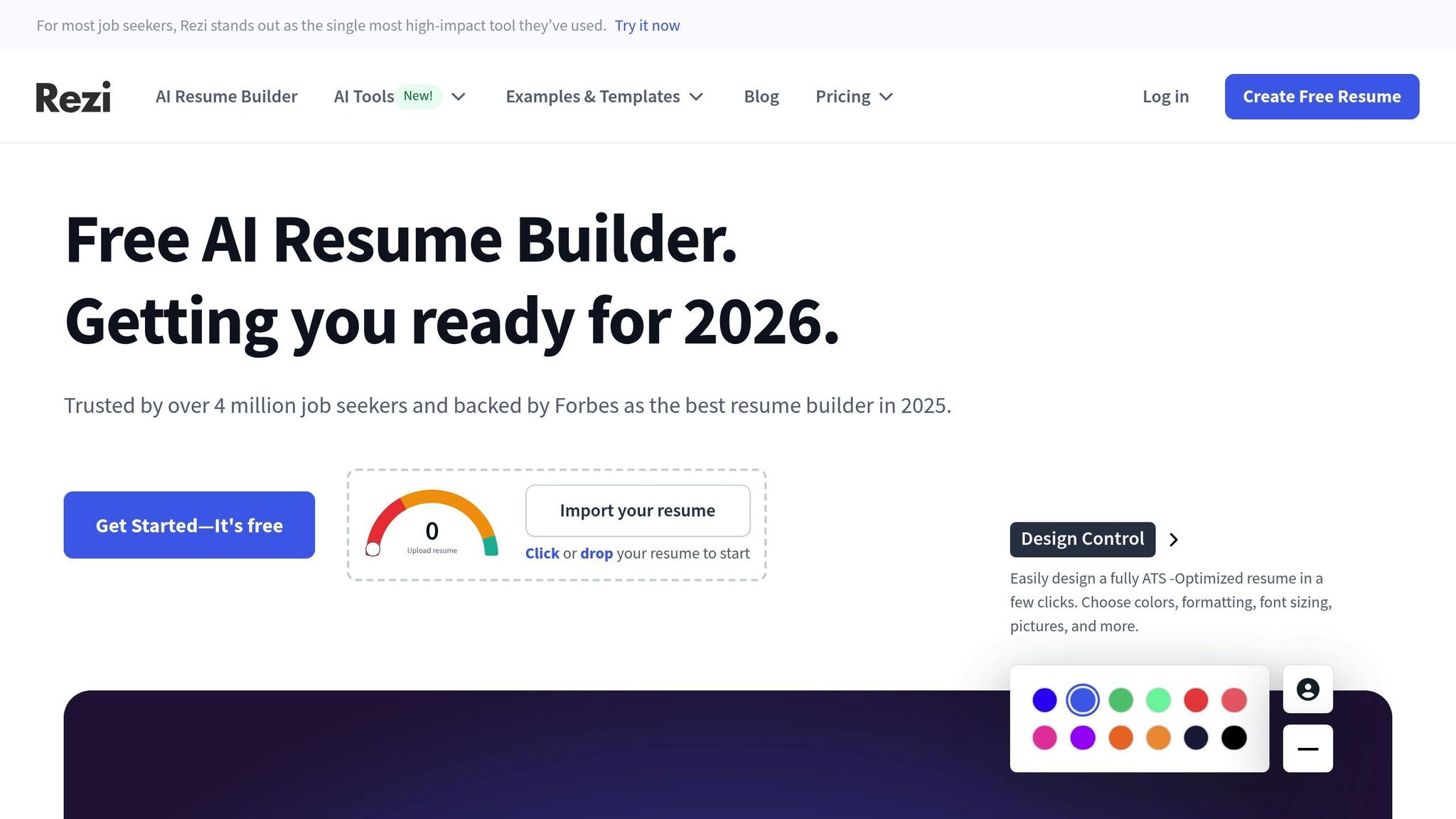
When comparing Rezi.ai and scale.jobs, the key difference boils down to the level of service provided. Rezi.ai is an AI-powered resume builder designed to create ATS-friendly resumes using pre-built templates. It’s a fast and efficient way to generate a polished resume, but that’s where its role ends. After downloading your resume, you’re left to handle job searching, tailoring your materials for specific roles, and submitting applications - all on your own.
On the other hand, scale.jobs takes a much broader approach, managing the entire job application process for you. Instead of just providing a resume, scale.jobs assigns experienced virtual assistants who find job openings, customize your resume and cover letter for each position, and handle the submission process. This makes scale.jobs a more comprehensive solution for job seekers who want to save time and effort.
The Time Factor: Rezi.ai vs scale.jobs
While Rezi.ai can save you a few hours by streamlining resume creation, it doesn’t address the time-consuming tasks that follow. Researching job opportunities, tailoring applications, and navigating complex platforms can easily add up to over 20 hours a week. In contrast, scale.jobs eliminates these tasks entirely, allowing you to focus on more critical aspects of your job search, like networking or preparing for interviews. (See our job interview preparation tips for more guidance.)
Pricing Comparison
Rezi.ai operates on a subscription model, requiring ongoing payments for access to its services. In comparison, scale.jobs uses a one-time payment system based on the number of applications you want to submit. Their pricing tiers include $199 for 250 applications, $299 for 500 applications with the help of two virtual assistants, and $399 for 1,000 applications. This means you’re paying for actual application submissions rather than just software access, and unused credits are refunded if you land a job before using them all.
Why scale.jobs Stands Out
1. Complete Application Management
Rezi.ai provides a resume and leaves the rest up to you. In contrast, scale.jobs handles everything - from finding jobs to submitting applications. Their virtual assistants even navigate complex platforms like Workday and Greenhouse, ensuring no opportunity is missed.
2. Personalized Customization
While Rezi.ai relies on AI-generated templates, scale.jobs goes a step further. Their virtual assistants manually tweak your resume and cover letter for each job, aligning your skills and experience with the specific requirements of the role.
3. Transparent Process
With scale.jobs, you’re not left in the dark. You get 24/7 access to a dedicated virtual assistant via WhatsApp, who provides time-stamped screenshots of every application submitted. This level of transparency ensures you know exactly what’s being done on your behalf.
4. Results-Based Pricing
Unlike Rezi.ai’s recurring subscription fees, scale.jobs charges a flat fee tied to the number of applications submitted. If your job search wraps up early, they’ll even refund unused credits - a feature that makes their pricing model both fair and results-oriented.
| Feature | Rezi.ai | scale.jobs |
|---|---|---|
| Primary Output | Resume/Cover Letter document | Submitted job applications |
| Application Submission | Manual (user must apply) | Managed by virtual assistants |
| Method | AI-driven software | Hybrid (AI + Human Virtual Assistants) |
| ATS Optimization | Automated templates | Human-tailored for each role |
| Support | Automated/Email | 24/7 WhatsApp with dedicated virtual assistant |
| Transparency | Dashboard metrics | Time-stamped screenshots |
| Pricing | Subscription-based | One-time flat fee |
| User Effort | High (find and apply to jobs) | Low (assistants handle applications) |
Ultimately, the choice between Rezi.ai and scale.jobs depends on your needs. If you’re comfortable managing your own job search and just need help creating a professional resume, Rezi.ai could work for you. However, if you’re looking for full-service support to maximize your application efforts without spending hours on logistics, scale.jobs is the better option. In the next section, we’ll dive deeper into how scale.jobs blends AI and human expertise to deliver exceptional outcomes.
How scale.jobs Combines AI and Human Assistants
scale.jobs takes a smart approach by merging the speed of AI with the precision of human expertise. Here’s how it works: AI generates quick drafts for resumes and cover letters, but instead of stopping there, the platform passes these drafts to skilled virtual assistants who fine-tune every detail before submission. This combination of automation and human oversight ensures efficiency without compromising accuracy - an essential balance for navigating today’s complex application systems.
This approach proves especially valuable when tackling intricate application platforms. AI-only tools like LazyApply often face issues with systems like Workday or Greenhouse, where automated bots can be flagged or blocked. In contrast, scale.jobs relies on virtual assistants to manually complete forms, ensuring every step is handled correctly. They work through multi-page questionnaires, tricky dropdown menus, and even nuanced sections like work authorization fields - areas where automation frequently stumbles.
What truly sets scale.jobs apart is its commitment to transparency. Your assigned virtual assistant keeps you in the loop by sharing proof-of-work through WhatsApp, complete with time-stamped screenshots. This way, you’re always aware of what’s being done on your behalf.
The platform’s adaptability makes it a strong choice for a variety of job seekers, including recent graduates, laid-off professionals, and immigrants managing visa requirements. For new grads, virtual assistants can translate academic projects into industry-relevant terms. Those in urgent job searches can benefit from high-volume applications (30+ per day), while immigrants navigating H-1B, OPT, or CPT fields get the accuracy required for these specialized forms. Whether you’re applying through government portals, niche job boards, or corporate ATS systems, the human touch ensures nothing is overlooked or incorrectly entered.
Unlike subscription-based services, scale.jobs operates on a pay-as-you-go model. You’re charged a one-time fee based on the number of applications submitted, and if you land a job before using all your credits, the unused portion is refunded.
Conclusion: Which Approach Works Best for Your Job Search
The best approach depends on your career stage and the types of roles you're pursuing. AI-only tools are great for quickly generating a high volume of applications, making them ideal for entry-level roles. However, they often stumble when it comes to ATS compatibility, can get flagged as spam, and lack the ability to handle complex forms or nuanced questions like those about work authorization or career gaps.
On the other hand, virtual human assistants shine when quality is more important than quantity. They tailor each resume and cover letter to closely match job descriptions, manually navigate tricky application portals, and help avoid automatic rejections by filters. This makes them especially useful for competitive mid-to-senior roles, career changers, or international candidates dealing with visa requirements - situations where a single, polished application can make all the difference.
A hybrid model, like the one offered by scale.jobs, combines the speed of AI with the precision of human expertise. AI drafts the initial materials quickly, which are then fine-tuned by trained virtual assistants before submission. This approach blends automation with human oversight, saving time while improving the quality of your applications. It’s a solution that balances efficiency with the attention to detail needed for success.
Whether you're a recent graduate translating academic experience into professional terms, a professional managing high application volumes, or an international candidate navigating visa complexities, the human touch ensures accuracy and reliability where AI tools alone may fall short. With scale.jobs, your dedicated assistant provides regular updates via WhatsApp, ensuring transparency and peace of mind throughout the process.
For those targeting competitive positions, scale.jobs offers an edge by prioritizing quality over quantity. The service operates on a one-time flat fee, with unused credits refunded if you secure a job early - eliminating the recurring costs and risks of automation-only tools. While AI tools might suffice for high-volume, low-stakes applications, serious candidates aiming for tech, finance, or other specialized fields will find scale.jobs delivers better, more reliable results.
FAQs
What makes virtual human assistants a better choice than AI tools for job applications?
Virtual human assistants bring a level of personalized and strategic support that AI tools simply can’t match. They craft tailored, ATS-friendly applications designed specifically for each job posting. This approach can dramatically boost your chances of getting a callback, often pushing rates to 12–18%, compared to the much lower 1–3% typically seen with automated AI systems. By aligning your application closely with the job’s requirements, they ensure you stand out in a crowded field.
What’s more, these assistants provide real-time, dedicated support, often using platforms like WhatsApp for seamless communication. This ensures you’re always in the loop and have complete transparency throughout the process. They also offer proof-of-work, giving you a clear view of how your applications are customized and submitted. For job seekers who want higher success rates and a truly tailored experience, virtual human assistants are an excellent choice.
How does scale.jobs achieve higher callback rates compared to AI-powered job application tools?
Scale.jobs stands out by blending human expertise with cutting-edge tools to craft job applications that are both personalized and optimized for Applicant Tracking Systems (ATS). Unlike platforms that rely solely on AI, often producing generic templates and mass submissions, Scale.jobs takes a different route. Their trained virtual assistants meticulously customize each application to align with the specific requirements of the job posting. This tailored strategy results in callback rates of 12–18%, a stark improvement over the 1–3% typically seen with generic AI-driven solutions.
What sets Scale.jobs apart further are its added features: ATS-friendly resumes, instant updates via WhatsApp, and full transparency through proof-of-work. These elements ensure that every application is not only polished and professional but also strategically designed to meet the job's criteria, giving job seekers a much better shot at landing interviews.
Are virtual human assistants worth the cost for improving job application success rates?
Yes, hiring virtual human assistants can often be worth the investment, especially when compared to AI-only tools. Services like those from Scale.jobs use trained professionals to craft personalized, ATS-optimized applications. This tailored approach has been shown to achieve callback rates between 12–18%, a stark contrast to the underwhelming <2% success rate of many automated platforms.
While human-assisted services may come with a higher upfront cost - such as $199 for 250 applications - they deliver higher-quality, customized applications that lead to quicker callbacks and more interviews. On the other hand, AI-driven platforms often prioritize speed and volume, resulting in generic applications that might not stand out in competitive job markets. For job seekers aiming for better results, especially in specialized fields, investing in human assistance can make a significant difference.