AI Applications vs Human Applications: The Results Are Surprising
AI mass applications give speed and low cost, while human-assisted tailored submissions boost callbacks for mid-senior roles, career changers and visa applicants.


In the world of job applications, speed and precision often clash. AI tools like LazyApply and Sonara.ai promise quick results by sending out hundreds of applications daily. However, their reliance on generic templates often leads to low response rates, as ATS systems and recruiters easily spot repetitive submissions. On the other hand, human-assisted services like scale.jobs focus on tailored, high-quality applications that align with specific job requirements, leading to better outcomes. While AI tools are budget-friendly and efficient for entry-level roles, human-assisted platforms excel for mid-to-senior positions, career transitions, or visa sponsorship needs, offering transparency and customization that AI tools can't match.
Key Takeaways:
- AI tools prioritize quantity over quality, making them suitable for entry-level or high-volume roles.
- Human-assisted services like scale.jobs deliver customized applications with higher callback rates, ideal for competitive roles or career changes.
- AI tools are affordable, while human-assisted services require a higher upfront investment but provide better long-term results.
- Transparency and proof of work, such as WhatsApp updates from scale.jobs, offer reassurance missing in AI tools.
For job seekers, choosing between AI tools and human-assisted services depends on your goals: speed and affordability versus precision and effectiveness.
AI-Powered Job Applications: What Works and What Doesn't
Where AI Tools Perform Well
AI tools shine when it comes to speed and volume. Platforms like LazyApply can churn out over 50 applications daily using automated form-filling technology, while Sonara.ai offers similar capabilities with minimal effort on your part. If your goal is to cast a wide net quickly, these tools are designed to meet that need.
For those focused on creating ATS-friendly resumes, tools like Rezi.ai and Jobscan stand out. Rezi.ai analyzes job descriptions and suggests keyword optimizations to help your resume get past applicant tracking systems (ATS). Jobscan takes it a step further by scoring your resume against specific job postings, identifying missing keywords, and pointing out formatting issues. These tools are particularly useful if you prefer a hands-on approach but still want to ensure ATS compatibility, with subscription costs ranging from $29 to $49 per month.
Another major advantage is affordability. Most AI tools are priced between $12 and $100 per month, making them far more budget-friendly than professional resume writing services, which can charge $199 or more for a single document. This cost-effective approach is especially appealing to early-career professionals or those just testing the waters of the job market.
However, the speed and affordability of AI tools come with some notable trade-offs.
Where AI Tools Fall Short
While AI tools can produce a high volume of applications, they often lack the finesse and personalization that human-assisted services provide. Template-based submissions are a key drawback. Tools like LazyApply and Simplify.jobs rely heavily on generic templates, which fail to capture the specific nuances of individual roles. When these platforms submit applications using nearly identical cover letters with minor keyword tweaks, both ATS algorithms and human recruiters can spot the repetition. This often leads to low response rates despite the high number of submissions.
Another limitation is context awareness. Simplify.jobs might excel at autofilling application forms, but it can’t distinguish between the unique requirements of a Product Manager role at a fintech startup versus an enterprise SaaS company. AI tools lack the ability to tailor your narrative, adjust the tone, or highlight the most relevant projects - tasks that human job search assistants handle with precision and care.
Finally, there’s the risk of ATS rejection. Some platforms, like LazyApply, prioritize speed over quality, often resorting to excessive keyword stuffing. This approach can trigger spam filters, reducing the chances of your application being reviewed. While tools like Rezi.ai focus on ATS optimization, many others fall short, leading to fewer callbacks and missed opportunities.
Human-Assisted Job Applications: What Works and What Doesn't
How Human Assistants Improve Applications
Human-assisted job application services take a more personal approach compared to automated systems. Instead of relying on mass-submission tools, platforms like scale.jobs assign trained professionals to manually craft and submit tailored applications. This ensures your application aligns closely with what hiring managers are looking for.
For instance, when it comes to Applicant Tracking System (ATS) optimization, human input provides a level of precision that automated tools often miss. While platforms like Rezi.ai might suggest generic keyword adjustments, a human assistant at scale.jobs carefully analyzes job descriptions, highlights your most relevant qualifications, and restructures your resume to emphasize key achievements. They also fine-tune formatting to ensure it passes ATS filters without triggering spam flags - something automated tools sometimes struggle with.
Another advantage is the personalized support. scale.jobs offers dedicated WhatsApp communication, allowing you to quickly ask questions or request changes. They even provide time-stamped screenshots as proof of work, ensuring full transparency. This is a step ahead of tools for automating your job search like LazyApply or Sonara.ai, which often leave users uncertain about the status of their applications due to their basic dashboards.
Once you provide your base resume and list of target roles, human assistants deliver customized applications within 24 hours. They handle even the trickiest application portals, from Workday systems with conditional questions to niche job boards requiring manual uploads. For those dealing with career gaps, visa issues, or transitioning industries, this tailored approach can be especially impactful. If you need help building a strong resume, check out our resume writing services.
Downsides of Human-Assisted Services
While the personalized attention of human-assisted services offers clear advantages, there are trade-offs to consider - mainly speed and cost. For example, LazyApply can process around 50 applications in mere minutes, while scale.jobs delivers 250 meticulously tailored submissions in 12–24 hours. If your strategy relies on submitting hundreds of applications per week without much customization, the slower pace of human assistance might not align with your goals.
Cost is another factor. Human-assisted services typically require a higher upfront investment. For early-career professionals or those casually browsing opportunities, the lower recurring fees of AI-based subscription models may seem more appealing. However, scale.jobs operates on a one-time payment system: you pay once, use your credits, and stop once you secure a position. For mid-career professionals or those targeting specific roles where precision matters, this approach often delivers better results compared to mass automation, which can lead to lower-quality callbacks.
The trend of using AI in job applications
Why scale.jobs Beats AI Competitors: Feature-by-Feature Breakdown
AI vs Human Job Application Services: Feature Comparison Chart
What Makes scale.jobs Different
When it comes to applying for jobs, many platforms rely heavily on automation, but scale.jobs takes a different route by integrating human oversight into the process. While platforms like LazyApply, Simplify.jobs, and Jobscan each bring useful features, they all share a common drawback: they lack human involvement when it matters most - during the actual submission process.
Here’s how scale.jobs stands out:
- Human oversight ensures applications don’t trigger ATS (Applicant Tracking System) bot flags.
- Tailored resume adjustments align with specific job requirements.
- Proof of submission through WhatsApp screenshots provides unmatched transparency.
Unlike competitors that rely solely on bots or algorithms, scale.jobs employs trained virtual assistants to manually complete every application. This approach bypasses anti-bot filters found on platforms like Greenhouse and Lever. Additionally, users receive real-time WhatsApp notifications with visual proof of each submission - something LazyApply’s dashboard cannot replicate. Jobscan, on the other hand, doesn’t handle submissions at all, focusing solely on ATS keyword analysis.
Another advantage is the one-time payment model. With scale.jobs, you pay once, use your credits, and stop when you’ve secured an offer. This is a refreshing change from the recurring monthly fees charged by LazyApply and Jobscan. Plus, if you need a polished resume to boost your chances, scale.jobs offers resume writing services that create ATS-friendly, role-specific documents.
Customization is another area where scale.jobs excels. LazyApply relies on generic templates with minimal adjustments beyond basic keyword swaps. Simplify.jobs, which autofills applications using stored profile data, results in submissions that lack individuality. By contrast, scale.jobs assistants carefully review each job description, highlight the most relevant parts of your experience, and even rewrite sections of your resume to better fit the role. This hands-on approach is particularly effective for complex scenarios, such as career changes or visa sponsorships, leading to noticeably higher callback rates.
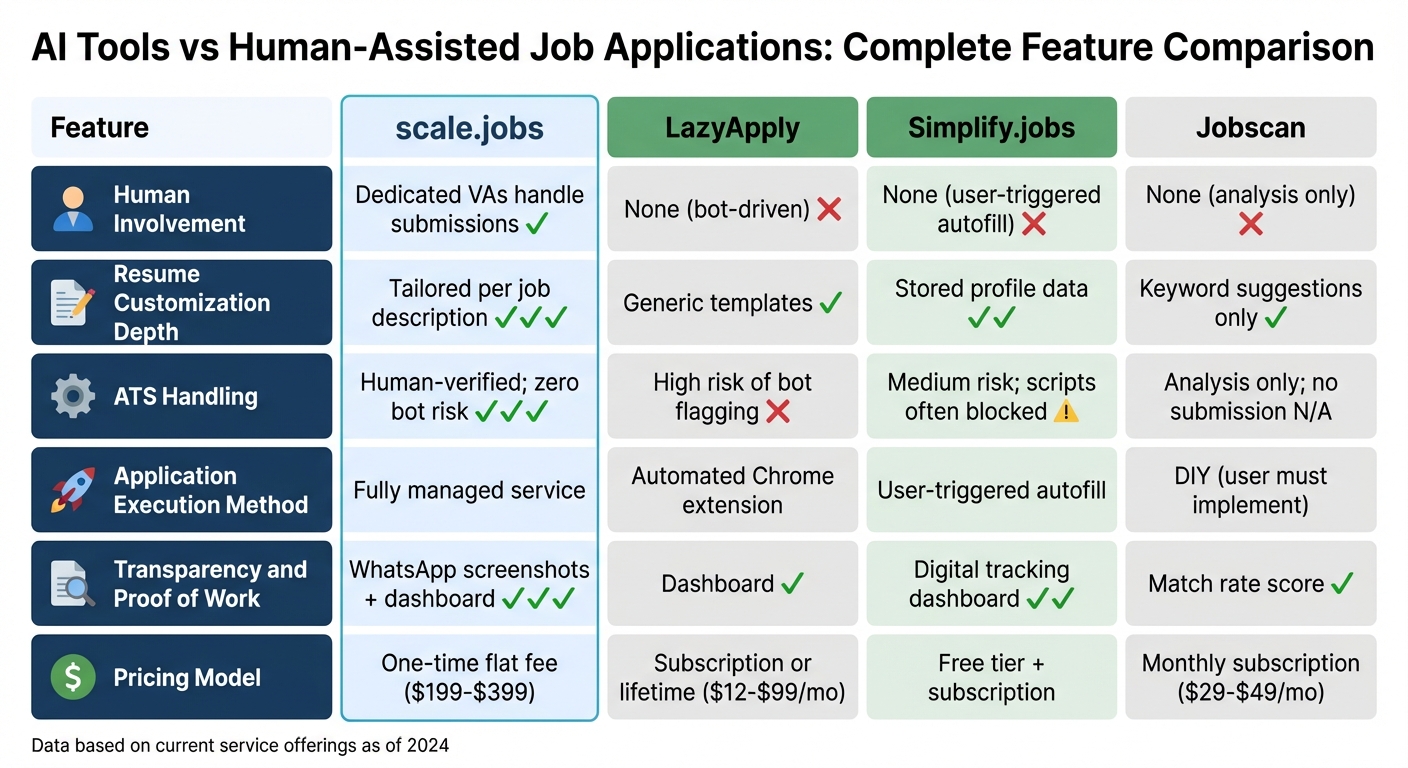
Here’s a feature-by-feature comparison to illustrate how scale.jobs stacks up against its competitors:
Comparison Table: AI Tools vs scale.jobs
| Feature | scale.jobs | LazyApply | Simplify.jobs | Jobscan |
|---|---|---|---|---|
| Human Involvement | Dedicated VAs handle submissions | None (bot-driven) | None (user-triggered autofill) | None (analysis only) |
| Resume Customization Depth | Tailored per job description | Generic templates | Stored profile data | Keyword suggestions only |
| ATS Handling | Human-verified; zero bot risk | High risk of bot flagging | Medium risk; scripts often blocked | Analysis only; no submission |
| Application Execution Method | Fully managed service | Automated Chrome extension | User-triggered autofill | DIY (user must implement) |
| Transparency and Proof of Work | WhatsApp screenshots + dashboard | Dashboard | Digital tracking dashboard | Match rate score |
| Pricing Model | One-time flat fee | Subscription or lifetime | Free tier + subscription | Monthly subscription |
Through its combination of human expertise, customization, and transparency, scale.jobs redefines how job applications are managed, offering a more reliable alternative to fully automated tools.
Who Should Use AI Tools vs Human-Assisted Services
When AI Tools Make Sense
AI tools like LazyApply and Simplify.jobs are a great fit when you're aiming to apply for a large number of entry-level positions without breaking the bank. These platforms shine in situations where job requirements are fairly standardized and applicant tracking systems (ATS) primarily filter resumes based on keywords. For roles such as customer service representatives, sales associates, or junior data analysts, these tools can save you a lot of time.
For students and recent graduates, particularly those seeking internships or entry-level programs at major corporations like Amazon, Target, or JPMorgan Chase, these tools can be especially helpful. Many of these companies use standardized application portals that focus on fields like GPA, graduation date, and basic skills. Automating the process here can save you hours while still meeting the basic requirements.
Additionally, if you're already employed but casually exploring new opportunities, AI tools offer a low-cost way to dip your toes into the job market. They allow you to test the waters without requiring a significant investment of time or money, making them a good option for passive job seekers.
On the other hand, if you’re looking for a more precise and customized approach, scale.jobs might be a better fit.
When scale.jobs Makes Sense
For those who need a more tailored and strategic approach to job applications, scale.jobs provides a level of customization that AI tools simply can't match. With human oversight, ATS-friendly optimization, and a transparent process, this service is ideal when every application needs to make an impact.
Mid-to-senior professionals, such as engineering managers, product leads, or financial analysts, often require resumes that go beyond generic templates. A human assistant can highlight specific achievements, measurable results, and technical expertise, ensuring your application aligns perfectly with the job description. This level of detail is something automated tools often overlook.
Career changers and candidates requiring visa sponsorship also benefit significantly from this service. For example, if you're transitioning from marketing to product management, a human assistant can craft a compelling narrative that emphasizes your transferable skills. Similarly, job seekers requiring H-1B sponsorship can receive tailored guidance to focus on employers who are more likely to support their visa needs.
If you’ve been using AI tools but aren't seeing the callback rates you’d hoped for, scale.jobs could be the solution. Their manual submission process is particularly effective for platforms like Workday, Greenhouse, or Lever, where automated submissions are often flagged by bot detection systems. Plus, the one-time payment model eliminates ongoing subscription costs, making it a smart choice for those targeting a specific set of roles.
For a complete package, scale.jobs also offers resume writing services to create ATS-optimized documents tailored to your desired positions. This can be especially useful if you’re looking to elevate your application strategy with professionally crafted materials.
Switch to scale.jobs If...
Building on the performance differences discussed earlier, scale.jobs stands out for those who need precision, transparency, and cost control - areas where AI tools often fall short.
You Need Custom Applications for Each Job
When applying for roles that filter out generic resumes, personalized applications make all the difference. AI tools like LazyApply and Sonara.ai rely on generic templates, which might work for entry-level, high-volume applications but fail to deliver for specialized or senior positions.
For example, a product manager targeting B2B SaaS roles versus consumer tech startups requires tailored applications. A human assistant can emphasize enterprise sales cycle experience for one role and user growth metrics for another - nuances that AI tools simply can’t replicate. They fill in fields but miss the judgment calls that make an application stand out.
This level of customization becomes essential for mid-to-senior roles, where hiring managers expect applications to align closely with the job description. If you’re pursuing engineering manager positions at top-tier companies like Stripe or Snowflake, your application needs to highlight achievements like scaling teams, making strategic technical decisions, and leading cross-functional projects - not just a list of skills. scale.jobs ensures human oversight to craft applications that align with these expectations, delivering a narrative tailored to the employer’s needs.
You Want Proof of Work and Transparency
AI tools often provide dashboards showing the number of applications sent, but they rarely offer clarity on what was submitted or whether the application bypassed spam filters. If you’ve used tools like Simplify.jobs or LazyApply and experienced low response rates, this lack of transparency might be a contributing factor.
scale.jobs takes a different approach by providing timestamped WhatsApp screenshots of submitted applications. This transparency is invaluable, especially when applying through platforms like Workday or Greenhouse, where automated submissions are frequently flagged by bot detection systems.
Additionally, real-time updates allow for quick adjustments. For instance, if a job posting requires a specific certification or skill that wasn’t initially included, the assistant can notify you immediately via WhatsApp. This two-way communication ensures your application aligns with the job's requirements - something AI-only tools simply don’t offer. This hands-on approach not only builds trust but also ensures compliance with applicant tracking systems (ATS).
You Prefer One-Time Payment Over Subscriptions
Many AI tools operate on subscription models, with monthly fees ranging from $12 to $99. These costs can add up quickly, especially if your job search extends over several months. Tools like LazyApply, Sonara.ai, and Rezi.ai charge recurring fees, meaning you’re paying even when you’re not actively applying.
In contrast, scale.jobs offers a flat-fee structure. You pay once for a set number of applications - options include 250, 500, or 1,000 - with no hidden renewals. Plus, if you don’t end up using all the applications you purchased, scale.jobs refunds the difference.
For those looking for a comprehensive service, scale.jobs also bundles application credits with resume writing services. This eliminates the hassle of managing multiple subscriptions, offering everything you need upfront with a single payment.
Decision Summary: When to Choose AI vs Human Applications
Here's a breakdown to help you decide between AI-driven tools and human-assisted services for your job search:
AI tools are ideal for entry-level candidates or those aiming for high-volume, less competitive roles where speed takes priority over precision. For instance, recent graduates applying to positions in retail, customer service, or general administrative roles can benefit from platforms like LazyApply or Sonara.ai. These tools allow you to send out hundreds of applications quickly, with subscription costs ranging from $12 to $99 per month. This model works well if you need to apply to numerous positions within a short time frame.
Human-assisted services such as scale.jobs are better suited for mid-to-senior-level professionals, career changers, or international candidates dealing with visa complexities. If you're targeting competitive roles at top companies like Stripe or Snowflake, you'll need the customization and ATS (Applicant Tracking System) optimization that these services provide. Their flat-fee pricing structure - ranging from $199 to $399 for 250–1,000 applications - offers better value for extended job searches. Plus, pro-rata refunds for unused credits add to the cost-effectiveness.
Consider switching from AI to human-assisted services if your response rate drops below 10% or if platforms like LinkedIn or Workday flag your applications as spam. A common issue with AI tools is the lack of transparency - dashboards may show high application counts without confirming actual submissions, which can lead to low interview rates despite the volume of applications sent.
Human-assisted options also provide added benefits, such as transparent proof of work and responsive support. For those who need both high-quality application materials and submission assistance, combining resume writing services with application credits can simplify the process. This approach eliminates the hassle of managing multiple subscriptions by bundling everything into a single upfront payment.
FAQs
How do I know if my applications are getting flagged as automated?
Signs that your job applications might be flagged as automated include consistently low response rates, frequent rejections, or feedback suggesting problems with Applicant Tracking System (ATS) filters. Submitting generic or non-personalized applications is a common reason for being flagged. If you're applying for roles that align with your skills but still experiencing poor outcomes, it might be time to explore human-assisted services. These services can help tailor your applications, making them more personalized and less likely to get caught by ATS systems. For example, using a job application service or a job search virtual assistant can enhance your approach and increase your chances of landing interviews.
What response rate is considered acceptable before switching approaches?
A response rate between 8% and 12% is generally seen as a reasonable benchmark before considering a shift in strategy. Studies indicate that resumes improved with AI tools can enhance hiring outcomes by 8%, while AI-facilitated interviews raise the chances of securing a position by 12%. If your results fall outside this range, it might be time to reassess your approach. Tools like an AI resume builder or a job search virtual assistant could help refine your efforts.
How should I split my effort between volume and customization?
Balancing efficiency with a personal touch is key when managing high-volume job applications. AI tools can handle repetitive tasks effectively, making them ideal for entry-level or less competitive roles. However, for specialized or senior positions, a more personalized approach is essential, as customized applications are more likely to grab a recruiter’s attention. A solid strategy is to aim for a 70/30 split - let AI handle 70% of the work, such as automating routine tasks, while dedicating 30% of your effort to tailoring applications strategically. This approach is especially useful in highly competitive hiring scenarios, where personalization can make all the difference.